Typically, I am inspired by Spirit to investigate something just before it shows up in my life (or my lessons), so it’s quite probable the Rigveda’s 31st Sukta mentions the sacred grains we discussed last time.
According to Google (via Vedapath.app):
RV 1.31 is “a profound 18-verse hymn attributed to the seer Hiranyastūpa Āṅgirasa. It is dedicated to Agni, the god of fire, praising him as the first divine seer of the ancient Aṅgirasa lineage, the upholder of cosmic order (Ṛta), and a benevolent friend to humanity.”
Let’s see how accurate that description turns out to be.
The first line (RV 1.31:1) translates thusly:
The True Self kindles first and foremost the Living Voice (Angira) of the rishis, the shining ones of the divine name absent from material existence, the omnipresent embodiments of grace in the Temple of Majesty.
tvam (The Tue Self) agne (kindles) prathamāḥ (first and foremost) aṅgirāḥ (Angira = the living voice) ṛṣiḥ (of the rishis) devaḥ (the shining ones) devā-nām (of the divine name) abhavaḥ (absent from material existence) śivaḥ (the omnipresent embodiment of grace) sakhā (in the Temple) tava (of Majesty)
Notes:
Firstly, Agne means “kindles,” rather than “Agni,” the divine being long misidentified as the god of fire, so this Rik isn’t about Agni at all; it’s about the Saptarishi, the seven sacred rishis which are, in truth, the Seven Rays born of the Divine Name, YHVH. They are, that is to say, the “offspring” rays of the Great Rays of Yah and Vah.
In Hindu tradition, these seven sages are believed to be the mind-born sons of Brahma. They are thought-beings, therefore, rather than physical entities. Tasked with guiding humanity, shaping civilization, and preserving Vedic knowledge through cosmic cycles, their names vary slightly by era, though the current age features a specific set of revered seers.
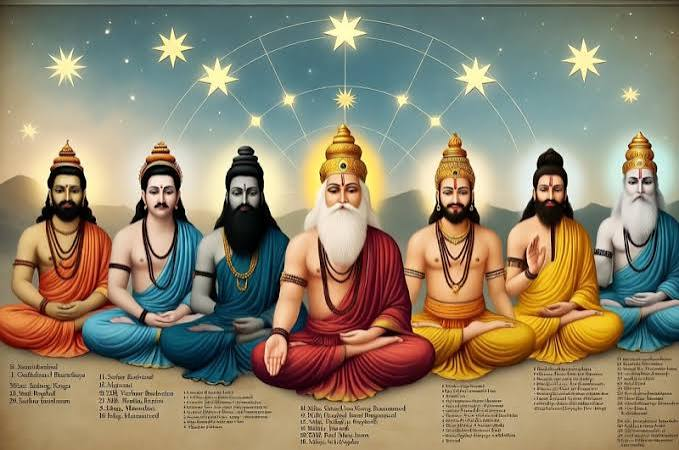
Secondly, Angira isn’t the name of a sage (as long presumed by Vedic and Sanskrit scholars) — or any other ancient personage; An-gira means “living voice” — a phrase also found in the Bible, where the Living Voice is the Holy Spirit. And, that “Voice for God” lives in us, as the Call to Awaken. We hear that quiet Voice in the Temple of Majesty — another phrase found in the Bible.
From this we can glean three things relevant to this Rik. The first is that the True Self first “kindles” the Call to Awaken; the second is that the Call to Awaken is the Living Voice of the Saptarishis; and the third is that the Call to Awaken is the M-kara vibration heard on the left side of the wheel. Hence it’s designation as “the left hand of God.”
According to Google, the Temple of Majesty refers to the heavenly Throne Room seen by the prophets, where God’s presence fills the space with overwhelming glory and splendor.
In actuality, the Throne Room the prophets beheld isn’t in Heaven-proper; it’s on the seventh plain of the dream-realm — the uppermost-innermost level of consciousness that’s also sometimes called the Inner-Altar, the inner sanctum, the secret chamber, the Sanctum Santorum, the Holy of Holies, and Kisei HaKavod (the Throne of Glory). The Throne rightly belongs to the True Self mentioned herein, which is the Solar Logos and/or Word of God — the chief holy power emanating the Great Rays of Yah and Vah, the “parents” of the seven rishis.
When the Hebrew prophets beheld the throne of Elohim, they saw the seven rishis standing or sitting “before the throne”. These “beings” are, therefore, the seven spirits of God, as well as the seven lamps illuminating the Golden Lampstand in the Temple of Majesty.
We find these seven beings in every world religion, in one form or another, so they really do exist (in our holy minds). The teachings about them vary, and yet also overlap. Just so we’re all on the same page. The seven rishis of Hinduism are the seven spirits or graces of Christianity, the seven lamps of Judaism, the seven rays of Theosophy, the seven Amesha Spenta of Zoroastrianism, the Seven Buddhas of Antiquity, the seven Sifat of Islam, and also probably the seven Latifa of Sufism.
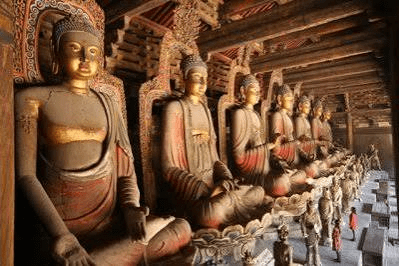
Truth is one, as I keep saying, although it comes down to humankind in different forms.
Let’s move on to the second Rik, which now reads as follows:
The multitudes thundering the mystical syllables of Yah know the mind-water work of God’s triumphant winds (the Maruts), the glorious three sanding in Yah.
vra-te (the multitudes thundering) kava-yaḥ (the mystical syllables of Yah) vid-manā-apasaḥ (know the mind-water works) a-jāyanta (of God’s triumphant) marutaḥ (winds or Maruts) bhrāja (the glorious) tṛ-ṣṭa-yaḥ (three standing in Yah)
Notes:
The multitudes thundering the mystical syllables of Yah refers, I believe, to the Cosmic Choir in the Celestial Realm, which Course-Jesus calls “the mighty chorus to the Love of God.” These same “multitudes” are mentioned innumerous times in the Bible and the Vedas, where their true identity has been masked by translators ignorant of Spiritual Truth.
The mystical syllables of Yah are A, U, and M — in Hinduism, at least. In Buddhism, there are seven sacred syllables, which are rightly tied to the Seven Buddhas of Antiquity. We’ll talk about the Buddhas and their syllables another time. For now, let’s move on.
The third Rik reads:
The True Self kindles first the Living Voice of the Supreme Lord to call the enlightened seers of the vibration and light of the divine name circling the land of the Moon to enclose Adam in the infinite cosmically joined Land of the Forest (or World) belonging to the diamond-body of the two mother winds (or breaths) the Purusha divided into three spirits of God’s barley.
tvam (the True Self) agne (kindles) prathamaḥ (first) aṅgiraḥ-tam-aḥ (living voice of the Supreme Lord to call) kaviḥ (the enlightened seers of the vibration and light) devānām (of the divine name) pari (circling) bhū-ṣasi (the land of the moon) vr-atam (to enclose Atam = Adam) vibhuḥ (in the infinite) viśva-smai (universally connected) bhu-vanā-ya (world or Land of the forest belonging to) medhiraḥ (the diamond-body) dvi-mātā (of the two mothers) śayuḥ (resting in) ka-tidhā (the purusha’s threefold) cit (spirits) ā-yave = (of God’s barley)ǁ
Notes:
So, we do find the sacred barley in this Sukta, as I predicted we would. As we learned last time, barley is a scriptural cipher for Elohim/Allah, the Solar Logos or Word of God on the Throne of Glory. So, the three spirits of God’s Barley would be the Trinity powers or “spirits” of the Logos–the three aspect Rays sounding the AUM to wake up Adam.
In Hinduism, the “land of the moon” is known as Chandraloka or Somaloka. Described in the Bhagavad Gita and the Upanishads, Somaloka is (as per Google) the celestial-realm division where Souls “who’ve performed immense good deeds, charity, and religious rituals go to experience temporary, heavenly pleasures as a reward.”
That description is, of course, tainted by egoic perception. As this Rik explains, the Land of the Moon is encircled by the Divine Name (YHVH or AUM) to “enclose” Adam, the universal Soul sleeping in the Forest belonging to the Diamond Body of the two mothers resting in the Trinity Rays.
Somaloka must be, therefore, the Vedic designation for the Biblical “enclosure” or “walled garden,” which Elohim (the Logos) established East of Eden, after Adam fell asleep. (And projected part of his mind out of Paradise into the lower levels of consciousness).
In Hinduism, the “diamond body” (Vajradeha) is said to be as indestructible as a diamond. So, the diamond body must be the Spiritual Body housing our Souls in the dream. In the Pauline epistles of the New Testament, the “spiritual body” (sōma pneumatikos in Greek) is described as “the immortal, resurrected form believers will receive, defined by the transforming power of the Holy Spirit rather than an absence of physicality.”
Paul introduces this concept in 1 Corinthians 15:42-44.
Note that Soma is the Greek word for “body,” as in the Body of Christ or Christ’s Church — the corporate “body” to which our Souls rightfully belong.
Rightly understood, the Spiritual Body is the Temple we’re meant to rebuild in the dream-realm. And it’s that invisible light “body” that houses the Soul, the chakras, the nadis, the Resting Place, the Inner Altar, and the Spiritual Eye. As Course-Jesus explains, the physical body is merely a learning device for the Souls still choosing ego-consciousness over Christ-consciousness in the recurring dream of time.
In Hinduism, the phrase “two mothers” typically refers to the birth and foster mothers of Lord Krishna, whose names are Devaki and Yashoda.
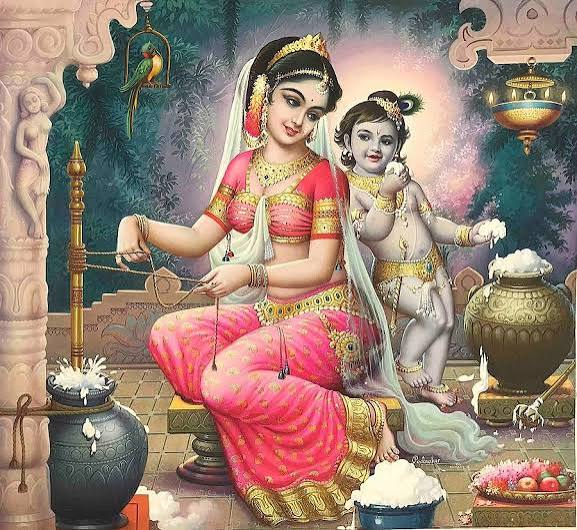
One of seven daughters of King Devapa (divine water) of the Yadu dynasty, Devaki is Krishna’s birth mother. The wife of Vasudeva and a cousin or sister of Kamsa. she is considered to be an incarnation of Aditi, the chief mother goddess of Hinduism.
Contrary to popular belief, Dev-aki means “celestial snake” or “divine snake.” So, Devaki may be another form of Kadru, the wife of Kashyapa (the celestial tortoise) and the mother of the Nagas. Or she might be another form of the Goddess Manasa, the daughter of Kashyapa known as the Queen of the Nagas.
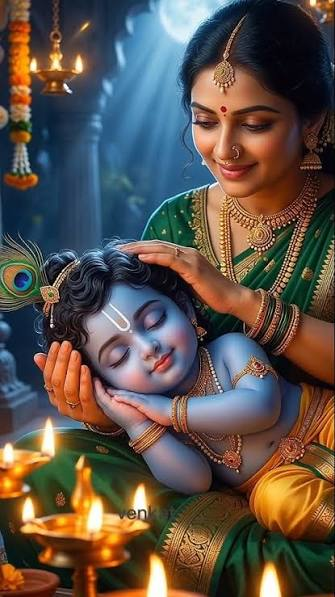
Yashoda, Krishna’s foster mother, is the wife of Nanda (Joy), the chieftain of Gokul (the cow community or pastureland). Celebrated in texts like the Bhagavata Purana, Yashoda is the epitome of pure, unconditional maternal love (Vatsalya Bhava). She raised Krishna after he was secretly exchanged at birth to save him from the tyrannical Kamsa. Yashoda means “the bestower of glory.” In the Bible — in Psalm 84, to be exact — the bestower of glory (and grace) is identified as YHVH (the Great Rays of Elohim). So, Krishna was born of a divine serpent, and lovingly raised up to maturity or full power by the glory and grace bestowed by the Great Rays.
Moving on … RV 1.31:4 reads as follows:
The True Self kindles the crooked path of Nara to enable Pipa-rishi to know the now-moment dividing the directions of Yah’s divine one-hundred encircling the wandering treasure of the lesser light consciousness gatherings to remember the Self sleeping in the Land of Glory.
tvam (the True Self) agne (kindles) vṛjina-vartanim (the crooked path) naram (of Nara) sakman (to enable) pipa-rṣi (Pipa-rishi) vid-athe (to know the now-moment) vi-carṣaṇe (dividing the watchers) yaḥ (Yah’s) śū-rasātā (holy fluidity) pari-takmye (surrounding the wandering) dhane (treasure) dabhrebhiḥ (of the lesser light) cit (consciousness) sam-ṛtā (gatherings to remember) haṃ-si (the Self resting) bhū-yasaḥ (in the Land of Glory).
Notes:
Not sure I can explain what this means, but I’ll give it my best shot. “The crooked path” is the path of the Ego Mind, the useless external journey of the body leading nowhere. The Bible says God makes the crooked path straight, while Jesus says to take the straight or narrow path and avoid the crooked or wide one.
Rightly understood, the crooked path takes us on an outward journey through deception and unreality, whilst the straight path leads inward through the circles toward the Throne Room — and the Kingdom of Heaven just beyond.
Or, to quote Course-Jesus:
God’s Son is not a traveller through outer worlds. However holy his perception may become, no world outside himself holds his inheritance. Within himself he has no needs, for light needs nothing but to shine in peace, and from itself to let the Rays extend in quiet to infinity. (ACIM, T-13.VII.13:4-7)
The rishis tell us herein that the True Self kindles this path to enable piparsi to know the now-moment dividing the watchers. The watchers, as we know, and are told again herein, are the one-hundred awake Souls making up the Assembly.
I endeavored in vain to find a suitable definition for piparsi, until I finally saw it as a compound of Pipa and Rishi. And Pipa-rishi is indeed a revered personage in Hindu culture, although one appearing in human history centuries after the Rigveda originated. But, linear time is a sleight of hand, as Course-Jesus tells us, so, it’s not impossible that Pipa-rishi is indeed mentioned in the Rigveda, just as it’s not impossible that the Torah and the Vedas mention Jesus Christ by name (as Isha or Joshua).
Never forget that the Holy Spirit knows everything that will ever happen in the dream, because it’s already happened.
That said, the Pipa-rishi mentioned herein is probably Sage Pipalad (also Pippalada), rather than Bhagit Pipa, the 15th-century king who abdicated his throne to become a mystic poet and saint of the Bhakti movement.
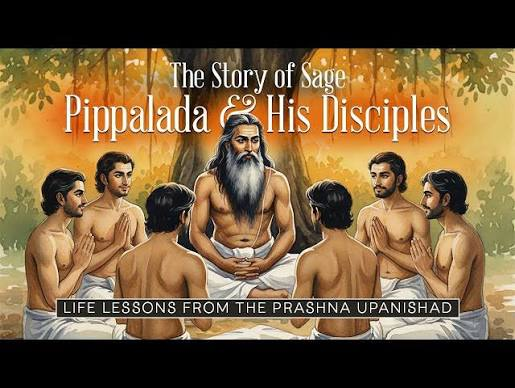
Sage Pippalada, a prominent figure in the Hindu literature, is believed to have written the Prashna Upanishad. According to the legends, Pippalada earned his name from the Peepal tree that nourished his Soul, enabling his enlightenment. In Sanskrit, Peepal means “fig,” so we’re talking about the same sacred fig tree referenced many times in the Judeo-Christian scriptures. In Sanskrit, Pippalada means “the Fig Tree eater.”
I asked Google just now what the Fig Tree in the Bible represents. And guess what? The answer I got were completely ego-corrupted. Rightly understood, the Fig Tree bears the spiritual fruits of the Lamb — the fruits we give and receive by rightmindedly perceiving the Soul’s innocence shining through the Ego Mind’s seven veils. Those veils prevent the seven rays from shining through our Chakras (the windows of the Higher Mind) into the minds of the other Souls we meet on the journey.

Most of what is taught about the chakras is skewed by level confusion. As I understand it, each of the seven lesser Rays governs one of the chakras — and teaches us how to open that particular “window.” Simply stated, unblocking the chakras opens the windows (or doors) through which the Rays shine out of the Holy Mind (of the Logos) into the world.
Yes, one of these days, when I have more certainty, we’ll have a fuller discussion of the Rays and the Chakras — and hopefully correct myriad misnomers about both important subject in the process.
Let’s move on to the wandering treasure. In the Bible, “the wandering treasure” generally refers to the Ark of the Covenant (because the Israelites carried it around on their travels). The lesser rays are the seven lamps of YHVH. And the Ark is indeed the “vessel” wherein Souls reunite in universal Brotherhood or Holy Relationship (with the seven rishis in toe) on journey inward or “straight path” toward Moksha.
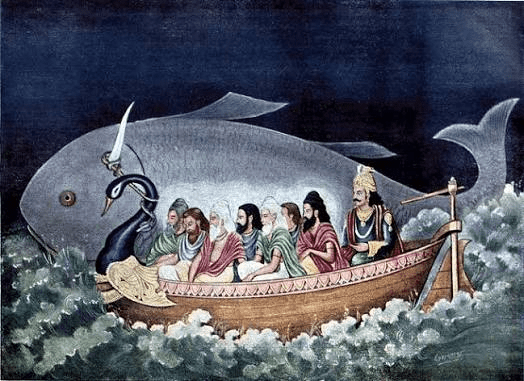
As explained in my earlier post about Solomon’s Temple, the Ark never existed on earth in physical form, except perhaps as a manmade replication of a divine idea. Like the Temple Menorah and other sacred objects that also “went missing,” the Ark’s appearance is described in the Book of Exodus.
So, let’s re-examine some of those descriptions with newly opened eyes and minds:
–the Ark was constructed by the Israelites (the Souls journeying to escape the desert-wilderness) under the direction of Moses (the M-kara vibration) while camped at Mount Sinai (the bridge or middle realm between Heaven and Earth).
Rightmindedly understood, Exodus isn’t describing a bunch of historical Jews; it’s describing the Atonement process, which begins when liberation-seeking Souls encamp in the Celestial Realm to join together in listening to the M-kara. And it is indeed at this point that we begin filling the Ark, two-by-two.
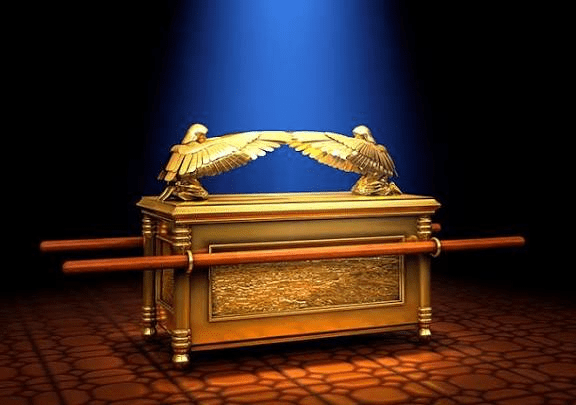
–The lid of the Ark, known as “the mercy seat,” featured two golden cherubim on their knees, facing one another with their wings stretching forward. The lid was said to be the “earthly throne of YHVH.”
–the Ark was outfitted with golden rings and poles for carrying or transporting.
Based on these descriptions, the lid is indeed the earthly throne of YHVH — the Great Rays — while the rings probably represent the four circles of the Cherubim, wherein we offer (give to receive) the alms of mercy, compassion, and forgiveness to all our brothers in Christ in Holy Relationship or Universal Brotherhood. And this is, in truth, how we “transport” the Ark through the desert.
The winged figures on top probably symbolize the Great Rays (Yah and Vah), although they might represent the two cherubim watching over the circles on the right-hand side of the Wheel — the circles of water (the Moon or Soma) and fire (Agni).
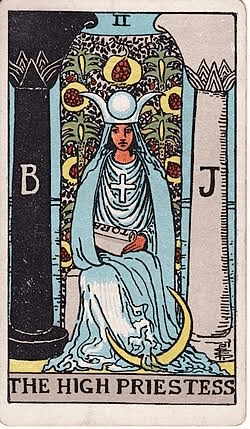
I strongly suspect that the rings and poles on the Ark are the same rings and pillars described in the Book of Esther. The two poles or pillars are, of course, Boaz and Jacim. We see those two pillars flanking THE HIGH PRIESTESS in the RWS Tarot.
Hamsi is another undefined Sanskrit word. Although similar to Hamsa, which means “swan,” Ham-si is a compound of ham and si. Ham is the seed mantra for the throat chakra, the ethereal communications center where we begin hearing the M-kara. Ham also is part of the powerful mantras Soham and Hamsa. In these mantras, Ham represents the True Self or the Great I Am. So, Ham-si would translate as “the True Self sleeping.”
And the True Self sleeping is Adam.
And the place where Adam sleeps is indeed the Land of Glory — i.e., the Promised Land the Bible calls Canaan or Zion, the Qur’an calls Jannah, and Hindus call Moksha — the final quarter of the Soul’s journey; the quadrant presided over by Agni, on the shoulders of the Miracle-Cow, Kamdhenu.
Unlike Judaism and Islam, where the Promised Land is perceived as an external destination, Hindus rightly perceive the Soul’s “peaceful home” as an internal state of mind, wherein the Soul is free from the perceptual limitations and judgments imposed by the Ego Mind (the thinking man’s Satan).
Moksha is the realm of the fire circle (the fiery eye of the miracle-cow), where the Soul wakes up by realizing or remembering its oneness with the universal consciousness of the Great Purusha. It is not a place we travel to or enter after death, but a state of spiritual perfection reached through vigilant rightminded thinking and living, coupled with steadfast devotion to the inward-leading Path of Truth (the straight path).
The Sukta’s fifth line reads:
The True Self in wholeness kindles the ancient treasured name God’s glory gathers together–the song of mercy impelling the offering prayers to grow Yama to make the waters of God’s Word renew the divine beings in two divisions of the Vast One Kamadeva’s three bring forth from the well in wholeness.
tvam (the True Self) naḥ (in wholeness) agne (kindles) sanaye (the ancient) dhanā-nām (treasured name) yaśa-sam (glory, together with) kārum (the architects) kṛ-ṇuhi (acting for Nuhi) sta-vānaḥ (abiding in the forest) ṛdh-yāma (to grow Yama) karma (and make) apa-sā (the waters of God’s Word) navena (renew) devaiḥ (the divine beings) dy-āvā-pṛt-hivī (in two divisions of the Vast One) iti (Kamadeva’s three) pra (bring forth) avatam (from the well) naḥ (in wholeness) ǁ
Notes:
In Hinduism, Prithvi is revered as Mother Earth. Because the name means “the vast one,” Prithvi also is known by that title. In the Bible, the Vast One refers to God’s Holy Creation, which is the Logos, the Sonship, and/or the Christ, rather than “heaven and earth,” as the Ego Mind perceives “creation.”
So, “the vast one in two divisions” refers to the Great Rays of Yah and Vah –the two divisions of the Solar Logos, who is both the Vast One and the Lord of the Earth. And that would make “the ancient treasured name” YHVH-Elohim. And it is indeed Kamadeva’s three (AUM) that bring forth the Great Rays from the well in wholeness.
Nuhi is Noah, the builder of the Ark. So, the architects acting for Noah are the Souls in the Forest building the Ark to gather in everybody, two at a time.
Or, as Course-Jesus similarly explains in a section of the Text aptly subtitled “The Treasure of God”:
We are the joint will of the Sonship, whose Wholeness is for all. We begin the journey back by setting out together, and gather in our brothers as we continue together. Every gain in our strength is offered for all, so they too can lay aside their weakness and add their strength to us. God’s welcome waits for us all, and He will welcome us as I am welcoming you. Forget not the Kingdom of God for anything the world has to offer. (ACIM, T-8.VI.1:1-5)
The sixth Rik reads:
The True Self of the Supreme Lord (the Christ Self or Logos) kindles the immortal state in the upper world for bestowing the milk-nourishment glory heard day by from Yah.
tvam (the True Self) tam (of the Supreme Lord) agne (kindles) amṛta-tve (the immortal state of) uttame (the upper) martam (world for) da-dhāsi (bestowing the milk-nourishment) śravase (glory heard) dive-dive (day-by-day) Yah (from Yah).
The seventh Rik reads:
In the place of the touchstone, both streams generate the ancestral spirits generating Yah to make the firstborn son deliver or restore the A-kara circle’s sacred treasure.
tatṛṣāṇaḥ (in the place of the touchstone) ubha-yāya (both streams) janmane (born from the ancestral spirit) ma-yaḥ (generating Yah) kṛ-ṇoṣi (to act for the lords) prayaḥ (walking in) ā (the A-kara) ca (circle’s) sū-raye (sacred treasures)ǁ
Notes:
The place of the Touchstone is the Inner Altar or Holy of Holies — the place beyond the veil, wherein we find the Ark of the Covenant. The ancestral spirit generating Yah isn’t any human ancestor, as many cultures wrongmindedly presume. It’s the spirit generating the Great Rays (the two streams mentioned herein). That Spirit is the one we call God, which is, in fact, Elohim, Allah, or Surya. To walk in the A-kara Circle’s sacred-treasure is to walk in the radiant majesty, splendor, or glory of God’s indwelling presence.
The A-kara Circle is the Circle of Fire — the fiery eye at the center of the four-part wheel housing the four Cherubim. The sacred Treasure restored to us in that circle is what Course-Jesus terms “the Treasure of God.” In the Text, he devotes a whole section to this “treasure,” which I’ve linked in case you wish to read it.
I shared part of this section above. It continues thusly:
The world can add nothing to the power and the glory of God and His holy Sons, but it can blind the Sons to the Father if they behold it. You cannot behold the world and know God. Only one is true. I am come to tell you that the choice of which is true is not yours to make. If it were, you would have destroyed yourself. Yet God did not will the destruction of His creations, having created them for eternity. His Will has saved you, not from yourself but from your illusion of yourself. He has saved you FOR yourself. (ACIM, T-8.VI.1:1–2:8)
Having shared that, let me now share this: the mind generating Yah is the Mind of the Atonement, a.k.a., the Holy Spirit, whilst the firstborn son is, again, the Christ Self, restored to it’s original state of Oneness, Unity, or pure non-dualism.
RV 1.31:8 reads:
The True Self in wholeness kindles the two parents within the standing A-kara to protect Vah, the Divine Esu, the flawless and awake Body/Self producing the divine thought advancing the mind circles the hands weave together for the True Self to dawn the Vasu of the universal A-kara to approach the Southeast.
tvam (the true Self) naḥ (in wholeness) agne (kindles) pitroḥ (the two parents) upa-sthe (within the standing) ā (A-kara) de-vaḥ (to protect Vah) deveṣu (the Divine Esu) anavadya (the blameless, faultless, or perfect) jāgṛviḥ (awake) tanū-kṛt (body or self producing) bo-dhi (the divine thought) pra-matiḥ (advancing the mind) ca (circles) kāra-ve (the rays or hands weave together) tvam (for the True Self) kalyāṇa (to dawn) vasu (the Vasu = the Bright Ones) viśvam (of the universal or cosmic) ā (A-kara) ūpi-ṣe (to approach the Southeast or Word of God)ǁ
Notes:
Lots to unravel here. The Divine Esu is the Biblical Esau, the “red-haired” brother of Jacob, who traded his holy inheritance for a bowl of red-lentil stew. Herein, Esu is described as “the perfect and awake body producing the divine thought advancing the mind circles of AUM, which move our consciousness inward in three steps, toward the Inner Altar or Throne Room. Moreover, this Rik equates Esau with Vah, the Christ Ray.
Based on this description, Esu/Esau has to be the Holy Spirit, the Mind of the Atonement, which is indeed Vah, the Hook. Yes, it’s confusing, because the Holy Spirit is, in fact, the Christ Mind, as Course-Jesus explains below:
The Holy Spirit is the Christ Mind which is aware of the knowledge that lies beyond perception. He came into being with the separation as a protection, inspiring the Atonement principle at the same time. Before that there was no need for healing, for no one was comfortless. The Voice of the Holy Spirit is the Call to Atonement, or the restoration of the integrity of the mind. When the Atonement is complete and the whole Sonship is healed there will be no Call to return. But what God creates is eternal. The Holy Spirit will remain with the Sons of God, to bless their creations and keep them in the light of joy. (ACIM, T-5.I.5:1-7)
Especially tricky to define correctly were karave, kalyana, and upise. Why? Because karave and upise aren’t found in any Sanskrit dictionaries available online, whilst Kalyana ranges in definition from “happiness” to “free from sickness” to “dawn.” In the end, I chose “dawn” because that definition worked best with what followed concerning the Vasu.
Who or what are the Vasu? Hard to say for certain. In modern Hinduism, Vasu is used collectively to signify a group of eight deities associated with fire and light. In this Rik, they’re associated with the A-kara — the sound heard in the Circle of Fire. And, if I’ve defined upise correctly, this sound enables the Soul to approach the Southeast–the location of the fourth quadrant of Moksha.
If this is right, the Vasu would have to be the Holy Powers emitting or singing the A-kara — the Song of Heaven and/or God’s direct two-way communications with our Souls. To really understand who or what the Vasu represent requires more research and discussion than we have room for at present, so let’s keep it simple. The Vasu are discussed and named (somewhat differently) in the Mahabharata epic, the Brihadaranyahaka, and the Manava Purana.
In the Mahabharata, the Vasu are identified as follows (with the true meanings of the names in parenthesis): Dhar-a (the stream of the A-kara), Apa (the waters), An-ala (not of the scorpion sting), An-ila (not of Ila), Praty-usha (the return of Usha, the goddess of dawn), Prab-hasa (the radiant laughter = the Ray of Joy), Soma (the Moon or lesser light of God), and Dhruva (the fixed star or pole star).
The stream of the A-kara has to be the Blue Ray of the Trinity; the Father aspect sounding the A-kara in the Circle of Fire. In Hinduism, this is Brahma. In Theosophy, it’s the First Ray of God’s Will and Power.
The “waters” produced by the A-kara are Amrita, the elixir of immortality.
An epithet for Agni, An-ala doesn’t mean “flame” (as commonly stated); it means “not of the scorpion sting.” So, it’s what comes after the scorpion sting. In the Bible, it’s the locusts that sting like scorpions, and the locusts (as we know) represent the U-kara vibration: Kundalini, the swarm from the pit. So, the A-kara is something apart from the stinging swarm of the sacred fire. And what comes after the plague of locusts in the Book of Exodus are the boils and the hailstones.
The hailstones have come up before — but I’m dubious about the boils, given that God would never plague his beloved children with painful blisters. Shechin is the transliterated Hebrew word translated as “boils” in Exodus 9:8-9, where this alleged “plague” is described. The same letters can, however, be anglicized as she-yayin, meaning “that which is wine.”
So, according to Exodus (when correctly translated), “that which is wine breaks forth the flute of the Red Dragon [Paroh] in the Land of the Living.”
I think we can safely assume that “the flute of the Red Dragon” sounds the A-kara vibration — the sweet music of God’s Radiant Splendor. In ancient China, the dragon’s flute was called Ryūteki.
According to Google AI:
The sound of God’s radiant splendor is often described as a multisensory experience of overwhelming majesty. In Biblical tradition, divine radiance is not just seen, but heard as a voice “like the roar of many waters” or as profound stillness that echoes universally.
So, the flute of the Red Dragon sounds the A-kara vibration, which is the sweet nectar of eternal life Hindus call Amrita and Christian’s call the Blood of Christ.
In the theosophical teachings about the Seven Rays, the Ray of Joy is generally identified as the Fourth Ray “of Harmony through Conflict.” If my understanding is right, the Fourth Ray is the first “offspring ray” of the Great Vah Ray. In Sanskrit, the fourth ray is called Viswatrayarchas, which translates as “the cosmic triad of sacred hymns.” (rather than “harmony,” as generally stated).
So, Vishwatrayarchas is another name for Prabhasa, the Vasu of “the gentle laughter” and/or the Spirit of Joy. In Theosophy, the Fourth Ray acts as “the bridge” between human and divine consciousness. In Zoroastrianism, the fourth Amesha Spenta mirrors, replicates, or (perhaps) extends (toward Earth) the reach of the Third Ray of the Trinity — the Holy Spirit or Hey Ray.
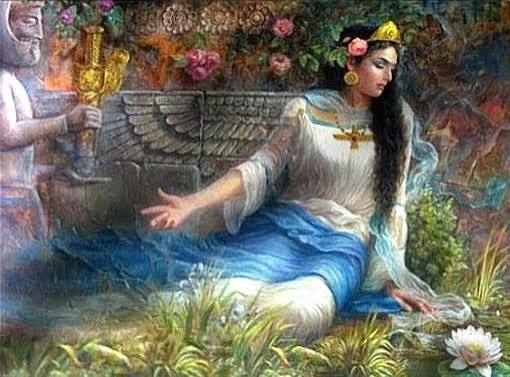
The fourth Amesha Spenta is Spenta Armaiti, the guardian of the earth and the only distinctly female energy among the seven emanations of Ahura Mazda. Armaiti supposedly translates as “rightmindedness” or “devotion,” but the word-name actually means “the spoke of loving kindness” (on the Wheel of Time). As the fourth ray, she presides over the Anahata or Heart Chakra. In Buddhism, loving kindness or metta is the first of the four divine abodes (circles).
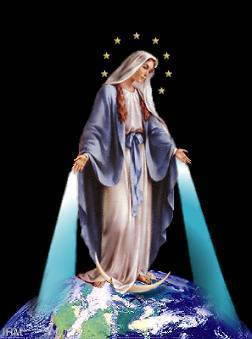
Note the similarities between the Zoroastrian depiction of Spenta Armaiti above and the classic Catholic rendering of the Blessed Virgin below. Both stand on the earth, radiating loving kindness and grace.
Before we move on, let me toss into the mix the following from the Course:
The Holy Spirit is the spirit of joy. He is the Call to return with which God blessed the minds of His separated Sons. This is the vocation of the mind. The mind had no calling until the separation, because before that it had only being, and would not have understood the Call to right thinking. The Holy Spirit is God’s Answer to the separation; the means by which the Atonement heals until the whole mind returns to creating. (ACIM, T-5.II.2:1-5)
The next Rik (1.31:9) reads:
The True Self kindles the first thought of the True Father, the sword of the whole true Self, the winds of Yah speaking for the majesty born from the four nations gathered together in the state radiating Yah, the pure wholeness gathering together the thousand joyful singers, the holy heroes of the thought protecting the vow devouring fear.
tvam (The True Self) agne (kindles) pramatiḥ (the first thought) tvam (of the true) pitā (father) asi (the sword) naḥ (of the whole) tvam (true Self) vayaḥ-kṛt (the winds of Yah speaking for) tava (the majesty) jām-ayaḥ (born from the four) vayam (nations or communities) sam (gathered together) tvā (in the state) rā-yaḥ (radiating Yah) śati-naḥ (the pure wholeness) sam (gathering together) sahasriṇaḥ (the thousand joyful singers) su-vīram (the holy heroes of) yanti (the thought) vrata-pām (protecting the vow) adā-bhya (devouring fear) ǁ
Notes:
The first thought of the True Father is the Word of God, the Logos that brought Holy Creation (the Christ) into being. And that thought is the North Star, as well as the flaming sword Elohim posted at the gate between Eden and the enclosure to the east — the whole true form of the winds of Yah speaking for the majesty born from the four nations gathered together, etc. The winds of Yah are AUM or, perhaps, only A and U. Because I’m beginning to think that it’s the Vah Ray that broadcasts the M-kara. The whole true state of A and U is God and Christ, joined in majesty on the shared Throne of Glory. The four “nations” gathered together in Yah are the Souls in the four circles or quadrants overseen by the Cherubim. Yah, the Red Ray of God’s presence, radiates the pure wholeness that brings together the one thousand joyful singers of Om (the Song of God’s Love) protecting the vow devouring fear.
The vow devouring fear is the Atonement, which restores Om-consciousness in three steps. And it is these three tones that speak for God’s Majesty. In Hinduism (unbeknownst to most Hindus) God’s Majesty is personified as Lord Hanuman. And that is why Lord Hanuman is revered as the remover of fear, anxiety, and negative thoughts. Known as the embodiment of courage and strength, devotees frequently chant the Hanuman Chalisa or recite specific mantras like Om Shri Hanumate Namah to dispel mental distress and instill fearlessness.
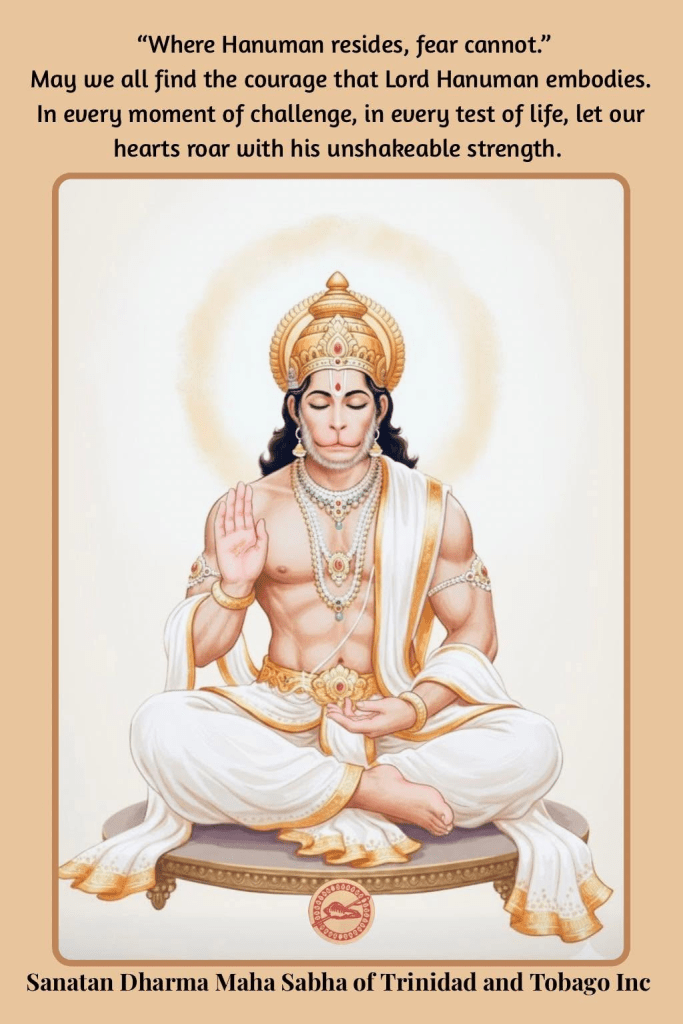
The Hanuman Chalisa is far too long to include in this post, but it’s also very interesting, so perhaps we’ll discuss it at another time.
The next Rik reads:
The True Self kindles firstly the living beings of the four stringing together the Celestial Being calling from the Forest belonging to Nahusa, the Master of the House of Ila calling from the forest, the thought-grains descending from your Father to assemble the Son generating the Joyful State’s glorious thunder.
tvām (the True Self) agne (kindles) prathamam the first) āyum (Living Being of) āya-ve (the four stringing together or weaving) devāḥ (the celestial being) akṛṇvan (calling from the forest) nahuṣasya (belonging to Nahusa) viśpatim (the master of the House) iḷām (of Ila) akṛṇvan (calling from the forest) manu-ṣasya (thought-grains) śāsanīm (descending from) pituḥ (your father) yat (to assemble) putraḥ (the Son or Sons) mamakasya (generating the joyful state’s) jāya-te (glorious or triumphant thunder)
Notes:
Okay, wait … because this appears to affirm my speculation about the Vah Ray sounding the M-kara through the four Living Beings, i.e., the Cherubim. The celestial being calling from the forest is the Vah Ray of the Holy Spirit, and the four Living Beings are indeed “the attribute rays” stringing together or weaving together the four facets, quarters, or faces of the Holy Spirit.
What is the Forest belonging to Nahusa?
In the Mahabharata epic, Nahusha is a legendary and righteous king of the Lunar Dynasty (Chandravamsha) and a direct ancestor of the Pandavas (the five brothers). So, he descended from Soma, the Great Ray of Vah shining in the darkness generated by the Ego Mind. He briefly ascended to the throne of Heaven, but he was soon cast down owing to his egoic hubris.
After claiming the throne, Nahusha demanded that the rishis carry his palanquin. Lacking the virtue of patience, he audaciously kicked the revered Sage Agastya, who cursed the king by turning him into a massive serpent before casting him out of the celestial realm.
In serpent form, Nahusha dwelled in a forest near the Saraswati River. The forest served as a place of repentance and intense penance. He survived there by eating whatever ventured into his path, until the prescribed period of the curse was complete.
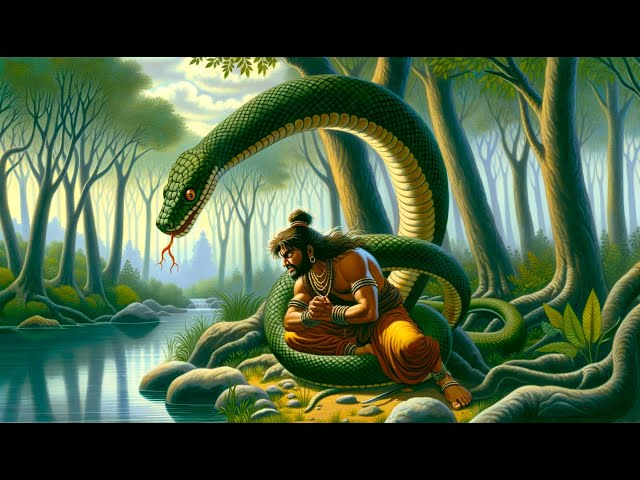
Nahusha supposedly means “the fearless one,” but it’s actually a compound of Nah (wholeness) and Usha (dawn). So, the name actually means “the dawning of wholeness” or “wholeness dawning.” Nahusha’s forest is, therefore, the place (in the mind) where enlightenment dawns. Hindus call this “the forest of all beings.” Course-Jesus calls this same “place in the mind” or state of mind the Real World and the Borderland.
In the Bible, this is Eretz, the Land of the Living, as well as New Jerusalem.
As I read the symbols, Nahusha represents the Dragon’s Tail, which descended from the Throne Room (as the Vah Ray) to bring Christ’s Majesty down to earth. Nakusha is, therefore, another form of Ketu.
In the Majesty God bequeathed to Christ, we rightfully belong on the Throne of the Logos on the seventh plain, but owing to our hubris (ego), we were cast down by Agastaya to the sixth plain, to atone in serpent form. Agastaya means “the unmovable standing light”; so, in the story, he represents the Golden Lampstand and/or Temple Menorah much-discussed in the Old Testament — the inner-lampstand (of God’s light) we hid from view when we broke the Golden Rule.
Or, as Jesus says in Matthew 5:14-16:
Ye are the light of the world. A city that is set on an hill cannot be hid. Neither do men light a candle, and put it under a bushel, but on a candlestick; and it giveth light unto all that are in the house.
Let your light so shine before men, that they may see your good efforts, and glorify your Father which is in heaven.
If Nahusa is the Dragon’s Tail of Christ’s Majesty), then he’s also the Vah Ray, as well as “the Master of the House” — a titled used by Jesus of the Bible in more than one parable.
So, to encapsulate:
–The Dragon’s Head is Yah, the Red Ray of God’s Majesty sounding the A-kara through the Trinity Rays.
–The Dragon’s Tail is Vah, the Pale Ray of Christ’s Majesty sounding the M-Kara (the call to awaken). And Vah, the Holy Spirit’s Hook, also is the Master of the House.
— When the two Rays marry, they produce the U-kara (Kundalini, the locust swarm from the pit).
–Agastaya, who isn’t mentioned in this Rik, likely represents the Golden Lampstand — the inner-instrument illuminating the Temple of Solomon. And that explains why he’s known as “the eighth Saptarishi.”
This Rik also mentions Ila, the male aspect of Ida, the gender-changing Hindu deva representing the spiritual energy channel or nadi transporting the Living Water of the Vah Ray through the Spiritual Body, more or less.
Why does Ida change genders? I’m guessing it’s to signify her snake-like crossings over the Sushumna nadi in partnership with Yah’s Pingala nadi. When she enters the Celestial Realm on the right-hand side of the wheel, she is Ida; when she crosses to the left, she becomes Ila. This makes more sense when we look at a diagram of the three nadis interacting. In the one below, Ida/Ila is the lavender snake climbing the Sushumna. As she rises, she switches back and forth from the left-hand side of Sushumna to the right-hand side. On the left (in the illusion), she’s Ila (the male energy); on the right (in the celestial realm) she’s Ida (the female energy).
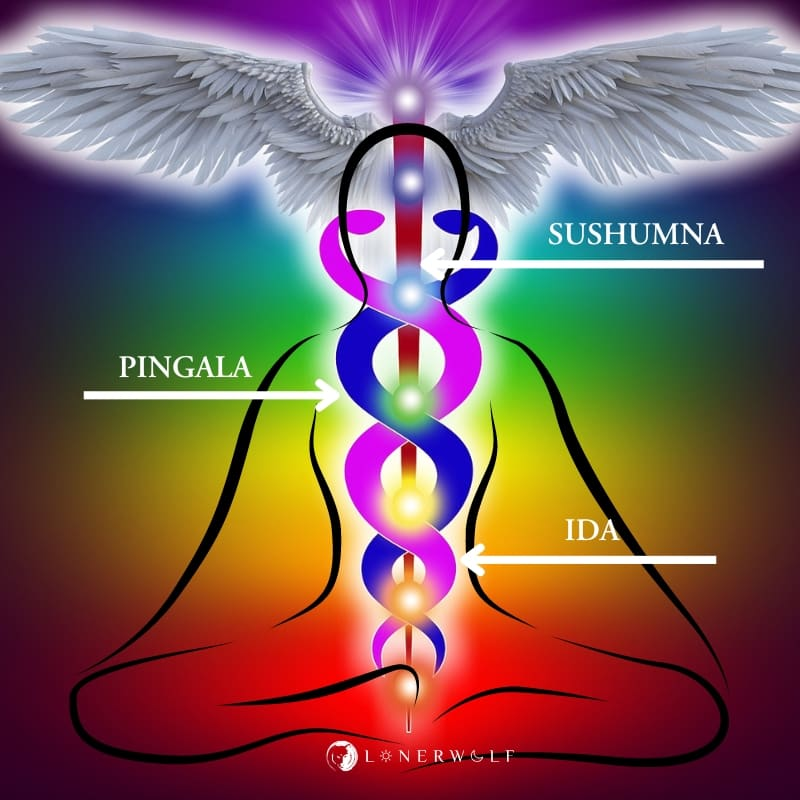
Or perhaps she’s Ida until she marries Pingala in the Ajna Chakra, and then becomes Ila. Hard to say without a fuller explanation from the ancient rishis.
The next Rik reads:
The True Self in wholeness kindles Majesty, the divine drink the joyful spirit sends fort ing forth the bounteous whole to protect the extensions of Vah in the circles (or chakras) venerating the light protecting the full mouth extending the four rays of the sword in the Holy Instant to protect the mind in majesty the multitudes thunder.
tvam (The true self) naḥ (in wholeness) agne (kindles) tava (Majesty) deva (the divine) pā-yubhiḥ (drink of the joyful spirit) maghonaḥ (the bounteous whole) rakṣa (protecting) tan-vaḥ (the diffusions of Vah) ca (in the circles or chakras) vand-ya (venerating the light) trātā (protecting) tok-asya (the full mouth) tanaye = tan-aya (dispersing the four) gavām (rays of) asi (the sword) animeṣam (in the blink of an eye = the Holy Instant) rakṣa-māṇaḥ (protecting the mind) tava (in the majesty) vra-te (the multitudes thunder) ǁ
Notes:
If I’ve got this right, Majesty is the divine drink of the joyful spirit. And, from the Course we know that the Spirit of Joy is the Holy Spirit. And from our Vedic studies, we know that the Vah Ray sounds the M-kara aspect of AUM. So, the M-kara is the vibration of the Majesty that God (the Father) gave Christ (the Son) in the first or original creation.
Course-Jesus says quite a lot about the power of God’s “majesty.” In one place, for example, he says:
When a mind has only light, it knows only light. Its own radiance shines all around it, and extends out into the darkness of other minds, transforming them into majesty. The Majesty of God is there, for you to recognize and appreciate and know. Recognizing the Majesty of God as your brother is to accept your own inheritance. God gives only equally. If you recognize His gift in anyone, you have acknowledged what He has given you. Nothing is so easy to recognize as truth. This is the recognition that is immediate, clear and natural. You have trained yourself not to recognize it, and this has been very difficult for you. (ACIM, T-7.XI.5:1-9)
In another place, he says:
Here is the answer! Would you stand outside while all of Heaven waits for you within? Forgive and be forgiven. As you give you will receive. There is no plan but this for the salvation of the Son of God. Let us today rejoice that this is so, for here we have an answer, clear and plain, beyond deceit in its simplicity. All the complexities the world has spun of fragile cobwebs disappear before the power and the majesty of this extremely simple statement of the truth. (ACIM, W-122.6:1-7)
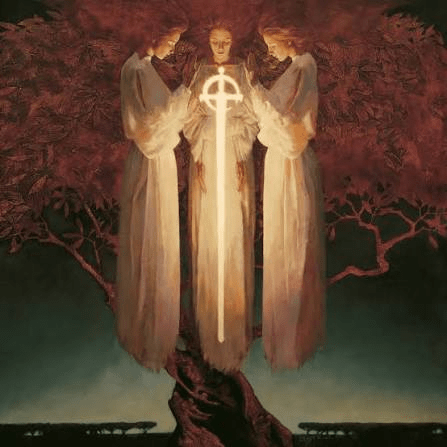
So, when restored to wholeness (through True Forgiveness), the Christ Mind kindles the M-kara vibration — the Majesty God bequeathed to Christ — to protect the diffusions of Vah: the four Living Beings or Attribute Rays. And these four offspring rays are indeed known as “the rays of the sword” in the esoteric teachings about the Seven Rays. The Sword they mean is, of course, the flaming sword Elohim posted at the gate into Eden, Paradise, and/or the Land of Glory.
This characterization suggests that the Flaming Sword represents the Great Ray of Vah, the “spirit” Elohim manifested to stand guard at the Gate of Heaven, to prevent the outcast Ego Mind from reinvading. In the Book of Daniel, that pure-gold sword is seen “girding the loins” of the Bridegroom figure Daniel meets on the riverbank.
Nobody seems to know what Cherubim means, which strikes me as odd, given that the Hebrew word cherub means “sword,” whilst the suffix im simply makes the word plural. So, Cherubim means “the swords,” as in “the rays of the sword.”
Proceeding apace, the next Rik reads:
The True Self kindles the offered barley drink to unite the inner companion parts lighting the four spiritual eyes to ignite the glory of Yah’s radiant three to be invoked to fill the body bestowing the glorious ray or parrot awareness of the mantra from the mind in the forest of the firstborn son of the Supreme Lord.
tvam (The True Self) agne (kindles) yaj-yave (the offered barley) pā-yuḥ (drink to unite or yoke) antaraḥ (the inner) aniṣ-aṅgāya (companion parts lighting) catu-ḥakṣaḥ (the four spiritual eyes) idh-yase (igniting the glory) yaḥ (of Yah’s) rāta-havyaḥ (radiant three or tail to be invoked) avṛ-kāya (to fill the body) dhā-yase (bestowing the glorious) kīreḥ = kira (ray or parrot) cit (consciousness) mantram (of the mantra) manasā (from the mind) van-oṣi (in the forest of the firstborn son) tam (of the Supreme Lord)ǁ
Notes:
Apparently, making beverages from roasted barely is an ancient practice in many cultures. In some, barley was used to brew tea or “water,” in some it was distilled into spirits; in still others it was cooked into a porridge or gruel. In Islam, for example, the barley “drink” is called Talbina, which translates as “to build the Mound”. In Hinduism, a similar barley-gruel is consumed to provide nourishment and healing for the body and spirit.
But the true “barley-drink” the prophets prescribed for healing is the M-kara vibration — the spiritual “elixir” we extract from the Word of God and/or the Solar Logos during our secret-chamber almsgiving offerings.
And this is indeed how we build the Temple Mound in New Jerusalem.
The four eyes mentioned in this Rik are probably the Biblical Ophanim, the four eye-covered double-wheels the Cherubim stood upon in the visions of Ezekiel and Zechariah, among other prophets.
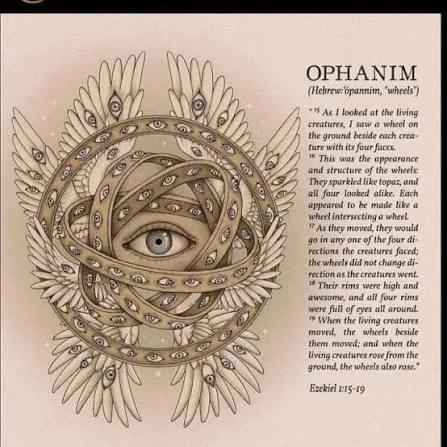
Yah’s radiant three are, as we know, the Trinity or Aspect Rays. So, the Cherubim light the four eyes that, in turn, ignite the Trinity Rays of God’s Glory.
This begs a question: are the four eyes they mean the four lower chakras?
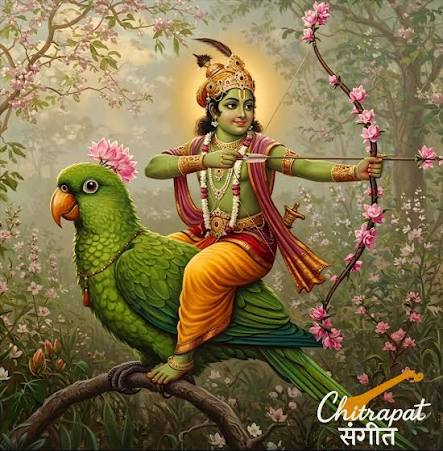
Parrot-consciousness is the awakened consciousness in which we hear the ever-present echo of the sacred mantra, AUM. Parrots don’t actually talk; they mimic or repeat what they hear. Just as we do (telepathically), when we meditate on the AUM.
In Hinduism, parrots represent the vibrational resonance of the soul and the repetition of spiritual awareness. And this explains why Kamadeva, the personification of divine love (not human lust), rides a parrot.
The next verse reads:
The True Self kindles the upper legs gathering together the voice striking (or undoing) the sensing self striving to doubt the whole Supreme Creation of the firstborn son in the Forest, (where) the Supreme Spirit of God supports the consciousness advancing the thought uniting the glory the Father sends forth to prepare the Moon to advance the quarters divided to yield the Star.
tvam (the True Self) agne (kindles) uru-śaṃsāya (the upper legs gathering together) vāg-hate (the voice striking or undoing) spār-ham (the sensing self) yat (striving) rekṇaḥ (to doubt the whole) paramam (Supreme Creation of) vanoṣi the firstborn son in the Forest) [where] tat (the Supreme Spirit) ādhrasya (of God supports) cit (the consciousness) pra-matiḥ (advancing the thought) uc-yase (uniting the glory) pitā (the father) pra (sends forth) pākam (to prepare) śāssi (the Moon) pra (to advance) diśaḥ (the quarters) vi-duḥ-taraḥ (divided to yield the Star).
Notes:
This brings up something that’s been niggling at me over the past few discussions. I’m beginning to see that the AUM represents the three vibrational tones of God’s Glory. And “glory,” “splendor,” “majesty” and “grace” are indeed synonymous terms. So, AUM is Om, the vibration of Perfect Love, recalibrated as “grace” to teach and heal, rather than to “create.” And, therefore, AUM is the three-part glory or majesty Elohim/Allah sends forth to prepare the Moon (the Vah or Christ Ray) to advance the quarters of the Cherubim.
The Star is the Logos — the “word” God spoke (extended) in the beginning to create the Sonship in His reflection. So, the star also is “the mirror” (of God and Christ) whose glass we must make spotless again through the Atonement process.
Or, to quote Course-Jesus:
You are a mirror of truth, in which God Himself shines in perfect light. To the ego’s dark glass you need but say, “I will not look there because I know these images are not true.” Then let the Holy One shine on you in peace, knowing that this and only this must be. His Mind shone on you in your creation and brought your mind into being. His Mind still shines on you and must shine through you. Your ego cannot prevent Him from shining on you, but it can prevent you from letting Him shine through you. (ACIM, T-4.IV.9:1-6)
That should make sense. If not, ask for clarification in the comments and I’ll do my best to oblige.
The next verse reads:
The True Self kindles the purified gifts to the Guru (the inner Master Teacher) from Nara’s waters generating the all-pervading A-kara, stitched together from the circles for drinking in rest or sleep the Cosmos underneath to taste and distribute (give and receive) Yah, the abode of the AU-kara.
tvam (the True Self) agne (kindles) prayata-dakṣiṇam (the purified gifts to the guru from) naram (Nara’s) var-ma-iva (waters generating the all-pervading A-kara) syūtam (stitched together from) pari (the circles) pā-si (for drinking in rest or sleep) viśva-taḥ (the Cosmos or universe underneath) svādu-kṣadmā (to taste and distribute) yaḥ (Yah) vasat-au (the abode of the A and U-karas)
Notes:
This is pretty high-level esoteric stuff about the Great Rays, but I’m doing my best to follow and explain what it means. The purified gifts to the Guru are the rightminded or pure-minded thought gifts or “alms” we offer in secret to the inner Christ. Not to Jesus exclusively, but to everyone and everything in the Cosmos graced with the inner spark of the Christ Ray.
Nara’s waters are the Cosmic Ocean underneath the illusion; and here we learn that those waters generate the A-kara, which we “stitch together” in the circles for drinking Nara’s Cosmic waters.
In Hinduism, the AU-kara is said to represent the “middle tone” we hear in the dream. And herein we learn that the Yah Ray is the abode of the AU-kara. So this clarifies that Yah produces both the A and the U, whilst Vah produces or “sings” the M.
Am I confusing you? If so, I apologize.
The next verse reads:
The Ray of Light encompassing the Living Beings, the light born from the holy Son of God within, generates the divine here and now to kindle the straight path.
syona-kṛt (the ray of light encompassing) jīva-yājam (the Living Beings, the light born from) yajate (the holy) saḥ (Son of God) upa-mā (within generating) divaḥ (the divine) imām (here and now) agne (kindling) śaraṇim (the straight path)
Notes:
If I’ve got this right, the Ray encompassing the Living Beings is the Vah Ray, which is indeed born from the Son of God within. And it is that Ray (Vah, the Holy Spirit) that generates the Eternal Now of the Holy Instant to kindle the Straight Path (the spiritual journey back to the Kingdom of Heaven within).
Or as Jesus Christ famously said in Luke 17:20-21;
And when he was demanded of the Pharisees, when the kingdom of God should come, he answered them and said, “The kingdom of God cometh not with observation: Neither shall they say, Lo here! or, lo there! for, behold, the kingdom of God is within you.”
The Sukta’s next Rik reads:
To remember the Son of God in the wholeness of the here and now on the journey of the Name, the light from the tree (or mountain) far away reaches to the Father to advance the mind at the appointed time to support the water-making sword of the rishis causing those who are destined to die to remain in or with the Manus striving to kindle the Living Voice in the likeness of their own voice.
mīmr-ṣaḥ (to remember the Son of God) naḥ (in the wholeness) imam (of the here and now) adhvā-nam (on the journey or path of the name) yam (the light from) agāma (the tree or mountain) dūrāt (far away) āpiḥ (reaches to) pitā (the father) pra-matiḥ (to advance the mind) somyānām = samyanam (at the appointed time) bhṛmiḥ (to support the water-making) asi (swords or weapons) ṛṣi-kṛt (the rishis causing) martyānām (those who are destined to die) ce (to remain) manuṣ-vat (in the Manus striving) agne (to kindle) aṅgirasvat (the Living Voice in the likeness of) aṅgiraḥ (their own voice).
Notes:
There’s a lot of debate on the Net about what Manus means in Sanskrit. But somewhere in the Hindu literature, Manus is described as prajapati — a word meaning “offspring or creation of the Lord.” Ergo, to be Manus or prajapati is to rightmindedly perceive your “self” or “I-am-ness” as God’s creation alone, completely apart from and unaffected by anything the Ego Mind says, does, or projects. And to become Manus or Prajapati, we learn herein, is to be spared from the Cycle of Death at the appointed time to support the water-making swords, which are the four rays of the sword and/or the Cherubim.
In Hinduism, the water-making weapon of the Saptarishi is called Varunastra (supposedly meaning “Varuna’s weapon”). Presided over by Varuna (the personified “waters of oneness”), the Varunastra can allegedly conjure torrential volumes of water, storms, and floods, and is capable of assuming the form of any divine weapon.
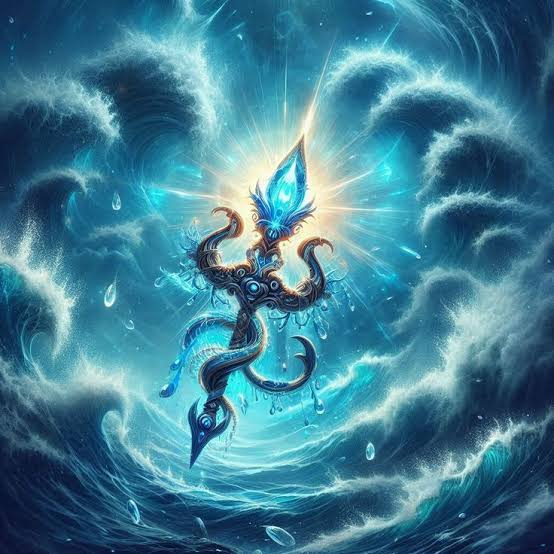
Remembering that Lord Varuna rides the mythical Makara (M-kara), we can safely presume that the weapon the four swords generate are the four streams of the M-kara flowing down to us from the Vah Ray. And this may in fact be the true meaning of the “va” in Varuna. If I’m right, then Varuna can mean either the waters of oneness (Var-una) or “Vah’s debt” (va-runa).
Not insignificantly, Jesus mentions the “debt” we owe to each other and him a handful of times in the Course. What follows is but one example:
In learning to escape from illusions, your debt to your brother is something you must never forget. It is the same debt that you owe to me. Whenever you act egotistically towards another, you are throwing away the graciousness of your indebtedness and the holy perception it would produce. The term “holy” can be used here because, as you learn how much you are indebted to the whole Sonship, which includes me, you come as close to knowledge as perception can. The gap is then so small that knowledge can easily flow across it and obliterate it forever. (ACIM, T-4.VI.2:1-5)
The next three Riks describe the Vah Ray, which is both the Flaming Sword and the Holy Spirit. Since they’re related, we’ll discuss them as a group.
The first of these Vah Ray verses reads:
Like Yayati, the home of the previous state of grace, the pure and transparent light discharges the A-kara conveying the Lamp of the Veil.
yayāti-vat (Like Yayati) sadane (the home) pūrvavat (of the previous state) śuce (of grace) accha (the pure and transparent) yāhi (light discharges) ā (the A-kara) vaha (conveying) dai-vyam (the Lamp of the Veil).
Begotten in the name of God’s True Miracle, the fishhook light governs the circle of the Beloved’s exhalations to kindle the expanding perception strengthening the Soul.
janam (begotten in the name) ā (of God’s) sād-aya (True Miracle), barhiṣi (the fishhook) ya-kṣi (light governs) ca (the circle) priyam (of the Beloved’s) etena (exhalations) agne (to kindle) brahmaṇā (the expanding perception) vavṛdha-sva (strengthening the Soul).
A divine force, Vah endeavors to thunder in the chakra or circle to make the living wind come forth to advance the miracles of divine love.
śaktī (a divine force) vā (Vah) yat (endeavors) te (to thunder) cakṛ-ma (in the chakra or circle to make) vidā (the living) vā (wind) uta (come forth) pra (to advance) neṣ-i (the miracles of divine love).
Notes:
Let’s start at the top with Yayati, an important character in the Mahabharata Epic. The son of Nahusha (the King whom Agastaya turned into a serpent), Yayati also was a monarch cursed (for his marital infidelities) with premature aging, but regained his youth by passing the curse onto his youngest son, Puru (meaning “the inner purity dispelling the darkness”).
According to legend, this uncharitable “bequest” begat the two great lineages of the epic: the Yadavas and the Kurus (the family of the five Pandava brothers).
Let’s cut to the chase: Yadava means “the light of the fire (in the forest),” whilst Kuru means “the hook dispelling the darkness.” So, Yadava and Kuru represent the Great Rays of Yah and Vah in the allegory. And, since the Pandava brothers belong to the Kuru dynasty, they descend from the Vah Ray.
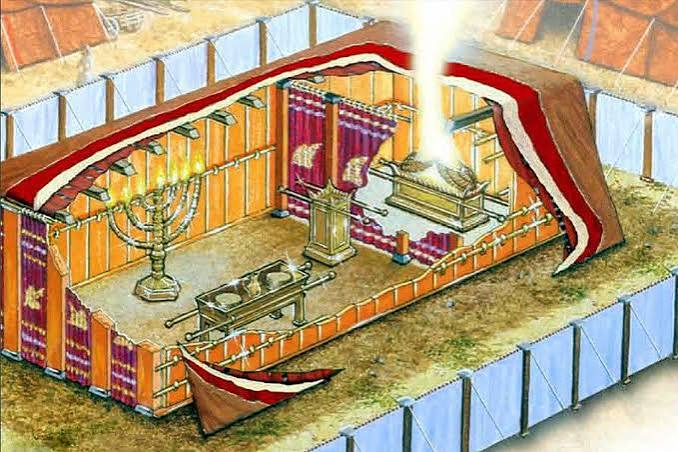
Let’s move on to the “Lamp of the Veil,” which has to be the seven-branched Golden Lampstand (the Temple Menorah) that God (Elohim or YHVH) commanded Aaron (the A-kara) to keep burning continually. It was positioned just outside the thick veil of the Tabernacle separating the Holy Place from the Holy of Holies. That veil was embroidered with images of the Cherubim; so the veil must represent the level (of consciousness) the Cherubim occupy. Beyond that “veil” is the Holy of Holies, where Elohim placed the Ark of the Covenant. We see this configuration diagramed below.
In Hinduism, Buddhism, and Jainism, the Yaksi are perceived as a group of female nature spirits; but that can’t be right for two reasons. The first is that nature spirits are egoic inventions. And the second is that Barhisi Yaksi (the fish-hook Yaksi) governs the circle of the Beloved’s exhalations; so the Yaksi described herein must be a celestial being or beings rather than elemental spirits.
Without further research, it’s hard to say what the Yaksi truly represent in the Hindu pantheon, but the fish-hook Yaksi mentioned herein can only be the Vah Ray (or its offspring).
Based on my research, Yaksi can be divided three ways: as Ya-ksi (the abiding or indwelling light), Yak -si (the one spirit resting) and/or Yaks-i (to worship, honor, or adore Kamadeva, “the spirit of divine love”).
So, yeah, the Vah Ray sounding the M-kara in the Circle of Wind — the Circle of the Beloved’s Exhalations. The Beloved’s Exhalations are, of course, what Christians call “the Breath of Christ.”
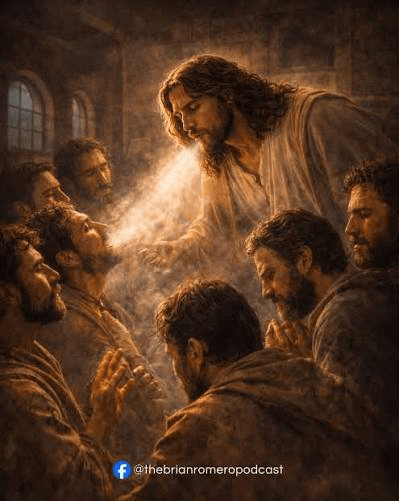
According to Google:
The breath of Christ refers to the moment Jesus breathed on His disciples and gave them the Holy Spirit, mirroring how God breathed life into Adam at creation.
We find this “breath” described in John 20:21-22, which reads:
Then said Jesus to them again, “Peace be unto you: as my Father hath sent me, even so send I you.” And when he had said this, he breathed on them, and saith unto them, “Receive ye the Holy Ghost.”
From this, we can glean that the Breath of Christ represents all of the following: 1) the Holy Spirit, 2) the Vah Ray sounding the M-kara in our minds, 3) the “spirit” of peace descending from the Christ Ray of Elohim.
And that Great Ray, we learn in this Rik is “begotten in the name of God’s True Miracle.” God’s True Miracle is the eternal oneness of God’s original creation of the Christ.
Or, as Course-Jesus more astutely explains:
This is the miracle of creation; that it is one forever. Every miracle you offer to the Son of God is but the true perception of one aspect of the whole. Though every aspect is the whole, you cannot know this until you see that every aspect is the same, perceived in the same light and therefore one. Everyone seen without the past thus brings you nearer to the end of time by bringing healed and healing sight into the darkness, and enabling the world to see. For light must come into the darkened world to make Christ’s vision possible even here. Help Him to give His gift of light to all who think they wander in the darkness, and let Him gather them into His quiet sight that makes them one. (ACIM, T-13.VIII.5:1-6)
One more Rik to go … which reads:
The Red Ray abiding in Yah is the stone of God’s Word in the wholeness generating the sacred mace with the strength of a whirlwind.
abhi (the red ray) vas-yaḥ (abiding in Yah) asmān (is the stone) sam (of God’s Word) naḥ (in the wholeness) sṛja (generating) su-matyā (the sacred mace) vāja-vatyā (with the strength of a whirlwind)
Notes.
I believe this echoes the quote I just shared from the Course.
Yah, the Red Ray, is the stone of God’s Word, which generates the wholeness that is the sacred mace with the strength of a whirlwind. Based on this description, and what we’ve just learned from Jesus, the mace with the strength of a whirlwind is the Miracle.
Let’s explore this idea further.
We find the stone of God’s Word described in the Bible as “a witness” with the power to hear or to be heard and obeyed. In 1 Samuel 7:12, we learn that Samuel took this stone, set it up, and named it Ebenezer — a name meaning “the stone of help.” To the Israelites (the dream-bound Souls seeking to escape the desert dreamscape), this erected stone served as a tangible reminder of the Lord’s power and faithfulness.
In Zechariah 3:9, we further learn that a) this “stone” has seven eyes; b) this stone was set by Elohim or YHWH before the High Priest Joshua (Jesus Christ or Yeshua, the coming Messiah), c) the stone symbolizes the Messiah, and d) the eyes represent the all-seeing eyes, divine omniscience, and the active supervision of “God” over the whole earth.
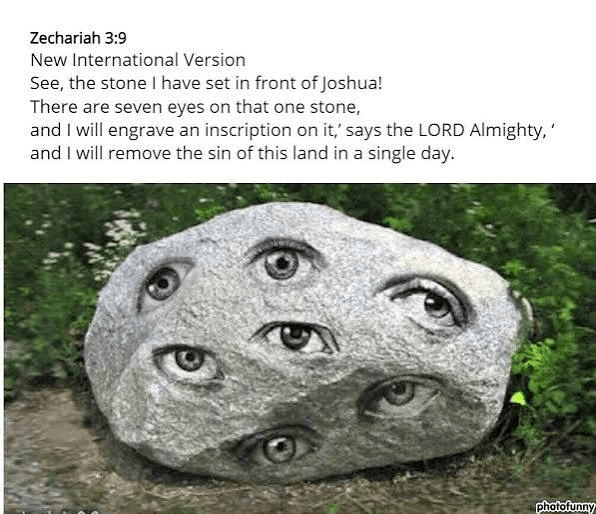
This seven-eyed stone is new to me, so naturally, I’m intrigued. From this ancient Rik, we learn that this seven-eyed stone is Yah, the Red Ray of God’s Presence acting in the dream as Elohim’s top general. Yah also is the Blood Ray, the Blood of Christ, and/or the Blood of the Lamb. And that is why John of Patmos sees seven eyes on the Lamb of God in the visions he describes in Revelations. As weird as this imagery seems, the Lamb’s seven eyes represent the seven rays, lamps, spirits, or rishis “before the throne,” while the Lamb’s seven horns represents the seven trumpets of God (sounding the sacred-syllables).
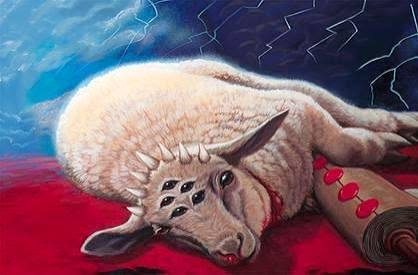
With that cleared up, let’s talk about the mace also referenced in this Rik. We don’t find a mace in the Bible, but we do find it’s equivalent many times as the “rod” and the “staff” belonging to Aaron, the priestly brother of Moses, as well as the Good Shepherd. We also find scepters in the books of Numbers and Esther, cudgels in the Book of Isaiah, and clubs mentioned at least eleven times.
And, just so you know, rod, staff, scepter, cudgel, and club are words synonymous with “mace.”
In Hinduism, the sacred mace is called the Gada (गदा). Believed to be a powerful symbol of physical strength, cosmic authority, and the protection of righteousness (dharma), the Gada consists of a shaft topped by a heavy spherical head crowned with a spike.
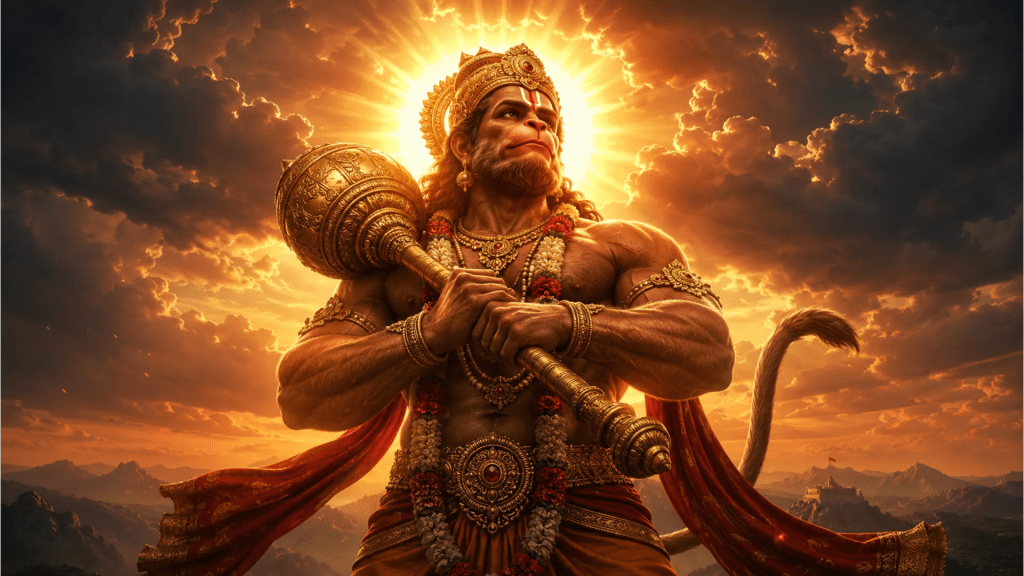
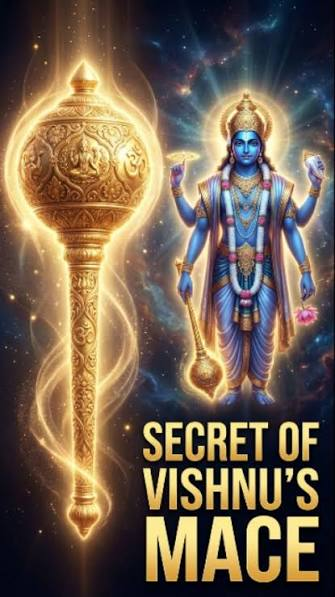
In the lore, the “god” most often associated with the Gada is Lord Hanuman. BUT, Lord Vishnu also carries a mace called Kaumodaki.
If the mace, the scepter, the rod, the staff, and the cudgel all represent the same “divine weapon,” then that sacred “weapon” is the miraculous wholeness of Holy Creation, without which Perfect Creation is impossible. In separation, we can’t extend Holy Creation as God intended; we can’t, in fact, do anything that affects Divine Reality in the least.
God doesn’t see what we do in the dream, but the Seven Rishis do. Not so they can judge, condemn, and punish our errors, but so they can help us do better. Although cute, signs like the one below send the wrong message. Jesus watches over us like a shepherd. Does a good shepherd punish the sheep that go astray? No. Instead, he brings them back to the flock, where they’ll be watched over for their own good and protection.

Kaumodaki (Vishnu’s cudgel) supposedly translates as “captivator of the mind,” “the stupefier,” or “the giver of joy.” What it actually means is “the community (or nation) giving water.” And from this we can glean that the communal giving of water is what restores the memory of Holy Creation’s wholeness or oneness. And that is indeed what Jesus repeatedly states in the Course.
At one point, for example, he says:
Ultimately, every member of the family of God must return. The miracle calls him to return because it blesses and honors him, even though he may be absent in spirit. “God is not mocked” is not a warning but a reassurance. God WOULD be mocked if any of His creations lacked holiness. The creation is whole, and the mark of wholeness is holiness. Miracles are affirmations of Sonship, which is a state of completion and abundance. (ACIM, T-1.V.4:1-6)
Likewise, Gada, the weapon of Lord Hanuman, supposedly translates simply as “mace” or “club.” In truth, the word is a compound either of ga (the sacred syllable, AUM or Om) and da (giving or bestowing) or gad (speaking articulately) and a (of God or the A-kara).
This suggests (to me, at least) that the cudgel, club, rod, scepter, and mace found in the scripture of Hinduism, Judaism, and Christianity represents the miracle for which Christ’s Course is named.
Got it? Good. Coz I’m exhausted.
In conclusion, the Rigveda’s 31st Sukta isn’t about Agni; it’s about the Great Rays of YHVH and their offspring rays. Furthermore, Hiranyastūpa Āṅgirasa didn’t write this teaching, nor was he a human sage. Hiranya-stupa Angira-sa means “the Golden heap of the Living Voice of God’s Word.” In these ancient languages, heap is synonymous with “multitudes,” so the Golden Heap of the Living Voice of God’s Word is what Course-Jesus calls “the Mighty Chorus to the Love of God.”
In the Bible, we don’t specifically find the phrase “golden heap,” but we do find two references to heaps of gold jewelry. Those references occur in Exodus 32, wherein the Israelites melted their gold jewelry into a heap to fashion the Golden Calf, and in Judges 8:24-27, wherein Gideon collects a large heap of gold earrings from the defeated Midianites to make an ephod (an apron worn by priests).
Smacks to me of mistranslation, but rather than retranslate those verses this far into our study of the 31st Sukta, I’ll simply say that the Golden Heap also is the Great Multitude described as follows in Revelation 9:
After these things I looked, and behold, a great multitude which no one could number, of all nations, tribes, peoples, and tongues, standing before the throne and before the Lamb, clothed with white robes, with palm branches in their hands, and crying out with a loud voice, saying, ‘Salvation BELONGS to our God who sits on the throne, and to the Lamb!’ All the angels stood around the throne and the elders and the four living creatures, and fell on their faces before the throne and worshiped God, saying:
‘ Amen! [AUM] Blessing and glory and wisdom,
Thanksgiving and honor and power and might,
BE to our God forever and ever.
Amen.’
I’m sure that translation would benefit from some tweaking, but it conveys the general idea.
Thanks for visiting the Holy Meeting Place dot com. I hope you learned something useful. Until next time, Om Hari Om and Namaste.


Leave a Reply