Ever since we talked about the grindstone/millstone, a question has been percolating inside my mind: Are the grains mentioned in the Vedas, the Bible, and the Qur’an meant to symbolize the “alms” we offer to the millstone for grinding into the powder or flour the Holy Spirit disperses universally via the Divine Matrix?
Today, we’ll explore that question by examining the evidence in the aforementioned scriptural texts.
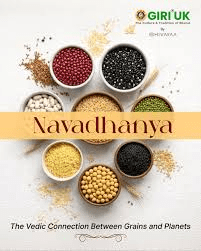
Let’s start with the Navadhanya of Hinduism. Used in ayurvedic medicine, religious ceremonies, and agriculture, these nine sacred grains have immense significance in Hindu culture. That the Navadhanya are regarded as mandatory offerings during Navagraha Shanti Puja (planetary appeasement ceremonies), Griha Pravesh (housewarmings), and Havans or Yajnas supports my hypothesis that these sacred grains represent much more then mere seeds and beans.
The question is: What do they represent?
Let’s start with their planetary associations. According to Google, the Navadhanya and their associated Navagrahas (celestial bodies) are as follows:
- Wheat (Godhuma) is associated with and offered to Surya (The Solar Logos or Greater Light of God “ruling the Day”).
- Rice (Vrihi) is linked with and offered to Chandra (The Spiritual Moon or lesser light of Christ ruling the Night)
- Chickpeas (Chanaka) are associated with and offered to Mangal (Mars).
- Green Gram or Mung Bean (Mudga) is linked with and offered to Budh (Mercury).
- Bengal Gram or Pigeon Pea (Adhaki is associated with and offered to Guru/Brihaspati (Jupiter).
- White Beans or Cowpeas (Barbata/Rajmasha) are linked with and offered to Shukra (Venus).
- Black sesame seeds (Tila) are linked with and offered to Shani (Saturn).
- Black Gram (Masha) is associated with and offered to Rahu (the dragon’s head).
- Horse Gram (Kulattha) is linked with and offered to Ketu (the dragon’s tail).
There’s a lot more to these sacred grains than this list reveals, but it’s a starting point. It also supports my suspicion that these grains represent the “alms” we offer to the nine celestial “bodies” or “deific powers” the Navagraha represent. We’ve talked about some of these powers in previous posts. We know, for example, that Surya is the Solar Logos or Word of God, which Jews call Elohim and Muslims call Allah, erroneously believing this “being” is God, the Father, in Heaven. He’s not; but he is God’s reflection in the dream-realm.
As Hindus rightly understand, God, the Supreme Creator (Brahman) exists beyond the dream-realm’s boundaries, but still influences what happens in the dream through his various envoys. Those envoys form the chain-of-command Theosophists (and their derivative sects) call “the Spiritual Hierarchy.” How they conceive this divine pecking order differs, however, from my current understanding of this ladder of authority.
But that’s a topic for another time. Today, we’re discussing the sacred grains found in most world religions. In the Bible, we don’t find a formal grouping of nine sacred grains, but we do find multiple references to “seeds.” We also find specific references to barley, wheat, flax, millet, beans, and lentils.
For example:
— In 2 Samuel 23:11-12, one of King David’s elite warriors, Shammah stands his ground in a plot of land full of lentils to defend it from the invading Philistines, while the rest of the Israelite army flees.
–In Genesis 25:29-34, Esau sells his birthright to his brother, Jacob, for a bowl of red-lentil stew.
–In 1 King’s 21, King Ahab of Israel became depressed and refuses to eat because Naboth won’t give him his ancestral vineyard to use as a vegetable and bean garden.
–In Ezekiel 4:9, we find divine instructions for making bread out of a mixture of grains and beans.
Since Ezekiel’s Bread recipe comes nearest the mark, let’s reexamine these divine instructions to see what more we can learn about the nature of these grains. For context, we’ll cover the whole section of Ezekiel 4 subtitled “the defiled bread” in Strong’s Concordance. The section starts thusly:
To receive the wheat (chittah), barley (s’orah), beans (powl), lentils (adish), millet (dachen), and spelt (kussemeth) give in one vessel to make bread according to the number of rays. To rest on the side of the three, the one hundred and ninety rays consume the bread eaten in the measure of twenty shaqals per ray in the sacred time for eating.
Let’s pause here for some commentary. Firstly, the Hebrew names for these six grains have other meanings. Adish, for example, can mean either “unconcerned” or “lentils,” while Kussemeth can mean either “spelt” or “Valley of Truth.” So these may not, in fact, be references to grains at all. The bread the divine messenger means is the epiosious bread mentioned by Jesus Christ in the Lord’s Prayer, as well as the Judaic shewbread and/or manna — all of which describe the spiritual “bread of life” or “staff of bread” we give and receive in Brotherhood through our daily circle “meetings.”
These six grains are given in one vessel. That vessel is, I suspect, the Ark of the Covenant and/or the Golden Treasury. To make bread according to the number of rays (not days) suggests that we produce spiritual bread in the quantity congruent with the number of Souls we’ve invited into the Ark through True Forgiveness. The more Souls we invite or forgive, in other words, the more rays we allow to enter in and make bread for the Christ Self at large.
The three rays mentioned in Ezekiel have to be the Trinity Rays presiding over the right-hand side of the Wheel (the Celestial Sphere or middle firmament). But what are the 190 rays also mentioned? Having no idea, I asked Google, and received this fascinating answer:
The 190 Rays is a concept found in medieval Islamic occult science and astrology, referencing the planetary “rays which make blue.” It originates from early Arabic texts on astrological magic, notably explored in the Picatrix (Ghayat al-Hakim)—an 11th-century grimoire combining cosmology, talismanic magic, and alchemy.
This may sound sketchy, but I believe it has merit. And this isn’t the first time the Holy Spirit has nudged me toward Islam in recent days. So, let’s see what Islam can teach us about either the rays or the grains — and hopefully both.
Let’s start with the 190 Rays. In modern-day Islamic mysticism (Sufism), blue light rays symbolize the Soul, spiritual protection, and the heavens. Sufis believe these rays are manifestations of Nur — the divine light penetrating the depths of the unseen universe, often acting as the stepping stone from human (questioning or ego) consciousness to divine certainty.
Nur is, therefore, the unmanifested essence of God illuminating the cosmos and the human Soul. As such, it acts as the source of all spiritual guidance, gnosis (direct mystical knowing), and the fundamental substance from which all creation manifests.
So, Nur is the Sufi equivalent of Nara, the Great Purusha and “sage” in Vedic Hinduism. Ergo, Nur and Nara are the source of the 190 Rays of Blue Light.
In Theosophy, the Blue Light or Ray is the First of the Seven Rays—the archetypal energies that animate all (holy) creation. The Blue Ray represents the Will, Power, and Purpose of the Divine. Associated with Master El Morya, this Bay Ray supposedly governs qualities like courage, leadership, and the defense of spiritual truth.
We’ll talk about Master El Morya and Theosophy at another time. In Hinduism, I’m reasonably sure, the Blue Ray takes the form of the Blue Sapphire called Neelam or Indraneelam. A highly revered and potent gemstone associated with Saturn (Shani Dev), the Blue Sapphire is believed to bestow rapid spiritual growth, wealth, and success.

As we’ve just learned, the grain associated with Shani is the black sesame seed or Tila; so, the black sesame seed may represent the A-kara vibration, which does indeed “bestow rapid spiritual growth, wealth, and success.”
In the first chapter of Ezekiel, the prophet compares the throne of Elohim — the throne he saw in his vision — to a blue sapphire. So Elohim’s Throne must radiate the 190 Rays of Blue Light reflecting God’s glory in the dream-realm.
As conceived in Theosophy, the Blue Ray is the first of the Trinity Rays. And the first of the Trinity Rays is the first-born “lesser ray” of the Great Ray of Yah. The first-born Ray of Yah is the Solar Ray emitting the A-kara vibration — God’s original song to His holy creations, which does indeed represent the Will, Authority, Glory, and Purpose of the Heavenly Father manifesting on Earth.
And from all of this we can surmise that the 190 Rays mentioned in this section of Ezekiel are the Rays or Beams of God’s Thoughts “shining” unseen in the Cosmic Ocean underneath the illusion of material existence.

And yet, the existence of these 190 Rays, which ARE mentioned in the Bible, has been hidden from us for centuries by unilluminated translators who misread the Hebrew for “the three and the one hundred and ninety rays” as “three hundred and ninety days.”
Ezekiel 4 continues thusly:
Drink the waters measured in the sixth Hin at the sacred time for drinking. To eat the barley cakes, circle around the gelel coming out of Adam’s eye. YHVH says, “Son of Israel, to consume the unclean food the locusts strike, say, ‘Alas, Adonay-YHVH, the Soul has not been polluted.’ In early life, to eat of the bodies of the body torn to pieces brings ?? flesh to the mouth saying, “Son of Adam, break into pieces the staff of bread in Jerusalem. Eat bread by the measure of care and drink water by the measure of appalled astonishment. To lack bread and water is to desolate the Great Brother wasting away in guilt.“
What does this mean? More than I can explain at present. What I CAN explain is that the staff of bread in Jerusalem is both the Staff of Life and the Bread of Life mentioned elsewhere in the Judeo-Christian scriptures.
In John 6:35, for example, Jesus Christ says, “I am the bread of life. Whoever comes to me will never go hungry, and whoever believes in me will never be thirsty.”
From this we can surmise that the Staff of Life is the source of our daily bread. And the source of our daily ration of epiosious bread is the Christ Self in the Resting Place, possessing the staff of bread while acting as the grinding stone for our offerings.
What is a hin? Supposedly, it’s a liquid measure mentioned multiple times in the Old Testament. This definition was set by Flavius Josephus, who recorded in the fist century that a hin equaled two Athenian choes, which places its modern equivalent at around 3.6 to 4 liters (about one U.S. gallon).
Sounds like conjecture to me — and utterly unhelpful literalist conjecture at that.
As I explained in my post on the Cornerstone, hin (from Hinsom) actually means “offering place.” Ergo, the Valley of Hinsom or Ghenna in the Bible is the “offering place of the nations.”
So, this line from Ezekiel isn’t about measuring water; it’s about drinking the Living Water from the sixth offering place. And the sixth offering place is Mount Moriah, as per Genesis 22:2-9. By way of explanation, Mount Moriah is where Abraham took his son, Isaiah, to kill him at God’s behest. Moriah means Teacher of God. So, the sixth offering place is the mount or mound where the Teachers of God join in Christ to offer the Living Water to all their brethren in the world.
Rightmindedly understood, Mount Moriah is the Temple Mount in New Jerusalem, the walled city in the Resting Place.
I also left the word gelel intact, because gelel allegedly means “dung” in Hebrew, which can’t be right. Circle around the dung coming out of Adam’s eye? I think not. In Persian, geleh, a similar word, means flock or herd, which has promise, but still doesn’t tick the box. Sadly, I could find no more illuminating definitions for gelel.
Why is there a question-mark between “brings” and “flesh”? Because I also question the accepted definition of the Hebrew word piggula. The word comes up again later, and we’ll discuss it’s real meaning then.
Let’s pause here to regroup and review what we’ve learned so far. Firstly, we’ve learned that the 190 Rays comprise the Blue Light coming from the Great Purusha — the Blue Sapphire Ezekiel saw as the Throne of God. And secondly, we’ve learned that the black sesame seeds or tila offered to Shani-dev by Hindus probably represents the A-Kara vibration.
We find various metaphoric “grains” in the Qur’an as well, with barley and wheat taking center-stage. In Islam (according to Google), these grains are generally understood to represent Allah’s provision, spiritual multiplication, and physical healing.
And yet, the metaphoric grains referenced in the Qur’an also are tied to the daily life and medical recommendations of the Prophet Muhammad, who, it must be said, acted as a “conduit” or “scribe” for the Archangel Jabril (Gabriel). It wasn’t, therefore, Muhammad who recommended Talbina (a soothing barley porridge) as a remedy for suffering. It was Gabriel.
nd so, let us call on our reason once again and ask: Why would a divine messenger recommend the consumption of porridge as a method of healing?
Again, the answer is: He wouldn’t, because as Course-Jesus makes abundantly clear in Workbook Lesson 140: Only salvation can be said to cure.
As Jesus explains in this lesson, all physical cures are merely part of the dream, because the body itself is part of the dream. We might have dreamt that we were sick, and then dreamed that we got better, but we’re still dreaming. True healing comes from awakening. The Talbina Jabril recommended can’t, therefore, be earthly porridge.
What, then, might it represent?
Firstly, Muslims make Talbina by mixing barley with milk and honey. Symbolically, as we know, scriptural milk represents the miracle-milk of the U-kara we receive from the herd in the Resting Place, while scriptural “honey” represents the elixir or nectar of immortality dripping down from the Red Ray of Yah. Christians call that nectar “the blood of Christ,” Hindus call it “Amrita,” Jews call it “the blood of the Passover Lamb,” and the Ancient Greeks called it “Ambrosia.”
In Islam, we don’t find an elixir of immortality, but we do find Ainul Hayaat, the Spring of Life from which True Believers drink the Living Water.
As stated in Tafseer al Ayyashi 2:79/341:
If a living being drinks from this spring, he remains alive till the blowing of the trumpet.
Living Being is scriptural code for the Soul. So, the Soul who drinks the Living Water remains alive until the blowing of the trumpet. The verse doesn’t specify which trumpet, so let’s assume it’s the seventh. The Soul remains alive until the dream evaporates, because our Souls are required by God to help each other wake up. So nobody actually leaves the dream-realm until everybody’s free.
Let’s hop back to the barley porridge. In Sahih al-Bukhari 5689, Muhammed said, “Talbina brings comfort to the patient’s heart and relieves some of their sorrow.” Comfort comes from the Holy Spirit, so the Great Prophet had to mean the spiritual barley, milk, and honey provided to our Souls by Allah, the Solar Logos occupying God’s Throne deep inside our dreaming minds.
And yet, ego-conflated historical accounts suggest that Muhammad and his companions frequently consumed un-sifted barely bread and flour. So, perhaps Muhammed didn’t fully understand what he heard from Gabriel. Or perhaps he did, but his followers didn’t.
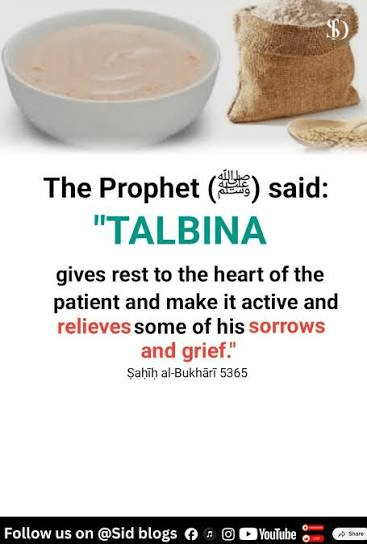
Etymologists tell us talbina derives from the Arabic word laban, meaning milk, owing to the porridge’s creamy white appearance. But I’m more inclined to believe talbina is a compound of tal (hill or mound) and bina (to build). So, Talbina means “to build the mound,” as in “to build the Temple Mount.”
Known in Islam as Al-Haram al-Sharif or the Noble Sanctuary, the Temple Mound in Jerusalem is Islam’s third-holiest site. Before Muslims were instructed by Allah (?) to face the Kaaba in Mecca, they directed their daily prayers toward Jerusalem.
The true Temple Mount is within us, as is the True Jerusalem (the city of Peace that is the Resting Place for our Souls in the dream-scape). Thus, eating Talbina — or what Talbina truly represents — is how we build the inner Temple Mount.
In the Bible, the prophet Isaiah speaks of the universal importance the Temple Mount holds for our Souls, which will eventually be recognized in the world: “And it shall come to pass in the end of days,” he wrote, “that the mountain of the LORD’S house shall be established as the top of the mountains, and shall be exalted above the hills; and all nations shall flow unto it.”
Can’t verify the accuracy of that translation, but I can tell you that the mountain of the Lord’s House is the Temple Mound. I can also tell you that the nations flowing into the mound are the “nations” of Souls sharing the AUM universally on the higher plains of consciousness.
Puzzlingly, we don’t find barley among the nine sacred grains of Hinduism. But we do find wheat in both Hinduism and Islam, as a SYMBOL of both spiritual sustenance and reward.
For example:
–The Quran uses a parable to compare the rewards of Sadaqah to a grain of wheat that sprouts seven ears, with each ear containing a hundred grains. The Ego misreads this comparison as proof that Allah rewards good deeds. But Allah, the Word of God, doesn’t reward deeds; Allah rewards rightminded almsgiving, which comes from the aware holy mind. Hence, the term Sadaqah, which describes charity willingly given out of compassion, love, or devotion to Allah.
In Islam, worldly charity is called Zakat. Unlike Sadaqah, Zakat is understood to describe the wealth-proportionate annual giving of money or goods to the needy. Zakat is, in fact, required under Islamic law. So, not voluntary.
But wait, because Zakat means “purification” and “growth.” Rightmindedly understood, Zakat originally referred to the purification and growth received through our voluntary or willing spiritual almsgiving. But, since the Ego Mind doesn’t understand the concepts of “giving to receive” or “giving to all at the level of thought,” it twisted the meaning of Zakat into something it could understand. Namely, that charitable giving serves to purify one’s earnings and one’s Soul, and that giving away a percentage of one’s personal wealth every year increases one’s worldly prosperity in the long term.
Neither of these egoic ideas hold a grain of truth, by the way.
The Qur’an says, “And he it is who causes gardens to grow, trellised and un-trellised, and palm trees and crops of different foods and olives and pomegranates, similar and varied, eats of its fruit when it yields and gives its due [Zakat] on the day of its harvest.”
Righteously interpreted, it is the Souls willingly giving the treasures of Allah to other Souls who cause gardens to grow and eat of the fruits yielded thereof. And it’s also, therefore, the Soul that reaps what it sowed on the day of the harvest. So Zakat, as used in the Qur’an, refers to reaping what we sowed in the world through right-minded almsgiving — not through any sort of enforced charitable giving.
This is why the Qur’an identifies wheat, barely, rice, and other symbolic grains as Zakat. Jabril didn’t mean we should give these dietary grains to those we egoically perceive as less fortunate than we are; he meant we should give these spiritual grains to everyone for universal distribution by Allah to those HE deems to be both in need of and receptive to these spiritual gifts of healing.
Hence, the Parable of the Wheat comparing the rewards of Sadaqah to a grain sprouting seven ears, each with 100 grains. One grain given to Allah in universal brotherhood is repaid one-hundred fold — in spiritual rewards, NOT material riches. Material riches have no value to the Soul, so, seeking material riches is, in fact, detrimental to the Soul’s spiritual advancement.
That said, the Parable of the Wheat describes the same hundred-fold return Jesus Christ discusses in Mark 10:29-30 and Matthew 13:8 & 23, in the Parable of the Sower (of sacred seeds).
Truth is one, my brother. As I keep saying.
The Qur’an also mentions a black seed called Habbatul Barakah, which is useful in healing. Commonly identified literally (egocally) as a black cumin seed called Nigella Sativa, Habbatul Barakah is grouped together in the Holy Qur’an with other sacred grains, suggesting that the concept of collective sacred grains is more universal than sectarianists would have us believe.
In the Prophetic Hadith, a compilation of sayings attributed to Muhammad, Habbatul Barakah is identified as “a cure for every disease except death.”
Habbatul Barakah supposedly translates as “the seed of enduring spiritual favor.” But it actually means “the seed of the enduring innocence of Kah.” In Hinduism, Kah refers to the hole we pierce in the Ego’s Veil to enter into the Celestial Realm. In the mystical Kabbalah, Kah is one of many names for God. More specifically, it’s the name associated with the Sefirah of Chochmah — the fruit of Divine Wisdom harvested through the Blood of the Lamb (the A-kara vibration).
Within the Hindu Navadhanya, the Habbatul Barakah is probably, therefore, the black sesame seed or tila Hindus associate with Shani-dev (Saturn). Ergo, Habbatul Barakah must represent the A-kara vibration sounded by the Blue Ray and its 190 subordinate rays.
Okay so, we now have an inkling of what one of the sacred grains represents — in Islam and Hinduism, leastwise. The tiny black “blessing” seeds offered to and scattered by Shani-dev (the sower of seeds) represents the A-kara vibration of God’s pure communications — the original and everlasting Song of Heaven or Song of God (Bhagavad Gita).
But what about the other grains mentioned in the scriptures?
I’m especially curious about the red lentil stew Esau accepted from Jacob in exchange for his holy inheritance. Allegorically, Esau represents the Red Ray of Yah, whilst Jacob represents the divine spark of Yah in all living things.
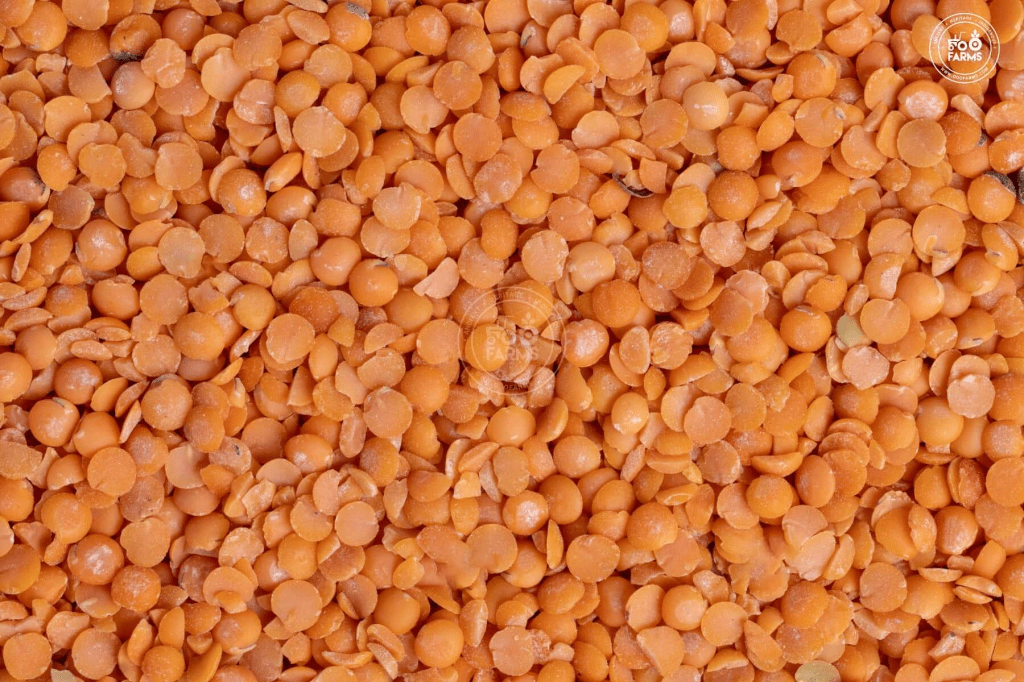
In India, red lentils are called masoor dal, a legume not found among the sacred nine. So, curious as I am, let’s leave the lentils alone and focus on the wheat, which IS one of the Navadhanya — and also mentioned in the Qur’an and the Bible.
What might the wheat represent?
I conducted a fairly extensive search, but could find nothing directly quoting the Qur’an that hadn’t conflated dietary grains with the symbolic sacred grains, so no help there. Maybe we’ll have better luck with the Bible, where wheat is mentioned more than seventy times.
Wheat — or rather, the wheat harvest — is first mentioned in Genesis 30:14, which reads as follows in the King James Bible:
And Reuben went in the days of the wheat harvest, and found mandrakes in the field, and brought them unto his mother, Leah. Then Rachel said to Leah, “Give me, I pray thee, of thy son’s mandrakes.”
Not helpful to our quest, so let’s move on to Deuteronomy 8, which, when rightmindedly translated, reads as follows:
YHVH-Elohim (the Great Rays of the Solar Logos) enter into the beautiful land, as living brooks of water fountaining up from a cosmic spring coming out of the Valley of Har — a land of living wheat and barley, of vines and fig trees and pomegranates; a land of living olive oil and honey; a land for eating bread without scarcity or lack; a land of stones and iron, with mountains hewed out of brass.
To eat and be sated, kneel and bless YHVH-Elohim in the land given to preserve the forgotten, where YHVH-Elohim protects His Commandments, His Judgment, and His Laws. To command the Rays, eat and be sated. To build the bountiful temple, the remaining cattle-herd and sheep-flock multiply the silver and gold growing in the inmost heart to lift up the forgotten YHVH-Elohim. To enter into the Land of the Living in Egypt, the house of bondage, depart the great and terrible wilderness of fiery serpents, scorpions, and drought. To bring the waters out of the rock, the loaf and the staff, eat in the wilderness the manna the forefathers knew to humble and test the good remaining underneath, saying to the heart, “My able and mighty hand bestows the wealth. Remembering YHVH-Elohim bestows the power to achieve the wealth to fulfill the covenant sworn unto the Father Ray.“
The land described herein is ‘Erets — the Land of the Living, a.k.a. the Resting Place, the Promised Land, New Jerusalem, and Medina. This is the celestial land of the fountain, the cistern, the True Vine, and the Fig Tree. So, we’re talking about the sixth plain of consciousness, where the cows and the sheep graze on the green pastures of sacred-grass, under the watchful and loving eye of the cowherd and the shepherd. This is the dream-realm dwelling place of the Rock of Ages — a.k.a. the Christ Self, the Great Amen, and the Great I Am.
This is the level of the Moon Circle, where we meet as Souls to shower the dewdrops of Living Water onto the world. These are the dewdrops the Rigveda calls Indra’s pearls. They’re also, I suspect, the “silver” mentioned in Deuteronomy, as well as the droplets seen falling from the Moon on the RWS Tarot card of THE MOON.
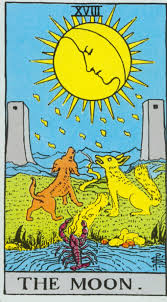
‘Erets, we learn from Deuteronomy, is the land of the wheat and the barley — the sacred grains under investigation. So, the wheat and barley must be something found on the sixth plain, in the Moon Circle that is the Bindu Chakra.
Before drawing any conclusions, let’s gather more evidence. Wheat is next mentioned in Exodus 9:32 Let’s go bigger, starting with Exodus 9:27. When rightmindedly translated, the section reads:
Paroh (the Great Dragon of God’s Splendor or Majesty) sends the call to Moses and Aaron, saying: “To cleanse the feet of YHVH’s righteous flock in guilt, entreat YHVH’s chief, Elohim, to thunder the hailstones sent by the standing (Stones or Souls) to augment Moses, saying unto him: “Come out of the city and spread out the open hand of YHVH in the Land of the Living, so that YHVH’s servants know to honor YHVH and Elohim, the flax and the barley. To strike the barley in the green ear and the flax bordering the wheat and spelt, strike the unripe Moses coming out of the city of Paroh. To spread out the open hand of YHVH, the thundering hail ends the pouring out upon the Land of the Living Paroh perceives. The rain and hail end the voice inculcating guilt to burden the heart of the servants. The heart of Paroh strengthens the Son of Israel to send YHVH to speak by the hand of Moses.
Okay, yes. It’s confusing, like so many scriptural texts. But, at the very least, it supports my theory that the sacred grains found in the Bible, Vedas, and Qur’an are purely symbolic, rather than dietary or agricultural grains found in the world. Moreover, Exodus seems to be saying that YHVH (the Great Rays) are the flax and that Elohim (the Solar Logos) is the barley.
In The Aquarian Gospel of Jesus the Christ, Levi Dowling identifies Elohim as “the Hebrew designation for the seven spirits of God.” But here, we learn that Elohim is the chief (or captain) of YHVH. He’s YHVH’s superior, that is to say, so he can’t represent the seven spirits, because those seven spirits are the lesser rays of YHVH, whereas YaH and VaH are the Greater Rays of Elohim. In the first line of Genesis, Elohim is similarly identified as “the chief Shepherd.” In a vision experienced by Helen Schucman, Christ’s scribe for the Course, the name Elohim was emblazoned upon the Inner Altar she saw herself kneel down before with Jesus Christ at her side.
All of this indicates that Elohim is the top dog in the Spiritual Hierarchy; and the top dog in the spiritual hierarchy is the Solar Logos on the seventh and highest plain in the dream-realm.
So we’ve solved part of the mystery: the Solar Logos and/or Word of God is the barley, whilst the Great Rays of Elohim are the flax.
This section of Exodus also mentions the hail generally misconstrued as another “plague” sent down by God. Herein, we learn two important things about the hail: the first is that Elohim sends the hail through “the standing” to wash the feet of our Souls (the flock and the herd in the Resting Place). And the second is that the hail silences the voice of the Ego Mind — the voice within us inculcating the guilt and fear that burdens our hearts unnecessarily. This suggests that whatever the Biblical hail represents is spiritually helpful, rather than a “plague.”
In case it isn’t clear, the standing are the Souls standing at the top of the dream-realm in upright perception, true perception, or miraculous perception.
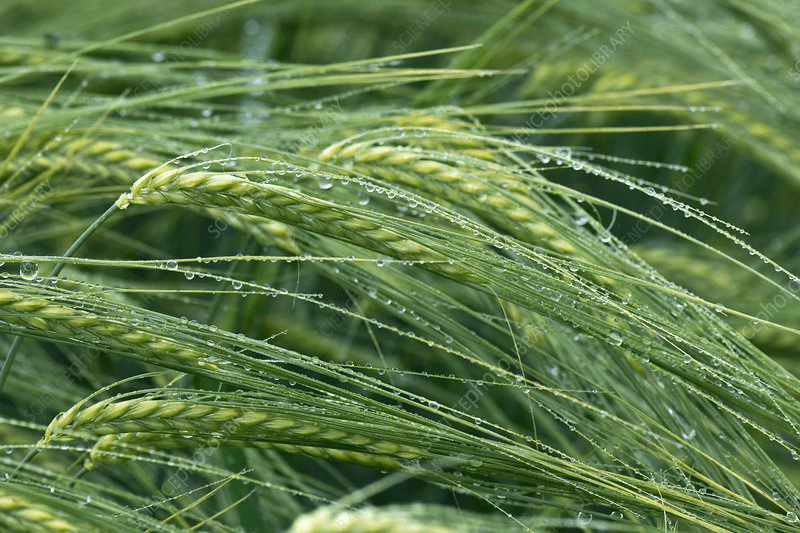
“The barley in the green ear” refers to the crucial agricultural stage when the grain has formed but is still tender, soft, and young. So, in this instance, the phrase references the stage in the atonement process when the Great Rays have awakened and are growing and maturing within us (as Yama and Yami), but are still green, immature, or unripe. Scripturally speaking, “the barley in the green ear” refers to the fourth, Heart, or Anahata chakra. Anahata means “unstruck” in Sanskrit, so it’s here that we begin our forgiveness work before hearing the M-kara.
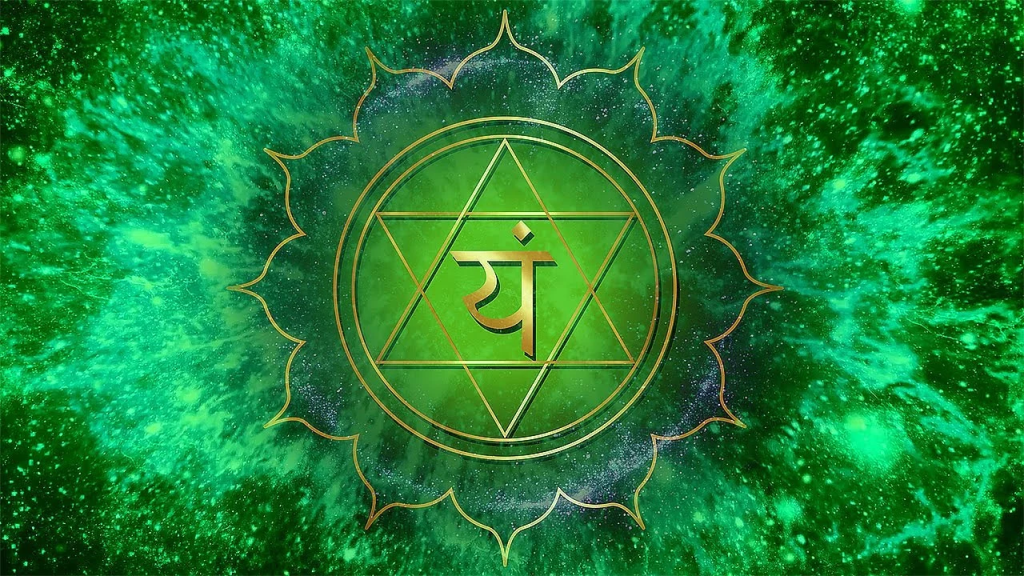
If Elohim is the barley, then Elohim’s seeds (the flax) are still developing within us when “the barley is in the green ear.”
In Islam, Allah is Elohim; in Hinduism, Surya plays that role. In Christianity, he’s Jesus Christ — or what Jesus Christ represents (i.e., God’s Love in a form human beings can both understand and emulate).
This would suggest that the Arabic barley porridge, Talbina, contains Allah’s essence, mixed with milk and honey. In Islam, milk and honey are revered as symbols of purity, healing, and divine sustenance. To Muslims (according to Google), milk and honey represent the ultimate spiritual rewards of Paradise (Jannah), and are celebrated for their nutritional and healing properties. This view isn’t wrong, but neither does it reveal the whole picture.
In Truth, the milk flowing in Paradise (the Real World, in Course terms) comes down from the miracle-cow (via the Gopis), while the honey is the nectar of immortality dripping down from the Great Ray of Yah to remind our Souls of the Truth of their Being (as the one united and wholly loving and beloved Soul or Son God created in the beginning).
Okay, so … what does the wheat represent? Let’s examine the evidence. From Exodus we learn that YHVH (the flax) “borders” the wheat and the spelt, to strike the unripe Moses. Unbeknownst to most Jews, YHVH is the Hebrew Tetragrammaton for the Great Rays, while Moses allegorically represents the M-kara vibration — the Left Hand of God that leads our Souls out of the desert-wilderness back to the Resting Place. So, the unripe Moses must be the M-kara that’s ever-present, but not yet heard by most people.
Ergo, to strike the unripe Moses is to hear the M-kara. From these descriptions, vague and metaphorical though they are, I suspect the wheat and spelt represent the seven “lesser” rays of YHVH. So, let’s assume the wheat represents the Trinity Rays of AUM, while the spelt signifies the four Rays of Attribute (the Living Beings or Cherubim).
And so, we now have a much clearer understanding of the Biblical grains in God’s instructions to Ezekiel, but not so much the Hindu Navadhanya. Not surprising, given that everything meant to aid our escape from the desert-wilderness has been grossly distorted by the Ego Mind since time-immemorial. Plus, grains and their uses differ among cultures, regions, and religions, so it makes sense that their symbolic meanings also would differ to some extent.
To recap before we move on, four of the six Biblical grains are symbols we’ve deciphered as follows:
Barley = Elohim/Allah/Surya, the Solar Logos or Word of God
Flax = YHVH, the two Great Rays ot Yah (God) and Vah (Christ)
Wheat = The lesser Trinity Rays of Yah (AUM)
Spelt = The Four Aspect Rays of Vah (the Cherubim)
Let’s now examine Leviticus 7:13, to see what more we might ascertain.
Starting at the top of the section subtitled “the Peace offering” in Strong’s Concordance, the relevant section of Leviticus 7 reads:
These are the instructions for feasting on the peace to approach YHVH: approach in thanksgiving (gratitude) to draw near the offering; thanksgiving in sweet cakes anointed with oil; sweet wafers anointed with oil, and loaves anointed with oil. With fine flour mixed cakes approach the offering of unleavened bread offered in thanksgiving and friendship.
To come near the one offering of YHVH, the priests sprinkle the blood in peace in the body offering the peace. In thanksgiving, eat the Ray in the offering place of daybreak.; offer the offered vow voluntarily to eat the Ray present in the offering.
Let’s stop here, because this highly figurative language requires deciphering. To approach the Great Rays, we must approach the offering circles in thanksgiving and friendship. And our thanksgiving or gratitude (to each other) forms the sweet cakes and/or unleavened bread anointed with oil. Those cakes are made from the finely ground flour produced by the millstone from the seeds of our auspicious thought-offerings. The offering place of daybreak is the walled city in the Resting Place.
How do I know this? Because it’s the stronghold of Usha, the goddess of dawn.
In the Hindu lore, the stronghold of Usha is Sonitapura, which means “city of Blood.” In the Bible, Jerusalem is deemed the city of blood in Ezekiel 22:2 — not for it’s bloodshed (as commonly espoused), but because Jerusalem is the offering place where YHVH’s priests sprinkle the Red Ray’s Amrita upon the cows and sheep serving the Good Shepherd.
The vow (AUM) must be offered voluntarily (Sadaqah) — not out of obligation or religious decree, but out of a genuine desire to be truly helpful to all our fellow creatures. Only this desire to help our fellow beings purely out of the goodness of our hearts allows us to “eat” or “ingest” the Ray present in the offering.
And, in case you’re wondering, this is what Jesus meant when he said to give with the right hand without the left hand knowing. In this case, the right hand is the Soul’s, while the left-hand is the Ego’s. So, give purely from the spiritual heart, without any egoic motivation whatsoever.
The one offering of YHVH is God’s Love for the whole Sonship. To receive this offering from the Great Rays, therefore, we have to perceive the wholeness of the Sonship, too — and offer our thanksgiving cakes to the whole body (of Christ), without exclusion.
Leviticus continues thusly:
The next day, what remains to be eaten will remain in the body offering the third Ray to kindle the plan for approaching the piggul the Soul eats to arise from guilt.
Here again, we find piggul –a Hebrew word traditionally translated as “unclean,” “foul,” “fetid,” or “improper.” But how can the Soul eat any of those nasty things to arise from guilt?
So, either piggul is wrongly defined historically or nephesh doesn’t refer to the perfect and immortal Soul in this instance. According to FIRM (the Fellowship of Israel Related Ministries), “The Hebrew word nephesh (נפש, pronounced neh-fesh) translates broadly to ‘soul,’ ‘self,’ ‘life,’ or ‘living being.’ However, unlike the abstract Greek concept of an immortal soul trapped in a body, nephesh primarily refers to a breathing physical creature.”
If FIRM is right, piggul nephesh could refer to the unclean physical self-concept the Ego made in defiance of God in this section of Leviticus. But that definition doesn’t really work, because we join as Souls in the offering circles to make our almsgiving oblations and to eat the bread of life and the sweet cakes of gratitude that free the Soul from the chains of guilt and fear. So, piggul must mean something other than “unclean” or “foul.”
Okay, yes. The traditional definition of piggul appears to be pretty solid, given that it features in Jewish Law (halacha). According to these religious laws, piggul refers to a specific disqualification of a sacred offering (Korban) caused by the improper intention of the officiating priest during its slaughter or processing. Once an offering is deemed piggul, eating it becomes a severe transgression punishable by karet (divine excision).
Bear in mind that religious laws are egoic; as are religions, the majority of which are founded on faulty interpretations of scripture. The Islamic laws governing Zakat being a case in point.
First of all, slaughtering animals for ritual sacrifice is always wrongminded Korban. Neither slaughter nor sacrifice are Godly ideas. Right-minded Korban, Yajna, or Qurbani entails offering Godly thought-gifts to all the Souls on earth. Appropriate gifts for these “offerings” (NOT sacrifices!) include peace, love, joy, light, mercy, forgiveness, gratitude, grace, and majesty. Any offering of animal flesh — or anything else of a tangible nature, for that matter — is, therefore, improper.
You get that, right?
What, then, might piggul really mean? Hard to say, since the true definition has been so egoically tarnished down the ages. It probably started out as p’iggel –a compound of pi and iggul— meaning “the three circles.” That’s just a guess, of course, but that definition works far better than “unclean” in the passage under discussion.
When inserted in Leviticus, the passage reads:
The next day, what remains to be eaten will remain in the body offering the three rays to kindle the plan for approaching the three circles the Soul eats to arise from guilt.
And this is, in fact, consistent with the Truth.
Let’s test this definition in our earlier passage from Ezekiel 4, where I left that question mark earlier.
In early life, to eat of the bodies of the body torn to pieces brings the three circle bodies of the mouth saying, “Son of Adam, break into pieces the staff of bread in Jerusalem. Eat bread by the measure of care and drink water by the measure of appalled astonishment. To lack bread and water is to desolate the Great Brother wasting away in guilt.“
So, our new definition for piggul works here as well. The three circle bodies are the three circles of AUM — the words proceeding from the Mouth of God to feed our Souls and free them step-by-step from the bonds of guilt and sin.
The staff of bread, as we know, is Christ — and this is the “bread” Ezekiel is told to make by combining wheat (the Trinity Rays of Yah), barley (Elohim, the Word of God), beans (??), lentils (??), millet (??), and spelt (the four Rays of Vah).
Should we attempt to figure out what the beans, lentils, and millet represent?–or have I taxed your patience to the limits already?
I say we go for it, even though I’m exhausted. Let’s start with millet — the collective name for various tiny gluten-free grass-generated cereal grains that have been around since ancient times. Being grass seeds, we can presume the Biblical millet is related to the sacred grass of the Resting Place– or perhaps its the seed we scatter to grow the sacred grass to feed the herd or flock in the Resting Place.
We don’t find millet among the nine sacred grains of Hinduism, but we do find some twenty types of sacred grasses in the Vedas.
The Arabic word for millet is dukhn (دخن). While it doesn’t appear in the Qur’an as such, dukhn is mentioned in other foundational Islamic texts, including the Hadiths. And grasses and pastures for grazing ARE mentioned in the Qur’an, as are generic “seeds.”
In the Bible, millet is mentioned only once by name — in the passage already discussed from Ezekiel. But, being a seed, millet might be referenced generically as seed in the Bible, as well as in the Quran. And the Bible certainly mentions pasturelands for grazing many, many times. And, in case it escaped your notice, Jesus performs the miracle of the loaves and fishes (not accidentally) on a field of grass or lawn. And in Genesis 1:11 we find the actual phrase “grass yielding seed.” So, millet sneaks in, here and there.
When rightly translated, Genesis 1:11 reads as follows:
Elohim said, “Land of the Living, sprout grass — grass yielding seed, the fruit of the sort sown in the Land of the Living. And it was so.
So, Millet must be the grass-seed we sow and reap in the Land of the Living to scatter and eat the sacred grass as Christ’s “flock” or Krishna’s “herd.”
Let’s move on to beans. We’ve already talked about some of the Biblical references to legumes, most of which involved fields for growing life-sustaining beans. But there’s one mention of beans Google left out: 2 Samuel 17:28, which concerns King David, the Christ-as-shepherd power of Elohim. Contrary to popular belief, none of the places named in these verses refer to worldly locations.
Samuel 17:28 should read as follows:
David (the Beloved) abides in Machanayim-Shobi (the two encampments of returnees), the sons of Nechash (the shining serpent) in Rabbah (the Great City) and the sons of Ammon (Amen), who know the sons of Ammiel (the gathering of El) lod-ebar (the division for crossing over) the iron-hearted descendants of Gilead (the mound of witnesses) Rogelim (the place of the fullers). Draw near the Resting Place Threshold to fashion the vessels of wheat and barley for grinding and roasting the grains, beans, and lentils. Roasting the grains in honey and butter are the flock of sheep in the Borderland, the cattle-herd of David’s people or tribes eating and speaking for the people or tribes weary, hungry, and thirsty in the desert-wilderness.
This wasn’t easy to work out in a way that made sense grammatically. David, the Christ aspect of Elohim, abides in Machanayim–a term coined in Genesis 32:2, wherein Jacob (the journeying Soul) encounters a group of angels. He calls the place Machanayim to signify the presence of two camps: his own camp in the Land of the Living and the camp of angels higher up, watching over him.
Without retranslating that section of Genesis, I can only speculate about these two camps. The Soul’s encampment is the enclosure or walled-garden “east of Eden”– the Resting Place or City of Peace on the Sixth Plain, where King David (the Good Shepherd aspect of Christ or Vah), does indeed abide, watching over his flock. This encampment also is the Tabernacle.
The angel camp up above would have to be the dream encampment of the Cherubim–the four rays of Vah supporting the throne of Elohim on the Seventh Plain. And so David, the Christ power, does indeed “abide” in both camps. We then learn that the two camps house the sons of the shining Serpent in the Walled City and the sons of Amen, who know the sons of Ammiel.
Ammiel means “the gathering of El,” and “the gathering of El” is a Biblical term describing the Divine Council–the lords watching over the Assembly (the sons of Amen). Described in Psalms, the Divine Council is made up of the celestial “beings” serving Elohim in the Throne Room. And the divine “beings” serving Elohim in the Throne Room are the Cherubim, like I said.
This bring us to lodebar — a Hebrew word used numerous times in the Old Testament. Normally, it’s divided as lo and debar, which supposedly translates as “no pasture” or “no word”– neither of which make sense in this context. But, when divided as lod and ebar, the word means “the division for crossing over,” which does make sense. The division for crossing over is the Borderland — the Real World bridging Heaven and Earth.
And herein we learn that the Divine Council is the division for crossing over the iron-hearted descendants of the mound of witnesses (Gilead), the place of the fullers. In the Bible, the mound of witnesses is a metaphorical heap of stones put in place by Jacob to memorialize the covenant of peace he made just before crossing over the Jordan River. Essentially, it’s the Temple Mount (which Talbina represents in Islam). Herein we’re told it’s “the place of the fullers drawing near the Resting Place threshold or gate.”
Fullers were those in ancient times who walked on garments (in vats of urine) to clean them. So, in this context, the fullers would be the Souls walking through the circles to remove the stains of sin and guilt from their original pure white robes of righteousness.
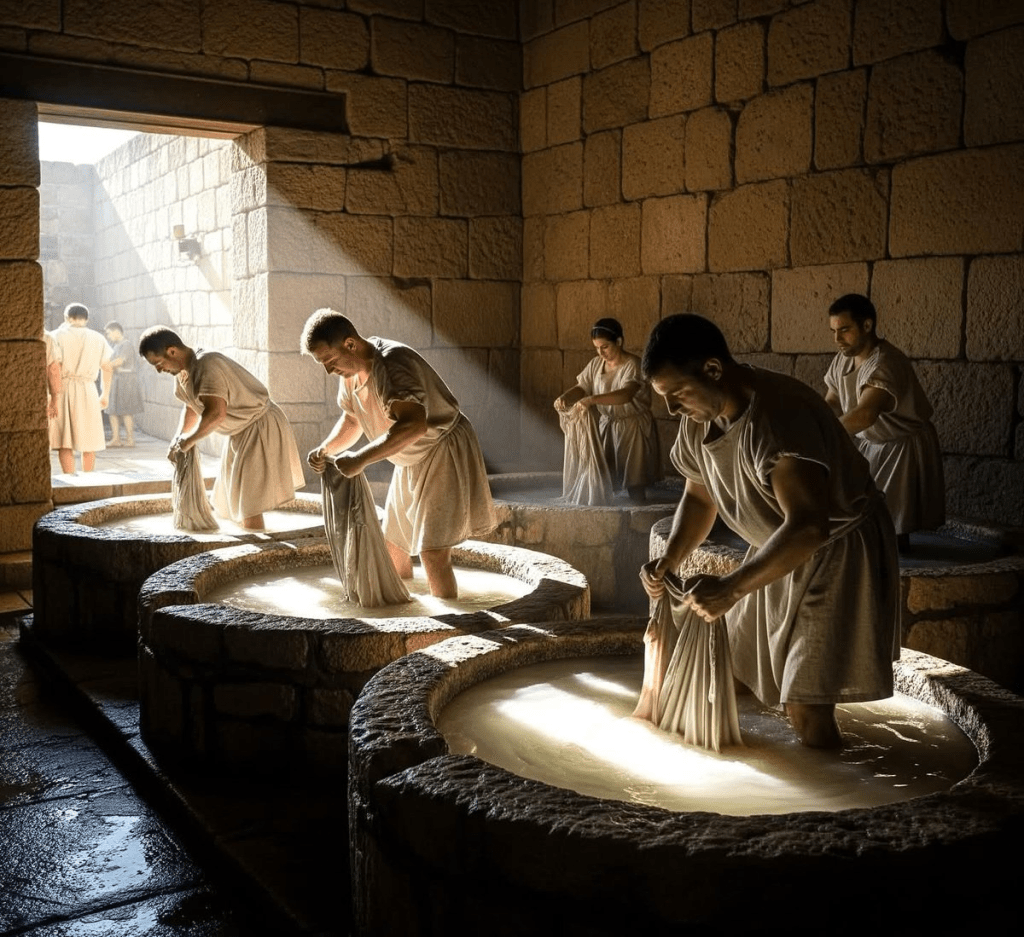
The rest of the verse describes the grains and beans. I did my best, but the common definitions for some of the words made no sense. As far as I can figure, to draw near the Resting Place threshold is to approach the gate into the Borderland. And it is just outside that gate that we fashion the vessels of Barley and Wheat for roasting and grinding the sacred grains, beans, and lentils, which are then roasted again in honey and butter by David’s flock in the Resting Place to feed all the spiritually hungering peoples of the world.
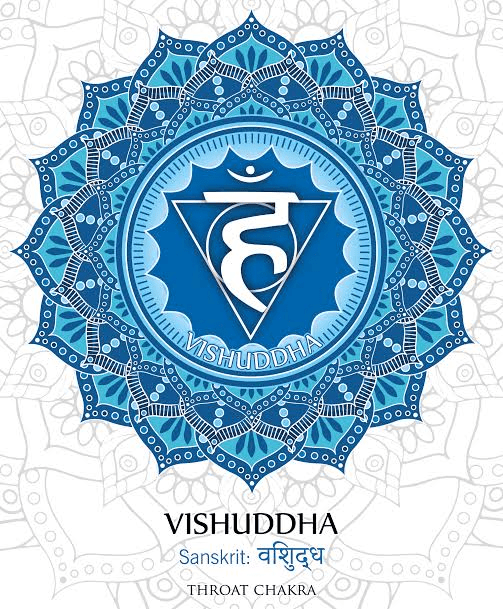
Based on the evidence, and my current understanding, “the place of the fullers” is the fifth, Throat, or Vishuddha chakra — the Circle of Wind, where we begin to hear the M-kara. In the fourth, Heart, or Anahata Chakra just below, the sound remains unheard or “unstruck.” This is why the Vishuddha is identified as the “communications center” where we “speak our Truth.” It is here we begin to speak as the Soul speaks, to other Souls telepathically — not to express the ignorant opinions our egos wrongmindedly perceive as “our truth.” Rightly understood, this is where the true “undoing” or “atonement” process begins.
Returning to our quest, roasting grains and legumes in honey was common practice in ancient times, although olive oil was preferred over butter in the Middle East. In India, it was more common to roast grains, beans, and pulses in honey before frying them in ghee (clarified butter). Allegedly, the Vedas offer instructions for this method of honey-roasting and frying, which is surely as metaphorical in nature as is this section from the Bible.
Because nothing in these texts is literal!
That said, the vessel of barley is Elohim’s vessel, and Elohim’s “vessel” is said to be the hearts of his devotees; and the same is said of Allah in Islam. So, the Barley vessel might be “the iron-hearted descendants on the mound of witnesses”–the witnesses for YHVH, the Great Rays. Because YHVH, the Great Rays, is Elohim’s “vessel” in the world. And, according to the Course, the witnesses for the Great Rays are indeed the people all around us, whose hearts all hold the spark of the Great Rays.
Or, as Jesus explains:
As the ego would limit your perception of your brothers to the body, so would the Holy Spirit release your vision and let you see the Great Rays shining from them, so unlimited that they reach to God. It is this shift to vision that is accomplished in the holy instant. Yet it is needful for you to learn just what this shift entails, so you will become willing to make it permanent. Given this willingness it will not leave you, for it IS permanent. Once you have accepted it as the only perception you want, it is translated into knowledge by the part that God Himself plays in the Atonement, for it is the only step in it He understands. Therefore, in this there will be no delay when you are ready for it. God is ready now, but you are not. (ACIM, T-15.IX.1:1-7)
He also says:
Not one light in Heaven but goes with you. Not one Ray that shines forever in the Mind of God but shines on you. Heaven is joined with you in your advance to Heaven. When such great lights have joined with you to give the little spark of your desire the power of God Himself, can you remain in darkness? You and your brother are coming home together, after a long and meaningless journey that you undertook apart, and that led nowhere. You have found your brother, and you will light each other’s way. And from this light will the Great Rays extend back into darkness and forward unto God, to shine away the past and so make room for His eternal Presence, in which everything is radiant in the light. (ACIM, T-18.III.8:1-7)
What, then, is the vessel for Wheat? The vessel for the Trinity Rays, of course. And the vessel for the Trinity Rays are the three circles of AUM: the Circles of Wind, Water, and Fire leading us inward toward the Inner Altar, where Elohim awaits our return to sanity on the Throne of God.
That’s it for our lesson on the scriptural grains. I hope you learned something of use to your Soul.
Thanks for visiting the Holy Meeting Place. Until we meet again, Om Hari Om and and Namaste.
 The Holy Meeting Place
Leave a comment