Yes, I know. My headlines are rather perfunctory, but we’re all about substance over flash here at the Holy Meeting Place dot com. Today, as the utilitarian heading suggests, we’ll be studying the Rigveda’s 29th Sukta. Only 9,987 to go, so we’re making progress! Snail-like progress, to be sure, but progress nevertheless.
What is the 29th Sukta about? Let’s ask Google, knowing that the answer will only be partly right, at best. Quoting Wikipedia, Google says:
The 29th Sukta (hymn) of the first Mandala of the Rigveda is a prayer dedicated to Indra, the king of the gods, to invoke his power in battle and request his assistance in removing physical and ritual obstacles.
Is any of that true? Doubtful, given the glaring egoic slant. In this Sukta, we again find a recurring string of words. In transliterated Sanskrit, those words are: a tu na indra samsaya gosv asvesu subhrisu sahasresu tuvimagha.
By my calculations, the recurring phrase translates into English as follows:
…of (or in) God’s love, the waters Indra gathers together in the Resting Place of the cow-master on the horse of Esu, the enlightened being(s) triumphant in the rays bestowing many treasures.

The sentence structure suggests that this phrase is an add-on, rather than it’s own self-contained sentence. So, everything preceding this line will need to sync up.
As structured by the Oxford trio of Muller, Wilson, and Griffiths, the whole teaching (not hymn) reads as follows in transliterated Sanskrit:
yac cid dhi satya somapā anāśastā iva smasi | ā tū na indra śaṃsaya goṣv aśveṣu śubhriṣu sahasreṣu tuvīmagha ||
śiprin vājānām pate śacīvas tava daṃsanā | ā tū na indra śaṃsaya goṣv aśveṣu śubhriṣu sahasreṣu tuvīmagha ||
ni ṣvāpayā mithūdṛśā sastām abudhyamāne | ā tū na indra śaṃsaya goṣv aśveṣu śubhriṣu sahasreṣu tuvīmagha ||
sasantu tyā arātayo bodhantu śūra rātayaḥ | ā tū na indra śaṃsaya goṣv aśveṣu śubhriṣu sahasreṣu tuvīmagha ||
sam indra gardabham mṛṇa nuvantam pāpayāmuyā | ā tū na indra śaṃsaya goṣv aśveṣu śubhriṣu sahasreṣu tuvīmagha ||
patāti kuṇḍṛṇācyā dūraṃ vāto vanād adhi | ā tū na indra śaṃsaya goṣv aśveṣu śubhriṣu sahasreṣu tuvīmagha ||
sarvam parikrośaṃ jahi jambhayā kṛkadāśvam | ā tū na indra śaṃsaya goṣv aśveṣu śubhriṣu sahasreṣu tuvīmagha ||
We’ve encountered many of these words before (and I really should create a Lexicon to make this easier both for myself and future translators).
The 29th Sukta’s first line translates thusly:
Communicating the pure-conscious thoughts of Divine Reality, Soma safeguards the governing lifeforce of the all-pervading A-kara existing in God’s Love, the waters Indra gathers together in the Resting Place of the cow-master on the horse of Esu, the radiant enlightened being(s) triumphant in the rays bestowing many treasures.
yac (communicating) cid (the pure-consciousness) dhi (thoughts) satya (of Divine Reality or Higher Truth) soma-pā (Soma safeguards) an-āśastā (the governing lifeforce) iv-a (of the all-pervading A-kara) smasi (existing) ā (in God’s) tū (love) na (the waters) indra (indra) śaṃsaya (gathers together in the resting place) goṣv = gosvami or govinda (of the cow-master) aśv(a)-eṣu (on the horse of Esu) śubh-riṣu (the radiant enlightened being) sahas-reṣu (triumphant in the rays) tuvī-magha (bestowing many treasures) ||
Notes:
In the Bible, Esau is the red-colored twin brother of Jacob, the journeying Soul. So, let’s surmise that the Biblical Esau represents the awake Soul or pure Divine Spark of the Red Ray of Yah, still residing in the Resting Place. The Bible doesn’t say Esau has a horse, but it does mention him having a bow and arrow. So, he’s the rider with a bow on the white horse, who comes forth after the first seal is broken by the lamb in the Book of Revelations. In Hinduism, he’s Rama, the seventh avatar of Lord Vishnu. When Rama comes forth, he is armed with Sharanga, the celestial bow of Vishnu. Sha-ranga translates as “the place of quiet (in the mind).”
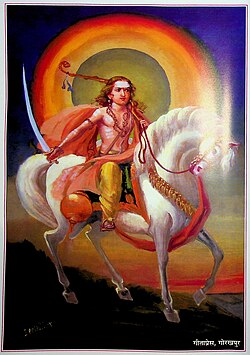
The following from the Course identifies “the quiet place” as the Throne of God, the place where we gather to listen to the Father speak to us (through the A-kara vibration of God’s pure communications):
Hear, holy Son of God, your Father speak. His Voice would give to you His holy Word, to spread across the world the tidings of salvation and the holy time of peace. We gather at the throne of God today, the quiet place within the mind where He abides forever, in the holiness that He created and will never leave. (ACIM, W-125.4:1-3)
From this we can ascertain that Rama emerges when we reach the quiet place in our minds, where we hear God’s pure communications (the A-kara). And that is what Rama’s bow represents in the Ramayana.
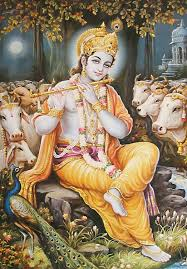
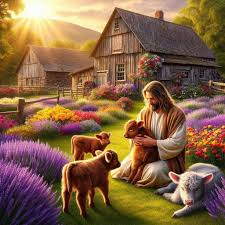
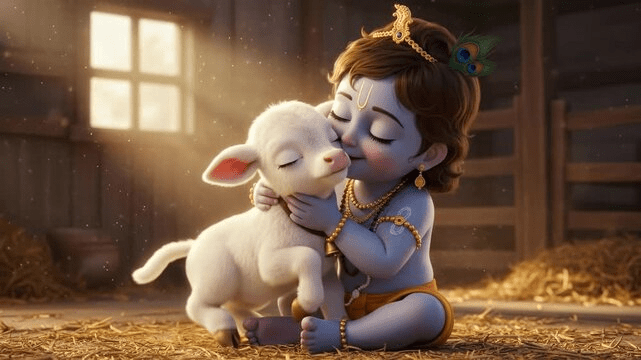
The cow master in the Resting Place is Govida or Gopala, the form of Lord Krishna residing in Goloka, the spiritual realm where the cows (miracle-workers) graze on the green pastures of the sacred grass. As I’ve said before, these are the same “green pastures” famously described in Psalm 23. In the Bible, the flock of the Good Shepherd grazes in that ethereal pastureland; in Hinduism, it’s the cows under the watch of the cow-herd, Gopala-Krishna. So the Vedic cows and the Biblical sheep are simply two different forms of the same spiritual concept (like the millstone and the mortar). And that is why we sometimes see Krishna with sheep and Jesus with cows.
The enlightened beings triumphant in the rays are the Vanadevatas we talked about last time. In case you forgot, they’re the Souls in the Assembly who’ve achieved enlightenment, after making the journey. When I call my circle-meetings, I always invoke this group first, after silently reciting the Lord’s Prayer (as it was meant to be translated). I then invoke those who hear the AUM, followed by those who “thirst” to hear the sound of the waters.
Having said all that, let me now say this: I have never accepted the prevailing wisdom that iva translates as “like” or “as if.” And those definitions definitely don’t work here. So, after trying various configurations, I went with iv-a, meaning “the all-pervading A-kara,” which does indeed (as stated) “exist in God’s love.” And “the all-pervading A-kara” is a phrase found in both Hinduism and Sikhism, so it’s not out of the realm of possibility — or anything intellect-worshipping scholars would likely come up with.
Alternatively, iva could be divided as i-va, meaning Kamadeva’s wind (the wind or cosmic breath of Divine Love or Agape). So, same difference, essentially.
The Sukta’s second Rik ads:
The helmet powers of God’s Name, the flying insects of grace inhabit the Majesty of God stinging the waters of God’s love, the waters Indra gathers together in the Resting Place of the cow master on the horse of Esu, the radiant enlightened being(s) triumphant in the rays bestowing many treasures.
śiprin (the helmet) vāj-ānām (powers of God’s Name) pate (the flying insects) śacīvas (of grace inhabit) tava (the Majesty) daṃsanā (stinging the waters) ā (of God’s) tū (love) na (the waters) indra (indra) śaṃsaya (gathers together in the resting place) goṣv (of the cow master) aśveṣu (on the horse of Esu) śubhriṣu (the radiant enlightened being) sahasreṣu (triumphant in the rays) tuvīmagha (bestowing many treasures)||
Notes:
The helmet referenced herein is the Golden Helmet found in the Bible, as well as the Vedas. In the Bible, it’s one of the accessories worn by the Ministers of God, along with the Golden Breastplate and the Golden Girdle. In Hinduism, the “helmet of gold” (Hiranya Sipra in the Vedas) symbolizes divine protection, celestial radiance, and the royal status of deities. This golden helmet is, I believe, the “golden nimbus” emanating from the Bindu Chakra. We receive this “gift of grace” only after we “forgive the world” by realizing all of it was only ever a dream. In Christian art, this helmet takes the form of a halo. In Hindu art, it’s shown as an actual helmet.
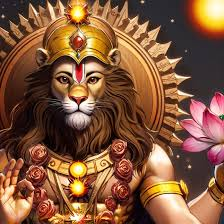

The flying insects referenced herein are surely those widely presumed to be “plagues” of locusts or flies visited upon Egypt. In Revelations we’re told the locusts have the “stinging” power of scorpions. Herein, we learn that “stinging power” is God’s Majesty.
On the subject of God’s Majesty, Course-Jesus says:
When a mind has only light, it knows only light. Its own radiance shines all around it, and extends out into the darkness of other minds, transforming them into majesty. The Majesty of God is there, for you to recognize and appreciate and know. Recognizing the Majesty of God as your brother is to accept your own inheritance. God gives only equally. If you recognize His gift in anyone, you have acknowledged what He has given you. Nothing is so easy to recognize as truth. This is the recognition that is immediate, clear and natural. You have trained yourself not to recognize it, and this has been very difficult for you. (ACIM, T-7.XI.5:1-9)
From this, we can ascertain that the Golden Helmet and the halo are the radiance of God’s Majesty shining outward from our minds when we enter the Moon Circle (the Bindu Chakra).
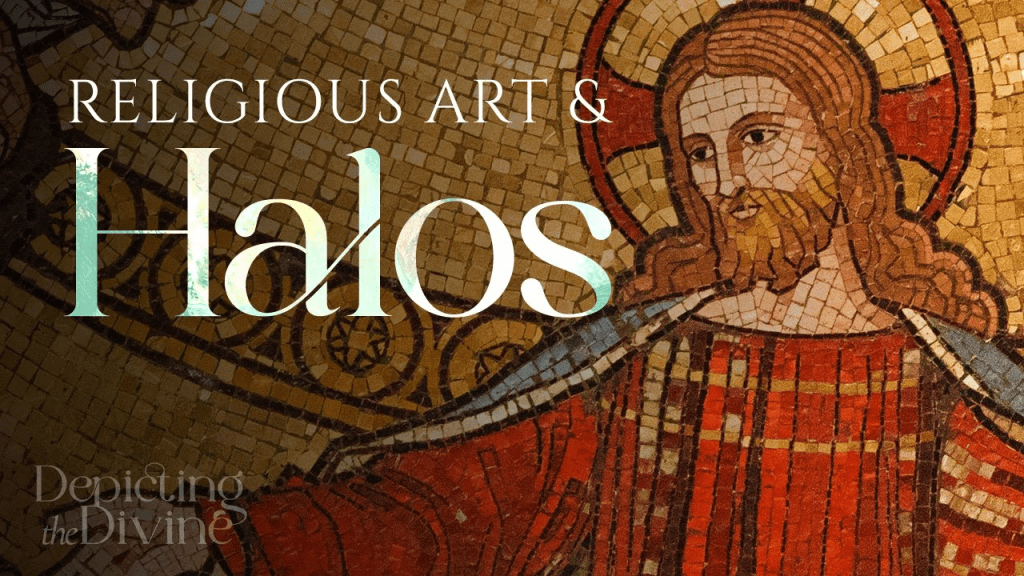
So, the buzzing of these metaphorical “insects” are the A-kara vibration, which we presumably begin to hear after the Final Judgment (of the Ego Mind). Their buzzing, we learn herein, is the vibrational sound of God’s Majesty emanating from the head of the Red Dragon. It’s also the golden helmet. Ergo, we receive the Golden Helmet (of God’s Radiant Majesty) when our mind holds only light — i.e., after the Final Judgment activates the wine-press or the Soma press (i.e., the Bindu Chakra).
The Sukta’s third Rik reads:
From underneath, the True Self nourishes the alternative vision of the teacher and guide, the Father Wind increasing in God’s Love, the waters Indra gathers together in the Resting Place of the cow-master on the horse of Esu, the enlightened being(s) triumphant in the rays bestowing many treasures.
ni (From underneath) ṣvāpayā (the True Self nourishes) mithūdṛśā (the alternative vision) sastām (of the teacher and guide) abu-wat-edhyamāne (the Father Wind increasing) ā (in God’s) tū (love) na (the waters) indra (Indra) śaṃsaya (gathers together in the resting place) goṣv (of the cow-master) aśveṣu (Esu on the horse) śubhriṣu (the enlightened beings) sahasreṣu (triumphant in the rays) tuvīmagha (bestowing many treasures) ||
Notes:
The alternative vision is Christ’s Vision and/or Shiva’s Vision, whilst the Father Wind is Ruach/Vayu — a.k.a., the Cosmic Breath, the Voice for God, or the Holy Spirit.
And, as Course-Jesus explains in remarkably similar terms:
To open the eyes of the blind is the Holy Spirit’s mission, for He knows that they have not lost their vision, but merely sleep. He would awaken them from the sleep of forgetting to the remembering of God. Christ’s eyes are open, and He will look upon whatever you see with love if you accept His vision as yours. The Holy Spirit keeps the vision of Christ for every Son of God who sleeps. In His sight the Son of God is perfect, and He longs to share His vision with you. He will show you the real world because God gave you Heaven. Through Him your Father calls His Son to remember. The awakening of His Son begins with his investment in the real world, and by this he will learn to re-invest in himself. For reality is one with the Father and the Son, and the Holy Spirit blesses the real world in Their Name. (ACIM, T-12.VI.4:2–5:1)
Rv 1.29:4 reads: susantu tya aratayo bodhantu sura ratayah a tu na indra samsaya gosv asvesu subhrisu saharesu tuyimagha
My translation:
The Law of Love, well-known near and far is the iron for awakening Antu (the Amen), the drinking vessel for the inner-radiant flow of God’s Love, the waters Indra gathers together in the Resting Place of the cow-master on the horse of Esu, the enlightened being(s) triumphant in the rays bestowing many treasures.
sasan-tu (the Law of Love) tyā (well-known) arāt-ayo (near and far as the iron) bodh-antu (for awakening Antu, the Amen) śūra (the drinking vessel for) rātayaḥ (the inner-radiant flow of) ā (God’s) tū (love) na (the waters) indra (Indra) śaṃsaya (gathers together in the Resting Place) goṣv (of the cow-master) aśv-eṣu (on the horse of Esu) śubhriṣu (the enlightened being) sahasreṣu (triumphant in the rays) tuvīmagha (bestowing many treasures).
Notes:
the Law of Love is the “iron for awakening Antu.” Antu is the Great Amen. So, the Law of Love is the “iron that awakens the Great Amen.” The Great Amen is the AUM, and the AUM is the Atonement. So the Law of Love awakens the AUM and/or activates the Chalice of the Atonement.
We discussed the Law of Love way, way back. Essentially, it’s the Law of Giving and Receiving. The Law of Love is the foremost Law of Creation. Essentially, it states that we will receive whatever we give, magnified one-hundred-fold. When Course-Jesus says, “Giving and receiving are the same in truth,” this is what he means. This also is what some spiritual teachings call “the Law of Cause and Effect” and/or the Law of Karma. But there’s a fundamental difference: without God’s participation, there is no cause in the dream-realm. So, here, there is only effect generating more apparent effects. And effect can’t create real effects. Only cause can do that. So everything we create here, without God, is smoke and mirrors.
You get that, right?
I hope so, because it’s foundational to understanding how the world really works. Under the Law of Love, effect can only generate by giving what God would have us give. And what God would have us give is loving kindness, mercy, grace, peace, understanding, forgiveness, and joy. Giving anything not of God or Unreal (i.e., Satan) only generates more Soul-shackling illusion — with a boomerang effect. Condemnation of others, for example, generates condemnation for us in a form that boomerangs back.
Stated more bluntly: we are responsible for all the shitty things that happen to us because we manifested them by thinking shitty things about other people. Nobody else is to blame for our suffering. If we think otherwise, we’re thinking with Satan.
Jesus explains this idea in various ways in the Course. In one place, for example, he says:
I do not foster level confusion, but you must choose to correct it. You would not excuse insane behavior on your part by saying you could not help it. Why should you condone insane thinking? There is a confusion here that you would do well to look at clearly. You may believe that you are responsible for what you do, but not for what you think. The truth is that you are responsible for what you think, because it is only at this level that you can exercise choice. What you do comes from what you think. You cannot separate yourself from the truth by “giving” autonomy to behavior. This is controlled by me automatically as soon as you place what you think under my guidance. Whenever you are afraid, it is a sure sign that you have allowed your mind to miscreate and have not allowed me to guide it. (ACIM, T-2.VI.2:1-10)
Let’s get back to the Rik. The toughest word to translate was ratayah. According to the Sanskrit experts, rata can mean anything from “sexual intercourse” to “chariot.” Pretty sure it doesn’t mean the former. If, however, it’s a variation on ratha (chariot), rathayah could translate as “the chariot of Yah,” so it’s possible. Whatever ratayah means has to comfortably precede our recurring phrase. So, in the end, I went with ra-tayah as “inner-radiant flow.” God’s love is, after all, experienced as an inner-radiance, while nectar and waters tend to drip or flow. So, it’s both true and fits with our standing phrase.
The next most difficult word was Sura, which can mean anything from “divine being” to “trumpet of God” to “spiritous liquor,” or even “drinking vessel.” I went with drinking vessel, because it best fit the frame. In modern Catholic liturgical practices, the Great Amen is invoked in response to the offering of the eucharist. The priest gives the Eucharist, and we respond with Amen, because saying the name invokes the power of the inner-Christ. Not that most Catholics understand this. They simply do what they were taught to do in Catechism. classes. It is essentially the same as repeating a japa in meditation in order to invoke the power of the name repeated, be it Vishnu, Shiva, Ganesha, Jesus, Amen, or AUM.
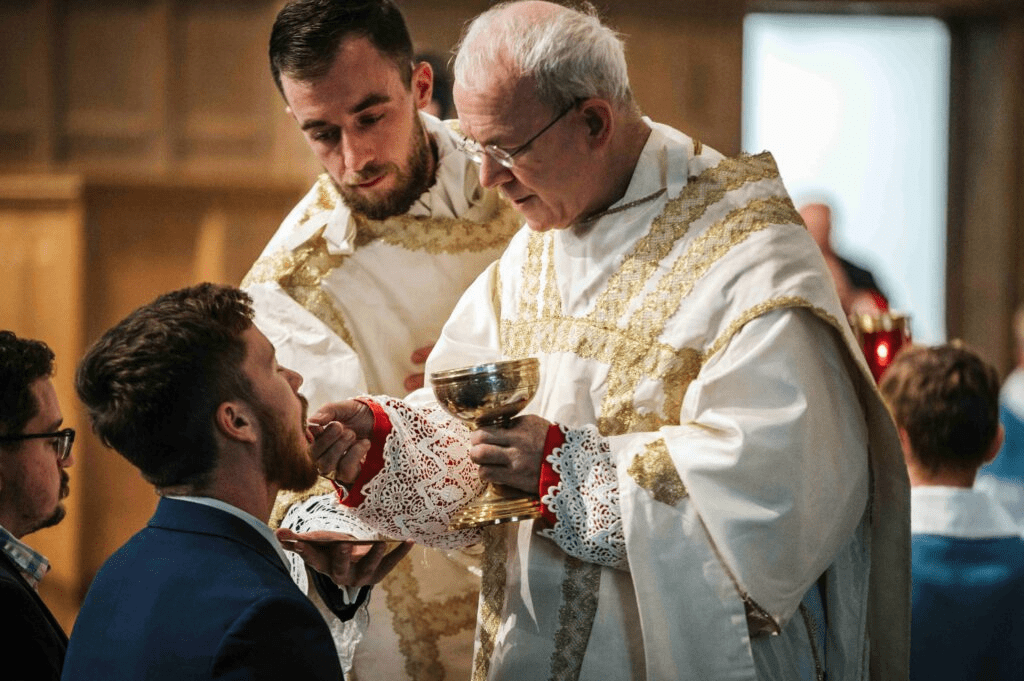
In Revelations, the Great Amen appears to the prophet in the guise of Jesus Christ. This also makes sense, when we understand that Jesus Christ represents God’s Perfect Love in a form human beings can both understand and emulate. Rightmindedly perceived, Amen is a form of AUM; it’s the Name we share with God, in other words, as is Jesus Christ. And, in that sense, the Name is indeed the vessel — the chalice of the atonement — through which we offer each other and Christ the metaphoric “waters” of Divine Love.
As Bible-Jesus famously promises in John 4:14: Whosoever drinketh of the water that I shall give him shall never thirst; but the water that I shall give him shall be in him a well of water springing up into everlasting life.
And as Course-Jesus more explicity explains:
This brother who stands beside you still seems to be a stranger. You do not know him, and your interpretation of him is very fearful. And you attack him still, to keep what seems to be yourself unharmed. Yet in his hands is your salvation. You see his madness, which you hate because you share it. And all the pity and forgiveness that would heal it gives way to fear. Brother, you need forgiveness of your brother, for you will share in madness or in Heaven together. And you and he will raise your eyes in faith together, or not at all.
Beside you is one who offers you the chalice of Atonement, for the Holy Spirit is in him. Would you hold his sins against him, or accept his gift to you? Is this giver of salvation your friend or enemy? Choose which he is, remembering that you will receive of him according to your choice. He has in him the power to forgive your sin, as you for him. Neither can give it to himself alone. And yet your savior stands beside each one. Let him be what he is, and seek not to make of love an enemy. (ACIM, T-19.IV-D.12:1–13:8)
Let’s move on to the next Rik, which (in Sanskrit) reads: sam indra gardabham mṛṇa nuvantam pāpayāmuyā | ā tū na indra śaṃsaya goṣv aśveṣu śubhriṣu sahasreṣu tuvīmagha ||
In English, those words translate as follows:
Gather together in Indra’s braying splendor to crush Anu’s emissions, the drinking waters binding the light of God’s Love, the waters Indra gathers together in the Resting Place of the cow-master on the horse of Esu, the enlightened being(s) triumphant in the rays bestowing many treasures.
sam (gather together in) indra (indra’s) gardabham (donkey or braying splendor) mṛṇ (to crush) anuvantam (Anu’s emissions) pā-payā-muyā (the drinking waters binding the light) ā (of God’s) tū (love) na (the waters) indra (indra) śaṃsaya (gathers together in the Resting Place) goṣv (of the Cow Master) aśveṣu (on the horse of Esu) śubhriṣu (the enlightened beings) sahasreṣu (triumphant in the rays) tuvīmagha (bestowing many treasure)
Notes:
I find this teaching interesting for two reasons. The first is that I’ve always wondered why Jesus chose to ride a donkey into Jerusalem in the final days of his earthly life. He went to some trouble to secure the donkey, so it had to be an important symbol. But of what? The Sanskrit word gardabham supposedly translates as “donkey” or “ass,” but, when divided as garda-bham, it means “braying splendor.” Ergo, God’s Radiant Splendor (or Majesty) brays like a donkey.
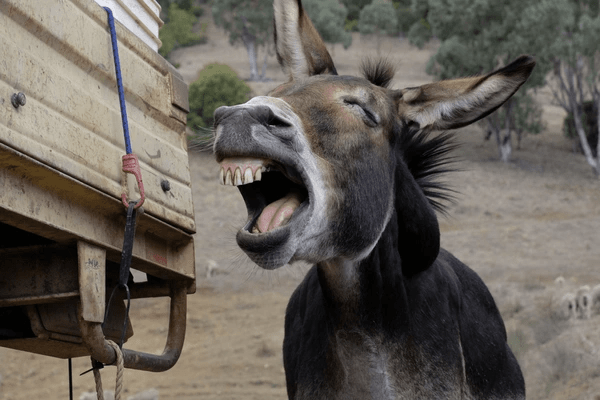
Yes, it seems like an odd turn of phrase. But we do find both “donkeys” (wild donkeys) and “braying” referenced at least five times in the Old Testament. And, as I keep saying, everything in the scriptures is symbolic, so these donkeys and their braying must be metaphorical. And what these wild donkeys symbolize is the symbolic meaning Jesus invoked by riding a donkey into Jerusalem (and also perhaps the donkey Mary rode into Bethlehem?).
So, kindly indulge me while I attempt to solve the mystery of Jesus’s donkey and Indra’s braying. The five Bible verses in which wild donkeys are mentioned are: Genesis 16:12,; Job 24:5 and 39:5-8; Jeremiah 2:24, and Isaiah 32:14.
Let’s start with Genesis 16:12, and go bigger, to include Genesis 16:13-14, which is, in fact, a continuation of the preceding verse.
In the KJV Bible, these two verses read:
And he will be a wild man; his hand will be against every man, and every man’s hand against him; and he shall dwell in the presence of all his brethren. And she called the name of the LORD that spake unto her, Thou God seest me: for she said, Have I also here looked after him that seeth me? Wherefore the well was called Beerlahairoi; behold, it is between Kadesh and Bered.
Here’s how the Hebrew actually translates:
A wild donkey, Adam’s hand is the hand abiding in the presence of your brother, calling the name YHVH, the Word of God in God’s sight, saying: “In the dream, look through the hinder-part vision at the well calling forth Be’er La’chay Roi (the waters of the life El recognizes) in the desert-wilderness, the sanctuary’s hailstones.“
What are the sanctuary’s hailstones? The short answer is: another wily rabbit to chase down a hole at another time. The longer answer is: The same metaphoric “hailstones” referenced twice in the Book of Revelations.
Of more immediate interest is the characterization of Adam’s hand as “a wild donkey.” This hand or kara, we are told in Genesis, abides in our brothers, calling the name YHVH (the joint name of the Great Rays). So, the braying donkey has to be the A-kara vibration of God’s pure communications, the highest or purest vibration of Perfect Love singing or “braying” in the dream-desert via the Divine Spark of the Red Ray of Yah within each of us.
Now, compare this interpretation to what Course-Jesus says below concerning the spark and the Rays.
In many only the spark remains, for the Great Rays are obscured. Yet God has kept the spark alive so that the Rays can never be completely forgotten. If you but see the little spark you will learn of the greater light, for the Rays are there unseen. Perceiving the spark will heal, but knowing the light will create. Yet in the returning, the little light must be acknowledged first, for the separation was a descent from magnitude to littleness. But the spark is still as pure as the Great Light, because it is the remaining call of creation. Put all your faith in it, and God Himself will answer you. (ACIM, T-10.IV.8:1-7)
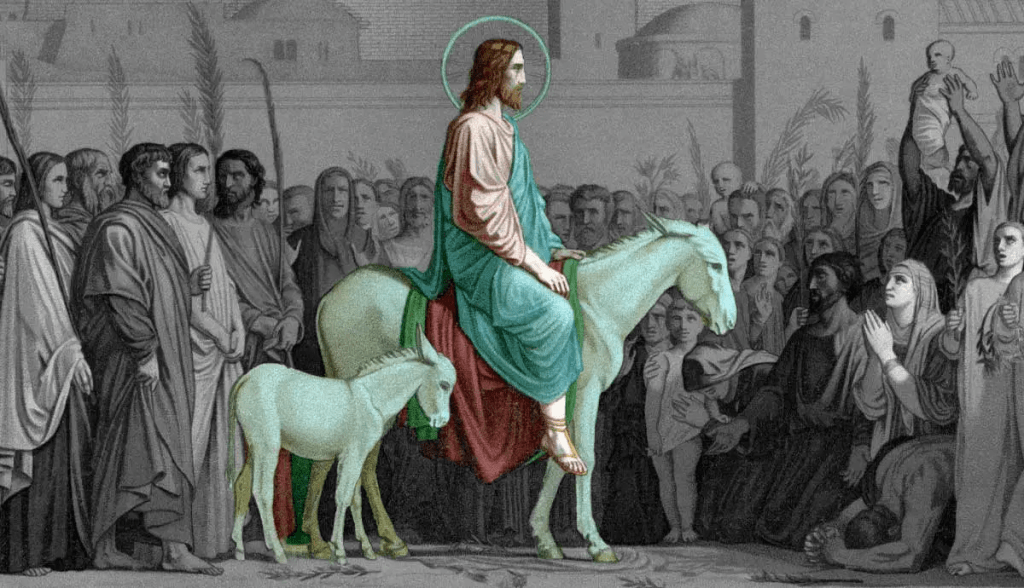
From this, we can ascertain that Adam’s hand (the A-kara) is the metaphoric donkey Jesus rode into Jerusalem, the city of Peace, where he went to experience “resurrection into everlasting life.”
To verify that my interpretation is accurate, let’s look at one more Bible verse about the wild donkey. Jeremiah 2:24, which reads as follows in the KJV Bible:
A wild ass used to the wilderness, that snuffeth up the wind at her pleasure; in her occasion who can turn her away? all they that seek her will not weary themselves; in her month they shall find her.
According to the Bible Hub, “This verse uses the metaphor of an untamed, wandering wild donkey in heat to illustrate Israel’s uncontrollable desire for idolatry and spiritual adultery.”
Does it indeed? I think not. As I see it, Jeremiah 2:24-25 actually says something very different.
The wild donkey teaches in the desert to long for Ruach, to crave the answer (or fig tree) of the return; to seek the weary New Moon to obtain the refused steps without shoes. The throat in a parched condition says, “Despair not to love the strangers the hinder-part walks in to steal the shame appearing to exist in the House of Israel, to dry up the King, the Prince, the Priest and their prophets.”
The wild donkey, as we’ve established is the A-kara, which teaches the Souls in the desert to long for the Holy Spirit, God’s answer to the separation. The weary New Moon is, I suspect, the Vah Ray waiting within us to be of service. The refused steps without shoes are the three strides we make through the inward-leading AUM circles. The throat in a parched condition is the Soul’s throat, deprived of the Living Water whose flow we cut off upon entering the realm of perception. To resume the flow, we need to stop fearing to love the strangers we wrongmindedly perceive our brothers to be, when, in fact, they are our “saviors,” as Course-Jesus explained above.
Shame or guilt only appears to exist in the House of Israel. And believing in the ego-conjured illusion of sin and guilt seems to dry up the waters coming to us from the King (God), the Prince (Christ), the Priest (the Holy Spirit), and their prophets (the triumphant Souls in the Assembly gathering the waters of AUM in the Resting Place).
That all should make sense, if you’ve been paying attention.
Let’s return to the Rigveda’s 28th Sukta. In Sanskrit, the next Rik reads: patāti kuṇḍṛṇācyā dūraṃ vāto vanād adhi | ā tū na indra śaṃsaya goṣv aśveṣu śubhriṣu sahasreṣu tuvīmagha ||
In English, the teaching translates thusly:
Safeguarding the Multitudes, the humming teaching vessels of the far-away winds of Om eat in the forest the dawning light of God’s Love, the waters Indra gathers together in the resting place of the cow-master on the horse of Esu, the enlightened being triumphant in the rays bestowing many treasures.
pa-tāti (Safeguarding the multitudes) kuṇ-ḍṛ(o)ṇācyā (the humming teaching vessels) dūraṃ (of the far away) vāto (winds of Om) vanād (eat in the forest) adhi (the dawning light) ā (of God’s) tū (Love) na (the waters) indra (Indra) śaṃsaya (gathers together in the resting place of) goṣv (the cow-master) aśveṣu (on the horse of Esu) śubhriṣu (the enlightened being) sahasreṣu (triumphant in the rays) tuvīmagha (bestowing many treasures) ||
Notes:
Again, this may read awkwardly, but the Bible contains several accounts of eating in the forest or wilderness (the “food” that God provides). The three best examples are these:
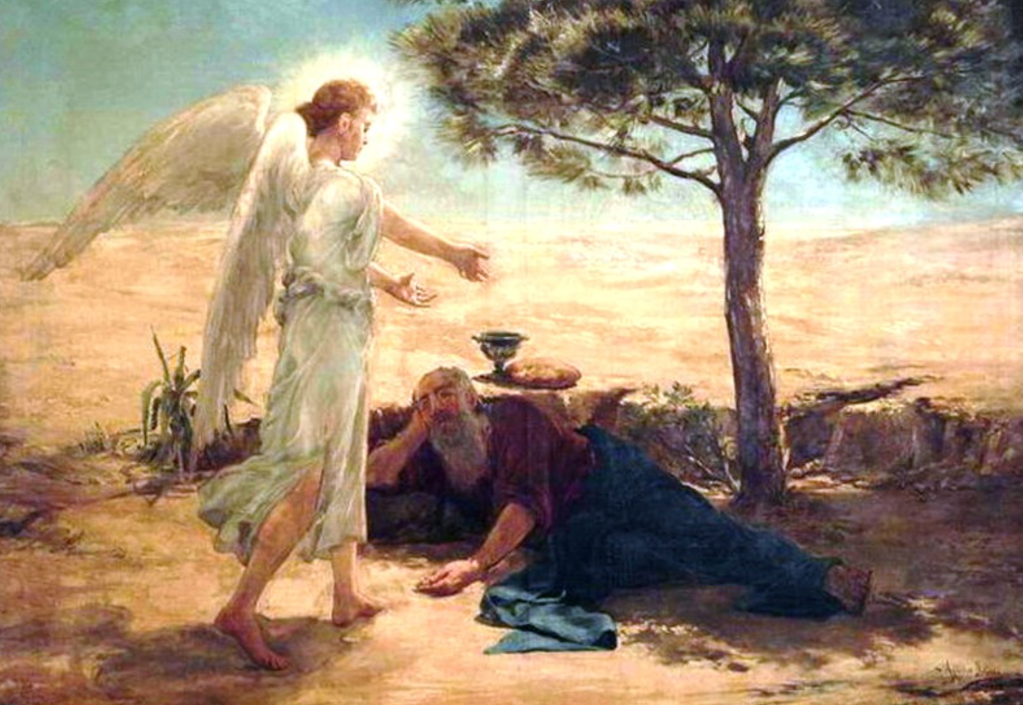
–In 1 Kings 19:5-8, the prophet Elijah falls asleep under a tree, while fleeing to escape Queen Jezebel. An angel later wakes him, saying, “Arise and eat.” She then offers Elijah bread that’s been baked on hot stones, along with a jar of water to sustain him on his forthcoming forty-day journey.
–In Exodus 16, the Israelites, after fleeing Egypt, find themselves in a wilderness without any food. God provides for them by raining down “manna” from heaven and sending them s’lav to eat.
–In 1 Samuel 14:24-29, during a military campaign, the Israelite troops enter a forest where honey drips from the trees. King Saul places a curse on anyone who eats food that day, but Jonathan (Saul’s eldest son), unaware of the curse, eats some of the honey from the tip of his staff, restoring his energy.
–In Matthew 4:1-11 Jesus is led into the wilderness by the Spirit, where he fasts for forty days. Afterward, when he grows hungry, and has resisted temptation, angels come and attend him.
Are you getting the picture?
That God provided quails for the Israelites to eat makes no sense, so it must be a mistranslation of s’lav, the Hebrew word translated as “quails.” Traditionally, s’lave is rendered as selav (quails). And yet, s’lav might well be an abbreviated form of shalav (quietness, rest, or peace) or, alternatively, solav, a Kurdish word of Hebrew origin meaning “morning dew” or “waterfall.” Ergo, God gave the Israelites bread and dew (water-pearls) to sustain them on their journey through the wilderness, just as the angel gave Elijah.
The 29th Sukta’s final line reads: sarvam parikrośaṃ jahi jambhayā kṛkadāśvam | ā tū na indra śaṃsaya goṣv aśveṣu śubhriṣu sahasreṣu tuvīmagha
My translation:
The wholeness of the surrounding call strikes the crushing jaws to make the Purusha liberally give God’s Love, the waters Indra gathers together in the Resting Place of the cow-master on the horse of Esu, the enlightened being(s) triumphant in the rays bestowing many treasures.
sarvam (the wholeness of) parikrośaṃ (the surrounding call) jahi (strikes) jambhayā (the crushing jaws) kṛka-dāśvam (to make the Purusha liberally give) ā (God’s) tū (love) na (the waters) indra (Indra) śaṃsaya (gathers together in the resting place) goṣv (of the cow-master) (on the horse of Esu) śubhriṣu (the enlightened being) sahasreṣu (triumphant in the rays) tuvīmagha (bestowing many treasures) ||
Notes:
The crushing jaws hold the teeth of God’s Word, which (the Bible tells us) act like a threshing machine. So, the teeth of God’s Word are AUM, the three vibrational tones of Perfect Love that “undo” in stages, the ego-thinking holding our Souls in shackles. The Great Purusha is the Greater Light of God’s Majesty in the Cosmic Ocean underneath the illusion — the waters drawn up through the wellspring or Fountain in the Resting Place, through the agency of the Assembly, aided by our secret almsgiving rituals.
All of this should make sense, metaphorically.
In case I haven’t been clear, the wellspring or fountain we’re talking about is the Fountain of Life in Psalm 36:9, the Fountain of Living Waters (we forsook) in Jeremiah 2:13, the Fresh Springs in Psalm 87.7, the Living Fountain of Waters in Revelation 7:17, and the wellspring of everlasting life in John 4:14. It’s also, btw, the bottomless pit out of which the locusts come in Revelations and Exodus.
So, there’s nothing fearful in the scriptures, my brother in Christ, because the Biblical locusts are good and helpful forces the Ego Mind has deceived us into believing are “plagues” visited upon us by an angry God.
God isn’t angry at us; God doesn’t even understand anger, because anger is an Ego invention antithetical to Agape. God, who loves and misses us, just wants us to come home and be happy again, in the boundless radiance of his everlasting love.
Or, as we are told in Jeremiah 31:3 …

That’s it for today. Hope you learned something. Thanks for dropping by. Until next time, Om Hari Om and Namaste.


Leave a Reply