Okay, WordPress. What happened to my post-draft? Two days ago, I was ready to publish my annotated translation of the Rigveda’s 28th Sukta; and today, all my work has vanished.
The thought of starting again sickens me, but what else can I do? But wait, because my post’s disappearance may have been for the best, in light of the fact, odd as it seems, that what I’d translated wasn’t the first mandala’s 28th Sukta. What was it? I only know it had six lines, most of which began with the word Agne (Agni is). Somewhere in the mix were two metaphors also found in the Bible: the Blue Sapphire and the City of Waters.
So, let’s start over, starting with Google’s summary of the 28th Sukta:
The 28th Sukta of the first Mandala of the Rigveda (Rigveda 1.28) is a unique 9-verse hymn dedicated to the ritual tools used for pressing Soma, primarily focusing on the mortar and pestle. The rishi (seer) is Ribhukshan, and the deity praised is the mortar itself (Vanaspati).
How accurate is this description? Right off the bat, I can tell you that Vanaspati means Lord(s) of the Forest. I can further tell you that the same string of words recurs four times in this non-metered teaching. The recurring word-string reads: ulukhala-sutanam aved v indra jalgulah.
By my calculations, those five words translate as “the grinding mortar of all the sons assembled to divide Indra’s water-pearl(s).” So, the mortar is mentioned, but it’s not called Vanaspati, as Google suggests.
The grinding mortar is the Vedic equivalent of the Biblical millstone — the stone used by the Assembly to grind the seeds or grains of our holy thought-offerings into the flour for our metaphoric “daily bread” or “offering cakes.”
Alternatively, the same words could translate as “the owl raising the roof assembled to divide Indra’s water-pearls.”
As strange as this phrase might sound, we find several apparantly random references to owls in the Bible ( in Leviticus 11:16-17, Deuteronomy 14:16, Job 30:29, Isaiah 34:11, Jeremiah 50:39, and Micah 1:8, among others).
In Hinduism, the owl is the vahana (vehicle) used by Lakshmi, the supposed goddess of wealth. So, at the very least, owls are important spiritual symbols in more than one world religion. Additionally, we find “raising the roof” as a Christian metaphor for “the Miracle.”
We find no water-pearl in the Bible, but we do find “dew.” In Hinduism, “Indra’s water-pearls” symbolize the cosmic droplets clinging to the Indrajala like pearls.
Indra’s net is, therefore, covered in these “pearls of moisture” (water-pearls) not unlike the spider’s web pictured below.

In the Course, Jesus says:
Miracles are part of an interlocking chain of forgiveness which, when completed, is the Atonement. Atonement works all the time and in all the dimensions of time. (ACIM, T-1.I.25:1-2)
In the original dictations, he used the phrase “cobwebs of iron” to describe the interlocking function of miracles. Found in the “Principles of Miracles” (Miracle Principle 21/22), this metaphor (supposedly) signifies that miracles unite human frailty with the immense strength of God. Or, viewed another way, the U-kara miracle-vibration links the M-kara of the unreal dream-state with the A-kara of the awake-state of Absolute Reality.
As for the rest, let’s see what we can glean from today’s adhyayana lesson.
In transliterated Sanskrit, Rv 1:28.1 reads: yatra grāvā pṛthubudhna ūrdhvo bhavati sotave ulūkhalasutānām aved v indra jalgulaḥ
Those words should translate approximately as follows:
On the journey, the stone’s broad-based foundation is raised to become Soma’s Majesty, the grinding mortar of all the Sons assembled to divide Indra’s water-pearl(s).
yatra (on the journey) grāvā (the stone or stones) pṛthubudhna (broad-based foundation) ūrdhvo (is raised) bhavati (to become) sotave (Soma’s majesty) ulūkha-las-utānām (the owl raising the roof of) aved (God’s knowledge) v (to divide) indra (Indra’s) jal-gulaḥ (water-pearl).
Notes:
I’m pretty sure aved, which isn’t a recognized Sanskrit word, should be avet (assembled), rather than aveda (beyond the Vedas). The broad foundation stone, I’m quite certain, is the cornerstone or “rock” on which we build Christ’s Church. That stone, the rishis say herein, is raised up to become the Millstone of Soma’s Majesty. From this description, we can deduce that the Millstone represents the Majesty of Christ. And this tracks pretty well with what Course-Jesus says below about Christ’s Majesty:
The images you make cannot prevail against what God Himself would have you be. Be never fearful of temptation, then, but see it as it is; another chance to choose again, and let Christ’s strength prevail in every circumstance and every place you raised an image of yourself before. For what appears to hide the face of Christ is powerless before His majesty, and disappears before His holy sight. The saviors of the world, who see like Him, are merely those who choose His strength instead of their own weakness, seen apart from Him. They will redeem the world, for they are joined in all the power of the Will of God. And what they will is only what He wills. (ACIM, T-31.VIII.4:1-6)
The second Rik reads: yatra dvay iva jaghanadhisavanya krta ulukhalasutanam aved v indra jalgulah.
Those words translate thusly:
On the journey, the two alike ever-awake river-lords of the forest act as the the grinding mortar of all the sons assembled to divide Indra’s water-pearl(s).
yatra (on the journey) dvāv (the two) iva (alike) jagha-nādhiṣa-vaṇyā (ever-awake river-lords of the forest) kṛtā (work as) ulūkhalasutānām (the grinding mortar for all the sons) avet (assembled) v (to divide) indra (Indra’s) jalgulaḥ (water-pearls)
Notes:
Who are the two alike, ever-awake river lords of the forest? Hard to say, given the variety of forest and river deities in Hinduism. That said, this probably refers to the Vanadevatas and Aranyakas, who are not, as commonly believed, two categories of nature spirits. The Forest to which this verse refers is the Forest of All Beings — the place where the Assembly meets deep within our minds. Vana-devata means “the forest celestial beings.” These “beings” are, therefore, the Souls who’ve awakened to the reality that they never left the forest. They only dreamed for a time that they left. But now they’ve returned to the Assembly in conscious-awareness, through the agency of Christ’s Majesty (the Millstone).
And this is the group Course-Jesus means when he says: The saviors of the world, who see like Him (Christ), are merely those who choose His strength instead of their own weakness, seen apart from Him. They will redeem the world, for they are joined in all the power of the Will of God. And what they will is only what He wills.
Comparatively, Aranyaka means something along the lines of “forest-guardians” or “born in the forest.” In many South Asian cultures, yakas are forest-dwelling supernatural being who protect hidden treasure. So, they’re the guardians of our holy inheritance, essentially. And, as Course-Jesus explains in Workbook Lesson 188: The Peace of God is shining in me now, the guardian of our holy inheritance is the light of God’s Peace still shining inside our Holy Minds.
Why wait for Heaven? Those who seek the light are merely covering their eyes. The light is in them now. Enlightenment is but a recognition, not a change at all. Light is not of the world, yet you who bear the light in you are alien here as well. The light came with you from your native home, and stayed with you because it is your own. It is the only thing you bring with you from Him Who is your Source. It shines in you because it lights your home, and leads you back to where it came from and you are at home. (ACIM, W-188.1:1-8)
As I understand it, the light of God’s Peace “shining in us now” is the Great Ray of Yah and/or the Red Ray. That light came with us, Jesus explains, from our “native home”– the Forest of All Beings the Bible calls the Forest of Lebanon. That forest, which is mentioned some 70 times, is a place in our minds, rather than a woodland found in the world.
From this we can ascertain that the Aranyaka are the light-beings that never left the forest, whilst the Vanadevatas are those who left (by covering their eyes) but have since returned. So, the river-lords of the forest would include the Souls who never “fell from grace” and the Souls who fell initially, but subsequently woke up ahead of the rest. And that is, as I understand it, the two divisions of Souls making up the Assembly and/or the Gathering of the Waters (Samudra Manthana in Sanskrit). And it is from this “gathering” that all the tools of the Atonement arise from the Ocean of Milk — the Cosmic Sea or Pool underneath the illusion.
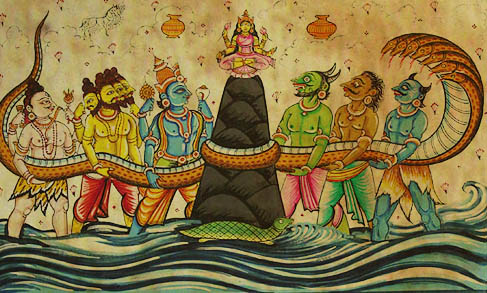
Rv 1.28:3 reads: yatra nary apacyavam upacyavam ca siksate ulukhalasutanam aved v indra jugalah.
Those words translate in this manner:
On the journey, Narayana’s waters shake the inwardly vibrating circles to acquire knowledge of the griding stone for all the sons assembled to divide Indra’s water-pearls.
yatra (on the journey) nāry (Narayana’s) apa-cyavam (waters shake) upa-cyavaṃ (the inwardly vibrating) ca (circles) śikṣate (to acquire knowledge of) ulūkhalasutānām (the grinding mortar of all the sons) aved (assembled) v (to divide) indra (Indra’s) jalgulaḥ (water-pearls)
Notes:
Regarded in Hinduism as a form of Lord Vishnu, Narayana is the twin of Nara, the Great Purusha of God’s Light rippling underneath the illusion. Narayana translates as “the resting place of all living beings.” The Resting Place is the Forest, so Narayana embodies the Forest, wherein Nara, the Light of God’s Peace abides, untouched by the dream. And Narayana’s waters shake the circles for acquiring the knowledge of Christ’s Majesty (the Millstone and the Mortar). Narayana’s waters would be, therefore the two streams of Lord Vishnu, the M-kara and the A-kara.
The fourth Rik reads: yatra mantham upacyavam rasmin yamitava iva ulukhalasutam aved v indra jalgulah.
My translation;
On the journey, the mind of the Moon’s inwardly vibrating ray of Yami’s majesty is like the mortar of all the sons assembled to divide Indra’s water-pearls.
yatra (on the journey) man-thāṃ (the mind of the Moon’s) upa-cyavaṃ (inwardly vibrating) raśmīn (rays of) yami-tavā (Yami’s majesty) iva (are like) ulūkhalasutānām (the mortar of all the sons) aved (assembled) v (to divide) indra (indra’s) jalgulaḥ (water-pearls)
Notes:
As explained in an earlier post, Yami and Yama are the twin “seeds” of the Great Rays hibernating, as it were, within the lowest chakra of our Spiritual Bodies. Once they awaken at the pre-appointed time, they begin to rise up, via the Ida and Pingala nadis, to aid the ascent of Kundalini, the U-kara miracle-vibration.
Herein we learn that Yami, the seed of the Vah Ray, contains the gestating energy of Christ’s Majesty within us. And that energy works in the manner of a grinding mortar, millstone, or traditional Indian silbatta.

Our next line reads: yac cid dhi tvam grhe-grha ulukhalaka yujvase iha dyumattamam vada jayatam iva dundubhih
My translation:
Communicating the pure-conscious thoughts of the True Self in the family home, the mortar in the forehead yokes the glorious Great Rays to illuminate the wholeness speaking for the victory like a kettle-drum.
yac (Communicating) cid (the pure-conscious) dhi (thoughts) tvaṃ (of the True Self) gṛhe-gṛha (the family home) ulūkha-laka (the owl in the forehead) yujyase (yokes the glorious) iha (Great Rays) dyumattamaṃ (to illuminate the wholeness) vada (speaking) jayatām (of Victory) iva (like) dundubhiḥ (a kettle-drum)
Notes:
This suggests that the mortar-effect of Christ’s Majesty takes place in the Ajna Chakra in the forehead, the mechanism for Christ’s Vision. As True Yoga teaches, the Third Eye is opened when the Great Rays meet or “marry” in this chakra.
In the Course, Jesus says something similar on the subject of wholeness:
Wholeness is the perceptual content of miracles. They thus correct, or atone for, the faulty perception of lack. (ACIM, T-1.I.40:1–41:2)
From this, we can surmise that Wholeness is the water-pearl of Indra, which is divided across the Indrajala as an interlocking chain of miracles leading back to the complete Atonement.
The kettle-drum simile is a nice touch, given that kettle-drums—specifically the Dundubhi and Bheri—symbolize triumphant announcements in Hinduism. Historically, the thunderous boom of these large, bowl-shaped drums echoed across ancient battlefields to terrify enemies and proclaim victory, with the Dundubhi even receiving its own “Hymn to the Battle Drum” in the sacred Atharva Veda.
Based on this Rig Veda comparison, I’m guessing the drum to which the Atharva Veda pays tribute isn’t an external battle-drum, but rather a sound heard with the inner-ears. Shamanic drums are sometimes used to imitate this sound.

Rv 1.28:5 reads: utasma te vanaspate vato vi vaty agram it atho indraya patave sunu somam ulukhala.
Those words translate thusly:
To elevate the stone, the thundering Lords of the Forest in the ethers divide the three winds of the dragon’s head, that, in the now-moment Indra lights to safeguard the Majesty begotten of Soma’s mortar.
ut-asma (To elevate the stone) te (the thundering) vanaspate (Lords of the Forest) vāto = vatau (in the ethers) vi (divide) vāty = va-ti (the three winds of) agram (the dragon’s head) it (that) atho (in the now-moment) indrā-ya (Indra lights) pātave (to safeguard the Majesty) sunu (begotten of) somam (Soma’s) ulūkhala (mortar)
Notes:
To elevate the stone is to lift up the cornerstone we rejected when building the loveless world, into the the middle position of the millstone, to end the loveless world we built in error.
Thus, the inner-Christ starts out as the Cornerstone, then serves as the Millstone/Mortar, and finally becomes the Capstone that completes the Temple rebuilding process.
The three winds of the dragon’s head (Rahu) are the A-kara, the U-kara, and the M-kara generated by the Red Ray of Yah. Rahu means “radiant offering.” And in Hindu cosmology and Vedic astrology, Rahu (the ascending node of Soma) does indeed have three “faces.” How these three faces, aspects, or “winds” are interpreted traditionally are, however, somewhat sketchy.
The first wind is said to be a turbulent storm bringing “chaos and instability” to disrupt the status quo, test our attachments to the ego’s illusions, and cause us to question and abandon societal norms. This may be “the period of undoing” Course-Jesus describes in the Manual for Teachers.
Rahu’s second wind is said to serve as a karmic “warning” for those blindly indulging their worldly desires by selfishly pursuing superficial or materialistic goals, with no thought for the reverberating consequences. This is probably, therefore, what Course-Jesus calls “the period of sorting out.”
Rahu’s third wind supposedly encourages “worldly prosperity through networking,” which I read as the ego’s version of “gathering together to save the world” (via our secret spiritual miracle-working or almsgiving meetings). This is probably, therefore, what Jesus calls “the period of achievement.” About this final phase in the process of developing total trust in the Holy Spirit, he says:
It is here that learning is consolidated. Now what was seen as merely shadows before become solid gains, to be counted on in all “emergencies” as well as tranquil times. Indeed, the tranquility is their result; the outcome of honest learning, consistency of thought and full transfer. This is the stage of real peace, for here is Heaven’s state fully reflected. From here, the way to Heaven is open and easy. In fact, it is here. Who would “go” anywhere, if peace of mind is already complete? And who would seek to change tranquility for something more desirable? What could be more desirable than this? (ACIM, M-4.I-A.8:2-10)
The Sukta’s sixth Rik reads:
Four Living Beings/Souls strengthen God’s one-hundred generating in fellowship the elevated ageless Husband or Bridegroom, Hari.
āya-jī (the four living beings or souls) vāj-a-sātamā (strengthen, energize, or empower God’s one hundred generating) tāhy = tahi (in fellowship) uccā (the elevated) vijar-bhṛtaḥ (ageless master, husband, or lord) harī (Hari)
Notes:
Here we find the four Living Beings seen by the Jewish, Islamic, and Christian prophets (if indeed aya-ji translates as “four souls”). God’s one hundred are the Assembly, so the Living Beings empower the Assembly to generate (in fellowship or brotherhood) the ageless Master, Lord, or Bridegroom, Hari.
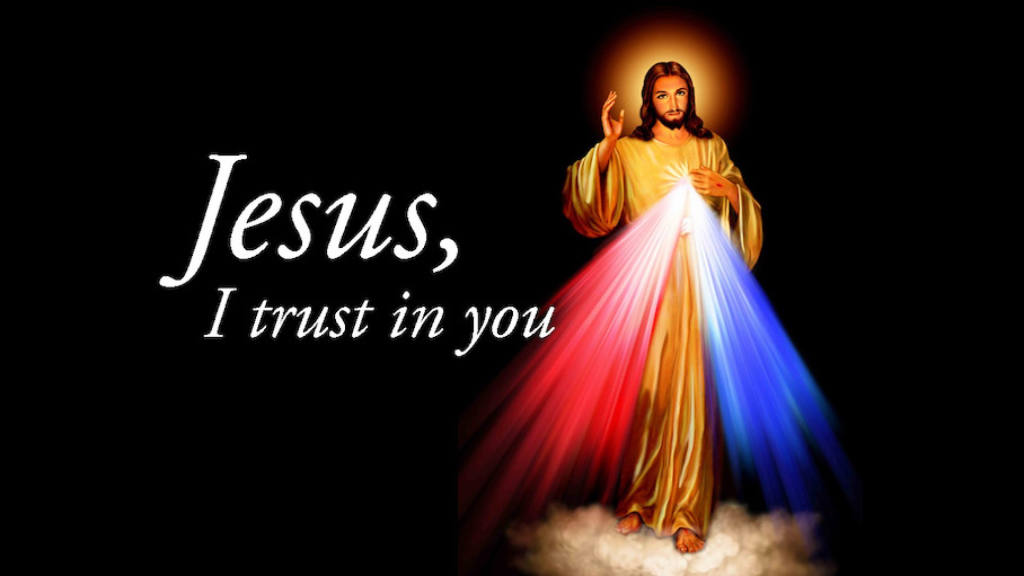
In Hinduism, Hari is Vishnu, the Holy Spirit beaming the two streams of Yah and Vah. In Judaism, Hari is YHVH, the unspeakable name of God in Israel. In Christianity, it’s Jesus, who showed the two streams (of divine mercy) to Sister Faustina in the manner depicted below.
The Sukta’s final line is a bit quirky, but nothing we haven’t encountered before. Rv 1.28:7 reads: ivandhamsi bapsata no adya vanspati rsvav rsvebhih sotribhih indraya madhumat sutam ucchistam camvor bhara somam pavitra srja ni dhehi gor adhi tvaci
Those words translate thusly:
In the manner of food, devour the dragon’s tail, the vessel of the foremost forest lords, the glorious exalted one’s three nectars of Indra’s light, the honey posessing the son’s remaining foodstuffs for eating to consume the bright inner radiance of Soma’s purifying agent of God’s creation within, to nourish and grow the cow of God’s mind in the flesh.
ivāndhāṃsi (in the manner of food) bapsatā (devour) tā (the dragon’s tail) no (the vessel) adya (of the first) vanaspatī (lords of the forest) ṛṣvāv (the glorious) ṛṣvebhiḥ (exalted one’s) so-tṛbhiḥ (three nectars) indrāya (of Indra’s light) madhumat (the honey possessing) sutam (the son’s) uc-chiṣṭaṃ (remaining foodstuffs for) cam-vor (eating to consume) bhara (the bright inner radiance) somam (of Soma’s) pavitra (purifying agent) ā (of God’s) sṛja (creation) ni (within) dhehi (to nourish and grow) gor (the cow) a-dhi (of God’s mind) tvaci (in the flesh)
Notes:
As we know, the dragon’s tail is Ketu, the descending node of Soma, the Great I Am still shining in our minds. And Ketu is AUM, the three “nectars” of the Atonement–the purifying agent God created within us “to nourish and grow” the miracle-cow, Kamdhenu.
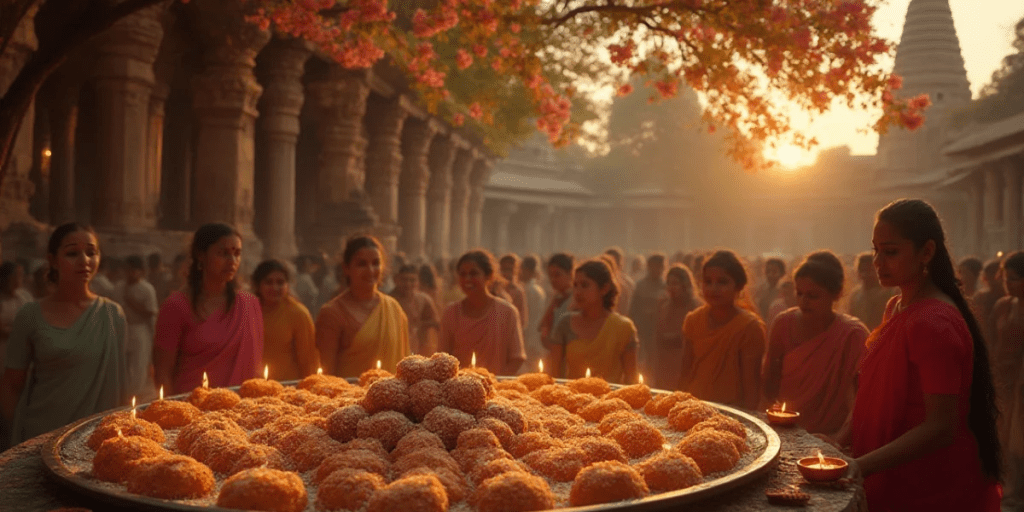
As we’ve learned in previous studies, we nourish and grow the miracle-cow by offering her the sweet cakes formed from the seeds or grains of our almsgiving fellowship meetings. The millstone or pestle is used to grind those seeds into the flour or powder forming the bread or sweet offering cakes “baked” in God’s oven (the fiery eye at the center of the Wheel). Fueling that fire are the dead branches of wrong-minded thought pruned from our minds through Christ’s perception-shifting miracles.
This is, btw, the original meaning of prasad — a word used to describe the food offerings Hindus make to the gods represented on their poojas. Prasad means “grace” in Sanskrit. Hence, my chosen nom-de-blog, Purusha Prasada, which means “the light of God in a state of grace.”
Until next time, Om Hari Om and Namaste.


Leave a Reply