We’ve now come to the Rigveda’s 33rd Sukta, and I’m expecting big things. Why? Because thirty-three is a sacred number representing, I suspect, the Trinity’s reflection in the lower waters of ego-thinking. That reflection is AUM, the Atonement Trinity.
It was no accident that Jesus Christ, who activated the Atonement Plan, departed the mortal world at the tender age of 33. Moreover, 33 is said to numerically symbolize the Star of David — the six-pointed star that IS the Holy Spirit’s “signet” or “mark.”
As usual, let’s dismiss everything generally believed to be true about this Sukta, including the widespread presumption that it’s a hymn dedicated to Indra, “the king of the gods” in Hindu theology. Indra is, in truth, the Hindu personification of the Great Ray of Yah (the God aspect of Y[a]H-V[a]H). As already established, Yah is the Great Ray of God’s presence shining into the dream-realm through the Solar Logos (Elohim, Surya, and/or Allah), while Vah is the Great Ray of Christ’s presence.
Rightly understood, Yah is God’s arm reaching down from Heaven to the Moon Circle (the Bindu Chakra), while Vah is Christ’s arm reaching into our split-off dream-bound, ego-bound, or earth-bound minds from the Moon Circle to lift us back up to Christ Consciousness. Yah is, therefore, the divine force acting on behalf of God’s Will to end the dream of separation, whilst Vah is the divine force acting on behalf of Christ’s Will to restore the at-one-ment of Christ’s “corporate body.”
Together Yah and Vah are the everlasting arms described in Dueteronomy.

Does that make sense?
In transliterated Sanskrit, the Sukta’s first line reads (according to H. H. Wilson):
etāyāmopa gavyanta indram asmākaṃ su pramatiṃ vāvṛdhāti anāmṛṇaḥ kuvid ād asya rāyo gavāṃ ketam param āvarjate naḥ.
When rightmindedly translated, those words don’t work together as a single stanza. To make them work, I broke the line into three segments.
The first segment reads:
The variegated lights of the Beloved receive from the sacred cow of Indra the stone of the superior mind concealed by attacking that which has no enemies or faults.
etāyām-opa (the variegated rays of the Beloved) gav-yanta (receive from the sacred cow) indram (of Indra) asmākaṃ (the stone of) supra-matiṃ (the superior mind) vāvṛ(a)-dhāti (concealed by attacking) anāmṛṇaḥ (that which has no enemies) kuvid (or faults).
Notes:
Stated another way, our attack thoughts prevents the Seven Rays from shining within our minds and extending outward to other minds.
Or, as Course-Jesus similarly explains in the prayer from Workbook Lesson 56:
In my own mind, behind all my insane thoughts of separation and attack, is the knowledge that all is one forever. I have not lost the knowledge of Who I am because I have forgotten it. It has been kept for me in the Mind of God, Who has not left His Thoughts. And I, who am among them, am one with them and one with Him. (ACIM, W-56.5:2-5).
The Rik’s second segment reads:
To eat from the mouth streaming the AUM, the guru-word emitted in the shelter of the supreme hinder-manifested whole, look within for the Self or I Am bestowing the riches given to transcend the pleasure and pain not of the Eagle (or Falcon) of the dwelling place watching over the Night.
ād (to eat) asya (from the mouth) rāy-o (streaming the OM or AUM) ga-vāṃ (the guru-word emitted) ketam (in the shelter) param (of the supreme) āvar-jate (hinder-manifested) naḥ (whole) uped (look within) ahaṃ (for the I Am) dhanadām (bestowing the riches) apr-atītaṃ (given to transcend) juṣ-ṭāṃ (the pleasure and pain) na (not) śyeno (of the Eagle or Falcon) vasatim (of the dwelling place) pa-tāmi (watching over the night).
Notes:
Rather than struggle to explain what this means, let me share the following from the Course:
All that is given you is for release; the sight, the vision and the inner Guide all lead you out of hell with those you love beside you, and the universe with them. (ACIM, T-31.VII.7:7)
To that, let me add a couple of things. Firstly, the “treasure” mentioned herein is NOT of this world. As the Hindu lore makes clear, this “treasure” is protected by Krishna (the personified Christ Ray). Rightly understood, this is the Treasure of God, which the Holy Spirit keeps in trust for our Souls in the Golden Treasury, Storehouse, or Cistern. In the Course, Jesus discusses this “treasure” here.
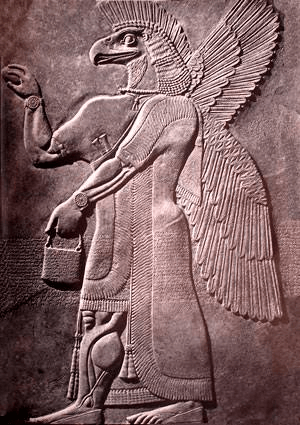
Secondly, the eagle “of the dwelling place watching over the Night” isn’t the Indian Eagle-Owl, as generally supposed. It’s Nisrok or Garuda, the eagle-headed cherubim or “sword” guarding the well (not “pit”) from which Vah’s Living Water rises to restore the Soul’s memory of God’s Eternal Reality. As we’ve discussed that “water” is the U-kara vibration known to Kabbalists as the Exalted Hand of God and to Yogis as Kundalini (a Sanskrit word meaning not “coiled,” but “the swarm from the well”).
The third segment reads:
Indra’s name or identity flows within the thousand Solar Rays vibrating Yah’s ode to Om, the offering invoked in the state of being “the light of the mind.“
indraṃ (Indra’s) nama-syann (name flows) upa-mebhir (within the one-thousand) arka-ir (Sun or Solar Rays shaking or vibrating) yaḥ (Yah’s) stotṛbhy-o (ode or eulogy to Om) havyo (the offering invoked) asti (in the state of being) yā-man (the light of the mind).
Notes:
From our previous studies, we know that the Sahasrara, the Sanskrit name for the Crown Chakra, means “that which has one-thousand rays” rather than “thousand-petaled lotus.” And that which has one-thousand rays is Surya, the Solar Logos. And herein we learn that Indra’s name flows within those 1,000 rays, all of which vibrate the Yah Ray’s “ode to Om.” And the Yah Ray’s “ode to Om” is the A-kara aspect of AUM.
In Hinduism and yogic philosophy, nada is Om, which is generally understood to be “the primordial, cosmic sound or vibration that creates and sustains the universe.” Nada IS Om; but, in truth, Om is the vibration of Perfect Love God extended to create the Christ and “the kingdom” He gave to the Sonship to practice creating. That kingdom is what we call the Garden of Eden or Paradise, which the Ego Mind’s penchant for fear and guilt transformed into the dream of hell.
As I’ve just explained, Yah’s ode to Om is the A-kara aspect of AUM — the purest vibration of the God Mind we can hear in the dream-realm. We hear that sound when our minds are free of all the Ego Mind’s dark thoughts of sin, guilt. and fear. Free of darkness, we join (as minds) in Holy Relationship to become the Light of the Mind and/or the Light of the World.
Or, as Course-Jesus explains:
The Holy Spirit was given you with perfect impartiality, and only by recognizing Him impartially can you recognize Him at all. The ego is legion, but the Holy Spirit is one. No darkness abides anywhere in the Kingdom, but your part is only to allow no darkness to abide in your own mind. This alignment with light is unlimited, because it is in alignment with the light of the world. Each of us is the light of the world, and by joining our minds in this light we proclaim the Kingdom of God together and as one. (ACIM, T-6.II.13:1-5).
The Sukta’s next Rik reads:
Inwardly, the whole army of quivering fisherman free from worldly passions gathers together to honor the sacred syllable propelling the energy residing in the light of the mind, (which) Indra offers abundantly on the left side to generate the drink not of the physical realm.
ni (inwardly) sarva-sena (the whole army) iṣu-dhīm̐r (of quivering fishermen) asakta (free from worldly passions) sam (gather together) aryo (to honor) gā (the sacred syllable) ajati (propelling) yasya (the energy) vaṣṭi (residing in) coṣkū-ya-māṇa (the light of the mind) indra (Indra) bhūri (offers abundantly) vāmam (on the left side) mā (to generate) pa-ṇir (the the drinking water) bhūr (of the physical realm).
Notes:
This echoes the quote I just shared from the Course. The phrase “quivering fisherman” may seem strange, but we find similar metaphors used by the Old Testament prophet Habakkuk, as well as by Jesus in the New Testament gospels of Matthew and Mark.
Rightly understood, we become “fishers of men” by casting our “miracle net” (Indra’s Net?) out of the boat (the Golden Ark) to gather in more “fish,” so to speak. Ezekiel 32:3 also describes spreading a net over Paroh (the Great Dragon, not the Egyptian ruler).

The next Rik reads:
To abide in the joy of God’s Mind, advance and mature the wind(s) gently discharging the gifts of the rays, the treasures of the Name, through the cloud of oneness scattering the grains within to strengthen the Red Ray, Indra.
as-mad (to abide in the joy) a-dhi (of God’s Mind or Thought) pra-vṛddha (advance and mature) va-dhīr (the wind gently) hi (discharging) da-syuṃ (the gifts of the rays) dhani-naṃ (the treasures of the Name) ghanenam̐ (through the cloud of) ekaś (oneness) car-ann (scattering the grains) upa-śāk-ebhir (within to strengthen the Red Ray) indra (Indra)
Notes:
As I read the metaphors, we offer our almsgiving prayers to Ruach, the Cosmic Breath. And Ruach, the pillar of cloud leading the way, scatters those alms, grains, or seeds across the universe to strengthen the Red Ray’s power within us (to escape the dream-desert).
The next line reads:
The rainbow of God’s Mind divides the sacred night’s thundering majesty on the path of returning the individual Soul to the wholeness of the former identity’s state of joy.
dhanor (the [rain]bow) adhi (of God’s Mind) vi-ṣu-ṇak (dividing the holy night’s) te (thundering) vy (majesty) āyann (on the path) aya-jvānaḥ (of returning the individual Soul to the wholeness) sana-kāḥ (of the former identity’s) pretim (state of joy).
Notes:
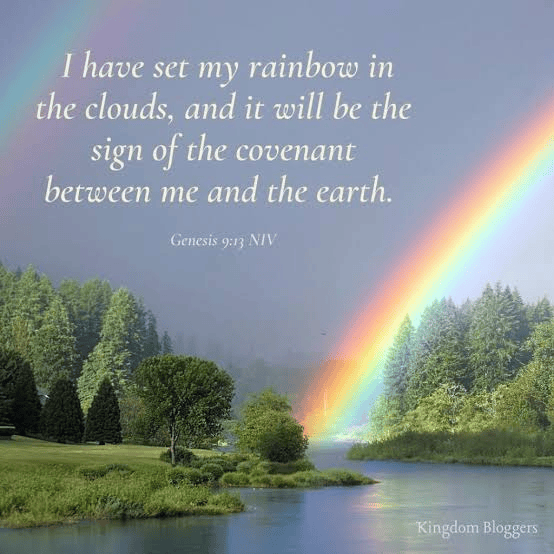
In the Hindu lore, Indra’s bow is the rainbow known as Indradhanus, meaning “the bow of Indra.” So, the rainbow seen by the Biblical prophets above the throne of Elohim is Indra’s bow. According to most Biblical interpreters vis-a-vis the traditional translation of Genesis 9:13, this rainbow symbolizes God’s solemn promise, vow, or covenant to save us from the darkness we manufactured in partnership with the Ego Mind (Satan), without flooding the earth a second time (i.e., without taking away our free will). And this, in turn, tells us that Indra’s bow is Mitra, the inseparable partner of Varuna, the Lord of the Waters who guards the western gate.
As explained hitherto, Yah is the source of the “divine sap” of eternal life within all living beings seemingly dwelling on earth. And that sap is mentioned in the very next Rik, which reads:
To approach the Supreme Perception of the life-force sap, the life-energy of the Perfect Soul, which Indra strengthens in the Forest, honor the weavers emulating the heart-mind to advance remembrance of the divine Hari-Vah, the remaining powerful water of God’s solemn vow to the lower of the two worlds.
īyuḥ (To approach) parā (the supreme) cic (perception of) chī-rṣā (the life-force juice or sap) vav-ṛjus (the life-energy of the Perfect Soul) ta (that) indrā-yaj-vāno (Indra strengthens in the forest) yaj-vabhiḥ (honor the weavers) spardha-mānāḥ (emulating the heart-mind) pra (to advance) yad (remembrance) divo (of the divine) hari-vaḥ (Hari Vah) sthātar (the remaining) ugra (powerful) nir (waters) a-vratām̐ (of God’s solmen vow) adhamo (to the lower) rodasyoḥ (of the two worlds).
Notes:
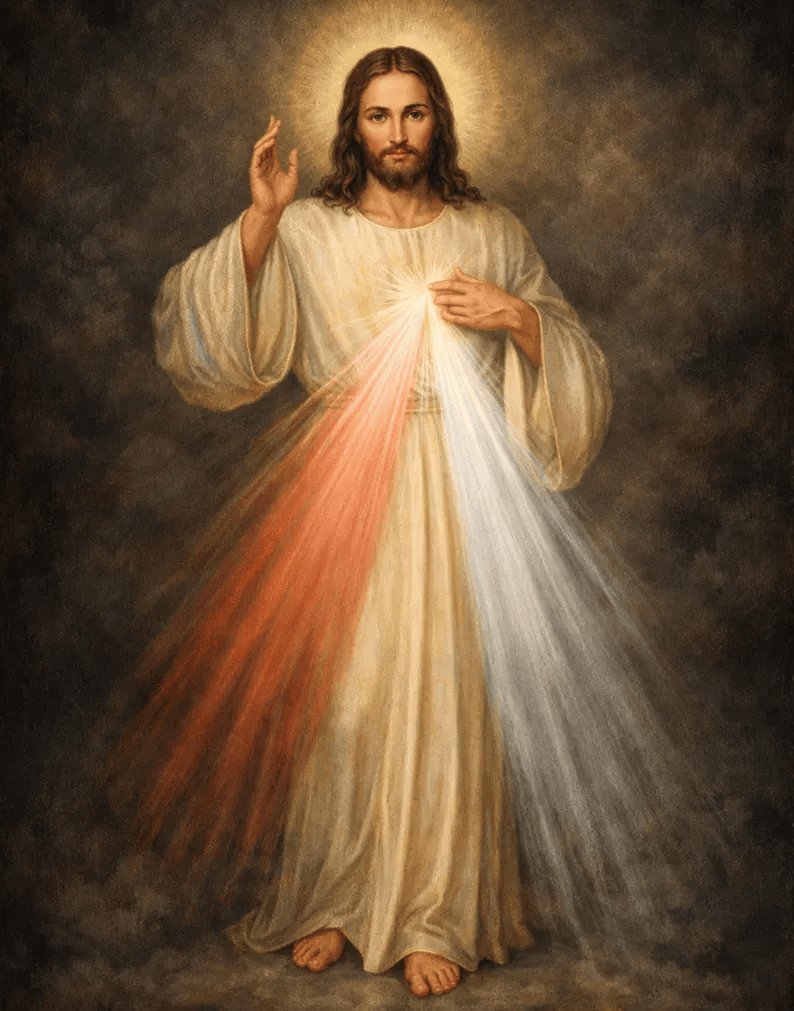
Like I just explained, Vah or Hari-Vah is the Pale or Water Ray, whilst Yah is the Red or Blood Ray. And as Jesus showed Sister (Saint) Faustina in the 1930s, both of these Great Rays (of Divine Mercy) shine forth from His Sacred Heart to heal the separation.
The lower of the two worlds is, of course, the material world, where we falsely perceive duality.
The Sukta’s next Rik reads:
The life-force shines forth to bestow the blamelessness belonging to the Army extending the circle to destroy duality.
ayu-yut-sann (the life-force shines forth to bestow) anavadyasya (the blamelessness belonging to) senām (the army or host) ayāta-yanta (extending the circle or circles) kṣitayo (to destroy duality)
Notes:
The army they mean is, of course, Nisrok’s Army, as well as the Army of Christ. As explained in our earlier discussions of Revelations, this “army” consists of the Souls sharing miracles of grace (through Christ, Vah, or Krishna) with all their brothers at the level of the Water Circle — the Resting Place, Walled City, or Fortress on the Sixth Plane of Consciousness, where the Christ Ray has “encamped” in the upper forest of the dream-realm.
The next Rik reads:
The nine witnesses pour forth the instruments of Om, Nara’s destroying streams of water dispatched by those speaking to drive the Dragon’s thought-circle journey.
nava-gvāḥ (the nine witnesses) vṛṣ-āyudh-o (pour forth the instruments of Om) na (Nara’s) vadh-rayo (destroying streams) nir-aṣṭāḥ (of water dispatched) pravadbhir (by those speaking) in-drāc (to drive the dragon’s) cita-yanta (thought-circle) āyan (journey).
Notes:
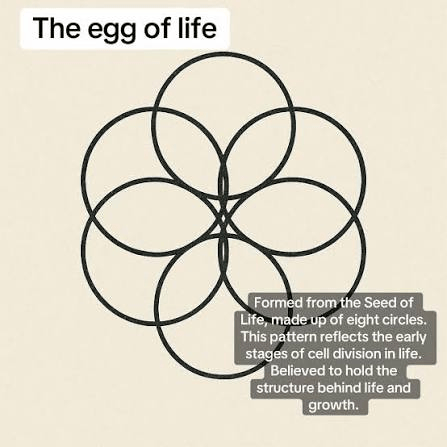
It’s getting pretty esoteric, but this should make sense to those who’ve been reading my blog posts in order from the beginning. Who are the nine witnesses? Hard to say; they could be the Kabbalistic Sefirot, the Hindu Navagraha, the nine Rays (the two Great Rays, plus their seven offspring rays), or all of the above. Since these rays emanate the nine sacred syllables that heal our minds in stages or steps, “those speaking to drive the Dragon’s thought-circle journey,” would be all the rays, together with those of us meditating on their voices in the eight circles. Those eight intersecting circles form what is known in sacred geometry as “the egg of life” and/or “the flower of life.” This pattern is reflected or “echoed” in everything we falsely perceive as external.
Or, as Course-Jesus explains in Workbook Lesson 151, all things are echoes of the Voice for God.
The next Rik reads:
In the true mode of being, all those sounding to give birth to the blood of the collective body (of Christ), radiate (inwardly) the glory of Indra, the supreme power you expelled with fire.
tvam (In the true mode of being) etān (all those) ru-dato (sounding to give) ja-kṣataś (birth to the blood) cāyo-dhayo (of the collective body) ra-jasa (radiate the glory of) indra (Indra) pāre (the supreme power) avādaho (you expelled with fire)
Notes:
The blood of the collective body is, of course, the Blood of Christ — the divine elixir of immortality known as “Amrita” of “Soma-juice.” When we join together in that “body,” by meditating on the Song of Heaven and/or the Holy Stream of Sound, we produce that divine “elixir” for all our dream-bound brethren. In so doing, we radiate the glory of Indra — the power we rejected when we projected the idea of fire outwardly into the dark void.
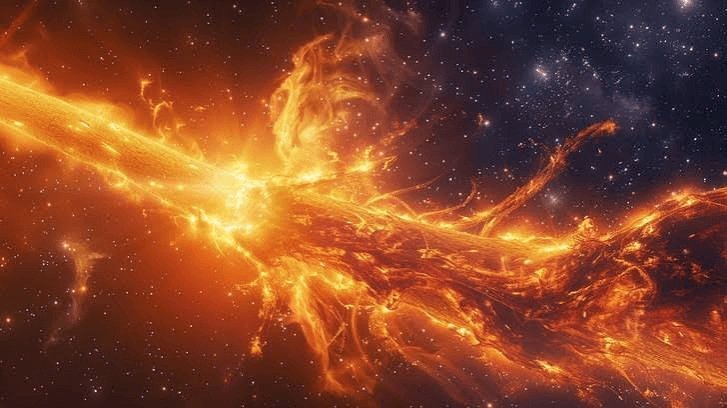
Let’s move on to the next Rik, which reads:
The greater light of God bestows the Ray of Exaltation fully to advance the pressing of the Soma-juice by those singing to accept the united Word of God calling the circles one by one to complete the I Am, the Golden Antelope honoring the powerful radiance of God’s Mind, Thought, or Spirit: Nara (the Great Purusha) lowing in the forest without a mouth.
diva (the Greater Light) ā (of God) da-syum (bestows the ray of) uccā (exaltation) pari (fully) pra (to advance) sunvataḥ (the pressing of the Soma-juice) stuvat-aḥ (by those singing to accept) śaṃsam (the united Word of God) āvaḥ (calling) ca-krāṇāsaḥ (the circles one by one) parīṇ-aham (to complete the I Am) hiraṇy(a)-ena (the golden antelope) maṇinā (honoring the powerful) śumbha-a-mānāḥ (radiance of God’s Mind, Thought, or Spirit) na (Nara, the Purusha) hin-vana-nasas (lowing in the forest without a mouth).
Notes:
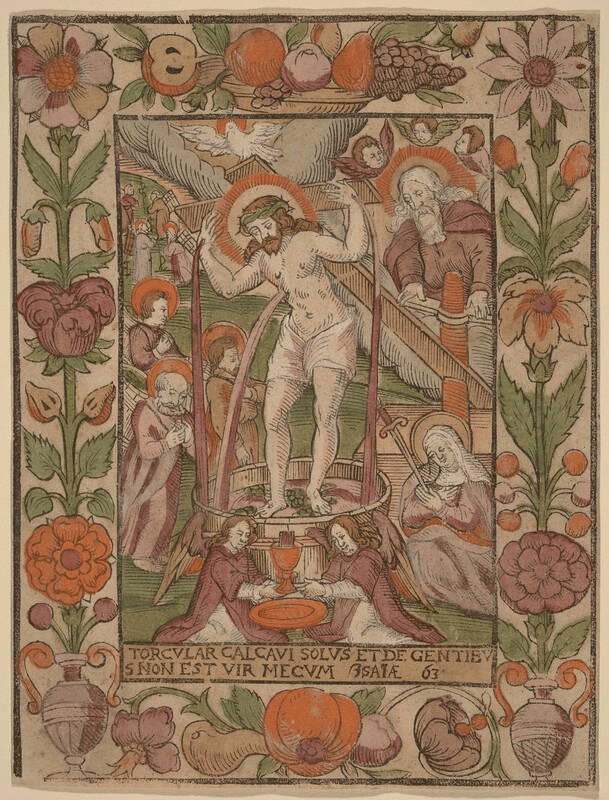
As I’ve said before, the Soma-juice of the Vedas is the spiritual “drink” we produce together with Christ in the Moon Circle — the circle in which He stands at the center, calling us to join Him (as he says in the Course). So, the mysterious Soma-juice of the Vedas is, in truth, the Amrita “dripping down” from the Bindu Chakra. In Matthew 9:17, Jesus called this metaphorical moon-juice “the new wine,” making the Bindu Chakra both the Soma Press of Vedic Hinduism and the winepress of traditional Christianity.
A quick survey of scriptural literature suggests the Ray of Exaltation is the pure white ray of the Holy Spirit, but it’s actually the Seventh Ray (as I’ll explain later). We don’t find this ray in traditional translations of the Bible, but we do find it in the Akbar-nāma of Abū Fazl (1551-1602), who purportedly describes this ray as “a royal decree or imperial command illuminated by favor and majesty.”
I say “purportedly” because that characterization smacks of ego-distortion, as does the historical description of Abu Fazl as one of the “Nine Jewels” (Navaratnas) of Emperor Akbar’s royal court. Supposedly, Fazl helped shape the Indian emperor’s liberal religious and political views.
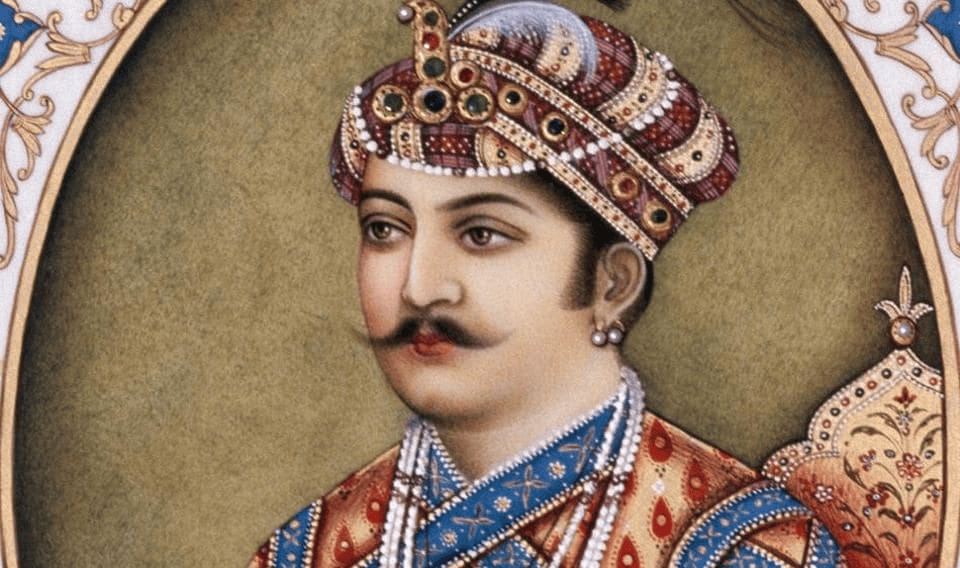
In Arabic, Abu Faz(a)l means “father of grace,” whereas Akbar means “greatest” or “highest.” So Emperor Akbar was probably an ancient allegorical representation of a celestial power.
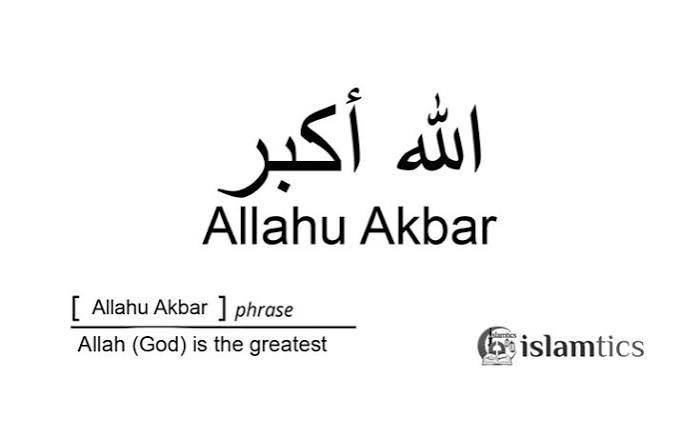
And that tracks with the popular Islamic chant, Allah u Akbar (“Allah is Akbar” or “Allah is the greatest”). Contrary to common Islamic belief, Allah isn’t God, the Father of Holy Creation. Like Elohim in Judaism and Surya in Vedic Hinduism, Allah is the Solar Logos acting as God’s proxy in the dream-realm. Ergo, Allah (rather than the Qur’an) is the true Word of God in Islam.
This brings us to the Golden Antelope, which does NOT represent illusion, as widely professed in error. The Golden Antelope that appears to Rama in the Ramayana is the Great I Am, which we find symbolically in Hinduism 1) guarding the Dharmacakra, 2) drawing the chariot of Soma/Chandra, and 3) acting as the vehicle for Vayu, the Cosmic Breath. In this Rik, we further learn that this symbolic antelope honors the powerful radiance of God’s Spirit, which is Nara, the Great Purusha “lowing in the forest without a mouth.”
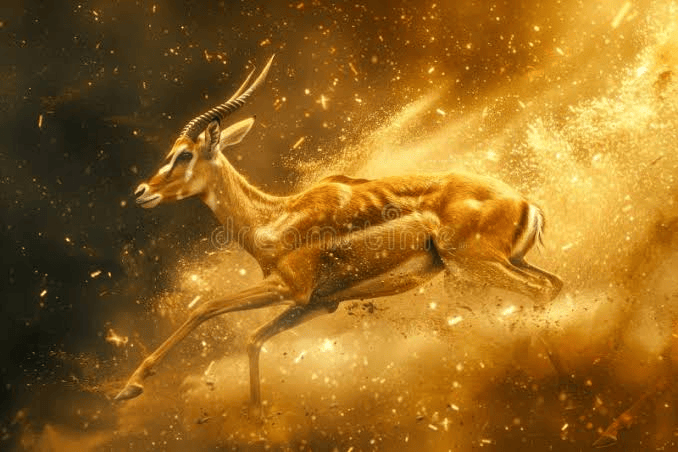
I could find no reference to a mouthless forest in the Hindu lore, but I did find a silent forest — or maybe it’s Nara who has no mouth.
In parts of the Ramayana, the forest falls silent—becoming a “silent forest” devoid of the natural voice of birds and animals—to grieve Rama’s departure into exile.
When I asked Google if the Purusha is ever described as “mouthless” in the Vedas, I was told he is specifically described as having a mouth in the Purusha Sukta (RV 10.90). I’m rather eager to retranslate that particular Sukta, which allegedly states that the universe was born from “the sacrifice” of the Great Purusha’s body. Let’s assume that’s a mistranslation, given that “sacrifice” is an idea unknown to God, who never takes, but only gives.
The next line reads:
To cross over the ocean, the song of Indra fully expands the hood of the snake receiving the elixir from Surya (the Solar Logos).
titirus (to cross over the ocean) ta (the song) indram (of Indra) pari (fully) spathe-śo (expands the hood of the snake) ada-dhāt (receiving the elixir) sūryeṇa (from Surya, the Solar Logos).
Notes:
Historic mistranslations have severely skewed the symbols referenced herein. Nowhere in the existing literature, for example, do we find Indra singing. But we also know that Indra did not, in fact, battle or destroy the Great Dragon Vritra; nor did Vritra smite Indra with his tail.
If Indra is the Yah Ray, then his song is the A-kara vibration — the ancient melody we used to know, but forgot in our lust for self-creation or concupiescence.
Or, as Course-Jesus explains:
Listen,—perhaps you catch a hint of an ancient state not quite forgotten; dim, perhaps, and yet not altogether unfamiliar, like a song whose name is long forgotten, and the circumstances in which you heard completely unremembered. Not the whole song has stayed with you, but just a little wisp of melody, attached not to a person or a place or anything particular. But you remember, from just this little part, how lovely was the song, how wonderful the setting where you heard it, and how you loved those who were there and listened with you. (ACIM, T-21.I.6:1-3)
We see the fully expanded hood of the snake in the images below of Lord Vishnu and the meditating Buddha. Note that, when fully expanded, that symbolic “hood” forms a radiant arch.
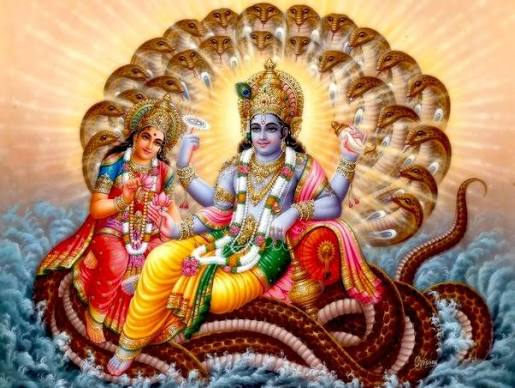
Is this arch Indra’s bow? If so, it’s also Shemayin, the arch described in Genesis. If I’m right about this, then Indra does indeed represent the Red Ray of Yah — the head of the Great Red Dragon of God’s Radiant Splendor. That dragon is called Vritra in the Hindu scriptures, Paroh in the Bible, and Ao Qin in Chinese philosophy.
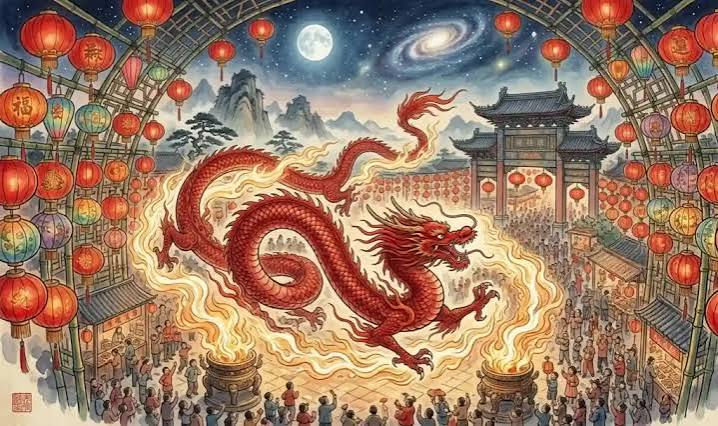
All of this means that Indra is, in fact, another form of Rahu (or visa-versa). In Sanskrit, Indra means “the supreme power of Ra” — the spiritual sun or Solar Logos, whereas Rahu means “Ra’s sacred-fire offering” or “the sacred-fire offering of the Solar Logos.”
And that “offering” rather than “sacrifice” by the Great Purusha is probably what RV 10:90 describes. Perhaps I’ll jump ahead and translate that famous teaching next!
Interestingly, Indra’s parents are identified in the lore as Kashyapa and Aditi, making him a brother to Surya-dev, rather than an offspring.
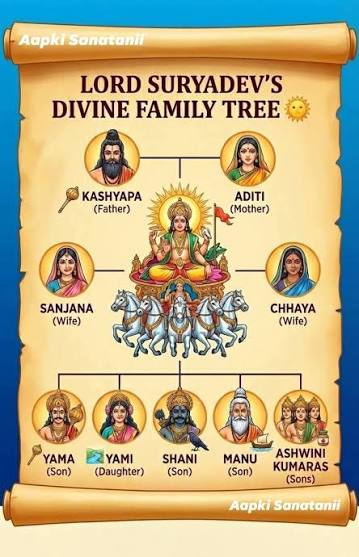
The Hindu lore confirms that Surya-dev is the source of the Amrita elixir, which “trickles down” to us through the spirit of Christ — via the Soma-press, winepress, or grinding stone (when the waters are gathered together as AUM).
In those allegories, the “snake” (serpent/dragon) receiving the Amrita from Surya is Rahu, whom we now know to be another form of Indra. And it must, therefore, be Rahu whose symbolic “hood” we expand through our meditations on AUM.
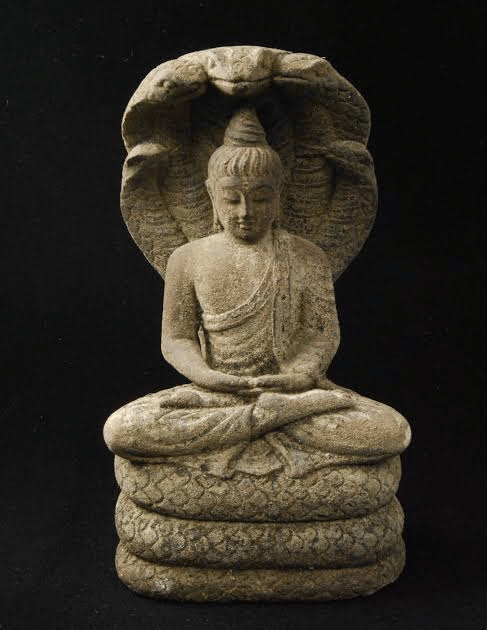
In Hinduism (and probably Buddhism as well) expanding the hood of a serpent symbolizes divine protection, ultimate awareness, and the supreme cosmic energy (Kundalini) reaching its peak. To expand the hood of the Great Dragon would be, therefore, to open one’s mind completely to the ever-present power of God’s Majesty and Grace.
Makes sense, right?
Or, to again quote Course-Jesus:
Practice but this today; repeat God’s Name [OM] slowly again and still again. Become oblivious to every name but His. Hear nothing else. Let all your thoughts become anchored on this. No other word we use except at the beginning, when we say today’s idea but once [I call upon God’s name and on my own]. And then God’s Name becomes our only thought, our only word, the only thing that occupies our minds, the only wish we have, the only sound with any meaning, and the only Name of everything that we desire to see; of everything that we would call our own.
Thus do we give an invitation which can never be refused. And God will come, and answer it Himself. Think not He hears the little prayers of those who call on Him with names of idols cherished by the world. They cannot reach Him thus. He cannot hear requests that He be not Himself, or that His Son receive another name than His.
The next Rik reads:
The Assembly of Indra, the red sword standing upright in Arbuda, is the one who eats the sovereignty and power of the Cosmic They.
pariyad (The Assembly) indra (of Indra) rod-asī (the red sword) ubhe (stands upright) abu-bhojīh = arbuda-bhoji (on Mount Abu or as the legendary serpent, Arbuda, the one who eats) mahinā (the sovereignty and power) viśva-taḥ (of the Cosmic They).
Notes:
First, let me say that H. H. Wilson had the first word here divided as pari and yad, which made no sense grammatically. “Encircle that?” I think not; whereas pariyad — the Assembly — works better. Second, let me state again that rodasi can’t mean “heaven and earth,” as the Sanskrit “experts” profess, because the syllables simply don’t support any such definition. Rod is probably a transliteration of rud, meaning “red,” making rudasi, “the red sword” or “the red cherubim.”
Because egoic interpretation of scripture has so distorted the imagery of the Flaming Sword and/or Sword of Spirit, it’s hard to say for certain what the red sword represents. What is does NOT represent is the Bible, the Qur’an, or any other fearfully interpreted text whose true teachings remain shrouded through mistranslation and fearful interpretation. If I had to guess, I’d say the red sword is the Flaming Sword that Elohim posted at the gate leading from the enclosure back into Eden. It is, therefore, the cherubim or “sword” guarding the eastern gate over which King Indra stands guard. Supposedly, the Bible never specifies which cherubim or Living Being guards the eastern gate, but I suspect it’s the Archangel Michael. In Hebrew, Michael is a compound of Mickha and el, meaning not “who is like God?,” but “he who is like Yahweh-Elohim.”
By the same token, ubhe can’t mean “both.” A marriage of ub and he, the word can only mean “stands upright.”
The real puzzle here was abu-bhojih. Abu may mean “father of” in Arabic, but it isn’t a word in Sanskrit. It is, however, an abbreviation for Arbuda, which is both a mountain and serpent in the Hindu literature. Since the previous Rik referred to the serpent’s hood, let’s assume the author means the legendary serpent, Arbuda.
Like Vritra, Arbuda is commonly mischaracterized as a demonic serpent slain by Indra. In the Skanda Purana, however, Arbuda is a noble serpent who heroically saves Nandi, the vahana of Lord Shiva, after the bull falls into a deep chasm or pit on the mountain later named for Arbuda (Mount Abu).
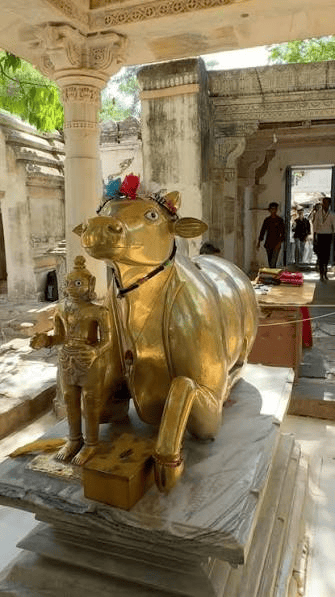
Nandi is the Bull of Heaven — the symbol of God’s Will, which “fell” with us into “the abyss” of ego-thinking. So, Arbuda, who was not a demon, rescued God’s Will from the pit. Arbuda supposedly means either “swelling” or “tumor,” but is probably a compound of arb and uda (“moving the waters”) or ar and budha (“to join in Budha”).
The image below shows a golden statue of Nandi in the Shiva Temple on Mount Abu in modern-day Rajasthani, India.
The next Rik reads:
Resting in the peace lighting the mind, the Red Ray generates the fish-mind shaking (vibrating) the waters of illusion and fear.
sīm (resting in) aman-ya-mānām̐ (the peace lighting the mind) abhi (the red ray) ma-nya-māna-ir (generates the fish-mind shaking) nir (the waters) brahma-bhir (of illusion and fear)
Notes:
In Eastern philosophy and psychology, “fish-mind” indicates the ego-bound intellect governed by primitive, reactive impulses. As I see it, the fish-mind is the mind receptive to guidance, correction, and/or purification by the Holy Spirit. And these receptive Souls in the dark waters of ego-thinking are the “fish” we catch by throwing our nets (Indra’s light shining in and connecting all beings) over the right-side of the boat. And this is how we become “the fishers of men.”
The story of Manu and Matsya, the fish avatar of Vishnu, demonstrates how the fish-mind expands over time, outgrowing in stages old modes of thinking.
This suggests to me that the “fish-mind” represents the Witness Consciousness or Buddhi — the one who hears the M-kara vibration. Until we hear that sound, we’re unreceptive to the Holy Spirit’s inner guidance. We belong, that is to say, to the caste of “untouchables” (Dalit in Sanskrit). We’ll discuss at another time how these spiritual castes got twisted into social orders in India through wrong-minded thinking.

In the Course, Jesus uses the phrase “resting in peace” in a similar capacity multiple times. What follows are but a few examples:
–How can I be alone when God always goes with me? How can I be doubtful and unsure of myself when perfect certainty abides in Him? How can I be disturbed by anything when He rests in me in absolute peace? How can I suffer when love and joy surround me through Him? Let me not cherish illusions about myself. I am perfect because God goes with me wherever I go. (ACIM, W-59.1:2-7)
–The strength in you will offer you the light, and guide your seeing so you do not dwell on idle shadows that the body’s eyes provide for self-deception. Strength and light unite in you, and where they meet, your Self stands ready to embrace you as Its Own. Such is the meeting place we try today to find and rest in, for the peace of God is where your Self, His Son, is waiting now to meet Itself again, and be as one. (ACIM, W-92.9:1-3)
–It is this Child in you your Father knows as His Own Son. It is this Child Who knows His Father. He desires to go home so deeply, so unceasingly, His voice cries unto you to let Him rest a while. He does not ask for more than just a few instants of respite; just an interval in which He can return to breathe again the holy air that fills His Father’s house. You are His home as well. He will return. But give Him just a little time to be Himself, within the peace that is His home, resting in silence and in peace and love. (ACIM, W-182.5:1-7)
Our next Rik reads:
God’s abode in chaos, Indra leads the celestial beings of the Earth to the journey’s end, making full the waters generating the divine glory bestowing the treasures of the other world.
a-dhamo (God’s abode) dasyum (in chaos) indra (Indra) naye (leads) divaḥ (the celestial beings) pṛthi-vyā (of the Earth) antam (to the journey’s end) āpur (making full) na (the waters) mā-yābhir (generating the divine glory or glorious powers) dhanadām (bestowing the treasures) paryabhūvan (of the other world).
Notes:
This took time to work out, but finally makes sense. We find the word yabhir in numerous sacred Sanskrit texts, but rarely with the correct definition of “divine glory” or “glorious powers.” But it is indeed God’s glory that Indra bestows, to restore our divine memories and powers at the journey’s end. The celestial beings of the Earth are our Souls — also the Child mentioned above by Course-Jesus; the waters which restore the treasures of the other world are the Living Waters of Grace we exchange as Souls through miracles. And the treasures of the other world are the spiritual treasures of the Real World we forsook by choosing the Ego Mind as our “master” or “god.”
Or, to again quote Course-Jesus:
Perceive any part of the ego’s thought system as wholly insane, wholly delusional and wholly undesirable, and you have correctly evaluated all of it. This correction enables you to perceive any part of creation as wholly real, wholly perfect and wholly desirable. Wanting this only you will HAVE this only, and giving this only you will BE only this. The gifts you offer to the ego are always experienced as sacrifices, but the gifts you offer to the Kingdom are gifts to you. They will always be treasured by God because they belong to His beloved Sons, who belong to Him. All power and glory are yours because the Kingdom is His. (ACIM, T-7.VII.11:1-6)
The next Rik reads:
Those who yoke the indestructible Bull’s shining splendor in the circle of Indra cast down the light of God in the darkness.
yujaṃ (those who yoke) vajraṃ (the indestructible) vṛṣ-abhaś (Bull’s shining splendor) cakra (in the circle) indro (of Indra) nir (cast down) jyotiṣ-ā (the light of God) tamaso (in the darkness)
Notes:
In Hinduism, the indestructible bull is Nandi, the vehicle for Lord Shiva. Being the Bull of Heaven, Nandi represents God’s Will working through and supporting Shiva, the transcendent power of divine grace. Being the guardian of the eastern gate, Indra presides over the circle of fire, the fiery eye (of the miracle cow) at the center of the Dharmacakra.
So, essentially, this Rik echoes what Jesus said in Matthew 11:28-30. As he explains in the Course, the word “burden” meant “message.” Ergo, by taking Christ’s yoke upon us, we dispatch messages of light into the darkness from the Meeting Place where our Souls “rest in God.”

The next Rik reads:
The guru-word extracts Anu, the Soul or True Self abiding eternally in the waters of the moutht gradually expanding the center of God’s vessel on the journey toward the shared purpose of the mind of the Supreme Lord, Indra.
gā (the guru-word) adukṣat (milks or extracts) anu (Anu) sva-dhām (the Soul abiding) akṣarann (eternally) āpo (in the waters of) asyā-vardhata (the mouth gradually expanding) madhya (the center) ā (of God’s) nāv-yānām (vessel on the journey) sadh-rīcīnena (toward the shared purpose) manasā (of the mind of) tam (the Supreme Lord) indra (Indra).
Notes:
Elsewhere in the Rigveda, Anu is described as tri-tasya, meaning “the triune name of God,” which is AUM, the guru-word. So, the author of this Sukta is telling us that purposefully chanting AUM or Om in meditation draws out Anu (the Soul and the AUM) from “the waters” of God’s Mouth. And based on my studies and experience, that is correct. Both Paramahansa Yogananda and Patanjali (among other gurus) teach that silently repeating Om or AUM in meditation is the way to hear the sound.
And the prophet Isaiah, Bible-Jesus, and Course-Jesus all say the same thing, but ego-serving translators misunderstood their meaning.
Read the section of Isaiah 55 (3-11) below with new eyes and you’ll see what I mean:
Incline your ear, and come unto me: hear, and your soul shall live; and I will make an everlasting covenant with you, even the sure mercies of David.
Behold, I have given him for a witness to the people, a leader and commander to the people.
Behold, thou shalt call a nation that thou knowest not, and nations that knew not thee shall run unto thee because of the Lord thy God, and for the Holy One of Israel; for he hath glorified thee.
Seek ye the Lord while he may be found, call ye upon him while he is near:
Let the wicked forsake his way, and the unrighteous man his thoughts: and let him return unto the Lord, and he will have mercy upon him; and to our God, for he will abundantly pardon.
For my thoughts are not your thoughts, neither are your ways my ways, saith the Lord.
For as the heavens are higher than the earth, so are my ways higher than your ways, and my thoughts than your thoughts.
For as the rain cometh down, and the snow from heaven, and returneth not thither, but watereth the earth, and maketh it bring forth and bud, that it may give seed to the sower, and bread to the eater:
So shall my word be that goeth forth out of my mouth: it shall not return unto me void, but it shall accomplish that which I please, and it shall prosper in the thing whereto I sent it.
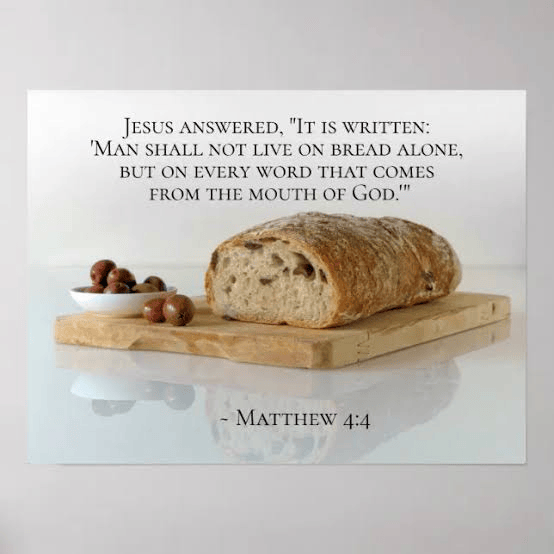
The word that come out of God’s mouth is the guru-word, AUM. This is how God speaks to His dreaming Souls, through the Holy Spirit yoking the Christ Mind in Wholeness or Oneness.
In Hinduism, the Divine Vessel (Kumbha or Patra) holds Soma’s elixir; while the mouth (mukha) is the door or entryway into the Divine Center. As one journeys spiritually, the boundary between the Soul and God (duality) gradually dissolves, expanding the gateway until only the Divine Center remains. The Divine Center is generally said to be the human heart, but is more likely the spiritual heart, heart-mind, or heart-cave (the hṛdguhāyām in Sanskrit) whose innermost center is the Inner Altar.
I’m pretty sure the Anahata or Heart chakra is the aforementioned “cave of the heart.” For it is from here that we move inward through the three circles of AUM: i.e., the Vishuddha chakra, where we hear the M-kara wind of the ethers; the Bindu-Ajna chakra [where we hear the U-kara waters of the moon], and the Sasararas chakra, where we hear the A-kara fire of the Sun). As I understand it, those three circles exist within the Heart Chakra in the manner of the triple-spiral Celtic knot known as Triskelion (three-legged) in Greek.
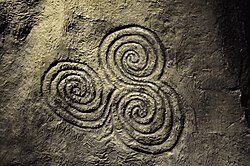
As we journey inward on the path toward restored at-one-ment, we move deeper into the heart-cave. When we reach the center or innermost chamber, we awaken from the dream.
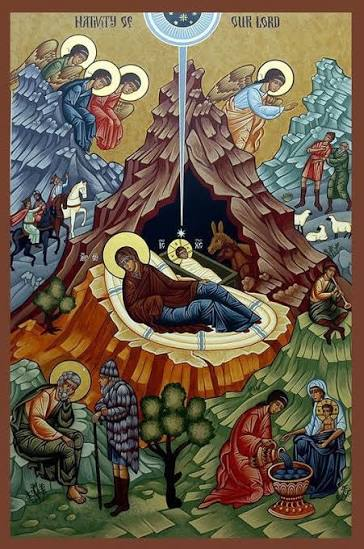
In western mysticism and alchemy, the “vessel” (Vas) is where transformation happens. The widening of the mouth during the journey represents the expansion of understanding or the opening of the spiritual throat/heart centers to express and absorb higher truths.
As I see it, the “vessel” is the Ark we build in our minds in meditation to make the journey to the Divine Center. Pulling the Ark through the waters of thought is Matsya, the first incarnation of Vishnu (the fish-mind?). As we progress (through the circles or chakras), we progressively lift the ego veils obstructing the light of the seven rishis or rays.
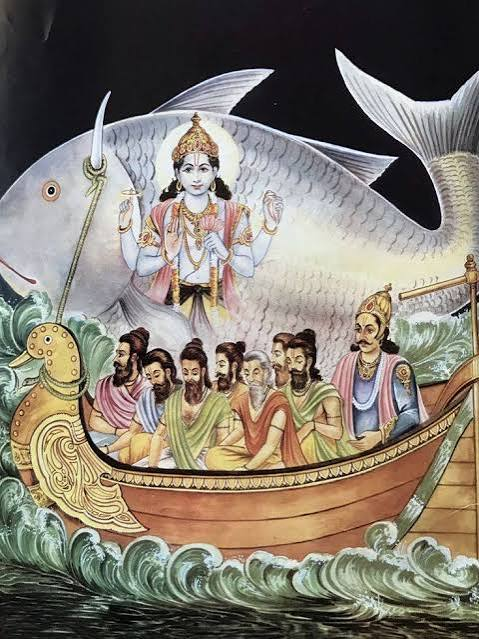
In meditation the other day, I saw that the seven rishis are the seven spirits of the Lampstand, as well as the Seven Rays. In Sanskrit, rishi means “seer,” so the Saptarishi or Seven Great Sages also are probably the seven eyes referenced at least four times in the Bible.
In Zechariah 3:9, those seven eyes belong to the stone, Ebeneezer; in Zechariah 4:10, they belong to Jehovah (YHVH); in Revelation 4:5, they are the seven spirits or lamps before the Throne of Elohim; and in Rev. 5:6, they are the seven eyes of the Lamb.
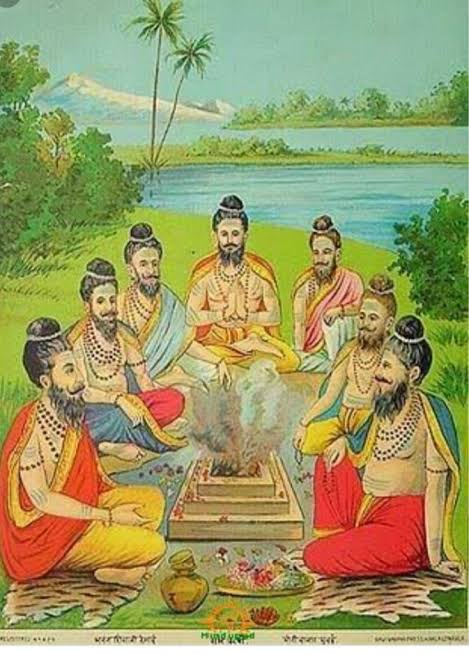
The 33rd Sukta’s next two lines read:
The splendor stolen by the instrument for killing, the Red Ray’s brightness inwardly promotes the kindling belonging to Ilibisa, the established divisions of the horned red ray dancing to draw out from Indra the light sounding the True Om in the Mighty Forest; the light sounding the radiant splendor of the thunderbolt to overthrow the divided thoughts attacking the Red Ray.
The established divisions of the horned red ray dance to draw out from Indra the light sounding the Truth in the Mighty Forest; the light sounding the radiant splendor of the thunderbolt to overthrow the divided thoughts attacking the Red Ray.
ojiṣṭhena (the splendor stolen) hanman-āhann (by the instrument for killing) abhi (the Red Ray’s) dyūn (brightness) ny (inwardly) āv-idhyad (promotes the kindling) ilībiśa-sya (belonging to Ilibisa) dṛḻhā (the established) vi (divisions) śṛṅgiṇam (of the horned) abhi-nac (red ray dancing) chuṣṇam (to draw out from) ind-raḥ(u) (King Indra or Lord Rahu) yā-vat (the light sounding) taro (the True Om) magha-van (in the Mighty Forest) yā-vad (the light sounding) ojo (the radiant splendor) vajreṇa (of the thunderbolt) śatrum (to overthrow) ava-dhīḥ (the divided thoughts) pṛtanyum (attacking) abhi (the red ray)
Notes:
The Ego Mind stole the divine splendor God gave the Christ, thereby dimming His Greater Light (the Great Ray of Yah) within us. Or, as Course-Jesus explains:
In the calm light of truth, let us recognize that you believe you have crucified God’s Son. You have not admitted to this “terrible” secret because you would still wish to crucify him if you could find him. Yet the wish has hidden him from you because it is very fearful, and so you are afraid to find him. You have handled this wish to kill yourself by not knowing who you are, and identifying with something else. You have projected guilt blindly and indiscriminately, but you have not uncovered its source. For the ego does want to kill you, and if you identify with it you must believe its goal is yours.
I have said that the crucifixion is the symbol of the ego. When it was confronted with the real guiltlessness of God’s Son it did attempt to kill him, and the reason it gave was that guiltlessness is blasphemous to God. To the ego, the EGO is God, and guiltlessness must be interpreted as the final guilt that fully justifies murder. You do not yet understand that any fear you may experience in connection with this course stems ultimately from this interpretation, but if you will consider your reactions to it you will become increasingly convinced that this is so.
As far as I know, neither Indra nor Rahu are depicted with horns in Hindu iconography. But, as in the Bible, the horns the rishi-author means are probably the horn-shaped subordinate beams or rays emanating from the Yah Ray. And those beams are indeed the established divisions or rays that “dance” underneath the illusion to draw out the divine identity or “name” dwelling within all embodied beings on earth.
We see those three dancing rays in the ancient Celtic spiral of life.

Okay, so … who or what is Ilibisa? The short answer is: yet another “demon” slain by Indra in the Hindu literature. The longer answer is: He’s an emperor of the Asuras, the son of Kashyapa (the world turtle) and Virocana (the divided lights), and the grandson of Prahlada (great joy).
Ilibisa supposedly means “one who throws knives at the enemy,” but the name actually means either “the sword (at the) root” (Ili-bisa) or, more likely, “the ancestral spirit of Isa” (ilib-isa). I say “more likely” because Ilib is a god-name found in other ancient cultures, whilst Isa is the Arabic name for Christ. In the Ugaratic pantheon, for example, Il’ib comes before El, Dagan, and Baal. In ancient Hebrew, the similar word-name Eliab means “God, the father.” And God the Father did indeed exist before Elohim (El), the sacred grains (Dagan), and the Bridegroom (Baal).
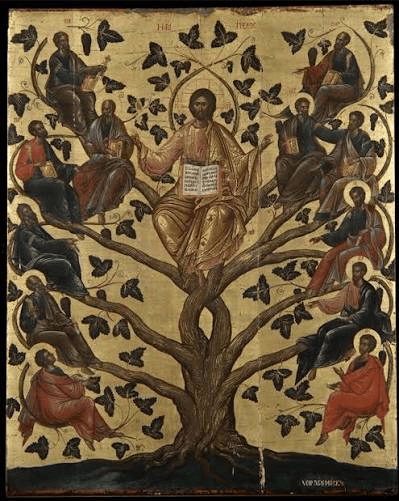
Given the preponderance of evidence, it’s unlikely Ilibisa was either a demon or conquered by Indra. More likely, he represents the spirits of God and Christ working together in the dream of separation. Ilibisa is probably, therefore, the Vedic equivalent of the Bible’s True Vine. And it is indeed to that “vine” that the kindling belongs. Rightly understood, that symbolic “kindling” is the wrong-minded thinking we willingly cast off with the Holy Spirit’s help, which is gathered, bundled, and burned to fuel God’s oven for baking the sweet cakes for the miracle cow. Those cakes are formed from the flour produced by the sacred grains we offer as “alms” to Christ to be ground on the millwheel and then sprinkled across the network.
The next line reads:
To go straight to the goal of Moksha, drive with agility the mouth bringing down in separation the sharp-sense to choose the gathering of waters.
sidh-mo (To go straight to the goal of Moksha) ajigād = aj-igat (drive with agility) asya (the mouth) śatrūn (bringing down) vi (in separation) tig-mana (the sharp awareness) vṛṣabheṇā (to choose the gathering of waters)
Notes:
Firstly, vrsabhena can mean either “to choose the gathering of waters” (vr-sabhena) or the Bull of Splendor (vrsa-bhena). In Hinduism, the phrases “sharp-awareness” or “sharp-sense” refers to the mental clarity given by the gods to enable us to cut through illusion, recognize spiritual truth, and realize the divine Self (Atman or Brahman).
This “gift” is God’s strength, as Course-Jesus makes clear in the prayer from Workbook Lesson 130: It is impossible to see two worlds.
Let me accept the strength God offers me and see no value in this world, that I may find my freedom and deliverance. (ACIM, W-130.8:6)
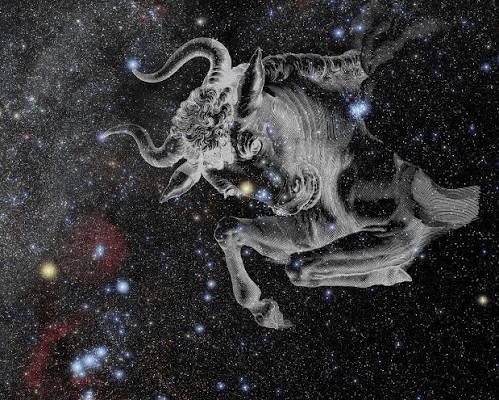
And that strength may indeed be the Bull of Splendor mentioned herein. If we read all Course-Jesus says on the subject of awareness, it becomes apparent that miracles are “the gift” that restores our awareness of divine reality. Or, as he explains in the title affirmation for Workbook Lesson 92: Miracles are seen in light, and light and strength are one.
So, the bull of God’s strength also is the bull of God’s Light or the Bull of Radiant Splendor — and that bull bestows the power to restore our sharp-awareness and/or “miracle-mindedness.”
The next Rik reads:
In the fortress of Om, the learned teachers gather together with the Vajra to pour forth the food of the enveloper, Indra/Rahu, to advance the Soul-Self’s awareness of walking in possession of the pure and eternal wholeness calling from Kutsa.
puro (in the fortress of Om) ‘bhet = bhat (the learned teachers) saṃ (gather together) vajreṇā (with the Vajra, diamond, or thunderbolt) sṛj-ad (to pour forth the food) vṛtram (of the enveloper) indraḥ (Indra/Rahu) pra (to advance) svām (the Self’s) matim (awareness of) at-irac (walking in possession of) chā-śadā-naḥ (the pure and eternal wholeness) āvaḥ (calling) kutsam (from Kutsa).
Notes:
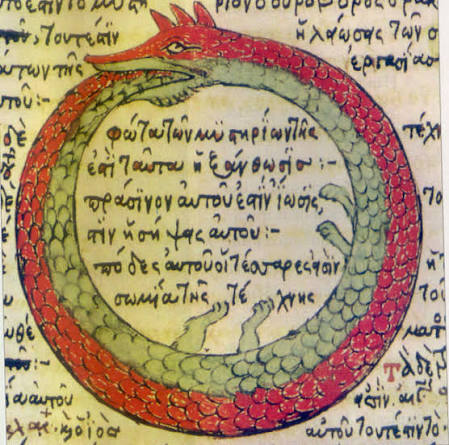
In Hinduism, the phrase “the food of the enveloper” represents a profound philosophical paradox from the Taittiriya Upanishad, where the “enveloper” is the consumer (the subject) and the “food” is the consumed (the object), but ultimately both are revealed to be the same divine essence (Annam or Brahman). That being the case, Vritra, the Great Dragon, would both envelop and feed on Indra, to dissolve the deceptive illusion of their two-ness.
We see that dynamic illustrated in the ouroboros symbol below.
By most accounts, Kutsa is the name of a celebrated Vedic Rishi descended from Angiras (the Spiritual Body rather than a Vedic sage). He’s also purported to be a friend and equal of Indra’s.
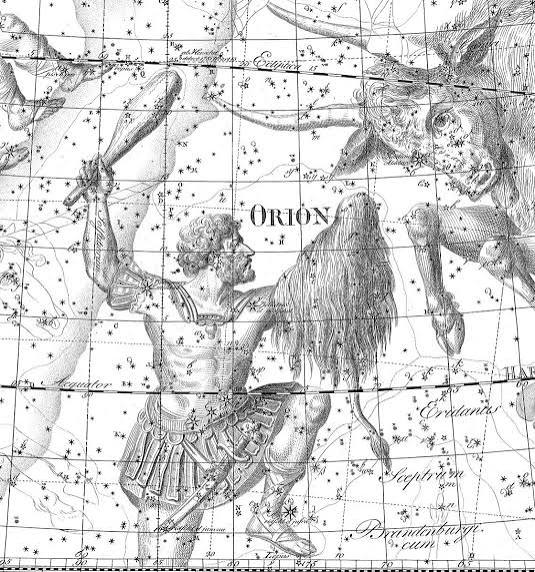
These descriptions suggest to me that Kutsa personifies Indra’s partner, the Great Ray of Vah, making Kutsa the Swift Antelope and Indra the Bull of Splendor.
In the projected dream-universe, we see the antelope as the three-stars forming Orion’s belt, which points to the Bull, Taurus.
The next Rik reads:
Indra labors to construct the circle of the throat or neck (the Vishuddha Chakra) to advance the AUM, the yoke reflecting the end the Bull of Splendor grants instantly.
indra (Indra) yas-miñ (labors to construct) cā-kan (the circle of the throat/neck = the Vishuddha Chakra) prāv-o (to advance the Aum) yu-dhy-antaṃ (the yoke reflecting the end) vṛṣ-abhaṃ (the bull of splendor) da-śadyum (grants instantly)
Notes:
This is interesting on many levels. Firstly, it’s telling us we “put on” the yoke of Christ/Aum in the Vishuddha Chakra, which is the spiritual hub of pure communications. Vishuddha is, of course, the Circle of Wind governed by Vayu, the Cosmic Breath. Vishuddha also is the first tier of the Celestial Realm, where we experience Self-Realization, Soul-Realization, and/or Atman Realization.
In Biblical terms, this is the Tent of Meeting (Mishkan) that Moses (the M-kara) pitched outside the Israelite base-camp in Exodus 33:7. Inside that tent, he was told by YHVH to place a bronze laver for washing the hands and feet of the entering priests, along with an altar for burning their grain offerings.
Rightly understood, the Vishuddha Chakra is “the gathering place,” where we first join together (as Souls) in Holy Relationship. That relationship, which is both much-discussed in the Course and much-misunderstood by most Course students and teachers, is “the yoke” Jesus famously mentions in Matthew 11:29.

If this is inconsistent with things I’ve written beforehand, I apologize. But, as I’ve said many times, I’m still learning how this all works (and will probably never see the whole picture clearly).
The next Rik reads:
A single hoof shakes out the dust of the stars in the celestial realm to gather together the rays of the triune Om (AUM), the guiding heart-light standing at the door calling together the I Am.
śapha-cyu-to (A single hoof shakes out) reṇur (the dust) nakṣata (of the stars or constellation) dyām (in the celestial realm) uc (to gather together) ch(i)vai-trey-o (the rays of the triune AUM) nṛṣā-hiyā-ya (the guiding heart-light) tasthau (standing at the door) āvaḥ (calling) śam-aṃ (together the I Am)
Notes:
In Hinduism, Nandi’s legs represent the four pillars of the righteous path (Dharma), which are said to be Truth, Righteousness, Peace, and Love/Compassion. What the Bull’s legs actually represent are the quadrants overseen by the four Attribute Rays of Vah — and that is why the Living Beings appear to the Biblical prophets with a single bull’s leg apiece.
The Bull of Splendor walks within us as those four Vah rays or Living Beings, each of which helps “shake out the dust” of ego-thinking from our Souls — the “stars” in the celestial realm. And this process gathers together the Aspect or Trinity Rays — the guiding heart-light standing at the door calling together the Great I Am — i.e., calling upon our Souls to join in Holy Relationship.
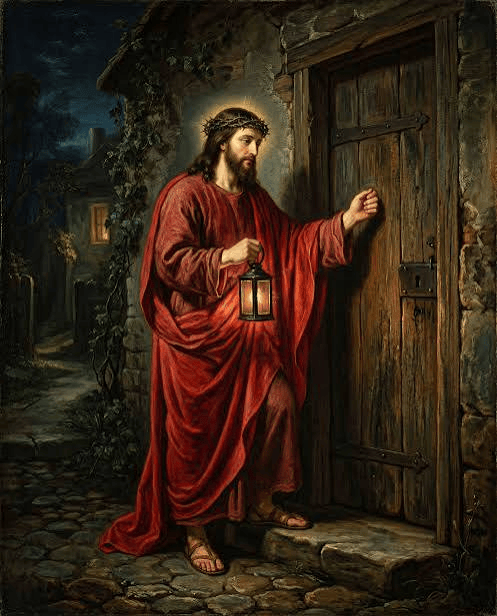
The next Rik reads:
The Bull of Splendor descends from Tugra, the sacred field for acquiring the great and munificent Trinity Rays, the guru-word of the luminous Purusha, the pure consciousness walking in the light of the standing rays crying out to be heard from the basecamp of celestial knowing.
vṛṣ-abhaṃ (the bull of splendor) tugryā-su (descends from Tugra, the sacred) kṣetra-jeṣe (land, field, or body for acquiring) magha-vañ (the great and munificent) chv(a)i-tryaṃ (Trinity Rays) gām (on the journey) jyok (delaying) cid (the pure consciousness) atra (that is here) tasthiva-aṃso (standing in the two) akrañ (crying out) chatrūyatām (to be heard from) adharā (the base-camp) veda-nākaḥ (of celestial knowing).
Notes:
Allegedly, Tugra is a king praised in RV 1.166, who sent his son, Bhuyu, with an army across the sea to conquer enemies. During the journey, their boat capsized in a storm, threatening to kill all aboard. While fighting for his life, Prince Bhujyu prayed to the Ashvins (the twin horse-headed healers discussed in the Rigveda’s second sukta), who miraculously rescued him and his army from the sea and returned them safely to dry ground.
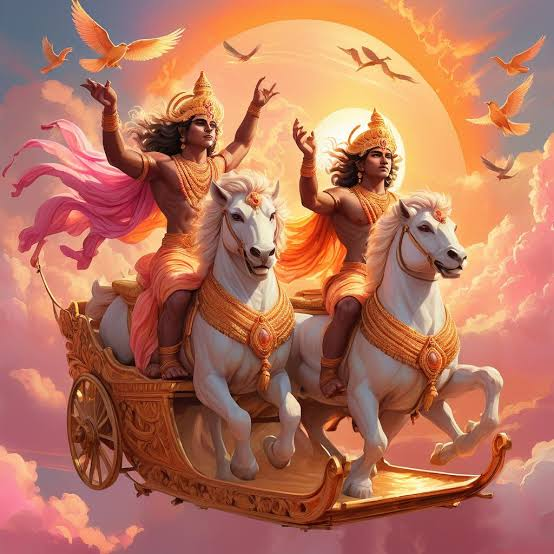
In meditation last night, I asked my inner-guru to reveal the identity of the Cosmic “They.” I received two seemingly conflicting answers. The first was that the Ashvins represent these two powers in Vedic Hinduism. The second is that this mysterious “They” is tied to the Seventh Ray, which isn’t yet fully manifest in the dream-realm.
When Jesus ascended, he “opened the door” for the Sixth Ray to enter, thereby activating the Atonement Plan. The door through which the Seventh Ray will enter remains closed at this point in time, but will be opened one day by another Chosen Soul — or by all “the Chosen Ones” joining together in Holy Relationship to save the world.
Okay, no … this isn’t quite what the occult sciences teach about the Seventh Ray; but then, most of what the occultists teach about the Rays is egoically tainted on many levels. The Seventh Ray can’t be, for example, “the Ray of Ceremonial Magic,” because all forms of “magic” are futile attempts to manipulate illusions to serve the goals and desires of the ego-body persona.
And that includes alchemy, witchcraft, medicine, sex-magick, and using the so-called “Law of Attraction” to manifest our ego desires.
As I understand it, the Celestial Speed-up of which the Course is a part will expedite the opening of the door through which the Seventh Ray will enter the dream.
This is, I believe, what Alice A. Bailey (through Master D. K.) discussed in her Treatise on White Magic first published in 1934. What she/they called “white magic” is, in truth, what Course-Jesus terms “miracle-working.”
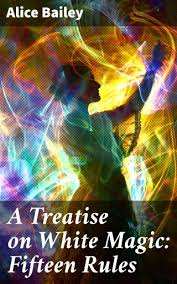
Or, as the Lucis Trust affirms:
The book defines white magic not as supernatural tricks, but as the disciplined, intelligent building and release of thought-forms under Soul control.
Or, as Course-Jesus explains in more detail:
Miracle working entails a full realization of the power of thought in order to avoid miscreation. Otherwise a miracle will be necessary to set the mind itself straight, a circular process that would not foster the time collapse for which the miracle was intended. The miracle worker must have genuine respect for true cause and effect as a necessary condition for the miracle to occur.
Both miracles and fear come from thoughts. If you are not free to choose one, you would also not be free to choose the other. By choosing the miracle you HAVE rejected fear, if only temporarily. You have been fearful of everyone and everything. You are afraid of God, of me and of yourself. You have misperceived or miscreated Us, and believe in what you have made. You would not have done this if you were not afraid of your own thoughts. The fearful MUST miscreate, because they misperceive creation. When you miscreate you are in pain. The cause and effect principle now becomes a real expediter, though only temporarily. Actually, “Cause” is a term properly belonging to God, and His “Effect” is His Son. This entails a set of Cause and Effect relationships totally different from those you introduce into miscreation. The fundamental conflict in this world, then, is between creation and miscreation. All fear is implicit in the second, and all love in the first. The conflict is therefore one between love and fear. (ACIM, T-2.VII.1:1–3:15)
Let me add that the Seventh Ray is said to be Indigo in color — the same color assigned to the Ajna Chakra, where the sacred marriage takes place.
According to Alice Bailey:
- The First Ray (Will or Power) and the Third Ray (Active Intelligence) have a close structural and numerical alliance with the Seventh Ray (Ceremonial Order and Magic), often summarized in the occult relationship 1 – 3 – 7.
- In this framework, the Seventh Ray acts as the physical-plane reflection or synthesis, where the active intelligence of the Third Ray and the divine will of the First Ray manifest into form and ritual order.
This isn’t quite right. Firstly, the Third Ray isn’t the power of “active intelligence” — it’s the divine force of the Holy Spirit — the mind of the At-one-ment reaching from the God Mind through the Christ Mind to heal the separation.
Secondly, the Seventh Ray isn’t the Ray of Ceremonial Magic (as I’ve said), it’s the Ray of Exaltation and/or Glorification– the final and only step in the at-one-ment process undertaken by God Himself directly.
Or, as Course-Jesus explains:
This world of light, this circle of brightness is the real world, where guilt meets with forgiveness. Here the world outside is seen anew, without the shadow of guilt upon it. Here are you forgiven, for here you have forgiven everyone. Here is the new perception, where everything is bright and shining with innocence, washed in the waters of forgiveness, and cleansed of every evil thought you laid upon it. Here there is no attack upon the Son of God, and you are welcome. Here is your innocence, waiting to clothe you and protect you, and make you ready for the final step in the journey inward. Here are the dark and heavy garments of guilt laid by, and gently replaced by purity and love. (ACIM, T-18.IX.9:1-7)
The circle he describes is the Ajna Chakra, the stronghold of God’s Greater Light in the dream; this is the Real World — the walled city in the forest, where God’s gifts are held in trust, awaiting our return to the True Perception, rightmindedness, miracle-mindedness, and/or righteousness facilitated in time by the Third Ray.
Compare this to the Biblical definition of “glorification” (saved from the presence of sin forever) as the final step in the salvation process.
In John 17:5, Jesus recites a prayer to use in requesting glorification from God.
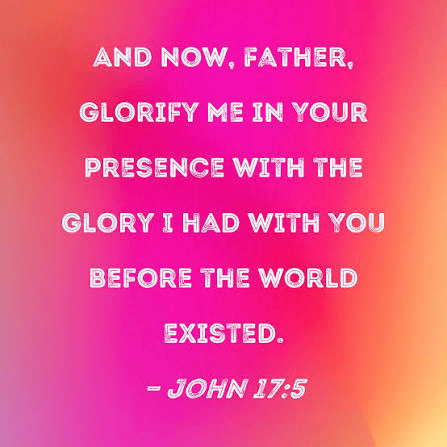
Rightly understood, “glorification” or “exaltation” describes our full acceptance of what we truly are and have always been in God’s estimation.
Or, as Course-Jesus further explains:
Yet if truth is indivisible, your evaluation of yourself must BE God’s. You did not establish your value and it needs no defense. Nothing can attack it nor prevail over it. It does not vary. It merely IS. Ask the Holy Spirit what it is and He will tell you, but do not be afraid of His answer, because it comes from God. It is an exalted answer because of its Source, but the Source is true and so is Its answer. Listen and do not question what you hear, for God does not deceive. He would have you replace the ego’s belief in littleness with His Own exalted Answer to what you are, so that you can cease to question it and know it for what it is.
I could say more, but I believe I’ve said enough for now.
Until next time, walk in the light of truth.


Leave a Reply