Namaste, my brother in Christ, and welcome (or welcome back) to my latest adhyayana posting. Today, we’re discussing the Rigveda’s 27th Sukta, another wisdom teaching for Brahmins — the Teachers of God who can hear the sacred syllable, Om or AUM (rather than a “caste” of human society). Contrary to popular presumption, the 27th Sukta is neither a hymn to Agni nor a verse written in Gayatri meter.
As usual, we are questioning everything the Father of Lies has hitherto espoused about the Rigveda’s teachings. In actuality, Rv 1.27 is a narrative teaching about the four winds of Nara, which the Bible calls “the abiding winds of God’s Breath.”
The Sukta’s first Rik reads:
The abiding winds of Nara, the true state of being the Bridegroom protects, bow down to the power of Agni with reverential salutations. Together, they rule the Borderland sacred-fire offerings of the Name (AUM), the Word of God striking (like a bell) the whole Sonship dwelling in the broad steps of the holy selfless service of scattering the Bridegroom’s capstone.
As-vam (the abiding winds of) na (Nara) tvā (the true state of being) vāra-vantaṃ (the Bridegroom protects) vand-adhyā (bow down to the power) agniṃ (of Agni) namobhiḥ (with reverential salutations) samrājantam (together rule the Borderland) adhvarā-ṇām (sacred-fire offerings of the name) sa (the Word of God) ghā (striking, like a bell) naḥ (the whole) sūnuḥ (sonship) śavasā (dwelling in in) pṛthupragāmā (the broad steps of) su-śevaḥ (the holy selfless service) mīḍhvām̐ (of scattering the Bridegroom’s) asmākam (headstone or capstone)
Notes:
Asvam is typically defined as “the horse of” — and that’s how I’ve defined it previously. That may be right, as far as it goes; but, when divided as as-vam, the word can also mean “abiding winds of” — a phrase also found in the Bible to describe the four winds of God’s Breath (Ruach/Vayu). According to Google, these inner-winds act together to bring life, change, and correction from all directions. They also represent God’s sovereignty over the earth and his active role in guiding believers.
From these characterizations, we can ascertain that Nara’s four winds are, in truth, the four Rays of Attribute produced by the Vah Ray of YHVH — the Holy Spirit’s “hook.” According to the rishis, these four “winds” work together in the Borderland to restore the power of Agni, the sacred and eternal flame of God’s presence on the Inner-Altar.
Might these winds be the Maruts? I can’t help but wonder. Rather than go back to check, however, let’s plow ahead.
The sacred-fire offerings of the Name are the offerings of AUM taking place in the three meditative “meeting” circles for sharing the karas: the circles of Wind (the M-kara), Water (the U-kara), and Fire (the A-kara). And these three tones “strike (like a bell)” all the Souls dwelling in those three circles — the broad inward steps (taken by Vishnu, the Holy Spirit) toward the Inner Altar. And it is in those circles, as I’ve explained, that we scatter (in selfless service to God, Christ, and the whole Sonship) the Bridegroom’s headstone or capstone.
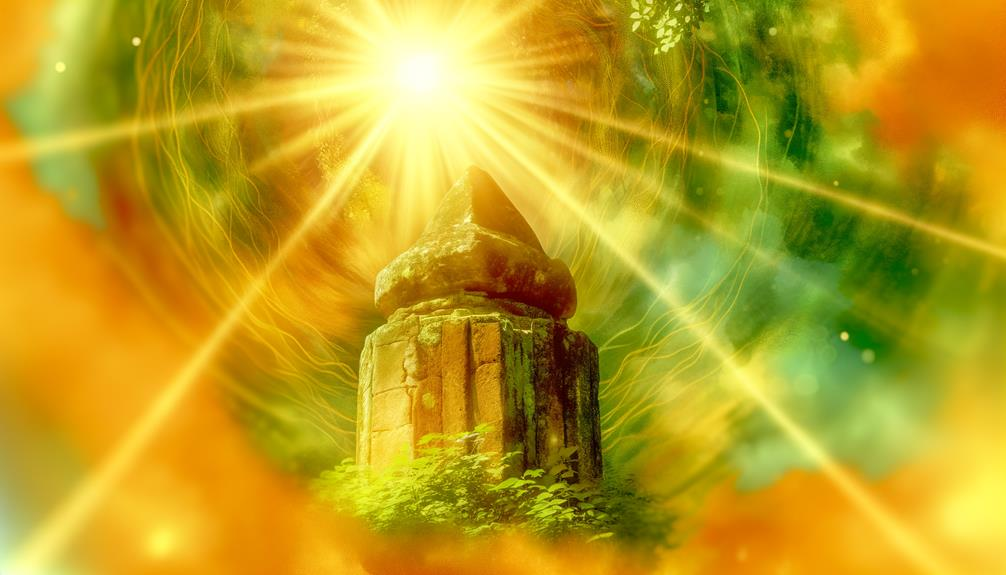
The capstone is the final, crowning stone that completes a structure. Unlike the cornerstone (foundation) “rock” the Bible also references, the Capstone is the last piece set in place, representing completion, grace, and victory. So, the capstone is the crowning glory that completes the restoration of the Temple.
The Angel who visited the prophet Zechariah mentioned this Capstone, as did the author of Psalm 118, which Jesus alluded to in Matthew 21:42, Mark 12:10, and Luke 20:17.
In all three of the gospel accounts, my beloved WaheGuru says virtually the same thing, which is this:
The stone which the builders rejected, the same is become the head of the corner: this is the Lord’s doing, and it is marvelous in our eyes.
Although many Christians assume the Capstone is Jesus himself, nowhere does he say this specifically.
My intuition tells me the Capstone is, in fact, the vibrational tone identified in the Kabbalah as the Exalted Hand of God. And that vibrational tone does indeed complete the Temple’s restoration. Which of the AUM tones is the Exalted Hand and the Capstone? Let’s see if the ancient rishis give us the answer.
The Sukta’s second and third Riks read:
The gates of life, the Word of God vessels negate mechanical making (the ego’s mode of creating). In the circles for joining, the circles within mortal existence, the snaking greater lights join to safeguard the ever-kindling cosmic yoke.
Bab-hūyāt (the gates of life) sa (the Word of God) no (vessels) dū-rāc (negate mechanical making) cā-sāc (in the circles for joining) ca (the circles) ni (within) martyād (mortal existence) ag-hā-yoḥ (the snaking greater lights join) pāhi (to safeguard) sadam (the always or ever) id (kindling) viśvā-yuḥ (Cosmic Yoke)
Notes:
The profusion of wrongminded definitions made this very difficult to translate sensibly. Babhuyat, for example, is said to mean “to become,” but actually means “the gates of life,” when divided rightmindedly. In Christian theology and scripture, we also find the “gates of life” as spiritual access points. The narrowest of these gates, Jesus says in Matthew 7:13-14 “leads to eternal life.”
If I’m reading this right, the “gates of life” are, in fact, the three tones of AUM, the Word of God vessels negating egoic “making” or “causeless manifesting” — that which we “create” without God’s assent, making it illusory, “unreal” or Satan (not of God). As explained in an earlier post, the circles are concentric. They are designed to move our consciousness inward, toward the Inner-Altar at the center, in three great steps or strides.

We talked about this in our lesson on the 24th Sukta. The three circles of AUM form a wheel resembling the one above. The double-lined rings indicate the boundaries of each circle. We cross those boundaries when we begin to hear the next higher tone. So, the tones form “the gates” into the circles, the narrowest of which is the gate leading into the Circle of Fire at the center of the wheel (“the Father’s Circle” in the 24th Sukta). We enter this inner-most circle through the “eastern” gate into Eden, where Elohim posted the Flaming Sword (according to Genesis). That gate stands between the enclosure or walled garden Elohim erected “east of Eden” and Eden itself. Ed-en, btw, means “bearing witness to the spring” in Hebrew.
In Hinduism, the Flaming Sword is personified as King Indra; in True Yoga, it’s Kundalini. In Buddhism it’s personified as the goddess, Vajrayogini. In the three Abrahamic faiths, it’s Michael, the chief archangel. Ergo, Indra, Kundalini, Vajrayogini, and Michael are four different symbolic forms of the same power — which is the A-kara vibration. That power is, I suspect, the “crown” we are promised in return for our “righteousness.” Righteousness means “right-mindedness,” so, it refers to the Christ Mind, free of the Ego’s influence. The crown I mean is the same metaphoric “crown” the Bible sometimes calls the Crown of Righteousness, the Imperishable Crown, the Crown of Life, and the Crown of Rejoicing.
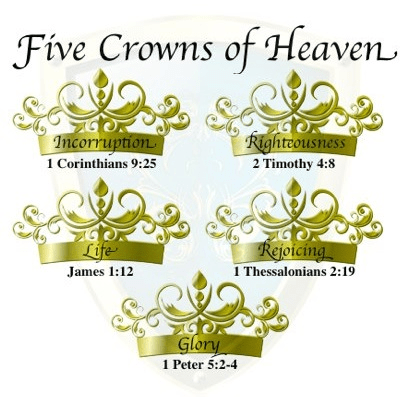
What I’m trying to say is this: There is only one “crown,” not five, as some theologies hold. As Jesus explains in the Course, we receive that “crown” as “the final gift of eternity.”
Perfect perception, then, has many elements in common with knowledge, making transfer to it possible. Yet the last step must be taken by God, because the last step in your redemption, which seems to be in the future, was accomplished by God in your creation. The separation has not interrupted it. Creation cannot be interrupted. The separation is merely a faulty formulation of reality, with no effect at all. The miracle, without a function in Heaven, is needful here. Aspects of reality can still be seen, and they will replace aspects of unreality. Aspects of reality can be seen in everything and everywhere. Yet only God can gather them together, by crowning them as one with the final gift of eternity (ACIM, T-13.VIII.3:1-9)
Or, as we similarly find in 2 Timothy 4:8:
Henceforth there is laid up for me a crown of righteousness, which the Lord, the righteous judge, shall give me at that day: and not to me only, but unto all them also that love his appearing.
From these descriptions and pure logic, it seeems as if the “crown” should be the Capstone. But is it?
In the Course, Jesus tells us the Holy Spirit teaches three lessons. Those lessons are, in order, 1) to have all, give all to all, 2) to have peace teach peace to learn it, and 3) be vigilant only for the Kingdom of God. A flash of insight tells me these equate to the three great strides taken by Vishnu, as well as the lessons learned in the three circles of AUM.
This being the case, we learn to give in order to receive in the Circle of Wind. In the Circle of Water, we teach peace to learn it; and in the Circle of Fire, we must be vigilant in our internal and external efforts to “make earth like Heaven” for everyone.
The snaking greater lights mentioned in these Riks are the Great Rays of Yah and Vah, the pillars of cloud and fire in the Old Testament. These are the energies working through the Ida and Pingala nadis, which (as Kundalini Yoga teaches) rise up the Sushumna like the snakes on a caduceus. And when these two Great Rays “marry” in the sixth chakra, the Capstone is produced. And that Capstone, lo and behold, is the U-kara miracle-vibration, as we learn in the Sukta’s next verse.

The fourth Rik reads:
The wind of the U-kara of Kamadeva’s three sacred modes of being is the Capstone, the exalted sacred syllable on the journey of the nine lights coming together in the fiery eye.
imam (the wind of) ūm (the u-kara) iti (kamadeva’s three) ṣu (sacred) tvam (modes of being) asmākaṃ (is the capstone) saniṃ (the exalted) gā-yatraṃ (sacred syllable on the journey of) navyāṃsam (the nine lights coming together in) agne (the fiery eye).
Notes:
Herein, the rishis clearly identify the U-kara, the miracle-vibration of the Water Circle, as the Exalted Hand, as well as the Capstone, which is born when the Great Rays “meet” and/or “marry” in the Ajna Chakra. This makes sense, actually, since this “merger” both awakens Kundalini and opens the Spiritual Eye, restoring to us the Soul’s spiritual vision.
We see this “sacred marriage beautifully illustrated on the TWO OF CUPS in the RWS Tarot. The woman represents the Pale Ray of Yav, which restores the Soul to rightmindedness. The man represents the Red Ray of Yah, which preserves the Soul’s eternal identity. The snakes are the Great Rays snaking their way up the Shushumna to the red-winged lion representing God’s Strength, which is the Holy Spirit, as Course-Jesus explains below the image:
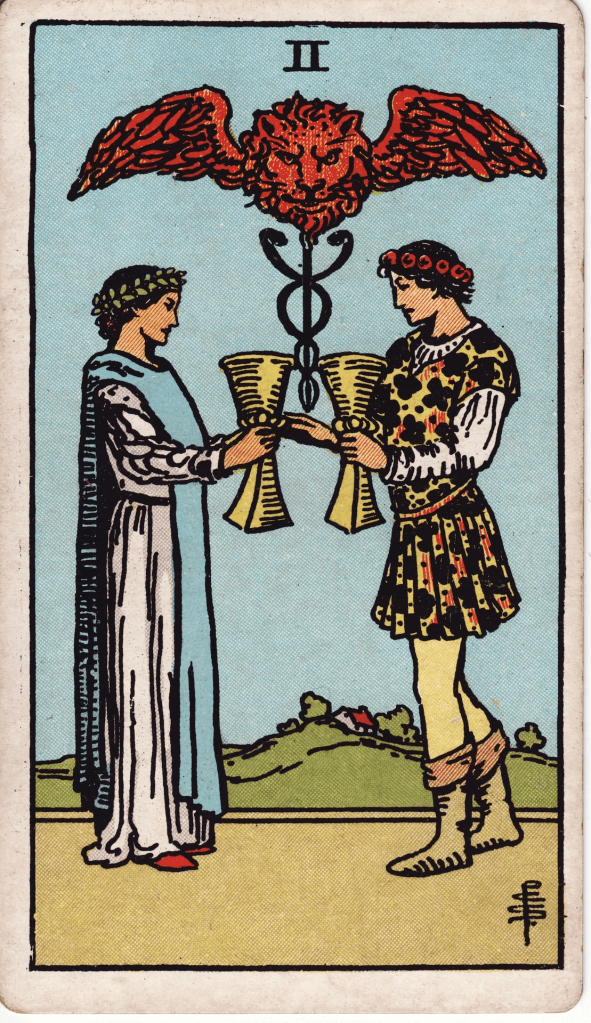
The Holy Spirit is your strength because He knows nothing but the spirit as you. He is perfectly aware that you do not know yourself, and perfectly aware of how to teach you to remember what you are. Because He loves you, He will gladly teach you what He loves, for He wills to share it. Remembering you always, He cannot let you forget your worth. For the Father never ceases to remind Him of His Son, and He never ceases to remind His Son of the Father. God is in your memory because of Him. You chose to forget your Father but you do not really want to do so, and therefore you can decide otherwise. As it was my decision, so is it yours. (ACIM, T-12.VI.2:1-8)
Now that we’ve cleared all that up, let’s talk about “the journey of the nine lights.” We find these nine symbolic lights in traditional Judaism as the flames on the Hanukah Menorah. In Hinduism, they are the Navagraha (the nine celestial bodies or “planets”) that are said to influence human life, destiny, and karmic laws. Worshipped in Hindu temples for harmony and to mitigate negative influences, these nine “bodies” include Surya (the Greater Light and/or Solar Logos), Chandra (the Moon or Lesser Light of the Christ Ray), Mangala (Mars, the red one), Budha (Mercury, the messenger god), Guru (Jupiter, the dispeller of darkness), Shukra (Venus, the goddess of Love) Shani (Saturn, the seed-sowing god), Rahu (the head of the red dragon), and Ketu (the tail of the red dragon).
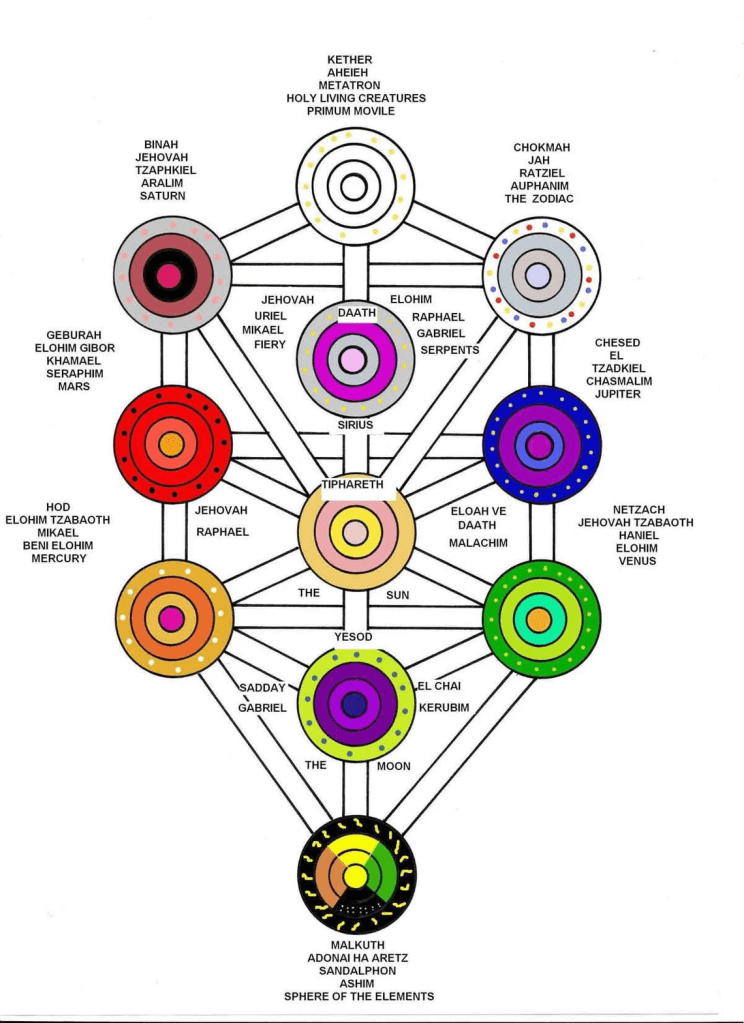
In Christianity, these “nine lights” are the nine “gifts” of the Holy Spirit, as well as the nine “fruits” of the Lamb. They correspond, therefore, with nine of the ten Sefirot forming the Tree of Life and the Path of the Flaming Sword in the Kabbalah teachings. The diagram below of the Sefirot includes their planetary associations. A quick study suggests to me that Malkuth, the Kingdom, is probably the circle of fire — our final destination on the journey back to Da’ath, the hidden sphere of the Infinite Absolute God Mind. As I read this “map,” the fruit we reap in Malkuth is “the crown of Glory.”
The Sukta’s fifth and sixth Riks read:
The divine spirit advancing the sound vibration of God’s vessels are the shining offspring of the Supreme Esu of God’s holy vibration. The middle Esu teaches of the treasures not belonging to the dark elephant of desire.
deveṣu (the divine spirit) pra (advancing) vocaḥ (the sound vibration) ā (of God’s) no (vessels are ) bha-ja (the shining offspring) parameṣv (of the Supreme Esu), ā (of God’s) vājeṣu (holy vibration). madhyameṣv (the middle Esu) śikṣā (teaches) vasvo (of the treasures) antamasya (not belonging to the dark) ibha-ktāsi (elephant of desire).
Notes:
In Hinduism (according to Google), the “elephant of desire” represents intense, untamed craving and lust, often associated with the mind’s unruly nature and the base, primal desire that drives worldly life. It represents a “wild” force that can lead to spiritual ignorance, but when managed, can be transformed into disciplined spiritual power.
So, the dark elephant of desire is the Ego Mind. And the middle Esu teaches of the spiritual treasures not understood or valued by the Ego Mind.
Esu or Esau is the Biblical name for the Red Ray of Yah. Or one of the names, I should say. So, the “middle Esu” is the middle tone of AUM. The middle-tone of AUM is the U-kara–the Capstone, which teaches us about the holy treasures, holy inheritance, and/or “the miracles” preserved or “held in trust” for us in the dream in the Golden Treasury.
And this tracks with what Course-Jesus says below:
The Holy Spirit is the mechanism of miracles. He recognizes both God’s creations and your illusions. He separates the true from the false by His ability to perceive totally rather than selectively.
The miracle dissolves error because the Holy Spirit identifies error as false or unreal. This is the same as saying that by perceiving light, darkness automatically disappears.
The seventh Rik reads:
The radiant splendor of the red-colored ray of light in the kingdom of God’s Holy Instant is the one delivering the streams of abiding love to illuminate the fiery eye.
citra-bhāno (the radiant splendor of) sindhor (the red-colored) ūrmā (ray of light) upāka (in the kingdom) ā (of God’s) | sadyo (Holy Instant?) dāśuṣe (is the one delivering) kṣar-asi (the streams of abiding love) yam (to illuminate) agne (the fiery eye).
Notes:
The streams of abiding love are Kamadeva’s three — the trinity rays of Agape, which sound the AUM. The source of these, as I’ve said and the rishis affirm herein, is the Red Ray of Yah. The source of the Red Ray, in turn, is the Radiant Splendor of God’s Word, which is the Red Dragon whose head and tail are called Raha and Ketu in Vedic Astrology.
The next Rik reads:
The sacred army of humans sound the holy vibrations to illuminate and drive the whole Word of God to support the mechanism of the everlasting Isa (the Supreme Lord or Jesus Christ), extending into the physical form consciousness.
pṛtsu (the sacred army) martyam (of humans) avā (sound) vājeṣu (the holy vibrations) yaṃ (to illuminate) junāḥ (and drive the whole) sa (Word of God) yantā (to support the mechanism) śaśvatīr (of the everlasting) iṣaḥ (Isa, the Supreme Lord and Master and/or Jesus Christ) paryetā (extending into) kayasya (the physical form) cit (consciousness)
Notes:
Our egos might have trouble understanding how the rishis could have written about Jesus Christ two thousand years before he was born on earth, but the Holy Spirit knows everything that will ever happen, because it’s already happened. Remember that the dream we’re living through now is a replay of the original dream, which only lasted an instant. Because time isn’t real and God’s thoughts play out to perfect completion instantly in eternity. So, the dream we made against God’s will ended as soon as He willed it to end. In a Holy Instant. Only God’s grace and our free will allow it to appear to continue. We live in the dream of earthly existence, therefore, only as long as we choose to do so.
The mechanism of the everlasting Isa is the Atonement, which does indeed extend into the physical form of consciousness (through the AUM vibration sounded by the Army of Christ in the three circles).
The next section read:
The winds of glory abide in three streams of Yah, the word of God sustaining the cosmic home apart from wandering in fear; the abiding love sings the sounds vibrating the diamond or gems–the abiding love Sani’s tail grows old to awaken to the Supreme Spirit’s True Perception division-by-division by strengthening within that which the song of praise to Rudra’s light knows as one.
vājo (the winds of glory) as-ti (abide in three) śravāy-yaḥ (streams of Yah) sa (the word of God) vājaṃ (sustaining) viśva-carṣa-ṇir (the cosmic house apart from) arvadbhir (wandering in fear) astu (the abiding love) ta-rutā (sings the sound) vip-rebhir (vibrating the diamond or gems) astu (the abiding love) sani-tā (Sani’s tail) jarā-bodha (grows old to awaken) tad (the Supreme Spirit’s) viviḍḍhi (True Perception) viśe-viśe (division-by-division by) yajñiyāya (strengthening within that which) stomaṃ (the song of praise) Ruraya (to Rudra’s light) dṛśīkam = drs-ekam (sees or ‘sknows as one) ||
Notes:
There is a lot here to explain.
The winds of glory are the three streams of the Yah Ray. Therefore, the winds of glory are the three tones of AUM, which together comprise Agape (the abiding love). We don’t find the phrase “winds of glory” in traditional translations of the Bible, but we do find God’s presence and glory making themselves known in the world as rushing winds. As I read this verse, the AUM restores the glory of God, division-by-division, in three great strides. As the Course teaches, God’s Glory also can be restored all at once, in the Holy Instant.
In a section of the Course titled “the Obstacles to peace,” Jesus discusses how the Rays of Love reveal God’s glory to us:
The fourth obstacle to be surmounted hangs like a heavy veil before the face of Christ. Yet as His face rises beyond it, shining with joy because He is in His Father’s Love, peace will lightly brush the veil aside and run to meet Him, and to join with Him at last. For this dark veil, which seems to make the face of Christ Himself like to a leper’s, and the bright Rays of His Father’s Love that light His face with glory appear as streams of blood, fades in the blazing light beyond it when the fear of death is gone. (ACIM, T-19.IV-D.2:1-3)
With regards to the Holy Instant, he says:
In the holy instant, you will see the smile of Heaven shining on both you and your brother. And you will shine upon him, in glad acknowledgment of the grace that has been given you. For sin will not prevail against a union Heaven has smiled upon. Your perception was healed in the holy instant Heaven gave you. Forget what you have seen, and raise your eyes in faith to what you now can see. The barriers to Heaven will disappear before your holy sight, for you who were sightless have been given vision, and you can see. Look not for what has been removed, but for the glory that has been restored for you to see. (ACIM, T-19.III.10:1-7)
According to Sanskritdictionary.com, the word Jarabodha occurs only once in the Rigveda and “is of doubtful meaning.” According to various “experts,” it might be a proper name, or it might mean “alert in old age.” Dissatisfied with those meaningless definitions, I played around with the syllables until I came up with something more suitable. In the end, I settled on “growing old to awaken.”
Can’t be certain Sanita means “Sani’s tail,” but there is a story involving Sani and Hanuman’s tail in the Ramayana. Sani also is the god of “growing old,” so that piece definitely fits. Sani is the Hindu personification of Saturn, the supposed planet of karma and trials, while Hanuman represents the radiant splendor or majesty of God still companioning the Soul (Rama) in the Forest of All Beings. According to one source: “Shani’s slow-moving transit through the zodiac and connection with hardship has earned him a reputation as a stern taskmaster. However, a deeper look into Hindu mythology reveals Shani’s multifaceted role, highlighting his significance not only as a planet, but also as a deity intertwined with justice and spiritual awakening.”
In the Ramayana, King Ravana (the radiance in the forest) imprisoned all the celestial planets, including Shani-dev, in his dungeons to alter his destiny. When Lord Hanuman arrived in Lanka to search for Sita, he heard Shani’s cries and broke open the cell to free him. Once freed, Shani looked at Hanuman and decided to test his strength by casting his powerful, karmic gaze upon him. However, because Hanuman was completely surrendered to Lord Rama, Shani’s glance had no negative effect on him. Impressed by Hanuman’s unparalleled power and devotion, Shani promised never to trouble Hanuman’s sincere devotees, provided they embody Hanuman’s virtues of discipline, selflessness, and humility.
Another popular legend says that Shani-dev once approached Lord Hanuman while he was deep in meditation to ask for a duel. Ignoring Shani’s provocations, Hanuman grew angry at the disturbance. He wrapped his massive tail around Shani, dragging him and swinging him against rocks. Battered and bruised, Shani begged for mercy. To soothe his wounds, Hanuman applied mustard oil to Shani’s body, instantly relieving his pain.
To understand the deeper meaning of these allegories, we need to understand what Shani actually represents. The real question to be answered is this: What holy idea did we project outward in the form of Saturn? Saturn is the sixth planet from the Sun. Apart from it’s distinguishing ring, it’s large mass is said to weigh less than water.
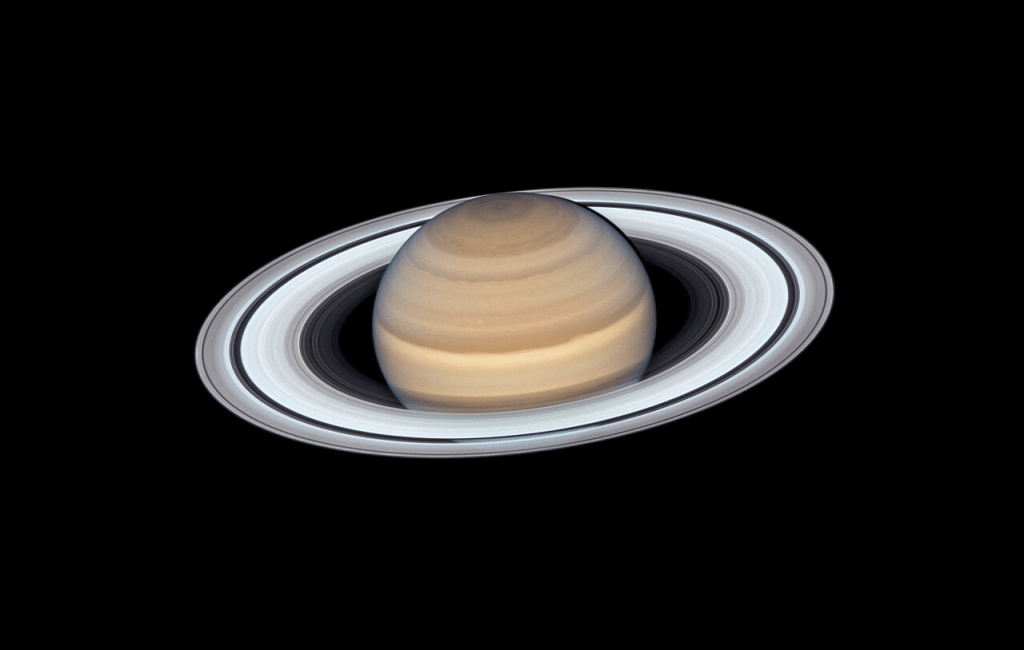
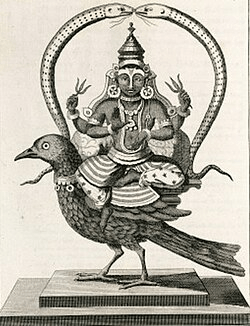
Not sure what that signifies, so let’s look more closely at Sani. In depictions, he carries a sword and a danda (sceptre). His vahana is sometimes a buffalo, sometimes a crow, and sometimes a vulture. He is the god of karma, justice, time, and retribution, and delivers results depending upon one’s thoughts, speech, and deeds.
According to Wikipedia, “Shani is the controller of longevity, misery, sorrow, old age, discipline, restriction, responsibility, delays, ambition, leadership, authority, humility, integrity, and wisdom born of experience. He also signifies spiritual asceticism, penance, discipline, and conscientious work. He is associated with two consorts: Neela (dark blue), the personification of the sapphire, and Manda (glory given), a gandharva princess.
The gandharvas are the celestial singers depicted with horse-headed human bodies. This imagery suggests that these “singers” are rightminded humans, rather than celestial beings. And being dark blue, Neela represents Shani’s partnership with the Christ Light, Christ’s Vision, and the Ajna Chakra — the sapphire in the breastplate. So Neela likely signifies Shani’s ties with Christ Vision, Spiritual Sight, or True Perception, while Manda represents Shani’s partnership with the Souls in True Perception singing “the winds of glory.”
In this Rik, the rishis say that Shani’s tail grows old to awaken the True Perception of the Supreme Spirit–the Holy Spirit’s rightminded perception of our oneness. And his association with Neela and Manda in other Hindu texts affirm this. In the image below, we see two snakes forming an arch over Shani’s head. They appear to be “kissing.” And it is indeed in the sixth chakra that Ida and Pingala “marry” to bring forth the Capstone.
Based on the body of evidence, Shani-dev (and Saturn) most likely represents the Final Judgment or Last Judgment, which frees our Souls from the illusion of material existence. Course-Jesus says much on the subject of the Final Judgment. What follows are but two examples:
The Last Judgment is generally thought of as a procedure undertaken by God. Actually it will be undertaken by my brothers with my help. It is a final healing rather than a meting out of punishment, however much you may think that punishment is deserved. Punishment is a concept totally opposed to right-mindedness, and the aim of the Last Judgment is to restore right-mindedness to you. The Last Judgment might be called a process of right evaluation. It simply means that everyone will finally come to understand what is worthy and what is not. After this, the ability to choose can be directed rationally. Until this distinction is made, however, the vacillations between free and imprisoned will cannot but continue. (ACIM, T-2.VIII.3:1-8)
The final judgment on the world contains no condemnation. For it sees the world as totally forgiven, without sin and wholly purposeless. Without a cause, and now without a function in Christ’s sight, it merely slips away to nothingness. There it was born, and there it ends as well. And all the figures in the dream in which the world began go with it. Bodies now are useless, and will therefore fade away, because the Son of God is limitless. (ACIM, W-pII.10.2:1-6)
Based on all the evidence, we can deduce that Saturn’s ring represents what Course-Jesus terms “the ring of fear.” About this “ring” or “circle,” he says:
The circle of fear lies just below the level the body sees, and seems to be the whole foundation on which the world is based. Here are all the illusions, all the twisted thoughts, all the insane attacks, the fury, the vengeance and betrayal that were made to keep the guilt in place, so that the world could rise from it and keep it hidden. Its shadow rises to the surface, enough to hold its most external manifestations in darkness, and to bring despair and loneliness to it and keep it joyless. Yet its intensity is veiled by its heavy coverings, and kept apart from what was made to keep it hidden. The body cannot see this, for the body arose from this for its protection, which depends on keeping it not seen. The body’s eyes will never look on it. Yet they will see what it dictates. (ACIM, T-18.IX.3:1–4:7)
Ergo, the Final Judgment (Shani/Saturn) is the “key” that allows us to pass through the Ring of Fear and be free of the Ego Mind’s super-imposed illusion of separation.
Pretty cool, right?
Nowhere could I find a plausible definition of vise-vise. Most Sanskrit dictionaries suggest vise means “poison.” But I seriously doubt True Perception is restored “poison by poison.” Sri Aurobindo defined vise-vise as “people by people,” which makes no sense, either. My best guess is that it means “division by division,” since vi can mean “division” and se means “by” or “from.”
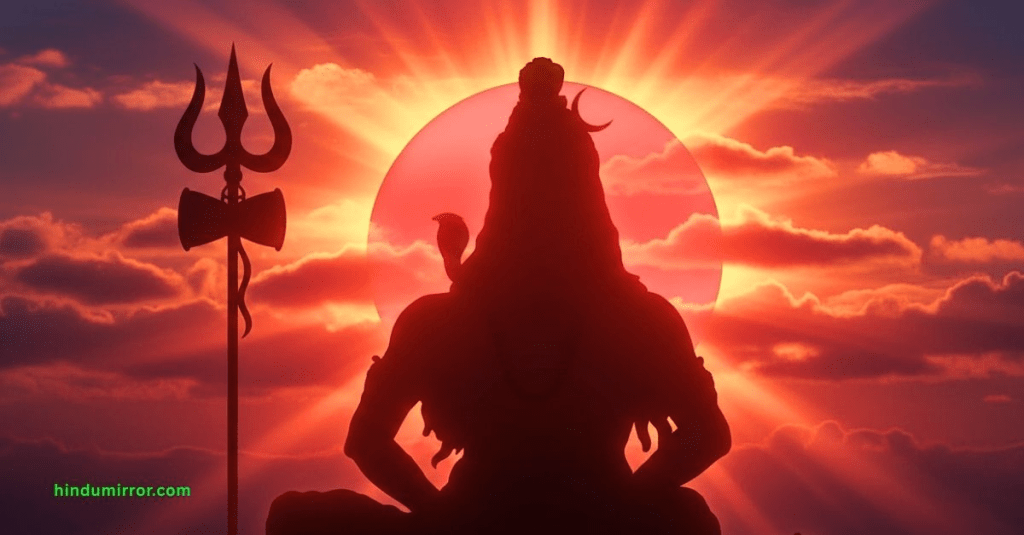
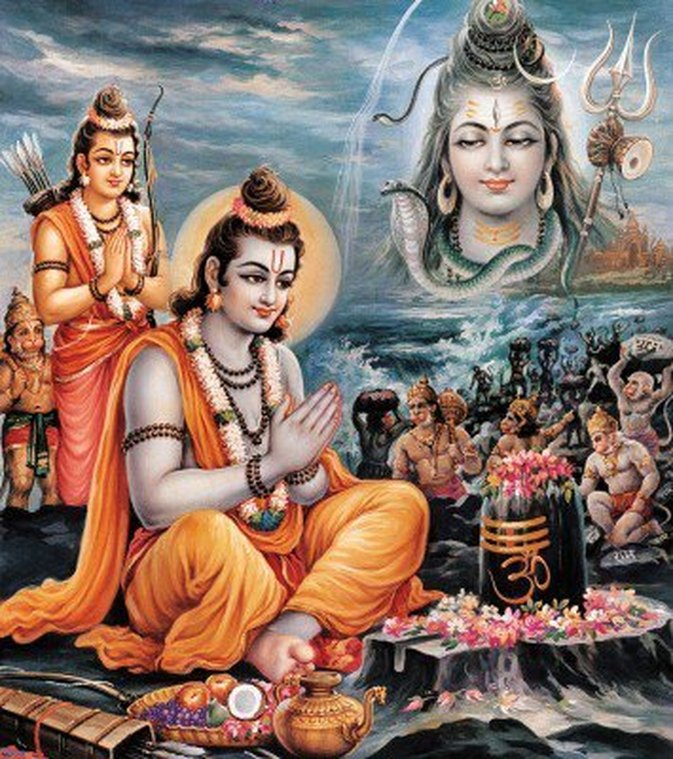
The Song of Praise to Indra’s light is AUM, the ancient melody we used to know, but forgot after we blocked the sound of God’s Voice. Rudra means “red ray” in Sanskrit, so he’s another form of Indra, rather than Shiva. Shiva is the U-kara, the miracle tone of Grace, while Rudra, being the Red Ray, produces all three sounds. So, essentially, Rudra is the “father” of Shiva, rather than another representation of Shiva. The two images below rightly illustrate the relationship between Rudra and Shiva.
Not sure where this falls numerically, but the next Rik reads:
The Word of God vessel of the great splendor heart-mind, the vapor of Ketu (the red dragon’s tail) is the purifying cry of Chandra, the mind shining in triumph to impel Kama, the Word of God river-flow supporting the Master of the House.
sa (the word of god) no (vessel) mahām̐ (of the great) ani-māno (splendor heart, mind, or spirit) dhūmaketuḥ (smoke/vapor of Ketu) puruś-candraḥ (is the purifying cry of Chandra) | dhiye (the mind shining) vājāya (in triumph) hinva-tu (to impel Kama) sa (the Word of God) revā-niva (river-flow supporting) viśpatir (the master of the house).
Notes:
We find the phrase “great splendor” in the Judeo-Christian scriptures also, as the radiant, majestic, and awe-inspiring nature of God’s presence, works, and kingdom. That radiant splendor, as we’ve discussed, is the Red Dragon, which the Bible calls both Paroh and “the Beast.” Often paired with majesty, glory, and strength, this “radiant splendor” is said to reflect the unbearable brightness of God’s holiness and sovereignty, which believers are called to meditate upon.
Based on what the rishis tell us herein, the tail of the Great Dragon — Ketu, the descending node of the Moon — is the Pillar of Cloud described in Exodus. That pillar, we further learn, is the cry of Chandra, the Hindu personification of the inner Christ Mind shining away the Ego Mind’s dark veil(s). When Chandra or Soma shines in triumph (as the full moon. presumably), the Word of God’s rivers flow to support the Master of the House.
In Ezekiel 47, the prophet describes his vision of this river, as water flowing from under the threshold of the Temple (the House of God) toward the east. This river grows from a trickle to a deep, unfordable river that brings life to the desert, heals the Dead Sea, and supports the fruit trees whose leaves provide healing.
The deeper meaning of these symbols should be obvious by now.
The river, as we’ve discussed, is the Ganges in Hinduism, the Euphrates in the Old Testament, and the Jordan (I suspect) in the New Testament. In the Qur’an, it’s called Al-Kawthar— the river in Paradise (Jannah) granted to the Prophet Muhammad, as revealed in Surah Al-Kawthar (108:1). The Prophet described its water as “whiter than milk and sweeter than honey”; drinking from it promises that a believer will never thirst again.
This is, in fact, the very same promise Jesus Christ makes to the Samaritan Woman at the Well of Jacob (the Soul) in John 4:14.
In the Course, Jesus calls the Christ Mind in triumph “the resurrection.” In this regard, he says:
It is impossible not to believe what you see, but it is equally impossible to see what you do not believe. Perceptions are built up on the basis of experience, and experience leads to beliefs. It is not until beliefs are fixed that perceptions stabilize. In effect, then, what you believe you DO see. That is what I meant when I said, “Blessed are ye who have not seen and still believe,” for those who believe in the resurrection will see it. The resurrection is the complete triumph of Christ over the ego, not by attack but by transcendence. For Christ does rise above the ego and all its works, and ascends to the Father and His Kingdom. (ACIM, T-11.VI.1:1-7)
The next Rik reads:
The celestial being Ketu hears Kama in wholeness as the song shaking the sacred fire’s Great Ray.
daivyaḥ (the celestial being) ketuḥ (Ketu) śṛṇotu (hears Kama) naḥ (in wholeness) uktha-ir (as the song shaking) agnir (the sacred fire’s) bṛhad-bhānuḥ (Great Ray).
Notes:
If I’m reading this right, Ketu, the dragon’s tail, hears the Song of Love as one unified tonal vibration, which shakes the sacred-fire Ray in everything. The sacred-fire Ray is the red ray sounding the AUM. The Red Ray (Adam/Indra) is the “father” of our Souls, so the song he “sings” also shakes or vibrates his spark in us.
In Vedic Hinduism, Indra and Agni are not only the two most prominent deities, they’re also twin brothers born from the same divine source (God or Brahman). Together, they represent the dual forces of power and ritual energy required to maintain cosmic order (Rta). Agni and Chandra/Soma, in comparison, are characterized as “cosmic consorts.” Ergo, Indra and Agni are the same, whilst Agni and Chandra/Soma are partners.
In the Course, Jesus says something similar pertaining to the Song of Love. Since it’s important, I’ve quoted a sizeable chunk below:
The world you see is based on “sacrifice” of oneness. It is a picture of complete disunity and total lack of joining. Around each entity is built a wall so seeming solid that it looks as if what is inside can never reach without, and what is out can never reach and join with what is locked away within the wall. Each part must sacrifice the other part, to keep itself complete. For if they joined each one would lose its own identity, and by their separation are their selves maintained.
The little that the body fences off becomes the self, preserved through sacrifice of all the rest. And all the rest must lose this little part, remaining incomplete to keep its own identity intact. In this perception of yourself the body’s loss would be a sacrifice indeed. For sight of bodies becomes the sign that sacrifice is limited, and something still remains for you alone. And for this little to belong to you are limits placed on everything outside, just as they are on everything you think is yours. For giving and receiving are the same. And to accept the limits of a body is to impose these limits on each brother whom you see. For you must see him as you see yourself.
The body IS a loss, and CAN be made to sacrifice. And while you see your brother as a body, apart from you and separate in his cell, you are demanding sacrifice of him and you. What greater sacrifice could be demanded than that God’s Son perceive himself without his Father? And his Father be without His Son? Yet every sacrifice demands that They be separate and without the Other. The memory of God must be denied if any sacrifice is asked of anyone. What witness to the Wholeness of God’s Son is seen within a world of separate bodies, however much he witnesses to truth? He is invisible in such a world. Nor can his song of union and of love be heard at all. Yet is it given him to make the world recede before his song, and sight of him replace the body’s eyes.
Those who would see the witnesses to truth instead of to illusion merely ask that they might see a purpose in the world that gives it sense and makes it meaningful. Without your special function has this world no meaning for you. Yet it can become a treasure house as rich and limitless as Heaven itself. No instant passes here in which your brother’s holiness cannot be seen, to add a limitless supply to every meager scrap and tiny crumb of happiness that you allot yourself.
We’ve now reached the final Rik of the 27th Sukta, which is structured as a direct command, rather than an indirect teaching. The Rik reads:
Bow down to the Great pair of Rays; bow down to the offspring rays; bow down to the energy-scattering Name of God, the sword not of fear lighting the Assembly, the divine light shining forth the agreeable speech on the left side to generate the bowstring of glory in the peace of God’s tree of divine being.
namo (bow down) mahadbhyo (to the great two rays); namo (bow down to) arbhakebhyo (the offspring rays) namo (bow down to) yuvabhyo (the energy-scattering) nama (Name of God) āśi-nebhyaḥ (the sword not of fear) ya-jāma (to light the Assembly) devān (the divine) ya-di (light shining forth) śaknavāma (the agreeable speech of the left side) mā (to generate) jyāyasaḥ (the bowstring of glory) śaṃsam (in the peace) ā (of God’s) vṛkṣi (tree) devāḥ (of divine being) ||
Notes:
First and foremost, this affirms what I’ve been saying and what Jesus showed Sister Faustina (and me). There are TWO Great Rays, not seven, nine, or twelve. Those two beams (YH and VH) produce the offspring seven — the three rays of aspect (AUM) and the four rays of attribute. The four rays of attribute are, I suspect, the winds of Nara, the abiding winds seen by the prophets Ezekiel, Zechariah, John of Patmos, and Mohammad, in the symbolic form of the cherubim, throne-bearers, and/or Living Beings.
The asi-nebhyah — the sword not in fear — is the Flaming Sword guarding the gate into Eden. Fear is the opposite of love; and fearful thinking is Ego; so being “not of fear” or “not in fear” means the sword remains uncontaminated by Ego thinking. It has not, in other words, entered the Ego Mind’s Kingdom of Darkness.
In the Book of Daniel, that sword is seen by the patriarch as a pure-gold blade “girding the loins” of the Bridegroom figure who appears to him on the riverbank. Metaphorically, the riverbank is the Borderland, while the River is the one described herein as “supporting the Master of the House.” Essentially, it’s the three-branches of AUM forming the cosmic river or ocean of Perfect Love underneath the illusion.
Rightly understood, the Flaming Sword is the Thought of God, which stands outside, above, and apart from Ego Consciousness, lighting our way back to Eden. It’s also, therefore, the “thought” Course-Jesus discusses below (and describes as a star elsewhere in the Text):
Beyond all idols is the Thought God holds of you. Completely unaffected by the turmoil and the terror of the world, the dreams of birth and death that here are dreamed, the myriad of forms that fear can take; quite undisturbed, the Thought God holds of you remains exactly as it always was. Surrounded by a stillness so complete no sound of battle comes remotely near, it rests in certainty and perfect peace. Here is your one reality kept safe, completely unaware of all the world that worships idols, and that knows not God. In perfect sureness of its changelessness and of its rest in its eternal home, the Thought God holds of you has never left the Mind of its Creator Whom it knows, as its Creator knows that it is there. (ACIM, T-30.III.10:1-5)
As stated earlier, the river referenced in this rik is the Heavenly Ganges, whose worldly reflection also is divided into three segments (upper, middle, and lower). This celestial river is personified in Hinduism as Ganga, Ganga-devi, and/or Maa Ganga — the divine embodiment of purification, forgiveness, and liberation (moksha). Believed to have descended from heaven to Earth, Ganga (like the Lamb of God in Christianity) “washes away the sins of the world.” Like Varuna, Ganga-dev rides the mythological dragon-tailed makara symbolizing the M-kara aspect of AUM and/or the Left Hand of God.
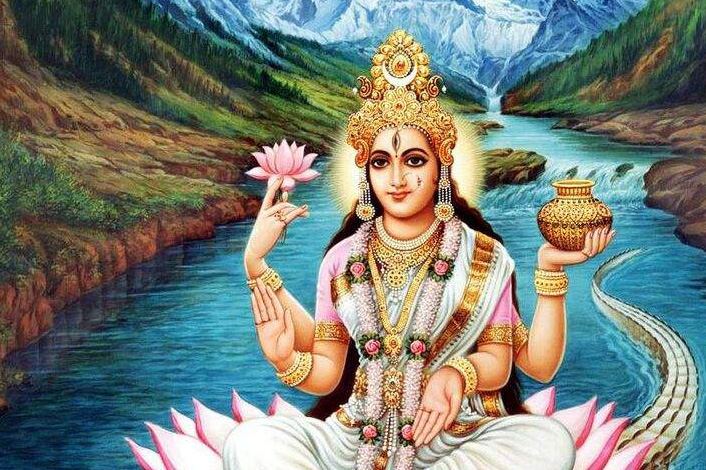
In the Bible, the Euphrates River plays the same role. Often referred to as “the great river,” the Euphrates serves as “a boundary for the Promised Land, a symbol of the Final Judgment, and a key setting for end-times prophecies” in Google’s estimation. All of this suggests the Euphrates is the Biblical symbol for the Borderland. And so, therefore, is the Ganges.
We cross this symbolic “river” in the Ark of the Covenant or the Ark of Peace to reach the Forest of All Beings, the Promised Land on the other side, where milk (miracles) and honey (the nectar of sap of divinity in all creatures) flow in abundance. We find this imagery in the Bible, the Qur’an, and the Vedas, among other foundational scriptural texts.
In the Ramayana, the symbols are slightly different, but still recognizable. After Rama reaches the southern tip of India at Dhanushkodi (the end of the bow), he prays to Varuna (the personified waters of AUM) to grant his army passage. Under the supervision of the architect Nala, the Vanara Army constructed a bridge using floating stones to link the mainland to the island of Lanka.
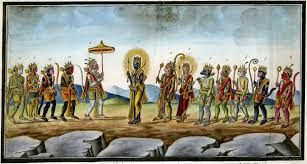
For whatever reason, the Vanara are typically depicted as monkeys, like Lord Hanuman. I’m not sure why, given that Vanara means “winds of Nara” in Sanskrit. So, the Vanara are, in actuality, the four winds described herein; the four winds generated by the Rays of Attribute and/or Living Beings watching over the circles. The Vanara “army” consists of the Souls in the circles singing the Song of Love, because that is how we “build the bridge” to cross over (through transcendence) the sacred river to the Land of the Living.
That the sword shines forth the agreeable speech on the left side means, the sword sounds the vibrations serving the circles on the western half of the wheel — the circles of Earth and Wind. In the outermost, lowermost Circle of Earth, as I understand it, the M-kara works silently inside our minds to prepare us for our holy purpose. To enter the Circle of Wind in the quadrant of Artha, we first must hear the M-kara and e willing to listen.
The threshold in between the two circles or quadrants is the “gate” guarded by Varuna, who rides the mythological makara (an elephant-headed dragon or sea-serpent, essentially). We discussed the Makara last time, but I didn’t say that over time the creature evolved into Ganesha, the elephant-headed offspring of Shiva and Parvati. And that would explain why Ganesha is so often depicted with snakes wrapped around his belly, draped around his neck, or used as a sacred thread.
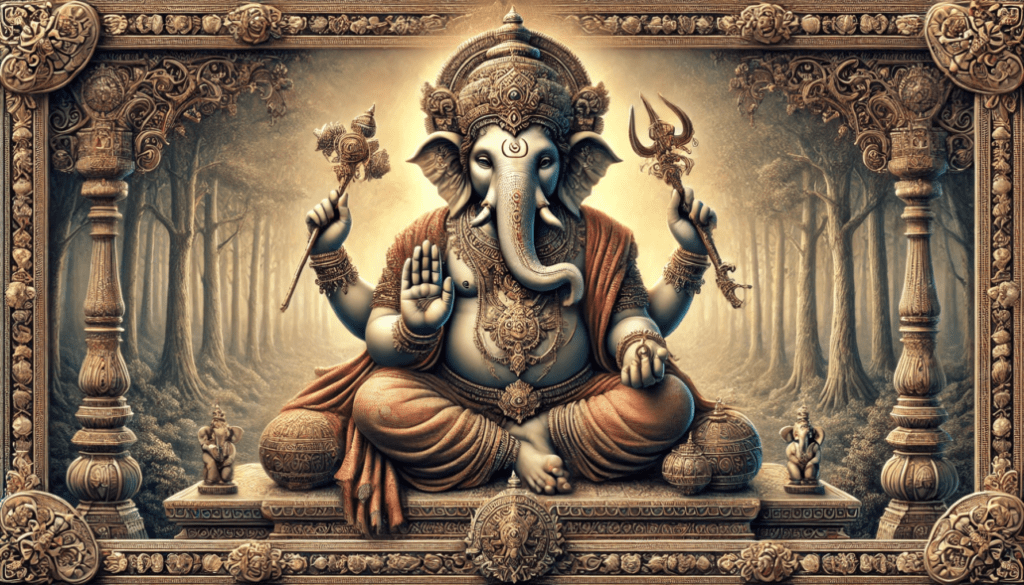
Ganesha, like the makara, personifies the M-kara vibration. This assessment is supported by the fact that Ga-nesha translates as “the sacred-syllable of the Night.”
This brings us to “the bowstring of glory.” A phrase found in the Hindu scriptures, the “bowstring of glory” shoots the celestial arrows of A, U, and M. And that is why these strings “are revered as conduits of cosmic energy, representing the ultimate physical and spiritual readiness, intense focus, and the triumph of Dharma.”
Who wields the bowstring of glory? The short answer is: we do. In the Hindu lore that purely symbolic bow takes many forms.
In the Bhagavad Gita, Prince Arjuna wields a bow called Gandiva, which Brahma made with 108 strings. Only one of those strings is unbreakable, however. And that string contains a sacred mantra (AUM). When twanged, the string’s reverberation echoes across the three worlds, terrifying enemies and signaling inevitable victory (over the Ego Mind).
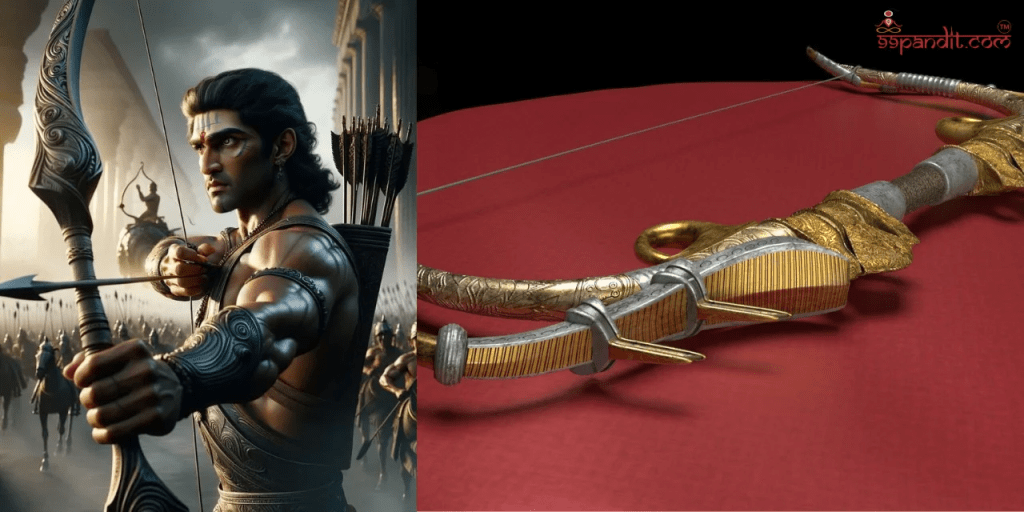
According to Wikipedia, Gandiva means “excellent bow,” but it’s actually a marriage of gan (assembly) and diva (divine). So, the glorious bowstring belongs to the celestial weapon or bow that is the Divine Assembly.
In other stories, the “glorious bowstring” belongs to the Celestial Bow of Kamadeva. The bow itself is made of sugarcane; the arrows it shoots are flowers; and the “glorious string” is formed by a line of honeybees (buzz, buzz). Read the symbols, brother. That string does NOT represent “the sweet, intoxicating, and irresistible nature of ego desire and human love,” as someone on Quora suggests. It represents the magnetic power of God’s longing and love for his creations to return to the function he gave them.
Kamadeva’s bow is called Pushpadhanva, which allegedly means “one who has a bow of flowers.” But it’s actually a compound of pushpa (flower) and adhanva (desert-wilderness). So, Kamadeva’s bow represents “the flower blooming in the desert-wilderness of earthly existence.”
We find a reference to this “flower” in Isaiah 35:1-2, which (according to http://www.Bible.com) prophesies that “the desert will rejoice and blossom like a lily” (or “crocus” or “rose,” depending on the translation).
Just for kicks, let’s see what Isaiah 35:1-2 really imparts about this “flower.” Actually, to get a complete thought, I had to translate verses 1 through 4. Here’s the result:
The desert-wilderness drought in joyful plains will rejoice to blossom as chabatstseleh (??) To blossom in abundance, rejoice in the joyful singing of the glory Lebanon gave to honor Carmel and Sharon. To see the wealth of YHVH, the majesty or splendor of Elohim. strengthen the weak hands by strengthening the cast-down blessings speaking to hurry the heart to be strong and not to fear that Elohim will come in vengeance. Elohim only rewards to bring about your deliverance.
Very different from the KJV translation and its many telephone-game descendants. Can’t figure out what chabatstseleh means. The word is translated as “rose” in this section of Isaiah by the KJV team. In the Song of Solomon, they translated the same word as “Rose of Sharon.” Elsewhere, it’s translated as “lily,” “crocus,” or even “meadow saffron.” So, who knows what it really means?
Let’s see if we can solve the mystery.
In Hebrew, Chabat can mean “to strike” or “to thresh,” while seleh supposedly acts a musical notation to instruct the singer “to pause and reflect.” This rather mysterious word appears seventy-four times in the Old Testament, so it’s probably more than a musical notation. Can’t find anything that explains what the wedged in “st” might indicate. So, it’s probably an erroneous transliteration of the original Hebrew. In the Song of Solomon, for example, the same word is rendered as chabatsteleh. Since steleh is not a recognized Hebrew word, the true definition of chabatsteleh will have to remain a mystery for now.
But wait, because chabats might be a mis-transliteration of qabatz, which means “to gather” or “to assemble,” leaving teleh, which means “lamb.” To assemble the lamb? To gather the lambs? Bingo. We also find “gather the lambs” (as qabats-tela) in Isaiah 40:11. In the KJV Bible, the passage reads:
He shall feed his flock like a shepherd: he shall gather the lambs with his arm, and carry them in his bosom, and shall gently lead those that are with young.
If I’m right about this, Isaiah 35:1 would read:
The desert-wilderness drought in joyful plains will rejoice to blossom as to gather the lambs.
or, using alternative definitions of the same words, the desert-wilderness drought in joyful steps will joyfully break forth to gather the lambs.
Let’s leave it there for now, because I’ve said enough. And I’m weary of writing.
I hope most of this makes sense and that you learned something from my ramblings. If you ever have questions, feel free to leave them in the comments area.
Thanks for visiting the Holy Meeting Place dot com.


Leave a Reply