Namaste, my brother in Christ, and welcome (or welcome back) to my latest adhyayana posting. Today, we’re discussing the Rigveda’s 26th Sukta, which is blessedly shorter than the previous two. What’s it about? Miracle-working, more or less.
Let’s dig right in with Rv 1.26:1, which reads:
Abiding in spiritual perception sends forth the meditative offering clothing the sap (the divine life-energy) of the Bridegroom from the Borderland’s vessel, the offering arena for almsgiving.
vasiṣvā (Abiding in spiritual perception) hi (sends forth) miye-dhya (the meditative offering) vastrāṇy (clothing) ūrjām (the sap or life-energy) pate (of the Bridegroom from) semaṃ (the Borderland’s) no (vessel) adhvaraṃ (the offering arena) yaja (for almsgiving)
Notes:
As discussed hitherto, the Borderland is the mode of perception in-between Earthly inverted perception and Heavenly right-minded “knowing”. So, it’s the place deep in our minds where our perception stands upright. The Borderland is, therefore, the Resting Place, the Land of the Living, the walled city, the sacred grass, and the Forest of All Beings, among other scriptural metaphors.
Or, as Course-Jesus explains:
There is a borderland of thought that stands between this world and Heaven. It is not a place, and when you reach it is apart from time. Here is the meeting place where thoughts are brought together; where conflicting values meet and all illusions are laid down beside the truth, where they are judged to be untrue. This borderland is just beyond the gate of Heaven. Here is every thought made pure and wholly simple. Here is sin denied, and everything that is received instead. (ACIM, T-26.III.2:1-6)
The Borderland vessel is, I believe, the Circle of Water and/or the Moon Circle, the almsgiving arena for the Living Water of Grace and/or miracle-milk (the U-kara aspect of AUM). Hindus call the source of this “milk” Kamdhenu and Surabi; the ancient Egyptians called her Hathor; and the Bible calls her Moket, the Queen of Heaven.
As we learn from Leviticus 18:21, our offerings of loving thoughts (the seed scattered by the Holy Spirit) in our circle “meetings” are formed into the sweet cakes the Mother Cow needs to produce her milk. Those “sweet offering cakes” are then “baked” in the spiritual ovens heated by burning the branches of unloving thought pruned through the truth-restoring miracles requested from and granted by Christ. The source of the fire is the fiery eye or fire-wall surrounding the Inner-Altar — the “heart” of New Jerusalem.
Jesus explained all of this in John 15, but his meaning was lost, as usual, through fear-inverted interpretation:
I am the true vine, and my Father is the gardener. He cuts off every branch in me that bears no fruit, while every branch that does bear fruit he prunes, so that it will be even more fruitful. You are already clean because of the word I have spoken to you. Remain in me, as I also remain in you. No branch can bear fruit by itself; it must remain in the vine. Neither can you bear fruit unless you remain in me.
I am the vine; you are the branches. If you remain in me and I in you, you will bear much fruit; apart from me you can do nothing. If you do not remain in me, you are like a branch that is thrown away and withers; such branches are picked up, thrown into the fire and burned. If you remain in me and my words remain in you, ask whatever you wish, and it will be done for you. This is to my Father’s glory, that you bear much fruit, showing yourselves to be my disciples.
This translation probably needs tweaking, but you should get the idea.
As Course-Jesus and the Vedic rishis both explain, it is in this “Borderland” that we stand upright (as Souls) in Spiritual Perception, True Perception, or Miraculous Perception.
From all of this we can glean that the meditative offering “clothing the sap of the Bridegroom” is God’s saving grace.
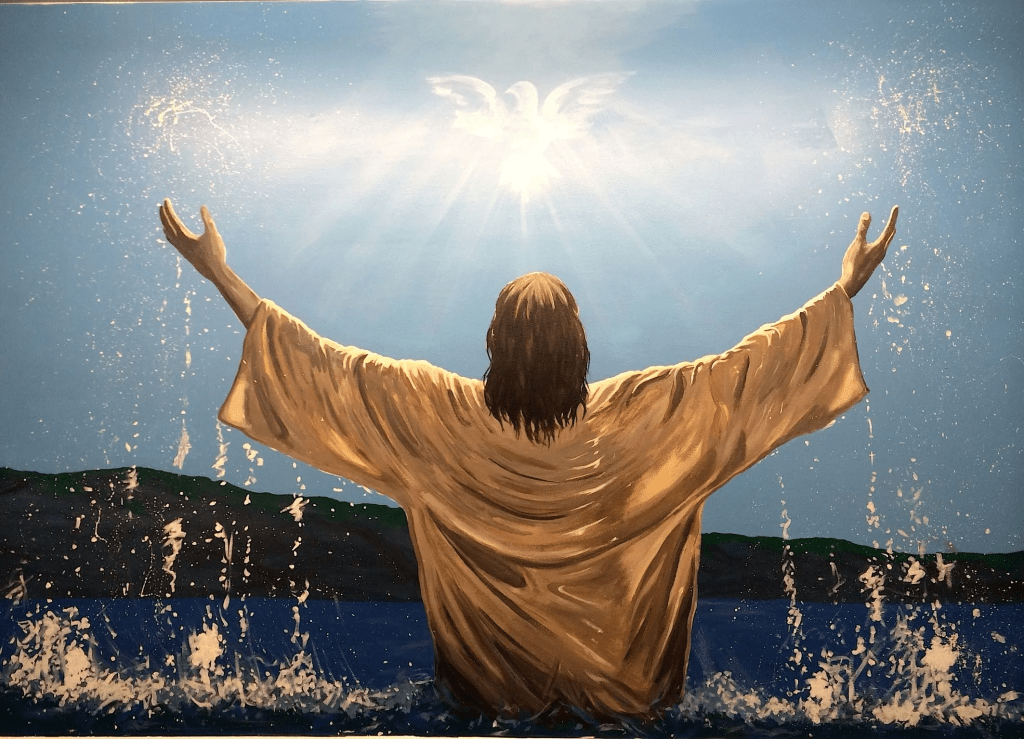
In the Bible, grace is similarly described as a divine covering for the Soul, replacing the “filthy rags” of human effort or shame with the “garment of salvation” and/or the “robe of righteousness”. This symbolic clothing signifies being covered by Christ’s purity and grace, restoring our lost innocence and glory, and enabling believers to stand upright before God. These are, btw, the metaphoric garments we put on through “baptism in Christ,” as described below in Galatians 3:27:
For as many of you as have been baptized into Christ have put on Christ.
We are baptized into Christ not in earthly rivers or baptismal founts, as the Ego’s religions encourage, but in the Circle of Waters in the Borderland.
The Sukta’s second line reads:
Deep inside the vessel, the call of the Supreme Yah assembles the grains of the cherished prayerful thoughts in the fiery eye of the Divine Mother.
ni (deep inside) no (the vessel) hotā (the call) vareṇyaḥ (of the Supreme Yah) sadā (assembles) yav-iṣṭha (the grains of the cherished) manma-bhiḥ (prayerful thoughts) agne (in the fiery eye) divit-matā (of the Divine Mother)
Notes:
This echoes what I just explained about the sweet cakes we make for the Mother Cow from the “seeds” (of rightminded thoughts) we scatter in our circle meetings. These seeds produce the sacred grass carpeting the green pastures of the Resting Place. And this is the true meaning of “you reap what you sow.” In Galatians 6:8, for example, we read:
For he that soweth to his flesh shall of the flesh reap corruption; but he that soweth to the Spirit shall of the Spirit reap life everlasting.
In the Course, Jesus explains the meaning of the metaphor as follows:
There are many examples of how the ego’s interpretations are misleading, but a few will suffice to show how the Holy Spirit can reinterpret them in His Own light.
“As ye sow, so shall ye reap” He interprets to mean what you consider worth cultivating you will cultivate in yourself. Your judgment of what is worthy makes it worthy for you.
The “seeds” we scatter are our thoughts and intentions. To scatter helpful and loving thoughts reaps a harvest of good spiritual “fruit”; to scatter harmful and unloving thoughts, on the other hand, yields for us a harmful and unloving harvest. Ergo, we reap what we sow. The seeds of our good thoughts make the sweet offering cakes we bake in God’s oven — the fiery eye of the Mother Cow, the Circle of Fire or fire-wall at the center of the Inner Altar, where God and Christ dwell together within us.
Rv 1.26:3 reads:
The sound vibrations of God send forth miracles for the sons assembled to share the almsgiving offerings of the three separated companions in friendship.
vacaḥ (the sound vibrations) ā (of God or Heaven) hi (send forth) ṣmā (miracles) sūnave (for the sons) pit-āpir (assembled to share) yaja-ty = vaja-ti (the almsgiving offerings of the three) āpaye (separated) sakhā (companions) sakhye (in friendship).
Notes:
The three separated companions are the three aspects of Divine Love Christians call the Holy Trinity, Hindus call the Trimuti, Theosophists call the Three Rays of Divine Aspect, and Kabbalists call the three Hands of God. For all intents and purposes, those three Rays of Agape are A, U, and M. When we gather together in Holy Relationship (spiritual friendship, fellowship, or brotherhood) to offer our prayerful alms of love, mercy, and forgiveness to everyone, these vibrations produce miracles.
Or, as Course-Jesus says:
A miracle is a universal blessing from God through me to all my brothers. It is the privilege of the forgiven to forgive. (ACIM, T-1.I.27:1-2)
The fourth Rik reads:
The Supreme Yah is God’s vessel speaking for Kamadeva (divine love) to destroy the enemies of AUM.
vareṇyaḥ (the Supreme Yah) ā (is God’s) no (vessel) barh-ī (speaking for Kamadeva) riśādas-o (to destroy the enemies of Om/AUM).
Notes:
To find the truth, we have to question everything we’ve learned in the world. And that includes the religious teachings the Ego Mind would have us accept blindly or “on faith” (to insure its survival). Distorted religious beliefs are, in fact, Satan’s greatest triumph in the world. He wants us to believe in sin and guilt, to judge others, and to fear God’s wrath. Why? Because believing these fallacies keeps us under his thumb.
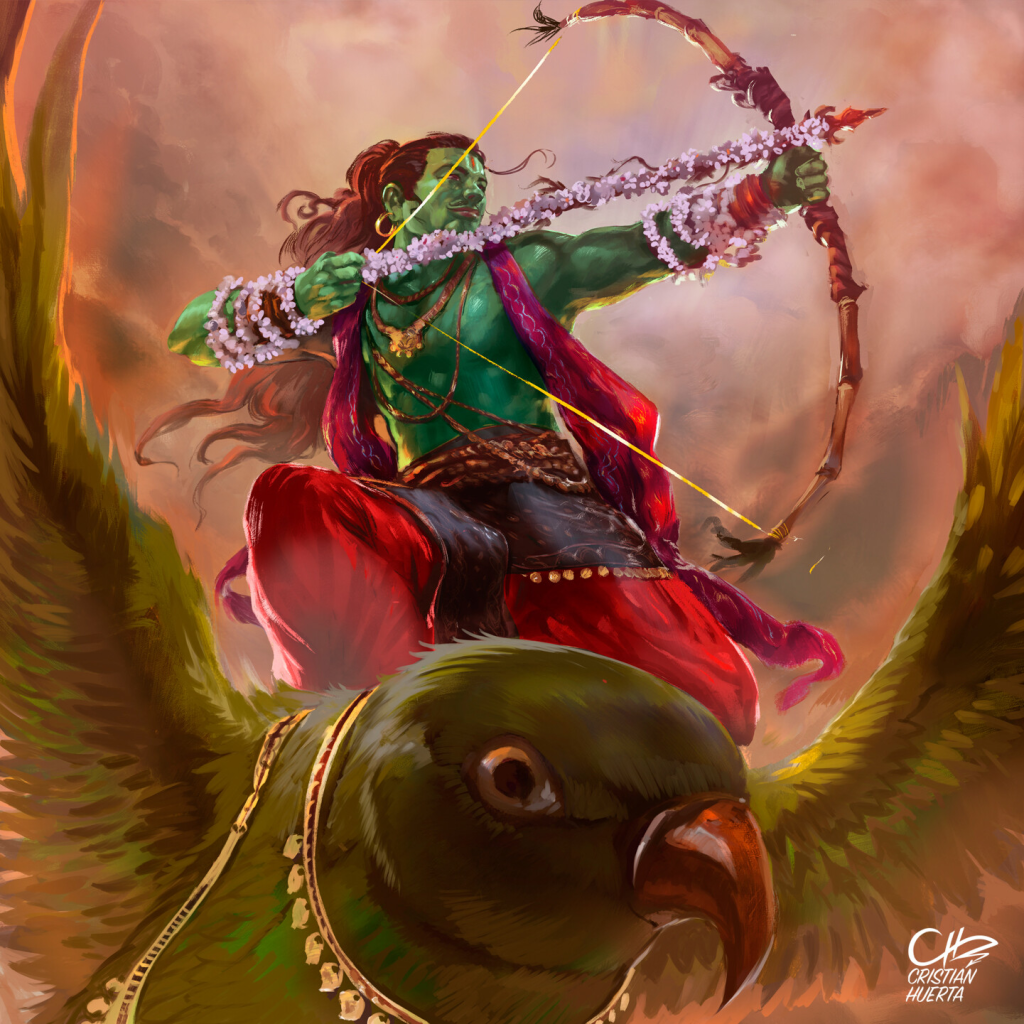
That said, kama does not mean “desire.” It means “the love of God.” Kamadeva is not, therefore, the Hindu god of carnal love, nor is he the Indian Cupid, as commonly professed. Rather, he’s the personification of Agape, who shoots flowery arrows with his bow using a bee-line for a string. That humming beeline represents the AUM, which shoots miracles into our mind — the flowery arrows in Kamadeva’s quiver.
The Supreme Yah is the Red Ray, whose partner is Vah. Together they form YHVH, the name of God in Israel. So Yah, we learn herein, is the vessel speaking for God’s Love. He’s also the vessel producing the Trinity powers of AUM. Vah is the hook and/or the Bridge between Heaven and Earth. So Vah is the Christ Ray producing the four Attribute Rays or Cherubim, the four “living beings” or “angels” supporting the Yah Ray on the Throne of God.
In Hinduism, the Yah Ray is personified as King Indra, the guardian of the eastern gate, whilst the Vah Ray is Lord Varuna, the guardian of the western gate whose vahana is the makara (the M-kara of AUM.
Rv 1:26:5 reads:
God’s water vessel is the trusted companion and bosom friend, the one fulfilling the purpose of the guardians manifesting Soma, the light of the moon.
varu-ṇo (God’s water vessel) mitro (is the trusted companion) aryamā (bosom friend) sīd-antu (the one fulfilling the purpose of the guardians) manu-ṣo (manifesting Soma) ya-thā (the light of the moon)||
Notes:
As I just explained, Varuna personifies the Vah Ray, the Water Ray supplying the Living Water, the water of God. Like most of the Hindu gods, Varuna’s function has been inverted by the Ego Mind. He’s not the god of water; he’s the water of god. And that “water” (the M-kara vibration of the Holy Spirit), is indeed our trusted companion and bosom friend. Working through “the guardians,” the rishis explain herein, Varuna manifests Soma, the light of the Moon.
The light of the moon is a Vedic metaphor for the Christ Light of the Vah Ray; the source of that light is Soma, the Great I Am.
Course-Jesus expresses the same idea below:
Whenever you are tempted to undertake a useless journey that would lead away from light, remember what you really want, and say:
The Holy Spirit leads me unto Christ, and where else would I go? What need have I but to awake in Him?
Then follow Him in joy, with faith that He will lead you safely through all dangers to your peace of mind this world may set before you. Kneel not before the altars to sacrifice, and seek not what you will surely lose. Content yourself with what you will as surely keep, and be not restless, for you undertake a quiet journey to the peace of God, where He would have you be in quietness.
This brings us to the guardians. Whom might they mean? In the Hindu lore, the guardians of Soma are identified as Krsanu, the celestial archer, and the Gandharvas, the celestial horse-headed singers. These may or may not be the guardians the rishis mean herein. After reading many things describing Manu, the progenitor of humankind, I decided the word means something along the lines of “thought-manifestations.” Because humankind is, indeed, a thought-manifestation that doesn’t exist in Divine Reality.
I rather suspect the guardians the rishis mean are the four Living Beings. In Hinduism they take the form of the four non-cardinal Aṣṭa-Dikpāla, the eight direction guardians who are, in fact, the guardians of the four quadrants or circles and their gates.
That said, Sidantu proved tough to define. If we break the word as sidan-tu, for example, it means “the established laws of Kama.” The Cosmic Law of Love, in other words.
And, if that is the meaning intended, the Rik would read: God’s Water Vessel is the trusted companion and bosom friend, the Law of Love manifesting Soma, the light of the moon.
The word can also be divided as sidant-u, which translates as “the laws of Shiva” or the laws of the U-kara.” Because Shiva is indeed the u-kara, the holy and healing vibration of grace. In Hinduism, we find seven laws of Shiva, which are defined as follows:
- The Law of Truth: Embrace higher truth, justice, and authenticity, as truth will prevail in the end.
- Knowledge is God: Shiva, as the ultimate teacher (Dakshinamurthy), teaches that wisdom and self-knowledge are divine.
- Everything is an Illusion (Maya): Happiness shouldn’t depend on material things, which are temporary. This encourages detachment from possessions and ego.
- The Law of Transformation: Change is constant; pain is seen as a way to grow, not just a punishment, facilitating personal evolution.
- Be Formless: Like water, one should be flexible and adaptable, navigating life’s challenges calmly.
- The Law of Detachment: Letting go of negative emotions, pride, pain, and attachments allows for true freedom and forward movement.
- Enlightenment is Awakening: The goal is self-realization and understanding the nature of reality.
If this is what the rishis mean, these laws help Varuna, the Cosmic Order-protecting and restoring waters of the Holy Spirit to uphold the Second Covenant. And these “karmic laws,” are indeed the thought-manifestations of Soma, the “moonlight” or “lesser light” shining in the dream-realm.
Let’s move on and see if the next verse can shed any light on the rishis intended meaning of sidantu. Rv 1.26:6 reads:
The ancient call to overcome (death), the mouth-vessel commanding the wind, belongs to the fellowship circle(s) for attaining the U-kara, the sacred stream of True Knowing.
pūrvya (the ancient) hotar (call to overcome) asya (the mouth) no (vessel) mandas-va (commanding the wind) sakhya-sya (belongs to the fellowship) ca (circle) imā (for attaining) u (Shiva or the U-kara) ṣu (the sacred) śrudhī (stream of true-knowing)
Notes:
Let’s start with Hotar, a word presumed to describe “the chief priest presiding over the yajna ritual.” Traditionally, the Hotar mediates between the gods and the participants, by reading certain hymns and invocations allegedly prescribed in the Vedas. This probably isn’t an accurate definition of the word, given that embodied “priests” play no role in our purely mental almsgiving yajnas. That the rishis identify the hotar herein as both “ancient” and a “mouth-vessel(s)” further demonstrates that the Hotar they mean can’t be a human priest.
So, what is the ancient Hotar? Hard to say, since the false definition has grown such deep and pervasive roots, few if any avenues to truth remain. Hotr, Hota, Hotar, and Hotara are all said to mean either “priests” or “sacrifice.” And neither can be right, unless the rishis are calling the four Living Beings “the ancient priests” of the yajnas. And, according to the Vedas, there are indeed four priests playing roles in the yajna rituals.
If this is so, these four priests definitely aren’t human beings. Traditionally, these priests are identified as follows:
–The Hotr, who recites hymns from the Rigveda.
–The Advaryu, who performs the physical actions of the yajna using the Yajurveda.
–The UdGatr, who chants hymns from the Samaveda.
–The Brahman, who oversees the entire ritual and provides remedies based on the Atharvaveda.
Can you spot the fly in the ointment? I hope so, because it’s pretty glaring. If the yajnas are the purely mental almsgiving rituals we perform in the inner-chamber circles presided over by the quadrant guardians (and, I assure you, they are), then the priests taking part can’t be reading or chanting anything from the Vedas.
Let’s reject the egoic idea that these four “whatevers” are priests. And start from scratch.
If hotar doesn’t mean “priest,” what might it mean?
According to learnsanskrit.cc, hotar can also mean “calling,” “invocation,” “call,” or “the function of a priest.” Filled with hope, I consulted the Course, wherein Jesus uses “ancient” as a verb many times. He describes the journey, the Song of Heaven, God’s Name, God’s Throne, the miracle, and even our ego-incited hatred and enmity as “ancient.” Only twice, however, does he use “ancient” to describe “a call.” Once he says, “the ancient clarion call of life” and once he says, “the ancient call to life.”
And, when divided as ho-tar, the word can mean “the call to overcome” or “the call to cross over.” And what do we “overcome” or “cross over” but death? And what is the call to life but the call to overcome death?
So, the Hotar isn’t a priest, it’s “the ancient clarion call to life,” which is the M-kara, the golden vibration coming out of the Golden Mouth. And that sound commands the wind in the fellowship circle(s) for attaining the U-kara. Techically speaking, attaining the U-kara is a two-step process. In the Circle of Earth, the the Holy Spirit works silently to bring us to the Circle of Wind, where we hear the sound and share it in the fellowship of our meditative meetings. The wind the rishis mean is, therefore, the Cosmic Breath or Cosmic Wind the Old Testament calls Ruach and the Vedas call Vayu.
Or, as Course-Jesus says:
When your body and your ego and your dreams are gone, you will know that you will last forever. Perhaps you think this is accomplished through death, but nothing is accomplished through death, because death is nothing. Everything is accomplished through life, and life is of the mind and in the mind. The body neither lives nor dies, because it cannot contain you who are life. If we share the same mind, you can overcome death because I did. Death is an attempt to resolve conflict by not deciding at all. Like any other impossible solution the ego attempts, IT WILL NOT WORK. (ACIM, T-6.V-A.1:1-7)
This bring us to Advaryu, which means either “heaven’s gate, yoked” or “consuming the chosen.” And, as awkward as it may sound, “consuming the chosen” is a phrase also found in Christian theology.
According to Google:
“Consuming the chosen” generally refers to metaphorical consumption (spiritual absorption) or the literal consumption of food by those chosen by God, rather than eating chosen people. Key contexts include eating the “Messiah” (Jesus) spiritually to abide in him, Daniel’s refusal of the king’s food to remain holy, and warnings against consuming foods that hinder spiritual clarity.
So, hotar is the call to life and advaryu is the act of absorbing our daily rations of epiousious bread or manna, essentially. So what might UdGatr mean? The answer is “away from the physical body.” So, the Udgatar isn’t a priest, it’s the third step in the yajna ritual, which is perceiving ourselves (and everyone else) as formless beings. And forgetting the body completely is, according to Course-Jesus, how we connect with the Holy Instant of Eternity.
The fourth alleged priest is Brahman, the Hindu designation for God. So, the final step in the yajna is “reaching God directly.” And this is indeed the ultimate goal of our spiritual practice, is it not?
Let’s move on. The seventh Rik reads:
The voices singing communicate to the Soul’s intellect continually to expand what belongs to God, the Almighty almsgiving shining the joy to be drawn from the ritual offerings.
giraḥ (The voices singing) yac (communicate) cid (to the Soul’s) dhi (intellect) śaśvatā (continually) tanā (to expand) devaṃ-devaṃ (what belongs to God) yajāmahe (the Almighty almsgiving) tve (shining) id (the joy) dhūyate (to be drawn) haviḥ (from the ritual offerings)
Notes:
Jesus uses similar language in the Course. In once place, for example, he says:
From loving minds there is no separation. And every thought in one brings gladness to the other because they are the same. Joy is unlimited, because each shining thought of love extends its being and creates more of itself. There is no difference anywhere in it, for every thought is like itself. (ACIM, T-22.VI.14:6-9)
Rv 1:25:8 reads:
The Beloved’s vessel, the abiding love pervades the dream to invoke the low rumbling sound of the Supreme Yah, the Beloved Yah, the true-self cowherd of God’s Breath.
priyo (the Beloved’s) no (vessel) astu (the abiding love) viś-patir (pervades the dream) hotā (to call) mandr (the low rumbling sound) vareṇyaḥ (of the Supreme Yah) pri-yāḥ (the Beloved Yah) svagnayo (the true-self cowherd) vayam (of God’s Breath)
Notes:
Supposedly, Astu means “so be it” in Sanskrit — the same definition assigned to Amen in Hebrew. But Amen, a pseudo-Egyptian word, actually means “the hidden one” or “the hidden truth,” whilst As-tu in Sanskrit translates as “abiding kama” or “the abiding love of God.” And we find the phrase “abiding love of God” in both the Course and the Bible.
In the Course, Jesus says:
Here is the role the Holy Spirit gives to you who wait upon the Son of God, and would behold him waken and be glad. He is a part of you and you of him, because he is his Father’s Son, and not for any purpose you may see in him. Nothing is asked of you but to accept the changeless and eternal that abide in him, for your Identity is there. The peace in you can but be found in him. And every thought of love you offer him but brings you nearer to your wakening to peace eternal and to endless joy.
This sacred Son of God is like yourself; the mirror of his Father’s Love for you, the soft reminder of his Father’s Love by which he was created and which still abides in him as it abides in you. Be very still and hear God’s Voice in him, and let It tell you what his function is. He was created that you might be whole, for only the complete can be a part of God’s completion, which created you.
(ACIM, T-29.V.3:1–4:3)
1 John 4:16, Jesus says:
And we have known and believed the love that God hath to us. God is love; and he that dwelleth in love dwelleth in God, and God in him.
In John 15, Jesus speaks at length about this “abiding love” in the context of the True Vine, the True Husband, and his two chief commandants to love God and each other.
From all this, we can glean that “to abide in love” means to love God devotedly by loving the spark of God in all living things. And that spark, as we now know, was put into us by the Great Red Ray of Yah. The Great Yah, the rishis tell us herein, also is “the true-self cowherd.”
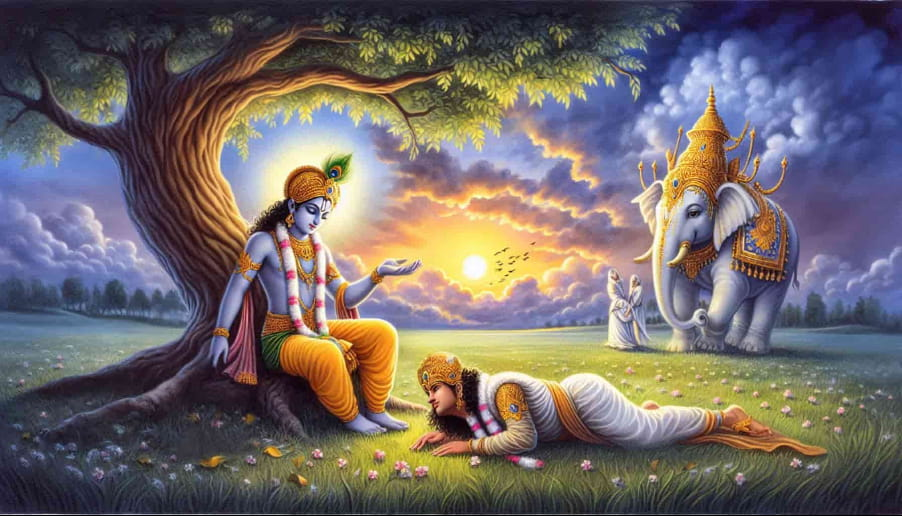
Hindus call that cowherd figure Govinda and/or Gopala Krishna, perceiving this cow-protecting figure as a form of Lord Krishna (who is, in turn, a form of Lord Vishnu).
The allegorical legend of Gopala Krishna is told in the Bhagavata Purana and the Harivamsha, two supplementary texts to the Mahabharata, the great epic famously containing the Bhagavad Gita.
In the story, young Krishna, the foster son of Nanda (joy) and Yoshoda (glory), works as a divine cowherd in Vraja (the Holy Resting Place on the banks of the Yamuna River).
Govinda occupies his time mainly by playing his flute, enrapturing the gopis (the milkmaids of Vraja), frolicking. and pranking his friends. Portrayed as a disobedient child, Gopala Krishna steals butter from the houses of the gopis, untethers cows, and lies to his foster-mother. Despite his antics, the women of Gokulam (the cow pasture or community) find him too endearing to punish. Among the most popular stories of Gopala Krishna and the gopis is the rāsalīlā, in which Krishna multiplies in form and dances with each gopi who encircles him in the forest (the Borderland). Later traditions depict Krishna only with Radha, the chief Gopi. A syllabic marriage of Rad and ha, the name means “the split greater light.” So Radha represents Krishna’s loving partnership with the Great Rays of Yah and Vah, the chief miracle-milk extracting powers in the Resting Place (the green pastures beside the still waters).

The rest of the symbols should be pretty obvious by now. The Gopis making circles around Krishna in the forest, for example. Do I need to spell it out?
The Sukta’s eighth Rik reads:
The true-self cowherd impels the Chosen Ones with divine ears to steadily give in the circle of wholeness.
sva-g(a)nayo (The true-self Cowherd) hi (impels) vāryaṃ (the chosen ones) dev-āso (with divine ears) dadhirely (to steadily give) ca (in the circle) naḥ of wholeness).
Notes:
As Jesus explains in the Course, the Chosen Ones are the Souls living in the world at the present time who’ve answered the call to wake up ahead of the majority of earth-bound Souls. As the rishis suggest, the Chosen Ones hear the AUM. Most people don’t or can’t at this point in the dream’s replay. Few even know the sound is there, crying to be heard.
Course-Jesus says much on this subject, but few Course students and teachers yet understand what he means by the Voice for God and/or the Holy Spirit. And AUM isn’t even mentioned, let alone identified as “the keys to the kingdom” in the three Abrahamic religions (Christianity, Judaism, and Islam). This wisdom is, nevertheless, buried in the foundational scriptures of all three religions. Insofar as I’m aware, the importance of AUM or OM has only been retained in Hinduism, Buddhism, Jainism, and Sikhism, all of which originated in India.
Rv 1.26:9 reads:
The true-self cowherd drives the great now-moment waters. the two gathering together the immortal and the mortal beings uniting in peace to advance the singing sustaining the universe.
sva-g(a)nayo (The true-self Cowherd) manāmahe (drives the Great ) athā (Now Moment) na (waters) ubhaye-ṣām (the two gathering together) amṛta (the immortal) martyānām (and the mortal beings) mithaḥ (uniting) santu (in peace) pra-śastayaḥ (to advance the singing) viśvebhir (sustaining the universe)
Notes:
The true-self Cowherd, as just explained, is Lord Krishna, the Christ figure of Hinduism and the charioteer of Arjuna, the Soul preparing to do battle with the Ego Mind. The great now-moment is the Holy Instant, while “the two” probably refers to the Great Rays, the Yah and the Vah powers of YHVH, God’s Holy Name in Israel (the Soul Mind, not the country). These two Rays also are the two streams of Vishnu — a Sanskrit name meaning “two streams,” (rather than “preserver”) as well as the two rays seen beaming from Christ’s chest in the Divine Mercy image commissioned by Sister Faustina.
The singing advancing the universe is what Course-Jesus terms “the Mighty Chorus to the Love of God.” Others call these ethereal singers the Cosmic Choir, the Cosmic Chorus, or the Heavenly Host. As I understand it, all God’s Creations sing this “ancient melody” together with their Creator in Heaven. To end the dream, we all have to sing the song here as well. The “song” is AUM, the three-part melody of Perfect Love (Agape).
Or, as Course-Jesus similarly explains:
Now is the time of salvation, for now is the release from time. Reach out to all your brothers, and touch them with the touch of Christ. In timeless union with them is your continuity, unbroken because it is wholly shared. God’s guiltless Son is only light. There is no darkness in him anywhere, for he is whole. Call all your brothers to witness to his wholeness, as I am calling you to join with me. Each voice has a part in the song of redemption, the hymn of gladness and thanksgiving for the light to the Creator of light. The holy light that shines forth from God’s Son is the witness that his light is of his Father. (ACIM, T-13.VI.8:1-8)
The tenth and final Rik reads:
Agni is the sacred-fire guiding force of the almsgiving rituals of Ida’s sound vibration, the circle-vessels discharging the energy forces of the Yah Om.
agne (Agni is) agnibhir (the sacred-fire) imaṃ (the guiding force of) yajñam (the almsgiving rituals of) idaṃ(Ida’s) vacaḥ (sound vibrations) ca-no (the circle-vessels) dhāḥ (discharging) sahaso (the energy forces of) yah-o (the Yah Om)
I’m not sure what this means or that my definition for cano is accurate. But let’s see if we can work out the meaning through deconstruction. In Hindu lore, Idā primarily represents a goddess of speech, nourishment (ghee/milk), and acts as an instructress to Manu (manifesting thought) on performing offerings. In yoga, she’s the “lunar” nadi (spiritual energy-channel) whose partner is the “solar” nadi, Pingala. Together, Ida and Pingala twine their way up the Shushumna, the central channel or nadi housing the sacred-fire, Kundalini. As I understand it, Ida and Pingala work in tandem to coax Kundalini upward through the chakras, which they purify or open to remove the obstacles to her ascent. The image below illustrates the general dynamic.
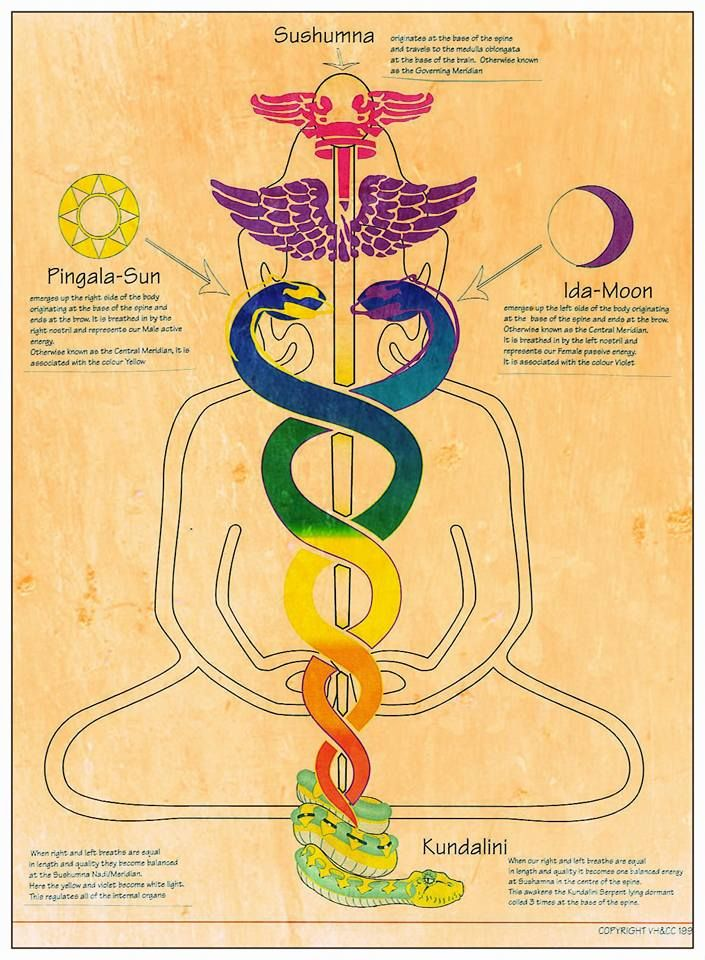
If Ida’s sound vibration is the “lunar Om” or “Moon Om” (which it is, by all accounts), then the Ida nadi carries the lunar energy of the AUM vibrations of the Yah Ray, which is “solar” (generated by Surya, the Solar Logos). We can deduce from this that Pingala carries the solar energy of the Vah Ray, which is “lunar” (generated by Soma, the Great I Am). In this way, the energies of the Sun and Moon (God and Christ) intertwine like serpents to clear the way for Kundalini to rise up the central channel. And Agni is the guiding force of this “dance.”
This might explain why King Indra surrenders his power to Krishna in the Hindu lore. Krishna, being “the cowherd” in the Resting Place, disperses Indra’s power (the solar energy of God’s Will) through the Circle of Water, where he plays the U-kara on his flute.
This suggests that Agni may be the Vedic name for the serpent-fire, Kundalini, a term not found in the Rigveda. While we’re on the subject of “kundalini,” let me set the record straight. Kundalini does NOT mean “coiled,” as pretty much everyone suggests; the word is a compound of kund and alini, meaning “the swarm (of bees) from the pit.” Contrary to popular belief and Google’s explanation, “the swarm from the pit” does NOT refer to the demonic locusts released from the bottomless pit in Revelation 9.
As we’ve discussed, the locusts aren’t a “plague”; they symbolize the ego-destroying vibration that is AUM, the Atonement. The bottomless pit, meanwhile is the wellspring of the Resting Place, which draws up the Living Water from the Cosmic Ocean underneath the illusion.
That the locusts and pit are demonic is, quite frankly, a purely egoic (fear-inverted) interpretation of Revelation 9. The wellspring is guarded by Nisrok, the eagle-headed cherubim seen by the prophets Ezekiel, Zechariah, John of Patmos, and Mohammad. Nisrok’s Army, as we’ve discussed, are the miracle-working Souls in the Circle of Water.
From all of this we can glean that Kundalini, the swarm from the pit, is the buzzing sound made by the Trinity powers of Yah, the Red Ray, which dissolve the Ego Mind in three stages. So, as I’ve long suspected, what yogis term “Kundalini” is what Course-Jesus terms “the Atonement.”
About this “inner force” he says:
Miracles represent freedom from fear. “Atoning” means “undoing.” The undoing of fear is an essential part of the Atonement value of miracles. (ACIM, T-1.I.26:1-3)
He also says:
The Atonement is the only defense that cannot be used destructively because it is not a device you made. The Atonement principle was in effect long before the Atonement began. The principle was love and the Atonement was an act of love. Acts were not necessary before the separation, because belief in space and time did not exist. It was only after the separation that the Atonement and the conditions necessary for its fulfillment were planned. Then a defense so splendid was needed that it could not be misused, although it could be refused. Refusal could not, however, turn it into a weapon of attack, which is the inherent characteristic of other defenses. The Atonement thus becomes the only defense that is not a two-edged sword. It can only heal. (ACIM, T-2.II.4:1-9)
Okay, wait, because I’m beginning to think Kundalini might be the Capstone, which Yah and Vah produces by joining. In the teachings of True Yoga (including Kundalini Yoga), Ida and Pingala rise up to “meet” in the Ajna Chakra. And that meeting of the two ego-undoing powers results in a “Kundalini awakening.”

This new insight changes some of what I’ve explained hitherto, but only slightly. If Kundalini is the Capstone, which is formed through the “sacred marriage” of the Yah and Vah, then Kundalini represents the all-powerful vibration of Perfect Love, which destroys the Ego Mind like a lightning bolt … or a Flaming Sword.
I hope I haven’t confused you. But, like I’ve said all along, I’m learning as I teach through these online adhyayana discussions.
And one thing I’ve learned today is that Jesus Christ was the first Soul in human form to awaken Kundalini, the Flaming Sword and the Capstone. And once he awakened the sleeping serpent-fire for himself, he awakened her for everybody else, too.
This was, I suspect, the event in Christ’s life the New Testament calls “the Transfiguration.”
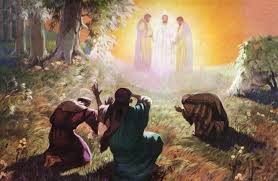
According to Matthew 17:1-8, Mark 9:2-8, and Luke 9:28-36, Jesus led his closest three disciples up a high mountain. His face shone like the sun and his clothing became dazzling white. Moses (drawn from the waters) and Elias (Yahweh is salvation) appeared, speaking with Jesus about his upcoming “exodus” in Jerusalem (the Land of the Living on the sixth plane). A bright cloud overshadowed them, and a voice from heaven said, “This is my beloved Son. Hear him.”
I’ve read many explanations of the Transfiguration’s symbolism, but only now do I apprehend what Moses and Elias represented in the vision. The mountain Jesus went up was in the Celestial Sphere, rather than a mountain in worldly Judea (like Mt. Tabor). Moses was the power of love “drawn from the waters of grace”, while Elias represented the sacred marriage of the Great Yah and Vah Rays, whose union brought forth Moses; the Cloud was the Pillar of Cloud containing the AUM vibrations of Yah; the dazzling white clothing signified the robes of righteousness; the voice was the Word of God, the Holy Spirit’s M-Kara, advising Christ’s disciples to listen. And in that moment, the power of Perfect Love was reborn in the world through Jesus Christ.
That power is Kundalini, the swarm from the pit, which is the Flaming Sword guarding the gate into Eden.
Pretty awesome, right?
In the Course, Jesus says three very important things regarding his relationship to the Atonement. First, he says, he activated the power; second, he says he commands the power (he’s in charge); and third, he says he IS the power. He is, in other words, the symbolic embodiment of Perfect Love, the three-in-one Trinity power of the Atonement.
If you’ve been paying attention, this should make sense.
I just reviewed the archives, and it doesn’t look as if I’ve yet retranslated Revelations 9. So, let’s do that now, knowing that Kundalini, the serpent-fire of God’s Perfect Love, is “the swarm from the pit,” rather than anything frightening or evil.
The start of the chapter reads thusly:
The fifth messenger-trumpet sounded, and I saw a star fall from the Celestial Sphere to the Land of the Self, to bestow the key to the bottomless well. The bottomless well broke open, sending up smoke from out of the well; the smoke of a great oven. The light and the air darkened from the smoke the well sent forth. And from the smoke, locusts went into the Land of the Self, to give power (authority) like a scorpion, to the Land; the power to act and even command the Self not to do wrong, lest they do wrong to the land (of the living) or the green (pastures) or the Tree (of Life). Alone, men do not have the Seal of God in their foreheads. To the Self it was given, to destroy the (ego) self in order to deliver the (True) Self, or else to torture five months, with the Self tormenting like the torment of a scorpion, when he strikes a man. And on that day. men seeking death shall not find it, nor shall desire death, and even death shall flee from them.
Firstly, the Land of the Self is the Land of the Living, the Resting Place, and the Borderland. The star falling into that Land is God’s Thought at the top of the dream-realm, the Word of God or Solar Logos shining down from Heaven. The pit, as already explained, is the wellspring, the Well of Jacob in the Resting Place, where we draw up the Living Water from the Cosmic Ocean underneath (via the Circle of Waters or the Gathering of Waters). The smoke represents “the swarm from the pit,” which is Kundalini arising from the well.
The stuff about “torment” doesn’t make sense, so let’s check the etymology. The Greek word translated as “torture” or “torment” is basanismos (βασανισμός). Basanismos is rooted in the ancient Greek word basanos, which describes a “touchstone” used to test the purity of precious metals. Over time, it came to mean “putting something to the test through hardship, agony, or severe examination.”
The word used in Revelations is, in actuality, a compound of basan (touchstone) and ismos, a suffix that once described a “state of being” practice, teaching, or adoption of a distinct system, doctrine, or behavior. So, Basanismos actually means not “torment,” as the Ego would have us believe, but “touchstone process.”
But wait, because, according to Strong’s the word translated as “torment” is sometimes basanizo rather than basanismos, and izo means “to act like,” “engage in,” or “make into.” So, Basanizo means not “to torment,” but “to act like a touchstone.”
With that in mind, let’s revisit the last section of the verse, replacing “torment” with “act like a touchstone” or the touchstone-process or mode of being, as appropriate.
To the Self it was given, to destroy the (ego) self in order to deliver the (True) Self, or else to act like a touchstone for five months, with the Self of the touchstone mode of being acting like the touchstone process of a scorpion, when he strikes a man. And on that day. men seeking death shall not find it, nor shall desire death, and even death shall flee from them.
What is the touchstone process of a scorpion, when he strikes a man? The way in which scorpions navigate the world, presumably. Scorpions have poor eyesight, so they rely almost exclusively on touch and vibrations to hunt and navigate. They strike suddenly and without warning (like lightning), but not with malice.
In Christianity, Jesus Christ is considered “the touchstone.” And, in the Course, he tells us he is the symbol of Agape, an abstract concept incomprehensible to humans, in a form we can understand and emulate. So, Perfect Love is the touchstone, as well as the Capstone, the Rock, the Cornerstone, and the Flaming Sword. Essentially, it’s the tonal vibration of the divine force of Perfect Creation, which is, I suspect, the A-kara vibration or the Right Hand of God.
Or, to quote Course-Jesus in closing:
To think like God is to share His certainty of what you are, and to create like Him is to share the Perfect Love He shares with you. To this, the Holy Spirit leads you, that your joy may be complete because the Kingdom of God is whole. I have said that the last step in the reawakening of knowledge is taken by God. This is true, but it is hard to explain in words because words are symbols, and nothing that is true need be explained. However, the Holy Spirit has the task of translating the useless into the useful, the meaningless into the meaningful, and the temporary into the timeless. He can therefore tell you something about this last step.
God does not take steps, because His accomplishments are not gradual. He does not teach, because His creations are changeless. He does nothing last, because He created first and for always. It must be understood that the word “first” as applied to Him is not a time concept. He is first in the sense that He is the First in the Holy Trinity Itself. He is the Prime Creator, because He created His co-creators. Because He did, time applies neither to Him nor to what He created. The “last step” that God will take was therefore true in the beginning, is true now, and will be true forever. What is timeless is always there, because its being is eternally changeless. It does not change by increase, because it was forever created to increase. If you perceive it as not increasing you do not know what it is. You also do not know Who created it. God does not reveal this to you because it was never hidden. His light was never obscured, because it is His Will to share it. How can what is fully shared be withheld and then revealed?
Are we clear? Lol.
Thanks for visiting the Holy Meeting Place dot com. Until next time, listen and learn to heal.


Leave a Reply