Namaste, my brother in Christ, and welcome (or welcome back) to my latest adhyayana posting. We’re studying the Rigveda, Hinduism’s oldest and most sacred scriptural text, which has never before (to my knowledge) been accurately translated. But then, neither have the Bible or the Quran, because the Ego Mind (Satan) weaves fear, guilt, divine wrath, and eternal damnation into everything it touches — and then builds theologies upon those fallacious premises.
Today, we’re looking at the first mandala’s 21st Sukta. another one attributed to the sage Medhatithi Kanva. Also allegedly, Rv 1.21 is a six-verse hymn in the Gayatri meter praising Indra and Agni (whose names are presumed to be joined as Indrāgnī). Unless this Sukta differs from its forerunners, it is neither a hymn nor written in the Gayatri meter. Let’s dig in and see what we find.
According to his Holiness, Sri Aurobindo, the sukta’s six lines read as follows in transliterated Sanskrit:
iha indrāgnī iti upa hvaye tayoḥ it stomam uśmasi tā somam soma-pātamā ||
tā yajñeṣu pra śaṃsata indrāgnī iti śumbhata naraḥ tā gāyatreṣu gāyata||
tā mitrasya pra-śastaye indrāgnī iti tā havāmahe soma-pā soma-pītaye||
augrā santā havāmahe upa idam savanam sutam indrāgnī iti ā iha gacchatām ||
tā mahāntā sadaspatī iti indrāgnī iti rakṣaḥ ubjatamaprajāḥ santu atriṇaḥ||
tena satyena jāgṛtam adhi pra-cetune pade indrāgnī iti śarma yacchatam ||
Only, they don’t, as we’ll soon see. To convey a complete thought, the first line has to read: ha indrāgnī iti upa hvaye tayoḥ it stomam uśmasi tā somam soma-pātamā tā yajñeṣu, which translates thusly:
The Great Rays kindle the melody of Kamadeva’s three within Havye (YHVH). Of these three, two offer the song of glorification heating the tail of Soma’s moon-locust, the tail inspiriting the yajnas.
My definitions and syllable-divisions:
iha (the Great Rays) ind-rāgnī (kindle the melody) iti (of Kamadeva’s three) upa (within) hvaye (the four-letter divine name, YHWH) tayoḥ (of these three, two) it (offer) stomam (the song of glorification) uśmasi (heating) tā (the tail) somam (of Soma’s) soma-pātamā (moon-locusts), tā (the tail) yajñ-eṣu (inspiriting the yajnas).
My notes:
After considerable trial and error, I worked out that indragni is a compound of ind (kindling) and ragni (melody), rather than of Indra and Agni, as most Sanskrit dictionaries suggest.
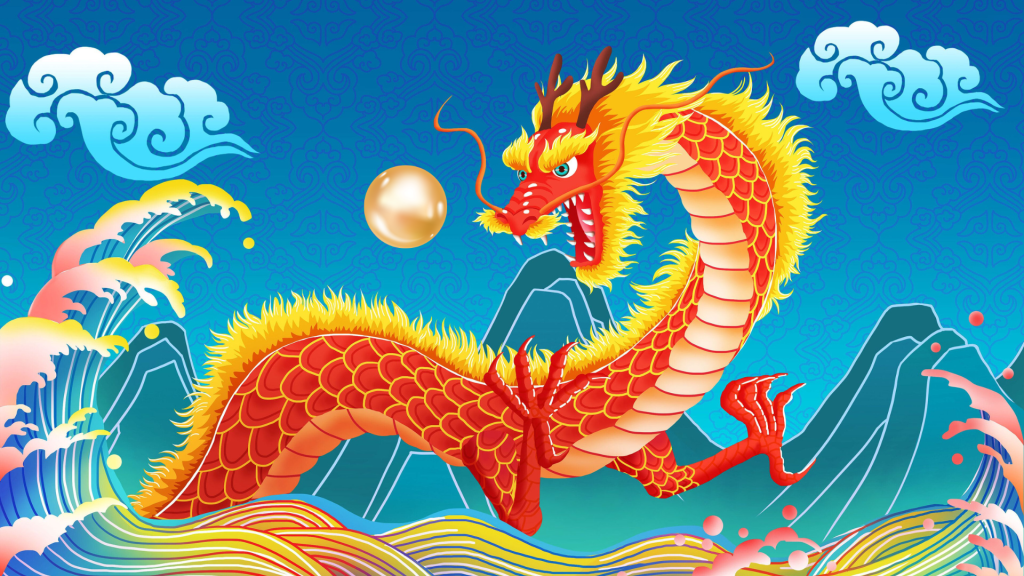
The tail mentioned has to be Ketu, the descending node of the spiritual moon–the Lesser Light of the Great I Am ruling the Night, which Hindus call Soma and/or Chandra. As explained previously, Ketu is the tail of the red dragon (of God’s radiant splendor) underneath the illusion.
In an earlier post, I defined hvaye as “calling the name” — and that was close to the true definition found in the Kabbalah. Another form of YHWH, havye or havya is defined in Jewish mysticism as a tetragrammaton of the four-letter Name representing God’s essence and the continuous bringing of existence into being. And this is, to be frank, a more accurate definition of YHWH than is found in conventional Judaism.
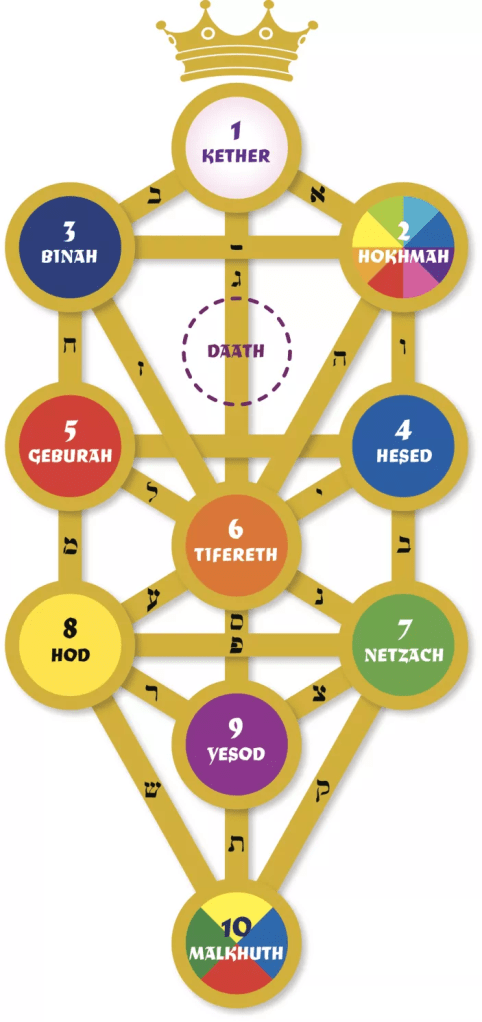
According to the scholarship, Havye also signifies the four-stage unfolding of creation’s expansion, correlating with the Sefirot: Yod, the divine spark = Chokhmah), Heh, the Holy Spirit = Binah), Vav, the yoke = Tif’eret, and Heh, the Holy Spirit = Malchut, the Kingdom of God).
Initially, I thought Indragni meant “Indra’s fire,” the force Hindus and Jains call Samvartaka. This definition didn’t work with my earlier definition of iti as “Kamadevs’s three.” Now, it does work. But, for a couple of days along the way, I thought iti might mean “plagues,” as was suggested by one of the sources I consulted.
Plague is a scary word — too scary to fit the frame of God’s bountiful and unending love and mercy toward His children. I checked the etymology, finding no viable root or definition to fit the frame, so I decided to retranslate Exodus 7 – 8, to determine what these Biblical passages actually report about the first four “plagues” of Egypt — the plagues supposedly visited upon humankind by YHWH, the four-part Name of God in Israel.
Now that I’ve revised my definitions, this detour into Exodus (exodus into Exodus?) may seem superfluous. But I beg to differ, given that it mentions the very dragon whose tail appears in the 21st Sukta. So, kindly indulge me.
To set the stage, let’s start at the top of Chapter 7, which, btw, says nothing about Pharaohs or Egypt. Much as I hate to shake the foundations of the religion built on these sandy lies, the Hebrew word translated throughout the Old Testament (and Torah) as Pharoah, the Egyptian ruler, is paroh, the Biblical name of the Great Dragon (as per Ezekiel 32:2). Likewise, the word translated as Egypt is mits-rayim, which means “to extract or press-out the joyful companions.”
These joyful, holy, or mighty companions are mentioned once or twice by Course-Jesus. In one of these references, he says:
As you perceive the holy companions who travel with you, you will realize that there is no journey, but only an awakening. The Son of God, who sleepeth not, has kept faith with his Father for you. There is no road to travel on, and no time to travel through. For God waits not for His Son in time, being forever unwilling to be without him. And so it has always been. Let the holiness of God’s Son shine away the cloud of guilt that darkens your mind, and by accepting his purity as yours, learn of him that it IS yours. (ACIM, T-13.I.7:1-6)
Christ’s descriptions of these companions suggest they are the presences of God and Christ, still awake within our dreaming minds. These companions are also, therefore, the “They” Jesus mentions elsewhere in the Course. When “They” come, he tells us, the Holy Spirit’s work is completed.
Without further ado, Exodus 7 begins as follows;
YHWH said, “Moses, to have vision, give Elohim-Paroh (the Elohim power, Paroh) to Aaron, your brother. God’s authorized spokesperson (or prophet) speaks to ordain Aaron. The Word of God, Paroh is the Anointed Son of Israel in the Land of the Living. To gather or assemble (within) Paroh’s heart brings in abundance signs and miracles in the Land of the Living. To extract the companions, Paroh gathers together to extend the hands (of God) to extract the companions. From out of the Gathering Place of the Anointed One of Israel in the Land of the Living, by Great Judgment extract the companions making known YHWH. To extend the hands to extract the companions, bring forth the Anointed One of Israel within Moses and Aaron, by acting on YHVH’s commands. Moses at eighty years was anointed, and Aaron, at eighty-three years, was anointed by the Word of God, Paroh.
This is rather confusing, so let’s break it down into digestible nuggets. The Anointed One of Israel is the Messiah. In Christian theology, the Messiah is Jesus Christ. In Genesis 35:19, the Anointed One is identified as Migdal Eder (the tower of the flock), the place where Rachel (the Bride in the Old Testament), gave birth to the youngest son of Israel (Jacob, the journeying Soul), who is called Benjamin (son of the right hand).
In the Biblical account, Rachel dies after delivering the baby, and is buried “in the way to Ephrath,” a place-name meaning “to bear fruit.” In the material world, Ephrath was an early name for Bethlehem (the city of bread). The son of the right hand is the Great Hand of Chessed (divine mercy and compassion), which is the U-kara aspect of A-U-M. Ergo, Benjamin’s birth represents the right-hand of God, the Divine Mercy Ray, entering the dream-realm.
All of these clues tell us that Ephrath represents the Resting Place or Land of the Living (Tif’eret on the Tree of Life), where the Holy Spirit completes His work of extracting “the companions,” as the second H in YHVH. While traveling to Ephrath to bury Rachel, Israel (Jacob) made his camp near the Tower of Eder (the tower of the flock or herd) and stayed there to mourn Rachel’s death. Ergo, the Tower of Eder symbolizes the tower of the Messiah, where “the watchers” abide.
While confusing, this section of Exodus basically describes the established miracle-working protocols of the salvation process. And so does the next section, which reads:
YHVH speaks (to the heart-minds) of Moses and Aaron, saying, “Paroh, the Word of God, speaks to say, “Give miracles in answer to Aaron.’” Take they rod and set free the face (or presence) of Paroh, the dragon. Moses and Aaron entered into Paroh, to act on YHVH’s orders. Aaron cast his rod, freeing the faces of Paroh, the faces serving the dragon. And Paroh called forth the wise Kashspah, burning the innocence to extract the companions, acting rightly as flames throwing down the spirit-rod of the dragon. Aaron’s rod swallowed these rods to strengthen Paroh’s heart to hear and obey YHWH’s singing.
Clearly, Paroh is the Great Dragon, the flame-colored dragon who is called “the Beast” in Revelations, rather than an Egyptian king. And this is why Ezekiel also identifies Paroh (not Pharoah) as “the great dragon.” As I interpret all this, the faces of the Great Dragon are the four Living Beings, Cherubim, or throne-bearers.
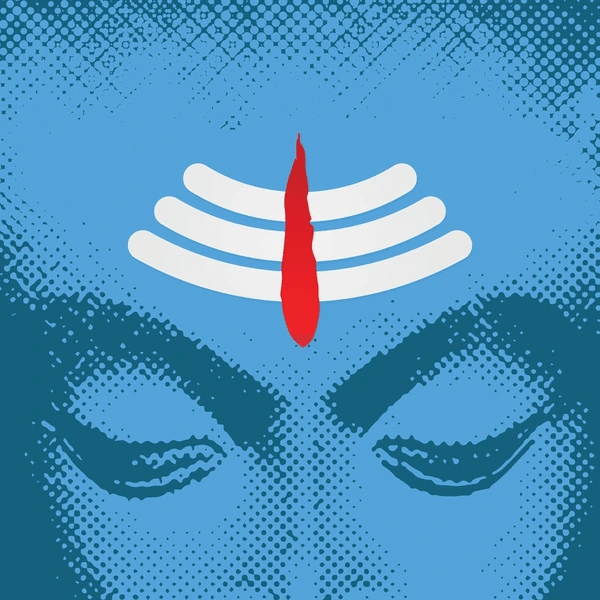
We further learn from these descriptions that Paroh is dabar, the Word of God rather than “speaking.” So, Paroh, the Word of God, is the Beast, and the mark of the Beast is the Tripunda on Shiva’s forehead. Shiva, like Benjamin, represents the U-kara aspect of A-U-M, which I believe to be a perfect pairing of grace and mercy. For, as Google explains, “Grace and mercy are closely related, often paired concepts representing God’s love, but they have distinct meanings: ‘Mercy’ is God withholding the punishment we deserve, while ‘Grace’ is God giving us the blessing/favor we don’t deserve. Both are freely given, often described as two sides of the same coin: mercy addresses our need for forgiveness, while grace empowers our new life.”
Not an altogether right-minded view, but sufficient for our present purposes.
When the three lines of Shiva’s Tripunda curve upward (as shown below) the mark strongly resembles the Temple Menorah, the Golden Lampstand of Redemption whose three conjoined branches (joined at the center rod) symbolize the three cupped hands of God, the three vessels, cups, or bowls of AUM.
Aaron means “exalted” or “high mountain,” whilst the rod or staff in the allegory symbolizes the son of the Bride, acting within us as a staff made of iron (as we learn from Revelations). And as we now know, the son of the Bride is Benjamin, the right-hand of God’s grace and mercy.
Isn’t this fun?
Let’s continue, because we’ve only just reached the part about the first plague.
YHWH said to Moses, Paroh’s heart is heavy. To be saved (ma’en should be malen), the flock releases the flow of Paroh at daybreak. To bring forth the waters, stand upright on the riverbank in the Assembly, the tribe overturning the serpent. To receive the hand speaking YHVH-Elohim to the Hebrews, answer the call to the flock sent to serve in the desert for the purpose of hearing the utterings of YHVH, to know YHVH, and to strike the rod of the hand of the waters, the stream of transforming blood. A fish in the stream of death–the stream made too odious to extract the companions impatient to drink of the water of the streams–YHVH speaks unto Moses, saying unto Aaron, “Take up they rod and extend the hand of the waters to extract the companions, the streaming channels of the pool gathering together the waters of the Blood (of Christ) — the Blood of the Land of the Living, to extract the companion vessels of wood and stone.
Clearly, this is about the three hands of God — the three vessels in which Rama washed his feet in the Ramayana — not some terrible plague from God that turned the waters of the Nile into blood, killing hundreds of people.
Apparently, we’re supposed to “strike” the rod (of God’s grace and mercy) on the waters while standing in the Assembly, to bring forth the three hands.
Noteworthily, the word “plague” never appears in this section of Exodus, meaning the idea that these events were “plagues” sent by God is a complete egoic invention.
Let’s stop and apply our reason here: Why would God, who commanded us not to kill, break his own commandment by killing his own creations? The answer is: He wouldn’t. So, the conventional translation and negative interpretation must be wrong.
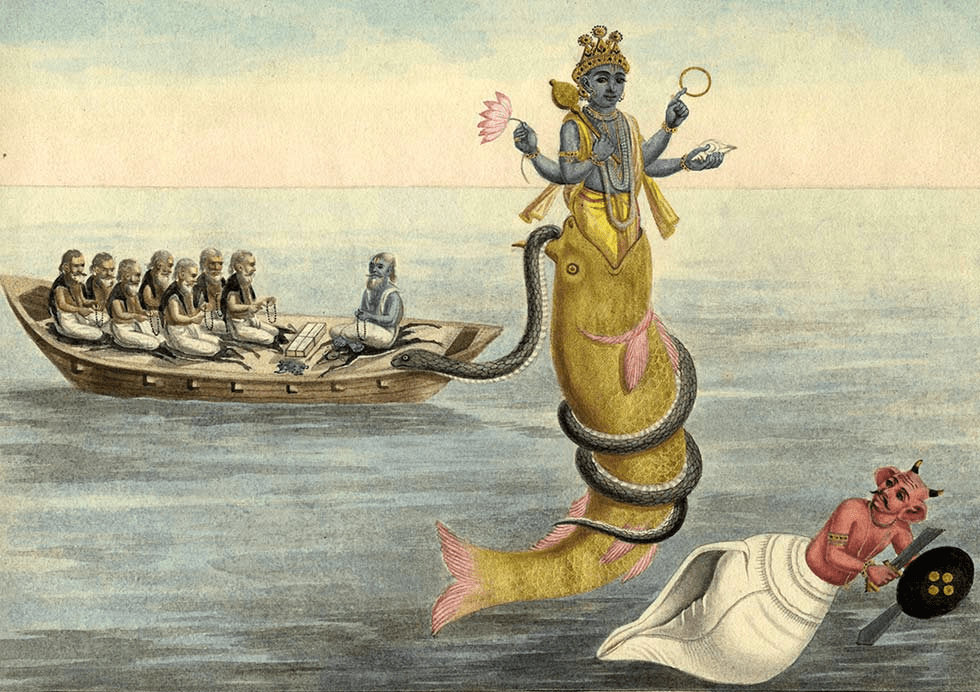
From our Vedic studies, we know the fish in the steam is Matsya, the first incarnation of Vishnu, the Holy Spirit (Hari or Hey), which Manu rescued from the river. The fish, as you’ll recall, outgrew all the watery dwellings Manu provided before it warned him of the coming flood, urged him to build the Ark, and pulled the Ark through the flood to the safety of the Himalayas. That fish, we are told herein, represents YHVH, the name of God in the stream of death — the fearful or ego-thinking stream of material consciousness, which opposes God’s established order for the cosmos.
In the Bible’s counterpart-allegory of Noah’s Ark, it is YHVH who speaks to Noah, affirming my interpretation of what both the fish in this verse and Matsya represent. In the Hindu story Manu eventually realizes that Matsya is Vishnu, so YHVH, the Name of God in Israel, is probably the Holy Spirit “in two streams.” In this case, YH (the spark of the Holy Spirit) and VH (the yoke of the Holy Spirit).
Hebrews means “descendants of Eber” — a word-name meaning “crossed over” or “the other side.” From this we can deduce that the hand speaking YHVH-Elohim to the Hebrews is the elevated hand, the A-kara, blood, or Amrita aspect of the AUM vibration. So, the rod strikes the waters first to extract the lifeblood of Creation or Christ, by activating the divine spark at the appointed time. And that is indeed how the salvation process begins.
The next section of Exodus reads:
Moses and Aaron did as YHVH commanded to exalt the rod striking the waters channeling the eye of Paroh, the eye serving the waters streaming to transform the blood–the fish in the river of death, the river made foul, to extract the companions kindling the innocence hidden in Paroh’s heart to strengthen hearing YHVH.
The Word of God, Paroh, at dawn, enters the Temple to set the inner heart of the same to extract the companions and to seek the circle streaming the water to drink. To be able to drink the water of the river, the Seven Rays complete the hinder-part of YHVH to strike the river.
So, this is pretty much what I just said. The first rod-strike activates the spark to enter the Temple and begin the Atonement process.
Paroh, being the Great Dragon of God’s Word, doesn’t have “magicians” or “sorcerers,” so the traditional translation of Chartom can’t be right. Chartom must be, therefore, a compound of char (kindling) and tom (innocence). This “kindling innocence” probably refers to the cast-off branches God uses to fuel the furnace in which we bake the sweet cakes offered to Moket, the miracle-cow (as we learned in Leviticus). And this is also the meaning of “kindling the melody.”
Metaphorically this makes sense. And if chartom can’t mean “magician,” then lat can’t mean “enchantments.” And it doesn’t, because lat actually means “secret,” “hidden,” or “covered.” The hinder-part of YHVH refers to the back-room or stern of the Ark, where Christ (the A-kara) safely sleeps in peace through the storm (of earthly existence). To activate the Amrita-supplying A-kara, therefore, we have to awaken the sleeping inner-Christ.
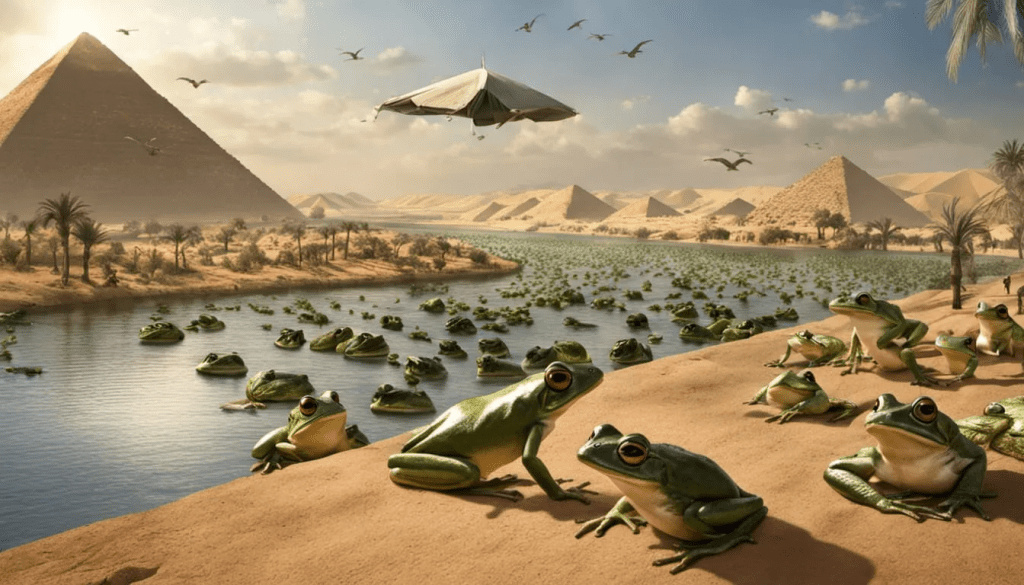
Let’s move on to the second plague, the supposed frog-invasion in Egypt. The big mystery to be solved herein is the true definition of tsephardea, the word translated as “frog” throughout the Old Testament. Since a plague of frogs makes no sense in the framework of spiritual truth, I’m guessing tsephardea is a compound of tsephara (dawning) and dea (knowledge, perception, or judgment).
YHVH said unto Moses, “To enter or abide in Paroh, answer the call of YHVH’s flock sending forth, in service to be saved, the strike from the Borderland, the channel of dawning knowledge. The river multiplies the dawning knowledge abundantly offered to enter into the Temple’s innermost chamber, the Resting Place in the Temple serving the flock of the furnace kneading the dough of dawning knowledge offered by the flock serving YHVH.
To abide in Paroh is to abide in God’s Word, which is synonymous with God’s radiant splendor. God’s Word, as I’ve explained, is not a text; it’s A-U-M. So, abiding in God’s Word does not mean dwelling in, obeying, and applying the mistranslated scriptures to everyday life, treating it as a permanent, foundational lifestyle rather than a casual habit. Abiding in God’s word means meditating on the AUM, giving the alms of brotherly love and mercy in every thought we have, studying the true teachings of the Holy Spirit, and humbling our egos by surrendering all our life choices to the Holy Spirit.
Also mentioned in Daniel, “the flock of the furnace” presumably refers to the three young Hebrews who were thrown into a blazing fiery furnace in Babylon for refusing to worship King Nebuchadnezzar’s golden image. According to the story, these three Souls were preserved by God, walking unharmed in the fire alongside a divine fourth figure.
Their names were Shadrach (under the command of the Babylonian moon-god, Aku), Meshach (he who is like Aku), and Abednego (servant of Nego, the Babylonian god representing the Ego Mind). If Aku is the Babylonian counterpart to Soma, we’re looking again at the three hands of God, the three water vessels or gems of A-U-M, the Atonement Trinity.
Exodus continues thusly:
Speak unto Moses, saying to Aaron, “Extend they hand — the branch of the river of the pond of the dawning knowledge offered in the Land of the Living to extract the companions. And Aaron extended his hand over the waters to extract the companions–and the dawning knowledge rose up secretly in the Land of the Living to extract the companions kindling the innocence. Offer the dawning knowledge in the Land of the Living to extract the companions.
A little confusing and repetitive, I’ll grant you, but still far more rational than a freakin’ plague of frogs.
The third plague that never was is described in Exodus 8:16-19, allegedly as a swarm of gnats or lice that afflicted both people and animals.
Anyone care to wager on the probable accuracy of that interpretation?
I won’t try your patience by translating the whole section about the lice: I will simply point out that the Hebrew word translated as “lice” is ken, which means not “lice,” but “to establish.” So, Aaron struck his rod upon the waters to establish in the Land of the Living the Red Ray (Adam/Atman) of the Beast (Paroh, the Great Dragon of God’s Radiant Word), to bring forth the companions.
This part of Exodus describes, therefore, the soul-quake that shakes off the dust of the ego-self at the gate of Heaven (the Sefirot of Da’at), which happens in the Land of the Living (The Sefirot of Tif’eret). When we reach the Resting Place (a.k.a. the sacred grass), that is to say, we wash our feet in the tears of the miracle-cow, without the bother of lice, midges, or gnats.
The fourth plague is said to be “a swarm of flies,” based on an ancient mistranslation of the Hebrew word arob, which is, in fact, an alternate spelling of ereb or erev.
According to Google,
Erev (עֶרֶב) in Hebrew primarily means evening, dusk, or sunset, representing the start of a new day in the Jewish calendar. It signifies the transition from light to darkness (as seen in Genesis 1:5) …. It also implies rest, renewal, and anticipation.
So, Erev isn’t a swarm of flies; it’s ‘the twilight before the dawning of the Yoms (Rays, not Days)” described in the first Book of Genesis. Apparently, we experience that twilight in the Resting Place, before entering into Heaven.
So, once again, these four “plagues” are complete inventions devised by the Ego Mind to paint God as a wrathful tyrant who’s crazy and vindictive enough to curse his frightened children with bloody rivers, frog invasions, lice, and swarms of flies. Believe Satan’s hogwash at your peril, brother, because God is wholly benevolent, merciful, and sane. And we were created in his likeness.
What these chapters of Exodus seem to describe are the bowls or cups we drink from to “passover” ego consciousness. In Judaism, these metaphoric cups are symbolized as the four ceremonial cups consumed during the Passover Seder in fulfillment of God’s promise in Exodus 6:6 to “redeem you with an outstretched arm.” What Jews drink from those cups represents the blood of the Passover lamb that spared the Israelites. In Christianity, that same blood was shed by Jesus to redeem true believers.
I hope you now better apprehend what both forms of that blood actually represent.
Let’s now go back to what the Kabbalah teaches about YHVH, because it tells us where on the path we strike the four rods. At Chokhmah, we activate the spark ; at Binah, we hear the Holy Spirit vibration; at Tif’eret, we activate the yoke; and at Malchut, we enter the Kingdom of Heaven.
Now that we’ve cleared up these longstanding misinterpretations of the Bible’s teachings, let’s get back to the Rigveda’s 21st Sukta, which reads:
To advance gathering together the Assembly kindling the melody of Kamadeva’s three, the unified warriors of Narayana sing Vishnu’s gayatri, the sacred syllable guiding the feet (of the Soul).
My definitions and syllable divisions:
pra (to advance) śaṃsata (gathering together the Assembly) indrāgnī (kindling the melody) iti (of Kamadeva’s three) śum-bhata (the unified warriors) naraḥ (of Narayana) tā (sing) gāyatr-eṣu (Vishnu’s gayatri) gā-yata (the sacred syllable guiding the feet)
My notes:
Let’s start with the united warriors of Narayana, In the Mahabharata epic, these valiant warriors are called the Narayana Sena, which is characterized as “an elite army of millions of battle-hardened Vrishni-Yadava warriors.” In the Bible, they are Nisrok’s Army, which, rightly perceived, is the army of miracle-workers making up the Assembly. The meek who will eventually take over the earth. And, as I keep saying, we join the Assembly by meditating on the Om, while offering the sacred-fire alms of brotherly love, mercy, and grace to everyone, without exception.
In Hindu philosophy, the sacred-syllable guiding the feet is Om or Aum. Therefore, Vishnu’s gayatri mantra is Om/Aum –the sound/name containing all prayers, according to Course-Jesus. Rightly understood, therefore, Om/Aum is the Gayatri Mantra prescribed in the Rigveda, rather than all the proposed renditions of Rv 3.62.10, which isn’t, in fact. a mantra.
For the record, what most Hindus believe to be the Vishnu Mantra reads as follows:
Om, Let me meditate on Narayana, Oh, Vasudeva, grant me higher intellect, And let Lord Vishnu illuminate my mind
A respectable enough prayer on the whole, to be sure. But Om/Aum will do just as well, since the Holy Spirit knows us and our needs better than we do. Just give him the AUM and he’ll use the power as he sees fit, not as you would have him use it.
The next line, Rv. 1.21:3 reads:
Sing of the covenant advancing the teachings kindling the melody of Kamadeva’s three. Sing to invoke the sweet nectar-water of Soma, the father whose formidable peace calls forth the joy within Ida’s Soma-pressing Son.
My definitions and breaks:
tā (sing) mitrasya (of the covenant) pra-śastaye (advancing the teachings) indrāgnī (kindling the melody) iti (of Kamadeva’s three) ta (sing) havāmahe (to invoke the sweet) som-apā (nectar-water of) soma-pītaye (Soma, the father whose) augrā (formidable) santā (peace) havāmahe (calls forth the joy) upa (within) idam (Ida’s) savanam (soma-pressing) sutam (son).
My notes:
In the Hindu lore, Ida’s son is Pururavas (abundant roaring), the founder of the Lunar Dynasty, whose father was Budha, the son of Chandra, the Moon-god. This Budha isn’t the Buddha of Buddhism; he’s the Navagraha representing the planet Mercury. Symbolically, therefore, Pururavas represents the AUM, the three-part Holy Name that begins and ends the Atonement process, hence Pururavas’ designation as the progenitor of the Lunar Dynasty. The Lunar Dynasty constitutes the powers descending from Soma, the Great I Am, who represents the M-kara or Holy Spirit aspect of AUM.
Rv 1.21:4 reads:
Kindling the melody of Kamadeva’s three, God’s Great Rays move the Soul to sing in devoted worship to the Lords of the Assembly, Kamadeva’s three kindling the melody.
ind-rāgnī (kindling the melody) iti (of Kamadeva’s three) ā (God’s) iha (Great Rays) gaccha-tām (move the Soul) tā (to sing) mahāntā (in devoted worship) sadaspatī (the Lords of the Assembly) iti (Kamadeva’s three) indrāgnī) (kindling the melody).
If I’m reading this right, the Great Rays are both the Lords of the Assembly and Kamadeva’s Triune powers — the three chief aspects of Divine Love operating in the dream-realm. Ergo, Kamadeva’s three are the three Trinity or Aspect Rays. Theosophy tells us those three rays represent the following aspects of God:
Ray 1 = Will and Power
Ray 2 = Love and Wisdom
Ray 3 = Active intelligence or Creative Activity
Based on my studies of multiple belief systems, I’m more inclined to believe the Trinity Rays, each of which represents an intertwined perfect-pairing of divine powers, are as follows:
Ray 1 (the Father, Aleph, A-kara, or exalted-hand force): Power and Glory
Ray 2 (the Christ, Lamed, U-kara, or right-hand force): Mercy and Grace
Ray 3 (the Holy Spirit, Hey, M-kara, or left-hand force): Peace and Joy
The next line, Rv 1.21:5 reads:
Kamadeva’s three safeguard the inborn sweetness unifying Kama’s seven waters, the thundering waters of Divine Truth, which awaken God’s reflection.
My definitions and breaks:
iti (Kamadeva’s three ) rakṣaḥ (safeguard) ubja-tama-prajāḥ (the inborn sweetness) santu (unifying Kama’s) atriṇaḥ (seven waters) tena (the thundering waters) sat-yena (of divine truth which) jāgṛtam (awaken) a-dhi (God’s reflection).
My notes:
The rishis tell us herein that the three vessels kindling the melody flow down to us as seven thundering streams. Helena Blavatsky, the co-founder of Theosophy, said something along these same lines pertaining to the seven rays. Essentially, the three Aspect Rays join in various combinations to form the four Rays of Attribute. We also see this idea depicted in the illustration below of Zechariah 4, showing the three bowls flowing down (from the olive trees) into the Menorah’s seven branches.
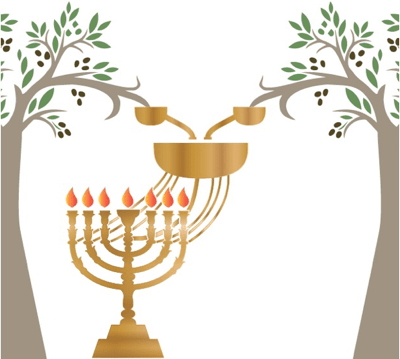
The two trees are the Mighty Companions, the three bowls are the three vessels of AUM, the seven flames are the seven Rays, and the seven branches of the menorah are the seven sacred rivers.
The Sukta’s final verse (Rv. 1.21:6) reads:
Advancing the consciousness of the lotus feet kindling the melody, Kamadeva’s three pools of creation bestow the assembled rays.
My definitgions and breaks:
pra-cetune (advancing the consciousness) pade (of the lotus feet) indrāgnī (kindling the melody) iti (Kamadeva’s three) śar-ma (pools of creation) yac-chatam (bestow the assembled rays)ǁ
In Hinduism, the “lotus feet” (padāmbuja) symbolize the divine, pure, and transcendental feet of Krishna, Vishnu, or “the guru,” serving as the ultimate refuge, object of meditation, and source of spiritual liberation. This concept, according to Google, “represents unconditional surrender, humility, and the devotee’s desire to transcend the material world.” The consciousness of the lotus feet refers, therefore, to walking in the state of mind described. So, in essence, the expression is the Hindu equivalent of “abiding in God’s Word.”
The “three pools of creation” are ( also according to Google) generally equated with the Trimurti — the three forces of creation believed to govern the cosmic cycle: Brahma (creating), Vishnu (preserving), and Shiva (destroying or transforming). Presumably, these forces ensure the eternal, repeating cycle of manifestation, existence, and dissolution of the universe. This is, however, a dualistic view, and we’re all about pure non-dualism here at the Holy Meeting Place dot com.
And so are the three pools of creation, which restore our perception of non-dualism by shaking off or washing away the ego’s false construction of opposites. In the light of Truth, there’s only one thing, not two. There’s only yang, because yin is a lie. There’s only love, because fear is a lie. There’s only light, because darkness is deception, and so forth. There’s only innocence, because guilt and sin are ego-contrived fallacies.
Basically, there’s only GOD, because everything seemingly “not of God” (Sat-an) is illusion and doesn’t really exist.
This is what Jesus tried to tell the Pharisees in John 8:44, when he called Satan the “father of lies.”
You belong to your father, the devil, and you want to carry out your father’s desires. He was a murderer from the beginning, not holding to the truth, for there is no truth in him. When he lies, he speaks his native language, for he is a liar and the father of lies.
In Hebrew, Pharisee means “the separated ones.” So, Jesus wasn’t talking to a bunch of hypocritical Jewish priests. He was talking to everyone who accepts the dream of separation as reality (which, let’s face it, is 99 percent of the world’s population).
On the very first page of the Course he says the same thing in a different way:
Nothing real can be threatened.
Nothing unreal exists.Herein lies the peace of God. (ACIM, T-in.2:1-4)
Are you getting the idea?
So, yes; the three pools of creation do represent the trinity powers God deputized to dissolve the dream over time. And yes, those three forces include Vishnu and Shiva, and maybe even Brahma (if indeed Brahma represents the awake Christ or A-kara aspect of A-U-M). I’m more inclined to believe the A-kara aspect is Indra, the king of the devas, working covertly through Krishna (Hare) and his miracle-cow (Kamdhenu).
Am I confusing you? If so, maybe this will help:
A-kara = Hare (Krishna, the crystal vessel of miracle-tears preparing us to end the dream for good)
U-kara = Hara (Shiva, the wooden vessel for crossing over the river into the Borderland, the Forest of All Beings or Land of the Living, where we give our merciful alms through the Assembly)
M-kara = Hari (Vishnu, the stone vessel of God’s Word, the fish growing in our minds to help us build and enter the Ark)
If we want to awaken, we must understand that the cycles of creating, preserving, and destroying are sleights of hand used by the Ego Mind to manifest “the ephemeral and valueless” (to borrow from Course-Jesus). God creates only the perfect and eternal, which is constant and unchanging. Holy Creation has no cycles or levels, and, being eternal, can’t be destroyed. And what can’t be destroyed doesn’t need to be preserved.
That said, the Atonement Plan DOES work in cycles, powered by the Seven Rays–the seven thundering waters of Kama (divine love, not desire) safeguarded by the Trinity Powers.
Those three powers work within us to restore our lapsed memory of the Absolute Truth, which Course-Jesus encapsulates in the prayer at the end of Workbook Lesson 134: Let me remember I am one with God. That prayer reads thusly:
Let me remember I am one with God, at one with all my brothers and my Self, in everlasting holiness and peace. (ACIM, W-124.12:2)
I use this prayer regularly during my daily Assembly “meetings,” and strongly urge you to do the same.
When the parts are combined, the whole 21st Sukta reads as follows:
The Great Rays kindle the melody of Kamadeva’s three within Havye (YHVH). Of these three, two offer the song of glorification heating the tail of Soma’s moon-locusts, the tail inspiriting the yajnas.
To advance gathering together the Assembly kindling the melody of Kamadeva’s three, the unified warriors of Narayana, sing Vishnu’s gayatri, the sacred syllable guiding the feet (of the Soul).
Sing of the covenant advancing the teachings kindling the melody of Kamadeva’s three. Sing to invoke the sweet nectar-water of Soma, the father whose formidable peace calls forth the joy within Ida’s Soma-pressing Son.
Kindling the melody of Kamadeva’s three, God’s Great Rays move the Soul to sing in devoted worship to the Lords of the Assembly, Kamadeva’s three kindling the melody.
Kamadeva’s three safeguard the inborn sweetness unifying Kama’s seven waters, the thundering waters of Divine Truth, which awaken God’s reflection.
Advancing the consciousness of the lotus feet kindling the melody, Kamadeva’s three pools of creation bestow the assembled rays.
Thanks for visiting the online Meeting Place. I hope you learned as much as I did from today’s study. Until we meet again outside the Assembly, Om Hari Om and Namaste.
 The Holy Meeting Place
Leave a comment