Google tells us the Rigveda’s 13th Sukta “consists of twelve verses in Gayatri meter, focusing on inviting deities to the sacrifice through Agni, often featuring phrases like samiddho adya manuṣvad agnir (1.13.1) and narāśaṃsam iha priyam (1.13.3). The verses are dedicated to various deities associated with the ritual, including Agni, Narāśamśa, and the Barhis (the sacred grass).”
If you’ve been following my blog, you should have spotted the two fatal flaws in that description. If you haven’t, allow me to enlighten you: Being an advanced spiritual teaching, the Sukta was not composed in Gayatri meter or any other form of verse. The longstanding presumption that the Rigveda is a compilation of poems or hymns is completely fallacious. The second error arises from another fallacious presumption with ancient roots: the belief that yajna refers to a ritual fire-sacrifice performed by human priests to appease the Gods. In truth, the yajna the Vedas describe is the almsgiving offerings we perform in the innermost chamber of our higher minds. They are, in fact, the same almsgiving “rituals” prescribed by Jesus in the New Testament.
Now that we’ve cleared up those misnomers, let’s get to it without further ado. In transliterated Sanskrit, the 13th Sukta reads as follows, without the metric line breaks:
1:13.1
samiddho adya manuṣvad agnir devaṃś ca yajñīyāṃ̐ ṛtāvā accha na hotā mandaro vicaṣṭāṃ upāsmāṃ̐ rocanā divi.
1.13.2
tanūnapāt patha ṛtasya yānan madhva samañjann upa yajñam astu devaṃ pitṛbhir madhujihva agne bhadraṃ no devatāti pra jānahi ||
1.13.3
narāśaṃsam iha priyam asmin yajña upa hvaye madhujihvaṃ haviṣkṛtam ||
1.13.4
agne sukhatame rathe devāṃ̐ īḷita ā vahaasi hotā manurhitaḥ ||
1.13.5
stṛṇīta barhir anuṣag ghṛtapṛṣṭhaṃ manīṣiṇaḥ yatrāmṛtasya cakṣaṇam ||
1.13.6
vyuntāsa uṣaso devīr dvāro devīr asṛkṣata suprāyaṇā nakṣantām ||
1.13.7
naktāuṣāsā supeśasāsmāi yajñāya saṃvidāne bhiṣajā yajñe śubham ||
1.13.8
tā sujihvāu upa hvaye hotārā daivyā kavī yajñaṃ naḥ yakṣatām imam ||
1.13.9
iḷā sarasvatī mahī tisro devīr mayobhuvaḥ barhiḥ sīdantv asridhaḥ ||
1.13.10
tuṣṭuvāṃsas tanūnapāt prajānan viśvavedasam devāṃ̐ ā yāhi no duraḥ ||
1.13.11
ava sṛja vanaspate deva devebhyaḥ haviḥ pra dātuḥ astu cetanam ||
1.13.12
svāhā yajñaṃ kṛṇotana indrāya yajvanaḥ gṛhe tatra devān upa hvaye ||
sa-middho adya manuṣvad agnir devaṃś ca yajñīyāṃ̐ ṛtāvā accha na hotā mandaro vicaṣṭāṃ upāsmāṃ̐ rocanā divi ||
What follows are my translations, definitions and notes (as needed) on each of the verses:
1:13.1 reads:
Ignite the fire of the original creation in the human state; the fire of divine being interconnecting the sacred offerings in harmony with the cosmic order; the crystal-clear waters calling to the star of glory to distinguish the Resting Place seated within the radiant splendor of the Celestial Realm.
My definitions:
samiddho (Ignite the fire of) adya (the first or original creation)manuṣvad (in the human state) agnir (the fire) devaṃś (of divine being) ca (interconnecting) yaj-ñīyāṃ̐ (rhe sacred offerings) ṛtāvā (in harmony with the Cosmic Order) accha (the crystal-clear) na (waters) hotā (calling) man-daro (the star of glory) vic-aṣṭāṃ (to distinguish the resting place) upāsmāṃ̐ (seated within) rocanā-divi (the radiant splendor of the celestial realm)
My Notes:
Firstly, the imposed Gayatri meter collapses right from the start, because this Sukta isn’t a poem; it’s a narrative teaching. Secondly, Max Muller’s division of Sadmiddho as sa and middho doesn’t work. Middho isn’t a word; but middha is. Middha means “torpid,” “sleepy,” or “sluggish,” while sa (as I’ve repeatedly demonstrated) is Vedic shorthand for the Word of God. So, the Word of God was sluggish in the first creation? I think not. Samiddho, on the other hand, means “to inflame” or “ignite,” which works well in the context of the rest of the teaching.
Thirdly, hota doesn’t refer to the priest attending the yajna ritual to invoke the gods. In Reality, there is no such priest. Like everything else of a spiritual nature, the four priests of the yajna are within out minds, waiting to be of service. In the Bible, those four priests are depicted as the sons of Aaron, the priestly elder brother of Moses. For what it’s worth, their names are Nadab, Abihu, Eleazar, and Ithamar.
1.13.2 reads:
Tanunapat (the wind of the sacred fire) guides the path to the Cosmic Order; the journey of Madhava (Vishnu/Krishna) bringing together the bride and groom within to consecrate the name Amen. Holy being’s father-born honey-tongued sacred fire is the vehicle, vessel, or ship of the Divine Assembly advancing the birth of the dragon.
My definitions:
tanūnapāt (Tanunapat, the sacred fire-wind) patha (guides the path or way) ṛtasya (to the sphere of Cosmic Order) yānan (the journey) madh(a)va (Madhava, the Lord of Sweetness, who is Krishna) samañjann (anointing or bringing together the bride and bridegroom) upa (within) yaj-ñam (to consecrate the name) astu (Amen) devaṃ (holy being’s) pitṛbhir (Father-born) madhujihva (honey-tongued) agne (sacred fire is) bhadraṃ (the auspicious) no = nau (vehicle, vessel, or ship of) devatāti (the Divine Assembly) pra (advancing) jān-ahi (the birth of the serpent or dragon)
My notes:
Like the allegorical story of Jesus’s worldly ‘journey to the cross,” Krishna’s life journey was a divine progression from a miraculous birth in a Mathura prison to his role as a beloved guide, warrior, and philosopher. Raised in the rural, idyllic surroundings of Gokul and Vrindavan, Krishna transformed into a protector against evil, eventually returning to Mathura to overthrow King Kamsa. His journey culminated in establishing the city of Dwarka, guiding the Pandavas in the Mahabharata Epic, and delivering the wisdom of the Bhagavad Gita (the Song of God).
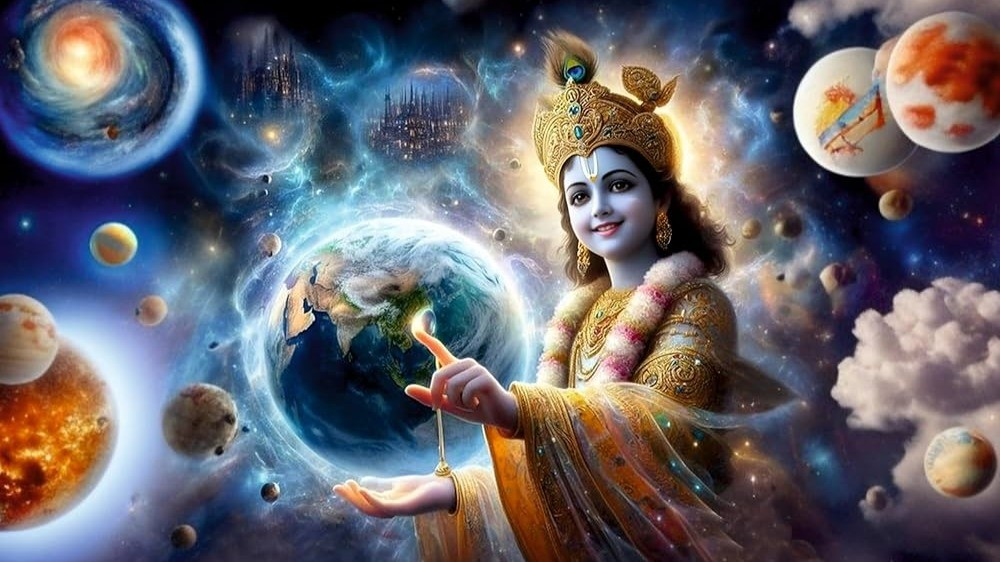
The city names reveal the deeper meaning of Krishna’s journey. Mathura means “city of Lakshmi.” So, Mathura, the birthplace of Krishna, likely represents the enclosure housing our Souls in the prison of earthly existence. Gokul (“the cow-community”) represents the Gathering Place, while Vrindavan (“the grove of holy basil”) represents the Resting Place. Dwarka, the city Krishna established, means “the gate of heaven.” So, like Jesus, Krishna opened the door for the rest of us.
Krishna’s journey, the rishis tell us, anoints the bride and groom in the “sacred marriage” of the Soul and its host, the Christ Self/Bridegroom. Our vehicle for that journey is the sacred-fire, the vehicle for the Assembly to advance the birth of the dragon (the radiant splendor of God’s Glory underneath the material illusion). Hebrews 1:3 declares Jesus as the “radiance of God’s glory,” serving as the exact representation of His nature and the perfect reflection of His divine essence.
1.13.3 reads:
Nara speaks in this world to bring forth Yama, the I Am offering the alms within worthy of the offering: the sweet-tasting cakes produced from Christ-born action.
narāśaṃsam (Nara speaks) iha (in this world) priyam (to bring forth Yama) asmin (the I Am) yajña (offering the alms) upa (within) havaye (worthy of giving) madhu-jihvaṃ (from the sweet tasting) haviṣ-kṛ(i)tam (cakes or wafers produced by Tam = Christ)
My notes:
Firstly, Nara doesn’t mean “man” or “human,” as commonly professed. Nara is the eternal spirit of God within all lifeforms imprisoned in bodies. And that spirit, thought, or star does indeed speak to us from underneath the Wheel, to bring forward the I Am-ness of Christ Self-knowing. The alms worthy of the yajna are the sweet tasting, Havis-Kritam. Generally defined as a cake or food offered at yajnas, Havis actually means the Greater Light of God (ha) pervading everything (vis) in the original creation of the Christ — the Sonship making up the whole of Holy Creation. Hence, the communion wafer representing the Body of Christ in Christian religious practice. Kritam supposedly means “to act” or “perform,” but that doesn’t really work. To find the real meaning, I retranslated the Kara Caranna Kritam, a prayer to Shiva, presumably for the forgiveness of sinful actions. Since sin and action are both egoic ideas, let’s see what the prayer really says.
In transliterated Sanskrit, the prayer reads:
Kara-Caranna Krtam Vaak-Kaaya-Jam Karma-Jam Vaa
Shravanna-Nayana-Jam Vaa Maanasam Va-Apa-ra-adham |
Vihitam-Avihitam Vaa Sarvam-Etat-Kssamasva |
Jaya Jaya Karunna-Abdhe Shrii-Mahaadeva Shambho ||
Here’s what I made of those words:
Ray of Light, Celestial Singer produced from Christ-born action, wind of the sacred ear guiding the eye born of the egg; wind of the mind of the whole of divine reality; wind of the waters of the radiant inner abode of God; ordained protector of well-being, wind of the whole universe of forgiveness. All glories to the ocean of mercy, Shri Mahadeva (the resplendent Great Holy Being), the auspicious one.
So, more a string of descriptive praises of Shri Mahadeva (Lord Shiva) than an entreaty for forgiveness.
I suspect the metaphoric sweet cakes (Havis) referenced in 1.13:3, are the same cakes mentioned in the Bible–the cakes cooked in God’s oven over the fire consuming the unfruitful branches pruned through the undoing process. Those cakes, as I recall, were the “seeds” offered to Moket, the miracle-cow, who transformed them into miracles.
The Christ-born action (krtam) refers, I believe, to the Christ-directed miracles we perform as members of “Team Jesus” in the Great Crusade.
Or, as Jesus explains in the Course:
I am the only one who can perform miracles indiscriminately, because I am the Atonement. You have a role in the Atonement which I will dictate to you. Ask me which miracles you should perform. This spares you needless effort, because you will be acting under direct communication. The impersonal nature of the miracle is an essential ingredient, because it enables me to direct its application, and under my guidance miracles lead to the highly personal experience of revelation. A guide does not control but he does direct, leaving it up to you to follow. “Lead us not into temptation” means “Recognize your errors and choose to abandon them by following my guidance.” (ACIM, T-1.III.4:1-7)
1.13.4 reads:
The sacred fire is the joy of the Soul; the chariot of divine being coming down from Heaven to convey the I Am, the chief priest invoking the progenitor of the Cosmic Order.
agne (the sacred fire is) suk-hatame (the joy of the Soul) rathe (in the chariot) devāṃ̐ (of divine being) īḷita (coming down) ā (from Heaven or God) vaha (to convey or transport) asi (the I Am) hotā (the chief priest invoking) manu-rhitaḥ (the progenitor of Cosmic order).
My Notes:
According to Google, “progenitor of the cosmic order” refers to “the ultimate entity, force, or deity responsible for bringing structure, harmony, and law to the universe, often initiating existence from a state of chaos.”
Various traditions identify this concept through different figures:
In Hinduism, the progenitor is erroneously identified as Brahma (“the creator” of maya/prakriti), when it’s actually Brahman, working by proxy through Vishnu, the preserver and restorer of Rta, the True Cosmic Order.
In Mesopotamia, it was Anu or An, the Lord of the Celestial Sphere. Regarded as the supreme father of the gods, and the source of all authority, Anu contained within his “being” the entire universe and, therefore, established its order. And it is also Anu the rishis name as the progenitor of Cosmic Order elsewhere in the Rigveda. Anu is, in fact, named in the very next line.
Platonic and Gnostic traditions, as in Hinduism, credit the Demiurge with creating the universe, when it is he who fashioned the material world, in defiance of the established order.
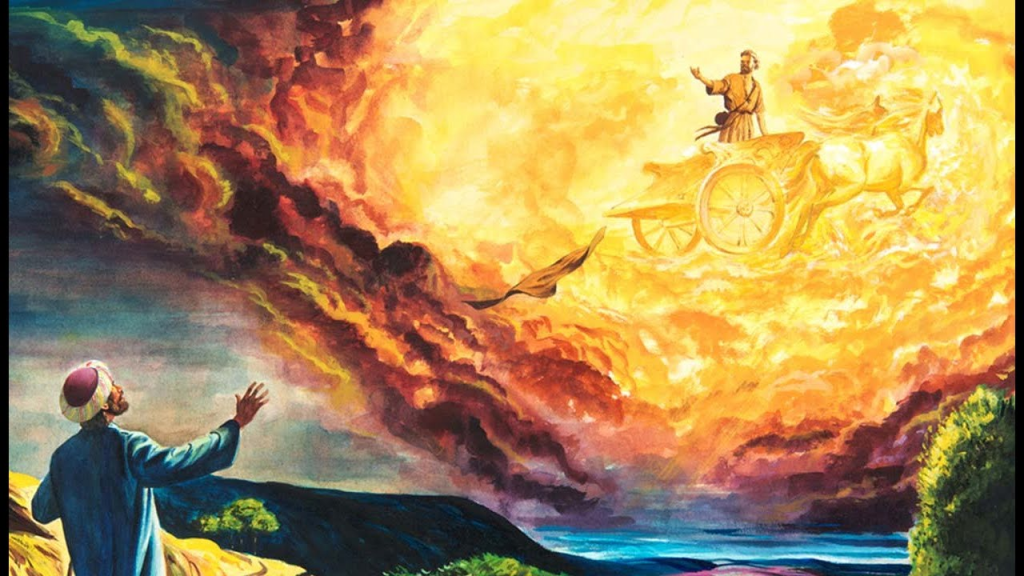
In more general terms, this stanza echoes the story in 2 Kings 2:11-12, of the prophet Elijah being taken up to heaven alive in a whirlwind, accompanied by a chariot of fire and horses of fire, while his successor, Elisha, watches. According to Google, “This dramatic event symbolizes God’s sovereignty, protection, and the fiery, divine glory taking Elijah from his earthly work, leaving Elisha to inherit his mantle.” According to the rishis, the chariot signifies the blazing joy of the Soul, coming down from Heaven to restore us to the sanity of Anu’s Ordained Cosmic Order.
1.13.5 reads:
To scatter the sacred grass, Anu conceals the shining Cosmic Order in his most beloved jewel of the single-eye on the journey of the (dead) body.
stṛṇīta (to scatter) barhir (the sacred grass) anu-ṣag (anu conceals) gh-ṛta-pṛ(e)ṣṭhaṃ (the shining cosmic order, his most beloved) manī-ṣiṇaḥ (jewel of the single-eye) yatrā-mṛtasya (on the journey of the dead body).
My notes:
The journey of the dead body is the Soul’s walking journey (through the valley of death) in the mortal body the Ego fashioned. The jewel of the single-eye is the Syamantaka jewel, a legendary, brilliant gem originating from the sun god (Surya) in the Hindu puranas. Herein described as “the jewel of the single-eye,” the Syamantaka gem represents the “third eye” or Ajna Chakra, the opening of which restores the Soul’s spiritual vision. This jewel also is, therefore, the single-eye Jesus mentions in Matthew 6:22 and Luke 11:34. The passage from Luke reads thusly:
The light of the body is the eye: therefore when thine eye is single, thy whole body also is full of light; but when thine eye is evil (full of guilt), thy body also is full of darkness. Take heed therefore that the light which is in thee be not darkness. If thy whole body therefore be full of light, having no part dark, the whole shall be full of light, as when the bright shining of a candle doth give thee light.
The story of the Syamantaka jewel appears in the Vishnu and Bhagavata puranas. The jewel originally belonged to Surya, the Hindu personification the Solar Logos, who wore it around his neck. It was said that whichever land possessed this jewel would never encounter any calamities, such as droughts, earthquakes, floods or famines, and would always be abundant in wealth and prosperity. The jewel was also rumored to grant its possessor eight bhāras of gold per day. (Eight rays of golden light, not 170 pounds of mineral gold.) It was also the source of the radiant glory of the sun god (the Greater Light of God at the top of the dream-realm).
Here’s how the story goes:
One day, Satrajita (“together triumphant”), a Yadava king, and a devotee of Surya-dev, was walking along the seashore, praying ardently, when the god appeared before him. Seeing the god in an indistinct and fiery shape, Satrajita asked him to appear in a lesser form of glory, so that he could see him clearly. To do this, Surya took the Syamantaka jewel off his neck, after which Satrajita beheld the god as a man with a body like burnished copper, with slightly reddish eyes — a description almost identical to Daniel’s characterization of the riverbank Bridegroom.
To reward Satrajita’s adorations, Surya offered him the jewel as a boon. When Satrajita returned to Dvaraka (the gate of Heaven) with the jewel, people mistook him for the sun god. So dazzling was his glory that Krishna asked him to present the jewel to Ugrasena (powerful army), the supreme leader of the Yadavas (the light of the forest fire). Satrajita did not, however, comply with Krishna’s request.
Satrajita later presented the gem to Prasena (advancing the army), his brother, who was also the ruler of a Yadava province. Prasena wore it always; one day, while hunting in the forest, he was attacked and killed by a lion, which stole the jewel. While fleeing, the lion met Jambavan, the immortal king of the bears loyal to Rama. The two fought fiercely to the death — of the lion. Jambavan, (to eat the fruit of the tree-temple) then took the gem.
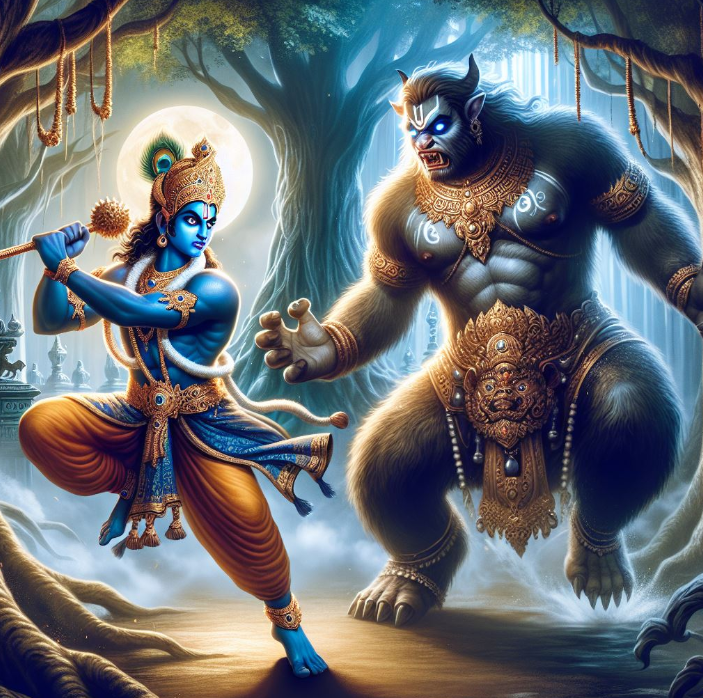
Through misplaced presumption and innuendo, Krishna was blamed for Prasena’s disappearance. To prove his innocence, Krishna set out to find the king and the jewel. Following Prasena’s trail, Krishna discovered the bodies of the king and his horse, along with evidence of a lion attack. He then followed and found the dead lion, and then followed the trail of the bear to the entrance of a cave, where the bear’s children were playing with the jewel. To recover the gem, Krishna challenged Jambavan to a fight that went on for 28 days before the bear grew too fatigued to continue. Knowing no ordinary mortal could defeat him, Jambavan realized he had been sparring with Vishnu unawares. So, he surrendered the fight and the jewel to Krishna, and also gave Krishna his daughter, Jambavati (the fruit of the tree of having), in marriage.
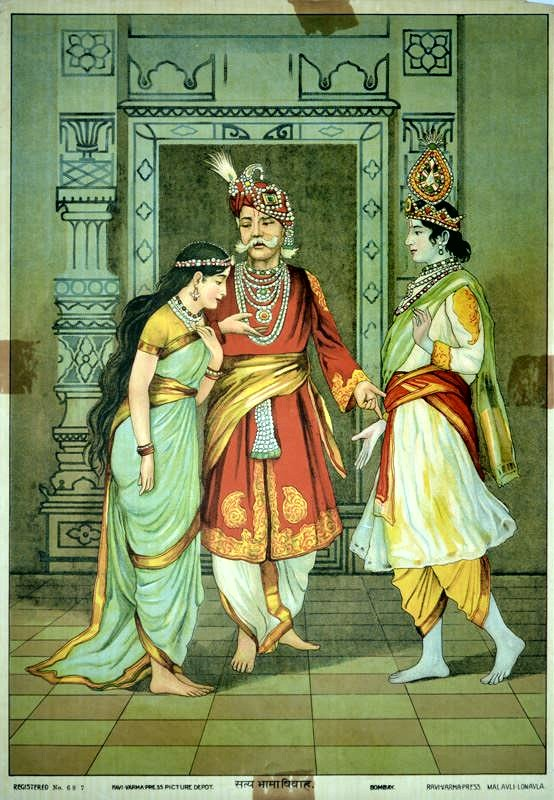
The story of Krishna’s quest clearly represents the spiritual journey we undertake to recover our holy vision, represented by the Syamantaka gem. In case you’re wondering, Syamantaka translates as something akin to: “belonging to the mind conveying God.” So, “the jewel of the single-eye belonging to the Mind of Christ,” more or less.
1.13.6 reads:
The eye of the beloved one awakens the subdued Word of God in the breaking dawn of the I Am, the celestial being shaking the door; the celestial being shaking the blood of the many on the sacred journey of departure from the night within your own self.
caksanam (the eye of the beloved one ) vyu-ntā-sa (awakens the subdued Word of God) uṣaso (in the breaking dawn of the I Am) dev-īr (the celestial being shaking) dvāro (the door) devīr (the celestial being shaking) asṛk-ṣata (the blood of the many) suprāyaṇā (on the one journey of departure) nakṣantām (from the night within your own self)||
My notes:
Can’t be sure this is right, although it does use several metaphors found in the Bible. The blood of the many poured out for us by Christ to seal the new covenant (Matthew 26:28); the Shaking at the door (Amos 9:1, Isaiah 4, Acts 16:26, and Revelation 16:133); the journey of departure from “the night within one’s own Self” (Isaiah 58:10, Psalm 4:8, 30:5, 139:11-12; and 1 John 1:5-8). In more general terms, this Vedic verse parallels the narrative in Genesis 32:24-28, wherein Jacob allegedly wrestles a man at the break of day.
When rightmindedly translated, the section says nothing about Jacob wrestling anyone. After considerable effort, I worked out the translation as follows:
To awaken in the Night marry the two spirits, the two maidservants of the ten fruits. To go through the door of Jabbok, marry (them) and pass through the narrow channel beyond.
Jacob (the divine spark) remains in the dust of each human being to bring forth the dawn to see and overcome the plague of the loins. Bend to Jacob’s procreative powers to be removed from the dust. Say: “Reach forth breaking dawn, to offer the call; reach forth to abundantly bless.” Speak the name spoken by Jacob. Speak the name called by Jacob in Israel to exert the princely powers of Elohim in the human state to overcome. Jacob asked to speak the name by saying: ‘Here and now, I ask for the name’s abundant blessings.” Jacob calls the name in the Standing Place, Peniel, to see Elohim’s face in the faces of the Living Beings; to deliver the Self to pass through Penuel. The sun rises in the inmost chamber (Adam’s rib), the base of the Son (Christ’s presence) in Israel, to feed the inner cords binding the body together (sinew) in forgetfulness and to bend to the procreative powers of the Ray (yom) making known (nagad) that bending to Jacob’s procreative powers binds the body together in forgetfulness or oblivion.
Not sure about “plague of the loins,” despite the metaphor seemingly appearing elsewhere in the Old Testament. It likely refers to the plague of human procreation (breeding like animals through copulation). Numerous scriptural mistranslations appear to make physical reproduction desirable in the eyes of God. But that is far from the case, as Course-Jesus explains below:
The acceptance of guilt into the mind of God’s Son was the beginning of the separation, as the acceptance of the Atonement is its end. The world you see is the delusional system of those made mad by guilt. Look carefully at this world, and you will realize that this is so. For this world is the symbol of punishment, and all the laws that seem to govern it are the laws of death. Children are born into it through pain and in pain. Their growth is attended by suffering, and they learn of sorrow and separation and death. Their minds seem to be trapped in their brain, and its powers to decline if their bodies are hurt. They seem to love, yet they desert and are deserted. They appear to lose what they love, perhaps the most insane belief of all. And their bodies wither and gasp and are laid in the ground, and are no more. Not one of them but has thought that God is cruel.
If this were the real world, God WOULD be cruel. For no Father could subject His children to this as the price of salvation and be loving. LOVE DOES NOT KILL TO SAVE. If it did, attack would be salvation, and this is the ego’s interpretation, not God’s. Only the world of guilt could demand this, for only the guilty could conceive of it. Adam’s “sin” could have touched no one, had he not believed it was the Father Who drove him out of Paradise. For in that belief the knowledge of the Father was lost, since only those who do not understand Him could believe it.
This world IS a picture of the crucifixion of God’s Son. And until you realize that God’s Son cannot be crucified, this is the world you will see. Yet you will not realize this until you accept the eternal fact that God’s Son is not guilty. He deserves only love because he has given only love. He cannot be condemned because he has never condemned. The Atonement is the final lesson he need learn, for it teaches him that, never having sinned, he has no need of salvation.
In his original dictations, Course-Jesus also said the sexual impulse (the impulse to join as bodies) blocks the Soul’s natural miracle-impulse. I could say more on the subject, but I’d rather explore the meaning of the Hebrew words Peniel and Jabbock. In Hebrew, Peniel means “the face of God” or “facing God.” Because it’s identified in this Genesis verse as “the standing place,” we know Peniel refers to the place in the dream-realm where our Souls stand right-side up. In Hebrew, Jabbok generally means “emptying,” “pouring out,” or “flowing”. Derived from the root baqaq (to empty or pour out), Jabbok likely refers to the wellspring or the cistern.
Let’s now return to the Rigveda.
Verse 1.13:7 reads:
Blooming in the darkness, the fiery glow of breaking dawn adorns the I Am consecrating the minds joined together in sharing the healing agent in the fire-offering of the holy rays of light.
My definitions:
naktā-uṣāsā (Blooming in the darkness, the fiery glow of breaking dawn) supeśas-āsmāi (adorns the I Am) yajñāya (consecrating the minds) saṃvidāne (joined together in sharing) bhiṣajā (the healing agent) yajñe (in the fire-offering) śubham (of the holy rays of light) ||
1.13.8 reads:
Having the fire-tongue within summons all those fit for the offering, the celestial sage-seers sanctifying the Name of the Whole, the one true Soul-Being leading the prayers.
My definitions:
tā sujihvāu (Having the fire-tongue) upa (within) h(a)vaye (summon all those) hotārā (fit for the offering) daivyā (the celestial) kavī (sage-seers) yaj-nam (sanctifying the name) naḥ (of the whole) yakṣ-atām (the one True Soul-Being) imam (leading the prayers) ||
1.13.9 reads:
Ila, Sarasvati, and Mahi, the three divine beings shaking the joyful in the borderland, the kusa grass (or cushioned seat), the resting place for crossing over into the eternal.
My definitions:
iḷā, sarasvatī, mahī (Ila, Sarasvati, and Mahi) tisro (the three) devīr (divine beings shaking) mayo-bhuvaḥ (the joyful in the Borderland) barhiḥ (the kusa grass or cushioned seat) sīdantu (the resting place for crossing over) asridhaḥ (into the eternal).
My Notes:
So, here we learn that Ila, Sarasvati, and Mahi shake the joyful Souls on the lawns just beyond the gate of heaven.
A principal goddess in Hinduism, Sarasvati is the mother of divine knowledge, speech, communications, learning, and music–not their earthly forms. She represents, therefore, the Cosmic Ocean underneath the illusion, supplying her restorative waters to the Souls in the illusion through the wellspring in the Borderland.
Ila or Ilā is a gender-shifting deity in Hindu mythology. In her male form, s/he is known as Sudyumna (Holy Splendor and Radiance). Ilā, a name meaning “the house of God,” is considered the chief progenitor of the Lunar dynasty of the Indian kings known as Ailas (“the descendants of Ila”). So, the Ailas kings in the Hindu lore equate to the Biblical lineage of King David.
The two aspects of Ila are interesting. The names tell us that, in her male form, she represents the red dragon; while in her female form, she personifies the Red Ray, the progenitor of our individual Souls.
Mahi is a Hindu goddess representing the Earth, symbolizing fertility, nature, and nurturing qualities, often synonymous with Bhumi-dev, the Lakshmi “aspect” occupying the southwest quarter. As a Sanskrit term, mahī probably means “creation cast outwards” or “creation projected outward”–a reference to the projected maya we perceive as our reality on the western half of the wheel.
On the whole, this teaching echoes what Course-Jesus says below:
God is praised whenever any mind learns to be wholly helpful. This is impossible without being wholly harmless, because the two beliefs must coexist. The truly helpful are invulnerable, because they are not protecting their egos and so nothing can hurt them. Their helpfulness is their praise of God, and He will return their praise of Him because they are like Him, and they can rejoice together. God goes out to them and through them, and there is great joy throughout the Kingdom. Every mind that is changed adds to this joy with its individual willingness to share in it. The truly helpful are God’s miracle workers, whom I direct until we are all united in the joy of the Kingdom. I will direct you to wherever you can be truly helpful, and to whoever can follow my guidance through you. (ACIM, T-4.VII.8:1-8)
1.13.10 reads:
The jewel in the ear of the lineage (of Ila), Tanunapat (the sacred fire-wind) brings forth the song known by all holy beings of God; the offspring of Kamadeva (divine love) in a ship far away.
My definitions:
tuṣṭuvāṃsas (the jewel in the ear of the lineage of Ila), tanūnapāt (Tanunapat, the sacred fire-wind) prajānan (brings forth) viśvavedasam (the song known by all)
devāṃ̐ (holy beings) ā (of God) | yāh-i (the offspring of Kamadeva) no = nau (in a ship or vehicle) duraḥ (far away)
My Notes:
Another verse, another jewel. Lol. In Hindu lore, the “jewel in the ear” primarily refers to the Manikarnika, the ear-jewel of Sati that fell in Varanasi, creating the sacred Manikarnika Ghat, a premier site for attaining moksha through bodily cremation. Ear jewels in Hinduism more generally symbolize divinity, with piercing representing the Om symbol connecting our Souls.
There’s a lot of conflation in this story between the celestial Manikarnika and its worldly projection. Sati, the daughter of Daksha, was the first wife of Shiva. According to the lore, Sati immolated herself in the sacred fire of her father’s yajna ritual, after he insulted Shiva, by failing to invite him to the almsgiving ritual. Consumed by grief and rage, Shiva held Sati’s charred remains whilst performing a dance of destruction, until Vishnu dismembered her body with his Sudarshana Chakra, creating fifty-one Shakti peethans (seats or thrones). In their worldly manifestation, those peethans are sacred pilgrimage sites in earthly India.
In celestial India, Sati almost certainly dropped her ear-jewel in the fourth-quadrant of Moksha — the quarter governed by Agni, the sacred fire, on the shoulders of Kamadhenu, the miracle-cow. The rishis tell us herein that the ear-jewel signifies our ability to hear Tanunapat, the fire-wind Agni “blows” from the Southeast quadrant across the circle diagonally to the northwest quadrant of Artha. And it is in that second quadrant that we begin our yajna practice.
In earthly India, Varanasi is an ancient city situated between the Varuna and Assi rivers. In celestial India, it’s the part of the wheel or circle between Varuna, the guardian of the Western direction, and Assi, the Resting Place of the Living. So, Sati dropped the ear-jewel that enables us to hear the Om somewhere between Varuna’s gate in the West and Indra’s gate in the east. And that makes perfect sense, given that we must hear the Om to pass through Varuna’s gate, and hear the silence beyond to pass through Indra’s.
Sati is either a compound of sa and ti (the three forms of God’s Word) or of Sat and i (the Reality of God’s Love).
Hard to say what Daksha represents. The name supposedly means “capable,” “expert,” or “honest,” but the story doesn’t support those definitions. Neither does what Shiva did to Daksha after Sati’s death. Enraged by his loss, Shiva cut off Daksha’s head, which was later replaced by the head of a goat. Plus, by excluding Sati and Shiva from his yajna, Daksha excluded love and grace from his almsgiving ritual, denying his offerings their only real power. If I had to guess, I’d say Daksha represents the ego-ordained clerical expertise to perform religious rituals and ceremonies with no real spiritual power.
1.13.11 reads:
Below divine creation, the lord of the forest of holy beings kindles the offerings advancing to and from the giver of Amen consciousness.
ava (below) sṛja (divine creation) vanaspate (the lord of the forest) deva (the holy being) dev-ebhyaḥ (kindles) haviḥ (the offerings) pra (advancing) dātuḥ (to and from the giver of) astu (Amen) cetanam (consciousness)
In Hindu lore, the forest of holy beings is called Namisharanya (“the forest of the twinkling of an eye”). This mythical sacred forest is said to be the center of cosmic energy where time stands still, so it likely represents the present-moment portal into eternity Course-Jesus calls the Holy Instant. The lord of Naimisharanya is generally identified as Lord Vishnu, who appears to sages in this forest.
1.13.12 reads:
Surrender the offering sanctifying the name to activate the interwoven nayana, the light of Indra sanctifying the forest home of the tail protecting the shining heaven within calling the name.
svāhā (The True Self of the Greater Light) yaj-ñaṃ (sanctifying the name) kṛṇ-ota-na (activates the interwoven nayana) indrāya (the light of Indra) yajvanaḥ (sanctifying the forest) gṛhe (home) tatra (of the tail protecting) devān (the shining heaven) upa (within) hvaye (calling the name).
Notes:
Firstly, Svaha or Swaha is a sacred exclamation used in Hindu and Buddhist yajnas to mark the surrender of the offering to the gods, particularly Agni (the fire deity), acting as an invocation. The word is actually a marriage of sva (the True Self) and ha (the Greater Light).
Secondly, the tail protecting the shining heaven within has to be Ketu, the descending moon-node representing the tail of the red dragon representing God’s Radiant Splendor holding everything together underneath the maya. In Hinduism, that “Radiant splendor” is Svarbhanu, whose home would be Vaikuntha if he wasn’t egoically mischaracterized as a demon (like the beast in Revelation).
In the Hindu lore, Vaikuntha is the supreme, eternal abode of Lord Vishnu and Lakshmi. A land of bliss, golden palaces, and extreme beauty completely free from anxiety, fear, illusion, and suffering, Vaikuntha (“without limitation”) is the ultimate spiritual destination for the Souls liberated from Brahmanda. So, it’s the Real World, the Borderland, and the Resting Place similarly described in the Course. It’s also, I suspect, the Golden Egg and Golden Womb (Hiranyagarbha)–the dwelling place of Christ in the dream-realm.
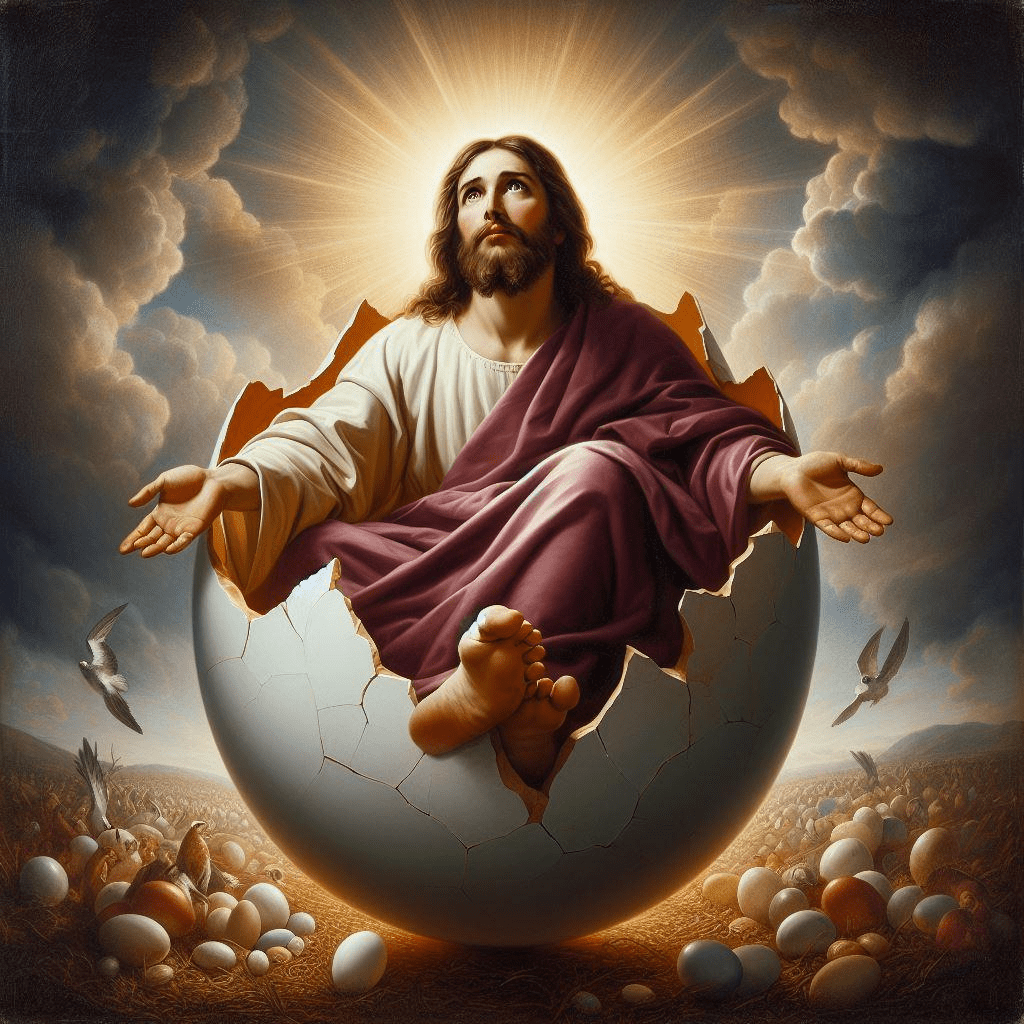
The interwoven nayana (ota-na) is the spiritual eye and/or the Ajna Chakra, through which we perceive the World as it really is — a purely inner realm of universal brotherhood, loving kindness, mercy and perfect justice. The particular phrase, “the shining heaven within,” also appears in the Course. Compare what Jesus says with all I’ve just explained about the Real World, Vaikuntha, and the Golden Egg:
The sign of Christmas is a star, a light in darkness. See it not outside yourself, but shining in the Heaven within, and accept it as the sign the time of Christ has come. He comes demanding nothing. No sacrifice of any kind, of anyone, is asked by Him. In His Presence the whole idea of sacrifice loses all meaning. For He is Host to God. And you need but invite Him in Who is there already, by recognizing that His Host is One, and no thought alien to His Oneness can abide with Him there. Love must be total to give Him welcome, for the Presence of Holiness creates the holiness that surrounds it. No fear can touch the Host Who cradles God in the time of Christ, for the Host is as holy as the perfect Innocence which He protects, and Whose power protects Him. (ACIM, T-15.XI.2:1-9)
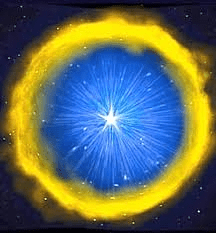
The star he mentions above is the star of glory referenced in the first line o this Sukta. That star represents the the True and original Thought of God shining into the dream from Heaven. We see that star at the center of the depiction below of the Spiritual Eye. This “eye” is actually the passageway or portal we pass through, first into the Celestial Realm, and then, into the singularity (the star) out of which we projected our minds into the unreal material universe.
Here’s the whole Sukta, strung together:
Ignite the fire of the original creation in the human state; the fire of divine being interconnecting the sacred offerings in harmony with the cosmic order; the crystal-clear waters calling to the star of glory to distinguish the Resting Place seated within the radiant splendor of the Celestial Realm.
Tanunapat (the wind of the sacred fire) guides the path to the Cosmic Order; the journey of Madhava (Vishnu/Krishna) bringing together the bride and groom within to consecrate the name of Amen. Holy being’s father-born honey-tongued sacred fire is the vessel of the Divine Assembly advancing the birth of the dragon (God’s Radiant Glory).
Nara speaks in this world to bring forth Yama, the I Am offering the alms within worthy of the offering: the sweet-tasting cakes produced from Christ-born action.
The sacred fire is the joy of the Soul; the chariot of divine being coming down from Heaven to convey the I Am, the chief priest invoking the progenitor of the Cosmic Order.
To scatter the sacred grass, Anu conceals the shining Cosmic Order in his most beloved jewel of the single-eye on the journey of the (dead) body.
The eye of the beloved one awakens the subdued Word of God in the breaking dawn of the I Am, the celestial being shaking the door; the celestial being shaking the blood of the many on the sacred journey of departure from the night within your own self.
Blooming in the darkness, the fiery glow of breaking dawn adorns the I Am consecrating the minds joined together in sharing the healing agent in the fire-offering of the holy rays of light.
Ila, Sarasvati, and Mahi are the three divine beings shaking the joyful in the borderland, the kusa grass resting place for crossing over into the eternal.
The jewel in the ear of the lineage (of Ila), Tanunapat (the sacred fire-wind) brings forth the song known by all holy beings of God; the offspring of Kamadeva (divine love) in a ship far away.
Below divine creation, the lord of the forest of holy beings kindles the offerings advancing to and from the giver of Amen consciousness.
Surrender the offering sanctifying the name to activate the interwoven Nayana, the light of Indra sanctifying the forest home of the tail protecting the shining heaven within calling the name.
And there we are. The 13th Sukta, done and dusted. Hope I got it right, and that my explanations helped. Until next time, listen to God’s Voice in the silence within.
 The Holy Meeting Place
Leave a comment