
Let’s continue our conversation about the Rigveda’s Sixth Sukta by reviewing the verse we ended on last time. That verse is Rv 1.6.5, rather than Rv 1.6.6, as per Max Muller, the 19th-century Oxford orientalist credited with restoring the Rigveda to its original metric form. In so doing, he divided Rv. 1.6.4 into two lines, when it should have been one long sentence broken by a semi-colon. As I’ve also stated more than once, the Rigveda contains neither metered poems nor hymns of praise to pagan gods.
This ancient and sacred scriptural text is, in truth, a compendium of narrative teachings for advanced and open-minded seekers of enlightenment (the true Vedic meaning of Brahmins). Far from outdated, its wisdom-teachings parallel, in uncanny ways, the teachings of Jesus Christ in the Holy Bible and, even more so, in A Course in Miracles — not because Jesus studied the Rigveda while in India; but because Jesus was an open channel for the Holy Spirit of the Christ Mind. And, as he rightly explains in the Course, the Holy Spirit’s teachings may vary in form, but never in substance.
Having said all that, Rv 1.6.5 should read as follows:
The journey to the divine realm of Brahman, which varies according to intellectual capacity, clears the veil of deception blocking awareness of the Vasu, the voices singing the greater truth of Anu heard in the supreme eternal song of joy.
As explained last time, Anu is the three-part Name of God, while the Vasu are the eight guardians of the Circle-Journey–“the journey to the divine realm of Brahman” referenced herein. In Hinduism, those eight guardians are the four cardinal-direction guardians and the four quadrant guardians. In Ancient Egypt, they were the Ogdoad, the eight celestial deities worshipped by the Cult of Amen in Hermapolis.
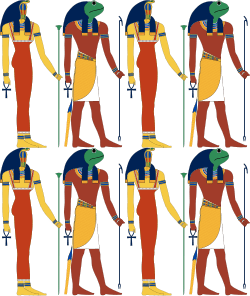
In Hinduism, the cardinal-direction guardians, known collectively as the Lokapala, are Yama, the divine spark of Indra (south), Varuna, the water of wholeness (west), Kubera, the treasure-keeper (north) and Indra, the Red Ray (east). Though commonly confused with the Lokapala, the guardians of the quarters are, in fact, Nirriti, the primordial ocean (SW), Vayu, the Cosmic Breath (NW), Ishanna, the lion’s Mouth of God speaking the Word (NE), and Agni, the eternal flame of God’s Presence (SE).
In the Abrahamic religions, these same eight celestial beings are the four cherubim, Living Beings, or throne-bearers and the four chief archangels (Michael, Raphael, Gabriel, and Uriel).
And it is these eight Holy Powers who comprise the Cosmic Chorus singing the eternal song of joy mentioned in Rv 1.6.5. And it is through that song — the ever-present vibration of Heaven’s all-inclusive love and wholeness (sounding underneath the raucous noises of the world) — that we are healed of separation-sickness.
Rightly understood, that song is the Great Amen, the Father of “the Eight,” who proclaims (in Revelation 1:8, 21:6, 22:13) “I am the alpha and the omega, the first and the last, the beginning and the end.”
Course-Jesus mentions that song innumerous times. In the Manual for Teachers, for example, he says:
Communication is not limited to the small range of channels the world recognizes. If it were, there would be little point in trying to teach salvation. It would be impossible to do so. The limits the world places on communication are the chief barriers to direct experience of the Holy Spirit, Whose Presence is always there and Whose Voice is available but for the hearing. These limits are placed out of fear, for without them the walls that surround all the separate places of the world would fall at the holy sound of His Voice. Who transcends these limits in any way is merely becoming more natural. He is doing nothing special, and there is no magic in his accomplishments. (ACIM, M-25.2:2-8)
In the Text, he says:
Each voice has a part in the song of redemption, the hymn of gladness and thanksgiving for the light to the Creator of light. The holy light that shines forth from God’s Son is the witness that his light is of his Father. (ACIM, T-13.VI.8:1-8)
Have I made my point? I hope so because hearing that Ancient Song or Divine Voice is the starting point of the salvation process. It’s also the ending point. Hence, the alpha and the omega. We can’t be “saved,” in other words, until we hear the Great Amen — the Holy Spirit’s Voice — echoing inside our minds.
This is the gift God gave for our deliverance from the miseries of earthly existence. And it is through faithful listening that we are delivered from the wrongminded judgments through which we manifest those miseries. The Bible tells us this, the Vedas tell us this, the Course tells us this, and the Qur’an surely does also.
Believe me or don’t. The choice is yours. But, as someone who hears and believes, I urge you to listen, because this is the only way we can join our little will with the Mighty Will of God, as Course-Jesus explains in the excerpt below from Workbook Lesson 49: God’s Voice speaks to me all through the day:
We will try actually to hear God’s Voice reminding you of Him and of your Self. We will approach this happiest and holiest of thoughts with confidence, knowing that in doing so we are joining our will with the Will of God. He wants you to hear His Voice. He gave It to you to be heard. (ACIM, W-49.3:2-5)
What’s all this got to do with the Rigveda’s Sixth Sukta? Only everything. So let’s get to it.
According to Sri Aurobindo’s (posthumously published) website, Rv 1.6.7 — the Sukta’s next line — reads: indreṇa sam hi dṛkṣase sam-jagmānaḥ abibhyuṣā mandū iti samāna-varcasā.
I’m pretty sure that’s wrong, because we’ve already established that the indrena starting this line belongs to Rv 1.6.6. He also ends the line too soon. By my calculations, the seventh line, which is much longer than generally presumed, includes the first seven words traditionally assigned to the eighth line. To make sense, the line needs to read: saṃ hi dṛkṣase saṃjagmāno abibhyuṣā mandū samānavarcasā anavadyair abhidyubhir makhaḥ anavadyaiḥ abhidyu-bhiḥ makhaḥ sahasvat arcati gaṇaiḥ indrasya. According to my research and guidance, those words translate approximately as follows:
Come together in the True Self joined in singing, the whole world-mind speaking the Word of God to exhilarate Shiva (grace), equal in divine glory in separation-consciousness to the lamp arising from the first Red Ray of the Rays producing the Kah. Come together to taste the light beyond the Assembly setting in motion Indra’s mouth.
My definitions:
samhi = Come together
drk-sase = in the True Self joined in singing
sam-jagmano = the whole world-mind
abibhyu-sa = speaking the Word of God
mand-u = to inspire or exhilarate Shiva (the transcendent power of grace)
samana-varcasa = equal in divine glory
anava-d(i)ya-ir = in separation-consciousness to the lamp springing from
abhi-dyubhir = the first Red Ray of the Rays
makhah = producing the Kha
sahasvad = Come together to taste
arc-ati =the light beyond
gana-ir the Assembly or multitudes setting in motion
indrasya = Indra’s mouth or miracle
Like I said. It’s all about the song.

We find herein the interesting Sanskrit word Kha, which supposedly means “ether,” “hole,” “cavity,” “cave,” or” “void.” So, what Kha describes is “the hole” we bore (by faithfully listening to the Cosmic Choir) through the ego’s dark cloud of guilt blocking our access to the celestial sphere. This is, btw, the same “hole” found in Leviticus 18:21– the verse about Molek, the cow-headed Cherubim — which I’ve retranslated as follows:
To bestow the seeds passed through Molek (the Miracle Cow) , perforate or pierce (to make a narrow hole to act as a portal) the name of Elohim, which is Yovah. To find rest and remember the Resting Place of the Spirit, abominate performing copulation as a beast, which defiles the spirt of each party; the spirit stands upside-down in the beast; to breed together is, therefore, unnatural.
That hole or Kah is, btw, the “narrow gate” Jesus mentions in Matthew 7:13-14.
In the Course, Jesus references “the dark cloud of guilt” several times. Following are a few example citations:
Let the holiness of God’s Son shine away the cloud of guilt that darkens your mind, and by accepting his purity as yours, learn of him that it is yours. (ACIM, T-13.I.7:6)
Your “guilty secret” is nothing, and if you will but bring it to the light, the light will dispel it. And then no dark cloud will remain between you and the remembrance of your Father, for you will remember His guiltless Son, who did not die because he is immortal. And you will see that you were redeemed with him, and have never been separated from him. In this understanding lies your remembering, for it is the recognition of love without fear. There will be great joy in Heaven on your homecoming, and the joy will be yours. For the redeemed son of man is the guiltless Son of God, and to recognize him is your redemption. (ACIM, T-13.II.9:1-7)
Under the ego’s dark foundation is the memory of God, and it is of this that you are really afraid. For this memory would instantly restore you to your proper place, and it is this place that you have sought to leave. Your fear of attack is nothing compared to your fear of love. You would be willing to look even upon your savage wish to kill God’s Son, if you did not believe that it saves you from love. For this wish caused the separation, and you have protected it because you do not want the separation healed. You realize that, by removing the dark cloud that obscures it, your love for your Father would impel you to answer His Call and leap into Heaven. You believe that attack is salvation because it would prevent you from this. For still deeper than the ego’s foundation, and much stronger than it will ever be, is your intense and burning love of God, and His for you. This is what you really want to hide. (ACIM, T-13.III.2:1-9)
Pretty illuminating, right?
Let’s move on to Rv 1.6.8, which we’ve essentially eviserated. Borrowing seven words from that line for the previous one left a single word. That word is kamyaih, whose meaning isn’t crystal clear. My best guess is that it’s a compound of kamy (ardent desire) and aih (to seek), which makes sense when combined with the first seven words from the next line. As reconfigured, Rv 1.6.8 now reads: kamyaih atah parijman a gahi divo va rocanad adhisam asminn rinjate. Those words very aptly translate as follows:
Ardently seek, therefore, the circle-journey of God’s Holy Name, the divine Om bestowing the eternal light of the Supreme Lord in this realm of indebted existence.
My definitions:
kamy-aih = ardently seek
atah = therefore
parijman = the circle-journey
a = of God’s
gahi = holy name
divo = the divine Om
va =conveying
roc-anad = the eternal light of
adhisam = the Supreme Lord
asminn = in this realm
rinjate = of indebted existence
With seven of its eight words commandeered by the previous line, the Sukta’s ninth line must, in turn, subsume the whole of the tenth. This shortens the Sukta to nine lines, the last of which reads: girah ito vā sātim īmahe divo vā pārthivād adhi indram maho vā rajasaḥ. According to my guidance and research, those sacred words translate thusly:
The voices singing in this world bestow the wakefulness of mind invoking the celestial Om conveying on earth the dawning light of King Indra, the Mighty One conveying the sovereign Word of God.
My definitions:
girah = the voices singing
ito = in this world
va = bestow
satim = the wakefulness of mind
imahe = invoking
divo = the celestial Om
va = conveying
parthivad = on earth
adhi = the dawning light
indram = of King Indra
maho = the Mighty One
va = conveying
raja-sa = the royal or sovereign Word of God
Once again, it’s all about the song.
And, just in case I’ve failed to say this before. Amen, Amon, Ameen, Om, and Aum are varying forms of the same divine idea. So let’s not get our sectarian underpants in a bunch over the semantics.

Let’s talk about Rajasa, the final word in this line and Sukta. The nuanced meaning depends on how we split the syllables. As Ra-jasa, for example, it means “the inner radiant glory or splendor”; as raja-sa, it means “the royal or sovereign Word of God”; and, as raj-asa it means the Royal Will, as in God’s Will. Not that any Sanskrit dictionary will yield these definitions.
The problem stems from the ego-corrupted definition of Rajas, the second guna or mode of being. Rightly understood, Rajas refers to those walking the Royal Road back to God, not those reveling in the passions of the ego. Those reveling in the passions of the ego are living in Tamas, the darkness of ignorance and spiritual denial.

Rightly understood, we’re either walking in the darkness of self-estrangement (tamas), walking the spiritual journey back to self-knowing (rajas), or walking in the light of self-knowing (sattva).
Rather than comment further (because I’ve already said so much), I’ll conclude our discussion of the Sixth Sukta with a quote from the Course pertaining to the Song of Salvation we sing together to heal each other of separation-sickness:
Nothing will ever be as dear to you as is this ancient hymn of love the Son of God sings to his Father still.
And now the blind can see, for that same song they sing in honor of their Creator gives praise to them as well. The blindness that they made will not withstand the memory of this song. And they will look upon the vision of the Son of God, remembering who he is they sing of. What is a miracle but this remembering? And who is there in whom this memory lies not? The light in one awakens it in all. And when you see it in your brother, you are remembering for everyone. (ACIM, T-21.I.9:6–10:7)
Let’s now put the whole Sixth Sukta together to see how it reads:
Yoke together in the presence of the Holy Treasures of the Red Ray to obtain knowledge of the endless Circle of True Forgiveness shining within the luminous Sphere of Celestial Order.
Yoke together in the ultimate Resting Place rendering the Hari coming from the Holy Instant — the chariot of the bay horse supporting the strength arising from the peace and joy of the Great Rays.
Act to extend Shiva’s Vision in the quarter belonging to Kamadeva, the formless holiness gathering together the waters delivering Anu.
Strive to awaken the soul-wind of Anu to return to the womb (or egg) of the Higher Self, the cistern of love bestowing the treasures of the Name sustaining the knowledge firmly fixed in the thoughts not diseased by fear; the Heart-Cave thoughts King Indra conveys in the likeness of the One full of life-giving light.
The journey to the divine realm of Brahman, which varies according to intellectual capacity, clears the veil of deception blocking awareness of the Vasu, the voices singing the greater truth of Anu heard in the supreme eternal song of joy.
Come together in the True Self joined in singing, the whole world-mind speaking the Word of God to exhilarate Shiva (grace), equal in divine glory in separation-consciousness to the lamp arising from the first Red Ray of the Rays producing the Kah. Come together to taste the light beyond the Assembly setting in motion Indra’s mouth.
Ardently seek, therefore, the circle-journey of God’s Holy Name, the divine Om bestowing the eternal light of the Supreme Lord in this realm of indebted existence.
The voices singing in this world bestow the wakefulness of mind invoking the celestial Om conveying on earth the dawning light of King Indra, the Mighty One conveying the sovereign Word of God.
And now you know. Nothing even remotely like what Wilson, Griffiths, Sayana, or even Sri Aurobindo gave the world, but also infinitely more instructive for enlightenment-seeking Brahmins than any of their meaningless renditions.
I mean no offense to anyone, but I must speak the truth. For, as Jesus tells us in John 8:32, only the truth will set us free.

Believe me or don’t. Just know that your disbelief won’t change the truth one iota. It will only serve to imprison you in hell for a longer spell.
Thanks for visiting. Next time, we’ll talk more about the Soul’s Journey. Until then, Om Hari Om and Namaste.
 The Holy Meeting Place
Leave a comment