At last, we reach the Fifth Sukta of the Rigveda, the most ancient and sacred of the Hindu scriptures. This one also concerns King Indra, but it’s neither a hymn nor a metered poem. Like the first four Riks, the fifth is a spiritual teaching aimed at “Brahmins.”
Contrary to popular egoic belief, Brahmin is not a term describing a “caste” or “class” in Indian society. The varnas described in the Vedas refer not to social classes, but to the levels of spiritual advancement our Souls have achieved on the present leg of the walking journey. The Brahmin order, being the highest varna, is composed of the advanced Souls nearing enlightenment. Brahmins are, therefore, the Indian equivalent of what Course-Jesus calls “Advanced Teachers of God.”
Brahmins are the obedient disciples (Brahmacharis) of the Master Teacher who have “submitted profoundly” by giving up their worldly identities and ambitions for the greater goal of attaining the Perfect Peace given and received through the Yoke of Higher Consciousness (in the Resting Place). And this is, in fact, what the fifth Sukta concerns.
This time around, we won’t bother with Max Muller, H. H. Wilson, Ralph T. H. Griffith, or even Sri Aurobindo’s wonky translations. Because, to be frank, they’re a hot mess. Contrary to what all four esteemed gentlemen propose, the Rik’s first line should read: ā tvā ita ni sīdata indram abhi pra gāyata sakhāyaḥ stoma-vāhasaḥ puru-tamam purūṇām īśānam.
Also counter to what all four gentlemen propose, these Sanskrit words communicate the following Great Truth:
God’s true state of being is remembered down below (in the dream-waters) in the peace given by King Indra, the first Red Ray of Holy Creation advancing the sacred syllable exerting the Word of God, moving in the ethers, and by which the Assembly channels the waters of abundance and wholeness from the walled city of Una, the divine name of Ishanna.
My word-for-word definitions:
a = God’s
tva = true state of being
ita = is remembered
ni = down below (in the lower waters of ego consciousness)
sidat = in the peace given by
indram = King Indra, the supreme power and radiance of
abhi = the first red ray of Holy Creation
pra = advancing
ga-yata = the sacred syllable governing
sa-kha-yah = the Word of God, moving in the ethers, and by which
stoma-vahasah = the Assembly channels the waters
puru-tamam = of abundance and wholeness
pur-unam = from the stronghold, fortress or walled city of Una
puru-nam = the divine name
isanam = of Is(h)ana
Two things in this verse are especially noteworthy. The first and less-important is that gayata means “the sacred syllable exerting,” rather than “singing,” “chanting,” or “joining in singing,” as is generally suggested. The second and more important is the appearance of the name Isana or Ishanna — our lion-faced cherubim in her Hindu form. This is important because Wilson, Griffith, and Aurobindo all translated isanam — the last word in this verse — as “the ruler” (the name’s alleged literal meaning), rather than as the deva-name Ishanna. As a consequence, Vedic scholars the world over incorrectly maintain that Ishanna is not mentioned by name anywhere in the Rigveda.
To verify this assertion, I “googled” the question: “Is Ishanna mentioned in the Rigveda?” And here’s the response I received from the search-engine’s AI brain:
No, “Ishana” is not explicitly mentioned in the Rig Veda; the term is more closely associated with later Hindu texts, particularly the Puranas, where it is considered one of the names of Shiva, representing his aspect as the ruler or lord of the universe; however, some scholars argue that the concept of “Ishana” might be hinted at in the Rig Veda through epithets applied to other deities, particularly Rudra, who is considered a precursor to Shiva.
Okay so … as my revised translation proves, the rishis not only mention Ishanna by name (as early as Rv 1.5.1), they also identify her as the walled-city dwelling source of the Living Waters of abundance and wholeness, whose flow is activated by the (Brahmin) Assembly — the upright-standing Souls working miracles through their almsgiving yajnas.
And the walled-city also is the Resting Place wherein we find the sacred grass and the wellspring. All of this confirms that Ishanna is indeed the guardian of the northeast quadrant. This verse also tells us that Una is Ishanna’s name in Heaven.
Who or what is Una? According to the wide-ranging definitions offered by the Sanskrit dictionaries, it might be Heaven’s name for the Lesser Light or our allotted food supply from God. It also might mean “less by one” — a reference perhaps to the perception of non-dualism Ishanna brings forth (a step below the superior state of pure non-dualism).
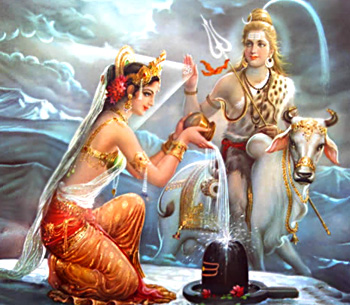
In many languages, Una means “one” or “universal oneness,” so that’s a distinct possibility. Una might also be a variation on Uma, a name sometimes used for Parvati, the lion-riding wife of Lord Shiva.
According to Google:
Uma Parvati is the same prominent Hindu goddess, the wife of Shiva, symbolizing divine feminine energy, power, love, and motherhood; Uma is often considered her more intimate name, representing light, wisdom, and the gentle aspect, while Parvati refers to her as the daughter of the Himalayas, embodying fertility, devotion, and strength, also known as Gauri, Durga, and Kali in her various forms, the essential energy (Shakti) for Shiva’s completeness.
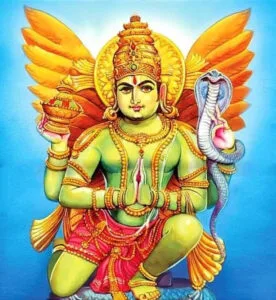
Ishanna is known to be mentioned in the much-later Krishna and Shukla Yajurvedas, wherein s/he is described as … well, let’s find out for ourselves, shall we? In the Krishna Yajurveda, the verse identified as the “Ishanna Mantra” reads: īśānassarvavidyānām īśvara-ssarvabhūtānām-brahmādhipatir-brahmaṇo’dhipatir-brahmā-śivo me astu sadāśivom.
Sabharathnam Sivacharyar, the noted Sanskrit and Shiva “expert” quoted in the Wikipedia article about Ishanna, translates those words as follows:
Lord Ishana—the Supreme Lord and Revealer of little knowledge through Lord Ishvara and spiritual disciplines, the nourisher and controller of all living beings, the Directing Lord of northeast, He who is guided by main direct authority of the Vidyeshvaras, who directs Brahma, Vishnu and others — may He who is vidyeshwara present Himself in this Sivalinga. By such benign presence, let there occur absolute purity and auspiciousness in Shiva. Om.
Let me be blunt. I no longer trust anybody’s Vedic translations, however learned or enlightened they profess to be. And for good reason, considering how embellished this interpretation actually is. According to my research, the “mantra” more succinctly translates thusly:
Ishana, the pure and complete knowledge-palanquin of Ishvara; the pure and complete Living Being stretching across the creation, beginning with Brahma as overlord, (but) belonging to Brahman, the higher overlord. The underlying and expanding vibration of love restores the reality of Sadashiva.
My word definitions are as follows:
isana = Ishanna
sarva = the pure and complete
vid-yanam = knowledge-palanquin of
isvara = Isvara
sarva = the pure and complete
bhu-tanam = living being stretching across
brahmadhi-patir = the creation, beginning with Brahma as overlord,
brahmano-adhi-patir = (but) belonging to Brahman, the higher overlord;
brah-mas-ivo (not Brahma-Siva, as generally presumed) = the underlying and expanding vibration of love
me = restores
astu = the reality
sadasivom = of Sadisiva (eternal auspiciousness, holiness, or grace)
As you can see, my translation differs significantly from the one provided by Wikipedia. Firstly, the “mantra” says nothing about Ishanna being the guardian of the Northwest Direction. In Hinduism, the guardian of the Northwest Direction is Vayu, the Cosmic Breath or Ruach. Secondly, the “mantra” tells us Ishanna is the “pure and complete knowledge-palanquin” of Ishvara, as well as the pure and complete Living Being stretching across the creation Brahma made to hide that which truly belongs to Brahman. Ishvara is, therefore, God’s creature, operating inside Brahmanda, the Cosmic Egg of the dream-realm ruled by the Ego Mind.
Ishanna, we are told, acts as Ishvara’s “knowledge-palanquin.” She is, in other words, the “vehicle” conveying Ishvara within the “thought-waters” of the dream-universe. In case you don’t know (as I didn’t to begin with), a palanquin is a pole-mounted, single-passenger “box,” “chair,” or “bed” carried by four to six “bearers” (as seen below).
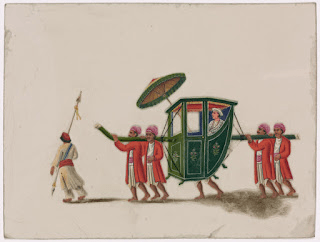
This should be ringing bells, but don’t worry if it isn’t. Because I’ll connect the dots in a minute. For now, let’s return to the fifth Sukta, whose next line again mentions this ethereal “palanquin.”
When correctly constructed, the line reads: varyanam indram some saca sute sagha nah yoga a bhavat sa raye sa puram-dhyam gamad vajebhir a. Those words translate roughly as follows:
The water-palanquin of King Indra, Soma restores the true begotten Word of God, the sound of Wholeness yoking God’s earthbound Sons to the treasures of the Word in the city of divine consciousness, the village community strengthening the power of God.
My word-definitions:
var-yanam = the water-palanquin
Indram = of King Indra (the Red Ray)
so-me = Soma restores
saca = the true
sute = begotten
sa = Word of God or Logos
gha = the sounding
nah = wholeness
yoga = yoking
a = God’s
bhu-vat = earth-bound, body-bound, or matter-bound
sa = Sons
raye = to the treasures
sa = of the Word
puram-dhyam = in the city of divine consciousness
gamad = the village community
vaj-ebhir = strengthening the power
a = of God
On the whole, this Vedic teaching echoes both the Course and the Ishanna Mantra from the Yajurveda — when all three are interpreted correctly. In this verse, Ishanna is equated with Soma (the Moon), while Ishvara is equated with King Indra (a solar power). The rest of the teaching is too similar to doubt that the rishis mean the same “palanquin” described in the Yajurveda.
Like I said in a much-earlier post, Hinduism only appears to be polytheistic. Just as the Vedas only appear to mention more than three hundred “gods” by name. If Ishanna also is Soma, then Soma also is Shiva and Nara. And if Ishvara also is King Indra, he’s also Vishnu and Narayana.
Confusing, isn’t it?
Let’s leave that for now, because there are three other things I want to point out. The first is that, depending on how it’s divided, varyanam can mean “foremost name” (varya-nam) or “the water-reservoir” (var-yanam). So, this verse might, in fact, describe Soma-Ishanna as “the foremost name,” the “water-reservoir,” or even the “water-horse” of King Indra, rather than as his “water-palanquin.”
I’m inclined to believe varyanam does indeed mean “water-palanquin” in this instance — and here’s why: The “thought-palanquin” Soma-Ishanna represents is none-other than “the wheel at the center of the universe”– the disc supporting the throne of God, the “chariot-throne” occupied by Surya-Elohim-Allah, the Greater Light, Spiritual Sun, and/or Solar Logos (a.k.a. the radiant Word of God). And, like the palanquin pictured above, that “chariot-throne” is carried, supported, and/or borne by the four Living Beings seen and described by Ezekiel, Zechariah, Mohammed, and John of Patmos (among other prophets).

And we’ve now identified those four beings as Nirriti-Nu-Noah, Surabhi-Bastet-Hathor, Ishanna-Ishtar-Inanna, and Garuda-Nisrok.
While writing the above, I saw (in my mind’s eye) the image below, which is, in effect, a water-palanquin of the sort referenced in this verse. The palanquin pictured is Sheesa, the multi-headed snake associated with Shiva. The waters upon which the palanqquin floats is the Cosmic Ocean, and its two passengers are Narayana-Vishnu and Lakshmi (rubbing his feet).

Okay wait. Because something just occurred to me, and it’s pretty major. That “palanquin” supporting King Indra’s throne is the shield protecting God’s Power and Authority above, and our free will down below. And that shield is Soma, the Mind of the Atonement (the Holy Spirit of the Christ Mind) through which the Red Ray (Indra) shines down onto the left-hand side of the Wheel.
The second thing I want to point out is that what this Vedic teaching communicates about the Word of God being “given” to those who don’t hear it by those who do parallels what Course-Jesus repeatedly explains, especially in the following from Workbook Lesson 125: In quiet I receive God’s Word today:
Hear, holy Son of God, your Father speak. His Voice would give to you His holy Word, to spread across the world the tidings of salvation and the holy time of peace. We gather at the throne of God today, the quiet place within the mind where He abides forever, in the holiness that He created and will never leave. (ACIM, W-125.4:1-3)
The third thing I want to point out is that “the city of divine consciousness” mentioned in this verse is the Biblical Jerusalem, the walled city of peace as well as the Resting Place, wherein we call together the Brahmin Assembly in the manner of a “village community.” And this is, in fact, “the Solemn Assembly” and/or Assembly of God referenced throughout the Old Testament. That Assembly takes place in our minds and looks something like this:
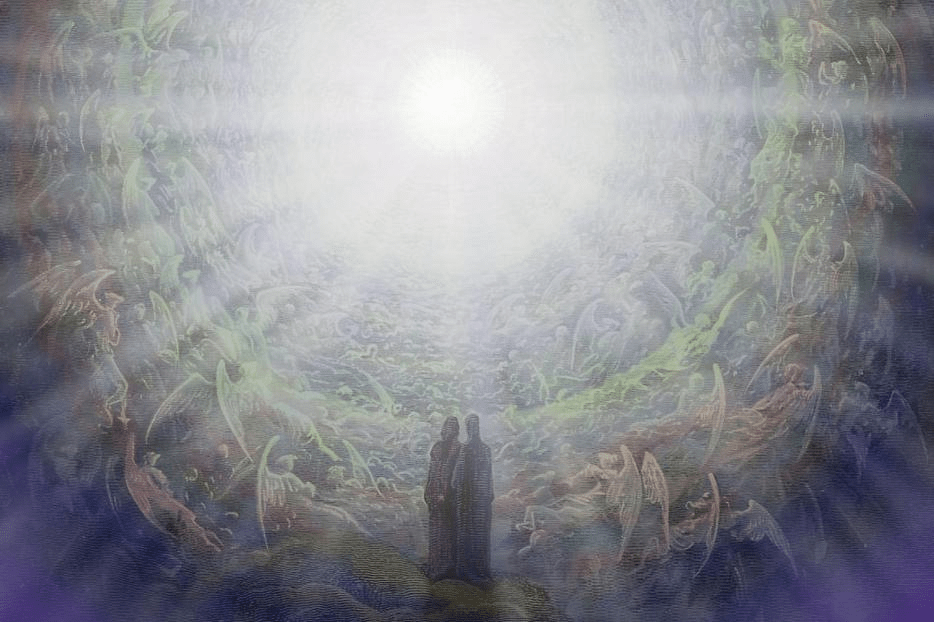
As Jesus and the rishis both attempt to explain, listening to the Om — the Word of God and Song of Heaven — exhilarates or brightens the star of God’s Thought deep in our minds. But we can’t just listen for our own benefit; we have to listen for the benefit of everyone connected to us through the divine yoke, web, network, or matrix connecting the seemingly separate parts of the Christ Mind. And that yoke, web, network, or matrix IS the “Holy Relationship,” as well as the Ark of the Covenant. We forged that covenantal relationship with God and each other long ago, in the spirit of Perfect Love.
And guess what? That’s precisely what the rishis tell us next.
The Sukta’s third line reads: sa nah yasya samsthe na vr(i)nate hari samatsu satravah tasma indraya gayata sutapavne. According to my research and guidance, those words translate thusly:
The Word of God, in the Wholeness of the Holy Relationship, establishes the shared purpose of working together for the common goal of choosing Hari . Uniting in sameness, the assembled devotees send forth King Indra’s Light by singing together through the charioteer swallowing the forest (fire).
My word-definitions:
sa = The Son of God
nah = in the wholeness of
yasya = the Holy Relationship
samsthe = establishes the shared purpose
na = vrinda (of working together for the common goal)
vrinvate = of choosing
hari = Hari
sama-tsu = uniting in sameness/as equals
satra-vah = the assembled devotees send forth
tasma = as a result
indr-aya = Indra’s Light or Indra’s Miracle
gayata = by singing together through
suta-pavne = the charioteer drinking in the forest or swallowing the forest fire.
The real stickler here was figuring out what Indraya was supposed to mean. The Sanskrit dictionaries, by and large, define the word as “belonging to Indra” or simply “of Indra.” But those definitions didn’t track with the only possible meaning of tasma (“therefore” or “as a result”). Eventually, I worked out that Indraya must be either a compound of indra (King Indra) and ya (“light” or “the light”) or a marriage of Indr (shorthand for Indra) and aya.
The Sanskrit dictionaries mainly define aya as the “profit” or “income” bearing the fruits of spiritual gain (the fruits of the Lamb coming from the Jewish Sefirot or the Hindu Mahvidya).

In Hinduism generally, aya refers to a spiritual presence with influence over human consciousness. In Arabic, the word means “amazing,” “wondrous,” or “miraculous.” In Mesopotamia, Aya was the name of a goddess associated with dawn. The wife of the Sun God, Aya was also called Sudag (golden-yellow shine) and Ninkara (to light up), among other names. So, as I was shown in meditation the other day, the enigmatic Vedic terms aya and ayas do indeed refer to the “Miracle of Grace” by which we heal each other by singing together through the charioteer swallowing the forest (fire).
Strange as the dexcription sounds, the charioteer mentioned herein is Lord Krishna, the Black One with the yoke seen in the Biblical Book of Revelation. And, it is indeed through his yoke that we give and receive the healing Miracles of Grace seen only in the light of breaking dawn. This strange description of Krishna comes from the Bhagavata Purana, wherein Krishna swallows a forest fire — a symbol of the Soul’s innate holiness still burning bright in the dark forest of earthly existence. Krishna, who is addressed as Hare, preserves that yoke of light as the charioteer-teacher of the ego-battling Soul.
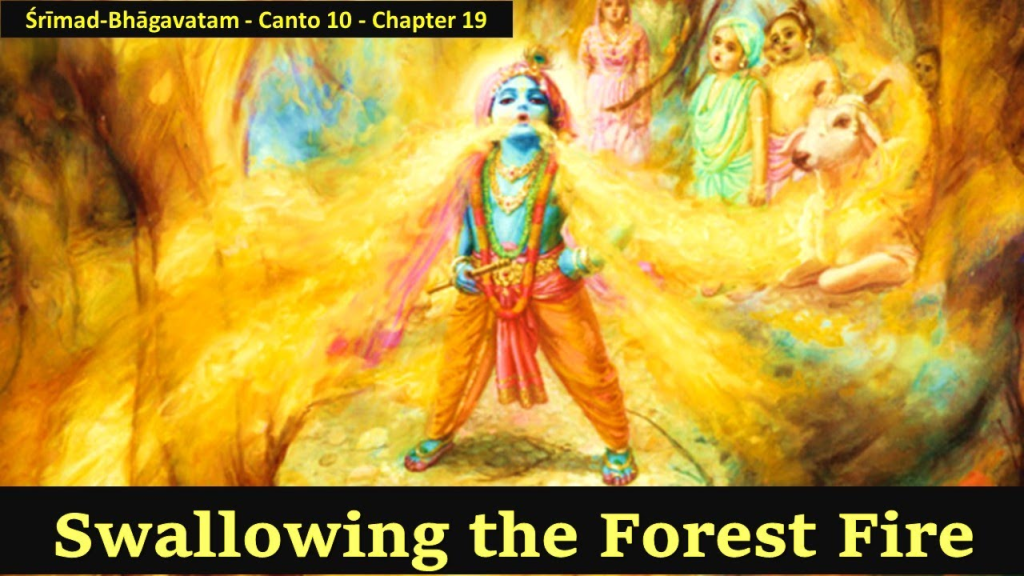
Compared to the Indraya conundrum, working out the intended meaning of Hari was a snap. In present-day Hinduism, “Hari” — an epithet for Vishnu and Krishna, supposedly means either “he who removes illusions” or “he who removes the obstacles to enlightenment.”
These definitions aren’t wrong, but Hari is, in actuality, a compound of Har and i. Har means “destroying power” — as in, ego-destroying or illusion-destroying — while i can be a shorthand reference to Kamadeva, the Hindu god of love and lust — the upside-down version of Divine Love. Kamadeva’s bow and five flowery arrows (Panchabana) tell a different story. Conflated with the love-inducing arrows of Cupid and Eros, Kamadevas arrows take out the bodily senses giving rise to our earthly desires.
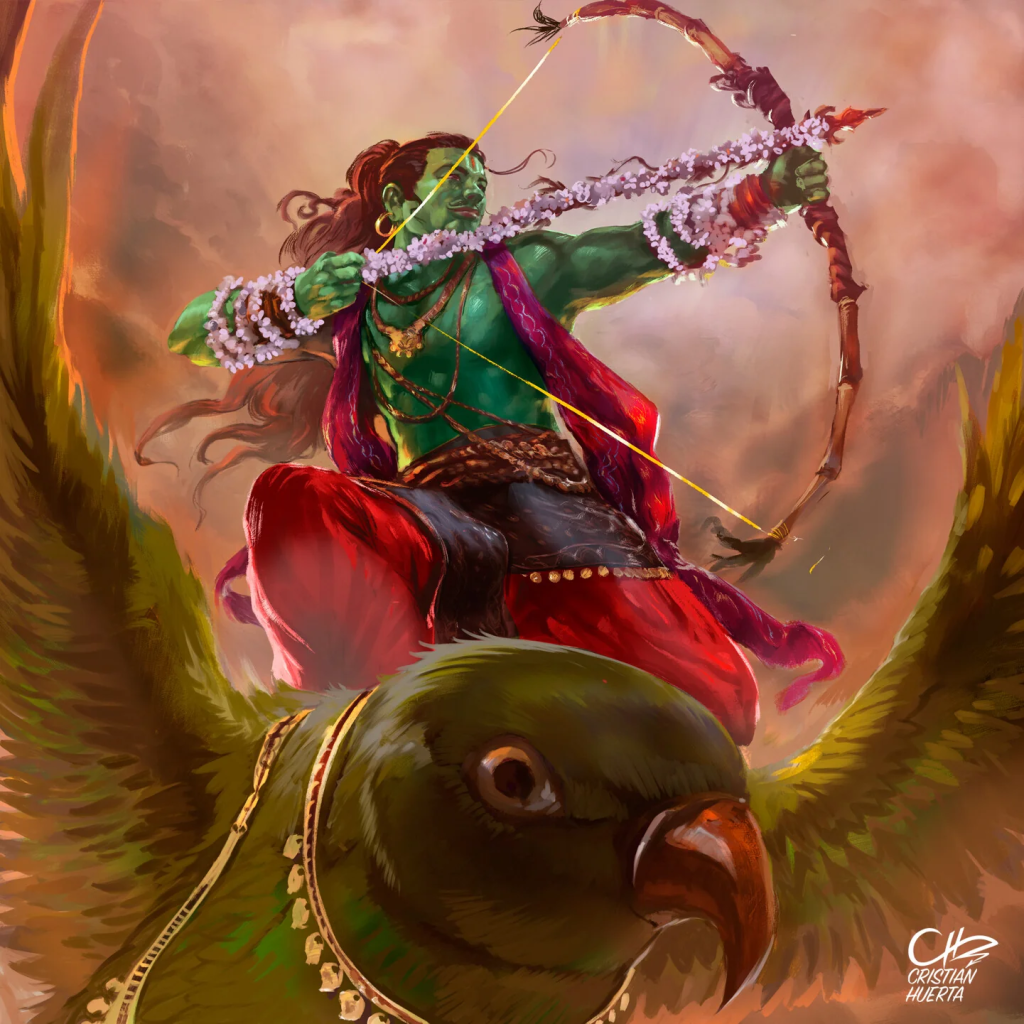
Rightly understood, the parrot-riding Kamadeva is no more the “god of earthly love” than Agni is the “god of elemental fire.” And we know this because Hari literally translates as “the illusion-destroying power of Kamadeva (the Love of God).
Let’s move on to the Sukta’s next line, which should read: suta ime sucayo yanti vitaye somaso dadhyasirah. In English, those words convert as follows:
The Charioteer in the now moment makes known the miraculous thoughts spreading across the world the time of peace to bestow Heaven on earth.
My word-definitions:
suta = the holy sound
ime = in the Holy Instant
suc-ayo = makes known the “ayo” (the miraculous)
yanti = thoughts
vitaye = spreading across the world
somaso = the time of peace
da-dhyas-irah = to bestow heaven on earth
The learned Sanskrit experts presume that ayo or ayas means “iron,” even though iron wasn’t known in India at the time the Rigveda was revealed to the rishis. Related to Aya, ayo or ayas probably means “miraculous,” which works perfectly in this verse (whereas “iron” does not).
Somaso is another word for which no feasible definition exists. Although I can’t explain how I came up with the meaning “time of peace,” my intuition tells me it’s right. In the Course’s standard edition, Jesus uses the phrase “time of peace” twice — within the same lesson. Not coincidentally, it’s one of the lessons I reviewed while originally working on this post in 2024: Lesson 125: In quiet I receive God’s Word today. His first mention of the “time of peace” occurs in the opening paragraph, which reads:
Let this day be a day of stillness and of quiet listening. Your Father wills you hear His Word today. He calls to you from deep within your mind where He abides. Hear Him today. No peace is possible until His Word is heard around the world; until your mind, in quiet listening, accepts the message that the world must hear to usher in the quiet time of peace. (ACIM, W-125.1:1-5)
He mentions the time of peace again in the fourth paragraph, wherein he says:
Hear, holy Son of God, your Father speak. His Voice would give to you His holy Word, to spread across the world the tidings of salvation and the holy time of peace. We gather at the throne of God today, the quiet place within the mind where He abides forever, in the holiness that He created and will never leave. (ACIM, W-125.4:1-3)
Note how Jesus and the Vedic rishis use identical language — “spreading across the world” — in reference to “the time of peace.” And, in case I haven’t said this before, these two divinely revealed texts are linked across time in ways intuitively understood but impossible to explain to anyone who still believes time is either linear or real.
Okay, so … what is this “time of peace” of which the Holy Spirit spoke to his chosen scribes? I’m not absolutely certain, but I suspect it’s the phase in our spiritual evolution when we’re more awake than asleep (individually and collectively). It’s the time, essentially, when “the meek inherit the earth.” Or, as Course-Jesus more fully explains:
Of your ego you can do nothing to save yourself or others, but of your spirit you can do everything for the salvation of both. Humility is a lesson for the ego, not for the spirit. Spirit is beyond humility, because it recognizes its radiance and gladly sheds its light everywhere. The meek shall inherit the earth because their egos are humble, and this gives them truer perception. The Kingdom of Heaven is the spirit’s right, whose beauty and dignity are far beyond doubt, beyond perception, and stand forever as the mark of the Love of God for His creations, who are wholly worthy of Him and only of Him. Nothing else is sufficiently worthy to be a gift for a creation of God Himself. (ACIM, T-4.I.12:1-6)
The fifth Sukta’s next line also resonates with Course-Jesus’s explanations of reality. In transliterated Sanskrit, the restructured verse reads: tvaṃ sutasya pītaye sadyo vṛddho ajāyathāḥ indra jyaiṣṭhyāya sukrato a tva. In English, those words translate more or less as follows:
The true state of being is the Charioteer of the Father’s Will in the now moment augmenting the invincible holiness of Indra, the first holy mind-born creation in God’s likeness.
My definitions:
Tvam = the true state of being is
sutasya = the charioteer of
pita-ye = the Father’s will
sa-dyo (sadyas) = in the now-moment (the Holy Instant)
vrddho (vrddhas) = augmenting
ajaya-thah = the invincible holiness of
indra = King Indra,
jyaishthya-ya = the firstborn light
su-kra-to = of the holy creative powers
a = in God’s
tva = likeness
The now moment is the Holy Instant, in Course terms. The Charioteer of the Father’s Will is the Holy Spirit whose net or yoke preserves the wholeness of the Christ Self or Christ Mind the true state of being still living and creating in harmony with the Father. That he’s called the Charioteer in this verse suggests that Krishna is, in fact, the Holy Spirit, rather than the Buddhi (as suggested earlier).
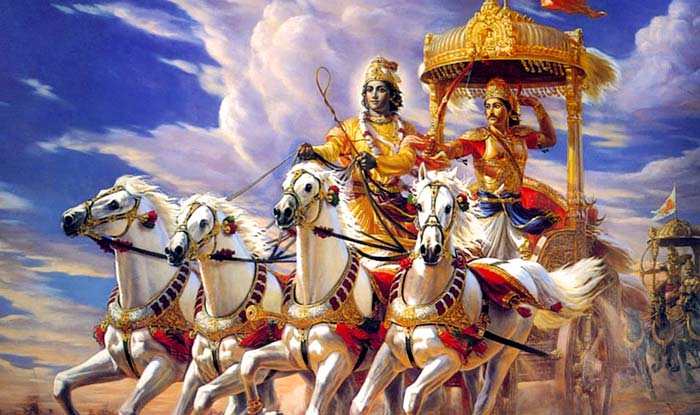
That Indra is described herein as the first or firstborn light of the holy creative powers in God’s likeness affirms my contention that Indra is indeed the Vedic personification of the Amrita-producing Red Ray.
And that Solar Ray of God’s Will is “king” among the Holy Powers of the Atonement.
The Sukta’s next rather lengthy verse reads: visantu asavah somasah indra girvanah sam te santu pracetase tvāṃ stomā avīvṛdhan tvām ukthā śatakrato iti satakrato tvāṃ vardhantu no giraḥ. In English, those words read roughly as follows:
To possess the mark of the life purpose Soma supports, Indra, the Divine Being in wholeness, joins with the peace advancing the consciousness of the Higher Self. Praising the creations of God augments the True Self speaking for the True Will coming from King Indra, the Self developing the wholeness speaking for infinite love.
My definitions:
vis-antu = To possess the mark
asavah = of the life purpose
soma-sah = Soma supports
indra = Indra
girva-nah = the divine being in wholeness
sam = together with
santu = the peace
pra-cetase = advancing the mind, thoughts, or consciousness
tvam = of the true state of being
sto-ma = praising the creations
a-viv(a)rdhan = of God to augment
tvam = the True Self
uktha = speaking for or invoking
sata-krato = the True Will
iti = coming from
satakrato = King Indra
tvam = the true Self
vardh-antu = developing
nah = the wholeness
gi-rah = speaking for infinite love
I’m beginning to see why my inner-guru guided me to translate Revelations before migrating and updating this post from my old blog. Firstly, “the mark of the life purpose Soma supports” is the Mark of the Beast, the Tripunda of Shiva we discussed last time. And it is that mark which brands us as miracle-workers or Brahmins (the life purpose Soma, the Great I Am, supports).
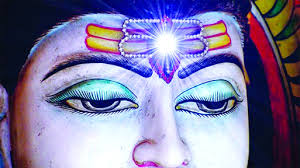
We also find herein the word or name Uktha. In the Mahabharata epic, Uktha is described as the son of Svaha (meaning “the Greater Light of the Upper World”), as well as 1) the means by which salvation is achieved, 2) the originator of the sacred sound, and 3) the embodiment of the essence of spiritual liberation and cosmic significance. And here, he’s further identified as the advocate for the True Will coming from King Indra — the Greater Light of the Upper World. So, Uktha is considerably more important than a hymn of praise or set of verses to be read or recited, as the word is typically interpreted.
As a word, Uktha is either a marriage of U and k(a)tha or of U and kta. If it’s the first, it means Shiva’s communications; if it’s the second it means Shiva’s thoughts or wisdom. Either way, the name describes the Living Water through which Shiva, the transcendent power of grace, speaks to the Souls in his care.
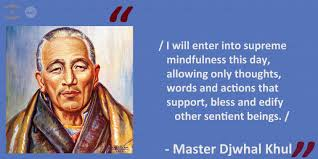
What this verse communicates about Uktha is something I’ve read before — in the books dictated to Alice A. Bailey by “the Tibetan,” Djwal Khul. What Master D.K. and this verse both explain is that WE strengthen the Will of God in the dream-universe through our yajna offerings. God’s Will can’t come down full-force through Soma’s “shield.” But it can “spring” upward through our the prayers and blessings we willingly offer universally in the Holy Resting Place.
Or, to quote Course-Jesus:
Miracles praise God through you. They praise Him by honoring His creations, affirming their perfection. They heal because they deny body-identification and affirm spirit-identification. (ACIM, T-1.I.29:1-3)
Like I said before, God couldn’t act directly in the dream without jeopardizing the free will of those who chose to remain in the dream. So, our Heavenly Father decreed that WE had to bring down — through our own abundant willing — the True Will to end the dream. We had to do this together, however, as one unified mind, because that’s how God designed True Creation or “creative willing” to work.
Does that mean we can’t escape until everyone else gets on board? The answer is: yes and no, but mainly no. Because complete forgiveness reestablishes the wholeness of mind necessary to end the dream right now. Ergo, when we forgive everyone for everything we misjudged as “sinful” and “wrong” — but which was really only helpful lessons for restoring at-one-ment — the dream-universe will end “just like that.” Gone and forgotten in a Holy Instant.
This Vedic verse further communicates that asavah, the purposeful breathing Soma supports is not the so-called “vital breath” of the body erroneously identified as prana. Right-mindedly understood, the body has no “vital breath,” because the spirit and the physical body exist in separate dimensions of perception. As Course-Jesus explains, assigning spiritual properties to the physical body exemplifies “level confusion.” Prana is, therefore, either an ego-invention or the same as asavah, and vayu, but widely misunderstood. So, I stand by what I said in my earlier post on the Yoga Sutras regarding the practice of pranayama.
Contrived yogic breathing exercises might help improve concentration in meditation– or relieve ego-engendered stress, but they have no actual spiritual or transcendental effects.

Let’s move on to the next line, which affirms what I’ve just explained. In Sanskrit, the line reads: akṣitotiḥ saned imaṃ vājam indraḥ sahasriṇam yasmin viśvāni pauṃsyā. In English, it says something along these lines:
Abiding in the spiritual perception of the Word of God brings nearer the here-and-now thunderbolt of King Indra, bringing together Srinam (the Holy Name) in the place of repose (the Resting Place) not of the world belonging to men.
My definitions:
askit-otih = dwelling, abiding (aksit) in the spiritual perception (otih)
sa-ned = of the Word of God brings nearer
imam = the here and now
vajam = thunderbolt
indrah = of King Indra
saha-srinam = bringing together Sri-nam (the hallowed Name)
yasmin = in the place of repose (the Holy Resting Place)
visva-ni = not of the world or universe
paumsya = belonging to men
This verse makes clear that the Holy Resting Place is part of the Real World — the invisible world underneath the visible one perceived through fthe body’s five senses. We enter that other world through “the door” we’ve discussed many times — the door mentioned close to one hundred times in the Holy Bible. In John 10:9, for example, Jesus says:
I am the door: by me if any man enter in, he shall be saved, and shall go in and out, and find pasture.
Presumably, we will find “pasture” or “rest for our Souls” (as Jesus promises elsewhere) in the place of repose beyond “the door” leading into the world “not of the universe belonging to men.” In the Course, Jesus mentions that “other world” myriad times. He also refers to “the door” repeatedly. In one place in the Text, he actually explains what this Sukta attempts to teach. Rather than paraphrase, I’ll quote him verbatim:
If your brothers are part of you and you blame them for your deprivation, you are blaming yourself. And you cannot blame yourself without blaming them. That is why blame must be undone, not seen elsewhere. Lay it to yourself and you cannot know yourself, for only the ego blames at all. Self-blame is therefore ego identification, and as much an ego defense as blaming others. You cannot enter God’s Presence if you attack His Son. When His Son lifts his voice in praise of his Creator, he will hear the Voice for his Father. Yet the Creator cannot be praised without His Son, for Their glory is shared and They are glorified together.
Christ is at God’s altar, waiting to welcome His Son. But come wholly without condemnation, for otherwise you will believe that the door is barred and you cannot enter. The door is not barred, and it is impossible that you cannot enter the place where God would have you be. But love yourself with the Love of Christ, for so does your Father love you. You can refuse to enter, but you cannot bar the door that Christ holds open. Come unto me who hold it open for you, for while I live it cannot be shut, and I live forever. God is my life and yours, and nothing is denied by God to His Son.
At God’s altar Christ waits for the restoration of Himself in you. God knows His Son as wholly blameless as Himself, and He is approached through the appreciation of His Son. Christ waits for your acceptance of Him as yourself, and of His Wholeness as yours. For Christ is the Son of God, Who lives in His Creator and shines with His glory. Christ is the extension of the Love and the loveliness of God, as perfect as His Creator and at peace with Him.
Blessed is the Son of God whose radiance is of his Father, and whose glory he wills to share as his Father shares it with him. There is no condemnation in the Son, for there is no condemnation in the Father. Sharing the perfect Love of the Father the Son must share what belongs to Him, for otherwise he will not know the Father or the Son. Peace be unto you who rest in God, and in whom the whole Sonship rests.
We’ve got one more line to go. But before we move on, I want to share something from Workbook Lesson 131: No one can fail who asks to reach the truth. It’s a pivotal lesson — but also a fairly long one; so I won’t try your patience by quoting the whole thing. I will only quote the section in which he explains how to reach the door in meditation:
For several minutes watch your mind and see, although your eyes are closed, the senseless world you think is real. Review the thoughts as well which are compatible with such a world, and which you think are true. Then let them go, and sink below them to the holy place where they can enter not. There is a door beneath them in your mind, which you could not completely lock to hide what lies beyond.
Seek for that door and find it. But before you try to open it, remind yourself no one can fail who seeks to reach the truth. And it is this request you make today. Nothing but this has any meaning now; no other goal is valued now nor sought, nothing before this door you really want, and only what lies past it do you seek.
Put out your hand, and see how easily the door swings open with your one intent to go beyond it. Angels light the way, so that all darkness vanishes, and you are standing in a light so bright and clear that you can understand all things you see. A tiny moment of surprise, perhaps, will make you pause before you realize the world you see before you in the light reflects the truth you knew, and did not quite forget in wandering away in dreams.
You cannot fail today. There walks with you the Spirit Heaven sent you, that you might approach this door some day, and through His aid slip effortlessly past it, to the light. Today that day has come. Today God keeps His ancient promise to His holy Son, as does His Son remember his to Him. This is a day of gladness, for we come to the appointed time and place where you will find the goal of all your searching here, and all the seeking of the world, which end together as you pass beyond the door.

Assuming the line-breaks are correct, the Sukta’s next and final line reads: mā nah martāh abhi druhan tanūnām indra girvaṇaḥ īśāno yavayā vadham. My hard-come-by translation reads something akin to this:
Producing wholeness in the world of men, the first Red Ray is the pole-star and still-point spreading the joy of King Indra, the arrow of Ishanna coming down to spread the fire-wind of divinity.
My definitions:
ma = Producing
nah = wholeness
martah = in the world of men
abhi = the first red ray
dru-ham = is the pole-star and still-point
tan-unam = spreading the joy of
indra = Indra
girvanah = the arrow of
isano (isanas) = Ishanna
yav-aya = coming down
va-dham = to spread the fire-wind of divinity
Under the ego’s truth-obfuscating influence, the worldly Sanskrit “experts” have mutated druhan into “harm” or “hate”; tanunam into “body”; yav and yava into “barley”; yavaya into “warding off” or “driving away”; and vadham into murder or death. Consequently, it took several days to extract a translation consistent with higher truth.

I couldn’t find a specific reference to Ishanna’s arrow in the Hindu literature, but the Puranas do describe her energy as the “sharp, penetrating, and enlightening force of supreme consciousness that dispels ignorance.” And what is an arrow, if not sharp and penetrating? Rightly understood, Ishanna’s arrows are the miracles of grace dispelling wrong-minded perception. Moreover, we find Ishanna carrying a bow and arrow (among other divine weapons generally associated with Shiva and Vishnu) in the image above. Significantly, she’s also riding a lion.
Before I share all Course-Jesus says along these same lines, I want to point out that my new-and-improved definition of abhi (as “the first red ray”) holds up beautifully in this final line.
Let’s now turn to the Course, wherein Jesus communicates parallel ideas in all of the following passages:
Miracles unite you directly with your brother. Neither emanates from consciousness, but both are experienced there. (ACIM, T-1.II.1:6-7)
Miracles are the way in which minds that serve the Holy Spirit unite with me for the salvation or release of all of God’s creations. (ACIM, T-1.III.3:4)
Miracles arise from a mind that is ready for them. By being united this mind goes out to everyone, even without the awareness of the miracle worker himself. The impersonal nature of miracles is because the Atonement itself is one, uniting all creations with their Creator. As an expression of what you truly are, the miracle places the mind in a state of grace. The mind then naturally welcomes the Host within and the stranger without. When you bring in the stranger, he becomes your brother. (ACIM, T-1.III.7:1-6)
God’s Oneness and ours are not separate, because His Oneness encompasses ours. To join with me is to restore His power to you because we are sharing it. I offer you only the recognition of His power in you, but in that lies all truth. As we unite, we unite with Him. Glory be to the union of God and His holy Sons! All glory lies in Them because They are united. The miracles we do bear witness to the Will of the Father for His Son, and to our joy in uniting with His Will for us. (ACIM, T-8.V.3:1-7)
Strength comes from truth, and shines with light its Source has given it; weakness reflects the darkness of its maker. It is sick and looks on sickness, which is like itself. Truth is a savior and can only will for happiness and peace for everyone. It gives its strength to everyone who asks, in limitless supply. It sees that lack in anyone would be a lack in all. And so it gives its light that all may see and benefit as one. Its strength is shared, that it may bring to all the miracle in which they will unite in purpose and forgiveness and in love. (ACIM, W-92.5:1-7)
The similarities are rather miraculous, are they not? Let’s now see how the Fifth Sukta reads without all the notes and definitions (and with a few minor tweaks):
God’s true state of being is remembered down below (in the dream-waters of ego consciousness) in the peace given by King Indra, the first Red Ray of Holy Creation advancing the sacred syllable exerting the Word of God, moving in the ethers, and by which the Assembly channels the waters of abundance and wholeness from the walled city of Una, the divine name of Ishanna.
Ishanna, the pure and complete knowledge-palanquin of Ishvara; the pure and complete Living Being stretching across the Creation, beginning with Brahma as overlord, (but) belonging to Brahman, the higher overlord. The underlying and expanding vibration of love restores the reality of Sadashiva.
The water-palanquin of King Indra, Soma restores the true begotten Word of God, the sound of Wholeness yoking God’s earthbound Sons to the treasures of the Word in the city of divine consciousness, the village community strengthening the power of God.
The Word of God, in the Wholeness of the Holy Relationship, establishes the shared purpose of working together for the common goal of choosing Hari. Uniting in sameness, the assembled devotees send forth King Indra’s Light by singing together through the Charioteer swallowing the forest (fire).
The Charioteer in the now moment makes known the miraculous thoughts spreading across the world the time of peace to bestow Heaven on earth.
To possess the mark of the life purpose Soma supports, Indra, the Divine Being in wholeness, joins with the peace advancing the consciousness of the Higher Self. Praising the creations of God augments the True Self speaking for the True Will coming from King Indra, the Self developing the wholeness speaking for infinite love.
Abiding in the spiritual perception of the Word of God brings nearer the here-and-now thunderbolt of King Indra. Join together in Srinam (the Holy Name) in the place of repose (the Resting Place) not of the world belonging to men.
Producing wholeness in the world of men, the first Red Ray is the pole-star and still-point spreading the joy of King Indra, the arrow of Ishanna coming down to spread out the fire-wind of divinity.
Much more than a hymn of praise to Indra, wouldn’t you agree? In actuality, this sacred teaching is as much about Ishanna and Krishna as it is about Indra. And yet, the world-defined “experts” have insisted for centuries that neither Krishna nor Ishanna are mentioned anywhere in the Rigveda. Now we know better,
Thanks for visiting. Until we meet again, Om Hari Om and Namaste.
 The Holy Meeting Place
Leave a comment