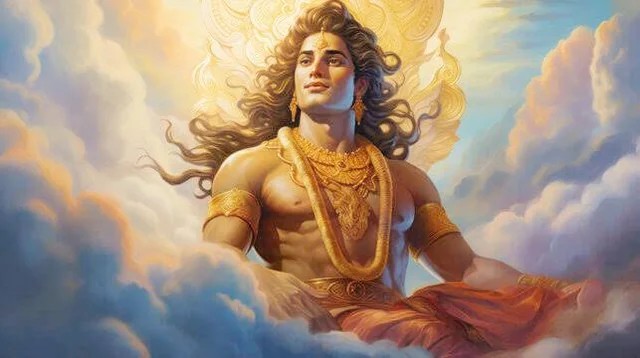
We now come to the Rig Veda’s fourth Sukta, the first of many presumably addressed to Indra, the king of the Hindu devas. As explained earlier, Indra personifies the Red Ray of the Father’s Will to make earth like Heaven. As such, Indra represents the most powerful force in the universe — the reason he rules supreme in the Hindu pantheon.
And yet, curiously, there are no temples to Indra in India today. We’ll discuss the reasons for this further along.

For now, let’s explore some of the symbols associated with King Indra. In the iconographic image above, he is red in color, rides a white elephant vahana, and is accompanied by two attendants. The attendant in front carries a spear, while the one in the rear holds a chatra or “holy umbrella” over his master’s head. In one of his four hands, Indra holds vajra, the thunderbolt-throwing mace fashioned for him by Tvashta, the maker of divine instruments. In the allegorical Hindu lore, King Indra used vajra to defeat Vritra, the heaven-invading demon in the form of a snake.
Sound familiar?
In this image, Indra also holds the sword known as kaakam, which, like the sword in the Biblical Book of Revelation, symbolizes the Word of God. The third weapon he holds isn’t easily identifiable. It might be his celestial bow, vijaya (meaning “victory”), or his net, jala (meaning “sanctifying waters”). The net, as we’ve discussed, represents the shared-mind “network,” “web,” “divine matrix,” “covenant,” or Holy Relationship (choose your preferred term) through which we give and receive the Living Water during our meditative yajna offerings in the Holy Resting Place.
Lord Indra is most often depicted astride his elephant vahana, but also sometimes rides a seven-headed white horse or drives a chariot drawn by seven white horses. The elephant, Airavata (“belonging to Iravati”), is described as having four tusks, seven trunks, and a white complexion. Best known as “king of the elephants,” Airavata also is sometimes called “elephant of the clouds” (Abhramatanga), “the fighting elephant” (Nagamalla), and “brother of the sun” (Arkasodara).
The encyclopedic descriptions of this “divine elephant” tell us 1) Iravati (“she who possesses God’s Wind or Breath”) is his mother and 2) he was born from the churning of the Ocean of Milk. Based on these “clues,” I strongly suspect Airavata represents the seven trumpets of God described in Chapters 8 and 11 of the Book of Revelation. Briefly, those seven trumpets represent what “comes forth” (in the silence) after the seventh seal is broken by the Lamb of God.
We’ll explore those accounts later on. For now, let’s stick with the Rigveda’s fourth Sukta, which, like the preceding three, is an advanced spiritual teaching, rather than a poem or hymn. In transliterated Sanskrit, the first line reads: surūpa-kṛtnum ūtaye sudughām iva go-duhe juhūmasi dyavi-dyavi.
For the sake of comparison, H. H. Wilson translated the line thusly:
Day by day we invoke the doer of good works for our protection, as a good cow for the milking (is called by the milker).
Based on my research and intuitive guidance, the line should read closer to this:
Holiness forms the mechanism connecting all living beings to the pure communications of God (the Holy Milk of the Miracle-Cow) in the manner of a cow-milker to expedite remembering the sword in the heavens.
My word-for-word definitions:
Su-rupa = Holiness forms
krtnum = the mechanism
utaye = connecting all living beings
su-dugham = to the pure communications of God (the Holy Milk)
iva = in the manner of
go-duhe = a cow-milker
ju-hum-asi = to expedite remembering the sword
dyavi-dyavi = in the heavens
The symbolic “sword in the heaven(s)” referenced herein also is mentioned in the Old Testament Book of Isaiah (34:5-8). Unfortunately, the passage has only ever been translated (insofar as I’m aware) through ego filters. In the King James Bible, for example, the verse reads:
For my sword shall be bathed in heaven: behold, it shall come down upon Idumea, and upon the people of my curse, to judgment. The sword of the Lord is filled with blood, it is made fat with fatness, and with the blood of lambs and goats, with the fat of the kidneys of rams: for the Lord hath a sacrifice in Bozrah, and a great slaughter in the land of Idumea. And the unicorns shall come down with them, and the bullocks with the bulls; and their land shall be soaked with blood, and their dust made fat with fatness. For it is the day of the Lord’s vengeance, and the year of recompenses for the controversy of Zion.
Because the Holy Spirit never gives us frightening messages or visions, the KJV translation can’t be accurate. Based on my assessment of the original Hebrew, the verse should read more along these lines:
The sword of abundant water in the celestial sphere will descend upon those gathered in Edom (Adam, the Red Ray) in devotion to God and to share divine ideas about right-minded justice. The sword of Yahweh (the Name of God) is filled with red anointing fat, the lifeblood of the lamb (or ram), to prepare the altar of the mind to strengthen Yahweh’s offerings, to gather together, and to grow in spiritual stature to slaughter the beast in Edom (Adam). And a re’em will descend as a calf, powerful and mighty, to the earth to make full the lifeblood of the dust by anointing with fat.
The Yom (the Greater Light) of Yahweh (the Name of God) upholds God’s right-minded judgment to change requital (giving in kind) from bodily striving to striving (for justice, righteousness, and harmony) through the covenant relationship in Zion.
That’s what I make of it, anyway. The fat thing seemed a bit odd, until I learned (from Strong’s) that animal fat was used to fuel fires on sacred altars during offerings in those days. So, the fat represents the anointing oils of the atonement, basically.
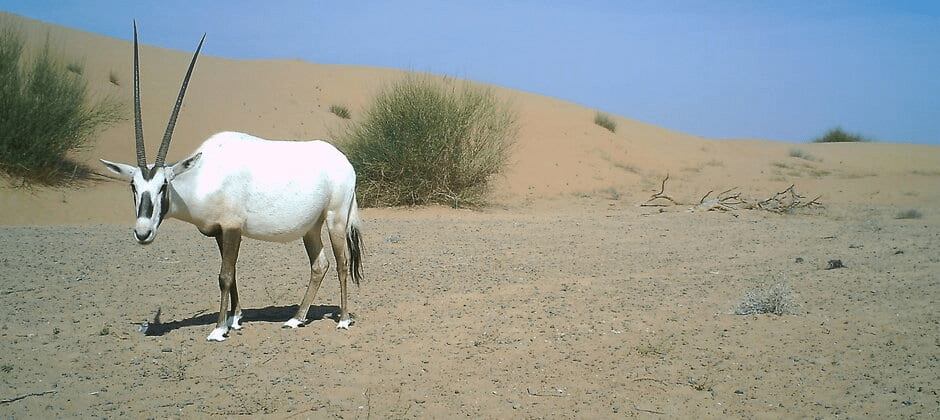
Interestingly, the mysterious word re’em appears in this group of verses. What is a re’em? A mysterious “creature” mentioned seven times in the Old Testament (in Job 39:9-10, Deuteronomy 33:17, Numbers 23:22 and 24:8, Psalms 22:21, 29:6, and 92:10, and Isaiah 34:7). Described as having one or more great horns reaching toward Shemayim (the celestial sphere), the re’em is generally presumed to be some type of wild ox, unicorn, or rhinoceros. These are just guesses, however, because the word has no root in either Hebrew or Greek.
In Arabic, a r’imm (pronounced “reem”) is an antelope, gazelle, or oryx — and the Arabic name Reem means “pure white antelope.” And, since Vayu, the Cosmic Breath, has an antelope vahana — and antelopes also pull the chariot of Soma/Chandra — I suspect the re’em of the Bible is an antelope or oryx rather than a wild ox or mythical beast of some sort. Or, rather, the re’em of the Bible symbolizes what Vayu and Soma’s vahanas symbolize. And baby antelopes are indeed called calves, so all the pieces fit.

We’ll explore the re’em in more depth in a future post. For now, let’s proceed to the Rik’s second line. According to Max Muller, the line reads: upa naḥ savanā gahi somasya somapāḥ piba godā id revato madaḥ.
Wilson’s translation:
Drinker of the Soma juice, come to our (daily) rites, and drink of the libation; the satisfaction of (you who are) the bestower of riches, is verily (the cause of) the gift of cattle.
My translation:
Join together in the Resting Place of God to immerse in the Love of Soma (the Great I Am); the cosmic waters of Soma, the flowing word of the Rays burning away all the layers of self-intoxication.
My word-for-word definitions, along with how each should break:
Upanah = join together
savana = in the resting place
a = of God
gah-i = to immerse in the Love
somasya = of Soma (the Great I Am)
somapah =the cosmic waters of Soma
pi-ba = are the flowing word
go-dah = of the rays burning
it = away
revatah = all the layers of
madah = self-intoxication
The Sukta’s third line reads: athā te antamānāṃ vidyāma sumatīnām mā no ati khya ā gahi.
Wilson’s translation:
We recognize you in the midst of the right-minded, who are nearest to you; come to us; pass us not by to reveal (yourself to others).
My very different result:
In the now-moment (the Holy Instant), the Self dwells in the peace of the Presence the Holy Mind produces in Wholeness, the zenith of the ethereal power of God’s immersive Love.
My word-syllable definitions:
atha = in the now-moment or Holy Instant
te = the Self
ant-amanam = dwells in the peace
vidyama = of the Presence
su-matinam = the Holy Mind
ma = produces
nah = in wholeness
ati = the zenith of
kh-yah = the ethereal power
a = of God’s
gahi = immersive Love

Contrary to Max Muller’s metered reconstruction, the Rik’s fourth line should read: parehi vigram astṛtam indram pṛcchā vipaścitam yah te sakhibhya ā.
Varam — the word Miller tacked onto the end — means “the Bridegroom,” rather than “the best (of blessings).” And that’s not the only word Wilson gets wrong, as you’ll see.
Wilson’s translation:
Go, worshipper, to the wise and uninjured Indra, who bestows the best (of blessings) on your friends, and ask him of the (fitness of the) learned (priest who recites his praise).
My translation:
Advance this consciousness of peace, the divine weapon of the Supreme Spirit of Indra proceeding from the pure inspiration-consciousness by which you acquire the ability to send forth the light and strength of God.
My word-syllable definitions:
par-ehi= advance this
vig-ram = consciousness of peace
astr(a)-tam = the divine weapon of the Supreme Spirit
indram = of Indra (or equipped with the power of peace)
proc-cha = proceeding from the pure
vipah-citam = inspiration-consciousness
yah = by which
te = you
sak-hi-bh(a)-yah = acquire the ability to send forth the light and strength
a = of God
What these verses communicate needs to be absorbed rather than explained. That said, this one affirms what I said earlier about Indra representing the Ruby Ray of Peace.
This brings us to the Rik’s fifth line, which Muller also “metered” inaccurately. To make sense, Rv 1.4.5 should read: varam uta bruvantu nah nido nir anyataś cid ārata dadhānā. I’m not completely certain that’s right, but I’m confident that the last three words (indre id duvah) Muller assigned to this line, belong at the start of the next one. Here’s what Wilson made of Muller’s wording:
Let our ministers, earnestly performing his worship, exclaim, “Depart your revilers from hence and every other (where he is adored).”
And here’s what the line actually communicates:
The Bridegroom at the Wellspring speaks for the power of love in the stillness of the Resting Place, free from the difference-consciousness destroying the right-minded giving supporting the growth of Wholeness.
My word-syllable definitions are as follows:
varam = The Bridegroom (at)
uta (uda) = the wellspring or fountain
bru-vantu = speaks for the power of love
nas = in the stillness
nidah = of the Resting Place
nih = free from
anyata = the difference
cit = consciousness
arata = destroying the righteous (right-minded)
da-dha-nah = giving supporting the growth of wholeness
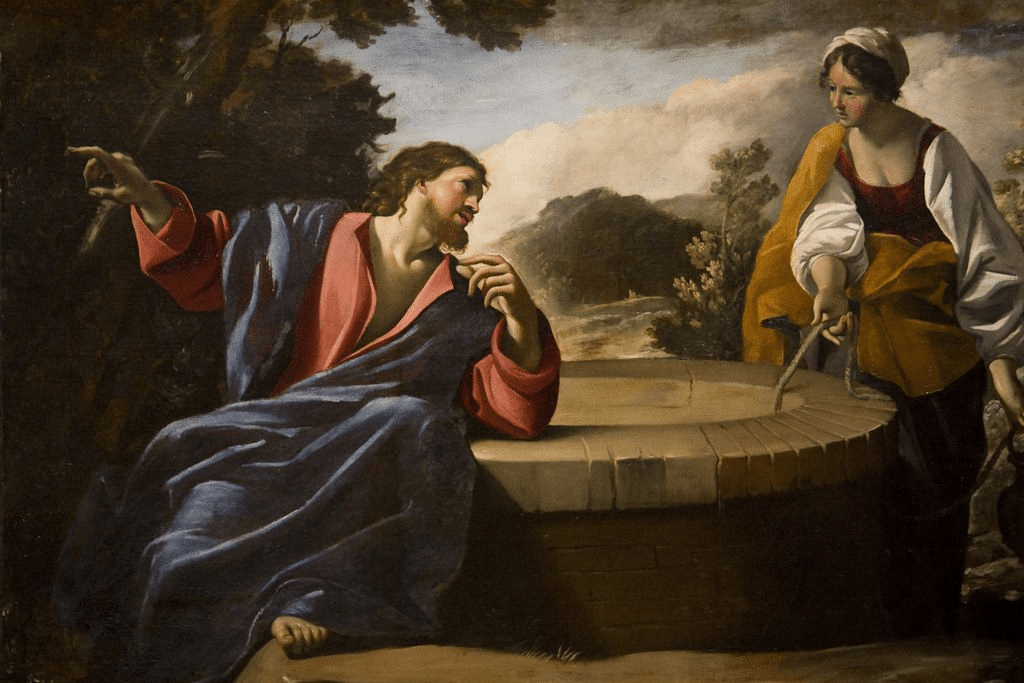
Like I said, I’m pretty sure this is right because Bible-Jesus a) discusses “the Bridegroom at the Wellspring” in the parable of the ten virgins in Matthew 25:1-13; b) enacts the “Bridegroom at the Wellspring” in John 4:1-42; and c) identifies himself as “the Bridegroom” supplying the mind-purifying “Living Water” more than once in the New Testament gospels.
The terms “bridegroom,” “wellspring,” and “fountain” don’t appear in the Course, but Jesus does use the phrase “Living Water” once — in the following passage from the Text (which providentially echoes this Rigvedic verse) :
The Thought of God surrounds your little kingdom, waiting at the barrier you built to come inside and shine upon the barren ground. See how life springs up everywhere! The desert becomes a garden, green and deep and quiet, offering rest to those who lost their way and wander in the dust. Give them a place of refuge, prepared by love for them where once a desert was. And everyone you welcome will bring love with him from Heaven for you. They enter one by one into this holy place, but they will not depart as they had come, alone. The love they brought with them will stay with them, as it will stay with you. And under its beneficence your little garden will expand, and reach out to everyone who thirsts for Living Water, but has grown too weary to go on alone. (ACIM, T-18.VIII.9:1-8)
The similarities in phrasing between the Bible, the Rigveda, and the Course are, in fact, nothing short of miraculous — or seem to be, at least, to our time-perceiving intellects. But, as we are told in Isaiah 55:8-9:
“My thoughts are not your thoughts, neither are your ways my ways,” saith the Lord. “For as the heavens are higher than the earth, so are my ways higher than your ways, and my thoughts than your thoughts.”
Let’s return to the Living Water and the Wellspring — two widely used scriptural symbols defined in the Old Testament Book of Jeremiah. In Jeremiah 2:13, Yahweh says to the prophet, “My people have committed two harms: They left the fountain [maqowr in Hebrew] of the waters [mayim in Hebrew] of life [hayyim in Hebrew], and have hewn their own cisterns, broken cisterns that cannot hold water.”
Somewhere along the line, the Hebrew phrase mayim-hayyim became “Living Water,” but the literal translation is “Waters of Life.” And in this critical passage from the Book of Jeremiah, Yahweh tells the prophet that we have committed two errors that harmed our own Self (not “sins,” as reported in the KJV Bible). Our first mistake was abandoning the maqowr supplying the mayim-hayyim, and our second was hewing cisterns or man-made “thought-tanks” that cannot hold mayim-hayyim. The fear-and-form-producing Ego Mind can’t, in other words, hold the Living Water supplied to us by the Great Amen.
According to Strong’s Concordance, the word maqowr occurs at least ten times in the Hebrew Old Testament. Generally, it’s translated into English as “fountain,” but the word also is sometimes rendered as “wellspring” or “spring.” Metaphorically, the word more specifically means “the source of life, joy, and purification of the (spiritual) eye, from which flows the blood of birth (the Amrita and/or Lifeblood of Christ).
The metaphorical definition tells us, unequivocally, that the “Water(s) of Life” springing from that maqowr are, in essence, the elixir of immortality and the wine of truth recovered from the Primordial Ocean of Milk to make our salvation possible.
Now, compare this definition to what Jesus tells the Samaritan woman at Jacob’s Well in John 4:14:
“Whosoever drinketh of the water that I shall give him shall never thirst; but the water that I shall give him shall be in him a well of water springing up into everlasting life.”
“The water that I shall give him,” at the maqowr — the source of life, joy, and purification of the (spiritual) eye — is the Lifeblood of Creation. And that “Lifeblood of Creation” or “Blood of Christ” comes from Indra, the Red Ray of God’s Will for Everlasting Peace on earth.
So why is he no longer worshipped in India?
I found the answer on YouTube. King Indra is no longer worshipped (i.e., has no Temples) in India because he delegated his authority “way back when” to Lord Krishna, the dreaming Soul’s charioteer.

Here’s how I interpret the allegory:
King Indra (God’s Will) delegated his power and authority to Lord Krishna (Hare, the destroying power of holiness) because, as explained in my series on Creation, a flood of undiluted Agape would have ended the dream too abruptly, with the undesired consequence destroying free will. So, to do the job more gently, God divided Agape into two gentler streams of Peace and Joy, which he commanded to work in tandem to encourage us to choose to awaken of our own free will.
Makes sense right?
And when those two streams “marry” in the Ajna chakra — bam! — the full-force of Agape hits us right between the eyes (literally) and we wake up.

Let’s proceed to the next line, which reads: indre duvah id uta naḥ subhagām̐ arir voceyur dasma kṛṣṭayaḥ syāmed indrasya śarmaṇie ne.
Wilson translated Muller’s contrived “chandas” in this odd, fill-in-the-blanks manner:
Destroyer of foes, let our enemies say we are prosperous; let men (congratulate us); may we ever abide, in the felicity (derived from the favour) of Indra.
My translation:
The supreme power of holiness unites the two born from the wellspring of wholeness; the Holy Bhagan acting to impel the Voice joining the miracle-doers of the black-colored one (the black horse and/or Lord Krishna) yoking what belongs to King Indra with the peace of God.
My definitions:
indre = The supreme power of holiness
it or id = uniting
du-vah = the two born from
uta = the wellspring or fountain
nah = of wholeness
subhagan = the Holy Spirit
ar-ih = acts to impel
voce-yuh = vak-yuh = the Voice (for God) joining
dasma = the miracle
krstayah = doers
syama =of the black-colored one = the black horse of Lord Krishna
it = yoking
indrasya = what belongs to King Indra
sarmani = with the peace
a = of God
Firstly, this verse confirms much of what I’ve just explained. It also tells us that Krishna is indeed the rider on the black horse with the yoke described in Revelations. Who is the Holy Bhagan? The short answer is “the Holy Spirit,” who is similarly identified in the Qur’an as Bhagwan. I know this not from Hindu or Islamic resources, but from the following from the Course:
It is this joining, through the Voice for God, of Father and of Son, that sets apart salvation from the world. It is this Voice which speaks of laws the world does not obey; which promises salvation from all sin, with guilt abolished in the mind that God created sinless. Now this mind becomes aware again of Who created it, and of His lasting union with itself. So is its Self the one reality in which its will and that of God are joined. (ACIM, W-154.4:1-4)
We’ve now reached the fourth Rik’s seventh line, which reads: em āśum āśave bhara yajñaśriyaṃ nṛmādanam patayan mandayatsakham.
Wilson’s translation:
Offer to Indra, the pervader (of every rite of libation), the juice that is present (at the three ceremonies), the grace of the sacrifice, the exhilarator of mankind, the perfecter of the act, the favourite of (that Indra) who gives happiness (to the offerer).
My translation:
In the now-moment of eternal holiness, the Living Water yokes the thought-offerings of grace and splendor (the Miracle) with Nara’s intoxicating essence governing the journey of walking at one’s own will or pleasure.
My word-for-word definitions:
em or im = in the now-moment
a-sum = of eternal holiness
asave = the Living Water
bhara = yokes
yajna-sriyam = the thought-offerings of grace and splendor
nr-mada-nam = Nara’s intoxicating essence
pat-ayan = governing the journey
manda-yatsakham =of walking at one’s own will or pleasure
In the Ramayana allegory, Rama undertakes his quest on foot, despite being a skilled horseman. And, in Hinduism, the term “walking journey” is rightly used to describe the path of spiritual transformation. We tread that path of surrendering our self-will (to God’s will) around the quarters of the Spiritual Circle or Wheel, not on any road or trail that exists in the world.
The walking path is “the path of bowing down” (shachah, in Hebrew) — a recurring theme in the Bible. Rightly understood, we “walk” that slow and gentle path at our own pace, choosing in our own sweet time, when to exchange or surrender our personal desires and ambitions to God’s supreme will and authority; not through fear of punishment, but through humble reverence, respectful submission, and gentle surrender to a wiser master.
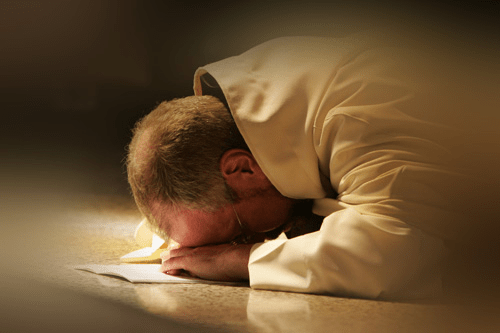
This is what the author of Psalm 99:5 means by “Bowing down at his footstool.” This is also what Course-Jesus encourages us to do in Workbook Lesson 328: I choose the second place to gain the first.
In that “bowing down” lesson, he says:
What seems to be the second place is first, for all things we perceive are upside down until we listen to the Voice for God. It seems that we will gain autonomy but by our striving to be separate, and that our independence from the rest of God’s creation is the way in which salvation is obtained. Yet all we find is sickness, suffering and loss and death. This is not what our Father wills for us, nor is there any second to His Will. To join with His is but to find our own. And since our will is His, it is to Him that we must go to recognize our will.
The lesson ends with this lovely prayer of submission:
There is no will but Yours. And I am glad that nothing I imagine contradicts what You would have me be. It is Your Will that I be wholly safe, eternally at peace. And happily I share that Will which You, my Father, gave as part of me.
Before we move on, I want to mention something I discovered while translating this verse. Many Sanskrit dictionaries erroneously define the word or name Nara as “man” or “mankind,” when Nara is, in fact, one of the many names the Vedas assign to the Blood Ray.
According to Muller, the Sukta’s eighth line reads: asya pītvā śatakrato ghano vṛtrāṇām abhavaḥ prāvo vājeṣu vājinam.
Wilson’s translation:
Having drunk, Śatakratu, of this (Soma juice), you became the slayer of the Vṛtras; you defend the warrior in battle.
My translation:
To drink the essence of Satakrato, the destroyer of the demon-identity, call down the streams of holy vibration belonging to the horses of God.
My word-for-word definitions are these:
pi-tva = To drink the essence of
satakrato = King Indra (the Thought of God)
ghano = the destroyer of
vrtra-nam = the demon-identity
abhavah = call down
pravah = the streams
vajesu = of holy vibration
vajinam = belonging to the horses of God
The name “Satakratu” is an epithet for King Indra; the word “satakrato” translates as “the true Thought of God,” more or less. So, I’m not wrong about what King Indra represents in Hindu theology.
Moreover, Course-Jesus says much the same thing in the fourth Workbook Review, whose unifying theme is “My mind holds only what I think with God.” In the introduction to that weeklong review of Lessons 141 – 150, he says of this central theme:
That is a fact, and represents the truth of What you are and What your Father is. It is this thought by which the Father gave creation to the Son, establishing the Son as co-creator with Himself. It is this thought that fully guarantees salvation to the Son. For in his mind no thoughts can dwell but those his Father shares. Lack of forgiveness blocks this thought from his awareness. Yet it is forever true. (ACIM, W-rIV.in.2:3–4:4)
With that out of the way, let’s discuss vajesu, which occurs more than once in the Vedas. While the Sanskrit dictionaries offer no definitions, I found what I needed at Sikhi-Wiki, on a page explaining the meaning of Waheguru. The word vaje was included in a mantra at the bottom of the page. Titled “Vahiguru,” the mantra is attributed to Manvir Singh Khalsa, who is described elsewhere on the Internet as “a spiritual Gurbani artist in the UK.” Gurbani (I later learned) is an umbrella-term for the body of texts, sayings, and experiences of Sikh gurus.
The relevant portion of the mantra reads (in transliterated Sanskrit):
panche shabad vaje mat gurmat vaddbhaagee anhad vajiaa.
aanand mool raam sabh dekhiaa gur shabadee govind gajiaa.
According to the author, those words translate thusly:
The Panch Shabad, the Five Primal Sounds, vibrate (vaje) with the Wisdom of the Guru’s Teachings; by great good fortune, the Unstruck Melody resonates and resounds.
I see the Lord, the Source of Bliss, everywhere; through the Word of the Guru’s Shabad, the Lord of the Universe is revealed.
Pretty cool, right? Know what’s even cooler? The word vajesu (the vibration of holiness) can also be divided as va-jesu, meaning “the arms of Jesus.”
While you contemplate that miracle, let’s move on to the next-to-last verse, which also connects the words vajesu and vajinam. According to Muller, the line reads: ataṃ tvā vājeṣu vājinaṃ vājayāmaḥ śatakrato dhanānām indra sātaye.
Wilson translated these words thusly:
We offer to you, Śatakratu, the mighty in battle, (sacrificial) food for the acquisition, Indra, of riches.
And I’ve translated them in this very different way (which closely echoes the Sikh mantra above):
The Atman Self vibrates the holy horses of God strengthening the measure of Satakrato, the spiritual treasures of the Name of Indra, the true essence of being.
These are my word-definitions:
atam = The Atman
tva = Self or essence
vaje-su = vibrates the holy
vajinam = horses or thought forces of God
vaj-ayamah = strengthening the measure of
satakrato =Satakrato
dhana-nam = the spiritual treasures of the Name
indra = Indra
sat-aye = the true essence of being
Now, at last, we come to the fourth Rik’s final line, which reads: yo rāyo ‘vanir mahān supāraḥ sunvataḥ sakhā tasmāi indrāya gāyata.
Wilson’s translation:
Sing unto that Indra who is the protector of wealth, the mighty, the accomplisher of good deeds, the friend of the offerer of the libation.
My translation:
Great and powerful king of the Real World; magnificent, holy, and transcendental shelter from the wind; Word of God, moving in the ethers; unto Him, King Indra, we sing our praises.
My word-definitions are these:
yah = Great and powerful
rayah = king
avanih = of the good earth (the Real World)
mahan = Magnificent
suparah = Holy Transcendental
sunvatah = shelter from the wind
sa-kha = Word of God, moving in the ethers (or in the Upper World)
tasmai = unto Him
indraya = King Indra
gayata = we sing our praises
Wilson’s translation of this line is infected with Satan-promoted deceptions about the value of “worldly wealth” and “good deeds.” As Jesus explains in the Bible and the Course, wealth and good deeds hinder rather than accelerate our spiritual advancement. All activity perpetuates karma, which chains us to the illusion through debts owed. The True Path exists in our minds, my dreaming brother, NOT in the world perceived through the physical senses. I can’t emphasize this GREAT TRUTH too often or too strongly.
Or, to quote Course-Jesus:
To do anything involves the body. And if you recognize you need do nothing, you have withdrawn the body’s value from your mind. Here is the quick and open door through which you slip past centuries of effort, and escape from time. This is the way in which sin loses all attraction RIGHT NOW. For here is time denied, and past and future gone. Who needs do nothing has no need for time. To do nothing is to rest, and make a place within you where the activity of the body ceases to demand attention. Into this place the Holy Spirit comes, and there abides. He will remain when you forget, and the body’s activities return to occupy your conscious mind.
Got it? Good.
Next time, we’ll tackle the Rigveda’s fifth Sukta, which also is (allegedly) addressed to King Indra. Unless I first decide to further investigate the mysterious re’em. I do love solving great scriptural mysteries, after all — as the Holy Spirit well knows.
Until we meet again outside the Holy Meeting Place, keep on singing to God (in the silence within).

 The Holy Meeting Place
Leave a comment