Detangling the Rigveda’s 2nd Sukta concerning Vayu, the Cosmic Breath
Now that we’ve established that the divine force the Vedic rishis call “Agni” actually represents the Transformational Fire of God in our heart-of-hearts (the Inner Altar within the Temple of the Holy Spirit), let’s proceed to the Rigveda’s second Sukta. Long presumed to be a “hymn” extolling the virtues of “Vayu,” the alleged “god of wind,” the second Sukta is, in truth, an advanced spiritual teaching about the Cosmic Breath.
Jews call this windless “breath of God” Ruach, Christians call it the Holy Spirit, and Muslims (especially Sufis) call it Nafas al-Rahman.
Or, as Google more fully explains:
In Islam, particularly Sufi mysticism, the “cosmic breath” (nafas al-Rahman) symbolizes the divine creative power, the continuous emanation of God (Allah) that brings all existence into being, sustains it, and reabsorbs it in a cycle of perpetual renewal, linking the universe’s manifestation to God’s presence and mercy. It’s seen as a luminous, life-giving substance, distinct from mere air, connecting the divine essence to creation, animating humans, and guiding spiritual states, making the universe a dynamic expression of God’s attributes, where all beings are words or traces of the Divine.
That definition is pretty good, actually. What it doesn’t specify is that the Cosmic Breath (Vayu) is the “wind” generated by Agni, to increase the reach and intensity of God’s Will to end the dream of earthly existence.
Today, we’re going to explore what the Rigveda’s second Sukta really says about Vayu, the antelope-riding guardian of the Northwest direction. In Hinduism generally, Vayu is said to be all of the following: 1) born from the breath of the Vishwapurusha; 2) the son of Lord Vishnu, 3) the father of Bhima and Hanuman, 4) the divine messenger of the gods, 5) closely associated with Indra, the king of the gods, and 6) the first to drink “the Soma.” When misidentified as a minor wind deity, he’s also said to be one of the Maruts, a rowdy group of storm gods presumably addressed in numerous Rigveda Suktas.
In Sanskrit, Ma-rut means “shining mothers” — a probable reference to the Septamatrikas, the seven mothers, sisters, daughters, and/or stars also referenced multiple times in the Bible, or possibly the ten shining handmaidens mentioned in the second Sukta. So stay tuned, because this Vedic teaching gets very, very interesting.
Is Vayu one of these “shining mothers”? I don’t know. What I do know is that Vayu is the Sanskrit equivalent of Ruach — a Hebrew word also sometimes mistranslated as “wind,” but which more particularly describes the “breath,” “mind,” and/or “spirit” acting in the world on God’s behalf to end the perceived separation. In the Hebrew Bible, the word Ruach appears 387 times, compared with (rather curiously) only twelve occurrences of Vayu in the Rigveda.
With all that background out of the way, let’s now explore what the Rigveda actually reveals about Vayu. We’ll start our investigation with the second Sukta’s original text in transliterated Sanskrit. According to the 19th-century Oxford “orientalist” Max Muller, the Rik is composed of eight metered lines reading as follows:
Let’s now see how this alleged “hymn” or “poem” was translated by H. H. Wilson and Ralph T. H. Griffith, both of whom (as explained last time) held the Boden Sanskrit Professorship at Queen’s College, Oxford University, prior to the British colonization of India. In my last post, I described the Boden Professorship as “evangelical,” and here’s why: the endowed position was funded by a former East India Company officer with the goal of helping convert the native peoples of India to Anglican Christianity. Anyone given the post was expected to carry out that imperative. The translation of the Rig Veda Samhita by Professors Wilson and Griffith were, therefore, driven to some extent by this agenda. Keep that in mind as we go forward.
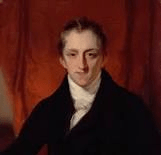
H. H. Wilson (1786-1860)
Let’s start with Wilson’s translation of the second Rik, which reads thusly:
Vayu, plural asant to behold, approach; these libations are prepared for you drink of them; hear our invocation.
Vayu, your praisers praise you with holy praises having poured out Soma juice, and knowing the (fit) season.
Vayu, your approving speech comes to the giver (of the libation), and to many (others who invite you) to drink of the Soma juice.
Vayu, these libations are poured out (for you); come hither with food (for us); verily the drops (of the Soma, abiding in the sacrificial rite, you are aware of these libations; come both (then) quickly hither.
Vayu and Indra, come to the rite of the sacrificer, for thus, men, will completion be speedily (attained) by the ceremony.
I invoke Mitra, of pure vigour, and Varuna, the devourer of foes; the joint accomplishers of the act bestowing water (on the earth).
Mitra and Varuna, augmenters of water, dispensers of water, you connect this perfect rite with its true (reward).
Sapient Mitra and Varuna, prosper our sacrifice and increase our strength; you are born for the benefit of many, you are the refuge of multitudes.
Ralph T. H. Griffith (1826-1906)
Here now is Griffith’s liberally stylized translation of the same verses:
BEAUTIFUL Vayu, come, for thee these Soma drops have been prepared: Drink of them, hearken to our call. Knowing the days, with Soma juice poured forth, the singers glorify Thee, Vayu, with their hymns of praise. Vayu, thy penetrating stream goes forth unto the worshipper, Far-spreading for the Soma draught. These, Indra-Vayu, have been shed; come for our offered dainties’ sake: The drops are yearning for you both. Well do ye mark libations, ye Vayu and Indra, rich in spoil, So come ye swiftly hitherward. Vayu and Indra, come to what the Soma presser hath prepared: Soon, Heroes, thus I make my prayer. Mitra, of holy strength, I call, and foe-destroying Varuna. Mitra and Varuna, through Law [of Giving and Receiving], lovers and cherishers of Law, Have ye obtained your mighty power, Our Sages, Mitra-Varuna, wide dominion, strong by birth, Vouchsafe us strength that worketh well.
How accurate are these two translations? Not at all, truth be told, because (for starters) both of these academic missionaries transcribed the related Sanskrit words vayu, vaya, vayo, and vayav as the proper name Vayu, rather than as the descriptive terms they actually are. Did they commit this faux pas out of ignorance, artfulness, or respect for longstanding religious and cultural traditions in India? Considering their imperialist intentions, I’m guessing it wasn’t the latter.
Rightly translated, Vayu is most likely a compound of va (spreading) and yu (the yoke). So, Vayu is the Cosmic Fire-Wind by which Agni spreads the Yoke meant to reunify Holy Creation The word can, however, also be divided two other ways (as v-ayu or vay-u). When divided as v and ayu, the word means “the divided Living Being” or “continuous consciousness in separate forms,” and, when split as vay-u, the word means “the sound, tone, or voice” of “U” — a stand-alone letter used fairly often in the Rigveda to designate Shiva, the transcendent power of Brahman.
Remember what I said last time about Sanskrit being a language of fluid syllables linked together, rather than one constrained by concrete grammatical rules? And here we see proof of the nuanced shades of meaning those fluid syllables can reveal.
Vayu is, therefore, the divine wind spreading the Yoke that rejoins or reunites the continuous consciousness of the Christ Self dwelling in separate bodies in the dream, as well as the sound of the Holy Name. And that sound, the Cosmic Vibration of Creation’s Wholeness, is indeed “the Yoke.”
So, Vayu, is both the Cosmic Breath and the Cosmic Vibration.
But wait, there’s more, because the rishis also describe this divine force as vaya, vayo, and vayav. Va-ya means “spreading the Light,” whilst Vay-a can mean either “the strength of God,” “the Living God,” or “the journey.” Vay-o, meanwhile, means “spreading the universal sound of Om” or “spreading the Holy Name,” whereas Vayav means “the Northwest quAdrant”–the quarter of the circle over which Vayu presides.
With all that firmly in mind, let’s now interpret afresh this ancient wisdom-teaching about Vayu, the Cosmic Breath generated by Agni, the eternal flame of God’s Presence within us. But first, let me state once more that the Rigveda contains NOT “the sacred hymns of the Brahmans” (as historically presumed), but elevated teachings for anyone and everyone sincerely seeking Higher Truth. These ancient narrative teachings are, in fact, remarkably similar in both substance, vocabulary, and intended audience to those presented in A Course in Miracles.
According to Sri Aurobindo’s posthumous website, the first line of Rv 1.2 should read as follows in transliterated Sanskrit:
I’m inclined to agree, since that transliteration works much better than does Muller’s “metered” contrivance.
With each hallowed word given its proper due, the first line of the second Rik translates roughly as follows:
Spreading the Holy Name (Om), the likeness of God’s Light in you, makes visible in material energy Soma’s garden of rest, the land of Divine Reality safeguarding the knowledge gained by hearing the offerings of the Greater Light’s water-mantra.
Individually, the word-definitions work out thusly:
vay-o (Spreading the Holy Name) iti (the likeness) a (of God’s) ya-hi (Light in you) darsa-teme (makes visible in material energy) so-mah (Soma’s) aramb-kratah (garden of rest) tes-am (the land of Divine Reality) pahi (safeguarding) srudhi (the knowledge gained by hearing) ha-vam (the Greater Light’s water-mantra)
Havam, the last word in this verse, is one of those Sanskrit terms assigned wide-ranging definitions–a sure sign nobody knows what it really means. Syllabically, the word breaks down as “the Greater Light’s” (ha) “water-mantra” (vam).
Vam is the seed-mantra chanted to open or balance the sacral chakra, which is associated with Sarasvati, the Cosmic Ocean.
In Hebrew, noteworthily, hava means “breath of life.”
And since Hebrew and Sanskrit are related, we can presume the Breath of Life and “the Greater Light’s water-mantra” are one and the same. And that “cosmic breath,” through which God gives life to Adam in Genesis, is indeed Ruach/Vayu.
Soma, which is mentioned herein, is one of the great mysteries of Vedic literature. Egoically presumed to be some sort of mystical plant once found in India, the word actually means the “I Am” (so) of Creation (ma) — a phrase also found in Judaism and Christianity to describe (according to Google) “the eternal, self-existent God (Yahweh) revealed to Moses and later identified with Jesus Christ.”
So, the Resting Place, we learn herein, belongs to Soma — the GreaT I Am of Creation — and also safeguards the knowledge gained by hearing the Om vibration. That knowledge is safeguarded for us in that “garden” or “enclosure” within the “cistern of Love” and/or “the golden storehouse” containing all that we voluntarily forgot or “threw away” when we chose the dream over God’s reality.
Or, to quote Course-Jesus:
Count, then, the silver miracles and golden dreams of happiness as all the treasures you would keep within the storehouse of the world. The door is open, not to thieves, but to your starving brothers, who mistook for gold the shining of a pebble, and who stored a heap of snow that shone like silver. They have nothing left behind the open door. What is the world except a little gap perceived to tear eternity apart, and break it into days and months and years? And what are you who live within the world except a picture of the Son of God in broken pieces, each concealed within a separate and uncertain bit of clay? (ACIM, T-28.III.7:1-5)
Let’s move on to the Rik’s second line, which, in Sanskrit, reads: vaya ukth-ebhirjarantetvamacchajar-itarahsuta-somaahar-vidah
In my estimation, those words best translate thusly:
The Wind of God sings the hymn that awakens the inner Higher Self veiled by the form. Awaken that light-bringing charioteer of Soma to inflame the Fire of Truth.
vay-a (The wind of God) ukthebhir (sings the praises) jarante (that awaken the inner) tvam (Higher Self) accha (veiled by the form). jar-itarah (Awaken that light-bringing) suta-soma (charioteer of Soma) aharvidah (to inflame the Fire of Truth).
We find herein the compound term “suta-soma,” which both Wilson and Griffith erroneously translate as a “Soma-juice.” The primary definition of suta is “charioteer.” So, Suta-soma identifies “the charioteer of Soma, the Great I Am” — the light-bringer driving the Merkabah of the Christ Self, in other words.
After poking around in Google, I found a character called Sutasoma in the allegorical Mahabharata epic. In the story, he is a prince who sacrifices himself to save a great king. More specifically, Sutasoma agrees to be devoured by a serpent to defeat the demon holding the king hostage.
Also mentioned in the Puranas, Sutasoma is described in all the following ways (according to the Puranic Encyclopedia):
He is/was the son of Bhīmasena (“the Body of the Supreme Lord or Spirit”) and his wife, Draupadī (a female form of Krishna), who came into being “through a portion of the Vishvedevas” (the Souls performing yajnas in the Resting Place).
Sutasoma was so named because he was born by the blessings of Chandra, the Hindu Moon god also called Soma.
In the story, Sutasoma combats Vikarna on the first day of the battle of Bharata (the struggle against the Ego Mind in the quest for spiritual truth and/or enlightenment). The son of Dhritarashtra (the blind king whose name means “total darkness”) and Gandhari (meaning “keeper of the common purpose”), Vikarna was the wisest and most respectable of the Kauravas (the antagonist forces in the epic). Based on these clues, Vikarna probably represents the Buddhi.
Sutasoma rescues Srutakarma (the Christ Self) from the clutches of Durmukha (an “ugly-faced” demon) in the battle of Bharata.
Sutasoma fights Viviṃśati (the personified idea of “body” and “family,” including “lineage” and “ancestry,” which must be overcome in the quest for Satya).
In an even bigger confrontation, Sutasoma fights Śakuni (the vulture), and is defeated.
Sutasoma also fights Aśvatthāmā (a character representing the egoic ideas of anger, attack, vengeance, and war). At one point in the battle, Aśvatthāmā enters the camp of the Pandavas (the good guys) in “the Night” and kills Sutasoma.
When factored together, these seven clues make evident that Sutasoma is indeed the Holy Spirit or Voice for God, which our attack thoughts and interpersonal conflicts do indeed silence.
And, as Jesus tells us in the Course, the Holy Spirt does speak on behalf of God’s strength and protection:
God is your safety in every circumstance. His Voice speaks for Him in all situations and in every aspect of all situations, telling you exactly what to do to call upon His strength and His protection. There are no exceptions because God has no exceptions. And the Voice which speaks for Him thinks as He does. (ACIM, W-47.3:1-4)
The verse now makes perfect sense and also communicates Satya, unlike the earlier translations.
Let’s proceed to the second Rik’s third line, which reads: vāyo tava prapṛñcatī dhenā jigāti dāśuṣe urūcī somapitaye.
By my calculations, Rv 1.2.3 should translate as follows:
Spreading the Holy Name belonging to all advances joining together in the song coming from worshipping together the Shiva radiance (the Christ Light) Soma assembles together.
vay-o (Spreading the Holy Name) tava (belonging to all) pra-prncati (advances joining together) dhena (in the song) jigati (coming from) dasuse (worshipping together) u-ruci (the Shiva radiance or Christ Light) soma-pitaye (Soma brings together).
Somapitaye, the last word in this verse, is generally translated as “soma-drink” or “soma-plant,” which can’t be right for three good reasons. Firstly, the translation of pitaye as “drink” or “drinking” simply doesn’t work in the context of this verse. Secondly, Soma isn’t a drink derived from a plant or any other earthly source. As already established, Soma is the Great I Am shining in the darkness as the metaphoric Moon (the Moon of God, rather than the god of the Moon). Thirdly, pitaye can be divided three ways, none of which has anything to do with drinking or plants. As pita-ye, the word translates as “the means by which the Father”; as pit-aye, it means “assembles together”; and as pi-taye, it translates as either “the shining or flawless protector or nurturer” or “the brightness streaming or extending from.”
The Rik’s next line reads: indra-vāyū iti ime sutāh upa prayobhir ā gatam indavo vām uśanti hi. By my calculations, those words translate along these lines:
Indra and Vayu end the journey of the body reality of the begotten Son. Shiva gives to drink the means of nourishing God’s clay instruments possessing the fire spreading Shiva’s peace sent forth in the northwestern quadrant.
Indra-vayu (Indra and Vayu) iti (end the journey) ime (of the body-reality) sutah (of the begotten Son) u-pa (Shiva gives to drink) prayobhir (the means of nourishing) a (God’s) gatam (clay instruments) indavo (possessing the fire) vam (spreading) u-santi (Shiva’s peace) hi (sent forth) vayav (in the northwestern quadrant)
Ho, boy; was this one tough to work out, mainly because prayobhir and indavo were nowhere to be found in the Sanskrit dictionaries. Plus, none of the standard definitions for upa or usanti were right, because both start with “u,” which means Shiva. But I did my best.
My translation makes more sense when we understand that the Northwestern quadrant is the section of the Circle-journey presided over by Vayu, the Cosmic Breath. And it is there we begin to fulfill our Holy Purpose by giving and receiving the Om vibration reminding us of Creation’s Wholeness. And that Reminder is the “drink” Shiva gives to spread the fire of God’s peace in the world of bodies.
In Sanskrit, the word gatam or ghatam refers to the “clay pots” used as percussion instruments in South India (as shown below). So, gatam means “clay instrument,” and Course-Jesus twice uses the word “clay” to describe the body.
In one place, for example, he says:
You want communion, not the feast of fear. You want salvation, not the pain of guilt. And you want your Father, not a little mound of clay, to be your home. In your holy relationship is your Father’s Son. He has not lost communion with Him, nor with himself. When you agreed to join your brother, you acknowledged this is so. This has no cost, but it has release from cost. (ACIM, T-19.IV-B.4:6-12)
In both the Bible and Qu’ran we are similarly told that Adam (the Atman or True Self) was encased in “clay,” which God’s Breath (Ruach/Vayu) brought to life.
That this verse states Indra and Vayu work together to end the journey of body-reality strongly suggests (to me, at least) that Indra and Vayu are the Vedic equivalents of the two Rays streaming from Christ’s heart in the Divine Mercy image below.
If I’m right about this, then Vayu is the Pale Ray that restores the Soul’s right-minded thinking, whilst Indra is the Red Ray restoring the Soul’s memories of its God-given immortality. Ergo, Indra supplies the Amrita flowing down from the Bindu chakra to urge Kundalini (God’s transformational fire) to rise up the Sushumna nadi. And Vayu, the cosmic breath, is the energy partnering him through the Ida nadi.
This begs a question: what is the relationship between Agni and Kundalini?
According to Google,
Agni (inner fire) and Kundalini are intrinsically linked: Agni is often described as the fiery, transformative energy that awakens and powers the coiled Kundalini Shakti at the base of the spine, while Kundalini itself is the manifestation of this divine, fiery consciousness, a potent energy that rises through the chakras to bring spiritual awakening and union. Agni fuels Kundalini’s upward ascent, helping to burn impurities (samskaras) and transform the individual, making Agni the driving force and Kundalini the awakened power, often seen as complementary forces in spiritual practice.
We’ll talk more about Kundalini by and by. For now, let’s move on to the second Rik’s fifth line, which reads: indraś ca cetathaḥ sutānāṃ vājinīvasū tāvā yātanupa dravat vayav.
Rightmindedly converted into English, those hallowed words communicate the following:
The celestial nectar (Amrita) works through the awake-consciousness of the sacred Wholeness of the Vajini of the Vasu that spread out the return of the Shiva-drink streaming from the northwest quadrant (belonging to Vayu).
ind-ras = The celestial nectar (Amrita) ca = works through cetathah = the awake-consciousness su-tanam = of the sacred Wholeness vajini-vasu = of the Vajini (horses) of the Vasu tava = that spread out yatan-upa = the recompensing Shiva-drink dravat = streaming or flowing vayav = from the northwest quadrant (belonging to Vayu)
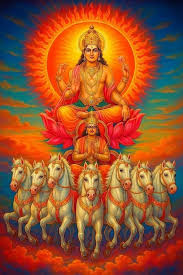
The Vasu are the eight holy guardians of the wheel: the four guardians of the cardinal directions (Yama, Varuna, Kumera, and Indra) and the our guarding the quadrants in between (Bhumi, Vayu, Ishana, and Agni). The Vajini are the horses (thought-forces) drawing “the chariot of the Holy Name,” a concept also found in the Judeo-Christian scripture to signify God’s power, glory, and active presence in the world, guiding and protecting his dreaming Souls. That chariot is the Throne of God, the Merkabah occupied by the Solar Logos or Spiritual Sun. In Hinduism, that merkabah (the chariot-throne) belongs to Surya, the deity personifying the Greater Light of God that is the Solar Logos. Surya’s chariot is drawn by seven horses driven by a charioteer called “Aruna,” a name meaning “the first Red Ray of dawn.” So, Aruna is another form of Indra, the Red Rayl whereas the horses represent the seven spirits or lamps before the throne. Those “spirits” are, therefore, the seven thought-forces emanating from the Solar Logos (the radiant Word of God). They also also, therefore, the seven Lamps of the Temple Menorah, the inner-instrument of the Spiritual Body.
The Sukta’s sixth line reads as follows: indraś ca sunvata ā yātanupa niṣkṛtam makṣv itthā dhiyā narā ||
The celestial nectar (Amrita) works through the holy stillness of God to return the Shiva-drink proceeding from the mother’s mouth to bring forth Nara.
Ind-ras = the celestial nectar (Amrita) ca = works through su-n(i)vata = the holy stillness a = of God yatan-upa = to return the Shiva-drink niskrtam = proceeding from ma-ksv = the Mother’s mouth ittha = bringing forth nara = Nara (the eternal mind in human beings)
Firstly, indras isn’t Indra, the god-name; it’s a marriage of ind (celestial or powerful) and ras (nectar). So, indras refers to Amrita, the nectar of immortality (the Blood of Christ in Christianity) produced by Indra, the Red Ray. That nectar works through the holy stillness of God, the meditative silence in which we come to know God (through his still, small voice). And it is in that profound silence that we give and receive the Shiva-drink (the Living Water of Grace) coming from the Mother’s mouth to bring forth Nara, the eternal spirit dwelling within human beings. Based on what we already know, the mother’s mouth has to be the Bindu or Moon chakra, where the Amrita is produced. That same “mother’s mouth,” is, btw, described in Proverb 31:26, which reads:
She openeth her mouth with wisdom; and in her tongue is the law of kindness.
Secondly, this is the Rigveda’s first mention of “Nara” — the eternal, indwelling spirit of Christ. Nara’s partner, who isn’t named herein, is Narayana or Narayani. These twin “sages” are said to be incarnations of Vishnu. They are probably, therefore, the two waters or “twin streams” implied in the name Vi-shnu.
A watercolor painting from the British Museum depicting Nara (Ner) and Narayana (Narayan), who are said to be twin incarnations of Lord Vishnu. Vishnu is also sometimes worshipped as Narayana.
The final three lines of the second Sukta are traditionally cast as invocations. But are they? Let’s find out. By my calculations, the first of the final three lines translates thusly:
Mitram summons the pure-minded Varunam working through the ten female sages of consciousness, the shining handmaids of disciplined spiritual practice.
Mitram = ?? huve = summons putadaksam = the pure-minded var-unam = ?? ca = working through risa-dasam = the ten female sages of dhiyam = consciousness ghr-tacim = the shining handmaids sadhanta = of disciplined spiritual practice
The verse begins with Mitram, a word typically translated as Mitra, a little-known god in Hinduism. Mitra supposedly means either “friend” or “covenant,” but the word can also be divided as Mi-tram (the preserver of the fixed order) or Mit-ram (the friend of Rama). Rama is Indra, whose companion is Vayu. So, Mitram might refer to Vayu, “the friend” of Indra. And Indra and Vayu are indeed portrayed as powerful allies in the Hindu Lore.
According to the rishis, it is Mitram who summons Varunam. And that certainly explains why the names Mitra and Varuna are intractably linked in the Vedas, as well as why neither god has a distinct identity in Hinduism.
Given the evidence, I suspect Mitram means “the preserver of the fixed order”–the role assigned to Vishnu in the modern Hindu pantheon. Ergo, Vishnu, Mitra, and Vayu are all interchangeable names for the same power, the Cosmic Breath Christians call the Holy Spirit– our only “friend” in the darkness, according to Jesus.
So, what the heck is Varunam? The answer depends on how we divide the word. As Var-unam, it means “water of oneness”; as va-ru-nam it means “spreading the darkness-displacing Name”; and as va-runam it means “spreading the debt.”
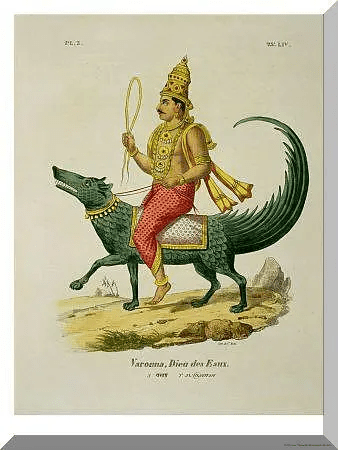
In rare depictions of Varuna, he rides a mythical makara, a crocodile-esque sea serpent with the tail of a fish.
The second definition works the best in the context of this teaching, especially when we drop the “m,” giving the god-name Varuna the definition of “spreading the darkness-displacing Nada (the Om vibration),” rather than “Lord of the Water.” As the image above indicates, Varuna’s vehicle is a makara, a word meaning “the instrument of creation,” which the Cosmic Vibration certainly is.
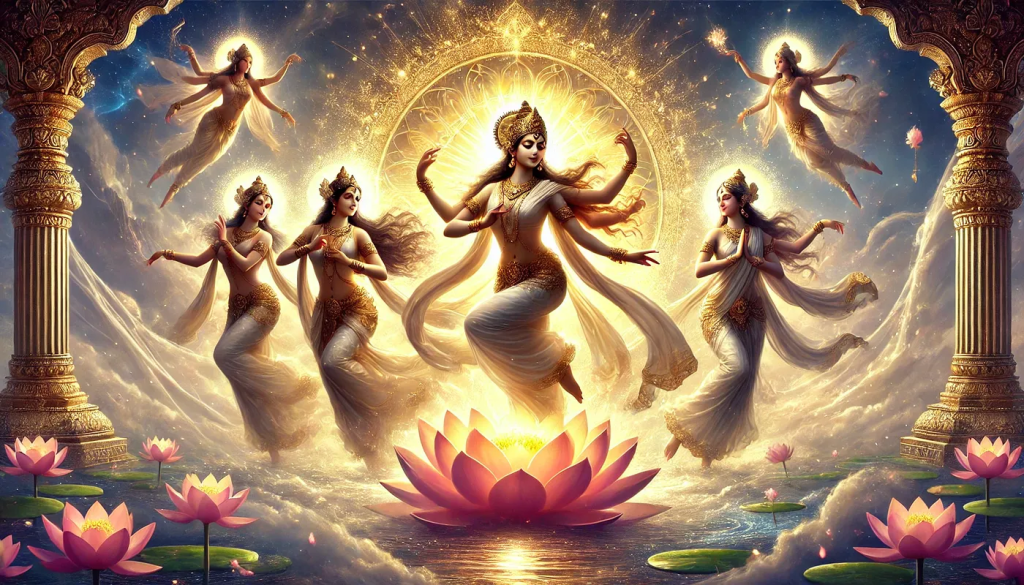
This brings us to the mysterious risa-dasamdhiyam–ghrtacim, which I’ve translated as “the ten female sages of consciousness, as well as the shining handmaids of disciplined spiritual practice. Those ten handmaids might be the celestial beings known as Asparas in Hindu and Buddhist mythology, or the ten Mahavidya (Great Wisdoms) found in the Shaivism and Vaishnavism branches of Hinduism, as well as in Vajrayana Buddhism.
The Asparas are described as beautiful nymphs associated with water and clouds, who wear graceful flowing garments and dance in Indra’s heaven. The Ten Mahavidya, on the other hand, are the shakti powers identified as Kali, Tara, Tripura, Sundari, Bhuvaneshvari, Bhairayi, Chhinnamasta, Dhumavati, Bagalamukhi, Matangi, and Kamalatmika. In Shaktism, they are said to represent “the one Truth sensed in ten different facets; the Divine Mother as ten cosmic personalities,” the Dasa-Mahavidya (ten-Mahavidyas).
Given their number and description, these shining handmaids are almost certainly the Rigvedic counterparts of the ten Sefirot of Kabbalistic mysticism.
Said to be the divine emanations or attributes through which Ein Sof, the Infinite Creator, interacts with the finite universe, the Sefirot form the Tree of Life, the True Vine, and the Path of the Flaming Sword, all of which are mentioned in Genesis. Hence their Vedic designation as the shining handmaids of disciplined spiritual practice.
As the ten shining attributes of God, these handmaidens show us the way back to Divine Perfection. They are also, therefore, the Ten Virtues of the Blessed Virgin of Catholicism, the Ten Virtues of Sham (the Sun or Greater Light of God) in Islam, the Ten Virtues of Dharma (the righteous path) in Hinduism and Jainism, and the dasa-kusala-kamma of Buddhism. They are also, I suspect, the ten characteristics of Advanced Teachers of God described in the Course’s Manuel for Teachers.
According to Google, the ten Sefirot “represent channels for divine energy, acting as archetypes for aspects of existence, consciousness, and personality, like wisdom, love, judgment, and majesty, allowing humans to understand and connect with the divine.”
These ten powers appear in the Old Testament as the ten golden Menorahs in Solomon’s Temple, and in the New Testament as the ten virgins with ten lamps in the parable Jesus shares in Matthew 25. In the story, five of the virgins placed their lamps on the north side of the inner Sanctuary, whilst the other five placed theirs on the south side. As I see it, Jesus used this parable to explain that the two rays work through the ten maidens on either side of the Inner Altar, which does indeed correlate with the layout of the Kabbalistic Tree of Life formed by the ten Sefirot (shown below). The eleventh circle at the center, the destination to which all the paths lead, is the invisible Da’at or “Knowledge of the Infinite.”
So, the Mother Goddess (Shakti or Mahadevi) opens her mouth (the Bindu or Moon chakra) and out come these ten “Great Wisdoms,” the shining handmaids of the Righteous Path back to God. And all of this is completely missed by Wilson, Griffith, among many others attempting to translate the Rigveda.
Are you still with me? Good. Because I should mention again that Varuna is the guardian or Lokapala of the western cardinal direction — the “gate” into the northwest quadrant presided over by Vayu. So, just as Agni and Vayu sit across the circle from one another diagonally, Indra and Varuna connect across the east-west axis. Moreover, Varuna (the disperser of the darkness-dispelling Om vibration) guards the gate into Vayu’s quadrant of Holy Purpose.
Marching onward, the Rik’s second-to-last line reads: ṛtena mitrāvaruṇāv ṛtāvṛdhāv ṛtaspṛśā kratum bṛhantam āśāthe, which I’ve painstakingly worked out very differently than is the norm.
In accord with the established order, the Preserver spreads the darkness-dispelling Nada in the Holy Mind to defend the pervading truth of the Radiant Word proceeding from the Love of God expanding the Wholeness of God’s Holy Creation
rtena = in accord with the established order, mitra-varuna-v = the Preserver spreads the darkness dispelling Nada speaking for rtavrdh-av = the holy mind to defend rtasp-ra-sa = the pervading truth of the radiant Word kra-tum = proceeding from the Love of God brh-antam = expanding the Wholeness a-sathe = of God’s Holy Creation
I really struggled with this one, largely because the words rtavrdhav and rtasprasa are generally believed to refer to rta — the shorthand Vedic designation for the Established Order. We also find herein the combed form of Mitra and Varuna, with a “v” tacked onto the end. That “v” is shorthand for vak, meaning “speaking” or “voice.” To find the true definition of these words, I had to break that old mold. The verse now makes perfect sense, and also speaks Satya. .
It also now compares favorably with the following from the Course:
You have learned your need of healing. Would you bring anything else to the Sonship, recognizing your need of healing for yourself? For in this lies the beginning of the return to knowledge; the foundation on which God will help build again the thought system you share with Him. Not one stone you place upon it but will be blessed by Him, for you will be restoring the holy dwelling place of His Son, where He wills His Son to be and where he is. In whatever part of the mind of God’s Son you restore this reality, you restore it to yourself. You dwell in the Mind of God with your brother, for God Himself did not will to be alone. (ACIM, T-11.I.1:1-6)
And the Rik’s final line reads kavī iti nah mitrā-varuṇā tuvijātā urukṣayā dakṣaṃ dadhāte apasam, which translates thusly:
Enlightenment arises from bringing together Mitra’s and Varuna, the Great Powers born in the Holy Resting Place to bestow forgiveness, the gift offered to the Self, in brotherhood.
kavi = Enlightenment (or Holy Vision) iti = arises from nah = bringing together mitra-varuna = Mitra and Varuna tuvi-jatau = the Great Powers born uruksaya = in the Holy Resting Place da-ksam = to bestow forgiveness da-dha-te = the gift offered to the Self apasam = in fellowship, brotherhood, or one to another
Okay, so … Mitra and Varuna have to be the two Rays Jesus showed Sister Faustina. And we learn herein, that they are born through our yajnas (miracle-exchanges) in the Holy Resting Place, where they grant the True Forgiveness achieved only in brotherhood. Being the two powers within the Ida and Pingala nadis, they come together or “marry” in the Ajna chakra. And this “marriage,” which opens the Spiritual Eye, is the heiros gamos, “sacred marriage,” and/or “ritual of the bridal bedchamber” much discussed in the “gnostic” texts found at Nag Hammadi.
According to Google, this sacred marriage is “a profound mystical union, not a physical one, symbolizing the spiritual reunification of divine masculine and feminine principles (like Christ and Sophia) within the soul or between the soul and its angelic counterpart, leading to spiritual enlightenment (gnosis), wholeness, and liberation from the material world. This spiritual alchemy involves integrating inner opposites (like spirit and matter, or male/female energies) to achieve divine knowledge and complete the soul’s journey back to Pleroma (divine fullness).”
Rightly understood, this sacred marriage brings about the reconciliation of opposites much-discussed in the Course. As Jesus repeatedly explains, there are no opposites in Holy Creation. We must, therefore, deny the reality of everything that seems to oppose God’s Truth.
Or, as Jesus explains much better:
True light that makes true vision possible is not the light the body’s eyes behold. It is a state of mind that has become so unified that darkness cannot be perceived at all. And thus what is the same is seen as one, while what is not the same remains unnoticed, for it is not there.
This is the light that shows no opposites, and vision, being healed, has power to heal. This is the light that brings your peace of mind to other minds, to share it and be glad that they are one with you and with themselves. This is the light that heals because it brings single perception, based upon one frame of reference, from which one meaning comes.
Here are both giving and receiving seen as different aspects of one Thought whose truth does not depend on which is seen as first, nor which appears to be in second place. Here it is understood that both occur together, that the Thought remain complete. And in this understanding is the base on which all opposites are reconciled, because they are perceived from the same frame of reference which unifies this Thought.
One thought, completely unified, will serve to unify all thought. This is the same as saying one correction will suffice for all correction, or that to forgive one brother wholly is enough to bring salvation to all minds. For these are but some special cases of one law which holds for every kind of learning, if it be directed by the One Who knows the truth.
To learn that giving and receiving are the same has special usefulness, because it can be tried so easily and seen as true. And when this special case has proved it always works, in every circumstance where it is tried, the thought behind it can be generalized to other areas of doubt and double vision. And from there it will extend, and finally arrive at the one Thought which underlies them all.
The one Thought of which he speaks is Ajna, the Thought of God that is the Holy Logos and/or the Radiant Word that restores our minds to Wholeness. And that Radiant Word dwells with our Souls on the sixth plane of consciousness.
Rightly understood, WE comprise the Radiant Word, not the Bible, the Qu’ran, or even Jesus, the Messiah, who tells us in the Bible and the Course: YOU are the Light of the World!
And Jesus also uses phraseology strongly echoing the Sukta’s last line in the following from the Course:
Christ’s hand holds all His brothers in Himself. He gives them vision for their sightless eyes, and sings to them of Heaven, that their ears may hear no more the sound of battle and of death. He reaches through them, holding out His hand, that everyone may bless all living things, and see their holiness. And He rejoices that these sights are yours, to look upon with Him and share His joy. His perfect lack of specialness He offers you, that you may save all living things from death, receiving from each one the gift of life that your forgiveness offers to your Self. The sight of Christ is all there is to see. The song of Christ is all there is to hear. The hand of Christ is all there is to hold. There is no journey but to walk with Him. (ACIM, T-24.V.7:1-10)
And with that auspicious thought, I will conclude today’s discussion. If you have any questions, leave them in the comments — or shoot me an email at purushaprasada@gmail.com.
Thanks for visiting. And may peace, joy, and love abide with you until we meet again.











 The Holy Meeting Place
Leave a comment