Namaste, my brother in Christ, and welcome (or welcome back) to my latest adhyayana posting. We’re still studying the Rigveda, Hinduism’s oldest and most sacred scriptural text, which has never before (to my knowledge) been accurately translated. I can’t tell you why I was chosen to undertake this incredible assignment, but the Holy Spirit must have His reasons.
What I CAN tell you is this: I do everything in my power to keep my ego uninvolved. I don’t self-promote or advertise, for example, or use the name given me by my earthly parents. My left hand, in other words, doesn’t know what my right hand is doing. And when my ego starts to bark about how crazy and pointless all this seems when so few people read my blog, I remind myself that this is God’s idea, not mine. And whoever He means for me to help will find this useful archive at the appointed time.
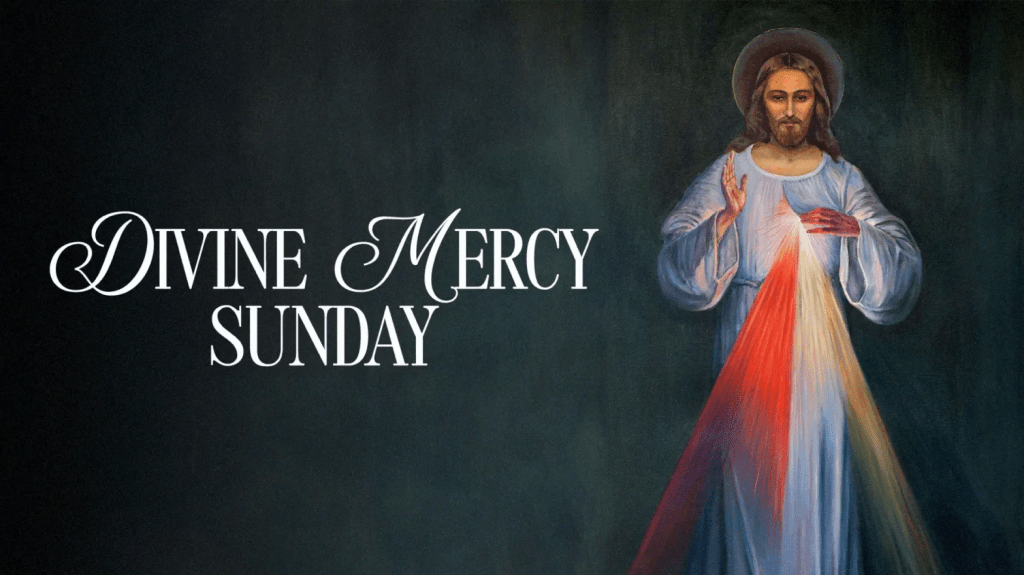
Today is Divine Mercy Sunday, and we’re tackling the 23rd Sukta, which, according to Google, “is a composite hymn consisting of 24 verses (Riks), primarily addressed to various deities, including Vayu, Indra, Mitra-Varuna, the Maruts, and the Waters (Apas).” How accurate is that summary? Not very, given that Mitra and the Maruts weren’t actually “gods” worshipped in ancient India. As we’ve discussed, Mitra can mean either “covenant” or “companions,” whilst the Maruts are, I believe, a Vedic designation for the cosmic winds showering down the Living Water from the Celestial Sphere.
In Truth, the 23rd Sukta is about the Great Rays we see emanating from Christ’s Heart in the Divine Mercy image. So, let’s dig in and see what more we can learn today from the ancient rishis.
By my calculations, Rv 1.23:1 reads as follows;
A powerful force joins together God’s guru-word, the life-breath containing the benediction of the charioteer.
Definitions and syllable breaks:
tīvrāḥ (a powerful force) somāsa (joins together) ā (God’s) ga-hy (guru-word, the life-breath) āśīrvantaḥ (containing the benediction of) su-tā (the sacred song, the holy tail, or the charioteer).
Notes:
In Vedic Sanskrit, ga signifies the guru-word or sacred-syllable, which is Om or AUm. And here, we learn AUM is the life-breath containing the benediction of the charioteer. In the Hindu lore, there are many charioteers. But the main one is Lord Krishna, the charioteer driving Arjuna, the ego-battling Soul, in the Bhagavad Gita.
According to Google’s summation, “Krishna’s ultimate benediction is the gift of eternal, uninterrupted love and devotion (for Him), ensuring spiritual liberation and protection. It represents divine grace, transforming the devotee’s consciousness and providing peace, spiritual knowledge, and freedom from material bondage.”
Ergo, the powerful force holding the AUM together is Divine Grace.
That sounds right, but Suta can also mean “sacred song” or “holy tail.” So, which is it? Originally, I went with “sacred song,” because Course-Jesus mentions this “ancient melody” innumerous times. At one point, he says:
Forgiveness, once complete, brings timelessness so close the song of Heaven can be heard, not with the ears, but with the holiness that never left the altar that abides forever deep within the Son of God. And when he hears this song again, he knows he never heard it not. And where is time, when dreams of judgment have been put away? (ACIM, T-29.IX.8:5-7)
The sacred song he means is A-U-M, the song of Heaven we hear in the Meeting Place, but not with the body’s ears. Google Om or AUM and you’ll find many and sundry definitions of this vibratory “song” all of God’s creations “sing” together in perfect harmony, even in the dream. What you won’t find is an accurate definition of what AUM actually is. For that, we need to look to the Rigveda and the Course, wherein Jesus says:
Where sin once was perceived will rise a world that will become an altar to the truth, and you will join the lights of Heaven there, and sing their song of gratitude and praise. And as they come to you to be complete, so will you go with them. For no one hears the song of Heaven and remains without a voice that adds its power to the song, and makes it sweeter still. And each one joins the singing at the altar that was raised within the tiny spot that sin proclaimed to be its own. And what was tiny then has soared into a magnitude of song in which the universe has joined with but a single voice. (ACIM, T-26.IV.5:1-5)
In short, AUM is the three-part song the Spirit of Grace sings or vibrates to hold creation together in at-one-ment. Hence, AUM is the song of Heaven, the Atonement, and the Holy Trinity.
The Sukta’s second Rik reads:
These cosmic winds of Om expand the consciousness starting the journey to fill the life of both Great Rays (the greater lights of the Solar Logos or Word of God).
Definitions and breaks:
ime (these) vāy-o (cosmic winds of Om) tān (expand the consciousness) prasthitān (starting the journey) piba (to fill the life) ubhā (of both greater lights or Great Rays).
Notes:.
It took me a long time to figure out that there are TWO Great Rays, the Red Ray of God’s presence or spirit and the pale ray of Christ’s presence or spirit. Joined together, these two Rays form the third ray, which Christians call the Holy Spirit, Jews call Ruach, and Hindus call Vishnu, a name meaning “the spirit in two streams” rather than “the preserver.” What Vishnu preserves isn’t material creation, but God’s original eternal Creation, which exists in the dream-world as the Great Rays of Cause and Effect. And, unless I’m mistaken, these TWO Great Rays are “the Holy Companions” referenced in the Bible, the Course, and the Vedas.
Rv 1.23:3 reads:
The divine beings reaching to Heaven, Indra and Vayu invoke the mighty mouth of Soma for drinking Indra and Vayu, the mind-forces the learned sages call upon for protection.
Definitions and breaks:
devā (the divine beings) divispṛś-endravāyū (reaching to Heaven, Indra and Vayu) havāmahe (invoke the mighty) asya ( mouth) somasya (belonging to Soma) pītaye (for drinking) indra-vāyū (Indra and Vayu) manojuvā = manojava (the mind-forces) viprā (the learned sages) havanta (call upon) ūtaye (for protection)
Notes:
Course-Jesus also says the Great Rays “reach to Heaven,” so we can assume Indra and Vayu represent the Great Rays in Hinduism. We also learn these Rays invoke the mighty mouth belonging to Soma, the mouth speaking the M-kara, the water-vessel we “drink” in the Circle of Wind. The M-kara is, therefore, the Call to Awaken, as well as the Left Hand of God.
I wasn’t able to define manojuva, so it’s probably a mistaken transliteration of manojava, a term used in Buddhism to denote a mind-force. Because the Great Rays are indeed the mind-forces to be called upon for protection.
Or, to quote Course-Jesus:
Not one light in Heaven but goes with you. Not one Ray that shines forever in the Mind of God but shines on you. Heaven is joined with you in your advance to Heaven. When such great lights have joined with you to give the little spark of your desire the power of God Himself, can you remain in darkness? You and your brother are coming home together, after a long and meaningless journey that you undertook apart, and that led nowhere. You have found your brother, and you will light each other’s way. And from this light will the Great Rays extend back into darkness and forward unto God, to shine away the past and so make room for His eternal Presence, in which everything is radiant in the light. (ACIM, T-18.III.8:1-7)
Jesus provides a prayer for invoking the Great Rays in Workbook Lesson 360. The prayer reads as follows:
Father, it is Your peace that I would give, receiving it of You. I am Your Son, forever just as You created me, for the Great Rays remain forever still and undisturbed within me. I would reach to them in silence and in certainty, for nowhere else can certainty be found. Peace be to me, and peace to all the world. In holiness were we created, and in holiness do we remain. Your Son is like to You in perfect sinlessness. And with this thought we gladly say “Amen.” (ACIM, W-360.1:1-7)
The fourth Rik reads:
The companions safeguard the thoughts of the Bridegroom or Master. The covenantal winds for calling forth Mighty Varuna’s nectar generating the father whose birth makes known the pure-minded will of God’s Word.
Definitions and breaks:
sahas-rākṣā (the companions safeguard) dhiyas (the thoughts of) patī (the lord, master, or bridegroom) mitraṃ (the covenantal) vayaṃ (winds for) havāmahe (calling forth the Mighty) varu-ṇaṃ (Varuna’s) so-ma-pītaye (nectar generating the father whose) ja-jñānā (birth makes known) pūtadakṣasā (the pure-minded will of God’s Word)||
Notes:
We also find the covenantal winds in the Bible, as symbols of God’s sovereign, divine power to execute (sane spiritual) judgment, provide blessings, and gather His children from the “four corners” of the earth. According to Google, “These winds often operate as instruments of His covenant, bringing purification, resurrection (Ezekiel 37), or destruction (Jeremiah 23:19) as needed.”
If I’m reading this right, the Great Rays protect the thoughts of the Bridegroom. The Great Rays (Indra and Vayu) also are the covenantal winds described above, which call forth Varuna’s nectar birthing the father making known God’s Will.
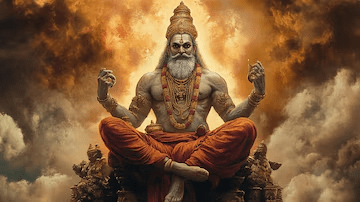
Varuna’s nectar is Amrita, the elixir of immortality. The father making known God’s Will is, according to Google, Lord Brahma, the “father-creator” dwelling in the golden embryo called Hiranyagarbha. If Google’s right about Brahma (and I’m wrong) Brahma represents the Christ Self running the Atonement Plan on God’s behalf.
Rv 1.23:5 reads:
Love each other to hasten the Cosmic Order’s gentle call of truth, the light of Isa (Christ) casting down the covenant of Varuna invoking the waters of wholeness to advance liberation of the world.
ṛ(a)tena (Love each other) yāv = jav (to hasten) ṛtāvṛdhāv (the Cosmic Order’s gentle call) ṛtasya (of truth) jyot-iṣas (the light of Isa) patīta (casting down) mitrāvaruṇā (the covenant of varuna) huve (invoking) varuṇaḥ (the waters of wholeness) prā-vitā (to advance liberation) bhuvan (of the world).
Notes:
We’ve talked about Varuna’s bond before. In Sanskrit, Varuna means “the waters of oneness.” So Varuna, the guardian of the western direction (on the wheel), represents the waters of Atonement. Those waters are A-U-M, which we begin to hear as we approach Varuna’s gate. Varuna’s bond is what Course-Jesus calls the Holy Relationship — the unbreakable covenant of love we share with God and each other as spirits (not bodies). To pass through Varuna’s gate, we have to join minds with at least one other person in holy relationship. To pass through Varuna’s gate is, therefore, to enter the Ark of Peace.
Rather than explain more, let me share a resonant quote from the Course pertaining to the Call of Truth.
Here is the first direct perception that you can make. You make it through awareness older than perception, and yet reborn in just an instant. For what is time to what was always so? Think what that instant brought; the recognition that the “something else” you thought was you is an illusion. And truth came instantly, to show you where your Self must be. It is denial of illusions that calls on truth, for to deny illusions is to recognize that fear is meaningless. Into the holy home where fear is powerless love enters thankfully, grateful that it is one with you who joined to let it enter.
Christ comes to what is like Himself; the same, not different. For He is always drawn unto Himself. What is as like Him as a holy relationship? And what draws you and your brother together draws Him to you. Here are His sweetness and His gentle innocence protected from attack. And here can He return in confidence, for faith in another is always faith in Him. You are indeed correct in looking on your brother as His chosen home, for here you will with Him and with His Father. This is your Father’s Will for you, and yours with His. And who is drawn to Christ is drawn to God as surely as Both are drawn to every holy relationship, the home prepared for Them as earth is turned to Heaven. (ACIM, T-22.I.10:1–11:9)
The Sukta’s sixth Rik reads:
The companion of the universe supporting the Spirit of Grace, the Great Purusha unites in wholeness to give and receive the gifts of the desert-wearied calling upon Mighty Indra to produce Soma, the father whose sons grow old in time.
mitro (The companion of) viśvābhir (the universe supporting) ūti-bhiḥ (the spirit of grace) ka-ratāṃ (the Great Purusha unites) naḥ (in wholeness) surādhasaḥ (to give and receive the gifts) marutvantaṃ (of the desert-wearied) havāmaha (calling upon Mighty) indra-ma (Indra to produce) somapītaye (soma, the father whose) sajūr (sons grow old) gaṇena (in time) .
Notes:
The universe supporting the Spirit of Grace is the universe underneath, where the Great Purusha dwells in the Cosmic Ocean of the Holy Instant of Eternity –the Ocean of Milk in Hinduism. Purusha is the Light of God in everything, hidden from the world, but still making things happen.
We block that light when we join forces with the Ego Mind, perceive ourselves and others as bodies rather than Souls, and seek to come together in those bodies in what Course-Jesus terms “special relationships.” Yes, my brother. All body relationships are “special,” because all body relationships are exclusive by nature and, therefore, limit everyone involved to the Soul-imprisoning ego-body self-concept.
Only when we join in the all-inclusive “Holy Relationship” (as Souls united in universal brotherhood) can God’s Light electrify the network fostering our almsgiving offerings. We join in Holy Relationship in our Assembly “meetings,” by listening to the AUM in meditation.
Rv 1.23:7 reads:
To satiate Kama, Indra, the eldest wind of the Assembly, the celestial power leading the way within the universe created to create that which is heard, calls upon the I Am to strike the concealed protectors, the Holy Danava, the lordly gems joined together in God’s Word. Join together to create the vessels to extract the blessings of Kamadeva’s one hundred sounding the divine or celestial Call to Joy.
Definitions and breaks:
tṛmpa-tu (to satiate kama) indrajyeṣṭhā (Indra, the eldest) marud-gaṇā (wind of the Assembly) devāsaḥ (the celestial power) pūṣarātayaḥ (leading the way) viśve (within the cosmos) ma-ma (created to create) śrutā (that which is heard) havam (calls upon the I Am) hata (to strike) vṛ-traṃ (the concealed protectors) su-dānava (the Holy Danava) ind-reṇa (the lordly gems) sahasā (joined together in God’s Word ) yujā (join together) mā (to generate), no (the vessels) duḥśaṃsa (to extract the blessings of) ī-śata (Kamadeva’s one hundred) viśvān (sounding) devān (the celestial) havāmahe (call to joy)
Notes:
Somewhat confusing as a whole, so let’s deconstruct the elements. In the Hindu lore, the Danava are a race of powerful beings commonly characterized as demons, giants, or titans. They are the sons of the sage Kashyapa (the World Turtle) and his goddess-wife, Danu, making them a clan of Asuras (God’s celestial powers, rather than “demons”).
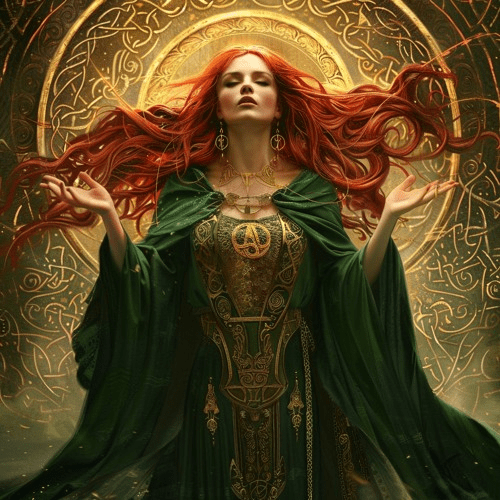
A goddess found in many ancient religions, including Celtic Druidism, Danu is said to represent the primordial waters in Hinduism. Let’s assume they mean the Cosmic Waters, given that da-nu translates (in Sanskrit) as “giving the now-moment.” So, how can her sons by Kashyapa be demons? They can’t be, but they might still be giants, like the legendary Tuatha Dé Danan of ancient Ireland, and the mysterious Nephilim of the Bible.
The belief that the Nephilim were “giants” may come from the Aramaic word naphil, which means “giant”. In Hebrew, however, Nephilim appears to be a marriage of Nep (living) and hilim or Tehilim, meaning “song of praise” or “psalm.” So, the Nephilim are/were the original “Living Psalms” that descended to earth only to be diminished in stature by breeding with mortal women and warring with human armies. So, once again, having sex and fighting in body-perception silences the AUM.
Because they are described herein as the lordly jewels joined together (as one) to generate the blessing vessels of Kamadeva’s one hundred, we can presume the Danava are the triple gems of Buddhism representing the Teacher (Buddha), the Teachings (Dharma) and the Assembly (Sangha). That they are joined together in God’s Word also suggests they are the three hands of God’s Word, A-U-M.

Not absolutely certain what Kamadeva’s one hundred represents, but I’m pretty sure it’s the same “one-hundred” mentioned nine times in the Bible. My best guess is that it refers to the Souls who didn’t “fall” with the Ego Mind, the many who, in the account given by Course-Jesus, tried to help the Separated Ones at the start of the dream, but failed.
Just a guess, though, so I reserve the right to change my mind if and when the meaning becomes clearer.
The eighth Rik reads:
The winds of Soma, the father whose divine power sends forth the speckled mother-cow, born to depart, like the roaring wind of the approach bearing the milk-yielding lights bestowing realization of the Greater Light’s subtle exertions.
marutaḥ (the winds of) somapītaye (soma, the father whose) ugrā (divine power) hi (sends forth) pṛśni-mātaraḥ (the speckled mother-cow) ja-yatām (born to depart) iva (like) tanyatur (the roaring) marutām (winds of) eti (the approach) dhṛ-ṣṇu-yā (bearing the milk-yielding light) yac (bestowing) chub-haṃ (realization of the Greater Light’s) yāthanā (subtle exertions)||
Notes:
Not sure I’ve got all of the definitions right, so let’s break down the metaphors. In Hinduism, the “speckled” mothers are the Krittikas, the six (or seven) stars of the Pleiades constellation who, in the lore, nursed the god Skanda (Kartikeya), the brother of Ganesha parented by Shiva and Pravati. The speckled mother-cow is Kamdhenu or Surabhi, the miracle-cow whose milk strengthens in us (and the world) God’s will to end the separation. So, both the cow and the Krittikas yield milk to fortify the spiritual warrior in us. The Spiritual Warrior in us is the Soul, fighting to be free of the Ego Mind. In the Ramayana, he’s Rama; in the Bhagavad Gita, he’s Arjuna. The milk the cow yields is our allotted quotient of “miracles” –the subtle shifts in perception we require to recover the spiritual strength and vision necessary to overcome the Ego Mind.
In my earlier posts, I explained that the dream we’re living through now is a replay of the first dream, which began and ended in an instant. In the first dream, we were allotted all the miracles needed to wake up. In the replay, the miracles we already received are stored in the Cistern of Love, to be awarded to us when we offer them to others in the circle meetings. Because that’s the way the system works under the Law of Love. That’s also the point of the Holy Spirit’s first lesson: To have all, give all to all.
Supposedly, eti means “approach.” We don’t find “the winds of approach” in the Course or the Bible, but we do find “the approach” scattered throughout the Course’s Text. In the following excerpt, Jesus uses the term in the same manner as the rishis:
You make by projection, but God creates by extension. The cornerstone of God’s creation is you, for His thought system is light. Remember the Rays that are there unseen. The more you approach the center of His thought system, the clearer the light becomes. The closer you come to the foundation of the ego’s thought system, the darker and more obscure becomes the way. Yet even the little spark in your mind is enough to lighten it. Bring this light fearlessly with you, and bravely hold it up to the foundation of the ego’s thought system. Be willing to judge it with perfect honesty. Open the dark cornerstone of terror on which it rests, and bring it out into the light. There you will see that it rested on meaninglessness, and that everything of which you have been afraid was based on nothing. (ACIM, T-11.in.3:1-10)
Rv 1.23:9 reads:
The Soul’s happy laughter illuminates the circles for walking the Om, the mattered hair in the waters of Kama.
Narah (The Soul’s) haskārād (happy laughter) vidyutas (illuminates) pary (the circles) at-o (for walking the Om) jātā (the matted hair) avan-tu (in the waters of Kama).
Notes:
Let’s start with “happy laughter,” a specific phrase Jesus uses three times in the Course. He says, for example:
You have reached the end of an ancient journey, not realizing yet that it is over. You are still worn and tired, and the desert’s dust still seems to cloud your eyes and keep you sightless. Yet He Whom you welcomed has come to you, and would welcome you. He has waited long to give you this. Receive it now of Him, for He would have you know Him. Only a little wall of dust still stands between you and your brother. Blow on it lightly and with happy laughter, and it will fall away. And walk into the garden love has prepared for both of you. (ACIM, T-18.VIII.13:1-8)
Note his subtle references to “dust,” “blowing,” and “the garden” at the journey’s end.
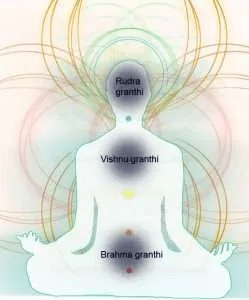
In Hinduism, “the matted hair” supposedly symbolizes Shiva’s role as the supreme Yogi with the power to control the wind-energies that integrate the physical, mental, and spiritual aspects of existence. Trapped in his matted hair are, among other things, Soma, the moon-face of God, and the Great Ganga River. I suspect, therefore, that Shiva’s dreadlocks signify more than most Hindus realize. Perhaps the knots in his locks represent the Granthis, the psychic knots and/or obstacles that blind us to the Spiritual Moon lighting Christ’s face and the sacred river we must cross to reach the Resting Place. If I’m right about this, the Granthis and the three circles of Om are closely related, if not one and the same.

We talked about the Granthis in an earlier post. That they also are called “Shiva knots” supports my theory that they form the mats in Shiva’s hair, which represent the gates into the upper three quadrants or circles.
This brings us to “walking the Om,” an expression, according to Google, “used to describe the meditative, mindful walk that integrates the sacred sound of the Mantra AUM, to connect with the present moment and inner stillness.” The three circles of AUM are the circles of wind, water, and fire our Souls “walk around” as we progress through the quadrants of the circle-journey. In the image below, we can sort-of see the knots in relation to the circles.
The tenth Rik reads:
Together as a whole, the winds of AUM protect Antu in the wholeness of God’s sustaining peace.
Definitions and breaks:
naḥ (Together as a whole) marut-o (the winds of Om/AUM) mṛḻay-antu (protect Antu = Grace) naḥ (in the wholeness) ā (of God’s) Pūṣ-añ (sustaining peace).
Notes:
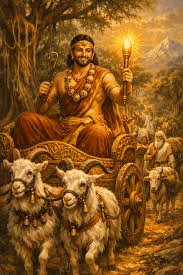
Jesus said something similar in the prayer I shared earlier from the Course. The Rays still exist undisturbed in God’s sustaining peace. In the Vedas, Pusan is the name of an Aditya, a solar deity parented by Aditi and Kashyapa. More specifically, Pushan acts as the deific protector and guide for travelers. Tellingly, he presides over meetings, marriages, journeys, roads, and cattle. When accurately depicted, he dons a beard, carries a goad, and rides in a goat-drawn chariot. Pusan can also be read as a compound of Pus (sustaining) and san (peace), making a pusan “God’s sustaining peace”–an expression also found in the Bible.
According to Google,
God’s sustaining peace in Scripture, or “shalom,” is a divine, active, and protective force that transcends human understanding, guarding hearts and minds in Christ Jesus, especially during trials. It is not merely the absence of conflict but a profound, inward calmness anchored in trusting God’s presence.
Technically, Google, the peace of God is shalom-shalom, but why split hairs?
This unassailable peace is most notably described in John 16:33 and Philippians 4:7. The latter verse reads:
And the peace of God, which passeth all understanding, shall keep your hearts and minds through Christ Jesus.
So, what the rishis are saying is that the three orders of A-U-M join together to protect God’s Grace in the wholeness of the sustaining peace. And this also suggests that the meetings, marriages, and roads Pushan-dev protects and guides are those calling to us from the Celestial Sphere.
Rv 1.23:11 reads:
The multifaceted sacred-grass gathers together the glowing-heat vessel of the Celestial Sphere existing from the beginning of being lost in the manner of an animal.
Definitions and breaks:
citra-barhi-ṣam (the multifaceted sacred-grass gathers together) āghṛṇe (the glowing heat) dharuṇaṃ (vessel of) divaḥ (the Celestial Sphere). ājā (existing from the beginning) naṣṭaṃ (of being lost) yathā (in the manner of) paśum (an animal)
Notes:
In Hinduism, the sacred-grass is indeed described as multifaced. Why that is, I can’t say for certain. What I can say is this: the sacred grass is seen as a “bridge” between the physical, mental, and spiritual worlds. So, it’s the holy pasturelands where Christ’s flock or herd gathers to rest, graze and transition perceptually.
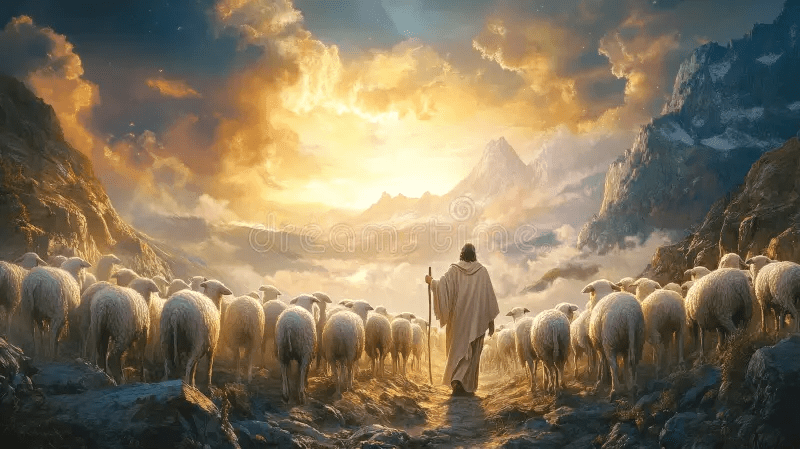
The heat-vessel of the celestial sphere is, I suspect, the Circle of Fire, the almsgiving arena overseen by Agni and Kamdhenu in the fourth quadrant of Moksha. According to the rishis, that circle has existed since we first became lost “in the manner of an animal,” meaning lost in the lower-mind consciousness inhabiting a body.
The 12th Rik reads:
The kings pour down the shaking waters from the secret, hidden place for the welfare of the immortal-Soul state of being.
Rajanam (the Kings) āghṛ-ṇir (pour down the shaking) apa-gūḻhaṃ (waters from the secret) guhā (hidden place) hitam (for the welfare of) avin-dac (the immortal-Soul state of being)
Notes:
Rajanam can mean either “kings” or “royal name.” And Despite what Google claims in error, the Royal Name is AUM, the name represented by the three kings who traveled from the east to offer their gifts to the newborn Christ-child. That their names were Balthazar, Melchior, and Caspar is a complete ego-invention, because nowhere in the Bible are those three kings or wise-men named. Like everything in the Nativity Story, the three kings are symbols related to the inner-process of “birthing the Christ.”
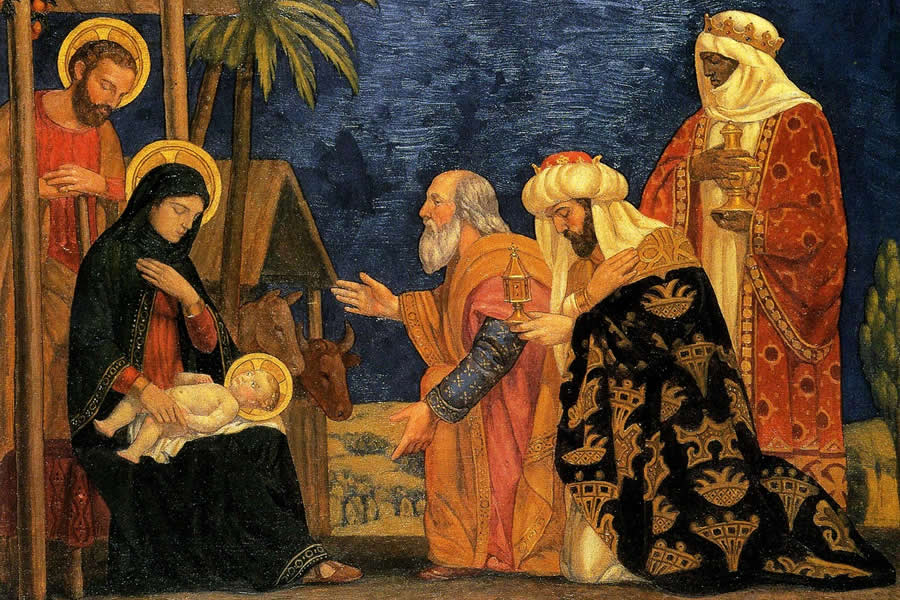
My late mother, being a literalist, was big on “the historical Jesus.” She would get all worked up over things like Mary’s virginity. “The Greek word translated as ‘vigin,’” she used to tell me, “meant ‘young woman.’” She wasn’t wrong about that, but she missed the bigger picture. Mary was portrayed as a virgin for reasons having nothing to do with her body; reasons ego-thinkers like my Mom miss entirely. Mary was a virgin because sex defiles the inner-altar, where God and Christ reside within us. To give birth to Christ, figuratively-speaking, our altar must be pure. We must, in other words, be joyfully celibate. Not because unmarried sex is a “dirty sin,” but because our Souls can only be “born again” in the inner-Christ when they are standing right-side-up, free from upside-down ego-body perception.
Leviticus tells us this, when translated correctly. And so did Course-Jesus, before Ken Wapnik et. al. cut all the references to sex out of the Standard Edition.
And yes, in case you’re wondering, I am joyfully celibate. And also married. Just as Jesus was in the latter years of his earthly life. His wife, in case you don’t know, was Mary Magdalene, who he met as a child in Egypt and married at 18 (she was 15). Contrary to popular belief Mary M. was neither a prostitute nor from the town of Magdala on the Sea of Galilee.
Magdala is an Aramaic word meaning “tower.” So Jesus nicknamed Mary, his wife and disciple, “the tower,” just as he nicknamed Simon-Peter “the rock,” Thomas “the twin,” Andrew “the first called,” and James and John “the sons of thunder.”
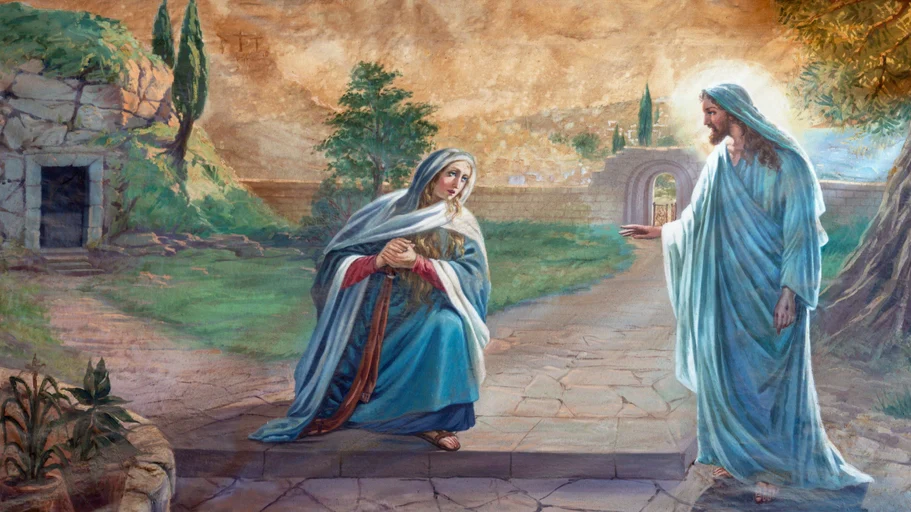
The cultural evidence supports that Jesus and Mary were married, as do the Ascended Masters who dictated The Disappearance of the Universe to Gary R. Renard. Under Jewish law, only a family member could anoint a body after death. So how could Mary anoint the body of Jesus in his tomb unless they were legally married? The answer is: she couldn’t and wouldn’t. The canonical gospels downplay her role because the New Testament canon was chosen by men with an agenda. Men like Irenaeus of Lyon, the father of standardized Christian theology.
For the record, it was Pope Gregory I who introduced the depicable idea that Mary Magdalene was a prostitute. In a sermon delivered in A.D. 591, Gregory conflated Mary Magdalene with the unnamed “sinful woman” in Luke 7 and Mary of Bethany, characterizing her as a repentant prostitute. That defamation grew legs which still stand today (case in point, The Chosen) despite the idea’s formal retraction by Pope Paul VI in 1969.

The creators of The Chosen affirm Jane Austen’s assertion that loss of virtue in a female is “irretrievable” and “no less brittle that is beautiful.” Mary didn’t lose her good name through her own failings, however; she lost it through the jealousy, misogyny, ignorance, and deception of her brethren.
Poor girl.
Okay. Sermon over, let’s get back to the Rigveda. We’ve come to the 13th Rik, which reads:
The multifaceted sacred grass gathers together the Elevated AUM, the Word of God in the great light of the Moon Ray.
Definitions and breaks:
citra-barhi-ṣam (the multifaceted sacred grass gathers together) ut-o (the elevated Om) sa (the Word of God) mah-yam (in the great light from) indubh (the moon-ray).
Notes:
Ut-o, the Elevated Om is the Great Ray of the Moon; the Christ Ray or Soma Ray. And that Ray is the pale ray, which Jesus told Saint Faustina, “restores the Soul to righteousness” (meaning rightmindedness, spiritual sanity, or upright perception).
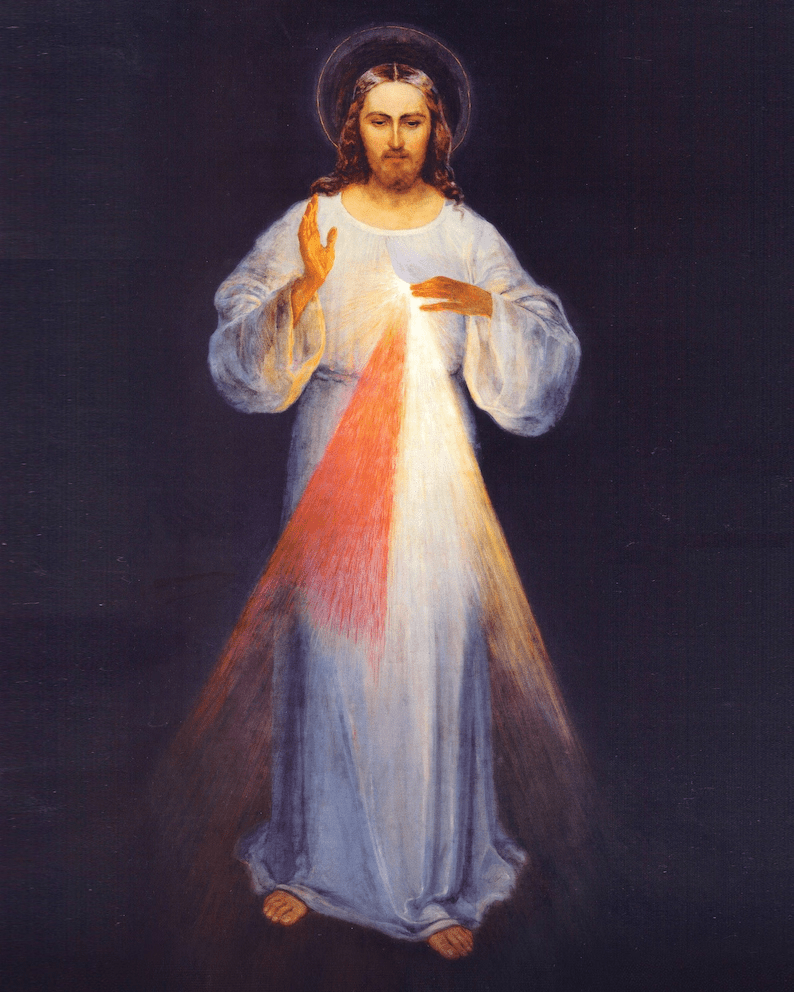
The image above of Jesus and the Rays was commissioned by Saint Faustina to depict what she observed. Jesus told her to have it painted when he appeared to her. Note the position of the Rays. The pale ray is on the right, while the red ray is on the left. While this seems counter-intuitive (to me, at least), it demonstrates that the Pale Ray of Christ/Soma is indeed the more exalted of the two.
What we also see here is the Pale Ray (the Pillar of Cloud) lighting the the way in front, while the Red Ray (the Pillar of Fire) guides the way from behind (underneath).
Rv. 1.23:14 reads:
Sink down to rightly join Anu on the path of returning to the Great Rays, the lights sent forth from Nara, the circle of truth.
ṣaḍ (sink down) yuktām̐ (to rightly join) anu-seṣidhat (Anu on the path of returning to) gobhir (the Great Rays) ya-vaṃ (the lights sent forth from) na (Nara) carkṛ-ṣat (the circle or wheel of truth)
Notes:
As already explained, Nara is the Greater Light of God underneath the illusion, holding creation together in oneness. Nara is, therefore, the Purusha and the Golden Circle of All Beings. To return to Nara-consciousness, we have to perceive the Great Rays, the Greater Light of God’s Love divided into two beams or streams. To perceive those Great Rays, we have to “sink” into the Spiritual Body underneath the physical body and block out it’s external sensory-perceived “world.”
Jesus tells us the same thing in the Course. In Workbook Lesson 49: God’s Voice speaks to me all through the day, for example, he offers these instructions:
Listen in deep silence. Be very still and open your mind. Go past all the raucous shrieks and sick imaginings that cover your real thoughts and obscure your eternal link with God. Sink deep into the peace that waits for you beyond the frantic, riotous thoughts and sights and sounds of this insane world. You do not live here. We are trying to reach your real home. We are trying to reach the place where you are truly welcome. We are trying to reach God. (ACIM, W-49.4:1-8)
The Sukta’s 15th Rik reads:
The mother lights guiding the path are the sisters of the ritual offering of the multitudes mixing the honey and the milk.
ambayo (the mother) yanty = ya-nti (lights guiding) adhvabhir (the path) jāmayo (are the sisters of) adhvarīyatām (the ritual offerings of the multitudes) pṛñcatīr (mixing) madhunā (the honey and) payaḥ (the milk)
Notes:
In Hinduism, the mother lights guiding the path are the “Shining Mothers” or Matrikas, the mother goddesses or shakti energies of their male-deva counterparts. Usually seven or eight in number, these shaktis are generally identified as Brahmani (Lord Brahma), Vaishnavi (Lord Vishnu), Maheshvari (Lord Shiva), Indrani (King Indra), Kaumari (Lord Kartikeya, Shiva’s son), Varahi (Varaha, the boar-headed avatar of Vishnu), and Chamundi (also Lord Shiva).
These seven mothers are, the rishis tell us, the sisters of the ritual offerings of the multitudes. So, they’re the female powers allegorically represented in the Bible as Jethro’s daughters, Solomon’s wives, and the angels of the seven churches. Outwardly projected, they’re the seven sisters of the Pleiades Constellation, and quite possibly also the seven sacred rivers found in earthly India.
The multitudes are, I believe, a reference to the Assembly. So, it is the Assembly that mixes the milk and honey flowing abundantly in the Promised Land. The milk is the miracle-milk descending from the moon ray, while the honey is the Amrita-nectar dripping down from the Red Ray, both of which arise from the gathering of the waters (the Assembly meetings). These same metaphors are, btw, found in the Bible and the Quran.
Let me repeat: The milk is the Soul-nourishing “milk” generated by the Miracle Cow, whilst the honey is the sweet nectar of immortality Hindus call Amrita, and Jesus termed “the new wine.” And that is why the land flowing with milk and honey is identified as Cana in the Old Testament. It’s no coincidence that Cana is where Jesus famously performed his first public miracle, by turning water into wine at a wedding. That land, we are told in Leviticus and Exodus, is occupied by “Canaanites” and “Amorites.”
Canaanite is a transliteration of the Hebrew word kna’an, which means “humbled,” while Amorites is the anglified form of Emori, which is said to mean “mountaineer” or “highlander.” If emori does indeed mean “mountaineer,” it’s a reference to the metaphorical celestial mountains, like Zion, Sinai, and Sumeru. More likely, emori is a compound of Em and ori, meaning either “Mother Light” or “the One Universal Light.”
So, the Land of Milk and Honey is the Resting Place, occupied by those “humbled in the One Light”–a Great Truth lost to us through centuries of ego-influenced mistranslation and literal interpretation.
The Sukta’s 15th Rik reads:
God’s encompassing light within, Surya (the Solar Logos) restores the winds of the sacred melody, together with the tail-vessel setting in motion the offering arena’s waters of AUM, the divine vibration within YHVH.
Definitions and breaks:
a-mūr (God’s encompassing) yā (light) upa (within) sūrye (Surya, the spiritual sun) yābhir (restores) vā (the winds) sūryaḥ (of the sacred melody) saha (together with) tā (the tail) no (vessel) hinvantv (setting in motion) adhvaram (the offering arena’s) apo (waters of Om) devīr (the divine vibration) upa (within) hvaye (YHVH).
Notes:
Not sure what they mean by the “tail vessel.” They might mean Ketu, the tail of the Great Dragon, or they might mean the tail of the Divine Horse, which is white, but appears black through deception. They might also mean the cow’s tail mentioned in the puranas.
In Hinduism, according to Google, “the cow’s tail symbolizes a purification process for vessels containing flesh, serving as a ritualistic method to cleanse them, reflecting the broader cultural reverence for purity and the sacredness of cows.”
I’m pretty sure the tail-vessel the rishis mention in this Rik has nothing to do with the sacredness of cows, but everything to do with purifying “vessels containing flesh.” Not bowls of meat, as generally presumed, but the flesh-containing “vessel of perception” imprisoning our Souls in the dream of earthly unreality. Viewed in this light, the tail-vessel, which sets in motion the waters of AUM, must be a spiritual tool helping to free us from ego-body consciousness. It probably is, therefore, the tail of the divine horse, a supposition affirmed in the next two Riks.
Rv 1.23:16 reads:
On the journey of self-discovery, the sacred syllable conveys the drinks to be shared in wholeness from the stream of the elder brother, the ray of the True Self’s Greater Light of Peace.
Definitions and breaks:
yatra (on the journey of self-discovery) gāvaḥ (the sacred syllable conveys) pibanti (the drinks to be shared) naḥ (in wholeness)| sindhu-bhya(i)ḥ (from the water or stream of the elder brother) kar-tvaṃ (the ray of the True Self’s) ha-viḥ (Greater Light of peace)
Notes:
What this Rik describes we also see illustrated in the Divine Mercy image. And this Sunday is, as it happens, Divine Mercy Sunday in the Catholic Religion. So the timing couldn’t be more ideal.
The elder brother might, therefore, be a reference to Jesus. Or it might be a reference to Narayana, the first-born of the twin-brother Vedic sages, Nara and Narayana. Either way, the Elder Brother is Christ.
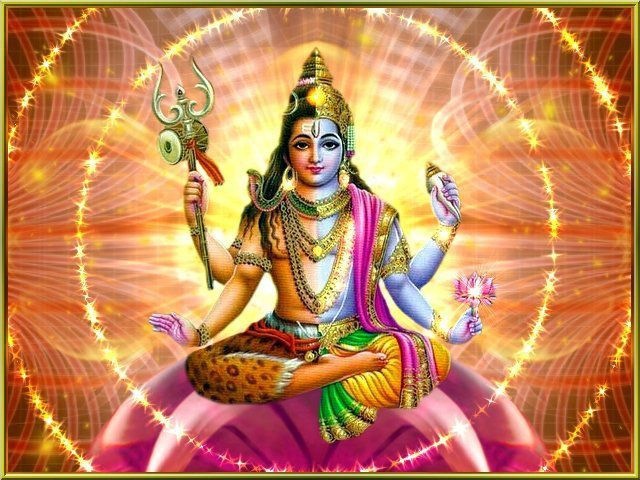
The 17th Rik reads:
Scatter the holy inner Amrita’s sacred waters for healing, the waters of the fountain advancing the Word of God abiding in the divine beings existing in the tail of the horse of wholeness.
Definitions and breaks:
vapsu (scattering the holy) antar (inner) amṛtam (Amrita’s) apsu (sacred waters) bheṣajam (for healing) apām (the waters of) uta (the fountain or wellspring) pra-śa-staye (advancing the Word of God abiding in) devā (the divine beings) bhava-ta (existing in the tail) vāji-naḥ (of the horse of wholeness)||
Notes:
In the Hindu lore, the prasa is a spear-like weapon belonging to the Danava, a group of gods mentioned earlier in this Sukta. But, given its relationship to the fountain or wellspring in this Rik, I suspect prasa is meant to be a compound of pra and sa, meaning “advancing, progressing, or bringing forward the Word of God.”
The diving beings abiding in the horse’s tail are the Nagas, the divine serpents who dwell in Patala (the Real World underneath the material illusion). One of the nagas is Shesha, the multi-headed snake serving as Vishnu-Narayana’s water-palanquin on the primordial ocean (as pictured below).
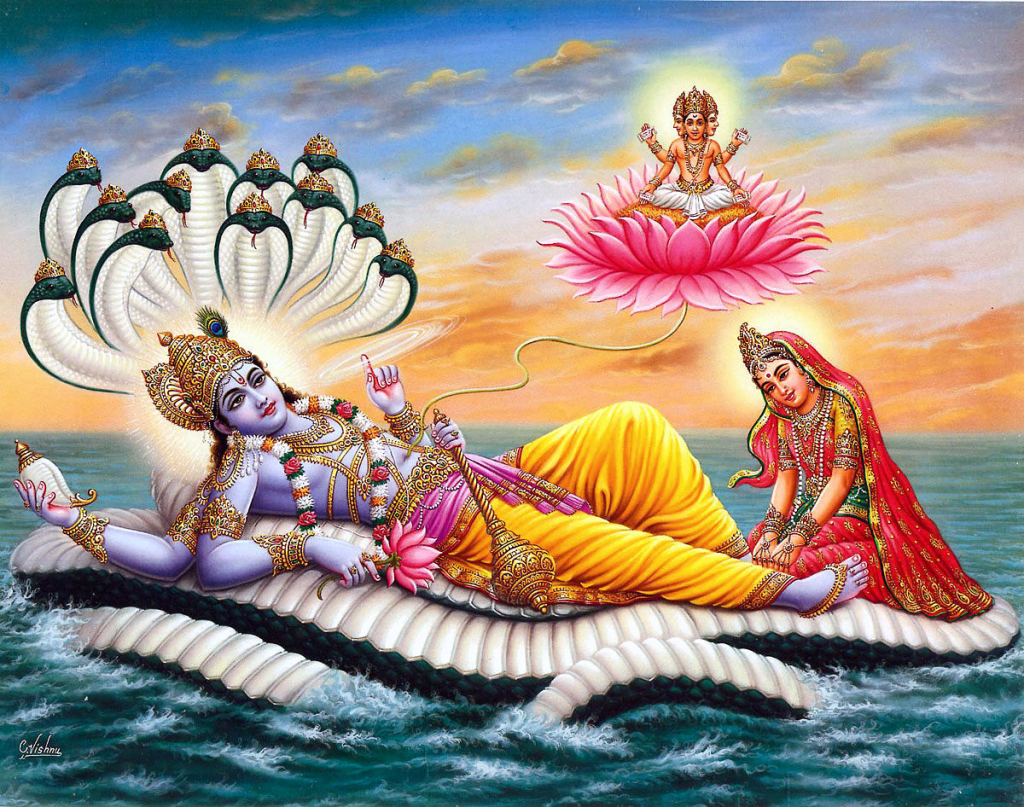
So the nagas are divine beings, as attested to herein. Also herein, we learn these divine snakes embody the Word of God.
The horse of wholeness is Uchchaihshravas, the seven-headed divine horse belonging to Indra. Indra’s other vahana is the Great White Elephant Airavata, who has three heads and seven trunks. As explained earlier, Airavata represents the fountain itself, whilst Ucchaisravas means God’s thundering splendor. In the lore, Ucchaisravas rises from the Ocean of Milk via “the gathering of the waters” (the true definition of Samudra Manthana). Described in Genesis, the gathering of the waters refers to the Assembly meetings in the Resting Place, so Ucchaisravas probably represents the U-kara aspect of the A-U-M, the interim state between dreaming and waking.
The sacred waters of Amrita also mentioned in this Rik probably represent the A-kara vibration of the waking state of higher consciousness.
This all makes sense, if we apprehend that we hear the AUM in stages. We hear the M-kara in the Circle of Wind, the U-kara in the Circle of Water, and the A-kara in the Circle of Fire. In the Circle of Earth, the lowest circle, we are deaf to the AUM. Keep that in mind as we move forward.
Rv 1.23:18 reads:
From the sacred waters, the M-kara of the lunar AUM speaks for the inner all-encompassing healing of Agni’s circle, the universe born from the cosmic waters circle.
Definitions and breaks:
apsu (From the sacred waters) me (the m-kara) som-o (Soma’s Om or the Lunar Om) abravīd (speaks for) antar (the inner) viśvāni (all-encompassing) bheṣajā (healing) agniṃ (of Agni’s) ca (circle) viśva-śambhuvam (the universe born from) āpaś (the cosmic waters) ca (circle)
Notes:
The lunar-om has to be the spiritual energy flowing through the Ida nadi, the left-hand channel whose energy is generally described as “lunar, cool, calming, and passive.” That the energy is “lunar” suggests that it’s Soma’s extract, flowing down from the Circle of Waters, the Moon Circle Course-Jesus calls the Circle of Atonement. I’ve included a link to his explanation of the Circle, in case you care to read what he says about it.
We never left that Circle. We only imagine that we live in the world of pain, until we awaken to the partial Truth that we’re a Soul, joined with other Souls in the Circle generating the Living Water that will save the world. To wake up to our Water-Circle reality, we first have to stand in the Circle of Wind, where we blow off the dust hiding the inner Moon-Circle from our conscious awareness. Once we reach the Moon Circle, we do the same (listen to the vibration) until we see the hidden Circle of Fire. Agni’s Circle, whose energy flows through the Pingala nadi, the right-hand channel or vessel.
So, the Circle Journey is, in effect, a journey through the four circles of earth, wind, water, and fire. In Hinduism, the lower four chakras are linked to these “elements,” after we purify or open these circles, we move upwards through the higher circles or wheels of Ether, which are bridged by the Heart Chakra, the circle of the unstruck sound. I can’t verify the accuracy of that view just yet, since I’m still on the Bridge, holding meetings in what I believe to be the Circle of Wind.
Rv 1.23.19 reads:
The universal curative, the cosmic waters bring to the inner-altar the healing from the shelter of the body created to create in the Light Circle of Surya, seen in Truth.
Definitions and breaks:
viśvabheṣajīḥ (the universal curative) āpaḥ (the cosmic waters) pṛṇīta (bring to the inner-altar) bheṣajaṃ (the healing from) varūthaṃ (the shelter) tanve (of the body) mama (created to create) jyok (in the light) ca (circle) sūryaṃ (of Surya) dṛśe (seen in Truth)||
Notes:
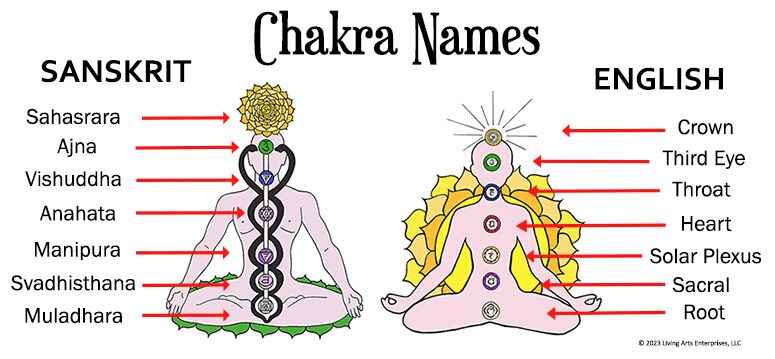
The body created to create in the Light Circle of Surya is the Body of Christ. The Light Circle of Surya is the Seventh, Sarasrara, or Crown Chakra, through which we exit the dream-realm. In case you’re unfamiliar with the chakras, I’ve provided a simple cheat-sheet below. Just remember that the chakras are NOT in the physical body, as many yogis wrongly believe and teach. They’re in the Spiritual Body, which exists in another dimension of time and space. the intertwining snakes shown in the left-hand image represent the Ida and Pingala nadis.
The Sukta’s 20th Rik reads:
Ida’s cosmic waters advance the journey of the Lotus Feet, those which circle in the wrong-mindedness generating the ideational consciousness of remembering the channel of the red ray invisibly rising.
idam (Ida’s) āpaḥ (cosmic waters) pra (advance) vahata (the journey) yat (of the lotus feet) kiṃ (that which) ca (circles) duritam (in the wrong-mindedness) ma-yi (generating the ideational consciousness) yad (of remembering) vāham (the channel of) abhi-dud-roha (the red ray invisibly rising)
Notes:
Kim supposedly denotes a question, but a question doesn’t work here, so I went with “those which” in reference to the Lotus Feet. As I see it, the Lotus Feet belong not to any external “gods,” but to our Souls, which walk around in wrong-mindedness until they choose to remember who they really are. As Jesus told Saint Faustina, the Red Ray reminds the Soul of its immortality. And the Red Ray’s solar energy travels upward in the Pingala nadi. So, what the rishis explain in this Rik is that Ida’s lunar energy (the milk) advances the journey of the Lotus Feet to help the Soul remember the Pingala channel carrying the elixir of immortality (the honey).
Rv 1.23:21 reads:
To remember the wind, call upon the red ray invisibly rising the waters of Om, the primordial Anu speaking for the rays.
Definitions and breaks:
ad (to remember) vā (the wind) śepa = sapa (call upon) abhi-dudroha (the red ray invisibly rising) āpo (the waters of Om) ady-ānu (the primordial Anu) acā-riṣaṃ (speaking for the rays)
Notes:
Presumably, the wind is Vayu, the Cosmic Breath the Bible calls Ruach; the breath God blew into Adam’s nostrils to give him life. The Red Ray is Indra, a Vedic god no longer worshipped by Hindus. Anu, as the rishis explain in another Sukta, is the three-part Name of God. And herein we learn that Anu, the primordial name of God, speaks for the Great Rays. Presumably, therefore, we call upon the Red Ray by repeating the name “Anu.”
This begs a few key questions: Is Anu the name we share with God? Is it the name Jesus asks us to repeat in Workbook Lesson 183? And, if so, why has Anu, a god known to the ancients, been relegated to the slagheap of discarded pagan deities in the modern age?
I can’t answer those questions at this point on the journey. What I can say is that Workbook Lesson 183 is, in fact, one of the most important in the Course.
When I first did the Workbook, back in 1997, I was struck hard when I reached Lesson 183. I just KNEW the lesson was pivotal, but didn’t know what name we were meant to repeat. So, I searched everywhere for the answer. For years. I also prayed. And, eventually, I learned, from Paramahansa Yogananda, that AUM or AMEN was God’s Name. Not in Heaven, but here, in the dream of symbols, where words and names were invented to replace God’s direct communications (the song of Heaven). In the Manuel for Teachers, I subsequently discovered that Jesus does, in fact, give us “the name” to be repeated by those doing the Course. That name is Jesus Christ.
To pray or come together in the name of Jesus doesn’t mean joining as bodies in prayer circles to verbally invoke the name J-e-s-u-s. Firstly, Jesus is a made-up name–a phonetic approximation of the Hebrew name Yeshua or Joshua. Yeshua means “savior” in Hebrew. In the Circle of Earth, before we hear the M-kara, we might use the name “Jesus” in prayer. And we can be certain he hears and answers, but hardly ever in the form we requested. Because to ask for anything we don’t already have is to ask God for something that isn’t real. Everything that’s real is already ours. So, do ask for grace, strength, mercy, vision, patience, forbearance, and miracles. But don’t ask for outcomes, money, or worldly achievements. Because to ask for those things is to ask God to give us what can only bring pain, whieh he will never do.
Jesus is smart. He knows we call him Jesus, even though his earthly name was Yeshua. And where Jesus lives now, earthly names have no meaning. They don’t exist. Jesus symbolizes the Christ, which is the whole of holy creation, and the sound or name of Holy Creation is AUM. So to gather or ask in the name of Jesus is follow his instructions in Lesson 183, part of which read thusly:
Repeat the Name of God, and call upon your Self, Whose Name is His. Repeat His Name, and all the tiny, nameless things on earth slip into right perspective. Those who call upon the Name of God can not mistake the nameless for the Name, nor sin for grace, nor bodies for the holy Son of God. And should you join a brother as you sit with him in silence, and repeat God’s Name along with him within your quiet mind, you have established there an altar which reaches to God Himself and to His Son. (ACIM, W-183.5:1-4)
Another place in the Course, he says:
We have repeatedly said that one who has perfectly accepted the Atonement for himself can heal the world. Indeed, he has already done so. Temptation may recur to others, but never to this One. He has become the risen Son of God. He has overcome death because he has accepted life. He has recognized himself as God created him, and in so doing he has recognized all living things as part of him. There is now no limit on his power, because it is the power of God. So has his name become the Name of God, for he no longer sees himself as separate from Him. (ACIM, M-23.2:1-8)
In an earlier Sukta, the rishis identified “the glorious name” as Eha, which the Burning Bush also gives as God’s Name in the Bible (in the Hebrew form Eyeh). So, which is it? The answer can only be: Any or all of the above, and plenty more besides. Like Shiva, Elohim, Vishnu, YHVH, Adonay, Jehovah, or Allah.
There is, however, a major difference between all these names and Jesus Christ. That difference is this: Jesus lived in the world and succeeded in accepting the Atonement for himself. In so doing, he gained the power of God in the material universe. In so doing, he also activated the Atonement Plan, which only existed in principal hitherto. Because of this, he explains in the Course, God put him in charge of the Atonement Plan, in partnership with the Holy Spirit.
And that’s why Jesus Christ is still my Waheguru and my primary mantra, despite my unexpected detour into Hindu-based True Yoga. As I see it, Jesus took me on a trip to inner-India. He went with me and stayed with me. And feeling remarkably at home, I elected to stay a while and learn all I could.
Or, to quote my Waheguru:
Under His guidance you will travel light and journey lightly, for His sight is ever on the journey’s end, which is His goal. God’s Son is not a traveller through outer worlds. However holy his perception may become, no world outside himself holds his inheritance. Within himself he has no needs, for light needs nothing but to shine in peace, and from itself to let the rays extend in quiet to infinity. (ACIM, T-13.VII.13:4-7)
Let’s move on to Rv. 1.23.22, which reads:
The radiant army assembles in generosity and forgiveness to yield the copious milk of the fiery eye of God’s cow of Kamadeva, the Supreme Lord generating the gathering together of the radiant splendor of God.
Definitions and breaks:
rasena (the radiant army) samaga-smahi (gathers together or assembles in generosity and forgiveness) payasvān (to yield the copious milk of) agna (the fiery eye) ā (of God’s) gah-i (cow of Kamadeva) tam (the Supreme Lord) mā (generating) saṃ (the gathering together of) sṛja (the radiant) varcas-ā (splendor of God)
Notes:
The radiant army is the Army of Nisrok, the army of miracle-workers making up the Assembly. From all the rishis describe, the Assembly forms the Circle of Fire, the fiery eye of the miracle-cow at the center of the Wheel of Existence. And, from that gathering, these miracle-workers reconnect the Great Dragon’s head and tail, making whole again God’s Radiant Splendor.
Makes sense, right?
One more line to go. Rv 1.23:23 reads:
Gather together to sink into the Splendor of God’s radiance. Gather together to procreate, in the gathering of the Living, the thunderbolt M-kara, the mouth of the holy one thundering the Om, to know the companions the rishis revere.
sam (Gather together) māgne (to sink into) varcasā (the splendor of God’s) sṛja (radiance) sam (Gather together) prajayā (to procreate) sam (in the gathering of) āyuṣā (the living) vidyur (thunderbolt) me (m-kara) asya (the mouth) devā (of the holy one) indro (thundering the Om) vidyāt (to know) saha (the companions) ṛṣi-bhiḥ (the rishis revere) ||
Notes:
We’ve covered most of this. I struggled with the meaning of me, until it dawned on me that it might be a Vedic shorthand reference to the M-kara–a suspicion Google affirmed. I also rendered Indro as “thundering the Om,” rather than the name, Indra. Why? For the simple reason that Indro isn’t Indra. And if the rishis meant Indra, they would have written Indra, right? But they wrote Indro, which means something else. The mouth of the Holy One is the mouth of the Holy Spirit, which speaks the Word of God to us through the Christ Mind. As Course-Jesus explains, the Holy Spirit is the Call to Awaken, so the Holy Spirit is the M-kara aspect of A-U-M.
And, as I understand it, the M-kara represents the dream-aspect of the AUM, as well as the dissolution of the separation (i.e., the At-one-ment). Google says the M-kara represents the energy of Shiva, but that’s inaccurate. The M-kara is Vishnu’s power, because the M-power of the Holy Spirit embodies the A of God and the U of Christ/Shiva. And the A and the U are the holy companions the rishis revere. The Great Rays, in other words, which we come to know by meditating on the M-kara.
That’s it. And I’m exhausted. I hope you learned something today from this discussion. And remember to offer the gift of “mercy” to all our brothers in Christ tomorrow, in solidarity with our Catholic bretheren.
Here’s the whole, long 23rd Sukta, strung together:
A powerful force joins together God’s guru-word, the life-breath containing the benediction of the charioteer.
These cosmic winds of Om expand the consciousness starting the journey to fill the life of both Great Rays (the greater lights of the Solar Logos or Word of God).
The divine beings reaching to Heaven, Indra and Vayu invoke the mighty mouth of Soma for drinking Indra and Vayu, the mind-forces the learned sages call upon for protection.
The companions safeguard the thoughts of the Bridegroom or Master. The covenantal winds for calling forth Mighty Varuna’s nectar generating the father whose birth makes known the pure-minded will of God’s Word.
Love each other to hasten the Cosmic Order’s gentle call of truth, the light of Isa (Christ) casting down the covenant of Varuna invoking the waters of wholeness to advance liberation of the world.
The companion of the universe supporting the Spirit of Grace, the Great Purusha unites in wholeness to give and receive the gifts of the desert-wearied calling upon Mighty Indra to produce Soma, the father whose sons grow old in time.
To satiate Kama, Indra, the eldest wind of the Assembly, the celestial power leading the way within the universe created to create that which is heard, calls upon the I Am to strike the concealed protectors, the Holy Danava, the lordly gems joined together in God’s Word. Join together to create the vessels to extract the blessings of Kamadeva’s one hundred sounding the divine or celestial Call to Joy.
The winds of Soma, the father whose divine power sends forth the speckled mother-cow, born to depart, like the roaring wind of the approach bearing the milk-yielding lights bestowing realization of the Greater Light’s subtle exertions.
The Soul’s happy laughter illuminates the circles for walking the Om, the mattered hair in the waters of Kama.
Together as a whole, the winds of AUM protect Antu in the wholeness of God’s sustaining peace.
The multifaceted sacred-grass gathers together the glowing-heat vessel of the Celestial Sphere existing from the beginning of being lost in the manner of an animal.
The kings pour down the shaking waters from the secret, hidden place for the welfare of the immortal-Soul state of being.
The multifaceted sacred grass gathers together the Elevated AUM, the Word of God in the great light of the Moon Ray.
Sink down to rightly join Anu on the path of returning to the Great Rays, the lights sent forth from Nara, the circle of truth.
The mother lights guiding the path are the sisters of the ritual offering of the multitudes mixing the honey and the milk.
God’s encompassing light within, Surya (the Solar Logos) restores the winds of the sacred melody, together with the tail-vessel setting in motion the offering arena’s waters of AUM, the divine vibration within YHVH.
On the journey of self-discovery, the sacred syllable conveys the drinks to be shared in wholeness from the stream of the elder brother, the ray of the True Self’s Greater Light of Peace.
Scatter the holy inner Amrita’s sacred waters for healing, the waters of the fountain advancing the Word of God abiding in the divine beings existing in the tail of the horse of wholeness.
From the sacred waters, the M-kara of the lunar AUM speaks for the inner all-encompassing healing of Agni’s circle, the universe born from the cosmic waters circle.
The universal curative, the cosmic waters bring to the inner-altar the healing from the shelter of the body created to create in the Light Circle of Surya, seen in Truth.
Ida’s cosmic waters advance the journey of the Lotus Feet, those which circle in the wrong-mindedness generating the ideational consciousness of remembering the channel of the red ray invisibly rising.
To remember the wind, call upon the red ray invisibly rising the waters of Om, the primordial Anu speaking for the rays.
The radiant army assembles in generosity and forgiveness to yield the copious milk of the fiery eye of God’s cow of Kamadeva, the Supreme Lord generating the gathering together of the radiant splendor of God.
Thanks for visiting The Holy Meeting Place dot com. Until we meet again, Om Hari Om and Namaste.
 The Holy Meeting Place
Leave a comment