Namaste, my brother in Christ, and welcome (or welcome back) to my latest adhyayana posting. Reaching the Rigveda’s 20th Sukta feels like a milestone, but it’s just a drop in the bucket, considering that the Rigveda’s Samhita contains ten mandalas (allegedly) organized into eighty-five anuvakas (lessons) and 1,028 suktas (hymns), totaling 10,552 mantras.
Yikes.
So far, no hymns, so only time will tell how accurate those stats prove to be.
The 20th Sukta is, according to Google, a hymn composed by the rishi (seer-sage) Medhatithi Kanva in praise of the Ribhus (the flow of purification), the three demi-god artisans credited in the Hindu literature with fashioning Indra’s horse, the miracle-cow, the divine chariots, and various other divine instruments to further humankind’s spiritual awakening. Said to be fathered by Sudhavan (the Holy Voice or sacred sound) and descended from Angiras (the Temple of the Holy Spirit), the three brothers are called Ribhu, Vibhu, and Vaja.
As you may recall, we met Vaja in our study of the 11th Sukta. As I explained in that lesson, Vaja means either “the strength of God” or “the sound of water coming from the mouth.” The youngest of the three brothers, Vaja supplies (according to the 11th Sukta) “the plenitude of the divine light and substance by which the complete work (of the Atonement) can be done.”
Based on the evidence, the Ribhus likely represent the three foot-washing basins we talked about last time, in our study of the 19th Sukta. Those three basins also are, I suspect, the Three Jewels or Triple Gem found in the teachings of both Hinduism and Buddhism.
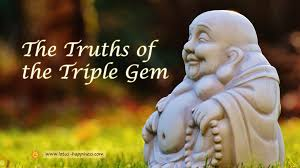
In Buddhism, the triple gems are Buddha (the teacher), Dharma (the teachings), and Sangha (the Assembly)
In the 11th Sukta, we learned that the Miracle Cow belongs to Vaja, so he probably represents the third bowl containing the tears of the miracle-cow. Vaja also, therefore, represents the third jewel of Sangha (the Assembly).
With all that in mind, let’s see what more we can learn from the 20th Sukta.
In my estimation, Rv 1.20:1 should read:
In the present moment, the divine light produces in the mind the multitude of illumined sages in the Resting Place manifesting the jewel of dharma.
Derinitions and syllable breaks:
ayaṃ (In the present moment) devā-ya (the divine light) janmane (produces in the mind) stomo (the Assembly) viprebhir (of illumined sages) āsayā (in the Resting Place) | akāri (manifesting) ratna-dhātamaḥ (the jewel of dharma) ||
Notes:
Firstly, Aya(m) (the shining present moment), has to be the Holy Instant much-discussed in the Course. And in that shining moment, according to the rishis, we perceive (in the mind’s eye) the Assembly in the Resting Place, manifesting the second jewel of dharma (the teachings).
About this powerful now-moment, Course-Jesus says:
Could you but realize for a single instant the power of healing that the reflection of God, shining in you, can bring to all the world, you could not wait to make the mirror of your mind clean to receive the image of the holiness that heals the world. The image of holiness that shines in your mind is not obscure, and will not change. Its meaning to those who look upon it is not obscure, for everyone perceives it as the same. All bring their different problems to its healing light, and all their problems find but healing there. (ACIM, T-14.IX.7:1-4)
Rv 1.20:2 reads:
The light of the ultimate now-moment (the Holy Instant) speaks the Om to yoke the celestial cistern of divine thought, Hari, together with the eight shaking the almsgiving ritual of God’s one hundred eyes to disappear duality.
My definitions and breaks:
ya (the light) indr-āya (of the ultimate now-moment) vac-o-yujā (speaks the Om to yoke) tatakṣur (the celestial pool, water-tank, or cistern) manas-ā (of divine thought) harī (Hari) śam-ībh-ir (together with the eight shaking) yajñam the (almsgiving ritual of) ā-śata (God’s one hundred) akṣan (eyes) nāsat-yābhyām (to disappear duality).
My notes:
The Bible suggests that God has only seven eyes, but herein He is credited with having one hundred. And so is Lord Indra, the Red Ray of Creation presiding over the dream-realm. In the Bible, we also find the four Cherubim standing on the Ophanim, the double-wheeled, eye-speckled beryl-like “spirits” believed to represent God’s omniscience and omnipresence. If each of those wheels had twenty-five eyes, we’d have the one hundred.
I’m just saying. Spiritual visions and their symbols are abstract, rather than concrete.
Rv. 1.20:3 reads:
The circle of the original creation in perfect peace, the chariot of the fashioner of the milch-cow, readily yields the strength of the Father.
pari-jmānaṃ (the circle of the original creation) sukhaṃ (in perfect peace is) ratham (the chariot of) takṣan (the fashioner of) dhenuṃ (the milch-cow) sabardughām (readily yielding) yuvānā (the strength) pitarā (of the Father) pun-aḥ (to purify acceptance of) satyamantrā (the True Mantra) ṛjūyavaḥ (of the straight path)
Notes:
The circle of the original creation in perfect peace is the Circle of All Beings — the Golden Circle Jesus discusses in the Course. This inner-circle, we are told herein, is the chariot of the fashioner of the milch-cow. The fashioner of the milch-cow is generally said to be Lord Krishna, but can also be Vaja, the divine fashioner of chariots and the miracle-cow. And since this Sukta is about the Ribhu, let’s assume the rishis mean Vaja here.
The eight shaking the yajnas of God’s one hundred eyes might be the Vasu, the divine immortals or the rajanagas, all of which are eight in number. So, let’s wait and see what more the rishis might reveal about this eight beings, if anything.
According to Google, “The true mantra of the straight path is often understood as the plea for guidance to align oneself with divine will and truth. In Islam, this is encapsulated in the Quranic verse, Ihdinas-siratal-mustaqim (Guide us to the straight path), reflecting a daily, humbling request for divine guidance.”
Punah is generally defined as “once again,” but the individual syllable meanings refute that presumption. Punah can only be divided as pu-nah (pure wholeness) or pun-ah (purifying acceptance). And purifying acceptance is a phrase found in the Judeo-Christian scriptures to describe, according to Google, “shifting from self-righteousness to accepting God’s grace through faith, cleansing the heart by obeying the truth. It is a process of being washed through Christ’s atonement, enabling believers to be “set apart” and justified, moving from human performance to unconditional acceptance by God.”
So, punah describes, more or less, the idea of what Course-Jesus terms “accepting the Atonement.” On this topic, he says:
All fear is ultimately reducible to the basic misperception that you have the ability to usurp the power of God. Of course, you neither can nor have been able to do this. Here is the real basis for your escape from fear. The escape is brought about by your acceptance of the Atonement, which enables you to realize that your errors never really occurred. Only after the deep sleep fell upon Adam could he experience nightmares. If a light is suddenly turned on while someone is dreaming a fearful dream, he may initially interpret the light itself as part of his dream and be afraid of it. However, when he awakens, the light is correctly perceived as the release from the dream, which is then no longer accorded reality. This release does not depend on illusions. The knowledge that illuminates not only sets you free, but also shows you clearly that you ARE free. (ACIM, T-2.I.4:1-9)
In Hinduism, the true mantra of the straight path (Sanatana Dharma) is generally believed to be the Gayatri Mantra. Allegedly found in the Rigveda, the mantra requests guidance toward righteousness and truth, purifying the mind and encouraging wisdom. I say “allegedly” because the Vedic verse long believed to contain the Gayatra Mantra is not, in fact, a mantra. Like this Sukta, it is a narrative teaching.
In the Course, Jesus give us the following simple mantra to repeat in Workbook Lesson 139: I will accept the atonement for myself:
I will accept Atonement for myself, for I remain as God created me. (ACIM, W-139.11:3)
Rv 1.20:3 reads:
The Ribhu divide the star God created to assemble the vessels of the intoxicating lifeforce (Amrita) restoring the majesty of Nara, the circle generating the rightminded jewel or nectar.
ṛbhavo (the Ribhu) v-iṣṭy (divide the star) akrata (God created) saṃ (to assemble) vo (the vessels) mad-āso (of the intoxicating life-force) agmat-endre-ṇa (restoring the majesty of Nara) ca (the circle) ma-rutva-tā (generating the rightminded jewels or nectar).
Notes:
The star God created is the Logos or Word of God shining down from the top of the dream-realm. And the Ribhu divided that star to assemble the three vessels of Amrita we must drink from to restore the majesty of Nara, the Greater Light of God underneath the illusion, which is the Golden Circle of All Beings generating the rightminded jewels or nectar. If I’m reading this right, Nara, the twin brother of Narayana (Vishnu), IS the Golden Circle, as well as the Purusha. And it is he who generates the gems and the nectar for our atonement.
Rv 1.20:4 reads:
The original seat of pure wisdom, the circle of sovereign light weaves the well-known wooden vessel, the boat of Tvastr (the divine artisan), the celestial being of the atonement God created in four parts to purify the whole thundering vessel of the jewels underneath, given in succession in three parts.
Definitions and breaks:
ādi-tyeb-hiś (the original seat of pure wisdom ) ca (the circle) rājabhiḥ (of sovereign light) uta (weaves) tyaṃ (the well-known) camasaṃ (wooden vessel) navaṃ (boat of ) tvaṣṭur (Tvastr, the divine artisan) devasya (the celestial being of ) niṣkṛtam (the atonement) | akarta (God created) caturaḥ (in four-parts) punaḥ (to purify the whole) te (thundering) no (vessel) ratnāni (of the jewels underneath) dhattana (given in succession) trir (in three parts)
Notes:
In Hinduism, Tvashtr is the celestial artisan or divine craftsman credited with making Indra’s vajra and Brihaspati’s axe, as well as various divine drinking vessels (cups and bowls, supposedly). Those metaphoric “drinking vessels” are, of course, the bowls in which our Souls wash their feet, including the wooden bowl representing the Ark of the Covenant –the boat mentioned herein; the same boat built by Manu and Noah to escape the Great Flood.
Rightly perceived, Tvastr is the builder of the inner-instruments of the atonement we must access and accept in succession to escape the illusion. In the Hindu lore, he travels in a chariot drawn by two fallow bay mares — the chariot of the bay horses seen in Zechariah’s vision. Fallow means “unseeded,” suggesting the mares are rootless (free to roam).
In Zechariah 6:1-8, that chariot is the fourth one seen emerging from between two bronze mountains. These horses, the angel tells Zechariah, “walk to and fro through the earth.”
In Sanskrit, the name Tvashtr (helpfully written Tvastur herein) means “the True Self covering.” And in Rv 1.18:3, the rishis say, “Join together in the power covering Usah (the dawn) to shake the path of the living being (the Soul) in what appears to be mortal, to protect the wholeness preserving the thundering.” The power covering Usha we now know is Tvastur, one of the Aditya (the sons of Aditi and the tortoise). In Hinduism generally, he is said to be the creator of forms, as well as the crafter of living beings and wombs.
Is Tvastur, therefore, the Vedic demiurge? Maybe and maybe not.
As I interpret the evidence, Tvastr represents the part of the Holy Spirit that recalibrated the dream-realm to serve God’s purposes, rather than the Ego’s. In so doing, he fashioned the atonement instruments and roams through the earth in four parts (as the Living Beings, Cherubim, or Rays of Attribute) named in the Bible as Molech, Bastet, Nisrok, and Noah or Nun (but misidentified as pagan gods through mistranslation and misinterpretation). In Hinduism, they are Kamdhenu, Ishana, Garuda, and Nirriti.
Let’s move on to the final line. The 20th Sukta is, it turns out, only five lines in construction, rather than the nine envisioned by H. H. Wilson. The final line, Rv 1.20:5, reads:
God’s seven winds press out Soma, the one and only Holy Teacher supporting the fiery splendor of the Assembly acting rightmindedly to share the holy inheritance of Lord Vishnu to fortify or sanctify the underlying reality of Yama.
ā (God’s) sāpt-āni (seven winds) sunvate (press out Soma) ekam-ekaṃ (the one and only) su-śastibhiḥ (Holy Teacher or Guide) adhārayanta (supporting) vahnayo (the fiery) abha-janta (splendor of the Assembly) sukṛtyayā (acting rightmindedly) bhāgaṃ (to share the holy inheritance) dev-eṣu (of Lord Vishnu) yaj-ñi-yam (to fortify the underlying reality or nature of Yama)||
Notes:
Nowhere could I find an appropriate definition for saptani, but I did find saptami — a term representing the seventh day of the lunar fortnight in Hinduism; a day widely associated with the worship of Lord Surya (the Solar Logos) and Durga, the chief goddess. I suspect the word has a deeper meaning, like the seven yoms (rays) in Genesis translated as seven days.
Ami may, for example, be shorthand for Amrita, the elixir of immortality. But nowhere could I find reference to seven Amritas or seven nectars in the Hindu literature. Ani, on the other hand, can mean many things, including lynch-pin, energy-point, grace, splendor, or wind, while sapt means “seven” pretty definitively. While we don’t find seven graces in Hinduism, we do find seven rishis and seven aspects of Vayu, the cosmic wind, known collectively as the Saptavayu.
According to the prevailing wisdom, as summarized by Google, the seven winds and what they represent are characterized as follows in Hinduism:
- Āvaha (God’s wind): Operates between the earth and the clouds, supporting cloud formation.
- Pravaha (the advancing wind): Moves between the clouds and the sun, acting as a life-sustaining force.
- Udvaha: (the uplifting wind) Situated between the sun and the moon, this wind carries water from the oceans to form clouds.
- Saṃvaha: (the gathering together wind) Operates between the moon and the stars, managing the movement of clouds and rainfall.
- Vivaha: (the dividing wind) Moves between the stars and planets, described as a powerful current (sometimes associated with cyclones).
- Parivaha: (the circle wind) Located between the Saptarṣi-maṇḍala (Great Bear/Ursa Major) and the Dhruva-nakṣatra (Pole Star), sustaining the Milky Way.
- Parāvaha: (the supreme wind) The outermost current that holds all matters and souls at the end of a Kalpa (cosmic cycle).
Bear in mind that these are cosmic forces, rather than elemental atmospheric winds, so those definitions are a bit too literal to be trustworthy.
If my definitions are right, the whole 20th Sukta reads:
In the present moment, the divine light produces in the mind the multitude of illumined sages in the Resting Place manifesting the jewel of dharma.
The light of the ultimate now-moment (the Holy Instant) speaks the Om to yoke the celestial cistern of divine thought, Hari, together with the eight shaking the almsgiving ritual of God’s one hundred eyes to disappear duality.
The circle of the original creation in perfect peace, the chariot of the fashioner of the milch-cow, readily yields the strength of the Father.
The Ribhu divide the star God created to assemble the vessels of the intoxicating lifeforce (Amrita) restoring the majesty of Nara, the circle generating the rightminded jewel or nectar.
The original seat of pure wisdom, the circle of sovereign light weaves the well-known wooden vessel, the boat of Tvastr (the divine artisan), the celestial being of the atonement God created in four parts to purify the whole thundering vessel of the jewels underneath, given in succession in three parts.
God’s seven winds press out Soma, the one and only Holy Teacher supporting the fiery splendor of the Assembly acting rightmindedly to share the holy inheritance of Lord Vishnu to fortify or sanctify the underlying reality of Yama.
Thanks for visiting the online Meeting Place. I hope you learned as much as I did from today’s study. Until we meet again outside the Assembly, Om Hari Om and Namaste.
 The Holy Meeting Place
Leave a comment