Namaste, my brother in Christ, and welcome (or welcome back) to my latest adhyayana posting. We’ve come to the Rigveda’s 19th Sukta, which, for the past 4,000 years, has been misperceived as a hymn calling upon Agni to invite the Maruts to the the yajna ritual. As established in our previous discussions 1) Agni is the Vedic name for the sacred-fire of God’s presence (rather than the god of fire) 2) yajna is the term used by the Vedic rishi-scribes for the secret (internal) almsgiving prayers also advocated by Jesus Christ (rather than an earthly fire-sacrifice ceremony), and 3) Maruts refers to those in the desert who both hear and answer the Holy Spirit’s call to awaken (rather than a group of storm gods).
Like the first eighteen suktas, the 19th is (not unlike the Course) an advanced teaching for Brahmins (the Priests, Minsters, or Teachers of God qualified to act universally through the Assembly meetings), rather than a hymn, poem, or invocation. Unlike the first eighteen suktas, the 19th features a repeating refrain at the end of each of its nine stanzas. In transliterated Sanskrit, the refrain reads marudbhir agna a gahi.
H. H. Wilson translated these words as “Come Agni, and bring the Maruts.” In the 14th Sukta, we find the similar phrase: devabhih agna a gahi, which I translated as “the divine Red Ray (is) the fiery eye of God in the cow of Kamadeva” (Kamdhenu, the miracle-cow, whose eyes reflect the sun and moon). So, unless I’m totally off-base, marudbhir agna a gahi should translate similarly, with marudbhir taking the place of dev-abhih.
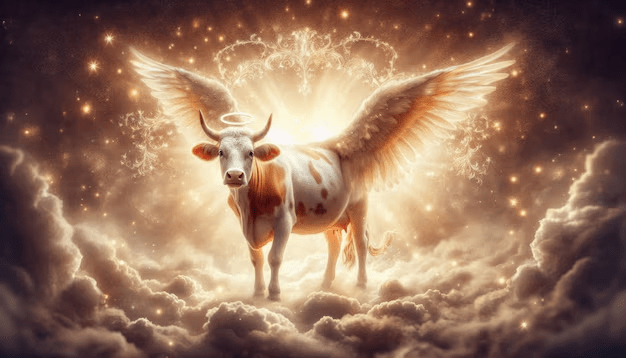
Marudbhir is most likely a compound of ma (producing, creating, or generating), and rudbhir (tears or crying) — making marudbhir “producing the tears” (of the fiery eye of Kamdhenu), rather than “Come Agni, and bring the Maruts.”
To find out if this definition works in context, let’s start with Rv 1.19:1, which I translate as follows:
To advance the three water vessels on the journey of Rama, the milkmaid of moonlight forwards the call to the living (beings) generating the tears in the fiery eye of Heaven’s miracle-cow.
My definitions and syllable breaks:
prati (to advance the three) t(o)yaṃ (water) cārum (vessels) adhvaraṃ (on the journey of Rama) gopī-thā-ya (the milkmaid of moonlight) pra (forwards) hūyase (the call to the living) ma-rudbhir (generating the tears) agna (in the fiery eye) ā (of Heaven’s) gahi (miracle-cow)
My Notes:
In the highly allegorical Hindu lore, we find the three water vessels on Rama’s journey, the milkmaid of moonlight, and Kamdhenu’s tears, so I’m pretty sure my translation trumps Wilson’s.
In the Ramayana, the three water vessels on Rama’s journey take the form of foot-washing basins. In the first, which is gold, King Janak (the Father or Creator) washes Rama’s feet during his marriage to Sita (Divine Love). In the second, a wooden vessel, the boatman, Kewat (the enclosure), washes both Rama’s feet before ferrying him across the river Ganga to the Forest of All Beings. And in the third, Shabari (an elderly female aesthetic) washes Rama’s feet in her tears out of pure devotion. Noteworthily, the name Shabari translates as the Word of God’s (sa) garden, covering, or narrow passage.
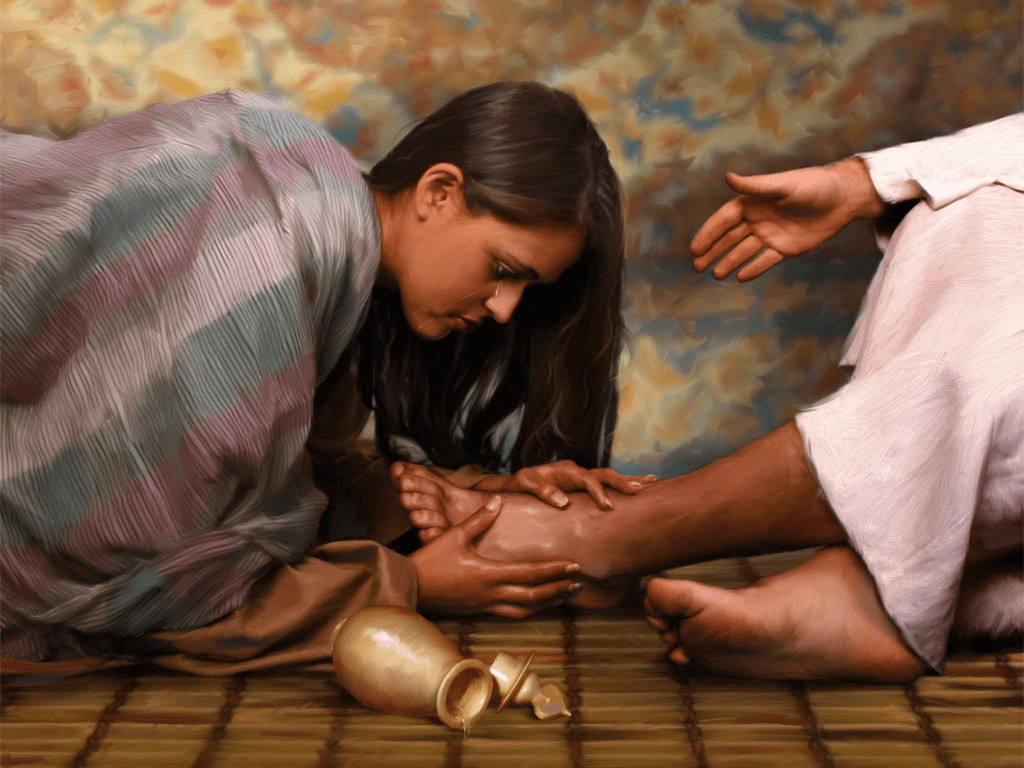
We find a similar figure in the Bible, in the form of the presumed prostitute who washes Jesus’ feet with her tears and hair in Luke 7:36-50.
“The tears of the heavenly cow” is a metaphor also found in a significant episode in the Ancient Egyptian myth known as The Book of the Heavenly Cow. In this tale, humanity plots against the aging sun god, Ra. To stop them, Ra sends his “Eye” (often Hathor or Sekhmet) to destroy them. The slaughter is halted when Ra, feeling remorse, uses red-dyed beer (Amrita) to mimic blood and intoxicates the vengeful goddess.
There’s tons of rich symbolism to be mined from these ancient stories, including the meaningful little detail that Kewat, the ferryman representing the enclosure, was born a tortoise; but rather than chase wild hares, let’s move on to Gopithaya, the milkmaid of moonlight, who is either one of the Gopis of Vrindavan (the pastoral Resting Place) or Lord Krishna’s beloved consort, Radha, who embodies the Soul’s deep yearning for God (felt in the Resting Place, where we stand upright or rightminded in the Assembly).
In Hinduism, Kamdhenu (Krishna’s miracle-cow, not humankind’s wishing-cow), which are shed for her suffering children in the dream-world. Those children aren’t earthly cows and oxen, as commonly presumed; they’re our Souls, struggling in vain against the cosmic purpose God gave the world. As I see it, Kamadeva’s tears are symbolically equal to the tears of divine mercy Jesus sheds over our unrelenting cruelty toward our brothers in all lifeforms.
Stripped of the Hindu symbolism, we find this remarkably similar teaching in the Course:
You are the spirit in whose mind abides the miracle in which all time stands still; the miracle in which a minute spent in using these ideas becomes a time that has no limit and that has no end. Give, then, these minutes willingly, and count on Him Who promised to lay timelessness beside them. He will offer all His strength to every little effort that you make. Give Him the minutes which He needs today, to help you understand with Him you are the spirit that abides in Him, and that calls through His Voice to every living thing; offers His sight to everyone who asks; replaces error with the simple truth. (ACIM, W-97.4:1-4)
Rv 1.19:2 reads:
In the wholeness of divine love, the celestial Om waters the world of mortals with the glory and majesty acting to complete the Supreme Reality generating the tears in the fiery eye of Heaven’s miracle cow.
My definitions and break:
nah-i (in the wholeness of divine love) dev-o (the celestial Om) na (waters) martyo (the world of mortals) mahas (with the glory) tava (and majesty) kratum (acting to complete) paraḥ (the Highest Reality or Universal Soul) marudbhir (generating the tears) agna (in the fiery eye) ā (of heaven’s) gahi (miracle-cow).
Notes:
We find herein the word parah, a term used in Hinduism to denote that which is superior to material existence and phenomenal reality, such as the highest reality (Para Brahman), as well as transcendental sound or spiritual knowledge.
Rv 1.19:3 reads:
The thundering splendor of King Soma, the wise and knowledgeable all-pervading divine presence in God’s wooden vessel of eternity generating the tears in the fiery eye of heaven’s miracle-cow.
Definitions and breaks:
ye (the thundering) maho (splendor of) raja-so (King Soma) vidur (the wise and knowledgeable) viśve (all-pervading or universal) devāso (divine presence) adru-haḥ (in God’s wooden vessel of eternity) | marudbhir (generating the tears) agna (in the fiery eye) ā (of God’s) gahi (miracle-cow) ||
My notes:
God’s wooden vessel of eternity is the Ark of the Covenant, as well as Noah’s Ark, the ferry conveying Rama across the Ganga, and the ship by which Matsya (the first Avatar of Vishnu) and Vasuki (Shiva’s snake-necklace) transport Manu and the seven sacred rishis to the safety of the Himalayas. To enter the Ark, apparently, we have to wash both our feet in the celestial Om “waters” bathing the pure-but-dusty feet of our Souls in God’s glory and majesty.
And yes, the Bible does indeed specify that the Ark of the Covenant was constructed of wood, specifically acacia wood (or shittim wood), which was overlaid with pure gold inside and out.
The next line (Rv 1.19:4) reads:
The light of Shiva holds the Ark of God’s unknown hymn of peace, the invisible Word of God, the divine lifeforce generating the tears in the fiery eye of Heaven’s miracle-cow.
Definitions and breaks:
ya (the light) u-grā (of Shiva holds) ark-am (the ark of God’s) ānṛc-ur (unknown hymn) an-ādhṛṣṭā-sa (of peace, the invisible Word of God) ojasā (the divine lifeforce of God) marudbhir (generating the tears) agna (in the fiery eye) ā (of Heaven’s) gahi (miracle cow).
My notes:
The Light of Shiva is the light of grace. And that light holds the Ark of God’s unknown hymn of peace, the melody we hear continuously in Heaven, but forgot on earth. In the Ark, the ego trembles (in fear) before dissolving, as Course-Jesus explains below:
And now the ego IS afraid. Yet what it hears in terror, the other part hears as the sweetest music; the song it longed to hear since first the ego came into your mind. The ego’s weakness is its strength. The song of freedom, which sings the praises of another world, brings to it hope of peace. For it remembers Heaven, and now it sees that Heaven has come to earth at last, from which the ego’s rule has kept it out so long. Heaven has come because it found a home in your relationship on earth. And earth can hold no longer what has been given Heaven as its own. (ACIM, T-21.IV.7:1-7)
Course-Jesus also talks about the Ark, which he calls both the Ark of Peace and the Ark of Safety, in the following excerpt:
The ark of peace is entered two by two, yet the beginning of another world goes with them. Each holy relationship must enter here, to learn its special function in the Holy Spirit’s plan, now that it shares His purpose. And as this purpose is fulfilled, a new world rises in which sin can enter not, and where the Son of God can enter without fear and where he rests a while, to forget imprisonment and to remember freedom. How can he enter, to rest and to remember, without you? Except you be there, he is not complete. And it is his completion that he remembers there. (ACIM, T-20.IV.6:5-10)
Entering this Ark is our holy purpose, Jesus states in the very next line– the only purpose God gave the world. And it is this wooden vessel in which we wash the dust (of ego consciousness) off our holy feet (with the tears of divine mercy) to cross the River Ganga (or Jordan) into the Real World.
Rv 1.19:5 reads:
The thundering pure rays of light bestow the pasa (the rope or noose) conferring the power of Soma, the ever-flowing power generating the tears in the fiery eye of Heaven’s miracle-cow.
Definitions and breaks:
ye (the thundering) śubhrā (pure) ghora-var-pasaḥ (rays of light bestow the pasa) sukṣatrā-so (conferring the power of Soma) ri-śāda-saḥ (the ever-flowing power) marudbhir (generating the tears) agna (in the fiery eye) ā (of Heaven’s) gahi (miracle-cow).
Notes:
As we learned from our study of the 15th Sukta, the pasa (of the gods) represents the Bond of Varuna (the waters of oneness = our covenant with God as the Christ), rather than the binding forces of worldly attachment, maya, ignorance, and ego that tether the Soul to the cycle of birth and death (as Google reports and many Hindus wrongmindedly believe). We see that pasa or noose in the right hand of Ganesha in the image below;
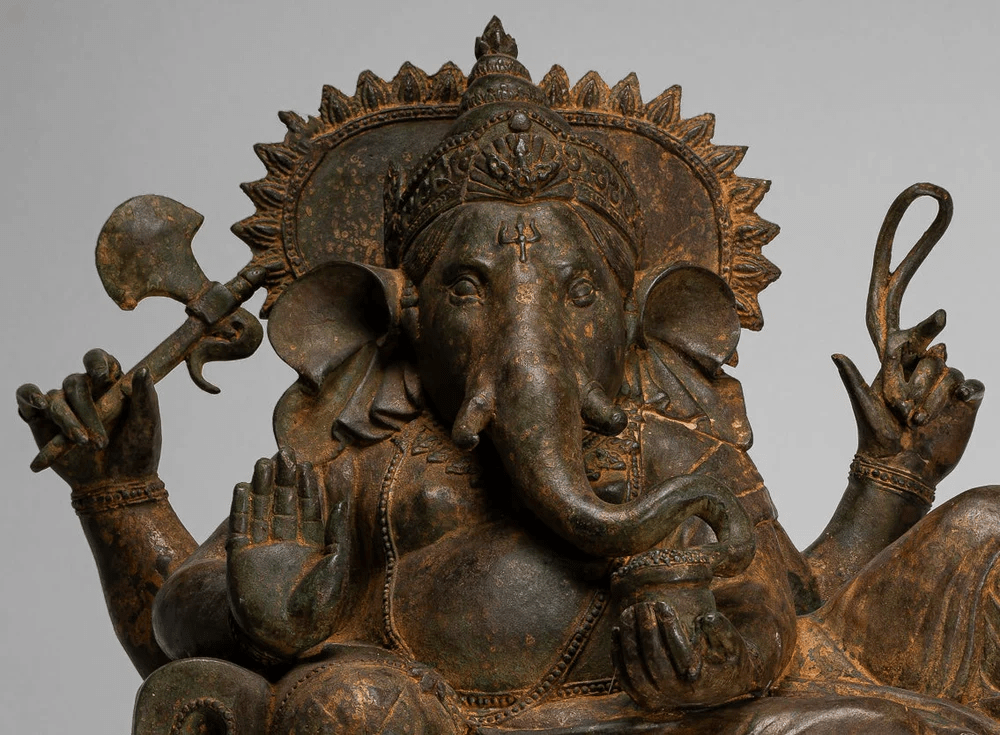
In a more general sense, the rishis are saying the Rays restore the covenant, which confers the power of Soma, the Great I Am, whose sweet elixir (Amrita) generates the tears (of mercy) in the fiery eye of God’s miracle-cow.
Rv 1.19:6 reads:
The thundering Celestial Realm’s true knowingness illuminates the shining love of God protecting the dwelling place in unreality generating the tears in the fiery eye of Heaven’s miracle-cow.
Definitions and breaks:
ye (the thundering) nākasyā-dhi (of the Celestial Realm’s true knowingness) rocane (illuminates) div-i (the shining love of God) de-vāsa (protecting the dwelling place) āsate (in unreality) marudbhir (generating the tears) agna (in the fiery eye) ā (of Heaven’s) gahi (miracle-cow)
Notes:
So far, so good, in that my revised definition of marudbhir agna a gahi appears to be holding up. The dwelling place in unreality generating miracles is the Resting Place, Meeting Place, or Gathering Place (of the Assembly), which the shining Love of God protects (covers) as long as any one of us wills the dream to continue.
Or, as Course-Jesus explains:
Release from guilt as you would be released. There is no other way to look within and see the light of love, shining as steadily and as surely as God Himself has always loved His Son. AND AS HIS SON LOVES HIM. There is no fear in love, for love is guiltless. You who have always loved your Father can have no fear, for any reason, to look within and see your holiness. You cannot be as you believed you were. Your guilt is without reason because it is not in the Mind of God, where you are. And this IS reason, which the Holy Spirit would restore to you. He would remove only illusions. All else He would have you see. And in Christ’s vision He would show you the perfect purity that is forever within God’s Son. (ACIM, T-13.X.10:1-11)
Rv 1.19:7 reads:
The light (of divine love) invigorates the Kha to reach the highest homeland beyond the gathering of the waters, the streams of Varuna generating the tears in the fiery eye of Heaven’s miracle-cow.
Definitions and breaks:
ya (the light) īṅ-kha-yanti (invigorates the Kha to reach or enter) par-vatān (the highest homeland) tiraḥ (beyond) samudram (the gathering of waters from) arṇa-vam (the streams of Varuna) marudbhir (generating the tears in) agna (the fiery eye) ā (of God’s) gahi (miracle cow)
Notes:
The light of love invigorates (or shakes) the Kha, the narrow-gate or passage through which we re-enter the realm of the Infinite Absolute (Da’at), which lies beyond the miracle-working Assembly (the gathering of the waters). I think I’ve got this right, since the light does indeed “invigorate the Kha” in Hindu philosophy.
Based on what Course-Jesus says below, the light of love shakes the Temple of the Body (the house built on sand), until it topples, revealing the true temple (of the Holy Spirit, the house built on rock) hidden underneath.
Idolaters will always be afraid of love, for nothing so severely threatens them as love’s approach. Let love draw near them and overlook the body, as it will surely do, and they retreat in fear, feeling the seeming firm foundation of their temple begin to shake and loosen. Brother, you tremble with them. Yet what you fear is but the herald of escape. This place of darkness is not your home. Your temple is not threatened. You are an idolater no longer. The Holy Spirit’s purpose lies safe in your relationship, and not your body. You have escaped the body. Where you are the body cannot enter, for the Holy Spirit has set His temple there. (ACIM, T-20.VI.7:1-10)
And this explains why Jesus washed the feet of his disciples after his last earthly meal — an episode described in John 13. Read the following carefully, knowing dusty feet symbolize the false ego-self, which must be shaken off before we can enter the Ark. And that’s also why the ferrymen, Kewet, washed both Rama’s feet.
It was just before the Passover Festival. Jesus knew that the hour had come for him to leave this world and go to the Father. Having loved his own who were in the world, he loved them to the end.
The evening meal was in progress, and the devil had already prompted Judas, the son of Simon Iscariot, to betray Jesus. Jesus knew that the Father had put all things under his power, and that he had come from God and was returning to God; so he got up from the meal, took off his outer clothing, and wrapped a towel around his waist. After that, he poured water into a basin and began to wash his disciples’ feet, drying them with the towel that was wrapped around him.
He came to Simon Peter, who said to him, “Lord, are you going to wash my feet?”
Jesus replied, “You do not realize now what I am doing, but later you will understand.”
“No,” said Peter, “you shall never wash my feet.”
Jesus answered, “Unless I wash you, you have no part with me.”
“Then, Lord,” Simon Peter replied, “not just my feet but my hands and my head as well!”
Jesus answered, “Those who have had a bath need only to wash their feet; their whole body is clean. And you are clean, though not every one of you.” For he knew who was going to betray him, and that was why he said not every one was clean.
The last statement is an editorial comment added by someone who didn’t understand the Miraculous Perception Jesus possessed at the end of his earthly life. (And neither, btw, do the creators of ‘The Chosen,” who also cast Mary Magdalene as a reformed prostitute, based on the Catholic Church’s long-since recanted slander of Jesus Christ’s beloved enlightened wife).
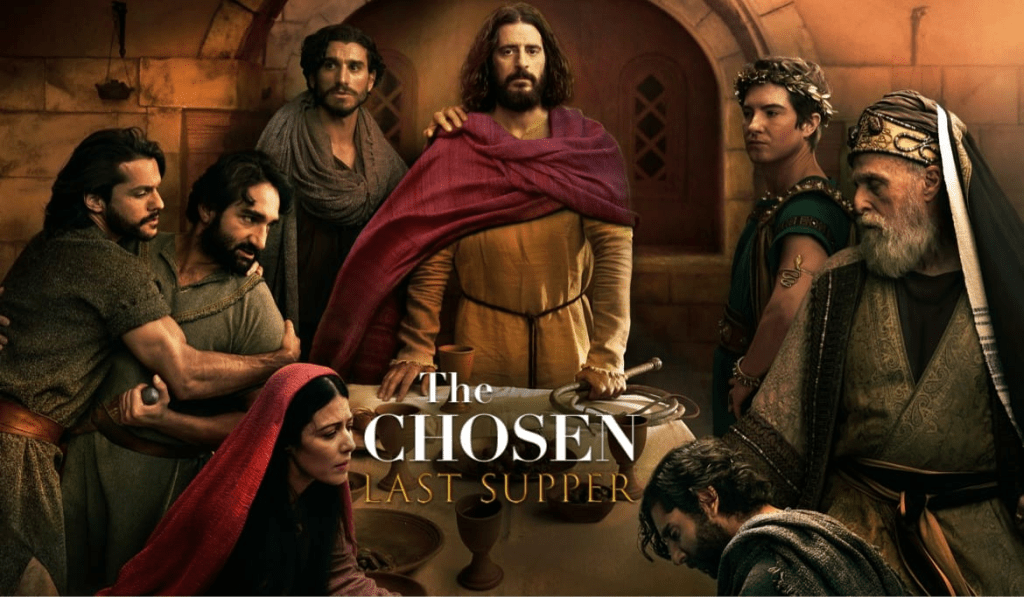
Judas didn’t betray Jesus, because Judas was a Soul, playing his assigned part in the drama, which Jesus fully understood (and explained to Helen Schucman). As “John” more accurately states earlier in this chapter: “Jesus knew that the Father had put all things under his power, and that he had come from God and was returning to God.” If Jesus knew he must die on the cross and why, then he also knew what Judas had to do to bring it about at the pre-appointed time.
This is, in fact, an example of True Forgiveness. Forgiving truly doesn’t mean overlooking what we perceive and wrongly judge as “sins.” It means perceiving only what the world is for in God’s estimation. And we can’t do that until we rightly perceive everyone standing with us in the Assembly, sending out alms to help our brothers shake the dust of the Ego Mind off their holy feet. In rightminded perception, those holy feet never left sacred ground, because our Souls never really left the Assembly. They only dreamed that they left. And in dreams, nothing can affect them.
Rv 1.19:8 reads:
God’s thundering extends the bridge of the rays beyond the gathering of the waters, the lifeforce of God generating the tears of the fiery eye of Heaven’s miracle-cow.
Definitions and breaks:
ā (God’s) ye (thundering) tanvanti (extends the bridge) raśmibhis (of the rays) tiraḥ (beyond) samudram (the gathering of the waters of) ojasā (the lifeforce of God) marudbhir (generating the tears) agna (of the fiery eye) ā (of Heaven’s) gahi (miracle-cow).
My Notes:
In Vedanta, the bridge (often described as Setu or the Bridge to Immortality) connects the individual self (Jiva) to the infinite, divine consciousness (Brahman), allowing one to pass from ignorance to enlightenment. It acts as the bridge over the ocean of mundane existence.
In Theosophy, we build this bridge by clearing the mental blockages or veils preventing the inner four celestial Rays of Attribute from shining out of our Chakras into the world. So, in essence, clearing the chakras of the ego’s light-blocking sludge builds “the bridge to eternity.” Jesus mentions this “bridge” many times in the Course. We find this same “bridge” metaphor in the Ancient Norse Edda, the Islamic Hadiths, and probably in plenty of other ancient texts, including the Ramayana and the Rigveda (as we now know). In the Ramayana, Rama builds this bridge through his persistent efforts (sadhana) to overcome the ocean of Maya.
Of this bridge, Course-Jesus says:
The perfect equality of the Holy Spirit’s perception is the reflection of the perfect equality of God’s knowing. The ego’s perception has no counterpart in God, but the Holy Spirit remains the Bridge between perception and knowledge. By enabling you to use perception in a way that reflects knowledge, you will ultimately remember it. The ego would prefer to believe that this memory is impossible, yet it is your perception the Holy Spirit guides. Your perception will end where it began. Everything meets in God, because everything was created by Him and in Him. (ACIM, T-6.II.7:1-6)
I’m pretty sure the bridge in all of these sacred texts represents the Antahkaraṇa, the “inner-instrument” within human consciousness through which we access the Higher Self.
In Hindu philosophy, the Antahkarana consists of four components or stages, which mirror 1) the four quadrants of the circle-journey, 2) the four lower chakras, 3) the four rays of attribute, and 4) the four Living Beings.
Those four components are 1) ahamkara (ego), representing our attachment to the ego-constructed world and identity; 2) buddhi (reason), the reasoning part of the mind that enables us to separate spiritual truth from ego-deception; 3) manas (the two minds or reins, we must choose between as we drive our Merkabah-chariot through the dream-world): the lower, sensory mind perceiving and desiring the external, false reality or the higher, intuitive mind perceiving and desiring the internal, true reality; and chitta (the memory). As with manas, there are two subconscious or memory “storehouses” we must choose between: the one holding our worldly past learning and memories and the one holding our Soul’s memories of Heaven. To access the Soul’s storehouse, the golden treasury or cistern, we first have to clear out the ego’s subconscious storehouse (i.e., undo all the ego’s past conditioning and learning).
Contrary to popular belief, the Buddhi is the reason restored to us by the Holy Spirit (as Course-Jesus explained in an excerpt shared earlier in this post). So, as I interpret the evidence, Buddhi (higher reason) bridges the gap between ignorance and knowledge.
Rv. 1.19:9 reads:
The Red Ray of the True Self is the eastern father who pours out the Amrita, the nectar of forbearance, the sweetly intoxicating offering generating the tears in the fiery eye of Heaven’s miracle-cow.
abhi (The red ray or cowherd) tvā (the true mode of being) pūrva-pītaye (the eastern father who) sṛj-āmi (pours out the Amrita) som-yam (the nectar of forbearance) mad-hu (the sweetly intoxicating offering) marudbhir (generating tears in) agna (the fiery eye) ā (of Heaven’s) gahi (miracle-cow).
We learn herein that Amrita, the elixir of immortality, also is the honey of forbearance (tolerance). According to Google, this honey also is the soft tongue described by King Solomon in Proverbs 25:15, which reads:
By long forbearing is a prince persuaded, and a soft tongue breaketh the bone.
That tongue, as I’ve said before, belongs to the Bridegroom–the Great I Am whispering “Om” into our inner ears. In Hinduism, the metaphoric bridegroom is primarily represented by Lord Vishnu (or his incarnation, Lord Krishna) or Lord Shiva, acting as the divine lover or husband to the human soul. In Christianity, it’s Jesus.
In Islamic Sufi poetry and literature, the metaphoric bridegroom is typically Allah, who like Elohim and Surya, represents the Solar Logos running the dream-universe, rather than God, the Absolute Creator. Not that any of the Abrahamic religions grasp this important distinction, except perhaps in their mystical arms (Gnosticism, Kabbalism, and Sufism).
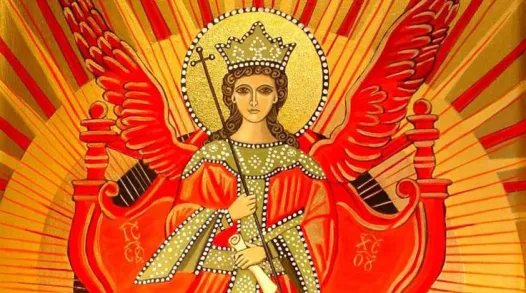
In Sufism, for example, bridal imagery is commonly employed to represent the Soul’s longing for reunion with the Divine. In this context, the human soul or seeker is the bride longing for the divine bridegroom, celebrating their spiritual union. In Hinduism, as mentioned earlier in this post, that longing is personified as Radha, the deeply devoted chief consort of Lord Krishna.
In Revelation, the Bride is seen by the prophet after the seventh trumpet is sounded. He also mentions the Temple, the Ark, and the tail of the dragon (Ketu) in this section, so it warrants reviewing:
And the Temple of God was opened in the celestial sphere, and there appeared in that Temple, an Ark of the True Self’s covenant, to bring into being brightness and voices of thunder, and shaking and great hailstones. And to make visible a great sign in the celestial sphere: A Bride clothed in the sun, with the moon beneath her feet, and upon her head, a crown (stephanos) of twelve stars. The Bride held within her womb a cry or call to be birthed in the trials and torments of delivery (deliverance).
And there appeared another sign in the celestial sphere: the vision of a fire-colored dragon, having seven heads, and ten horns, and seven royal crowns (diadems) upon its head; and a tail pulling a third of the stars in the heavens, to cast them down to earth. And the dragon stood in front of the Bride — the one about to give birth — in order to eat up her child, when it came forth.
And she brought forth a strong son, who was to act as a shepherd to every habitual mindset of sickness (ethnos), as an inner staff made of iron. And the Bride’s child was pulled forcefully toward the God-Self’s throne. And the Bride fled into the wilderness, where she had a place to prepare apart from God, to be nourished (by extension) a thousand two hundred and sixty days.
As explained in earlier discussions, the fire-colored dragon is “the beast” traditional Christians equate with Satan, but which actually represents God’s Radiant Splendor underneath the illusion. The dragon’s tail is Ketu, the descending node of the moon (Soma, the Great I Am), which counts among the Hindu Navagraha (the celestial bodies, excluding Earth). That the tail pulls a third of the stars in the heavens (the celestial sphere) to cast them down to earth, tells us something of great importance. But what that might be, I can’t yet say with any certainty.
What I can say is that the Bride represents the Soul in the Resting Place, yearning for her Bridegroom, as Radha yearns for Lord Krishna’s return to pastoral Vrindavan. We further learn that this metaphorical Bride gave birth to a son, who will act as a shepherd to the Souls bound in “separation-sickness” in the manner of an inner staff of iron. That child probably represents the divine spark in us, which is indeed magnetically drawn toward the God-Self’s throne — the chariot-throne of the Solar Logos (Elohim, Allah, and/or Surya).
Or, to again quote Course-Jesus:
I heard one Voice because I understood that I could not atone for myself alone. Listening to one Voice implies the decision to share It in order to hear It yourself. The Mind that was in me is still irresistibly drawn to every mind created by God, because God’s Wholeness is the Wholeness of His Son. You cannot be hurt, and do not want to show your brother anything except your wholeness. Show him that he cannot hurt you and hold nothing against him, or you hold it against yourself. This is the meaning of “turning the other cheek.” (ACIM, T-5.IV.4:1-6)
After giving birth, the Bride flees into the wilderness (the dream-realm), where a place is prepared for her “apart from God,” to be nourished 1,260 days. Not sure what the number represents, but I’m certain the place prepared for her is the Land of the Living — the Real World (Tif-eret), the sefirot one step below Da’at, the Infinite Absolute on the Kabbalistic Tree of Life.
In Gnosticism, the Bride is Sophia, a Greek word meaning “wisdom” or “profound understanding.” Her story is told in the highly esoteric Pistis Sophia, a 4th-century text discovered in 1773. In many other Gnostic texts and teachings, Sophia is a major female divinity, but in the Pistis Sophia, as in the Revelations account, she originates and dwells outside the divine realm. Her fall and redemption parallel the story told in the equally esoteric Apocryphon of John, the true gospel of John, the Apostle of Christ.
In the Pistis Sophia, the glorified Jesus appears to his assembled disciples (including his mother, his wife [Mary Magdala], and Martha, the sister of Lazarus). According to the text, Jesus could only reveal the lower mysteries to his disciples during his life and immediately after his resurrection. Eleven years later, he returns to teach them the higher mysteries, clad in the white robe of the Bridegroom. These mysteries, which are twenty-four in number, involve complex cosmologies and knowledge necessary for the Soul to reach the highest divine realms.
Pretty interesting, right? And all of these Great Truths are woven through the scriptures of every world religion, but lost for the most part through the insanity of sectarianism. Truth is one, my brother, as I keep saying.
Threaded together, the whole 19th Sukta reads thusly:
To advance the three water vessels on the journey of Rama, the milkmaid of moonlight forwards the call to the living (beings) generating the tears in the fiery eye of Heaven’s miracle-cow.
In the wholeness of divine love, the celestial Om waters the world of mortals with the glory and majesty acting to complete the Supreme Reality generating the tears in the fiery eye of Heaven’s miracle cow.
The thundering splendor of King Soma, the wise and knowledgeable all-pervading divine presence in God’s wooden vessel of eternity generating the tears in the fiery eye of heaven’s miracle-cow.
The light of Shiva holds the Ark of God’s unknown hymn of peace, the invisible Word of God, the divine lifeforce generating the tears in the fiery eye of Heaven’s miracle-cow.
The thundering pure rays of light bestow the pasa (the rope or noose) conferring the power of Soma, the ever-flowing power generating the tears in the fiery eye of Heaven’s miracle-cow.
God’s thundering extends the bridge of the rays beyond the gathering of the waters, the lifeforce of God generating the tears of the fiery eye of Heaven’s miracle-cow.
The Red Ray of the True Self is the eastern father who pours out the Amrita, the nectar of forbearance, the sweetly intoxicating offering generating the tears in the fiery eye of Heaven’s miracle-cow.
Thanks for visiting the online Meeting Place. I hope you learned as much as I did from today’s study. Until we meet again outside the Assembly, Om Hari Om and Namaste.
 The Holy Meeting Place
Leave a comment