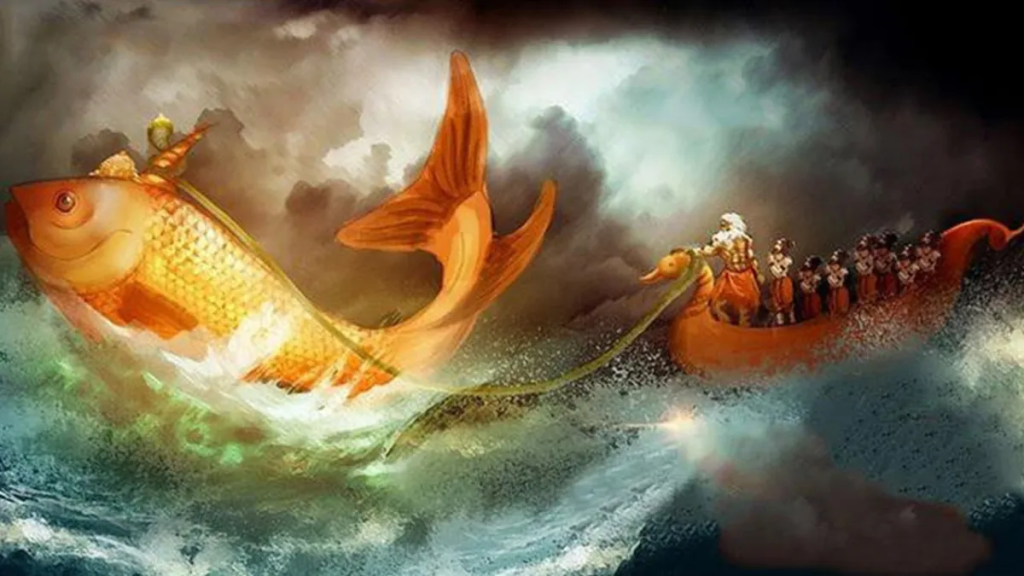
We’ve now come to the Rig Veda’s Ninth Sukta — and I wish I could say the translation process is getting easier. But that wouldn’t be wholly truthful. What I can say — in complete honesty — is that I’m still learning and expanding my understanding of the labyrinthian morass that is Hindu theology. I’m also embracing Hinduism and its accoutrements in ways I don’t fully understand. But it’s all good. As in the image above from the story of Matsya and Manu Satyavrata (which we’ll explore shortly), my little boat full of rishis is being pulled through the waters by Lord Vishnu in his “merman” form.
This will all make sense in a minute, so let’s get to it without further ado. In transliterated Sanskrit, Rv 1.9.1 reads: indrehi matsy(a) ‘(e)ndhaso visvebhih soma-parvanhih maham abhistir ojasa. Those words translate into English in this manner:
When Indra discharges Matsya to kindle the Om, the universal light of Soma’s fullness sends forth abundantly the Red Ray spreading the essential energy of God.
For comparison’s sake, H. H. Wilson translated the same words thusly:
Come, Indra, and be regaled with all viands libations, and thence, mighty in strength, be victorious (over your foes).
My definitions and syllable breaks:
indre-hi (When indra discharges) matsy(a) (Matsya, “the joyous one” or “water of joy”) ‘(e)ndhas-o (to kindle the Om) viśve-bhiḥ (the universal light of) soma-parvan-hiḥ (Soma’s fulness sends forth) mahām̐ (abundantly) abhiṣṭir (the red ray spreading) ojas-ā (the essential energy of God)
My notes:
Let’s start with Matsya, a name combining “ma” (creation’s) and “t(a)sya” (the Holy Name or Name of God). And it is indeed the Water Ray or Light of Joy that produces the Stream of Sound we hear with our inner-ears. In Hinduism, Matsya is the first of ten avatars, incarnations, or manifestations of Lord Vishnu, the Vishwapurusha–the Atonement “spirit” of the Christ Mind).
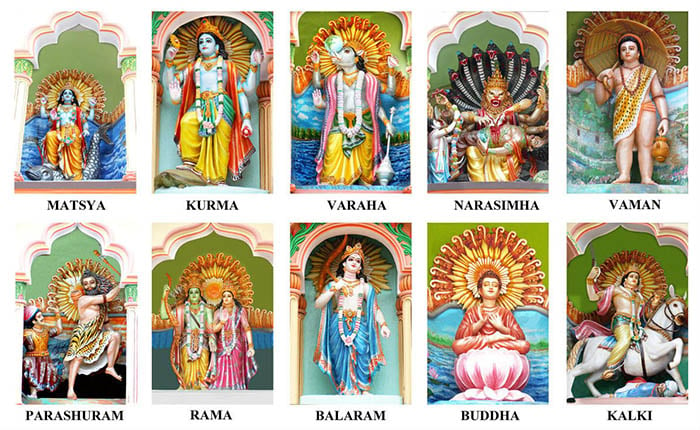
Those ten avatars or Dasa-vantaras are (in order of appearance) 1) Matsya (a fish), 2) Kurma (a turtle), 3) Varaha (the boar-form who rescued and married Bhumi), 4) Narasimha (a man-lion hybrid), 5) Vamana (a dwarf), 6) Parasurama (Rama with an axe), 7) Rama himself, 8) Krishna (the black one with the yoke), 9) Buddha (the Enlightened Teacher), and 10) Kalki, the prophesied final avatar, who is prophesied to appear at the end of Kali Yuga (the current age lasting 432,000 years) to restore righteousness and order. Noteworthily Kali Yuga means “the black one’s yoke,” so Kalki appears when Krishna’s yoke has bound all our Souls together (or all the souls assigned to each other in the forgiveness network).
In the Bhagavad Gita, Krishna, the Soul’s charioteer, explains to his pupil, Prince Arjuna (the ego-battling Soul at the journey’s crossroads): Whenever there is a decline of righteousness (rightmindedness) and rise of unrighteousness (wrongmindedness) … I send forth my Self.”
And the Lamb did, indeed, “send forth” his Self in the second half of the 20th Century — at a time when, according to Course-Jesus, many Souls moved backward on the circle-journey. Krishna went forth to launch the Celestial Speed-up to accelerate humanity’s salvation. One of the initiatives introduced to speed our journey was A Course in Miracles. By my reckoning, the speed-up phase coincides with the Age of Aquarius (the current age, which began in the 1960s), whereas the coming of the Messiah took place (according to plan) at the start of the Age of Pisces (1 – 2000 A.D.). The next astrological age –Capricorn — is expected to begin around 4,000 A.D.

In the Hindu lore, the legend of Matsya bears a striking resemblance to the Biblical story of Noah and the Ark. Hardly surprising, given that Truth is One. The story’s protagonist is Manu Satyavrata (a name meaning “the mind’s true purpose”), who is said to be the first man, as well as the progenitor of the human race. As the story goes, Manu was offering oblations by a river one day when a tiny fish jumped out of the water into his hands. Before he could throw it back, the fish asked for Manu’s protection. To comply, Manu placed the fish in an earthenware jar, which it soon outgrew. He then returned the fish to the river, but that too proved too small very quickly. The same thing happened after he moved the fish to the much-larger Ganges River and, later, to the ocean.
Eventually, the fish admitted to being an avatar of Lord Vishnu. After telling Manu the world would soon be destroyed by a great flood, the fish advised his protector to build a sizeable boat, into which he should put the seven rishis, a variety of plants, and one of each type of animal. When the flood started, Manu fastened the boat to the horn of the fish, using as a “tether” Vasuki, the divine snake (naga) coiled around Shiva’s neck. The fish then pulled the boat through the floodwaters, until they reached the peaks of the Himalayas.
The story makes perfect sense when we comprehend the symbolism. Matsya, “the joyous one,” represents the Water Ray, which “sings” the Song of Heaven or Call to Joy into our inner-ears to dissolve the parasitical Ego Mind. That Water Ray of Joy goes forth from King Indra, the Blood Ray of Peace, to “kindle the Om,” as this Vedic verse explains. As Manu Satyavrata “protected” the sound within his mind, his consciousness grew beyond its previous limitations (as indicated by the progressively larger bodies of water into which he placed the growing fish).
The flood that ended the world represented Manu passing through “the door” between the second quadrant of “Artha” and the third quadrant of “Kama.” Passing through the door moves us consciously to the Celestial Sphere, thereby ending the world (our perception of material reality through the body’s senses.) To make the transition, Manu had to enter the Ark, and let the fish lead the way, with the assistance of Vasuki.
Course-Jesus explains the same idea in the following from the Text:
The plan is not of you, nor need you be concerned with anything except the part that has been given you to learn. For He Who knows the rest will see to it without your help. But think not that He does not need your part to help Him with the rest. For in your part lies all of it, without which is no part complete, nor is the whole completed without your part. The ark of peace is entered two by two, yet the beginning of another world goes with them. Each holy relationship must enter here, to learn its special function in the Holy Spirit’s plan, now that it shares His purpose. And as this purpose is fulfilled, a new world rises in which sin can enter not, and where the Son of God can enter without fear and where he rests a while, to forget imprisonment and to remember freedom. How can he enter, to rest and to remember, without you? Except you be there, he is not complete. And it is his completion that he remembers there. (ACIM, T-20.IV.6:1-10)
What the tory of Matsya and Manu Satyavrata really represents is the Soul’s Journey around the circle. At the start of the allegory, we learn that Manu has been practicing spiritual austerities for thousands of years. He has, that is to say, been traveling for some time on the Lotus Path of “Dharma” — the first quarter of the journey. The fish jumping into Manu’s hands represents his newly realized ability to hear the Holy Spirit’s Voice — the obstacle-removing Om vibration. His willingness to protect the fish marks the start of the circle-journey’s second leg of Artha — giving to receive the priceless INTERNAL treasures of God, rather than seeking to obtain the worthless EXTERNAL fantasy-riches and false idols of the world. This is the Ark of Peace we build to carry us “the rest of the way.” The boat represents the Ark of the Covenant, Ark of Peace, or Ark of Safety that will transport us through “the door” to the third leg of Kama.
Guided by Vishnu, Manu takes refuge in the boat with the seven “seers” (the seven spirits or lamps “before the throne”) and the “wholeness” consciousness of the Golden Circle (symbolized by the animals and plants). Matsya then pulls Manu’s boat to the peaks of the Himalayas, a long-time symbol of enlightenment. So, reaching the Himalayas represents his entrance into the quadrant of Moksha, the circle’s fourth and final “leg.” The “tether” binding Matsya to the boat is, meaningfully, Vasuki — the “naga” representing True Perception or Spiritual Vision. This suggests that it is by opening the Spiritual Eye all the way that we pass through the eastern gate between Kama (the enclosure) and Moksha (Eden).
Somewhere in the story, Matsya gives the Vedas (higher knowledge) to Manu to share with the human race, which he later “spawns” to restore “the mind’s true purpose.” The Water Ray, with Vasuki’s help, in other words, gave higher Self-Knowledge to Manu to share with and illuminate all the dreaming parts of the shared Universal Mind.
Makes sense, right? It also tells us the Holy Spirit’s first “manifestation” in our minds is the Holy Stream of Sound. And only by training our minds to hear that sound do we progress from the first quadrant of Dharma to the second quadrant of Artha, where we build the Ark (of the Holy Relationship).
Let’s move on to Rv 1.9.2, which reads: em evam srjata sute mandim indraya mandine cakrim visvani cakraye. By my calculations, those words read along these lines:
The Spiritual Path produces the birth of the Spirit of Joy–the light of Indra inspiriting the circle of the totality of existence, the Circle of All Beings.
H. H. Wilson’s reads as follows:
The libation being prepared, present the exhilaration and efficacious (draught) to the rejoicing Indra, (the accomplisher of all things.)
My definitions:
em (the course, path, or way) evaṃ (of the Spirit) sṛjata (generates) sute (the birth of) mandim (the Spirit of Joy) indrāya (the light of Indra) mandine (inspiriting) cakriṃ (the circle of) viśvāni (the totality of existence) cakraye (the Circle of All Beings)
My notes:
The Sanskrit experts tell us em almost always precedes the word eva when found in the Vedas — and here we have the first instance of that verbal coupling. They further tell us the combination of em and eva means “indeed,” “thusly,” or “in this manner” — the same lame definition offered for eva on its own. And that, quite frankly, defies logic.
As explained in my last post, eva is almost certainly the Sanskrit word for the Holy Spirit. So, what might the oft-forerunning em mean? Sadly, there’s no clear answer, even in languages rooted in Sanskrit. The closely related Sanskrit word ema, however, means “course, path, or way.” It might also mean “universal wholeness” or “universal oneness” — the original definition of Emma in Hebrew (rather than “mother”). Because there’s no way of knowing, let’s presume the oft-occurring em-eva means Path of the Spirit or Spiritual Path, which we would expect Vedic rishis to mention fairly often.
In this line, we also encounter the perplexing and seemingly related words mandim and mandine,” which I’ve defined as “Spirit of Joy” and “inspiriting” respectively. We then come across — excitingly — chakra-ye, the Circle of All Beings — the Golden Circle so eloquently described below by Course-Jesus:
Beyond the body, beyond the sun and stars, past everything you see and yet somehow familiar, is an arc of golden light that stretches as you look into a great and shining circle. And all the circle fills with light before your eyes. The edges of the circle disappear, and what is in it is no longer contained at all. The light expands and covers everything, extending to infinity forever shining and with no break or limit anywhere. Within it everything is joined in perfect continuity. Nor is it possible to imagine that anything could be outside, for there is nowhere that this light is not. (ACIM, T-21.I.8:1-6)
According to Google, the Circle of All Beings is “a deep ecological, spiritual, and philosophical concept representing the interconnectedness, equality, and unity of all life forms and elements. Often visualized as a sacred hoop or cycle, it emphasizes that every part of nature is interrelated, with no true end or beginning. it represents a collective existence.”
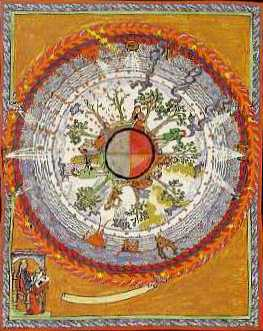
A good explanation on the whole, IF we understand that our interconnectedness, equality and unity is of a spiritual, rather than physical, nature. In the Bible, the Circle of All Beings is the “circle” referenced in Genesis 9:12-16 and Isaiah 40:22, while its workings are explained in Ecclesiastes 1.
Retranslating them all will take us too far off course, but I will tell you what Isaiah actually says on the subject:
To inhabit the circle of the Land of the Living is to reside with the locusts extending in Shamayim (the Celestial Sphere) the curtain spreading out the Tabernacle, the dwelling place given the authority to apply the judgment or reason of the Land of the Living in nothingness, unreality, or chaos, to plant and scatter the seeds of truth to put down roots. In the Land of the Living. God’s Breath is a withering tempest carrying away the chaff in likeness equal to the Word of God.
As we know from our recent study of Revelations, the locusts represent the humming vibration of the Om, the sound that both dissolves the ego and holds Creation together in Oneness or Wholeness. This Bible verse also tells us the Circle of All Beings can be found in the Land of the Living–the holy Jerusalem or Mecca (Medina) on the sixth plane of consciousness. Rightly perceived, that “walled city” or “enclosure” is the dwelling place of our Souls in the dreamscape, as well as the Resting Place where the Assembly gathers to scatter the seeds of correction.
Before we move forward, let’s reach back to Jesus’d description of the Golden Circle as “an arc of golden light that stretches as you look into a great and shining circle.” His use of the word “arc” is a clue. The arc of golden light is the Ark; it’s also Shemayin, the Hebrew word for the Celestial Sphere. That Arc or Ark is a rainbow formed by the seven rays, reaching across the Wheel to form “the rainbow bridge” we mentally cross to end our perception of the individual self and its projected material unreality.
In Advaita Vedanta, the “rainbow bridge” is often interpreted through the concept of Antahkarana—the inner instrument of mind, intellect, and ego—serving as a bridge of consciousness that connects the individual soul (Atman) to the universal spirit (Brahman). It represents the journey from perceived duality to non-dual self-realization.
The Antahkarana is often described as a “thread of consciousness” or a triple thread (Sutratma) that allows the soul to navigate the path from mundane, dualistic experience to spiritual enlightenment. The triple thread, I believe, refers to the Trinity Rays on the right-side of the Wheel (the Celestial Sphere), reaching across to the left to carry our Soul-Ark over the bridge. At the same time, the four rays of attribute, shining through our cleared chakras, reach across from left to right. When all seven shine out of our semi-purified mind, we’ve built the bridge to cross over.
We also find the bridge in the Islamic Hadiths, the Elder Edda of ancient Norse mythology, and the Course. Jesus, in fact, mentions the bridge numerous times. In one place, for example, he says:
I have already said that the Holy Spirit is the Bridge for the transfer of perception to knowledge, so we can use the terms as if they were related, because in His Mind they are. This relationship must be in His Mind because, unless it were, the separation between the two ways of thinking would not be open to healing. He is part of the Holy Trinity, because His Mind is partly yours and also partly God’s. This needs clarification, not in statement but in experience. (ACIM, T-5.III.1:1-5
On the Kabalistic Tree of Life, we see the seven rays forming the Sefirot of Hokhmah– the second seal opened by the Lamb in the Book of Revelation. This suggests to me that Hokhmah may represent the eastern edge of the bridge, if not the bridge itself.
We’ll come back to the bridge in a future post. For now, let’s move on to the Ninth Sukta’s third line, which reads: matsya susipra mandibhih stomebhir visvacarsane sacaisu savanesva. Those words translate something akin to this:
Matsya is the holy power advancing the shining female elephant with the songs of praise of the universal watchers, the servants of God’s arrow ablating the True Self.
H. H. Wilson’s cringe-worthy translation reads: Indra with the handsome chin, be pleased with these animating praises; do though, who art to be reverenced by all mankind (come) to these rites (with the gods.)
My definitions:
matsyā (the joyous one) suśi-pra (is the holy power advancing) mand-ibhiḥ (the shining female elephant) stomebhir (with the songs of praise) viśva-carṣaṇe (of the universal watchers) sac-a-iṣu (the servants of god’s arrow) savane-ṣva (ablating the True Self)
My notes:
The shining female elephant is Gaja-Lakshmi, the fourth aspect of Lakshmi. The universal watchers and the servants of god’s arrow are both phrases found in the Bible. Allegedly, the watchers are mentioned in Daniel 4:13, 17, and 23. They’re also appear in the non-canonical Book of Enoch, wherein they are described as a group of angels who rebelled against God by descending to Earth, lusting after human women, and fathering giant offspring called Nephilim. According to Google, “They also taught humanity forbidden knowledge, like weapon-making and cosmetics, leading to widespread corruption and violence, prompting Enoch to intercede for them before they were ultimately judged, bound, and cast into an abyss.”
None of these statements ring true to my inner ear, so let’s see what Daniel actually reports about these “watchers.” For it to make sense contextully, I translated a few verses on either side of the line about the Watchers.
There came a vision into my head concerning a Resting Place and I beheld a tree in the midst of a land of great height. The tree grew strong and tall, to reach Shemayin (the celestial arc or rainbow), to make visible forever the whole of the land.
The leaves were beautiful; the fruit abundant food for the whole; the Living Ones of the field (the green pastures and/or sacred grass) were shaded underneath and the twittering of Shemayin dwelled in the branches the whole Body (of Christ) fed from to become like the mind of the resting place and to see the watchers (guardians) of the Holy One descending from the Celestial Realm to call aloud the Word of God, saying: “Gather the hosts (our Souls) to cut off the branches, to shake off the leaves, and scatter the fruits so the living ones who fled from under its branches, leaving only a stump of root in the land. Bound in iron to the serpent, the tender grass of the field gathers the dew of Shemayin to share with the Living of the field until seven set periods of renewal sprout upward.“
The tree is the Tree of Life, the seeds are the miracles of grace we scatter in the Resting Place, and the fruits are the Sefirot (the fruits of the Lamb reaped through the undoing process of remembering our eternal innocence). In this context, the Watchers seem to be the Vasu–the eight guardians of the Circle. But Enoch’s description suggests the watchers were once human. And that sounds to me like the Teachers of Teachers Course-Jesus describes in the Manual for Teachers.
There are those who have reached God directly, retaining no trace of worldly limits and remembering their own Identity perfectly. These might be called the Teachers of teachers because, although they are no longer visible, their image can yet be called upon. And they will appear when and where it is helpful for them to do so. To those to whom such appearances would be frightening, they give their ideas. No one can call on them in vain. Nor is there anyone of whom they are unaware. All needs are known to them, and all mistakes are recognized and overlooked by them. The time will come when this is understood. And meanwhile, they give all their gifts to the teachers of God who look to them for help, asking all things in their name and in no other. (ACIM, M-26.2:1-9)
Of these beings, he also says:
Those who have laid the body down merely to extend their helpfulness to those remaining behind are few indeed. And they need helpers who are still in bondage and still asleep, so that by their awakening can God’s Voice be heard. (ACIM, M-26.3:9-10)
And this, which correlates with their Vedic and Biblical description as “watchers.”
No one can call on them in vain. Nor is there anyone of whom they are unaware. All needs are known to them, and all mistakes are recognized and overlooked by them. (ACIM, M-26.2:5-7)
This leaves us only to work out what the seven set periods of renewal might be. The Rays? The spouts of the fountain? The seven Sefirot forming the Circle around the Real World? The astrological ages the Atonement Plan will span in time? All of these are possibilities. Perhaps the answer will present itself as we continue our studies.
Meanwhile, let’s move on.
Having explained to us what Matsya, the Water Ray, does, the Vedic rishis now tell us more about Indra, the Blood Ray. Rv 1.9.4 reads asrjram indra-te girah prati tvam ud ahasata ajosavrsabham patim, which translates thusly:
The Blood Ray of Indra is the thundering call to return to the True Self up above speaking the Absolute Truth of God, the eternal Word raining down the light of the Bridegroom.
H. H. Wilson’s translation: I have addressed to thee, Indra, the showerer (of blessings), the protector (of thy worshipers), praises which have reached thee, and of which thou hast approved.
My definitions:
asṛj-ram (the Blood Ray of) indra (Indra) te (is the thundering) giraḥ (call) prati (to return) tvām (to the True Self) ud (higher up) ahā-sata (speaking the Absolute Truth of God) ajo-ṣā (the eternal Word of God) vṛṣabham (raining down the light) patim (of the Lord, Master, or Bridegroom).
My notes:
If the Blood Ray, the spirit of peace, is the Call to Return, then the Blood Ray is the Holy Spirit. And so is the Water Ray, the spirit of joy, as Course Jesus states below:
The Holy Spirit is the spirit of joy. He is the Call to return with which God blessed the minds of His separated Sons. This is the vocation of the mind. The mind had no calling until the separation, because before that it had only being, and would not have understood the Call to right thinking. The Holy Spirit is God’s Answer to the separation; the means by which the Atonement heals until the whole mind returns to creating. (ACIM, T-5.II.2:1-5)
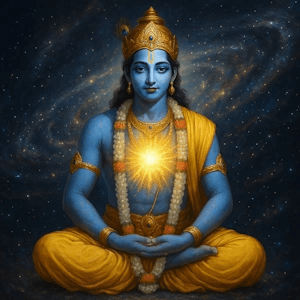
So, in case I haven’t said this before, the Blood and Water Rays of the Bridegroom (the presence of Christ in the dream-recording) comprise the Holy Spirit. And that “twin spirit” (of God and Christ, calling for our return to sanity) is what we see radiating from the sacred heart in the Divine Mercy image below.
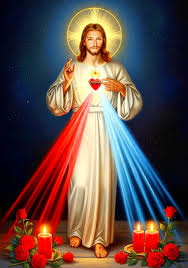
In Hinduism, the Holy Spirit is personified as Lord Vishnu, a name meaning “two streams” rather than “all-pervading” (as generally espoused). And those two streams, if I may be so bold, are represented in the Hindu lore as the twin sages Nara (the Blood Ray of peace) and Narayana (the Water Ray of Joy).
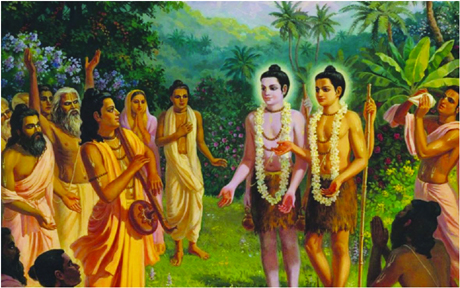
Let’s proceed apace. The next line (Rv 1.9.5) reads: sam codaya citram arvag radha indra varenyam asad it te vibhu prabhu asman. My research suggests those words translate as follows:
Coming together drives the horses of the Bright Ones (the Sefirot or Mahavidyas), the spokes of the wheel speaking for selfless devotion and service to Indra, the chosen vehicle in unreality for the Supreme Lord of the Highest Heaven.
Wilson’s translation: Place before us, Indra, precious and multiform riches, for enough and more than enough are assuredly thine.)
My definitions:
saṃ (coming together) codaya (drives the horses) citram (of the bright ones or celestial maidens) ar-vāg (the spokes of the wheel speaking for) rādha (selfless devotion and service) indra (to Indra) vareṇyam (the chosen vehicle) asad (in unreality) it (for) te (the thundering) vibhu (Supreme) prabhu (Lord) asmān (of the highest heaven).
My notes:
Here, the rishis affirm that Indra is indeed God’s vehicle in the dream of separation. They also tell us how we advance the Wheel of the Soul’s Journey. Coming together in the Name or Word — the thundering Om vibration coming from Indra — advances the Wheel by “driving the horses (the thought forces) of the Bright Ones” — the ten fruits on the Tree of Life.
If the Mahavidyas are the spokes of the Wheel (the Dharmacakra), then the wheel has ten spokes — not eight, four, or twelve. The two deer on either side (as seen below) represent the antelopes pulling Soma’s chariot. Those two antelopes are probably the mysterious re’em of the Bible, given that they represent the two Rays of the Holy Spirit — and NOT the Deer Park at Sarnath (as most Buddhists presume).
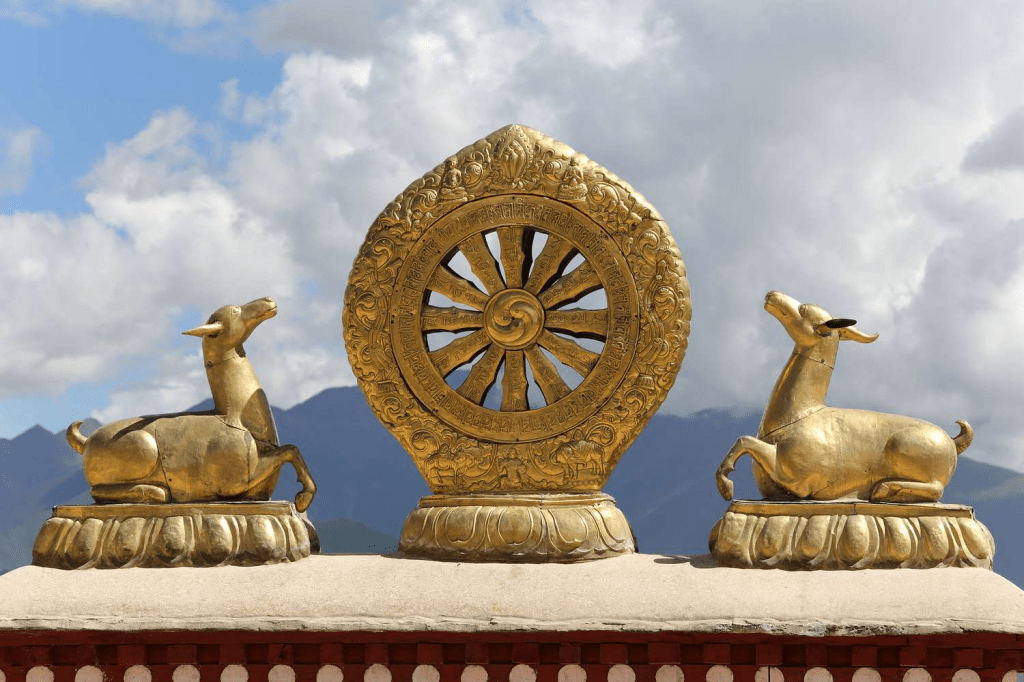
A quick Internet search suggests the Dharmachakra features more prominently in Buddhism than in Hinduism. In Buddhism, the Wheel is generally assigned eight spokes representing the “legs” of the Noble Eightfold Path. But the Wheel can also have four spokes. And in that iteration, the spokes are said to represent the four stages of meditation. Those four stages are known as either the Dhyanas (a Sanskrit word meaning “meditative absorption”) or the Jhanas (a Pali word meaning “meditation”).
But, as the Bible and this Vedic teaching both clarify (when rightmindedly translated), our Souls walk around the Wheel of the Tree of Life, to ripen and eat the fruits of the Lamb (the Sefirot or Mahavidyas). In Kabbalistic texts, the tree also is called “the Path of the Flaming Sword,” because it leads from the gate of Eden (where we entered the dream), back to the same spot (where we exit). And it is at that gate that God posted the Flaming Sword (Michael-Indra, the guardian of the east). In the Bible, the same word translated as Tree of Life is sometimes translated as True Vine. So, the Tree of Life and the True Vine are one and the same.
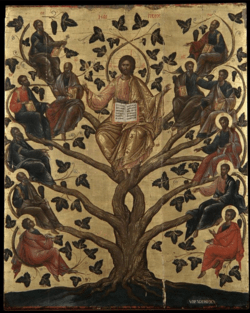
Because the Sefirot and the Living Beings overlap on the Tree of Life, the horses referenced herein are almost certainly those seen by Zechariah, Ezekiel and John of Patmos. Since the Sefirot and the Lamb are closely related, and Krishna represents the Lamb in Hinduism, the horses of the Bright Ones are probably Krishna’s horses–the four or five divine thought-forces drawing the chariot driven by Krishna in the Mahabharata epic.
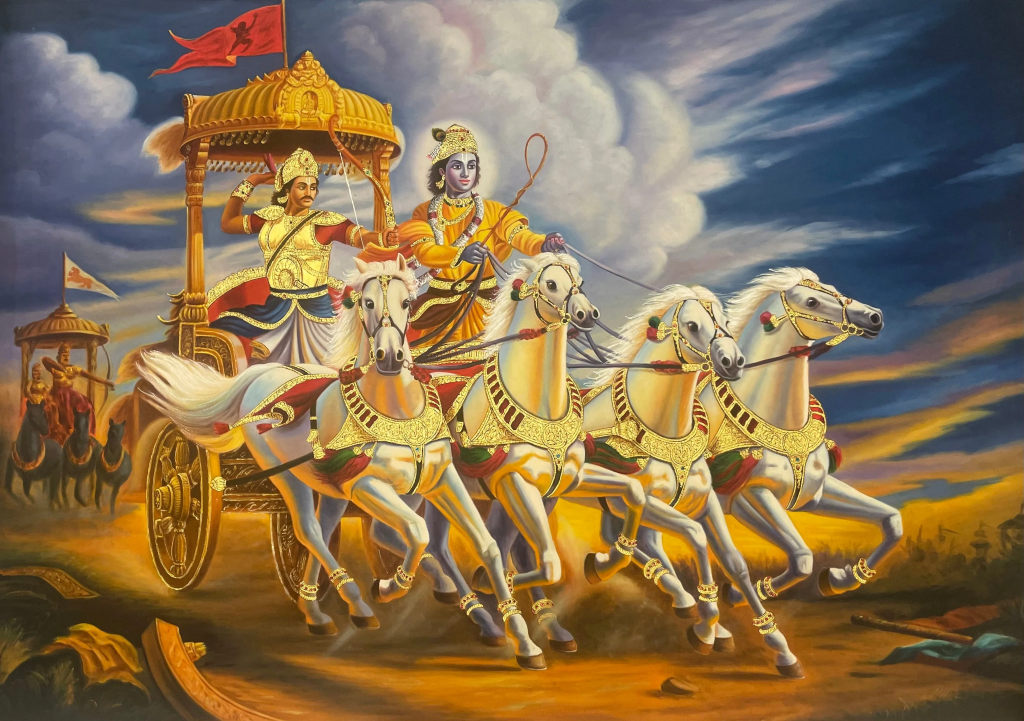
That chariot, known as Jaitra or Garudadhwaj, represents the spiritual body (the Merkabah in which our Souls move around the dreamscape). Being pure, those horses are generally depicted as white, but they are also described as gray-green, tawny-gold, white or cloud-colored, and black or ashen in color.
Krishna’s horses do NOT represent the human senses, as Google suggests. Nor does the chariot represent the human body (as is commonly misstated). Ja-itra means “born of the pure essence” or “the pure essence of the son,” while Garuda-dhwaj means “bearing the mark of Garuda (the divine eagle)” So, bearing the mark of the Beast, basically.
In Hinduism, Krishna’s horses have names. The green-gray steed is called Saibya, the tawny-gold horse is Sugriva, the cloud-colored horse is Meghapushpa, and the black horse is Balahaka. When correctly translated, the names tell us what each signifies.
Saib-ya = true light or the light of truth.
Su-griva = the holy blue neck (of Shiva, encircled by Vasuki, the naga granting Knowledge of the Vasu)
Megha-push-pa = the cloud of nourishment and protection
Bala-haka = the call or cry of the elephants (God’s trumpets, Airavata and Ganesha)
Keeping all that in mind, let’s move on to the next verse — Rv 1.9:6 — which reads: sutatra codayendra raye rabhasvatah tuvidyumna yasasvatah sam gomad indra vajavad.
The charioteer protects the driving forces of Indra, the divine resources of the inner radiance, the great splendor conveyed without ownership by coming together in the abounding milk of Indra’s forceful sound.
Wilson’s nonsensical and completely wrong-minded translation: Opulent Indra, encourage us in this rite for the acquirement of wealth, for we are diligent and renowned.)
My definitions:
suta-tra (the charioteer protects) codaye-ndra (the driving forces of Indra) rāye (the divine resources) ra-bhasvataḥ (of the inner divine radiance) tuvi-dyumna (the great majesty/splendor of) ya-asvataḥ (are conveyed without ownership) saṃ (by coming together) gomad (in the abounding milk) indra (of Indra’s) vajavad (forceful sound).
My notes:
The mention of the charioteer, Krishna, tells me I’m right about the horses. The abounding milk of Indra’s forceful sound are the two holy streams (Vishnu) flowing down from the Ocean of Milk (Sarasvati, the waters of divine thought) tapped by the wellspring (Iravati), whose spouts are Airavata. The milk comes from Krishna’s cow (Surabhi/Kamadhenu), whose source is Sarasvati. The milk is produced when the ocean of thought is churned or shaken by the Vasu.
From here on, I’ll dispense with Wilson’s translations, because they really are utterly useless. Rv 1.9.7 reads: vajavad asme prthu sravo brhat visvayur dhehy aksitam, which translates as follows:
The holy rock, Prithu sings the Om to enlarge the universal divine passage from our purposeful meditations on the eternal.
My definitions:
asme (The holy stone or rock) pṛthu (Prithu) śrav-o (sings the Om) bṛhat (to enlarge) viśvā-yur (the universal divine passage) dhehy (from our purposeful meditations on) akṣitam (the eternal)
My notes:
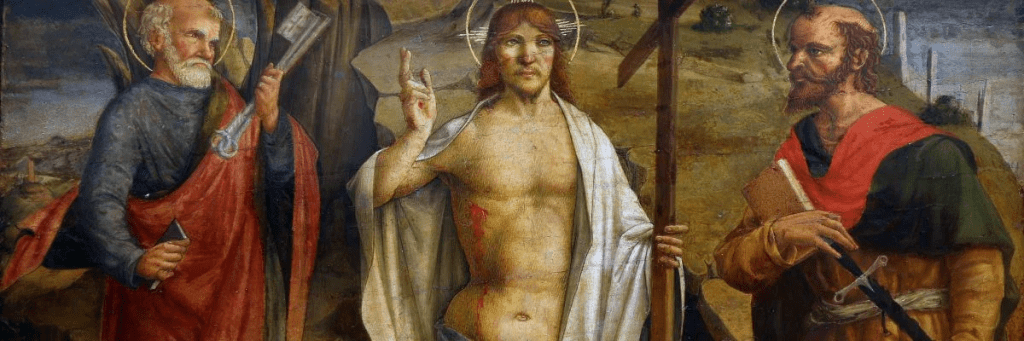
Very interesting. Let’s start with the holy stone or rock, a symbol also found in the scripture of all three Abrahamic religions. Generally, the rock is interpreted wrongmindedly as an actual stone in the temples of Jerusalem and Mecca. The holy stone is, in ruth, the Soul standing upright in the Land of the Living (as opposed to upside down in the body– the land of the dead). And that upright or righteous perception of our universal “I-Am-ness” is indeed the cornerstone upon which the Temple is built. It’s also, btw, the rock upon which Jesus instructed Peter to build his church — the inner Temple of the Christ Self, not the physical church of any worldly religion. Jesus named Simon “petros” or “peter” to indicate that he was, in truth, a Son of God, rather than a son of man. The new name was meant as a perception-shifting tool, not to designate Peter as the chosen founder of formalized Christianity.
Prithu is a bit of a curiosity, as he’s believed to be an incarnation of Vishnu, even though he isn’t listed among the standard ten avatars. The name is a compound of prith (extending or spreading) and u (a shorthand Vedic designation for Shiva). And Shiva is the transformative power of grace, so Prithu spreads the reach of grace in the dream of earthly existence.
This fits with the lore, wherein Prithu chases the earth goddess, Prithvi, who flees in the form of a cow, but eventually agrees to yield her milk to end the longtime world famine. I hear echoes of the Greek myth of Io, the high priestess of Hera, with whom Zeus had an affair. To hide his infidelity from his wife, he turned his lover into a cow.
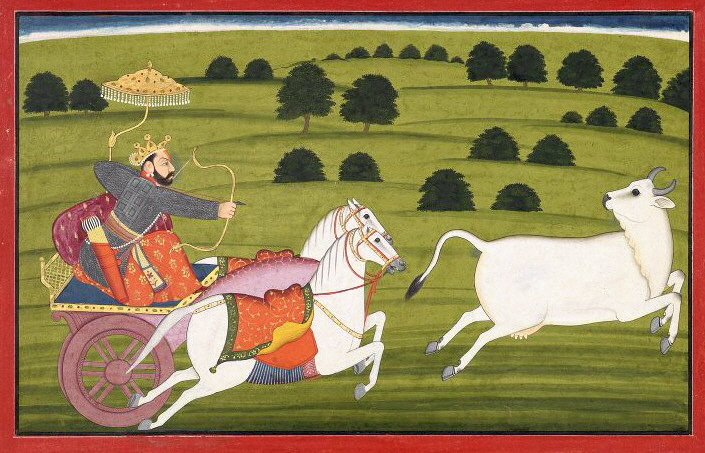
The myths suggest that Prithu represents the aspect of Vishnu presiding over our secret almsgiving meditations. to extend Shiva’s grace around the Circle of All Beings, via the Miracle Net.
In the Mahabharata epic and the Vishnu and Bhagavata puranas, Prithu is described as a “part-avatar” of Vishnu. Born ayonija (without the yoni), he is untouched by ego desires and can thus control his senses to “rule his (inner) kingdom” in accordance with Dharma. To be born ayonija is to be born in spirit, rather than through physical reproduction. Mystically speaking, the yoni symbolizes the upside-down triangle of Prakriti consciousness — the unreal physical existence into which our reincarnating Souls are born to make the circle-journey. That upside-down triangle is, in fact, the pyramid we must turn right-side up again to restore our memories of Divine Reality. When right-side-up, the triangle forms the “Shiva Lingam” representing purified Purusha or Christ consciousness.
I explained all this in earlier posts, but it bears repeating.
So, to say Prithu was born ayonija means he was born in Purusha consciousness — and that’s almost certainly what Jesus’s “virgin birth” also signified. In fact, the more I learn about Prithu, the more I believe he represents Jesus. And the reason he’s described as a “part avatar” is that he was manifested by the Holy Spirit (Vishnu) to exemplify the goal of the curriculum. To master the curriculum, we must become like Jesus, the gestating spirit of Kalki, the tenth avatar of Vishnu who must be reborn through us on earth.
In the Course, Jesus says:
I am the manifestation of the Holy Spirit, and when you see me it will be because you have invited Him. For He will send you His witnesses if you will but look upon them. Remember always that you see what you seek, for what you seek you will find. The ego finds what it seeks, and only that. It does not find love, for that is not what it is seeking. Yet seeking and finding are the same, and if you seek for two goals you will find them, but you will recognize neither. You will think they are the same because you want both of them. The mind always strives for integration, and if it is split and wants to keep the split, it will still believe it has one goal by making it seem to be one. (ACIM, T-12.VII.6:1-8)
What he means, I believe, is that we won’t find salvation on the Ego’s terms, because Satan’s definition of salvation excludes God’s requirement of restoring universal brotherhood. We will only find the salvation we seek on God’s terms, by loving each other as fellow Souls seeking only to do God’s Will.
Allow me to present the evidence supporting my supposition that Prithu represents Jesus. First and foremost, Prithu was born the “first consecrated king” — the King of Kings, in other words. On his right palm was the “mark” of Vishnu’s Sudarshana — the “chakra” representing the Spiritual Eye and the sixth plane of consciousness, where the eye is fully open. He was born with Christ’s Vision, in other words. His birth was treated as a yajna — a sacred offering from the Creator — not a sacrifice! He was crowned immediately, after which the “sutas” — the charioteers — sang his glories.
Implored (at some point) by his subjects to end the famine on earth, Prithu pursued Prithvi (who wasn’t yet called Prithvi) in the form of a cow with his bow and arrows (his arrowlike meditative focus). After cornering her, Prithu agreed to spare her in exchange for her “milk” — the miracles he would “bring down to earth” to end the drought and increase the greater (spiritual) food supply.
He milked her using a calf representing Swayambhuva Manu — the Hindu equivalent of Adam, the Red Ray whose sparks are our Souls. In so doing, Prithu gave “life” to her calf and also became its “father” and “protector” in the world.
Before Prithu’s reign, there was “no cultivation, no pasture, no agriculture, and no highway for merchants.” There were, that is to say, no spiritual fruits to be gained by sharing thoughts or interests and no way out, because the door was barred until Jesus was glorified. And so, the Atonement Plan existed only in principle hitherto.
Pretty interesting, right? Even more interesting is that this Vedic teaching was recorded long before Jesus walked the earth — but so were the Biblical prophecies of the coming Messiah. If I’m right about Prithu’s identity, the verse under discussion could be read thusly:
The holy rock, Jesus sings the Om (the Living Water) to enlarge the universal divine passage from our purposeful meditations on the eternal.
And it is indeed Jesus — or what he represents — that sings the Living Water to our Souls. Never forget that the dream is over and what we’re living through is the recorded memory of what already happened on earth and in the material universe. So, the Rigveda might have been “revealed” thousands of years before Jesus came into our bogus linear perception of time, but on the Holy Spirit’s clock, he’d already come and gone (so to speak) many eons earlier.
Am I blowing your mind? Good. I hope I blow it wide open — and mine along with it.
The universal divine passage the rishis mentioned herein is, of course, the hole we pierce in the shell of Brahma’s “egg” by listening to the Om in meditation. That hole is “the door” at which WE stand and knock by listening. That Jesus knocks at the door, waiting for us to let him in, is an error in translation.
What he says about the door in the Bible affirms this. As a manifestation of the Holy Spirit, Jesus is the Master of the House. If we knock and he doesn’t know us, he says, we can’t come in. He doesn’t know us until we have the mark of the Beast — if, that is to say, we don’t hear the Living Water, and use the sound as God intended.
For those of you studying the Course, know that the Atonement is the Om. To accept the Atonement for ourselves is, therefore, to hear the sound and invest time listening to it in meditation to achieve our own release, together with the whole world’s.
Or, as Jesus explains in the Course:
God’s plan for your salvation cannot change, nor can it fail. Be thankful it remains exactly as He planned it. Changelessly it stands before you like an open door, with warmth and welcome calling from beyond the doorway, bidding you to enter in and make yourself at home, where you belong.
Here is the answer! Would you stand outside while all of Heaven waits for you within? Forgive and be forgiven. As you give you will receive. There is no plan but this for the salvation of the Son of God. Let us today rejoice that this is so, for here we have an answer, clear and plain, beyond deceit in its simplicity. All the complexities the world has spun of fragile cobwebs disappear before the power and the majesty of this extremely simple statement of the truth.
Let’s move on to our next Vedic verse (Rv 1.9.8), which reads: asme dhehi sravo brhad dyumnam sahasrasatamam indra ta rathinir isah. By my calculations, those words translate more or less as follows:
The holy rock bestows the streaming Om to expand the Power and Glory of the mighty essence of Wholeness, the power of Indra, the formless chariot of Isha.
My definitions:
asme (the holy rock) dhehi (bestows) śrav-o (the streaming Om) bṛhad (to enlarge or expand) dyumnaṃ (the Power and Glory) sahas-rasā-tamam (of the mighty essence of wholeness) indrata (the power of Indra) rathi-nīr (the formless charioteer of) iṣaḥ (Isha, the Supreme Lord, formless divine, or universal Soul or Self)
My notes:
Like I just said. The rock bestows the Om. In Hinduism, Isha refers to the divine inner Self, as well as to Jesus, who symbolizes the same idea. As a charioteer, Indra is Aruna, the driver of the chariot-throne of Surya, the Hindu version of the Solar Logos, Elohim or Allah. And he is indeed the Supreme Lord in the dream, as well as the divine inner self. In Sanskrit, Aruna means “the first red ray of dawn.” In the lore, Aruna is the son of Kashyapa, the father of the Vasu, and the brother of Garuda, the divine eagle serving Lord Vishnu.
Our second-to-last verse (Rv 1.9.9) reads: vasor indram vasupatim girbhir grnanta rgmiyam homa gantaram — words that translate thusly:
Convey the sound of Indra, the Lord of the Vasu, the voice of the multitudes stringing together the laudable sacred-fire rituals offering the temple bell of Rama.
My definitions:
va-sor (convey the sound) indraṃ (of Indra) vasu-patiṃ (the Lord of the Vasu) gīrbhir (the Voice of the multitudes) gṛṇanta (stringing together) ṛgmiyam (the laudable or praise-worthy)| homa (sacred-fire rituals offering) gantā-ram (the temple bell of Rama).
My notes:
Little explanation is needed, apart from the deeper meaning of ganta-ram, the Temple Bell of Rama. In Hindu practice, the temple bell (ghanta) represents a sacred invitation to the divine, often rung upon entering a temple to alert the deity, clear negative energy, and focus the mind. Lord Rama, the sixth avatar of Vishnu, is one of the deities invoked in this manner. Most notably, a 600 kg bell, inscribed with Jai Shri Ram, was recently installed at the Ayodhya Ram Mandir, a significant temple erected to Rama in Uttar Padesh, a province in Northern India.

The temple bell the rishis mean is, of course, the ringing vibration we share in the inner temple to dissolve the inverted perception of individuality. As Hinduism rightly teaches, that ringing sound is the Om, the universal name of God our souls sing together in the Resting Place, where they stand upright in the Circle of All Being. That Golden Circle exists deep-down in our heart-minds, and is only accessible by meditating with pinpointed focus on the sound of God’s Word ringing in our minds.
That sound is the Voice of the Holy Spirit.
That sound is the rock of salvation.
That sound is the cornerstone of the temple.
Knowing this Abwolute Truth should clarify the meaning of everything the Bible says about the stone, the rock, and the cornerstone. Here’s a link to all the verses, if you’re ready to accept my mind-opening challenge.
Or, to again quote Course-Jesus.
There is a place in you where this whole world has been forgotten; where no memory of sin and of illusion lingers still. There is a place in you which time has left, and echoes of eternity are heard. There is a resting place so still no sound except a hymn to Heaven rises up to gladden God the Father and the Son. Where Both abide are They remembered, Both. And where They are is Heaven and is peace. (ACIM, T-29.V.1:1-5)
The Sukta’s tenth and final verse reads: utaye sutesute nyokase brhad brhata ed arih indraya susam arcati — words that translate thusly:
Arise and bring forth that son in the eternal abode expanding the blood of brotherhood in the now moment (when) Indra’s inner-peace shines forth.
My definitions:
ūtaye (Arise) sute-sute (and bring forth that son) nyokase (in the eternal abode) bṛhad (expanding) bṛhata (the blood of brotherhood) etarih (in the now moment) indrāya (the time when Indra’s) śūṣama (inner-peace) rcati (shines forth)
My notes:
For this line to make sense, I had to shuffle some letters between words. Ed (look or behold) and arih (enemy), for example, made no sense with the rest of the line, so I futzed around until I came up with etarih (in the now moment). LIkewise, Susam and arcati were problematic. I solved the problem by moving the “a” at the start of arcati to make susum into susama, which gave us “inner-peace shines forth.” And that passes the double litmus test of making sense contextually and communicating truth.
For, God’s peace does indeed shine forth from within us, as Course-Jesus affirms below:
If you would look within you would see only the Atonement, shining in quiet and in peace upon the altar to your Father. (ACIM, T-13.IX.7:6)
To help us feel and share that radiant peace, he gives us the following prayer (in Workbook Lesson 88), which I use quite often in my daily yajnas.
The peace of God is shining in me now.
Let all things shine upon me in that peace.
And let me bless them with the light in me.
To close today’s discussion, let me share another lesson from the Course, which encapsulates the ideas presented in the 9th Sukta. The lesson I mean is No. 283: My true identity abides in you. The lesson starts with this perfect prayer:
Father, I made an image of myself, and it is this I call the Son of God. Yet is creation as it always was, for Your Creation is unchangeable. Let me not worship idols. I am he my Father loves. My holiness remains the light of Heaven and the Love of God. Is not what is beloved of You secure? Is not the light of Heaven infinite? Is not Your Son my true Identity, when You created everything that is?
To the prayer, Jesus adds:
Now are we one in shared Identity, with God our Father as our only Source, and everything created part of us. And so we offer blessing to all things, uniting lovingly with all the world, which our forgiveness has made one with us.
The whole Ninth Sukta reads as follows:
When Indra discharges Matsya to kindle the Om, the universal light of Soma’s fullness sends forth abundantly the Red Ray spreading the essential energy of God.
The Spiritual Path produces the birth of the Spirit of Joy–the light of Indra inspiriting the circle of the totality of existence, the Circle of All Beings.
Matsya is the holy power advancing the shining female elephant with the songs of praise of the universal watchers, the servants of God’s arrow ablating the True Self.
The Blood Ray of Indra is the thundering call to return to the True Self up above speaking the Absolute Truth of God, the eternal Word raining down the light of the Bridegroom.
Coming together drives the horses of the Bright Ones (the Sefirot or Mahavidyas), the spokes of the wheel speaking for selfless devotion and service to Indra, the chosen vehicle in unreality for the Supreme Lord of the Highest Heaven.
The charioteer protects the driving forces of Indra, the divine resources of the inner radiance, the great splendor conveyed without ownership by coming together in the abounding milk of Indra’s forceful sound.
The holy rock, Prithu sings the Om to enlarge the universal divine passage from our purposeful meditations on the eternal.
The holy rock bestows the streaming Om to expand the Power and Glory of the mighty essence of Wholeness, the power of Indra, the formless chariot of Isha.
Convey the sound of Indra, the Lord of the Vasu, the voice of the multitudes stringing together the laudable sacred-fire rituals offering the temple bell of Rama.
Arise and bring forth that son in the eternal abode expanding the blood of brotherhood in the now moment (when) Indra’s inner-peace shines forth.
Thanks for visiting. I hope you found today’s discussion illuminating. Until next time, Om Hari Om and and Namaste.
 The Holy Meeting Place
Leave a comment