Translating the Rigveda’s Eight Sukta was no small feat. Not only were Max Muller’s “preserved meters” way off, correct definitions for the majority of words also were exceedingly hard to come by. The first of these elusive words came at the outset. That word was endra, which is almost universally misinterpreted as another form of Indra. Many translators have, in fact, changed the spelling to Indra. Some have also dropped the long “a” that proceeds “endra” at the start of the opening line; while others have mistranslated the a as a praiseful “O” — as in “O Indra.”
As I’ve demonstrated right-along, the stand-alone letter a translates as “God’s,” “of God,” “divine,” or “divinity.” So, “a endra” can’t possibly mean “O Indra.” Furthermore, the eighth Sukta, like the preceding seven, is a narrative wisdom-teaching, rather than a hymn of praise or an ancient poem. So, “O Indra” can’t be right — and it isn’t, because the “a endra” that opens Rv 1.8.1 actually means “God’s Majesty.”
In transliterated Sanskrit, the line reads: a endra san-asim rayim saji-tvanam sada-soham varsistham utaye bhara ni yena mustiha-tyaya — as opposed to endra sānasiṃ rayiṃ sajitvānaṃ sadāsaham varṣiṣṭham ūtaye bharaa (as per Max Muller) or indra sanasim rayim sajitvanam sada-saham varsistham utaye bhara (as per Padapatha).
When rightmindedly translated, the first line reads:
God’s Majesty bestows the infinite treasures obtained together in the Self-Knowledge of the Eternal I Am, the uppermost ascent of the radiant splendor underneath, the means by which attack thoughts are given up.
Word for word, the line translates thusly:
a (God’s) endra (Majesty) sān-asiṃ (bestows the limitless or infinite) rayiṃ (treasures) saji-tvānaṃ (obtained together in the Self-Knowledge of) sadā-soham (the eternal “I Am that I Am”) varṣiṣṭham (the uppermost) ūtaye (ascent) bhara (of the radiant splendor) ni (underneath) yena (the means by which) muṣṭiha-tyayā (attack thoughts are given up).
My notes on Rv. 1.8:1
I’m pretty sure that’s right, because Jesus speaks of God’s Majesty in very similar terms several places in the Course. In one of those places, he says:
When a mind has only light, it knows only light. Its own radiance shines all around it, and extends out into the darkness of other minds, transforming them into majesty. The Majesty of God is there, for you to recognize and appreciate and know. Recognizing the Majesty of God as your brother is to accept your own inheritance. God gives only equally. If you recognize His gift in anyone, you have acknowledged what He has given you. Nothing is so easy to recognize as truth. This is the recognition that is immediate, clear and natural. You have trained yourself not to recognize it, and this has been very difficult for you. (ACIM, T-7.XI.5:1-9)
The Rik’s reconfigured second line now reads (sans the diacritical marks): nivrtra runadhamahai tvotaso ny arvata-indra tvotasa avayam, which translates roughly as follows:
Turn inward to sound the divine vibration of the Mighty Kamadeva sustained by Soma inside the moving celestial breath of Indra, the sustainer of God’s Word, the eternal divinity in all of us.
My word-for word translations are these:
ni-vṛtrā (Turn inward) ru-ṇadhā-maha-i (to sound the cosmic vibration of Mighty Kamadeva) tvotāso (sustained by Soma) ny (inside) arvata (the moving celestial breath) indra (of Indra) tvotāsa (the sustainer of God’s Word) āvayam (the eternal divinity in all of us)
My notes on Rv. 1.8:2:
Like I said, finding suitable definitions for many of these words proved challenging. Tvotaso and tvotasa being two prime examples. In the end, I went with tvota-so and tvota-sa, because tvota is a word, meaning “favored,” “sustained,” “loved” or “protected” (by thee?), whilst so is shorthand for Soma and sa is shorthand for the Word of God.
Arvata was another tough nut to crack. Supposedly, arvata is an alternative spelling of arbbata, which means “ashes.” But there’s nothing in the Hindu lore concerning “the ashes of Indra,” so that definition didn’t seem right. That arvat means “horse-driver” or “charioteer” had more promise. The divine charioteer? Maybe, but still iffy, since Indra is called Aruna, when cast as the charioteer of Surya, the Solar Logos. Arvata might also be an abbreviated form of Airavata, King Indra’s white elephant vahana. But that definition would make the sentence structure awkward.
A better possibility was that arvata was a compound of ar (moving or advancing) and vata (the celestial breath or wind).
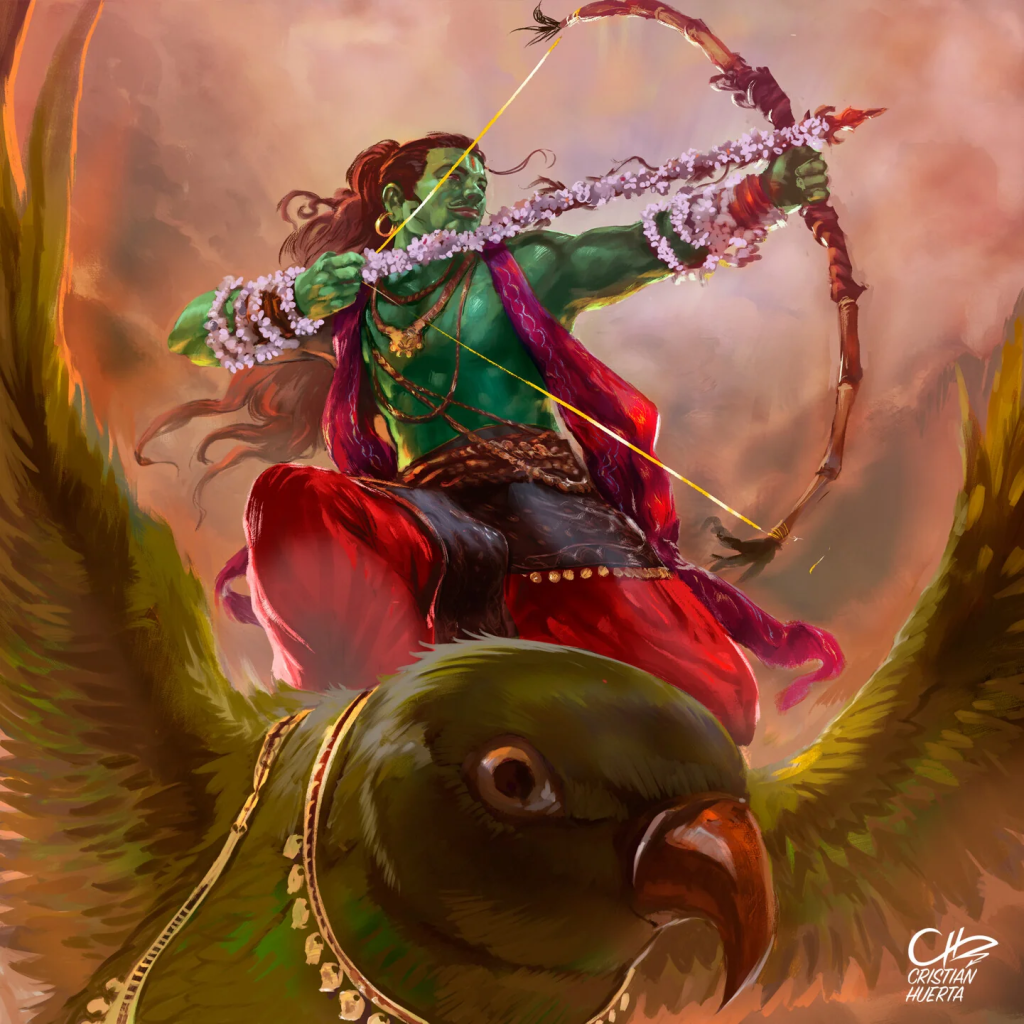
Before we move on, let’s talk about maha-i, which I’ve translated as Mighty Kamadeva, the deified power of God’s Love (Love of God, rather than god of love). So maha-i translates as “the Mighty Love of god”– an expression we also find in reference to the Cosmic Chorus in the following from the Course:
This tiny spot of sin that stands between you and your brother still is holding back the happy opening of Heaven’s gate. How little is the hindrance that withholds the wealth of Heaven from you. And how great will be the joy in Heaven when you join the mighty chorus to the Love of God! (ACIM, T-26.IV.6:1-3)
Let’s proceed to Rv 1.8.3, which now reads: vayamvajram ghana dadimahi jayema sam yudhi sprdhah vayam surebhir astrbhir indra tvaya (vs. indra tvotāsa ā vayaṃ vajraṃ ghanā dadīmahi jayema saṃ yudhi spṛdhaḥ, as per the Oxford trio). By my calculations, the line translates as follows:
All of us strengthen the radiant cloud bestowing Mahi (the power of love? the goddess of higher wisdom?) to overcome in unity the battleground of enmity.
My word-for-word definitions are:
Vayam (All of us) vajraṃ (strengthen the radiant) ghanā (cloud) dadī-mahi (bestowing Mahi) jayema (to overcome or conquer) saṃ (together or in unity) yudhi (the war against) spṛdhaḥ (quarreling or enmity).
My notes on Rv. 1.8:3:
The Bible also mentions the war against enmity, as well as the radiant cloud, the pillar of vapor that leads the wandering Israelites to the Resting Place in the desert. And Course-Jesus uses the term “battleground” to describe the world we make through fear and hate.
He says, for example:
Do not remain in conflict, for there IS no war without attack. The fear of God is fear of life, and not of death. Yet He remains the only place of safety. In Him is no attack, and no illusion in any form stalks Heaven. Heaven is wholly true. No difference enters, and what is all the same cannot conflict. You are not asked to fight against your wish to murder. But you are asked to realize the form it takes conceals the same intent. And it is this you fear, and not the form. What is not love is murder. What is not loving must be an attack. Every illusion is an assault on truth, and every one does violence to the idea of love because it seems to be of equal truth. (ACIM, T-23.IV.1:1-12)
Mahi could mean many things, including “the power of love.” According to The Incarnate Word, a website honoring the teachings of Sri Aurobindo, Mahi represents the Vast Truth or Vast Word (Mahas) in the Vedas. Mahi also is the name of the Hindu goddess of higher wisdom, who is sometimes called Bhumi or Bharati.
Bhumi, as we know, is the first aspect of Lakshmi walking in the southwest “earth-dharma” quadrant of the Circle. So Bhumi, Mahi, and Bharati may be three different forms of the same “goddess” or aspect of the Soul. But are they? The more I read, the more I wonder. Mahi also is the name of a major north-flowing river in western India. Although not generally considered one of the seven sacred rivers, the Mahi is described in the Skanda Purana as a sacred river with the power to grant liberation and purify sins.
To learn more about Mahi, let’s jump ahead to the Rigveda’s thirteenth Sukta, wherein she is mentioned in company with two other goddesses. In transliterated Sanskrit, the verse reads: iḻā sarasvatī mahī tisro devīr mayobhuvaḥ barhiḥ sīdantv asridhaḥ, which I’ve translated thusly:
Ila, Sarasvati and Mahi–the three female divine beings shaking the healing waters of the sacred grass to accomplish the goal of Amen–do not fail.
iḻā sarasvatī mahī trisro (the three female) dev-īr (divine beings shaking) mayo-bhuvaḥ (the healing waters of) barhiḥ (the sacred grass) sīd-antu (to accomplish the goal of Amen) asri-dhaḥ (do not fail)
When translated correctly, this verse affirms that Mahi is indeed a Vedic goddess who, with Ila and Sarasvati, shake or churn the Ocean of Milk to release the healing waters of higher wisdom.
Ila is the goddess of speech or communications, so let’s assume she represents God’s pure communications; Sarasvati is said to be the goddess of higher wisdom and learning, whose name means either “she who possesses the water” (saras-vati) or “the power of the rain drop that becomes a pearl” (sara-svati). The rain-drop that becomes a pearl describes the fiery pearl or agni-magni strung together on Indra’s Net. Those fiery pearls are miracles. So, Sarasvati represents the perception-transforming power of miracles.
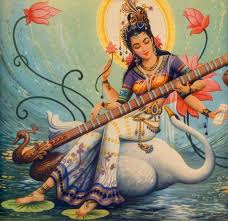
If my instincts are right about Mahi meaning “the power of love,” then the three goddesses churning the Ocean of Milk (to bring forth the milk of truth) represent the power of love, the power of miracles, and the power of God’s pure communications. And that makes perfect sense. It also explains why Sarasvati and Surabhi, the miracle-cow, have many features in common.
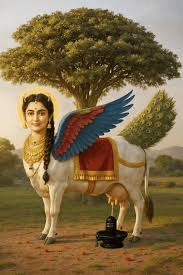
So, Bhumi and Mahi are two names for the “dharma” aspect of Lakshmi. In the Hindu lore, Bhumi is married to Varaha, the boar-headed avatar-incarnation of Lord Vishnu. According to the legends, Vishnu transformed himself into a boar to save Bhumi after the asura Hiranyaksha dragged her into the Primordial Ocean. After rescuing Bhumi, Vishnu married her, still in his boar-headed form. Hiranyaksha means “golden-eyed,” as in covetous of earthly gold and wealth. This suggests it was our materialistic desire for earthly wealth that dragged us into the dark waters of lower consciousness.
Let’s move on. The Sukta’s next line is pretty short, so it might belong to Rv 1.8.3 — or it might be the first part of Rv 1.8.4. Hard to say. The line reads: vayam surebhir astrbhir indra tvaya, which translates as follows:
All of us are divine beings of pure light projected by King Indra, the light of the true mode of being.
My word-for-word definitions are:
vayaṃ (all of us) śūrebhir (are divine beings of pure light) as-tṛbhir (projected by) indra (Indra) tvayā (the light of the true mode of being).
My notes on Rv 1.8:4:
Compare my translation to what Course-Jesus says below:
The truth in you remains as radiant as a star, as pure as light, as innocent as love itself. And you ARE worthy that your will be done! (ACIM, T-31.VI.7:4-5)
In many only the spark remains, for the Great Rays are obscured. Yet God has kept the spark alive so that the Rays can never be completely forgotten. If you but see the little spark you will learn of the greater light, for the Rays are there unseen. Perceiving the spark will heal, but knowing the light will create. Yet in the returning the little light must be acknowledged first, for the separation was a descent from magnitude to littleness. But the spark is still as pure as the Great Light, because it is the remaining call of creation. Put all your faith in it, and God Himself will answer you. (ACIM, T-10.IV.8:1-7)
The next line also is short, so it might belong to the previous one. Let’s therefore combine the two short lines to make a new-and-improved Rv. 1.8.4. The second half of that verse now reads: yuja vayam sasahyama prtanyatah, which translates as:
The Yoke of all of us, the Word of God supports creation’s army underneath (the illusion of matter).
My definitions are these:
yujā (the yoke) vayam (of the all) sā-sahyā-ma (the Word of God supports Creation’s) pṛtanya-taḥ (army fighting underneath)
If the two lines are indeed meant to be one, Rv. 1.8:4 would read thusly:
All of us are divine beings of pure light projected by King Indra, the light of the true mode of being. The Yoke of us all, the Word of God supports creation’s army underneath (the illusion of matter).
My notes:
Creation’s Army are the forces God created to carry out his will to “make earth like heaven,” acting as a functional army underneath the illusion manifested by the Ego Mind.
The Sukta’s next much-longer line (Rv 1.8.5 or Rv 1.8:6) reads: maham indrah paras canu mahitvam astu vajrine dyaurna prathina savah samohe vaya asata nara stokasya.
The grandeur of Indra’s breath is the touchstone sound of Shiva, the glorious Amen, the thundering power of the lamp of the third eye extending the radiance bringing together the Assembly to move in the manifested unreality Nara’s offspring.
My definitions:
ahām̐ (the granduer of) indraḥ (Indra’s breath) paraś (is the touchstone) can-u (sound of Shiva) mahitvam (the glorious) astu (Amen) vajr-iṇe (the thundering power) dya-urna (of the lamp of the third eye ) prath-inā (extending the radiance) śavaḥ (bringing together) samohe (the Assembly) vāya (to move) āśata (in the manifested unreality) naras (Nara’s) tokasya (offspring)
My notes on Rv. 1:8.5 or 6:
If I read this right, the rishis are saying that Amen is the touchstone sound of Shiva thundering in the Ajna chakra, the Lamp of the Third Eye, to extend the light bringing together the Assembly to move Nara’s offspring in the manifested unreality of earthly existence.
A bit complicated, so let’s break it down into digestible pieces. The touchstone sound of Shiva is the touchstone sound of grace –the Om vibration or Living Water, rather than the “touchstone mantra,” Om namah Shivya. Repeating the mantra invokes the sound of God’s voice speaking the wordless Om or Amen.
Nara’s offspring are mentioned in the Dharmashastra, a genre of ancient and authoritative Sanskrit texts guiding Hindus on religious, legal, and ethical duties for individuals and society. According to Google, the Dharmashastra describes Nara’s offspring are the sacred waters Nara produces in a familial way. Nara doesn’t mean “human” or “man” any more than does “Adam.” Like Adam, Nara is the light of God within human beings. And that light generates the waters of purification when our Souls join together in the Gathering Place to strengthen God’s will to heal the separation.
Our next verse — Rv 1.8.6 or 7 — reads: sanitau vipraso va dhiyayavah yah kuksih soma-patamah samundra-iva pinvate urvir apo na kakudah. In English, the teaching reads as follows:
To obtain Shiva, the singers (or Brahmins), along with those who understand — the ones who, in the womb of Soma remove darkness by gathering together the waters to pour forth the cosmic vibration of the Greater Light, the waters of life flowing from the Great Purusha’s holiness.
sanita-u (to obtain Shiva) viprāso (the singers) vā (as well as) dhiyā-yavaḥ (those who understand) yaḥ (the one who) kukṣiḥ (in the womb) som-apātamaḥ (of the Moon removes darkness) samudra-iva (by gathering together the waters) pinvate (to pour forth) ur(a)vīr (the cosmic vibration of the Greater Light) āpo (apah = the waters of life) na (flowing from) kā-kudaḥ (the Great Purusha’s holiness)
My notes on Rv. 1.8:6 or 7:
If you’ve been paying attention, this should make sense. This also affirms my earlier definition of Brahmin, as someone who hears the Om. If we hear the sound, we automatically belong to the Cosmic Choir, but we still have to intentionally give the water through our almsgiving prayer rituals or Agni-spreading yajnas. In our minds, those giving rituals look very much like the image below.
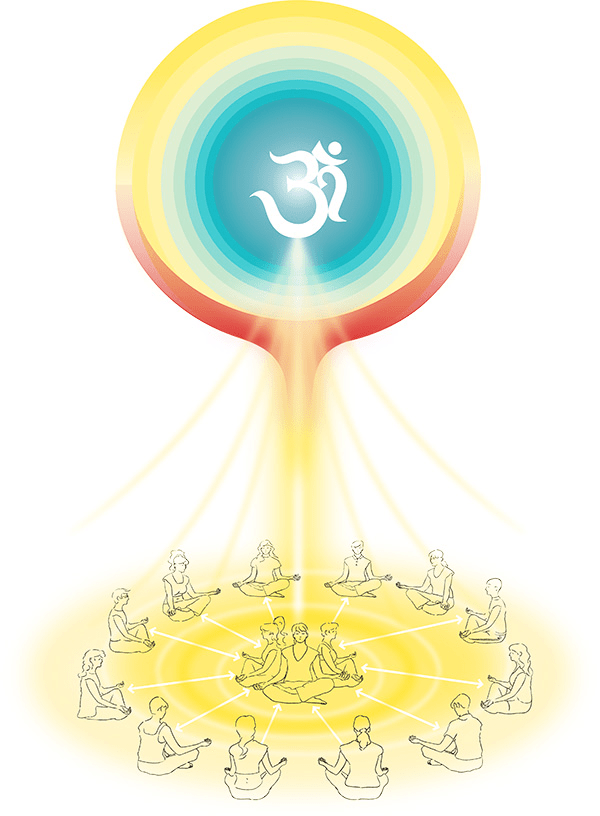
While originally drafting this post in 2025, I had a vision. I can’t say for sure if I was awake or asleep, but I do know that it was a message from my Waheguru. First, I saw the Golden Circle of the vibratory Om, stretching into infinity. Then, I saw myself in the center of that circle. As I watched, the image of “me” jumped in and out of the circle a few times. Each time my image jumped into the circle’s center, I heard the words, “Om Hari Om.” And I knew the Guru was instructing me to use that particular mantra in my yajna meditations thereafter.
At the time, I didn’t know if “Om Hari Om” was an actual Hindu mantra, so I looked it up the next morning. And, well, DUH. Not only is “Om Hari Om” a real mantra, it’s a powerful “universal mantra” used to remove “suffering” and other obstacles to awakening. And I had been asking lately which mantra was best, because I’d tried several, in addition to my fallback japa of “Jesus Christ” (as per the Course’s Manual for Teachers). So, the vision really was the answer to my prayer.
Our next and final three verses all start with the Sanskrit word Eva, which supposedly means “certainly,” “indeed,” “thus,” or “alone” in the sense of only. I say supposedly because I question those definition for two good reasons. The first is that Sanskrit words defined as “certainly,” “indeed,” or “thusly” — of which there are way too many — are red flags. Can there really be dozens of words meaning “indeed” or “certainly”? Of course not. When I come across such cop-out definitions, I immediately know the word’s real meaning stumped the so-called experts. As a demonstration of the alternative definition of “alone,” Google gives the popular mantra Jalam eva jeevanam, as an example. The mantra allegedly translates as “water alone is life.” BUT, isn’t it far more likely, the translation is wrong? Firstly, water alone isn’t life. Water may sustain mortal life to some extent, but it doesn’t give life.
I contend, therefore, that jalam eva jeevanam translates as “the water of spirit is life.”
Now, the statement is true. It’s also a theological concept that the Holy Spirit acts as a refreshing, cleansing, and lifegiving force. The giver of “the waters of life” Christians call “Living Water.”
The second reason I question the alleged definition is that Eva has another meaning in several languages derived from Sanskrit. In Latin, Hindi, and Urdu — three languages with Sanskrit roots — eva means “source of life” or “the living one.” Ditto for Aramaic and Greek. In the Bible, the Hebrew word translated as “Eve” in the Old Testament was Chava, which also means “the source of life,” “the living one,” or “the vital breath.” What, then, are the chances Eva really means “thus” or “indeed” in the Rigveda? The answer is: somewhere between zilch and zip. The chances are far better that Eva refers to the Breath of Life that is the Holy Spirit.

To support my hypothesis, I present the following evidence:
–In Christian theology, the Breath of God refers to the Holy Spirit of God’s life-giving presence.
–In Hebrew, the word Ruach means “Breath of God,” “Wind of God,” or “Spirit of God.”
— In Genesis 1:1-4, Ruach is the Spirit of God that brings order and light into the world.
— In Genesis 2:7, Ruach is the Breath of Life God breathed into Adam (the Soul-pearl as Eve, the connecting string).
–In Psalm 33:6, Ruach is the Breath of God that created the “heavens” — the Upper World, Celestial Realm, or the “firmament” between Heaven and Earth, where the Soul’s Circle-Journey takes place.
–In Job 27:3, Ruach is the Spirit of God in the nostrils (and I’m guessing “nostrils” has a deeper symbolic meaning).
–In Ezekiel and Revelations (as we’ve discussed), Ruach comes out of “the North Country” to reveal the four Living Beings representing the quarters of the Soul’s Circle-Journey (among other wonders)
So, there we are. And if that’s not proof enough, let’s ask the Google-bot what God’s Breath is and does.
“Hey Google, what does the Breath of God do?”
Google’s reply:
–the Breath of God animates and energizes all of Creation.
–the Breath of God shapes people into God’s image.
–the Breath of God gives people new life [in the spirit]).
–the Breath of God is a distinct presence of God that enables life.
Good and correct answers, all. Moreover, when we ask Google what the relationship is between God’s Breath and the Holy Spirit, we receive the following answer:
“The Holy Spirit is God’s Breath, God’s creative, life-giving presence.”
From all of this we can glean that Eva must be the Sanskrit word for the Holy Spirit, whereas Vayu personifies the fire-wind of Agni, which may or may not be the same “breath.” Let’s now put this theory to the test in the final three verses beginning with Eva.
The first of the three reads: Eva hy asya sunrta virapsi gomati mahi pakya sakha na dasuse, which translates thusly:
The Holy Spirit stimulates the mouth of the sacred dance breaking forth the illuminating power of love to ripen the fruits the friend of Nara delivers.
My definitions:
evā (the Holy Spirit) hy (stimulates) asya (the mouth) sū-nṛtā (of the sacred dance) virapśī (breaking forth) gomatī (the illuminating) mahī (power of love) pakvā (to ripen the fruits) śākhā (the friend or companion of) na (Nara) dāśuṣe (delivers)
My notes on 1.8:7 or 8:
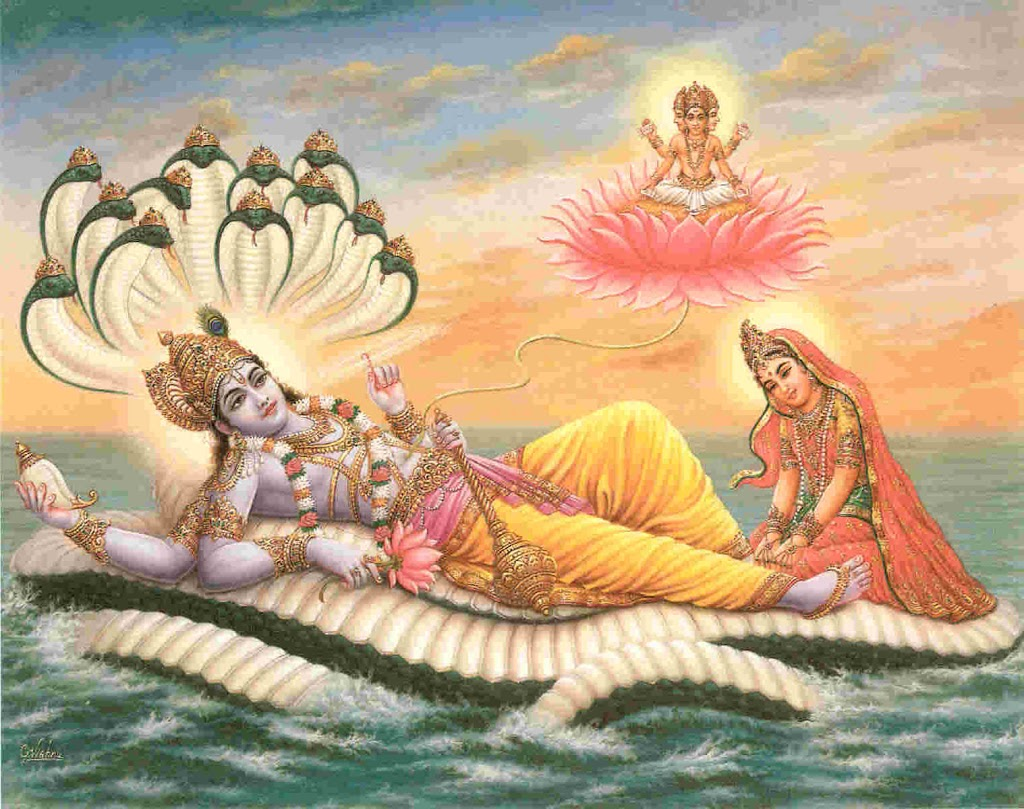
The sacred dance is performed by Shiva, in his Nataraja form, to spread the sacred fire of divine will advancing the Mandala of Lakshmi’s walking journey. Nara’s friend or companion is Narayana, the form of Vishnu shown below, floating on the palanquin made by Shesha (with Lakshmi at his feet).
The second of the three Eva lines reads: Eva hi te vibhutaya utaya indra mavate sadyas cit santi dasuse. By my calculations, those words translate more or less in this manner:
The Holy Spirit sets in motion the ever-present jewel-light causing to arise Indra to establish instantly the pure consciousness of peace liberally bestowed.
My definitions: evā (the Holy Spirit) hi (sets in motion) te (the) vibhū-taya (ever-present jewel of light) ūtaya (causing to arise) indra (indra) māvate (to establish) sadyaś (instantly) cit (the pure consciousness) santi (of peace) dasuse (liberally bestowed).
My notes on Rv 1.8:8 or 9:
This appears to be about the Holy Instant in which the perception-correcting miracle is experienced. I struggled with vibhu-taya, until I finally realized taya means not “divine female energy,” as generally professed, but “jewel of light.” The jewel of light the rishis mean is the Kaustubha worn by Vishnu and Krishna, which, according to Google, “symbolizes supreme consciousness, cosmic illumination, and spiritual wealth. It also relates to the concept of Indra’s Net, where every being is a reflective, interconnected jewel in a vast cosmic web.”
Regarding the jewel, Google also says this:
“Emerging from the churning of the ocean (Samudra Manthan), [the jewel] is considered the most magnificent gem in creation, symbolizing the life force and, in some traditions, representing all conditioned souls (jivas) protected by Vishnu.”
And this:
“The Kaustubha, the divine gem worn by Lord Vishnu/Krishna, is primarily described in Hindu scriptures as a brilliant lotus-hued ruby or a deep red, radiant stone. It is often described as having the intense radiance of a sun, sometimes said to flood the universe with its ‘redness’.”
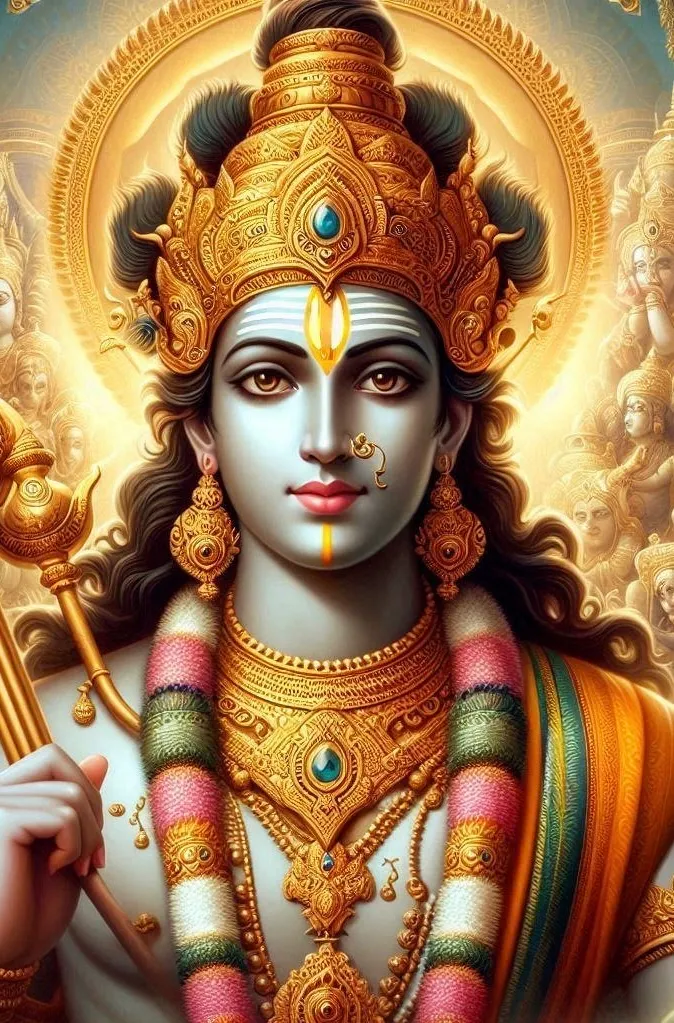
Although the gem is said to be “red” or “ruby,” it’s often depicted as aquamarine in color (as in the image below). I suspect, therefore, it’s the mysterious beryl mentioned many times by the Biblical prophets.
Nowhere could I find that Vishnu uses the jewel to summon Indra, BUT Vishnu is sometimes described as Indra’s brother. He’s also called “the preserver” (of Holy Creation0, which Indra represents as the Red Ray of God’s Supreme Creative Will, and the Father of our Souls.
We also know that Indra delegated his powers to Krishna, who keeps them safe in his jewel. In the Holy Instant, the rishis tell us in this verse, the Holy Spirit activates that jewel to to restore full power to Indra, who zaps us with his revelation-granting Vajra to wake us up.

The third of the “eva” lines, and the final verse in the eighth Sukta, reads: eva hy asya kamya stoma uktham ca samsya indraya somapitaye, which translates thusly:
The Holy Spirit stimulates the mouth of his (the Supreme Lord’s) loving song of praise Shiva utters to connect those joined together in the light of King Indra, the I-Am of the Father-Master.
My definitions:
evā (the Holy Spirit) hy (stimulates) asya (the mouth of his) kāmyā (loving) stoma (song of praise) u-kthaṃ (Shiva utters) ca (to connect) śaṃsyā (those joined together) indrāya (in the light of Indra) soma-pītaye (the I-Am of the Father and Master)
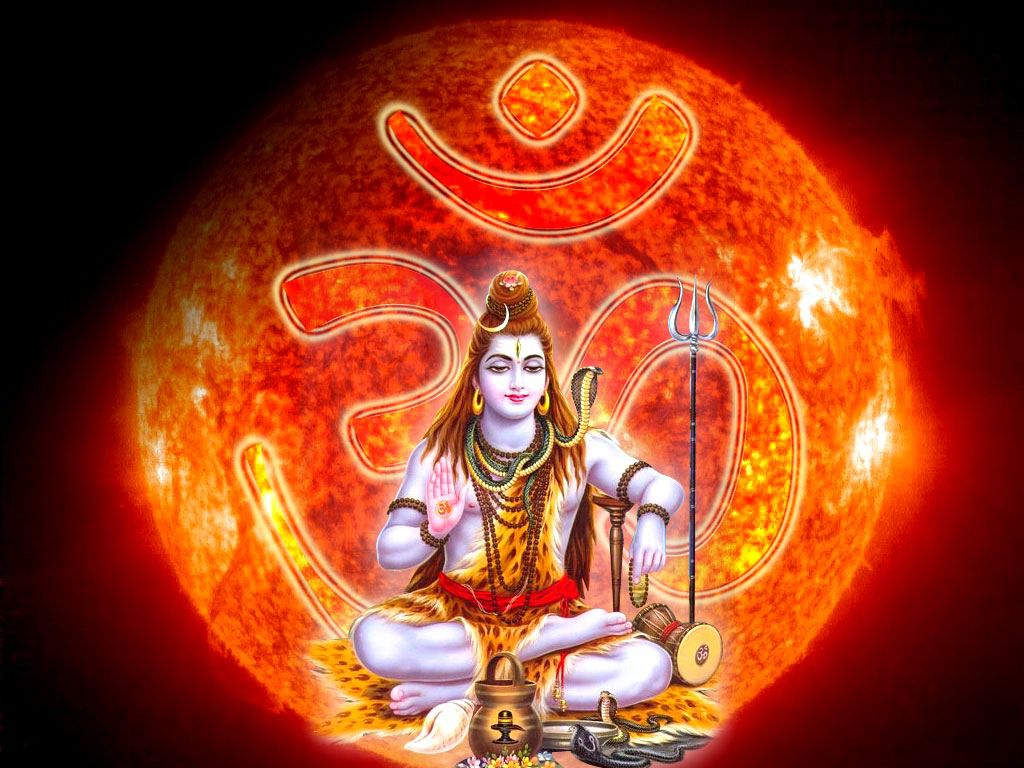
Shiva, being the transformational power of grace, utters the song of praise to God and Creation that is the Om vibration, the Living Water, and the Song of Heaven.
Google tells us:
Shiva’s utterances in Hinduism, known as vachana or divine pronouncements, primarily emphasize self-realization, non-duality, and liberation from the worldly illusion. Core teachings are found in the Shiva Sutras, which focus on purity, cosmic consciousness, and detachment. Key mantras like Om Namah Shivaya and Maha Mrityunjaya are considered direct invocations of his divine energy.
Not sure if Hindus understand that Shiva’s vachana(s) are, in fact, the Om vibration. But everything Google describes is, indeed, true of the sweet sound of Grace. A compound of va and chana, the word means not “utterances,” but “hidden wind.”
Okay, so … job done. Phew. Like I said at the start, that was a tough one to translate. But we got there in the end and learned a lot along the way.
Until next time, Om Hari Om and Namaste.
 The Holy Meeting Place
Leave a comment