Let’s start our discussion of the Rigveda’s Seventh Sukta with a relevant quote from the Course — a quote so central to the process of awakening, I added it to my blogger profile to serve as a constant reminder. Because, as Jesus explains somewhere in the Text, we can not be too often reminded of the Truth of our Being.
And that Truth, as he states in Workbook Lesson 95 (I am One Self, united with my Creator), is essentially this:
You are one Self, in perfect harmony with all there is, and all that there will be. You are one Self, the holy Son of God, united with your brothers in that Self; united with your Father in His Will. Feel this one Self in you, and let It shine away all your illusions and your doubts. This is your Self, the Son of God Himself, sinless as Its Creator, with His strength within you and His Love forever yours. You are one Self, and it is given you to feel this Self within you, and to cast all your illusions out of the one Mind that is this Self, the holy truth in you. (ACIM, W-95.13:1-5)
It is given us to FEEL this Self within us, he says. And, in my experience, we FEEL that Self as a radiantly energetic fullness in the center of our chest. That radiant “fullness” is known as pleroma in Christian theology.
And it is this pleroma to which St. Paul refers in Ephesians 4:13:
Till we all come in the unity of the faith, and of the knowledge of the Son of God, unto a perfect man, unto the measure of the stature of the FULLNESS of Christ.
Listening to the Living Water for extended periods feeds that glorious pleroma, and that glorious pleroma, in turn, feeds the Living Water. In this way, the two powers work in symbiotic partnership to “cast all your illusions out of the one Mind that is this Self, the holy truth in you.”
This is both HOW the Holy Spirit engineered the At-one-ment process and WHY “drinking” or “absorbing” the Living Water (the Om vibration or Song of Wholeness) for long periods of time (in deep meditation) is an absolutely essential practice for sincere enlightenment-seekers. There is no other way, as all advanced Teachers of God will attest.
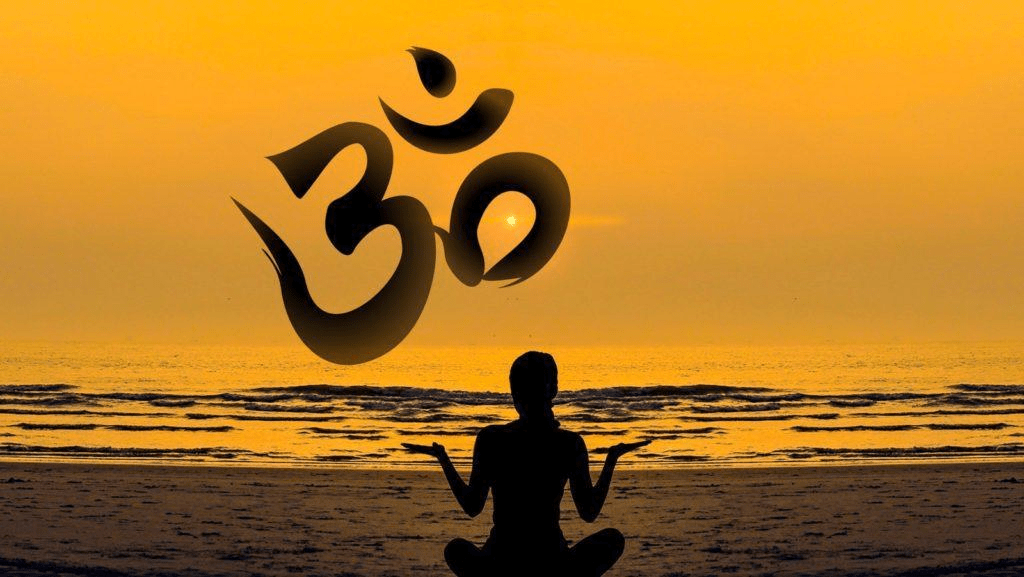
What’s this got to do with the Rigveda’s Seventh Sukta? Everything, of course. Not that we’d get that from Ralph T. H. Griffith’s rather absurd contortion of its illuminating prose. What Griffith gets right is that the Rik concerns King Indra, who is (unbeknownst to Griffith) the Red Ray of the One Self we FEEL more and more FULLY as we progress around “the radiant circle of the spiritual journey.” What he gets wrong is pretty much everything else. First and foremost, the Sukta is NOT an ingratiating hymn of praise addressed TO King Indra; it’s a teaching ABOUT what King Indra represents in Hindu theology — and how to tap into his glorious pleroma to hasten our circular sojourn toward remembrance of God.
Yes, I know. I said I wouldn’t quote Griffith and his Oxford cohorts any more, but it feels at times like I’m walking the high-wire without a balance-pole. So, I’ll share Griffith’s translation for equilibrium’s sake, and let you decide whether to read, skim, or scroll through it.
INDRA the singers with high praise, Indra reciters with their lauds,
Indra the choirs have glorified.
Indra hath ever close to him his two bay steeds and word-yoked car,
Indra the golden, thunder-armed.
Indra hath raised the Sun on high in heaven, that he may see afar:
He burst the mountain for the kine.
Help us, O Indra, in the frays, yea, frays, where thousand spoils are gained,
With awful aids, O awful One.
In mighty battle we invoke Indra, Indra in lesser fight,
The Friend who bends his bolt at fiends.
Unclose, our manly Hero, thou for ever bounteous, yonder cloud,
For us, thou irresistible.
Still higher, at each strain of mine, thunder-armed Indra’s praises rise:
I find no laud worthy of him.
Even as the bull drives on the herds, he drives the people with his might,
The Ruler irresistible:
Indra who rules with single sway men, riches, and the fivefold race
Of those who dwell upon the earth.
For your sake from each side we call Indra away from other men:
Ours, and none others’, may he be.
Having investigated the original Sanskrit, I can understand how he arrived at some of his definitions. The trouble is, he was rowing with only one oar in the water, because he had no guiding understanding of higher truth. Moreover, he wasn’t interested in uncovering whatever Great Truths the Sukta might reveal to him, because he regarded the Vedas not as timeless sacred teachings to be mined for wisdom, but as historical recordings of ancient “heathen” hymns and ritual-practices.
Griffith was, in fact, bound by the terms of the Bowden Professorship to convert as many Hindus as possible to Anglicanism. Never mind that the Church of England was established rather nefariously (in 1524) so King Henry VIII could divorce his legitimate wife and install his mistress as queen. Hinduism, in comparison, dates back to at least 5,000 BCE. Not that Hinduism is without its distortions and obscurations, of course. They are, in fact, rampant. How could they not be when Satan/Vritra has had so many millennia to work his wiles?
Luckily, we now have both oars in the water. We have the framework understanding and the Lamp of Truth to shine away those pesky distortions and obscurations. So, let’s pull hard on those paddles as we row through the Great Ocean of Vedic wisdom.
We’ll start by reviewing the whole of Rv 1.7 in transliterated Sanskrit, so we can see all the variations of the word-name “Indra.” Notably, the rishis use indram, indrah, indra, and indrasya — all of which have slightly different meanings. Insensitive to these nuances, Griffith (among others) rendered them all as plain-old Indra. So, right off the bat, we know his translations aren’t trustworthy.
indram it gāthinaḥ bṛhat indram arkebhiḥ arkiṇaḥ indram vāṇīḥ anūṣata
indraḥ it haryoḥ sacā sam-miślaḥ ā vacaḥ-yujā indraḥ vajrī hiraṇyayaḥ
indraḥ dīrghāya cakṣase ā sūryam rohayat divi vi gobhiḥ adrim airayat
indra vājeṣu naḥ ava sahasra-pradhaneṣu ca ugraḥ ugrābhiḥ ūti-bhiḥ
indram vayam mahā-dhane indram arbhe havāmahe yujam vṛtreṣu vajriṇam
saḥ naḥ vṛṣan amum carum satrā-dāvan apa vṛdhi asmabhyam aprati-skutaḥ
tuñje-tuñje ye ut-tare stomāḥ indrasya vajriṇaḥ na vindhe asya su-stutim
vṛṣā yūthā-iva vaṃsagaḥ kṛṣṭīḥ iyarti ojasā īśānaḥ aprati-skutaḥ yaḥ ekaḥ carṣaṇīnām vasūnām irajyati indraḥ pañca kṣitīnām
indram vaḥ viśvataḥ pari havāmahe janebhyaḥ asmākam astu kevalaḥ
Let’s now proceed line by line. By my calculations, the first line (indram it gāthinaḥ bṛhat indram arkebhiḥ arkiṇaḥ indram vāṇīḥ anūṣata) should translate in this manner:
King Indra animates the song of Brihaspati (the Lord of the Song of Prayer); King Indra, the Lesser Light descending from the Greater Light of Wholeness–King Indra’s loom for weaving Anu’s true nature.
My definitions:
indram (King Indra) it (animates) gāthinaḥ (the song of) bṛhat (Brihaspati, the Lord of the Song of Prayer) indram (King Indra) arkenhi (the Lesser Light) arkiṇaḥ (descending from the Greater Light of Wholeness) indram (King Indra’s) vāṇīḥ (loom for weaving) anū-ṣata (Anu’s essence, substance, or true nature)
My notes:
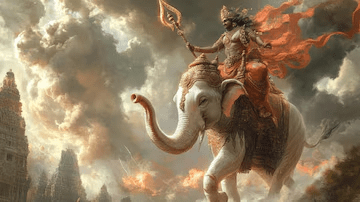
Firstly, Brhat is Vedic shorthand for Brihaspati, the Lord of the Song of Prayer, who is generally described as a divine teacher. On my old blog, I explained what Brihaspati actually represents in the Vedas. I also translated part of a Vedic teaching about Brihaspati, to back up my assertions. In case you missed those posts, Brihaspati is the deva-sage modern-day Hindus call Ganapati, Ganpati, and/or Ganesha. He is, in short, the personified Water Ray–the little brother of Airavata, the seven-headed celestial elephant representing the spouts of the fountain through which Indra communicates with us from inside the Heart Cave.
Make sense, right?
It also explains why the name Indra supposedly means “possessing drops of rain” in Sanskrit.
So, this verse tells us (among other things) that it is King Indra, the Red Ray of the One Self, who “animates” or “enlivens” the Cosmic Chorus directed by Brihaspati. It further tells us that King Indra is the Lesser Light descending from the Greater Light of Wholeness, the loom by which Indra weaves together the broken threads of Anu’s true nature.
Anu represents the Holy Trinity in the dream. And the true nature of the Holy Trinity is the Perfect Love we share and extend (as God’s creations) in wholeness to expand Holy Creation.
Let’s move on to the second line (indraḥ it haryoḥ sacā sam-miślaḥ ā vacaḥ-yujā indraḥ vajrī hira-ṇyayaḥ), which translates more or less as follows:
Indra’s breath animates Hari, the Truth endowing God’s Voice-Yoke. Indra’s breath strengthens the fire of the Golden Self (or the Crest Jewel of Discrimination).
My definitions:
indraḥ (Indra’s breath) it (animates) haryoḥ (Hari) sacā (the truth) sammiślaḥ (endowing) ā (God’s) vacaḥ-yujā (Word-Yoke) indraḥ (Indra’s breath) vajrī (strengthens the fire of) hiraṇyayaḥ (the Golden Self or the Crest Jewel of Discrimination)
My notes:
Indrah means Indra’s breath or, more specifically, the aspirations from Indra’s Mouth. The rest is pretty self-explanatory, with the possible exception of the word hiranyayah. While it might be a compound of hiran (gold) and yayah (journey?), it’s more likely a marriage of hiranya (golden) and yah — a word with various meanings, including “who,” “self,” or “light.” Of these options, I chose “Golden Self,” because we find that expression used in Hinduism to describe the ultimate, divine Self residing within the heart cave. According to Google, the Golden Self represents the “pure light, consciousness, and eternal essence beyond physical form. It is the untainted, higher Self (Atman) that acts as a guide, distinguishing it from the lower ego self, and is often envisioned during deep meditation as a radiant entity.”
So, Hiranyaya might also mean Golden Light.
Alternatively, Hiranyaya could be a marriage of Hira (diamond, precious gem, necklace, thunderbolt, or lion) and nyaya (method, rules, judgment, or logic). One of the six darshans (world-views) in Hindu philosophy, Nyaya essentially describes the intellectual reasoning culminating in right-minded judgment. Hiranyayah might, therefore, translate as “diamond rule” or “jewel of reason” — a possible early reference to the Vivekachudamani or “Crest Jewel of Discrimination.”
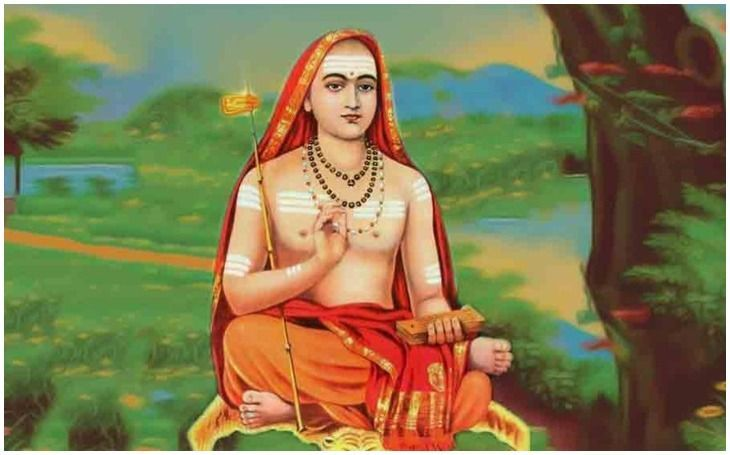
A concept attributed to Adi Shankara, an early honored teacher of Advaita Vedanta, the “crest jewel of discrimination” describes the higher reason guiding truth-seekers to differentiate the eternal Divine Reality of the True Self from the fleeting, illusory world of the false, ego-self. Or, to differentiate the valuable from the valueless, in Course terms.
Can’t help but think that both hiranyayah and vivekachudamani refer to the perception-shifting power of miracles. If I’m right, miracles come to us from Indra’s mouth, via the Word-Yoke or Indrajala. And that seems to fit with everything else we’ve learned so far.
The crest-jewel is sometimes called “the crown jewel of yoga,” so it may be the “fruit of the lamb” we harvest by opening the first seal — the Sefirot of Keter at the top of the Tree of Life. Curious about this, I went back to find the passage from Revelation about the first seal, which reads as follows:
And I perceived a lamb open the first seal of a signet ring, and also listened as a thunder-voice came out from among the four Living Creatures to say, “Come and look, and envision brightly, a horse, and to be the Self seated upon the same, and to have the bow and the crowning glory, and to give them to go forth and be strong and to overcome.”
So, upon opening the first seal of Keter, the Soul receives the bow of Rama and the “crowning glory” providing the strength to overcome the Ego Mind’s parasitic influence.
This begs a question: is the crowning glory also the crowning jewel of yoga?
Our next line (indraḥ dīrghāya cakṣase ā sūryam rohayat divi vi gobhiḥ adrim airayat) translates roughly as follows:
Indra’s breath extends the light of Brihaspati, the teacher of god; the divine being supporting cultivating the fruits of the celestial realm; the two rays of the grinding stone born from the waters of joining.
My definitions:
indraḥ (indra’s breath) dīrghā-ya (extends the light) cakṣase (Birhaspati, the teacher) ā (of god) sūr-yam (the divine being supporting) rohayat (cultivating the fruits) divi (of the celestial realm) vi (the two) gobhiḥ (rays) adrim (of the grinding stone) airayat (born from the waters of joining)
My notes:
In the Hindu lore, Brihaspati is described as the Lord of the Song of Prayer, the master of sacred wisdom, the guru to the gods, and the embodiment of divine intelligence. He’s the master of the higher mind, in other words; the master of the house of God, the Temple of the Holy Spirit. All of this suggests he is, in fact, the Hindu equivalent of Solomon, the Holy Spirit and Lord of the Om.
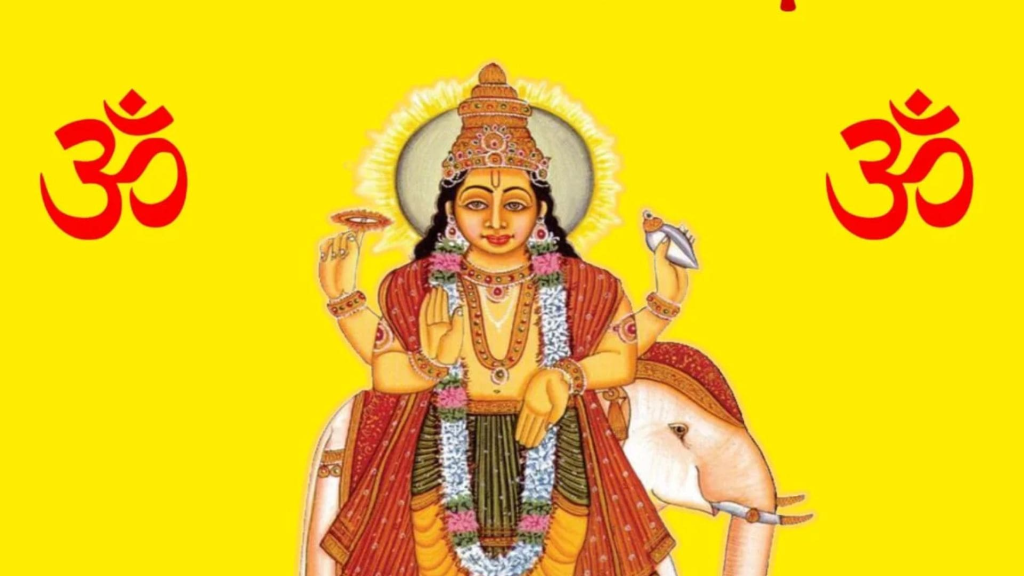
My supposition is reinforced by the description of Brihaspati’s light coming out of Indra’s mouth in two parts, as “the rays of the grinding stone” (the Biblical winepress symbolizing the Bindu Chakra). My supposition is further solidified by Brihaspati’s characterization as “the teacher of god supporting the cultivation of the fruits of the celestial realm.”
Based on these characterizations, who else could Brihaspati be but the Holy Spirit?
When depicted iconographically, Brihaspati has a golden body, legs of striped blue, and a halo of moon and stars. Often depicted with Airavata, he holds different items depending on the region of origin. In parts of South Asia, for example, he holds a container of Soma, sometimes with a tamed tiger. In other depictions, he carries a stick, a lotus, and the prayer beads or mala for counting repetitions of a japa-mantra.
Fathered by Angiras (the Temple cart of the Soul) and mothered by Surupa (the embodiment of grace), Brihaspati married Tara (the journeying Soul). In some myths from the Medieval period, Tara is abducted by Chandra/Soma, the god of the Moon, with whom she bears Budha, the Hindu god of the planet Mercury, also known as Somaya or Rohinaya.
The god of the Moon is the Great I Am, the mind of the Atonement, with whom the Soul gives birth to Budha — the personified Buddhi, probably.
That’s more than you probably need to know, but it paints a fair picture of Brihaspati as an agent and ally of King Indra in the war against the Asuras (the anti-gods).
This brings us to Rv 1.7.4, which reads: indra vājeṣu naḥ ava sahasra-pradhaneṣu ca ugraḥ ugrābhiḥ ūti-bhiḥ). Pulling hard on my two metaphoric “oars,” I’ve translated that verbiage as follows:
Indra, the strengthening spirit of wholeness, brings down the powerful inner-radiance advancing the spiritual treasures and the de-eclipsing forces of rising grace.
My definitions:
Indra (Indra) vāj-eṣu (the strengthening spirit) naḥ (of wholeness) ava (brings down) sahas-ra-pra-dhan-eṣu (the powerful inner-radiance advancing the spiritual treasures) ca (and) ugraḥ (the de-eclipsing) ugrābhiḥ (power of) ūt-ibhiḥ (rising grace)
My notes:
A beast to work out, due to a serious dearth of useful word-definitions. I did my best, but there might be room for improvement. I’m pretty sure I’m right about Indra being the strengthening spirit of wholeness–the shining thought advancing the de-eclipsing power of rising grace. That power is the miracle that reverses our upside-down perception in the Holy Instant.
Or, to quote Course-Jesus:
Ultimately, every member of the family of God must return. The miracle calls him to return because it blesses and honors him, even though he may be absent in spirit. “God is not mocked” is not a warning but a reassurance. God WOULD be mocked if any of His creations lacked holiness. The creation is whole, and the mark of wholeness is holiness. Miracles are affirmations of Sonship, which is a state of completion and abundance. (ACIM, T-1.V.4:1-6)
Proceeding apace, Rv 1.7.5 (indram vayam mahā-dhane indram arbhe havāmahe yujam vṛtreṣu vajriṇam) translates something akin to this:
Indra’s descendants greatest wealth is Indra’s fear-slaying Call to Joy, the Yoke of the enveloping spirit of the indestructible Name of God.
My definitions:
indram (King Indra’s) vayam (descendants) mahā-dhane (greatest treasure is) indram (indra’s) marbhe (fear-slaying) havāmahe (call to joy) yujam (the Yoke) vṛtreṣu (of the enveloping spirit) vajri-ṇam (of the indestructible Name of God)
My notes:
The rishis tells us herein that our greatest treasure, as Indra’s descendants, is the Call to Joy, the yoke binding together our Souls or spirits in the indestructible Name of God.
Course-Jesus describes the Call to Joy in similar terms in the following excerpt from the Text:
The principle of Atonement and the separation began at the same time. When the ego was made, God placed in the mind the Call to joy. This Call is so strong that the ego always dissolves at Its sound. That is why you must choose to hear one of two voices within you. One you made yourself, and that one is not of God. But the other is given you by God, Who asks you only to listen to it. The Holy Spirit is in you in a very literal sense. His is the Voice that calls you back to where you were before and will be again. It is possible even in this world to hear only that Voice and no other. It takes effort and great willingness to learn. It is the final lesson that I learned, and God’s Sons are as equal as learners as they are as Sons. (ACIM, T-5.II.3:1-11)
Let’s proceed to the sixth line, which reads: saḥ naḥ vṛṣan amum carum satrā-dāvan apa vṛdhi asmabhyam aprati-skutaḥ. In English, those words translate more or less as follows:
The Supreme Lord of Wholeness rains down that blessed offering on the faithful — Holy Water to inflame the fearless I Am to make full the utmost (spiritual) body underneath.
My definitions:
saḥ nah (The Supreme Lord of Wholeness) vṛṣan (rains down) amum (that) carum (blessed offering) satrādāvan (on the faithful) — apa (holy water) vṛdhi (to inflame) asm-abhyam (the fearless “I am”) apr-ati (to make full the utmost) sku-taḥ (spiritual body underneath)
My notes:
As I interpret this passage, the Supreme Lord of Wholeness is Surya, the Solar Logos whose chariot-throne Indra drives. The blessing he bestows is the aforementioned “enveloping spirit of God’s Name.” The Holy Spirit, in other words. And that “enveloping spirit” (Brihaspati) is indeed the Red Ray’s water-bearing partner.
This line also affirms what I explained before about the Living Water “inflaming” or “swelling” the One Self that “makes full” the spiritual body “underneath” (not within!) the physical body. As I explained several posts back, the spiritual body and the physical body exist on two separate planes of consciousness, one inside the mind and one outside the mind.
In Judeo-Christian terms, the spiritual body is the Temple of the Holy Spirit housing the Menorah (the inner-instrument), the seven Mansions and/or Churches (the Lunar Mansions or chakras), and the Holy of Holies (the inner-altar or Heart-Cave). St. Paul also differentiates these two bodies in 1 Corinthians 15, wherein he writes:
It is sown a natural body; it is raised a spiritual body. There is a natural body, and there is a spiritual body.
In Hinduism and Buddhism, these two bodies are often erroneously conflated. The chakras and primary nadis are not, for example, part of the flesh-body; they are located in the spiritual body “underneath” the flesh-body.

Our next line (Rv 1.7.7) reads: tuñje-tuñje ye ut-tare stomāḥ indrasya vajriṇaḥ na vindhe asya su-stutim. In English, the line reads more or less as follows:
Sing! Sing! those who are on the northern side (the northwest quarter of the Mandala), the songs of praise from Indra’s mouth: the indestructible wholeness unblocking the mouth of the holy glorification.
My definitions:
tuñje-tuñje (sing, sing) ye (those who are) uttare (on the northern side) stomāḥ (the songs of praise) indrasya (from Indra’s mouth) vajriṇaḥ (the indestructible wholeness) na-vindhe (unblocking) asya (the mouth) sustutim (of the holy glorification).
My notes:
I love it when the rishis use terms found in the Course. I love it even more when they use terms found in the Judeo-Christian scriptures — like su-stuti, which literally translates as “holy glorification.” As Christianity rightly espouses, “glorification” is the final stage of spiritual purification. Some sects confuse “glorification” with “canonization” — the granting of sainthood by church authorities — but they are not the same thing at all.
As the Catholic Church correctly asserts (but doesn’t fully apprehend), “at the end of time, the Kingdom of God will come in its fullness. After the universal judgment, the righteous will reign for ever with Christ, glorified in body and soul. The universe itself will be renewed […] The visible universe, then, is itself destined to be transformed, ‘so that the world itself, restored to its original state, facing no further obstacles, should be at the service of the just,’ sharing their glorification in the glorification of the risen Jesus Christ.”
The Catholic Church also correctly teaches that glorification takes place in Purgatory. What the Catholic clergy fails to understand is that Purgatory isn’t a place good-but-imperfect Souls are sent after physical death to be “cleansed of sin” before entering Heaven. The English word “Purgatory” derives from the Latin word Purgatorium, which means “to purge,” “to cleanse,” or “to purify.”
The Sanskrit word vishuddha likewise means “final purification.” And Vishuddha is the name assigned to the fifth or throat chakra — the chakra wherein we experience Self-Realization. True Yoga teaches that to enter Vishuddha Consciousness, we have to “undo” the Vishnu Granthi — the second of three “psychic knots” our Souls bump up against and must undo as they walk around the circle. Like the chakras and nadis, these “knots” are located in the spiritual body, rather than in the physical body.
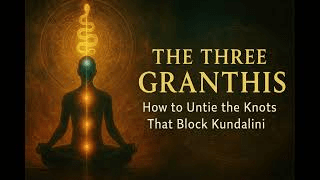
The Vishnu Granthi — the “knot” of individual ego-interests and wrong-minded judging — resides in or around the Anahata or Heart Chakra, the “energy center,” “wheel,” or “window” just below the Vishuddha Chakra. The Vishnu Granthi represents, therefore, “the door” into the third or Northeast quadrant presided over by Ishana, the lion-like Mouth of Glorification speaking, breathing, and spewing (if you will) from the Resting Place, the walled city of Jerusalem.
The Final Judgment (made in Ego deception) breaks the Vishnu knot, opening the door to the Celestial Sphere.
Opening that “door” can take an instant or many lifetimes, depending on our willingness to accept the judgment suspending Holy Instant.
Or, as Course-Jesus explains:
Be willing, for an instant, to leave your altars free of what you placed upon them, and what is really there you cannot fail to see. The holy instant is not an instant of creation, but of recognition. For recognition comes of vision and suspended judgment. Then only it is possible to look within and see what must be there, plainly in sight, and wholly independent of inference and judgment. Undoing is not your task, but it IS up to you to welcome it or not. Faith and desire go hand in hand, for everyone believes in what he wants. (ACIM, T-21.II.8:1-6)
Breaks the knot of judgment opens “the mouth of the holy glorification” mentioned in this Vedic verse. To unblock that “mouth,” the rishis tell us, we have to “sing” the Song of Wholeness. We sing that song by listening to the Word of God in meditation.
So, we break the Vishnu Granthi by listening to the Cosmic Chorus, the hearing of which transports us through the gate between the first and second quadrants. The guardian of that gate is Varuna, the water of Una (oneness or wholeness). Once we hear that chorus, we will be told how to perform the almsgiving yajnas that open the third gate–the Northern gate guarded by Kubera, the keeper of the storehouse.
We perform our yajnas in the Northwest quarter–the quadrant of Artha (Holy Purpose) presided over by Vayu-Garuda –by meditating on the “unstruck” or otherworldly sound we begin to hear after Kundalini pierces the Anahata Chakra. And that sound, as Course-Jesus affirms, will purify our minds enough to pass through the narrow gate into Purgatory, the Northeast Quadrant of Kama, presided over by Ishana.
Does that make sense?
From all of this we can glean that what Christians call Purgatory is, in truth, the walled city, Resting Place, and/or enclosure wherein our Souls stand right-side up during the final stages of purification that will enable them to enter the fourth quadrant of Moksha — the “heaven on earth” Course-Jesus calls the Real World. As the Bible tells us (when rightmindedly translated), our Souls hang upside-down in the body, but stand upright in Jerusalem (the reason the Assembly is called the Standing Circle of Yaweh).
Rv 1.7.8, which reads: vṛṣā yūthā-iva vaṃsagaḥ kṛṣṭīḥ iyarti ojasā īśānaḥ aprati-skutaḥ, should translate as follows:
The Bull of Heaven unites the separated family of Christ in this world to brighten the radiant energy of Ishana to make full the utmost spiritual body underneath sustaining the one shining circle of the Vasu arranging Indra’s breath into five kingdoms.
My definitions:
vṛṣ-ā (the Bull of Heaven, Nandi, Shiva’s vahana) yūthāiva (unites the separated) vaṃsagaḥ (family of) kṛṣṭīḥ (Christ or Creation in this world ) iyarti (to brighten) ojasā (the radiant energy of) īśānaḥ (Ishana) aprati-skutaḥ (to make full the utmost spiritual body underneath) yaḥ (sustaining) ekaḥ (the one) carṣaṇīnām (shining circle) vasūnām (of the Vasu) irajyati (organizing, arranging or guiding) indraḥ (Indra’s breath) pañca (in the five) kṣitīnām (kingdoms)
My notes:
What this says is fascinating, so let’s dig in.
In Hinduism, the resting Bull of Heaven is Nandi, the vehicle for Lord Shiva, whose legs represent the quadrants of the Circle-Journey. In his active form, Nandi is Kamdhenu or Surabhi, the sacred miracle-cow that emerged from the churning of the Ocean of Milk. Nandi represents the ever-present Will of God in a passive state to preserve free-will, while Surabhi represents the power through which we willingly activate God’s Will to end the dream within the dream.
I hope that makes sense.
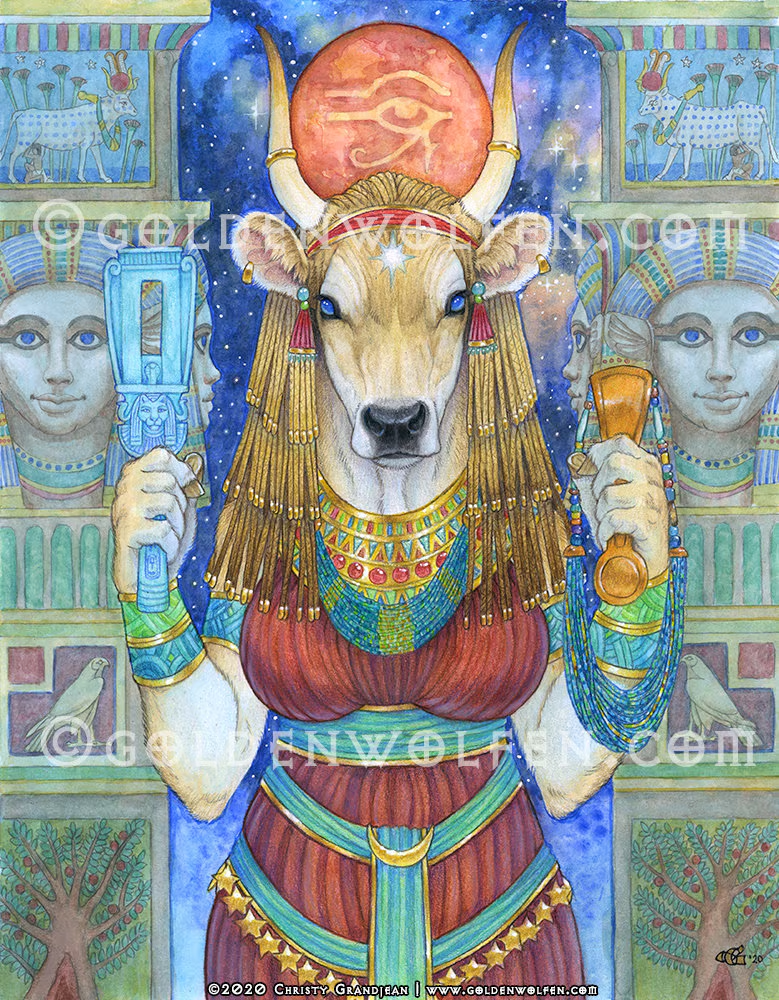
In the Abrahamic religions, she’s the bull-headed cherubim or throne-bearer presiding over the final quadrant of Moksha. In ancient Egypt, she was called Hathor. In ancient Mesopotamia and Judea, she was called Moket, but was vilified in the Old Testament through mistranslation and ignorance of her true identity. In the RWS Tarot, she’s THE HIGH PRIESTESS, seated between the Temple pillars, Boaz and Jacim.
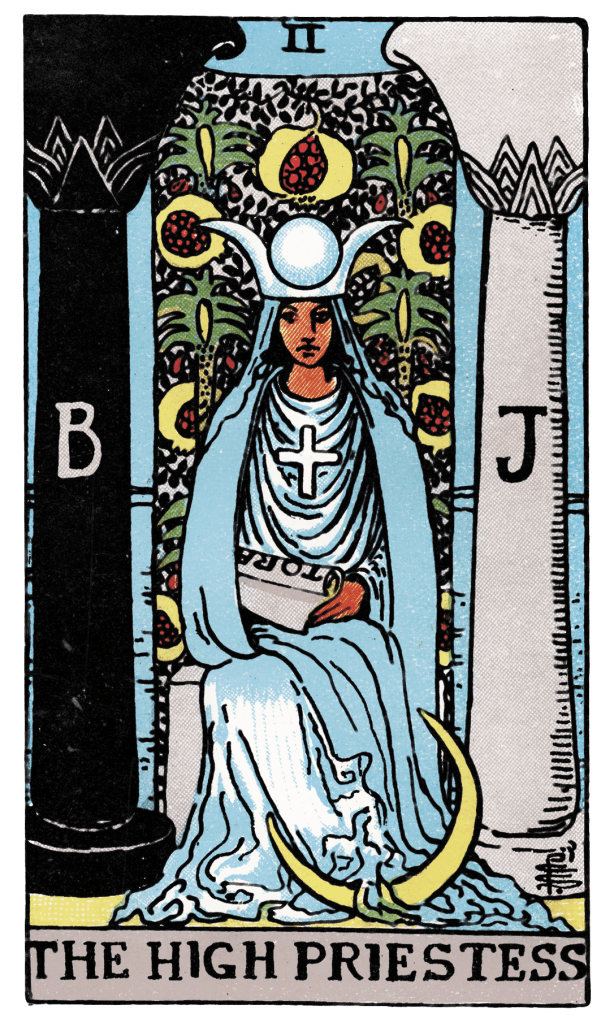
Let’s move on to the phrase panca-kstinam, which is usually wrong-mindedly translated as “five tribes,” “five lands,” or “five peoples”. But it’s actually a reference to the five kingdoms established by Elohim to awaken Adam from the dream of leaving Eden.
Indra’s breath is the Breath of Life, the divine breath giving life to the Soul. In Genesis 2:7, we learn that God blew this breath into Adam’s nostrils to make him a living being (i.e., a true and eternal holy creation). That breath is, in fact, Eve, the Holy Spirit, as we learn in John 20:22, when Jesus gives this “breath” to his disciples in the form of the Holy Spirit. And in Psalm 150:6, we further learn that this breath is the source of life for all creatures. The eternal life given by God to the Soul, not the life temporarily animating the mortal body. Being the only source of Life in existence, God’s Breath (Ruach) also animates the Soul’s earthbound mortal body to serve as a learning device for the Atonement curriculum.
So, the five kingdoms referenced by the rishis are the kingdoms housing the Souls hanging upside-down in the world in the “material bodies” of minerals (first kingdom), plants (second kingdom), invertebrate animals (third kingdom), vertebrate animals (fourth kingdom), and humans (fifth kingdom).

Think haptic suit for virtual-reality gameplay and you’ve got the general idea of what your body’s really for.
In Theosophy and Buddhism, these kingdoms represent the evolutionary ladder all Souls must climb to return to their original state of “being” — the wholeness of mind experienced in the peaceful paradise of Eden, the Real World.
In The Aquarian Gospel of Jesus the Christ, Jesus corrects this idea (which some Hindus share), explaining that human Souls have always been human Souls. We don’t evolve, in other words, from lower lifeforms.
My sense is that The Aquarian Gospel is right on this score, but I have no conclusive evidence to support this feeling, as Jesus says nothing on the subject in the Course (my go-to authority on spiritual matters). The Bible mentions these kingdoms in several places, but the orders are generally misinterpreted as earthly kingdoms.
This line from the Rigveda isn’t definitive, either; but it seems to suggest that Ishana’s grace fills the spiritual body to sustain “the one shining circle of the Vasu,” the eight Living Beings dividing Indra’s breath (the living souls on earth) into the five kingdoms.
Not sure what to make of this, but I do know this: “the one shining circle” is the Golden Circle Jesus describes in the Course, as well as the fiery circle with a well in the center described by Ezekiel. In traditional Christian terms, it’s the golden circle of Jesus Christ, glorified. So, once again, the Rigveda, the Bible, and the Course are in perfect concordance.
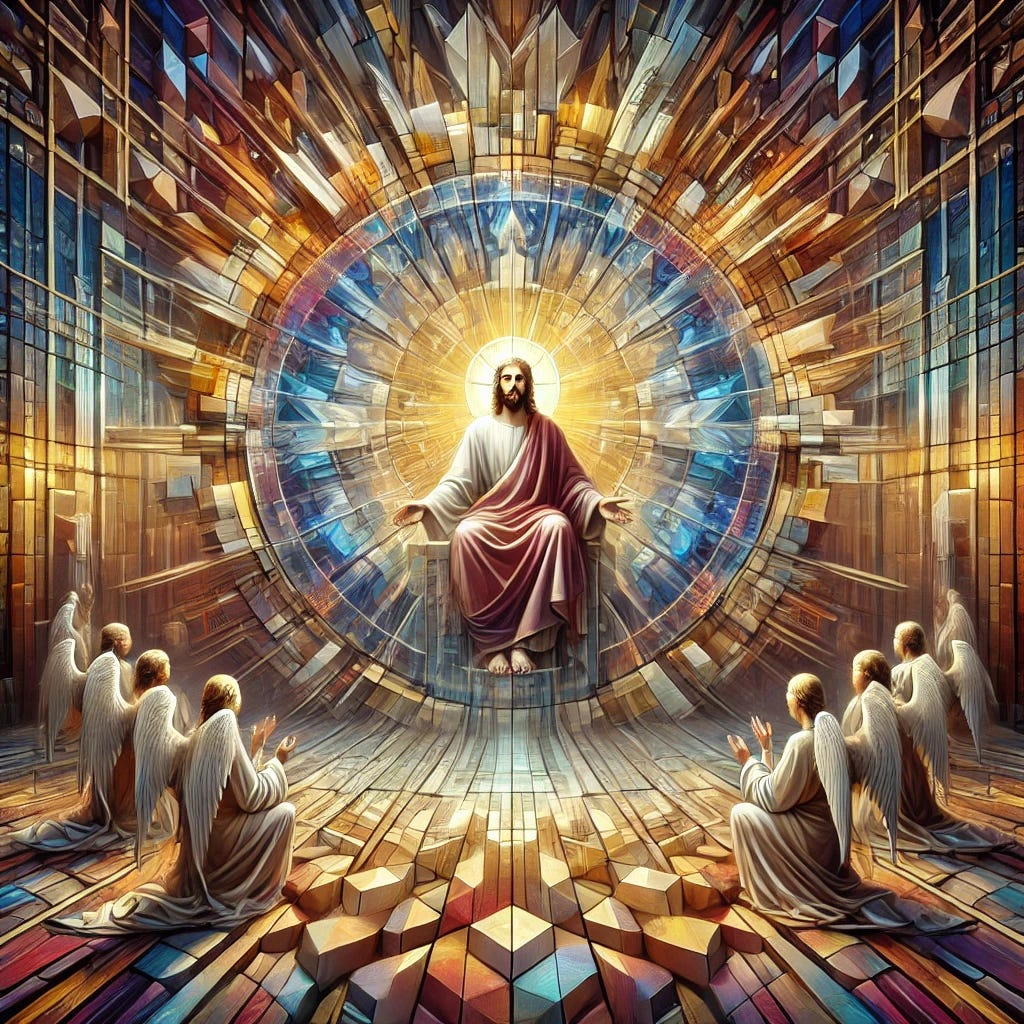
The Sukta’s final line (indram vaḥ viśvataḥ pari havāmahe janebhyaḥ asmākam astu kevalaḥ) translates more or less as follows:
Indra’s vehicle in all directions moves in a circle the call to joy, to generate the sacred union of our collective consciousness with Amen, the one and only Self, pure and complete.
My definitions:
indram (indra’s) vaḥ (vahana/vehicle) viśvataḥ (in all directions) pari (moves around the circle) havāmahe (the call to joy) janebhyaḥ (to generate the sacred union) asmākam (of our collective consciousness with) astu (Amen) kevalaḥ (the one and only Self, pure and complete)
My notes:
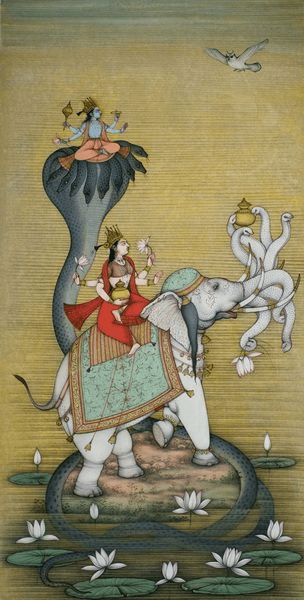
Indra’s vehicle is Airavata, the Great White elephant representing the Living Water flowing down (in seven streams) from the wellspring at the center of the shining circle of the Vasu. And that water, from all directions, moves around the circle to spread the call to joy generating the sacred marriage between the collective consciousness (of the Souls in all five kingdoms) and the Great Amen, the Christ Self, forever whole and complete.
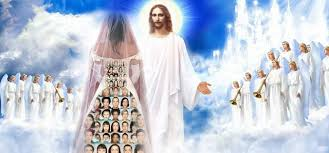
So, we get in this final verse of the Seventh Sukta a verbal picture of Airavata, the seven-trunked Elephant of Heaven, spreading Indra’s Call to be joyful around the Mandala of the Soul’s journey to bring about the sacred marriage of the Bride (Pistas Sophia, Lakshmi, or Tara) and the Bridegroom (the Great Amen, Jesus, or Vishnu, the symbolic Christ Self preserving Creation’s oneness in the dream).
I identified Vishnu as the Hindu representation of the Bridegroom because, in the story of the churning of the ocean, Lakshmi chooses Vishnu as her future husband upon emerging from the waters, knowing that their union will restore cosmic harmony, balance, and the reciprocal devotion existing between God and his creations. Below, we see a depiction of their marriage ceremony with Lakshmi riding Airavata, and Vishnu seated on Shesha.
Let’s now put the whole Sukta together for easier reading and reflection:
King Indra animates the song of Brihaspati (the Lord of the Song of Prayer); King Indra, the Lesser Light descending from the Greater Light of Wholeness — King Indra’s loom for weaving Anu’s true nature.
Indra’s breath animates Hari, the Truth endowing God’s Voice-Yoke. Indra’s breath strengthens the fire of the Golden Self (or the Crest Jewel of Discrimination).
Indra’s breath extends the lights of Brihaspati, the teacher of god; the divine being supporting cultivating the fruits of the celestial realm; the two rays of the grinding stone born from the waters of joining.
Indra, the strengthening spirit of wholeness, brings down the powerful inner-radiance advancing the spiritual treasures and the de-eclipsing forces of rising grace.
Indra’s descendants’ greatest wealth is Indra’s fear-slaying Call to Joy, the Yoke of the enveloping spirit of the indestructible Name of God.
The Supreme Lord of Wholeness rains down that blessed offering on the faithful — Holy Water to inflame the fearless I Am to make full the utmost (spiritual) body underneath.
Sing! Sing! those who are on the northern side (the northwest quarter of the Mandala), the songs of praise from Indra’s mouth: the indestructible wholeness unblocking the mouth of the holy glorification.
The Bull of Heaven unites the separated family of Christ in this world to brighten the radiant energy of Ishana to make full the utmost spiritual body underneath sustaining the one shining circle of the Vasu arranging Indra’s breath into five kingdoms.
Indra’s vehicle in all directions moves in a circle the call to joy, to generate the sacred union of our collective consciousness with Amen, the one and only Self, pure and complete.
I hope you found this helpful on your quest. Thanks for visiting. Until next time, Om Hari Om and Namaste.
 The Holy Meeting Place
Leave a comment