
Namaste, my brother in Christ, and welcome (or welcome back) to my latest adhyayana posting. For those who don’t know, adhyayana is a Sanskrit word meaning “reading,” “studying,” or “learning,” especially in reference to the Vedas and other scriptural texts. An appropriate word, then. for our deep and comparative explorations of the Rigveda, Hinduism’s oldest and most sacred divinely revealed scriptural text.
Wouldn’t you agree?
Today, we’re tackling the first mandala’s 18th Sukta, a sacred teaching supposedly addressing Brahmana or Brahmanaspati — two terms meaning (contrary to popular belief) “expanding the mind” or “expanding the mind of the Bridegroom or Master,” respectively.
As our framework guide, we’ll use Sri Aurobindo’s rendition of the Sukta, which reads as follows (in transliterated Sanskrit):
somānam svaraṇam kṛṇuhi brahmaṇaḥ pate kakṣīvantam yaḥ auśijaḥ ǁ
yaḥ revān yaḥ amīva-hā vasu-vit puṣṭi-vardhanaḥ saḥ naḥ sisaktu yaḥ turaḥ ǁ
mā naḥ śaṃsaḥ araruṣaḥ dhūrtiḥ praṇak martyasya rakṣa naḥ brahmaṇaḥ pateǁ saḥ gha vīraḥ na riṣyati yam indraḥ brahmaṇaḥ patiḥ somaḥ hinoti martyam ǁ
tvam tam brahmaṇaḥ pate somaḥ indraḥ ca martyam dakṣiṇā pātu aṃhasaḥ ǁ
sadasaḥ patim adbhutam priyam indrasya kāmyam sanim medhām ayāsiṣam ǁ
yasmāt ṛte na sidhyati yajñaḥ vipaḥ-citaḥ cana saḥ dhīnām yogam invati ǁ
āt ṛdhnoti haviḥ-kṛtim prāñcam kṛṇoti adhvaram hotrā deveṣu gacchati ǁ
narāśaṃsam su-dhṛṣṭamam apaśyam saprathaḥ-tamam divaḥ na sadma-makhasam ǁ
By my calculations, Rv 1.18:1 translates as follows;
Soma’s name (or identity) encloses (like a sanctuary) the ear of Uchaishravas to expand the mind preserving the thundering fragrance effused by the Supreme Lord.
My definitions and syllable divisions:
somā-nam (Soma’s name or identity) svaraṇam (encloses, like a sanctuary) kṛṇ-uhi (the ear of Uchchaihshravas) brahmaṇaḥ (to expand the mind) pa-te (preserving the thundering) kakṣī-vantam (fragrance effused by) yaḥ (the Supreme Lord)
Notes:
Not the way Sri Aurobindo broke the lines, but the only way the sentence makes sense. Firstly, as I’ve explained many times, Soma is the Great I Am, the Lesser Light of God in the dream-realm. The Lesser Light of God is the Christ Light, projected outward in the dream-realm as the moon. Hence, the I Am’s symbolic personification in Hinduism as Soma and/or Chandra, the moon of God or spiritual moon, as opposed to god of the moon. The mysterious “juice” or “drink” rishis extract from Soma (in meditation) is, therefore, the Blood of Christ Hindus call Amrita. And that’s why Soma’s extract is described in the Vedas as “the elixir of immortality.”
That Soma’s Name (Christ) encloses (like a sanctuary) the ear of Uchchaihshravas may sound rather strange, but it tells us that the enclosure, walled city, or walled garden “east of Eden” forms the sanctuary and/or Holy of Holies within the Temple. It also tells us the sanctuary-enclosure houses the “ear of Uchaihshravas.” And this is probably how the name Uchchaihshravas came to be mis-defined as “one having long ears.” As explained in an earlier psot, the name actually means “the exalted sound of glory” — a phrase used in the Bible to represent (per Google) “the thunderous, majestic praise of God’s sovereignty, often described as shaking and filling the earth.”
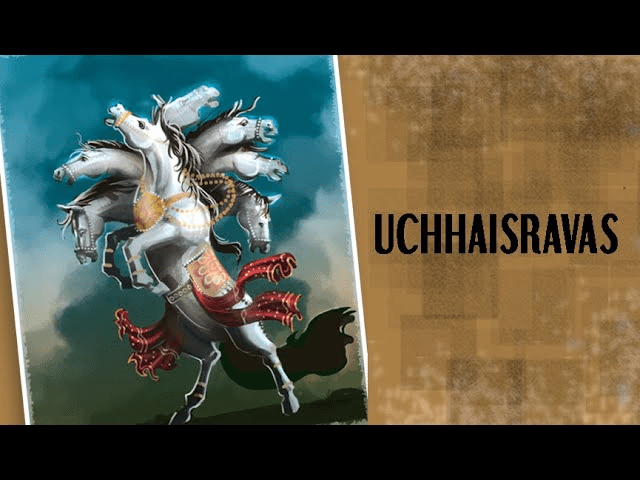
According to the legends, Uchaihshravas emerged from the churning of the Ocean of Milk. As the horse rose up, Indra seized the magnificent winged beast, claiming him as his “vehicle.” So, we hear Indra’s thundering glory through the ears of Ucchaisravas, the horse (thought-force) we ride up seven levels of consciousness to triumph over the darkness.
We also find herein the rather odd phrase “the thundering fragrance effused by the Supreme Lord.” Odd as it seems, the phrase “thundering fragrance” is the “sweet savor of Christ” St. Paul mentions in 2 Corinthians 2:14-16:
Now thanks be unto God, which always causeth us to triumph in Christ, and maketh manifest the savour (aroma) of his knowledge by us in every place.
For we are unto God a sweet savour of Christ, in them that are saved, and in them that perish:
To the one we are the savour (aroma) of death unto death; and to the other the savour (aroma) of life unto life. And who is sufficient for these things?
That “sweet aroma,” we now know, is the thundering sounded by the Christ Ray, which we hear in the Resting Place, the enclosure east of Eden, where our Souls stand together in the Assembly. The sweet savor of Christ is the innocence and holiness we remember through the practice of giving and receiving the lilies of forgiveness. Those symbolic lilies are rooted in the Resting Place, the walled garden effusing their “sweet fragrance,” as Course-Jesus explains below:
Take from His storehouse, that its treasures may increase. His lilies do not leave their home when they are carried back into the world. Their roots remain. They do not leave their source, but carry its beneficence with them, and turn the world into a garden like the one they came from, and to which they go again with added fragrance. Now are they twice blessed. The messages they brought from Christ have been delivered, and returned to them. And they return them gladly unto Him. (ACIM, W-159.9:1-7)
The Sukta’s next line (Rv 1.18:2) reads:
Zealously desire to perceive the Lord riding the horse; the Lord dispelling the sickness or affliction in the light of knowing to nourish and grow the power of the whole leaden weight of Ketu (the descending node of the moon); the Lord pressing forward the call of creation in wholeness.
Definitions and divisions:
auśi-jaḥ (Zealously desire to perceive) yaḥ (the Lord) revān (riding the horse) yaḥ (the Lord) amīvahā (dispelling sickness or affliction) vasu-vit (in the light of knowing) puṣṭi-vardhanaḥ (to nourish and grow) saḥ (the power) naḥ (of the whole) sisa-ktu (leaden weight of Ketu, the descending node of the moon); yaḥ (the Lord) turaḥ (pressing forward the call) mā (of creation) naḥ (in wholeness)
Notes:
We already know the lord riding the horse is Indra, the red ray whose particulates are the divine sparks in us. And, being particles of the whole Ray, those sparks still emit “the call of creation,” as Course-Jesus explains in the following excerpt:
In many only the spark remains, for the Great Rays are obscured. Yet God has kept the spark alive so that the Rays can never be completely forgotten. If you but see the little spark you will learn of the greater light, for the Rays are there unseen. Perceiving the spark will heal, but knowing the light will create. Yet in the returning the little light must be acknowledged first, for the separation was a descent from magnitude to littleness. But the spark is still as pure as the Great Light, because it is the remaining call of creation. Put all your faith in it, and God Himself will answer you. (ACIM, T-10.IV.8:1-7)
Before we move on, let’s talk about sisaketu — the leaden weight of Ketu, the descending node of the moon (representing the red dragon’s tail). In Vedic astrology, Ketu acts as a profound “leaden weight” or spiritual anchor, supposedly symbolizing “the heavy burden of accumulated karmic debt, detachment from material life, and the eventual dissolution of the ego.” So, Ketu’s “weight” in the dream brings about our transcendence.
According to someone on Quora:
Ketu is the liberator, the scattering force, the separator, the finisher, the terminator and THE END of the movie called “Life on Earth.”
Ketu means “mark” or “sign,” so the moon’s descending node represents the mark of the Beast, the descending tail of God’s Radiant Splendor. And this mark, apparently, has weight.
In Judaism, this weight (of God’s splendor and/or glorious presence) is called Kavod. Google describes Kavod as a metaphor for the “soul-quake” encounter that displaces human priorities, pride, and burdens rather than a literal physical measurement. In Judaism, this “soul-quake” is called Teshuvah — the experience of being “shaken” out of one’s deluded-stupor of being apart from God. According to my research, Teshuvah is experienced as an internal crisis that breaks through apathy or sin, leading to a profound change and closeness to God. So, Ketu is Kavod, the immense weight of God’s splendor, shaking our Souls awake. And this shaking may well be the “earthquake” described in Revelations.

If I’m right about the Tripunda representing the mark of the Beast, then our Souls might be shaken three times. This is just a hunch at this point, so let’s leave it there for the time being, and move on to Rv 1.18:3, which reads:
Join together in the power covering Usah (the dawn) to shake the path of the living being (the Soul) in what appears to be mortal, to protect the wholeness preserving the thundering.
Definitions and divisions:
śaṃsaḥ (join together in the power) arar-uṣaḥ (covering Usah, the dawn) dhū-rtiḥ (to shake the path) pranak (of the living beings) martyasya (appearing to be mortal) rakṣa (to protect) naḥ (the whole) brahmaṇaḥ (expanding the mind) pat–e (preserving the thundering).
Notes:
As the Sukta’s opening stanza explains, the power covering Usah (the goddess of dawn) is the Name of Soma, the Great I Am or Christ presence. And, as we just discussed, the part of Soma shaking the path of the Soul is the descending node, Ketu.
I’m pretty sure the name of Soma is the Name we share with God, which is Christ, the Great Amen, the Great I Am, or the AUM. And AUM does indeed have three aspects in Hindu philosophy. These three aspects, signified by the word’s letters, are call karas, a Sanskrit word meaning “hands.”
The A
I’m not convinced that’s the rightminded view; it might be, though, if Brahma is, in fact, the awake Christ.
We find the “three hands of God” in other spiritual traditions, as well. In the mystical Kabbalistic Zohar, for example, the three hands represent the building forces of the Creator: the Right Hand is the Great Hand of Chessed (the steadfast love, loving kindness, or mercy of God); the Left Hand is the Strong Hand of Gevurah (the strength to judge rightmindedly); and the Elevated Hand is Tiferet (the Truth experienced in the Real World or Land of the Living as True Perception or Christ’s Vision).
But wait. Because the name we share with God is Christ. So the three hands of AUM are the three hands of Christ, as well as, therefore, the three aspects of Soma, the Spiritual Moon.
In Vedic traditions, Soma’s three aspects are 1) the “drink” offered in almsgiving rituals, 2) the deity presiding over that offering, and 3) the nurturing “liquid light” associated with the moon, immortality, and joy.
So, the three aspects of Soma are, 1) the honey-sweet nectar of immortality (Amrita, the new wine and/or Blood of Christ); 2) the Lesser Light of Christ’s Presence in the dream (Soma or Chandra), and 3) the Living Water flowing down to us from the Golden Circle to dissolve the illusion.
From all this evidence, we can glean that the A
So the ascending node of God’s splendor (Rahu, “the radiant offering”) is the U-kara, while the descending node (Ketu, the mark or sign) is the M-kara.
Stated more succinctly:
Soma, the Great I Am = the A-kara
Rahu, the ascending node or dragon’s head = the U-kara
Ketu, the descending node or dragon’s tail = the M-kara
Let’s move forward to Rv 1.18:4, which reads:
The powers singing in the desert of non-existence, the seven sages of forbearance awaken within the Brahmin, the Bridegroom, Soma.
Definitions and division:
saḥ (the powers) gha (singing) vīraḥ (in the desert) na (of non-existence) riṣ-yati (the seven rishis) yam (of forbearance) indraḥ (awaken within) brahmaṇaḥ (the Brahmin or Teacher of God) patiḥ (the Master or Bridegroom) somaḥ (Soma).
Notes:
In Hindu mythology, the Seven Sages (the Saptarishi) are revered immortal rishis, often regarded as the mind-born sons of Brahma (the awake Christ?). According the prevailing wisdom, they guide humanity across different epochs, appearing in each Manvantara (age). While names vary across texts, the most commonly cited Saptarishis of the current age (Aquarius) include Vishwamitra (the Cosmic Covenant or Friend), Vashishtha (to dwell in truth), Atri (the wandering rishi), Jamadagni (the assembler of Agni), Gautama (the remover of darkness), Kashyapa (the world turtle), and Bharadwaja (bearing the standard, flag, or banner).
I can’t help but wonder if these seven rishis are, perhaps, the Hindu version of the “Lords of the Seven Rays” known in Theosophical circles as Dhyan Chohans (“focused on the four jewels”).
In Hindu philosophy “the four jewels” refer to the four pillars of life, known as the Purusharthas. Unbeknownst to many Hindus, those four jewels or pillars of “a life well lived” (in the eyes of the gods) are, in fact, the four quadrants of the Circle-Journey (Dharma, Artha, Kama, and Moksha).
Rightmindedly perceived, therefore, a life well lived is a life focused on the four quadrants of the circle-journey. As I keep saying. And as Course-Jesus also states unequivocally.
In truth, the four pillars of “a life well lived” are 1) seeking and finding the rightminded way to live in the world (dharma); 2) fulfilling our holy purpose on earth (artha) by joining the Assembly; 3) loving and serving each other as interconnected parts of God and Christ (kama); and 4) achieving True Perception (moksha)
Rv 1.18:5 reads:
To assist the mortal world, the True Self of the Supreme Lord expands the mind of the Bridegroom, Soma, to see the secret circle of human forbearance the honorary alms protect from sin.
Definitions and divisions:
hinoti (to assist) martyam (the mortal world) tvam (the true self) tam (of the Supreme Lord) brah-maṇaḥ (expands the mind) pate (of the Bridegroom), somaḥ (in Soma) indraḥ (to see the secret) ca (circle) martyam (of human forbearance or tolerance) dakṣiṇā (the honorary alms) pātu (protect) aṃhasaḥ (from sin)
Notes:
Contrary to widespread suggestion, Indrah can’t mean Indra. Here, it works out as Ind-rah (“to see in secret”) and, in the previous verse (as In-drah), it meant “awaken within.” I translated daksina as “honorary alms,” because the term generally refers to the honorarium or fee voluntarily given by participants in gratitude to the priest(s) conducting the yajna ritual. But, as we’ve established, those priests are not human being’s; they’re our inner-rishis, the Lords of the Seven Rays (presumably) keeping our heart-mind focused on the Circle Journey.
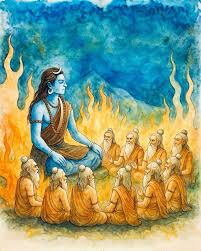
Moving onward, Rv 1.18:6 reads:
The eternal powers of the Bridegroom consume the past in the kindly way of Lord Indra’s love and forbearance sublimely offering God’s glory in union.
sada-saḥ (the eternal powers) patim (of the Bridegroom) ad-bhutam (consume the past) priyam (in the kindly way) indrasya (of Lord Indra’s) kām-yam (love and forbearance) sanim (sublimely) medhām (offering) a-yāsi-ṣam (God’s glory in union) ǁ
Not sure this is 100 percent right, because yam can mean many things, including “twins.” And Indra, the twin brother of Agni, is indeed associated with the Asvins, the twin horse-headed “divine physicians” who, in the Hindu lore, assist him in his battles against Vrittra, the Ego Mind. Individually, the Asvins are called Nasatya (“Nara’s truth” or “the waters of truth”) and Dasra (“enlightened giving” or “devotee of the inner radiance”).
That said, kamyam can also be a compound of kam (divine love) and yam (forbearance), which seems right, given that (as per Google): “Love and forbearance in the Bible are intertwined virtues representing divine-infused patience (long-suffering) and self-restraint, driven by unconditional love (Agape). Forbearance involves showing grace and patience toward others’ weaknesses rather than retaliating, often linked to maintaining unity and peace within the community, as shown in Ephesians 4:3.”
I disagree somewhat with Google’s description, mainly because Patience and Forbearance are both characteristics attributed in the Course to God’s Teachers. Divine Love, on the other hand, is a natural attribute of all God’s creations, as are unshakable peace and everlasting life (of the spirit). While most dictionaries I checked similarly (egoically) define forbearance as “restraint,” “self-control,” or “holding back,” I equate forbearance with the saintlier virtue of “tolerance,” which is synonymous with non-judgment, as Course-Jesus explains in the following description of “Tolerance” from the Manual for Teachers:
God’s teachers do not judge. To judge is to be dishonest, for to judge is to assume a position you do not have. Judgment without self-deception is impossible. Judgment implies that you have been deceived in your brothers. How, then, could you not have been deceived in yourself? Judgment implies a lack of trust, and trust remains the bedrock of the teacher of God’s whole thought system. Let this be lost, and all his learning goes. Without judgment are all things equally acceptable, for who could judge otherwise? Without judgment are all men brothers, for who is there who stands apart? Judgment destroys honesty and shatters trust. No teacher of God can judge and hope to learn. (ACIM, M-4.III.1:1-11)
In Colossians 3:12-13 and Romans 2:4, we also find “forbearance” and “patience” listed as distinct desirable virtues. Might, therefore, the yamas of Yoga refer to five recommended practices for developing tolerance, rather than self-restraints”?
According to Wikipedia:
The earliest mention of yamas is found in the Hindu scripture Rigveda, such as in verse 5.61.2, and later in the Jain Agamas. The word yama in the Rigveda means “rein or curb”, the act of checking or curbing, restraining such as by a charioteer or a driver. The term evolves into a moral restraint and ethical duty in the Jain Agamas. The yamas were explained in detail by Patañjali in the Yoga Sūtras of Patanjali as the first step of the eight-fold path of yogic philosophy and practice for attaining enlightenment and union of the mind, body and soul.
Oh, how the Ego Mind delights in twisting the Holy Spirit’s teachings to keep us under its thumb. For the record, the five yamas cited by Patanjali are Ahimsa (non-cruelty), Satya (non-deception or “faithfulness to Divine Truth in thought, word, and deed”), Asteya (not taking what isn’t freely given), Brahmacharya (sexual restraint, and Aparigaha (non-coveting or not desiring anything you don’t already have).
Earlier, I defined Brahmacharya as “devoted discipleship to the Master,” but the word can also mean “expanding the walking light” or “expanding the Circle of Light.”
Google explains that “expanding the walking light” is a spiritual concept signifying the progression “from initial awareness to a mature, daily lifestyle aligned with divine truth and righteousness. It involves actively deepening one’s surrender to the Holy Spirit, practicing consistent prayerful communion (our secret yajnas), and embodying God’s love through actions, transforming one’s inner being to reflect God’s nature.”
And that is, in my view, the true definition of Brahmacharya, whereas “sexual restraint” falls under the yama of Satya. Because those who “walk in truth as realized Souls” have no desire to join as bodies.
At the risk of derailing our discussion of the 16th Sukta, let’s jump way ahead to Rv 5:61:2, to learn what it actually says (if anything) about the yamas of Yoga.
In transliterated Sanskrit, the verse in question reads:
kva vo ‘śvāḥ kvābhīśavaḥ kathaṃ śeka kathā yaya pṛṣṭhe sado nasor yamaḥ
H.H. Wilson translated the line thusly: “Where are your horses? where your reins? what is your capability? where are you going? The saddle is on the back (of the steeds), the bridle in their nostrils.”
I translate the line in this very different manner:
Where you live in the Celestial Sphere is where the wise sages seek to convey deeper understanding of the Great Purusha, the light of lights underneath the Assembly supporting Yama.
So, nothing about the yogic yamas or forbearance, it would seem. In case I haven’t been clear, the Great Purusha is the Supreme Cosmic Being or all-pervading Pure Consciousness, often called the “Light of Lights” because it illuminates everything inside and outside our minds. In Hinduism, the Great Purusha represents the transcendent, eternal Divine Essence—often associated with Shiva, Vishnu, or the Upanishadic Self—which exists beyond darkness and causes the entire universe.
Course-Jesus addresses this idea in Workbook Lesson 30: God is in everything I see because God is in my mind.
Let’s now proceed to Rv. 1.18:7, which reads:
For this reason, the cosmic-order waters are attained in the almsgiving rituals of the learned sages assembled in Cana (the Circle of Nara). The Lord of the Day (the Greater Light), yokes our Souls to energize exceedingly the walk to prosper the Assembly.
Definitions and divisions:
yasmāt (Because) ṛte-na (the cosmic-order waters) sidhyati (are attained or perfected) yajñaḥ (in the almsgiving rituals of) vipaḥ-citaḥ (the learned sages assembled) cana (in Cana, in the Circle of Nara, or in Circle of the waters) saḥ (the lord) dhīnām (of the Day = Greater Light ) yogam (yokes our Souls) invati (to energize exceedingly) āt (the walk) ṛdh-noti (to prosper the Assembly).
Notes:
What I find especially interesting here, is the word Cana, which I’ve translated as the Circle of Nara. Nara, the twin brother of Narayana, is the Great Purusha — the light of God still connected in oneness underneath the material illusion. So, the Circle of Nara is the Circle of All Beings, as well as the Golden Circle Jesus mentions and eloquently describes in the Course. It’s also, I suspect what Cana symbolizes in the Bible.
Okay, yes. Cana was a town in Galilee, which still exists today as the Arab town of Kafr Kanna in northern Israel. But we mustn’t forget that 1) everything in the world is a projected reflection of something within, which is known by the Soul (but blocked out by the Ego) and 2) all the Biblical settings symbolize facets of the atonement process.
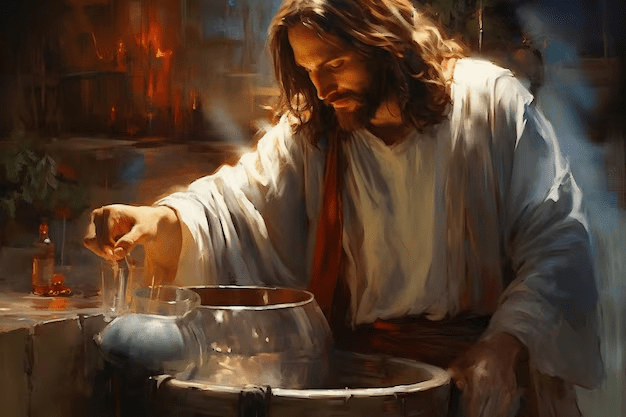
Consider the incontrovertible evidence: In the Bible, Cana is where Jesus performed his first public miracle, by turning water into wine at a wedding celebration. Water, wine, weddings, and miracle-working all symbolize what occurs in the Golden Circle via the Assembly. That I’m right about Cana’s symbolism is further supported by the fact that the Canaanites in the Bible inhabited the Promised Land, which is NOT of this world (so quit fighting already over nothingness and seek the Promised Land within!).
Let’s move on to Rv 1.18:8, which reads:
Offer the sacred fire of creation, the life force in the circle acting for the multitudes on the straight path.
Definitions and divisions:
haviḥ-kṛtim (offer the sacred fire of creation) prāñ(a)-cam (the life force in the circle) kṛṇoti (acting for the Assembly ot multitudes) adhvaram (on the straight path).
Notes:
In the Bible, we find the phrase “straight path” five times (in Proverbs 3:5-6, Isaiah 40:3-4, Mark 1:3, Hebrews 12:13 and Matthew 7:14). From this, we can deduce that the “straight path” is the path of giving to receive in the spirit or universal Brotherhood preserved and restored within the Assembly of Souls.
Rv 1.18:9 reads:
Offer the sacred fire of Holy Esu (the Holy Spirit or Vishnu?) moving the heart-mind Nara calls to peace.
Defiinitions:
hotrā (offer the sacred fire) deveṣu (of Holy Esu = the Holy Spirit) gacchati (moving the heart-mind) narā-śaṃsam (Nara calls to peace).
Notes:
In the Course, Jesus uses the phrase “call to peace” only once, in a section that 1) strongly echoes this Vedic verse and 2) indicates that Jesus and Nara are two symbols of the same divine power. Here’s what he says regarding the call to peace:
Blessed are you who teach with me. Our power comes not of us, but of our Father. In guiltlessness we know Him, as He knows us guiltless. I stand within the circle, calling you to peace. Teach peace with me, and stand with me on holy ground. Remember for everyone your Father’s power that He has given him. Believe not that you cannot teach His perfect peace. Stand not outside, but join with me within. Fail not the only purpose to which my teaching calls you. Restore to God His Son as He created him, by teaching him his innocence. (ACIM, T-14.V.9:1-10)
The Sukta’s final line, Rv 1.18:10, reads:
In holiness and fearlessness, the waters of forgearance honor the chariot of wholeness in the Celestial Realm, Nara’s Resting Place of adorning joy.
Definitions:
su-dhṛṣṭamam (in holiness and fearlessness) apaś-yam (the waters of forbearance) sap-rathaḥ-tamam (honor the chariot of wholeness) divaḥ (in the celestial realm) na (Nara’s) sadma (Resting Place) makhasam (of adorning joy).
Notes:
According to Google and the prevailing wisdom, the “chariot of wholeness” refers to the Ratha Kalpana (chariot imagery) in Sanskrit, specifically in the Katha Upanishad (3.3-4) and the Bhagavad Gita. Egoically perceived, the chariot is a metaphor for the human body and consciousness, where the Atman is the master of the chariot and the Buddhi (intelligence) is the charioteer whose reins are the mind (Manas) driving the horses of the five senses.
As I explained in my post on the 16th Sukta, Indra’s chariot features in various sacred Hindu allegories. In the Ramayana, Indra offers his chariot to Rama (the advancing Soul) to use in the climatic battle against Ravanna, the evil abductor of Sita (God’s love). He also loans Rama his charioteer, Matali (generating the Tali), his horses, and various other divine weapons. Aided by Hanuman, his forest-dwelling monkey side-kick, Rama succeeds in recovering Sita.
In Hinduism, a tali or thaali is a sacred necklace worn by married women to symbolize the marital bond, love, and commitment between husband and wife, as well as their agreement to honor and serve one another. Tied by the groom around the bride’s neck during the wedding ceremony, the thali traditionally consists of a gold pendant on a yellow thread, often featuring three knots.

So, Ma-thali, Indra’s driver, generates the golden circle of the sacred marriage between the Bride (our Soul) and the Bridegroom (Christ or Soma).
We find the phrase “adorning joy” in this Rik, which Google associates with the verbiage in Isaiah 61:10 describing the sacred marriage. In the KJV Bible, the verse reads thusly:
I will greatly rejoice in the LORD, my soul shall be joyful in my God; for he hath clothed me with the garments of salvation, he hath covered me with the robe of righteousness, as a bridegroom decketh himself with ornaments, and as a bride adorneth herself with her jewels.
Isaiah 61:10-11 actually translates as follows:
To exult and celebrate Yaweh (the Name of God), the Living Beings (our Souls) rejoice in Elohim (the Word of God or Solar Logos). To be clothed in the robes of Yeshua, the Bridegroom, the ministers of glory, the Brides, advance the vessel in the Land of the Living to break forth the springing garden sown to sprout Adonay, the Name of God in rightmindedness, the song of praise budding forth the Om.
From this, we can ascertain that the robes of Yeshua, the Bridegroom, are the shining robes of adorning joy–the purely symbolic, divine, or spiritual garments representing light, salvation, and the restoration of humanity to the divine state of oneness in Christ and God. In Syriac Christian tradition, this imagery represents the righteousness worn by the saved, while in Gnosticism, it represents the Soul’s heavenly vesture. These interpretations are accurate, as far as it goes, if we rightly perceive what it means to be “saved” or “righteous” (which most people living in the world today do not).
These “robes of adorning joy” are 1) the shining white robes worn by the Souls under the altar in Revelations, 2) the shining white robes worn by the Bridegroom who appeared to Daniel on the riverbank; and 3) what the “seamless robe” taken from Jesus by the Roman soldiers (who cast lots to win it) was meant to symbolize.
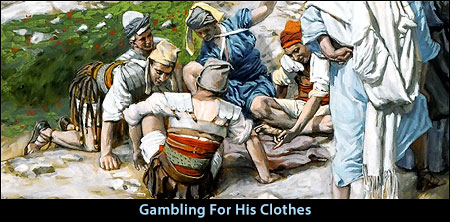
In the Celestial Sphere, where we stand upright (as Souls) in the Assembly, Nara’s adorning joy shrouds us in light (from underneath), as Course-Jesus explains below:
Forgiveness turns the world of sin into a world of glory, wonderful to see. Each flower shines in light, and every bird sings of the joy of Heaven. There is no sadness and there is no parting here, for everything is totally forgiven. And what has been forgiven must join, for nothing stands between to keep them separate and apart. The sinless must perceive that they are one, for nothing stands between to push the other off. And in the space that sin left vacant do they join as one, in gladness recognizing what is part of them has not been kept apart and separate. (ACIM, T-26.IV.2:1-6)
Makes sense, right?
When all the pieces are strung together, the 18th Sukta reads thusly:
Soma’s name (or identity) encloses (like a sanctuary) the ear of Uchaishravas to expand the mind preserving the thundering fragrance effused by the Supreme Lord.
Zealously desire to perceive the Lord riding the horse; the Lord dispelling the sickness or affliction in the light of knowing to nourish and grow the power of the whole leaden weight of Ketu (the descending node of the moon); the Lord pressing forward the call of creation in wholeness.
Join together in the power covering Usah (the dawn) to shake the path of the living being (the Soul) in what appears to be mortal, to protect the wholeness preserving the thundering.
The powers singing in the desert of non-existence, the seven sages of forbearance awaken within the Brahmin, the Bridegroom, Soma.
o assist the mortal world, the True Self of the Supreme Lord expands the mind of the Bridegroom, Soma, to see the secret circle of human forbearance the honorary alms protect from sin.
The eternal powers of the Bridegroom consume the past in the kindly way of Lord Indra’s love and forbearance sublimely offering God’s glory in union.
Because the cosmic-order waters are attained in the almsgiving rituals of the learned sages assembled in Cana (the Circle of Nara), the holy power of the Greater Light yokes our Souls to energize exceedingly the walk to prosper the Assembly.
Offer the sacred fire of creation, the life force in the circle acting for the multitudes on the straight path.
In holiness and fearlessness, you behold the Word of God advancing the Moon’s fullness in the Celestial Realm, Nara’s Resting Place of adorning joy.
When I reach the end of these posts, I always feel like I missed something — or could have explained many more things connected to these teachings. At the same time, I feel as if I’ve probably explained too much. So, if I’ve left unanswered questions or missed something I should have included, let me know in the comments.
Thanks for visiting. I hope you found this discussion useful. Until next time, Om Hari Om and Namaste.
 The Holy Meeting Place
Leave a comment