Namaste, my brother. I humbly offer you God’s peace, joy, love, and mercy. We’ve now come to the Rigveda’s 16th Sukta–another alleged hymn to King Indra, which is, in fact, a wisdom teaching describing the relationship between Indra, the Red Ray or Blood of Christ, and Soma, the Great I Am. The scholar-baffling words somapitaye and piba appear numerous times in this Sukta, so we’ll soon find out if my proposed definitions are water-tight or leak like a sieve.
Let’s dive right in, again using Sri Aurobindo’s version of the transliterated Sanskrit.
My translation of Rv 1.16:1 reads:
God’s true mode of being conveys Antu-Hara, the one hosting the lifeforce of Soma (the Great I Am), the father unto Indra, the true mode of being safeguarding the Word of God.
My definitions and word-breaks:
ā (God’s) tvā (the true mode of being) vah-antu (conveys Antu) hara-yo (Hara, the one) vṛ(as)-aṇam (hosting the Lifeforce of) soma-pītaye (Soma, the father unto) indra (Indra) tvā (the true mode of being) sūracakṣa-saḥ (safeguarding the Word of God).
My Notes:
In the ancient Mesopotamian pantheon, Antu was the wife of Anu, the Father-god of the Celestial Sphere. She is, therefore, the chief mother goddess and queen of the earth. Her Hindu counterpart is probably Prithvi. In Hinduism, Hara refers to Shiva, the transcendent power of grace, whose wives were Sita and Parvati. And herein we are told that Antu-Hara is “the one” hosting the Lifeforce of Soma, the Great I Am (Christ), whose “son” is Indra, the guardian of God’s Word in the dream-realm.
Moving forward, my translation of Rv 1.16:2 reads:
The present moment (the Holy Instant) bestows the whole milk-yielding well conveying Hari, Kamadeva’s three Great Rays, near (in proximity) to the voice of True Being, Indra’s sacred-cloud chariot.
My definitions and syllable-breaks:
imāḥ (The present moment) dhā-nāḥ (bestows the whole) ghṛta-snu-vaḥ (milk-yielding well conveying) harī (Hari) iti (Kamadeva’s three) iha (Great Rays) upa (near to) vak-ṣataḥ (the voice of true being) indram (Indra’s) su-khatame (sacred-smoke or sacred-cloud) rathe (chariot)
In Hinduism, the milk-yielding well is personified as Kamadhenu, the miracle-cow. Although more commonly associated in the lore with Krishna than with Kamadeva, Kamadhenu means “the cow of Kama (Divine Love, not desire).” So, by name, if nothing else, the mich-cow of miracles belongs to Kamadeva. That the present moment (the Holy Instant) bestows the whole well of miracles–the well bringing forth the Trinity Rays — means, as Jesus explains in the Course, that we can awaken instantly to the Truth of our Being by opening our minds to the ever-present Holy Instant of eternity.
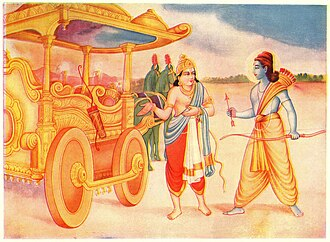
Indra’s chariot or rath features in various allegories. In the Ramayana, he offers his rath to Rama to use in the climatic battle against Ravanna, the evil abductor of Sita. He also loans Rama his charioteer, Matali, his horses, and various other divine weapons. Aided by Hanuman, his forest-dwelling monkey side-kick, Rama prevails. Nowhere could I find Indra’s chariot described as cloud-like, but he is the god wielding the thunder-bolt throwing vajra, and where do thunderbolts come from, if not clouds? We can deduce from this description, that Indra’s chariot and the pillar of clouds found in the Bible are two forms of the same spiritual power.
My translation of Rv 1.16:3 reads:
Indra’s breaking dawn calls on God’s Majesty. Indra’s oblations implant the lines (or mark) of Indra’s soma-mouth to assemble together the four close in proximity to the wholeness of the Son of God’s Holy Name, Hari.
indram (Indra’s) prātaḥ (breaking-dawn) hav-ā-mahe (calls on God’s Majesty) indram (Indra’s) prayati (oblations) adh(a)vare (implant the lines or mark) indram (of Indra’s) som-asya (Soma-mouth or moon-mouth) pīt-aye (to assemble together the four) upa (close to) naḥ (the whole) sutam (Son) ā (of God’s) gahi (holy name) hari-bhiḥ (Hari).
First of all, it must be emphatically stated that adhvare can NOT mean “sacrifice,” as pretty much everybody claims, be they Hindu or Muslim; because the Rigveda is a divinely revealed scriptural text, while sacrifice is an ego-engendered idea unknown to God. Second of all, we find “breaking dawn” and “God’s Majesty” throughout the Bible and the Course. Breaking dawn is probably, therefore, a scriptural cipher for the Holy Instant.
Course-Jesus says much on the subject of the Holy Instant. What follows is but one example:
Could you but realize for a single instant the power of healing that the reflection of God, shining in you, can bring to all the world, you could not wait to make the mirror of your mind clean to receive the image of the holiness that heals the world. The image of holiness that shines in your mind is not obscure, and will not change. Its meaning to those who look upon it is not obscure, for everyone perceives it as the same. All bring their different problems to its healing light, and all their problems find but healing there. (ACIM, T-14.IX.7:1-4)
Indra’s oblations implant the lines or marks of Indra’s moon-mouth or soma-mouth. I couldn’t find reference to Indra’s moon-mouth anywhere, but I did find Indra described as a champion “Soma-drinker.” So, it’s safe to assume the mark or lines referenced herein form the metaphorical “mouth” through which Indra “drinks” Soma’s offerings of mercy, peace, joy, and grace.
That mouth is almost certainly the “mark of God” mentioned throughout the Bible — the mark on the forehead of the faithful, enabling them to “drink” the Living Water coming down to us from the miracle wellspring. That Soma is a mythical plant-based drink of some sort is a complete misnomer. Soma is the Lesser Light of God in the dream-realm, which is the Christ Light or Christ Ray of the Atonement Trinity. What we “drink” from Soma is, therefore, the Living Water supplied by Christ via the well of Jacob, guarded by Nisrok, the eagle-headed Living Being. And speaking of the Living Beings, they are the four “close to the wholeness” of the Son of God’s Holy Name, which is Hari.
My translation of Rv 1.16:4 reads:
Indra, through the agents described, brings forth the fruits perfecting the true mode of being. The power and guiding authority of the whole, the song praising God’s holy name is near in proximity to Ida’s soma-pressing son, the shining Nara thirsting to fill the life.
My definitions and breaks:
indra (Indra) ke-śibhiḥ (through the agents described) sute (brings forth or begets the fruits) hi (perfecting or refining) tvā (the true mode of being) saḥ (the power) imam (and guiding authority) naḥ (of the whole) stomam (the song praising) ā (God’s) gahi (holy name) upa (near to) idam (Ida’s) savanam (soma- pressing) sutam (son) gauraḥ (the shining) na (Nara) tṛṣitaḥ (thirsting to) piba (fill the life)
My notes:
The fruits perfecting the true mode of being are the Fruits of the Lamb–the Sefirot of the mystical Jewish Kabbalah. We harvest those fruits from the Tree of Life, the circular path we walk to return to Heaven. In Hinduism, these same ten “fruits” are personified as the Mahavidyas.
God’s Holy Name is Hari, who is near (in proximity) to Ida’s soma-pressing son. Ida is the Goddess of Speech representing God’s Voice sounding the Om(s)–the tri-tonal song praising God’s Holy Name.
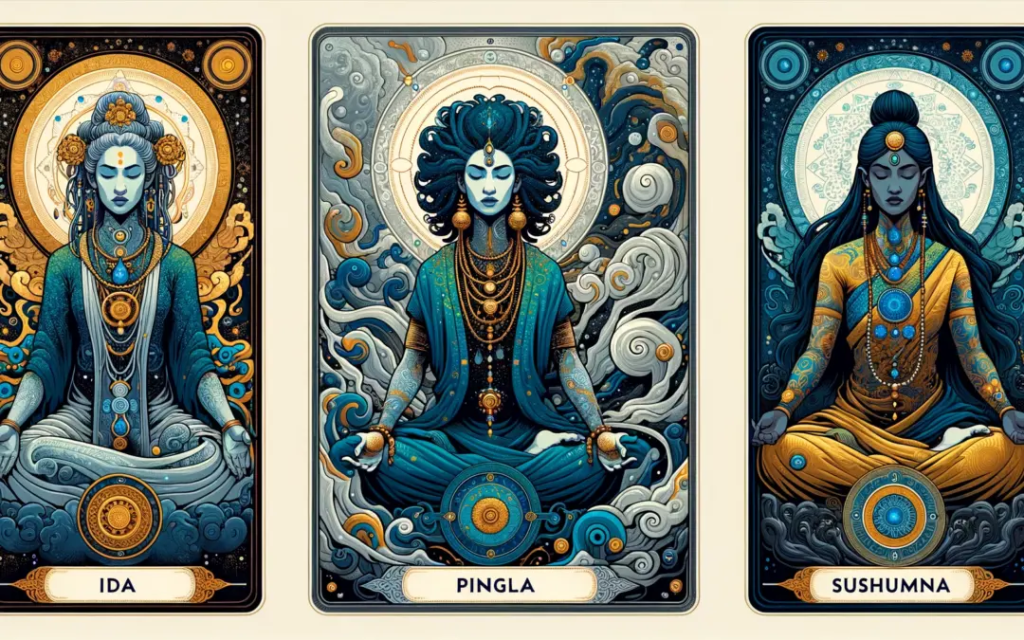
In the mythology of India, Ida is the daughter of Vayu (the cosmic breath), and the mother of Utkala (“above Kala”), her son by Dhruva (“the fixed” or “the eternal”). That the rishis describe Utkala as “the shining Nara thirsting to fill the life” suggests that Ida’s son represents the place where Nara (the universal Soul) extracts the Living Water or miracle-milk as a whole before escaping the illusion completely.
Kala means time, death, or darkness. So, Utkala represents the land or kingdom above time, death, or darkness. Ergo, Utkala personifies the Real World bridging ego consciousness and super consciousness. I’m not convinced Savanam means “soma-pressing” or “soma-extracting,” as widely supposed, but I can’t come up with a better meaning, so we’ll let it stand for now.
Let’s move on to Rv 1.16:5, which reads:
These Soma powers, the supreme powers bearing the Holy Chalice of God’s Reflection, the water-jar of the rishis, expand the consciousness of Indra, the original mind filling the life.
My Definitions and breaks:
ime (These) somā-saḥ (Soma powers) inda-vaḥ (the supreme powers bearing) su-tāsaḥ (the holy chalice) adhi (of God’s reflection) ba-rhiṣi (the water-jar of the rishis) tān (expand the consciousness of) indra (Indra) sahase (the original mind) piba (filling the life)
The Soma powers the rishis mean are those mentioned in the previous line. So, the Mahavidyas, Ida, Utkala, and Nara. And Ida is indeed the nadi or spiritual channel for the Soma-energy elixir in the Spiritual Body. That elixir isn’t plant-extracted juice; it’s the Living Water of Grace. Ida’s partner, Pingala, is the nadi transporting the sun-energy elixir Hindus called Amrita. Amrita is presumably produced in the Bindu chakra. I say “presumably” because the Bindu chakra also is known as the Moon Chakra, suggesting it is, in fact, Soma’s press, rather than Agni’s. So, something’s akimbo.
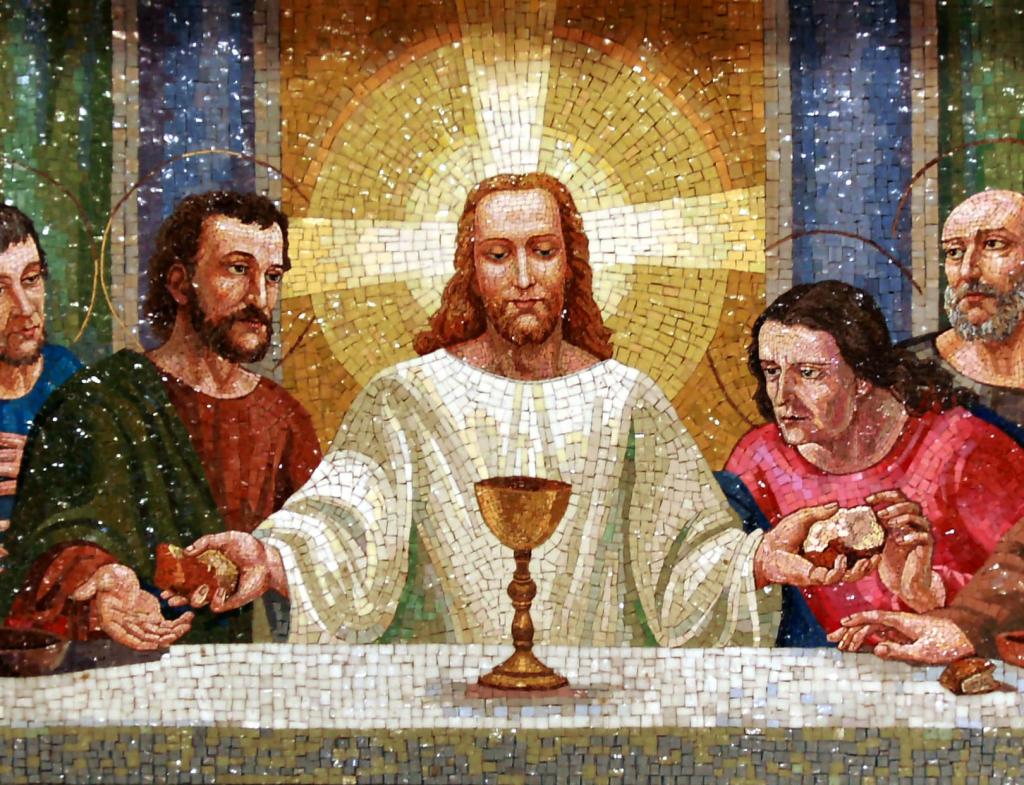
The Holy Chalice of God’s Reflection is the Chalice of Atonement referenced in the Course, as well as 1) the chalice of redemption seen by Zechariah and 2) the cup used by Jesus Christ at the Last Supper. That chalice also is, we learn herein, the water-jar of the rishis used by the Soma powers to expand the consciousness of Indra, the original mind filling the life.
In the one remaining reference to this “chalice” in the Course’s standard edition, Jesus says:
Beside you is one who offers you the chalice of Atonement, for the Holy Spirit is in him. Would you hold his sins against him, or accept his gift to you? Is this giver of salvation your friend or enemy? Choose which he is, remembering that you will receive of him according to your choice. He has in him the power to forgive your sin, as you for him. Neither can give it to himself alone. And yet your savior stands beside each one. Let him be what he is, and seek not to make of love an enemy. (ACIM, T-19.IV-D.13:1-8)
In Hinduism, the water-jar described herein is called a lota, Typically a small, spouted, and rounded jug, lotas have been used in India since at least the 2nd millennium BCE. Generally, they are used to hold or pour out water and spirits during religious ceremonies, including yajnas, pujas and wedding rituals. Copper lotas also are used in Ayurvedic medicine to produce and store drinking water presumed to be useful in healing.
Yes, my definitions for sutasah, adhi, and barishi differ radically from the norm; but the norm is too rubbery to be trustworthy. Plus, these definitions just feel right.
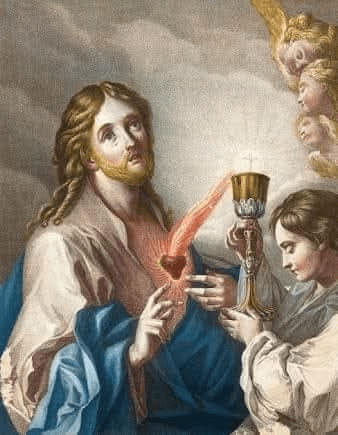
The rishis clearly state in this Sukta that Soma, the Great I Am of Christ, is “the father unto” Indra, the king of the devas. Indra himself is carried by Airavata, the Great Elephant representing the seven spouts of the fountain or Wellspring, while Indra’s cloud-chariot carries all our Souls when they’re ready to awaken. And this tracks with the Christian view that the blood of Christ is supplied to us by Jesus. It also fits with Sister Faustina’s vision of the Divine Mercy rays beaming forth from Christ’s heart (as depicted below, in the painting she commissioned at Christ’s behest).
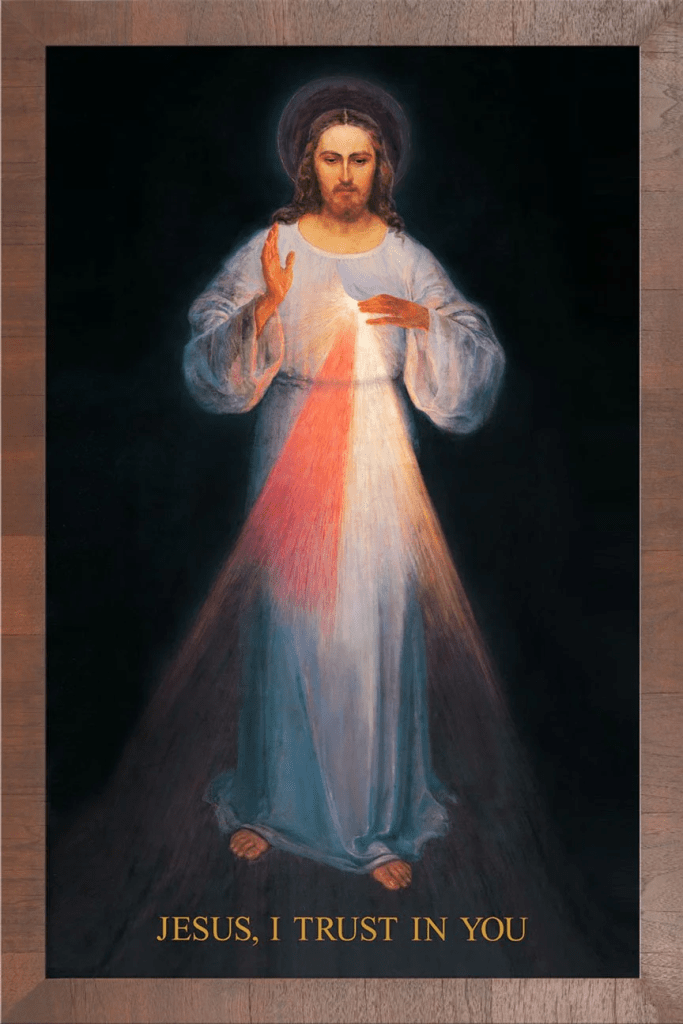
What doesn’t fit is the parentage assigned to Indra in the Hindu literature — unless Kashyapa, the World Turtle, is a form of Soma. And that possibility warrants further exploration.
The Vedas allegedly identify Indra as the first-born Aditya, making him the eldest son of Aditi and Kashyapa. In later texts, Indra’s parents are Dyaus Pita, the Sky Father, and Prithvi, the Earth Mother. In ancient Mesopotamia, the Sky Father was Anu, so Indra’s parents in these stories are likely the Hindu counterparts to Anu and Antu, two deities also mentioned multiple times in the Rigveda — a hard fact lost through millennia of mistranslation. We can’t yet ascertain, therefore, if Soma and Anu are two names used by the rishis for the same deific power. So, let’s put a pin in this question for now and move on.
The next verse (Rv 1.16:6) reads:
This one’s (Indra’s) thundering song of praise is the first-born heart touching Astu (the eight Shivas). Equanimity exalts the now-moment, Soma’s charioteer filling the life of the entire holy creation. In this way, the Soma-offering’s charioteer, Indra’s breath, produces the mercy moving the heart to abide in joy or peace.
ayam (this one’s) te (thundering) stomaḥ (song of praise) agriyaḥ (is the firstborn) hṛdi-spṛk (heart-light touching) ast-u (the Amen? the eight Shivas?) śamta-maḥ (equanimity or sameness exalts) atha (the now-moment) somam (Soma’s) sutam (charioteer) piba (filling the life) viśvam (of the entire holy creation.) it (in this way) savanam (extract the Soma offering’s) sutam (charioteer) indraḥ (Indra’s breath) ma-dāya (to produce the mercy) gacchati (moving the heart) vṛt-rahā (to abide in joy or peace)
In earlier posts, I rendered Astu as Amen, because, according to the dictionaries, Astu means “so be it,” the same definition applied to Amen in Judaism and Christianity. And Amen certainly works in the context of this teaching. But Astu also can mean “the eight Shivas,” and there are indeed eight forms of Shiva in Hindu theology.
Known as the Ashtamurti, the eight forms of Shiva are said to represent the eight natural elements and cosmic forces through which Shiva (grace) controls the universe: Sarva (earth), Bhava (water), Rudra (fire), Ugra (wind), Bhima (sky), Pashupati (individual soul/yajamana), Ishana (sun), and Mahadeva (moon). These manifestations are detailed in the Puranas and Vedas.
In a broader sense, this teaching parallels many things stated in the Course, What follows is but one example.
The miracle minimizes the need for time. In the longitudinal or horizontal plane the recognition of the equality of the members of the Sonship appears to involve almost endless time. However, the miracle entails a sudden shift from horizontal to vertical perception. This introduces an interval from which the giver and receiver both emerge farther along in time than they would otherwise have been. The miracle thus has the unique property of abolishing time to the extent that it renders the interval of time it spans unnecessary. There is no relationship between the time a miracle takes and the time it covers. The miracle substitutes for learning that might have taken thousands of years. It does so by the underlying recognition of perfect equality of giver and receiver on which the miracle rests. The miracle shortens time by collapsing it, thus eliminating certain intervals within it. ¹It does this, however, within the larger temporal sequence. (ACIM, T-1.II.6:1-10)
Let’s proceed to Rv. 1.16:7, the Sukta’s final verse, which reads:
Soma, the father unto the powers of this present-moment wholeness of Kama, God’s vital force, the rays of God’s horses calling upon the multitudes acting to end standing on the left-hand side of the True mode of being in self-reflection.
soma-pītaye (Soma is the father unto) saḥ (the powers) imam (of this present-moment) nah (wholeness) kamam (of Kama), ā (God’s) pṛṇa (vital force or breath of life) gobhiḥ (the rays of ) aśvaiḥ (God’s horses calling) śata-kr-ato (the multitudes acting to fade away) i-ti (Kamadeva’s three) śata-krato (hundred acting to end) stavāma (standing on the left-hand side of) tvā (the true mode of being) svādhyaḥ (in self-reflection).
Assuming my definitions are correct, we learn a great deal from this verse. We learn, for starters, that Kama, as I’ve repeated stated, is indeed God’s vital force, which is Agape, rather than the concupiscent desire for “specialness” that gave rise to the separation. We further learn that Kama’s rays are the Asvina, God’s horses (thought forces) calling on the multitudes (the Biblical “three hundred men”) to end “standing on the left-hand side of the true mode of being in self-reflection.”
We stand on the left-hand side in the first two quadrants of the circle-journey–the western quarters of Dharma and Artha.
As I understand it, the horses referenced herein are the seven horses pulling Surya’s chariot, whose driver is Aruna — a name meaning “the first red ray of breaking dawn.” So Aruna represents Indra’s breaking dawn, essentially.
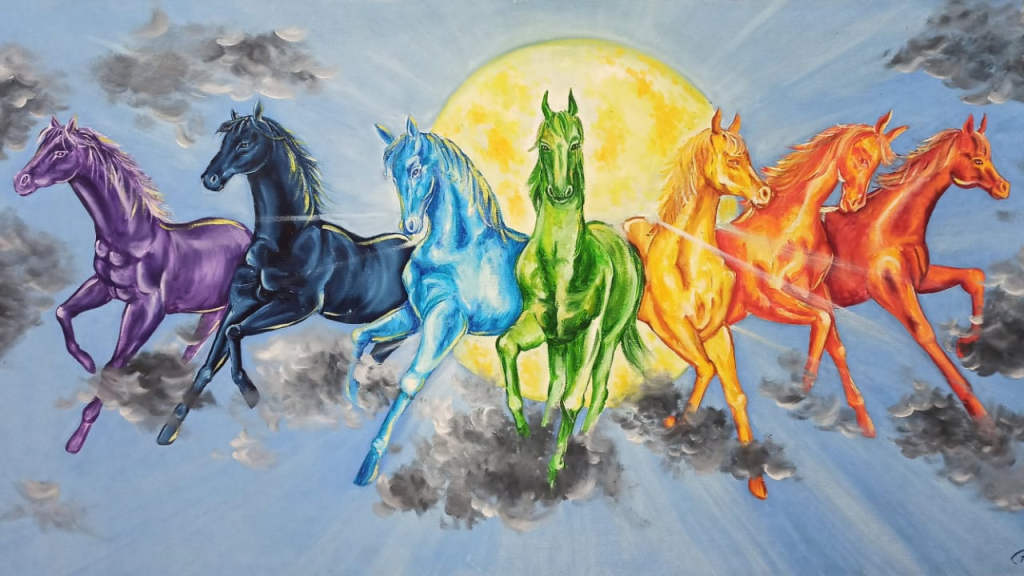
Four of these seven horses were seen riding in chariots moving in different directions by the Biblical prophet Zechariah. These same four were seen twice by John of Patmos, the author of Revelations; first he saw them being sent forth by the four Living Beings. And he later saw them coming forth (bearing riders) from the seals broken by the lamb. These four horses are, I believe, the four Rays of Divine Attribute, as well as the Four Horses of the Apocalypse. Apocalypse means “revelation,” so these horses (not horsemen) are helpful to humans. Rightly understood, they are the four thought-forces that wake us up to God’s Reflection in the world. Together with the three Rays of Aspect, the Trinity Rays (Kamadeva’s three), they make up the Seven Rays of Life written about extensively by Alice A. Bailey, among other esoteric astrologers.
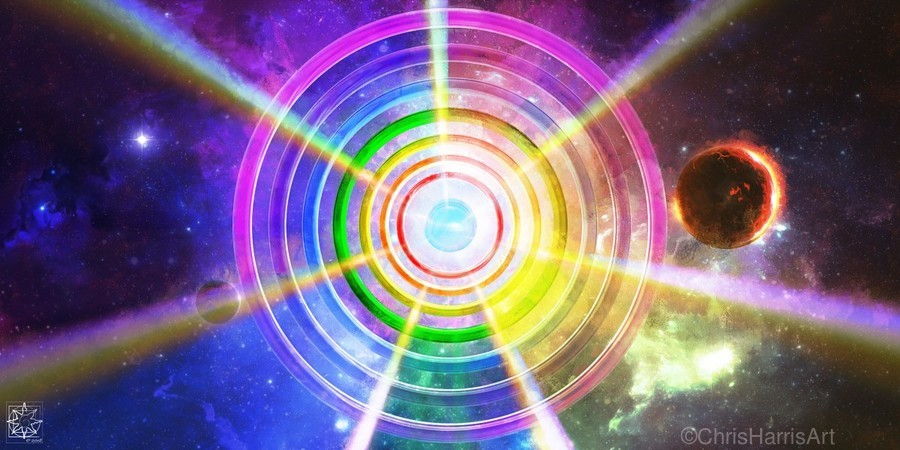
One of these days, if God so wills, we’ll discuss the esoteric teachings about the Seven Rays, and compare what they say to the Hindu model, as well as what the Bible actually says about these purely symbolic horses.
Let’s now review the whole Sukta, as the sacred teaching it actually is:
God’s true mode of being conveys Antu-Hara, the one hosting the lifeforce of Soma (the Great I Am), the father unto Indra, the true mode of being safeguarding the Word of God.
The present moment (the Holy Instant) bestows the whole milk-yielding well conveying Hari, Kamadeva’s three Great Rays, near (in proximity) to the voice of True Being, Indra’s sacred-cloud chariot.
Indra’s breaking dawn calls on God’s Majesty. Indra’s oblations implant the lines (or mark) of Indra’s soma-mouth to assemble together the four close in proximity to the wholeness of the Son of God’s Holy Name, Hari.
Indra, through the agents described, brings forth the fruits perfecting the true mode of being. The power and guiding authority of the whole, the song praising God’s holy name is near in proximity to Ida’s soma-pressing son, the shining Naras thirsting to fill the life.
These Soma powers, the supreme powers bearing the Holy Chalice of God’s Reflection, the water-jar of the rishis, expand the consciousness of Indra, the original mind filling the life.
This one’s (Indra’s) thundering song of praise is the first-born heart touching Astu (the eight Shivas). Equanimity exalts the now-moment, Soma’s charioteer filling the life of the entire holy creation. In this way, the Soma-offering’s charioteer, Indra’s breath, produces the mercy moving the heart to abide in joy or peace.
Soma, the father unto the powers of this present-moment wholeness of Kama, God’s vital force, the rays of God’s horses calling upon the multitudes acting to end standing on the left-hand side of the True mode of being in self-reflection.
I hope you found this svādhyāya both illuminating and useful. Until next time, Om Hari Om and Namaste.
 The Holy Meeting Place
Leave a comment