Contrary to what Google reports, the 15th Sukta of the Rigveda’s First Mandala (Rv 1.15) is not “a hymn invoking the Maruts, a group of storm gods worshipped in ancient India, to assist Agni and Indra in blessing the fire-sacrifice ritual-ceremonies called yajnas.” It is, in fact, a great deal more than a simple hymn of invocation. The Maruts are mentioned, but only once. More predominant are the mysterious terms Rtu and piba, which each appearing a dozen times in various forms.
As we learned from our discussion of RV 1.1:14, Maruts is another name for the Adityas, the solar-god sons of Aditi, the Mother of Boundless and Undivided Creation. She is, therefore, the Hindu personification of Creation’s Wholeness, which we remember in the Great Forest or Golden Circle.
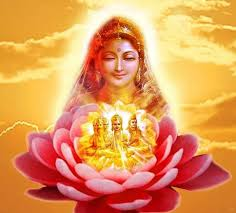
The father of the Maruts/Adityas is Kashyapa, a name meaning “tortoise” in Sanskrit. Kashyapa is probably, therefore, the Hindu equivalent of the Black Tortoise or the Black Dragon of the North Sea in Chinese mythology.

Given the name’s meaning, Kashyapa may represent “the World Turtle” better known as Akupara (boundless) or Chukwa (error-option or error-wind) in Hinduism. References to Akupara appear in the circa-1500 AD writings of Jnanaraja, who described the World Turtle as “A vulture, whichever has only little strength, rests in the sky holding a snake in its beak for a prahara [three hours]. Why can [the deity] in the form of a tortoise, who possesses an inconceivable potency, not hold the Earth in the sky for a kalpa [billions of years]?”
These descriptions all suggest that Kashyapa represents the Ego Mind manifesting the illusory world of form.
Akupara is described (and depicted) as a sea turtle bearing on his back the world supported by four elephants. The elephants are called Maha Pudma. Presumed to be an alternative spelling of padma, pudma is generally translated as “lotus.” But Pudma might also be a marriage of Pud (joining) and ma (creation). making the definition of Maha Pudma not Great Lotus, but the Great Joining of Creation.

So, let’s see what, if anything, the Rigveda’s 15th Sukta says about the Maruts, Rtu, piba, the Golden Circle, and/or the World Turtle. This time, to maintain a semblance of ecumenical balance, we’ll use Sri Aurobindo’s phrasing and line breaks as our guide. According to His Holiness, the Sukta reads as follows in transliterated Sanskrit:
indra somam piba ṛtunā ā tvā viśantu indavaḥ matsarāsaḥ tat-okasaḥ ǁ
marutaḥ pibata ṛtunā potrāt yajñam punītana yūyam hi stha su-dānavaḥabhi yajñam gṛṇīhi naḥ gnāvaḥ neṣṭariti piba ṛtunā tvam hi ratna-dhāḥ asi ǁ
agne devān iha ā vaha sādaya yoniṣu triṣu pari bhūṣa piba ṛtunā ǁ
brāhmaṇāt indra rādhasaḥ piba somam ṛtūn anu tava it hi sakhyam astṛtam ǁ
yuvam dakṣam dhṛta-vratā mitrāvaruṇā duḥ-dabham ṛtunā yajñam āśāthe iti ǁ
draviṇaḥ-dāḥ draviṇasaḥ grāva-hastāsaḥ adhvare yajñeṣu devam īḷate ǁ
draviṇaḥ-dāḥ dadātu naḥ vasūni yāni śṛṇvire deveṣu tā vanāmahe ǁ
draviṇaḥ-dāḥ pipīṣati juhota pra ca tiṣṭhata neṣṭrāt ṛtu-bhiḥ iṣyata ǁ
yat tvā turīyam ṛtu-bhiḥ draviṇaḥ-daḥ yajāmahe adha sma naḥ dadiḥ bhava ǁ
aśvinā pibatam madhu dīdyagnī iti dīdi-agnī śuci-vratā ṛtunā yajña-vāhasā ǁ
gārha-patyena santya ṛtunā yajña-nīḥ asi devān deva-yate yaja ǁ
We’ll start as ususal with the first verse, Rv 1.15:1. Here’s what I made from these sacred words:
Indra, from Soma, drinks the celestial waters of God’s true mode of being, to enter into Shiva, the supreme power conveying Matsya’s sap, in the infinite dwelling place.
My definitions and breaks:
indra (indra) somam (from soma, the lesser light or Moon of the I Am) piba (filling the life or breath) ṛtunā (in the appointed time) ā (of God’s) tvā (true mode of being) viśantu (to enter into Shiva) indavaḥ (the supreme power conveying) matsarāsaḥ (Matsya, the joyous one’s sap, juice, or essence) tat-okasaḥ (in the infinite dwelling place, residence, or abode)
My Notes:
Firstly, piba –a word occurring 12 times in this Sukta — does not mean “to drink” in Sanskrit, as pretty much every dictionary suggests. Pi-ba means “filling the life” or “filling the breath” — two phrases also found in the Bible. We find, for example, “filling the breath” (the ruach or pneuma God breathed into Adam) in Genesis 2:7.
According to Google, the phrase “represents receiving the divine life, spirit, and word of God,” whereas “filling the life” means allowing the Holy Spirit and God’s Word (the Om, not the Bible!) to fill one’s mind, actions, and heart, transforming life from a survival-mode existence to an “abundant life” in the spirit.
So, the rishis are telling us in this verse that Indra, the Red Ray of God’s Presence, from Soma, the Christ Presence, fills the life or breath of God’s True Mode of Being to bring us back to Shiva (the Soul’s natural state of Grace), who carries Matsya, the fish-avatar of Vishnu, in the infinite dwelling place (Da’at).
That Matsya, the Joyous One, possesses “the sap” tells us Vishnu’s first incarnation embodies Na’aman, the “sweet sap” and healed-leper of the Bible.
My translation of Rv 1.15:2 reads:
Those in the desert fill the life of the formless divine in this world at the appointed time in cycles to make pure the guardians of the almsgiving offerings, the pure downward-growing shoots yoking the twins perfecting the standing well of the nine red rays sanctifying the name; the rays of the solar logos in wholeness; the rays conveying the soma vessels filling the life at the appointed time in cycles from the true essence polishing the jewel bestowing the sword.
My definitions and word-breaks:
maru-taḥ (those in the desert) pibata (fill the life of the formless divine) ata (in this world) ṛtunā (at the appointed tie in cycles) po-trāt (to make pure the guardians) yajñam (of the almsgiving offerings) pu-nītana (the pure downward-growing shoots) yū-yam (yoking the twins) hi (perfecting) stha (the stationary) sudā-navaḥ-abhi (wellspring of the nine red rays) yajñam (of the yajna) gṛṇīhi (the rays of the solar logos) naḥ (in wholeness) gnāvaḥ (the rays conveying) neṣṭariti (the soma vessels) piba (filling the life) ṛtunā (at the appointed time in cycles) tvam (from the true essence) hi (polishing) ratna-dhāḥ (the jewel bestowing) asi (the sword)ǁ
Notes:
There’s a lot here, so let’s unpack it in stages, parcel by parcel. In Sanskrit, maru means “desert” or “wilderness” — the identical terms used in the Bible to represent the illusory material world. So it’s hard to imagine the word Maru-tah can mean anything other than “those in the desert-wilderness.” And those in the desert-wilderness can’t be a group of elemental storm-gods. If, therefore, the Maruts are the Aditya, as the 14th Sukta suggests, then both terms describe the Souls giving and receiving the sacred fire to restore the One Son of God to rightmindedness by bringing together the Infinite Cosmos and the World Turtle (through the four elephants supporting the dome).

In Hindu theology, the guardians of the yajna are said to be Agni and Vishnu, aided by four priests. Contrary to common belief and practice (among Hindus), those priests aren’t human beings; they’re spiritual helpers. Associated (rightly or wrongly) with the four Vedas, those four helpers are called the Hotr, he who invokes the gods; the Adhvaru, he who prepares the altar and offerings; the Udgatr, he who chants the hymns; and the Brahman, he who supervises the ritual.
Like the four priests of the holy word in the Bible, these Vedic “priests” represent our internal helpers– be they spiritual powers or advanced Souls–appointed by Christ to officiate at our inmost almsgiving offerings.
The guardians of the ritual are described in this verse as “the down-ward growing shoots” yoking the twins from the stationary wellspring of the nine red rays. In the Bible, those twins are Jacob and Esau; in Hinduism, they’re either Yama and Yami or Nara and Narayana. The nine red rays are the Navagrahas, the planetary deities we talked about in an earlier post.
We find the rather queer phrase “downward-growing shoots” in Isaiah 37:31 and 2 Kings 19:30, so it’s definitely the correct translation of punitana (a word previously undefined). According to Google, the phrase describes the concept of “taking root downward to bear fruit upward,” symbolizing the deep spiritual grounding that paves the way for visible success. Visible success, to my mind, implies manifest miracle-working. So, essentially, our roots in the earth must be purified before we can see the results of our miracle-working in the world.
As the two steams within Vishnu, Nara and Narayana dwell at Badrinath (the fruits of the tree), in penance for the welfare of the world. They are always depicted together, with Nara (the Universal Soul) constantly in the service of Narayana (the water ray of grace).
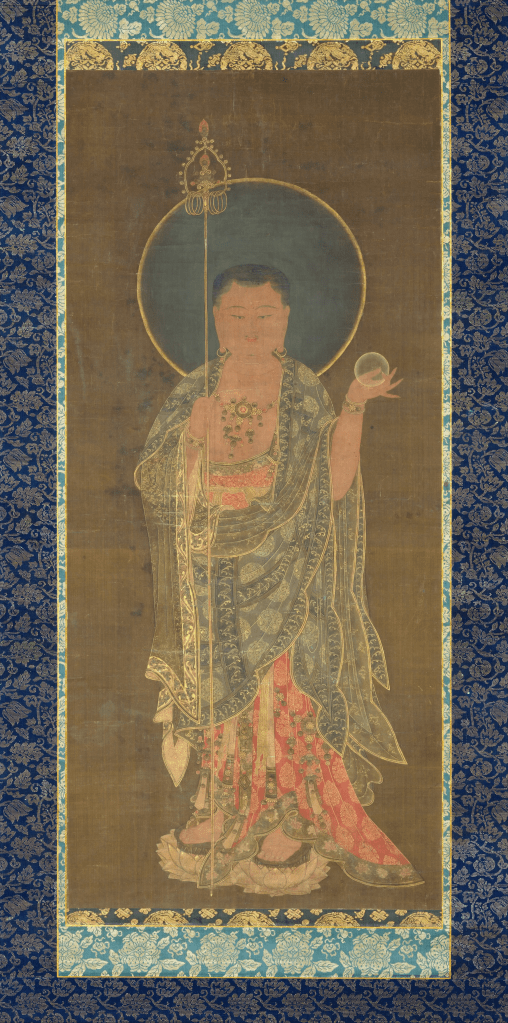
The jewel bestowing the sword is probably the Cintamani, which is described in Hinduism and some Buddhist schools as “a wish-granting gem resembling a pearl.” I’m dubious about that description, given that Cintamani means “jewel of (the) reflection.” I’m more inclined to believe the Cintamani is another name for the Agnimagni, the fiery gem or pearl reflecting God’s face in us. We see that pearl in the claws of the Chinese dragons, in the hand of the Buddha, and in Lakshmi’s right hand in Shintoism. And that fiery pearl does indeed manifest the Flaming Sword, as we learn later in this Sukta.
Let’s move on to Rv 1.15:3, which translates thusly:
Agni is divine love, Kamadeva’s greater light; God’s vehicle for mercy in the form of three sacred circular adornments to fill the life at the appointed time in God’s Plan.
My definitions and breaks:
agne (Agni is) de-vān (divine love) i-ha (Kamadeva, the greater light) ā (of God’s) vaha (vehicle) sādaya (for mercy) yoniṣu (in the form of) triṣu (three sacred) pari (circular) bhūṣa (adornments) piba (to drink) ṛtun-ā (at the appointed time in God’s Plan)
My Notes:
Firstly, it took me a while to work out that devan means “divine love,” while iha means “Kamadeva, the greater light,” given that no such definitions are offered by any online resources. And yet, in the Atharva Veda (6.36.3) Kama (divine love, not desire) is directly identified with Agni. Elsewhere in the literature (including the Rigveda, as we now know), Kamadeva (the Love of God) is presented as a superior form of Agni (the sacred fire). The significance of this is lost, however, on those who mistakenly identify Kamadeva as “the Indian Cupid.”
The three sacred round adornments are the three “crowns” we receive through our merciful devotions. In Jewish tradition, the “three crowns” (Katarim) are sacred, metaphorical adornments representing different aspects of divine service: the Crown of Torah (Ark of the Covenant), the Crown of Priesthood (the Incense Altar), and the Crown of Kingship (the Showbread Table). In Christian theology, the three crowns are generally identified as the Crown of Life, the Crown of Righteousness and the Crown of Glory. In Hinduism, the three crowns represent the Trimurti, presumably consisting of Brahma, Siva, and Vishnu.
But wait, because the rishis say these three crowns are God’s vehicles of mercy. And, in Christ’s instructions to Saint Faustina, the Polish nun to whom he revealed the rays of Divine Mercy, he discussed the three attributes of divine mercy.
Here’s what he said, as recorded in her published diary:
My daughter, if I demand through you that people revere My mercy, you should be the first to distinguish yourself by this confidence in My mercy. I demand from you deeds of mercy, which are to arise out of love for Me. You are to show mercy to your neighbours always and everywhere. You must not shrink from this or try to excuse or absolve yourself from it.
I am giving you three ways of exercising mercy towards your neighbour: the first – by deed, the second – by word, the third – by prayer. In these three degrees is contained the fullness of mercy, and it is an unquestionable proof of love for Me. By this means a soul glorifies and pays reverence to My mercy. Yes, the first Sunday after Easter is the Feast of Mercy, but there must also be acts of mercy, and I demand the worship of My mercy through the solemn celebration of the Feast and through the veneration of the image which is painted. By means of this image I shall grant many graces to souls. It is to be a reminder of the demands of My mercy, because even the strongest faith is of no avail without works.”
As much as I want to believe this is a verbatim account of what Jesus Christ told Sister Faustina, I know her diaries were altered and “catholicized” by a group of priests prior to their Vatican-approved publication in English. In the Course, Jesus uses similar wording to describe his expectations for our merciful service to the greater good (of worldwide atonement). Some of what he said was cut by the FIP editors. Here’s what the FIP let stand:
As you share my unwillingness to accept error in yourself and others, you must join the Great Crusade to correct it; listen to my voice, learn to undo error and act to correct it. The power to work miracles belongs to you. I will provide the opportunities to do them, but you must be ready and willing. Doing them will bring conviction in the ability, because conviction comes through accomplishment. The ability is the potential, the achievement is its expression, and the Atonement, which is the natural profession of the children of God, is the purpose. (ACIM, T-1.III.1:6-10)
So, as I see it, miracle-working is both the “prayer” and the “deed” forms of Mercy, the third of which is words. With regard to the word-aspect, Course-Jesus says:
God offers only mercy. Your words should reflect only mercy, because that is what you have received and that is what you should give. Justice is a temporary expedient, or an attempt to teach you the meaning of mercy. It is judgmental only because you are capable of injustice.
Elsewhere, he adds:
When you have accepted the Atonement for yourself, you will realize there is no guilt in God’s Son. And only as you look upon him as guiltless can you understand his oneness. For the idea of guilt brings a belief in condemnation of one by another, projecting separation in place of unity. You can condemn only yourself, and by so doing you cannot know that you are God’s Son. You have denied the condition of his being, which is his perfect blamelessness. Out of love he was created, and in love he abides. Goodness and mercy have always followed him, for he has always extended the Love of his Father. (ACIM, T-13.I.6:1-7)
I hope all of that makes sense. Let’s go forward to my translation of Rv 1.15:4, which reads:
Brahman walking, Indra apportions the joy filling the life of Soma (the Great I Am) at the appointed time. Anu, the mark of God, in this manner promotes the holy relationship of defenselessness.
brāhmaṇ-āt (Brahman walking or roaming) indra (Indra) rād-hasaḥ (apportions the joy) piba (filling the life) somam (of Soma) ṛtūn (at the appointed time) anu (Anu) tav-a (the mark of God) it (in this manner) hi (promotes) sakhyam (the holy relationship) astṛtam (of defenselessness).
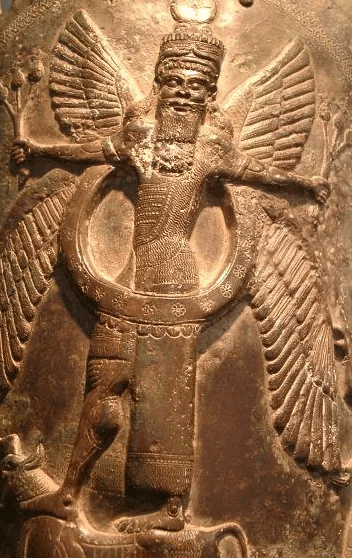
Indra, they say, is “Brahman walking,” meaning Indra represents the inner-presence of God walking with us “in perfect holiness” around the wheel. It also suggests to me that Indra is the Brahman “priest” supervising our merciful yajnas. They also identify Anu, the three-part name of God, as the mark of God promoting the Holy Relationship of defenselessness. Ancient Mesopotamian depictions of Anu show him as a crowned and winged figure standing on a bull within a circle covered in eyes. In each hand, he holds a branch sprouting three fruits resembling pomegranates or figs. Might these tridents represent the three-fruit clusters remaining at the top of the tree after it’s shaken?
Course-Jesus says much on the subject of “defenselessness,” an important subject for another time. In line with this Vedic teaching, he says this:
Without defenses, you become a light which Heaven gratefully acknowledges to be its own. And it will lead you on in ways appointed for your happiness according to the ancient plan, begun when time was born. Your followers will join their light with yours, and it will be increased until the world is lighted up with joy. And gladly will our brothers lay aside their cumbersome defenses, which availed them nothing and could only terrify. (ACIM, W-135.20:1-4).
My translation of Rv 1.15:5 reads:
The Yoke emits from the right hand of God the established universal covenant of Varuna to extract the shining rays at the appointed time, from the almsgiving ritual to make visible Kamadeva’s three aspects.
yu-vam (The yoke or joining emits) dak-ṣam(a) (from the right-hand of God) dhṛta-v(i)ratā (the established universal) mitrāvaruṇā (covenant of Varuna) duḥ-dabham (to extract the shining rays) ṛtunā (at the appointed time in cycles) yajñam (from the almsgiving ritual) āśāthe (to make visible) iti (Kamadeva’s three)
My Notes:
Iti is another one of those Sanskrit words with a thousand meaningless definitions. And that tells me nobody has a clue what it actually means. Only yesterday, while struggling to work out this translation, it suddenly came to me: iti is a compound of i (Kamadeva) and ti (three). And Kamadeva does indeed have three companions in the Hindu lore. Those three companions are named Rati, Vasanta, and Maras.
Traditionally, those three names are translated as “carnal lust” (Rati), “the spring season” (Vasatana), and “death” (Maras), all of which make no sense allegorically. And that’s because the names actually mean “the radiant three” (Rati), “the house of guidance” (Vasa-nta), and “the sap of life” (Mar-as).
From this we can ascertain that the almsgiving ritual makes visible (in stages), the Trinity rays, the house of guidance (the Spiritual Body\Temple), and the sap of eternal life.
And, as we learn in Psalm 104:16: “The trees of the Lord are full of sap.” That sap is Amrita, the honey-sweet elixir that restores the Soul’s memories of its Eternal Reality.
With that settled, let’s talk about Daksam, a form of Dakṣa, which is generally defined as “able,” “expert,” “skillful,” “competent,” and the like. These definitions arise from the belief that Daksa derives from the root-word daks, allegedly meaning to be strong or able. That may be so in some cases, but the Hindu lore identifies Dakṣa as Prajāpati, the lord of creatures and the father of Sat. So, “able” or “competent” doesn’t really fit the bill.
Ergo, the lordly name Daksa is more likely a compound of Daks (right-hand) and a (of God). In this case, we have Daksam, which is probably Daksa with an m tagged on the end to indicate “from” or “of.” A major biblical metaphor, the Right Hand of God represents the open hand with which our Heavenly Father generously and everlastingly scatters the seeds of his merciful love on all his creations.
Are you still with me? I hope so, because we still have a ways to go.
I rendered mitravaruna as “Covenent of Varuna,” because Mitra, which supposedly means either “friend” or “covenant,” can also mean “bond.” And “the bond of Varuna” is referenced in the Mahabharata Epic.
Varuna’s bond, often depicted as a noose or rope (pasa), is said to represent his deific authority. As the “Great Binder,” Varuna reportedly uses this bond to restrain those who violate ethical principles, as well as to maimtain cosmic harmony and, in yajna rituals, to tie the almsgivers in the spiritual purpose of almsgiving. I’m more inclined to believe Varuna’s bond represents “the yoke” of universal brotherhood, binding God’s creations together in oneness.
Varuna’s bond is, therefore, the second covenant– our agreement with God to share his will to return to our natural state of at-one-ment (at the appointed time). And this is why Varuna is hailed in the Vedas as a powerful Asura reigning supreme over men, the gods, and all that exists.
Makes sense, right?
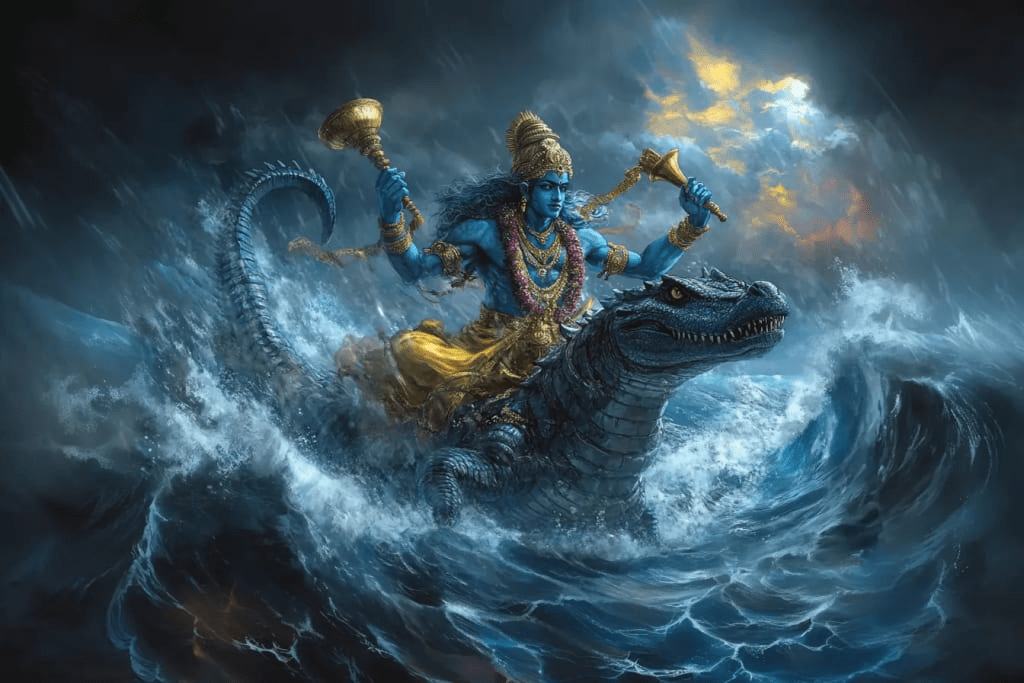
Varuna — a name meaning “the celestial waters of oneness”– is the son of Aditi, making him one of the Adityas. Mitra, meanwhile, is an enigmatic god whose name is rarely mentioned apart from Varuna’s. This tells me, at least, that Mitra isn’t, in fact, a deva at all. The rishis used the word-name in partnership with Varuna’s to describe “the covenant of the atonement” — our agreement with God to wake up at the appointed time by restoring the bond of universal brotherhood our Souls still share in the Ark, the Standing Circle, or the Forest of All Beings.
In the Hindu lore, Varuna governs the Cosmic Order, saves humans from peril, liberates them from sin, and promotes ethical conduct. Varuna also is connected with the symbolic waters of creation from which the manifest world emerges (the primordial ocean). This is probably because Varuna stands guard at the western compass point on the wheel — the gate between the quadrants of Dharma and Artha on the left-hand side of the circle. This posting makes sense, since we pass through that gate only after we start to hear the Living Water — an ability 1) made possible by accepting Atonement as our sole life’s purpose and 2) required to fulfill our holy purpose of saving the world through our shared universal almsgiving offerings.
My translation of Rv 1.15:6 reads:
The fluid of wholeness bestows the riches of the Son of God, the stone in the hand during the ritual offering to Esu, the supreme personality of the godhead in non-existence.
My definitions and breaks:
dravi-ṇaḥ-dāḥ (the fluid of wholeness bestows) draviṇa-saḥ (the riches of the Son of God) grāva-hastāsaḥ (the rock or stone in the hand) adhvare (during the ritual) yajñeṣu (offering to Esu) devam (the supreme personality of the godhead) īḷlate (in non-existence) ǁ
My Notes:
We also find the metaphor of “the stone in the hand” in the Bible, as a symbol of the superior power of the Soul’s eternal sinlessness, guiltlessness, or innocence. In 1 Samuel 17:40, David uses that stone to defeat Goliath; in John 8:7, Jesus challenges those accusing a woman of adultery to “cast” the first stone if they are “without sin”; in Daniel 2:34 we find the “stone cut without hands”; and in Revelation 2:17, we find the stone again, this time as the white stone (a not-guilty verdict in ancient times) to signify the new name given to those who’ve overcome ego-body I-am-ness. There are probably other instances as well, because that “stone” represents the superior strength of our innocence as the upright Soul offering the universal alms of mercy in the yajna circle.
My translation of Rv 1.15:7 reads:
The fluid of wholeness bestows oneness to all those who hear the valiant warrior, the celestial being Esu-dev, singing in the Great Forest.
My definitions and breaks:
draviṇaḥ-dāḥ (the fluid of wholeness bestows) ūni (oneness) yāni (to all those who) śṛṇvire (hear the valiant warrior) dev-eṣu (the celestial Esu) tā (singing) vanāmahe (in the Great Forest) ǁ
My notes:
As we’ve discussed, there’s no deva named Esu in the Hindu pantheon. But E is Vedic shorthand for Vishnu, whilst su means sacred or holy (not “good”). And Vishnu is frequently characterized as a valiant warrior dwelling in the Great Forest of All Beings. There’s nothing in the Hindu lore suggesting that Vishnu sings; but I know he does, because I hear his two singing streams, loud and clear. And really, it’s the singing of our own Souls we hear. This truth is outwardly mirrored in the Hindu practice of singing devotional songs to Lord Vishnu.
Moving swiftly ahead to Rv 1.15:8, we find:
The fluid of wholeness gives to the thirsty multitudes the sacred-fire offering advancing the circle of the standing Nestrat at the appointed time to enter Heaven.
My definitions and word breaks:
draviṇaḥ-dāḥ (the fluid of wholeness gives to) pipīṣati (the thirsty multitudes) juhota (the sacred-fire offering) pra (advancing) ca (the circle) tiṣṭhata (of the standing) neṣṭrāt (the priest preparing the Soma-vessels for the offering? or returning Souls) ṛtubh-iḥ (at the appointed time and place) iṣyata (to enter Heaven)
My notes:
I struggled to find a definition for Nestrat other than “the priest preparing the Soma-vessels for the offering.” If the rishis do, in fact, mean the Nestr, and that Nestr is indeed a priest, then he or she is some form of Christ, not a human priest taking part in an earthly ritual. The Nestr seemingly mentioned herein is said to be the Adhvaru-equivalent in Soma-offering rituals. Customarily, the Nestr leads forward the wife of the offeror and prepares the Surā (our holy inner radiance, rather than a beverage). Like the four priests of the holy word in the Bible, the Vedic “priests” represent our internal helpers, be they spiritual powers or advanced Souls appointed by Christ to officiate at our inmost almsgiving offerings.
Nestrat might, on the other hand, be the Sanskrit version of Nestor, a word of Greek origin meaning “homecoming” or “return.” In Christianity, Nestor was a 4th-century Thessaloniki monk and martyr who famously defeated the imperial gladiator Lyaios in combat to end the forced fighting of Christians, subsequently being executed by Emperor Maximian. In Hebrew lore, Nestor is the King of Pylos known for his wisdom. In Hebrew, the name carries connotations of a “traveler” or “one who returns from travels”. And “returning Souls” definitely works in the context of this Vedic teaching.
There is no appropriate definition for isyata to be found, so I went with isyat “to enter” and a (god or heaven) based on the syllabic definitions and what Jesus says below, which echoes this teaching, right down to the use of the phrase “to enter Heaven”:
There is no need for help to enter Heaven for you have never left. But there is need for help beyond yourself as you are circumscribed by false beliefs of your Identity, which God alone established in reality. Helpers are given you in many forms, although upon the altar they are one. Beyond each one there is a Thought of God, and this will never change. But they have names which differ for a time, for time needs symbols, being itself unreal. Their names are legion, but we will not go beyond the names the course itself employs. God does not help because He knows no need. But He creates all Helpers of His Son while he believes his fantasies are true. Thank God for them for they will lead you home. (ACIM, C-5.1:1-9)

We also find the fluid of wholeness (Varuna) in Zoroastrianism (as the Amesha Spenta, Haurvatat), and the phrase “thirsty multitudes” in the Bible, as the Israelites in the wilderness (Exodus 17:1-7), as the promise of satisfaction in Isaiah 55:1, and as the famine-ending sound of God’s Word in Amos 8:11.
Let’s move on to Rv 1.15:9, which reads:
That which the True Self in the fourth state of consciousness (pure non-dualism) at all times desires, the fluid of wholeness bestows the alms of majesty underneath, the former whole given to anoint the original state of being.
My definitions and breaks:
yat (That which) tvā (the true Self) turīyam (in the fourth state of pure consciousness, pure non-dualism) ṛtubhiḥ (at all times desires) draviṇaḥ-daḥ (the fluid of wholeness bestowing) yajā-mahe (the alms of majesty) adha (underneath) sma (the former) naḥ (whole) dadiḥ (given to anoint) bhava (the original state of being) ǁ
My Notes:
In the true state of being — the fourth state of pure non-dualism — we desire the fluid of wholeness (Varuna) at all times. Deprived of this “living water” in the desert-wilderness, we become “the thirsty multitudes.” I explained this way back, but few of my readers appear to be heeding my instructions to read my posts in order from the beginning. So, to recap, the four states of consciousness — the four rungs on the ladder back to the top (Heaven) — are 1) dualism, 2) semi-non-dualism, 3) non-dualism, and 4) pure non-dualism.
The next line (Rv 1:15:9) translates as follows:
The Horses of God fill the life of the Self’s nectar of immortality to brighten the splendor of Kamadeva’s three divisions of Agni. The holy promise, at the appointed time of God sanctifies the nine joys.
aśvin-ā (the horses of god) piba-tam (fill the life of the Self’s ) madhu (nectar of immorality) dīdyagnī (to brighten) iti (Kamadeva’s three) dītiagnī (divisions of Agni) śuci-vratā (the holy promise) ṛtunā (at the appointed time of God) yaj-ñavā-hasā (sanctifying or strengthening the nine joys = the nine fruits of the spirit)
My notes:
We know from previous discussions that the horses of God are God’s thought-forces rippling underneath the dream to transform the dream into a school for the salvation of our Souls. As the Book of Revelation teaches, the horses come forth (as evolved self-awareness) when we break the seals (i.e., reap the fruits of the lamb) from the Tree of Life.
We’ve also learned that the nectar of immortality is Amrita, the Blood of Christ, the Blood of the Lamb, and/or the New Wine we receive from the Bindu chakra (the winepress) after churning the Ocean of Milk. We further understand that Kamadeva’s three are the Trinity powers, the Temple, and the sap of Amrita. Or are they instead the three divisions of Agni?
Through research, I discovered that the Vedas do indeed divide Agni into three cosmic forms: Garhapatya (the earth-fire), Dakshina (the moon-fire), and Ahvaniya (the life-fire).
Let’s explore these common designations further, keeping in mind that these three forms of Agni are cosmic rather than elemental in nature. As Jesus explained to Helen Schucman, we blocked God’s communications when we projected His inner sacred-fire outward as physical fire. So Agni’s earth-fire form can’t be elemental fire.
And it’s not. Although Hindus perceive garhapatya as the household fire to be kept burning perpetually, the word actually translates as “Master of the House” — a title used in multiple parables shared by Bible-Jesus. So, Garhapatya is the sacred fire of God’s presence burning within us in our earthly forms. If we allow this inner-fire to go out (by forgetting our divine origins and neglecting our sworn obligation to love God and all his Creations), we are like the servants in the stories who neglected their duties while their master was away from home.
So, the Garhapatya form of Agni represents the divine spark of God’s Love dwelling within all living beings on earth.
In various schools of Hinduism, Dakshima refers to a disciple’s gift to his spiritual master upon initiation, collected by begging and given as a token of gratitude. So, Agni’s Dakshima aspect represents the alms we give and receive, essentially, to support and reward the inner Master (the divine spark of the True Self). Noteworthily, Dakṣima refers to the right hand. So, Dakshima refers to the alms of sacred fire we give with the right-hand, “without letting the left hand know” (as Jesus specifies in Matthew 6:3).
In ancient Judea, the left hand generally signified lesser honor, weakness, or, in some contexts, judgment, standing in contrast to the right hand’s symbolism of strength, authority, and blessing. While the right hand held primary status, the left was not inherently evil, but was associated with secondary status or material, rather than spiritual, blessings.
So, Dakshima, the right hand (where Christ sits on God’s Throne) is the “giving hand of the soul,” while the left is the inferior hand of ego, which only gives to gain something in return, be it gratitude, indebtedness, recognition, or smug satisfaction.
In Hebrew, this rightminded form of giving is called nedivut, the generosity of spirit emanating from a place of genuine love and altruism rather than obligation. This concept highlights that true giving is a form of spiritual expression, purification of the self, and connection to a higher power. It is characterized by open-handedness, compassion, and sincerity.

What Jews call nedivut is what Christians perceive as the “spiritual fruit” of generosity. In the Manual for Teachers, Course-Jesus explains what that “fruit” truly represents:
The teacher of God is generous out of Self interest. This does not refer, however, to the self of which the world speaks. The teacher of God does not want anything he cannot give away, because he realizes it would be valueless to him by definition. What would he want it FOR? He could only lose because of it. He could not gain. Therefore he does not seek what only he could keep, because that is a guarantee of loss. He does not want to suffer. Why should he ensure himself pain? But he does want to keep for himself all things that are of God, and therefore for His Son. These are the things that belong to him. These he can give away in true generosity, protecting them forever for himself. (ACIM, M-4.VII.2:1-12)
Ahvaniya is the celestial form of Agni we offer each other in our yajna rituals to dissolve the ego illusion. Ahvaniya means “the name (of one’s own) to be offered”. In Hinduism generally, ahvaniya is perceived as the purifying presence of the divine acting within the ritual space. So, ahvaniya is the sacred fire burning away the thorns (of unforgiveness) choking the heart-mind (inner altar) we share with each other (and God). We see this concept illustrated in the image below of the Sacred Heart of Jesus.
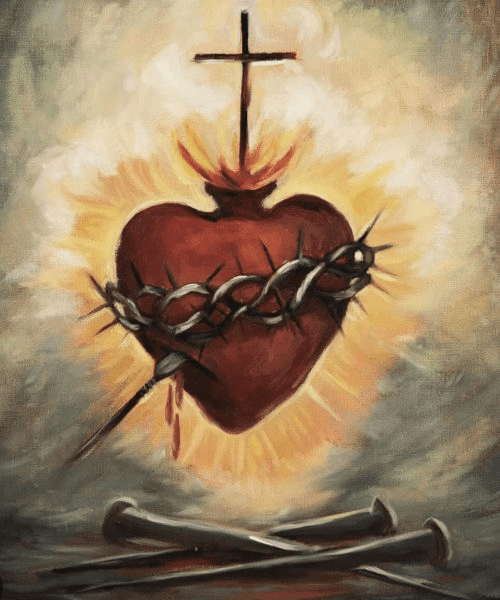
So, essentially, ahvangni is the sacred-fire of God and Christ’s inward presence we give and receive through our almsgiving rituals.
Whittled down to essentials, he three divsions of Agni are as follows:
- Garhapatya, the earthly form of Agni, is the divine spark in all embodied beings.
2. Dakshima, the celestial form of Agni, is the sacred-fire we give to the Christ Self to heal our own mind of separation-sickness.
3. Ahavaniya, the living form of Agni, is the sacred-fire of the Name we give (in the Land of the Living, the Circle of All Beings), to save the whole world.
Makes sense, right? Well, it should, if you’re a student of Hinduism or the Course.
The holy promise the rishis reference is the Holy Spirit’s promise, which Course-Jesus describes at length in the following excerpt, using similar language:
Do you realize that the ego must set you on a journey which cannot but lead to a sense of futility and depression? To seek and not to find is hardly joyous. Is this the promise you would keep? The Holy Spirit offers you another promise, and one that will lead to joy. For His promise is always, “Seek and you will find,” and under His guidance you cannot be defeated. His is the journey to accomplishment, and the goal He sets before you He will give you. For He will never deceive God’s Son whom He loves with the Love of the Father.
You WILL undertake a journey because you are not at home in this world. And you WILL search for your home whether you realize where it is or not. If you believe it is outside you the search will be futile, for you will be seeking it where it is not. You do not remember how to look within for you do not believe your home is there. Yet the Holy Spirit remembers it for you, and He will guide you to your home because that is His mission. As He fulfills His mission He will teach you yours, for your mission is the same as His. By guiding your brothers home you are but following Him.
Behold the Guide your Father gave you, that you might learn you have eternal life. For death is not your Father’s Will nor yours, and whatever is true is the Will of the Father. You pay no price for life for that was given you, but you do pay a price for death, and a very heavy one. If death is your treasure, you will sell everything else to purchase it. And you will believe that you have purchased it, because you have sold everything else. Yet you cannot sell the Kingdom of Heaven. Your inheritance can neither be bought nor sold. There can be no disinherited parts of the Sonship, for God is whole and all His extensions are like Him.
The Atonement is not the price of your wholeness, but it IS the price of your awareness of your wholeness. For what you chose to “sell” had to be kept for you, since you could not “buy” it back. Yet you must invest in it, not with money but with spirit. For spirit is will, and will is the “price” of the Kingdom. Your inheritance awaits only the recognition that you have been redeemed. The Holy Spirit guides you into life eternal, but you must relinquish your investment in death, or you will not see life though it is all around you.
Traditionally, the “nine joys” are said to be the Fruits of the Spirit delineated by St. Paul in Galatians 5:22-23, which are: love, joy, peace, patience, kindness, goodness, faithfulness, and self-control.
Course-Jesus gives us a similar list in the Manual for Teachers, as the “ten characteristics of the Teachers of God.” which are: Trust, Honesty, Tolerance, Gentleness, Joy, Defenselessness, Generosity, Patience, Faithfulness, and Open-Mindedness. Let’s assume these ten traits are the “fruits” we harvest or reap by shaking the Tree of Life. We talked about those fruits (the ten Sefirot) in earlier posts, and will come back to them again, I’m certain.
The next verse of the 15th Sukta reads:
The sacred syllable remains hidden by the Bridegroom, the bestower of the gift at the appointed time of God. In the ritual almsgiving offerings free from the sword of Divine Love, the Shining One spreads out the alms.
My definitions and word breaks:
gā-r(a)ha-patyena (the sacred syllable remains hidden by the Bridegroom) santya (the bestower of the gift) ṛtunā (at the appointed time of God). yajña-nīḥ (in the ritual offerings free from) asi (the sword) devān (of heaven) dev-ayate (the Shining One(s) spreads out) yaja (the alms) ǁ
My Notes:
Last but not least, and rather beastly to work out. Garha supposedly means criticism or condemnation, which simply didn’t work with the rest of the sentence. So, I divided it as ga (the sacred-syllable) and raha (remains hidden), which did make sense. From this, we can presume that the sacred syllable is the “sword of heaven,” a symbol also mentioned in Isaiah 34:5 and Revelation 19:15, presumably to represent God’s word and/or judgment. In Hinduism, Asi is the primordial divine sword, the first and greatest weapon made by Lord Brahma (via a massive yajna) to restore Dharma and destroy the demons perpetuating fear and guilt. Originally a powerful entity, the sword transformed into a sharp, fiery blade, first wielded by Shiva, and later passed down through Vishnu, the Rishis, and various kings, representing supreme power and divine protection. As I see it, Asi is a marriage of a (God’s) and si (Shiva or rest). So Asi means “God’s grace” or “God’s Rest.”
Asi probably represents, therefore, the one defense God provided that couldn’t be used for Satan’s purposes. That weapon is “the Atonement,” which Jesus describes in the Course as “the only defense that is not a two-edged sword. It can only heal.”
Gleaned ffom all Jesus says, my own experience, and the Vedic teaching under discussion, I’m reasonably sure “the Atonement” is Course-code for the Om vibration. But, to be absolutely sure, let’s investigate what Isaiah 34 originally imparted about the “sword of heaven.” I may live to regret this, but here goes. Let’s start at the top with Isaiah 34:1:
To come near the goy (the Om, not non-Jews), to hear and pay attention, gather in the Land of the Living and listen to the multitudes of the inhabited world issuing forth the Borderland’s fruitful sword of Yahweh. The goy burns in the gathering (place) to consecrate and exchange Tev-ach (the mark of God) to cast off the stench, and offer the dead body (the physical body) to Har (the Mount? or the falcon-headed Egyptian god, Horus?) to dissolve the bloodguilt.
The gathering place in Shemayin (the Celestial Sphere) shall fade away, and Shemayin shall be rolled up as a scroll. The gathering place shall wither like a leaf and fall from the vine; fall away like a withered fig.
The sword waters abundantly Shemayim’s Borderland, where Adam’s devoted flock stand apart from judging. The sword of Yahweh consecrates the blood to anoint the finest fat; the blood of the Lamb prepared by the right choice for the inmost being of the Tree.
Yaweh offers in Bozrah (the enclosure, fortress, or sheepfold) the great food from the Land of the Living.
In Edom, the Re’em (Soma’s antelopes) bring down the calf of the valiant ones in the Land of the Living, to bathe in the blood the dry earth, to anoint the choicest crops.
So, it’s the sword of Yahweh (the Name of God in Israel) rather than the sword of heaven. And the sword of God’s Name (and our own) symbolizes the Athavaniyu aspect of Agni, the sacred fire, which is also, therefore, the Flaming Sword of the Bridegroom. And that Flaming Sword is personified in Hinduism as King Indra, and in the three Abrahamic religions as the Archangel Michael.
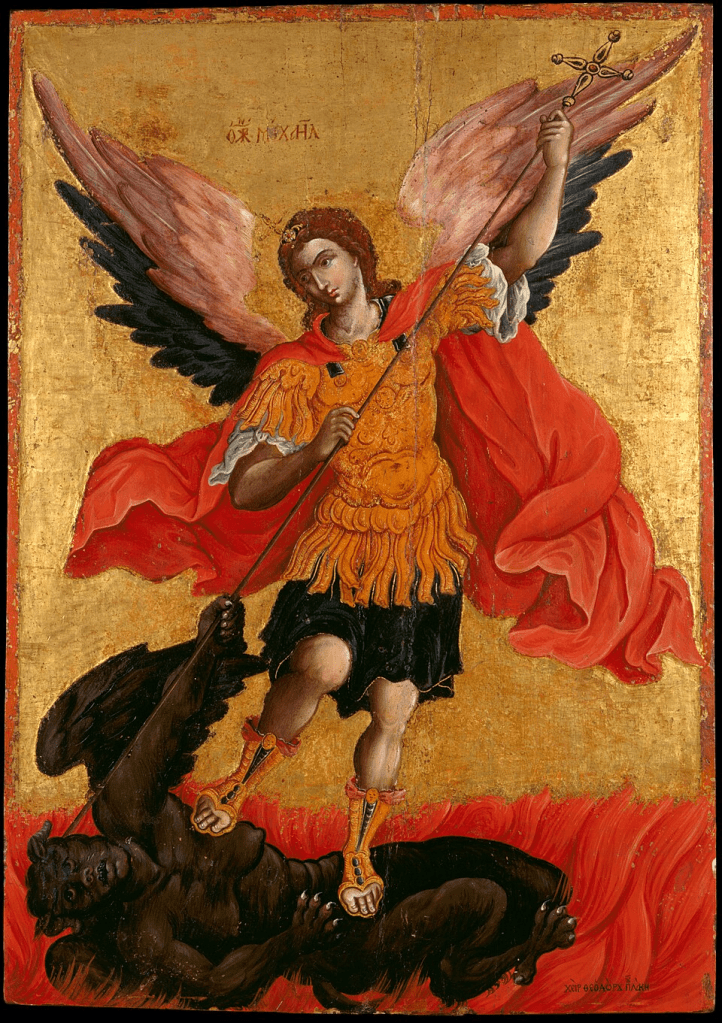
Like I said, I may live to regret this, because I’m stomping on some pretty engrained beliefs, but so be it. As explained in an earlier post, goy is the Hebrew equivalent of the Sanskrit word ga, which is pretty clear in this verse. Goy refers, therefore, to the Om vibration, not to the anti-Christ concepts of “gentiles” or “foreigners.”
Furthermore, I refuse to accept the prevailing “wisdom” that tebach or tevach means “slaughtered” or “slain” in Hebrew. Slaughters and massacres happen way too often in the Old Testament to be helpful to truth-seekers; so Tebach might be an erroneous transliteration of Tebah (the Ark or Word) or Tavach (the mark of God). Hard to say, but “slaughter” definitely doesn’t track with the rest of Isaiah’s message.
The calf mentioned herein is Kamadhenu’s calf, Nandini, who represents the shared will we “grow” by ingesting the miracle-milk. Nandi, the white bull belonging to Shiva represents God’s Will to end the separation, while Kamdhenu is the miracle-cow of Hare Krishna, supplying the milk of truth (God’s Thoughts) in the land of milk and honey.
In Hinduism, the Valiant One is Lakshmana (the forehead mark), the fiercely devoted younger brother of Rama. We know this because Rama addresses his younger brother as “O Valiant One” in the Ramayana epic. As the son of King Dasharatha (ten chariots) and Queen Sumitra (the sacred covenant), Lakshmana is considered an incarnation of Shesha, the multi-headed serpent serving as Vishnu’s water-palanquin on the Cosmic Ocean of Milk. In the allegory, Lakshmana accompanied Rama and Sita into their 14-year exile, acting as their protector.
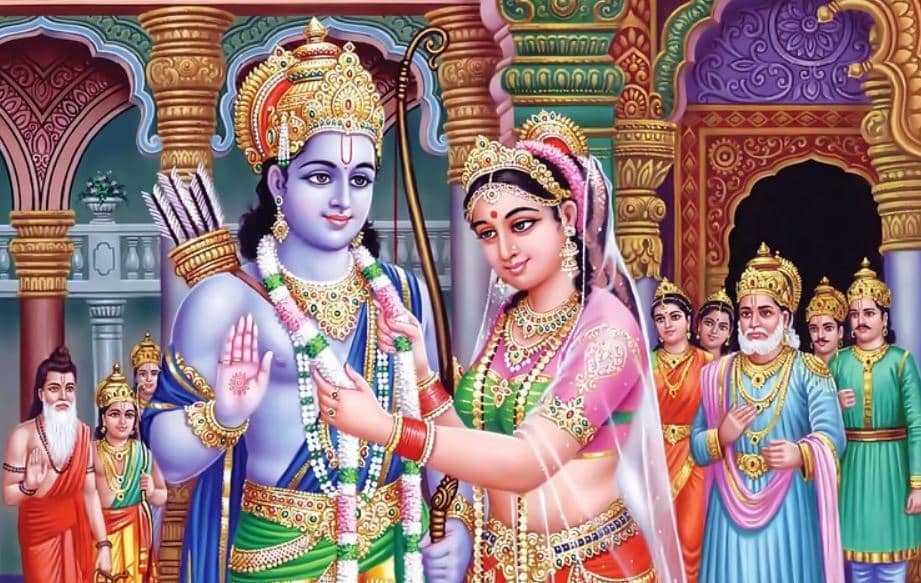
Nandini, the calf, plays a background role in the Ramayana. She belongs to Rama’s teacher, Rishi Vasishtha. Rama attempts to steal her at one point in the epic story. In Sanskrit, Vasishtha means “richest in righteousness,” so he’s akin to the “choicest crops” or “finest fat” in this and other Biblical verses. As I read all this, the choicest crops and/or finest fat refers to the Souls in the Borderland–the Standing Stones in the circle performing the almsgiving yajnas to make the dream-world we made in fear and guilt “fade away.”
When Isaiah writes that the Borderland of Shemayin will “fade away,” this is what he means.
Or, to quote Course-Jesus:
The Atonement is the guarantee of the safety of the Kingdom, and the union of the Sonship is its protection. The ego cannot prevail against the Kingdom because the Sonship is united. In the presence of those who hear the Holy Spirit’s Call to be as one, the ego fades away and is undone. (ACIM, T-5.IV.1:9-11)
Have I made my point?
So, the final verse of the 15th Sukta explains that the Bridegroom keeps the sacred-syllable hidden until the appointed time, but we can still perform our inmost almsgiving offerings through our merciful words and prayers, which the Shining One(s) disburses universally. In Hinduism, the Shining One is an epithet for Surya, the Solar Logos. And ultimately, it is the Rays of the Greater Light that spread out to other Souls in need the alms of our merciful offerings. Alternatively, the shining ones might refer to the Visvadevas, the Hindu term for all the Holy Helpers working toward our Higher Good in the dream.
Some of the wording is still a bit clumsy, but let’s now compile the pieces. If my translations are accurate, the whole 15th Sukta reads as follows:
Indra, from Soma, drinks the celestial waters of God’s true mode of being, to enter into Shiva, the supreme power conveying Matsya’s sap, in the infinite dwelling place.
Those in the desert fill the life of the formless divine in this world at the appointed time in cycles to make pure the guardians of the almsgiving offerings, the pure downward-growing shoots yoking the twin discharging the standing well of the nine red rays sanctifying the name; the rays of the solar logos in wholeness; the rays conveying the soma vessels filling the life at the appointed time in cycles from the true essence polishing the jewel bestowing the sword.
Agni is divine love, Kamadeva’s greater light; God’s vehicle for mercy in the form of three sacred circular adornments to fill the life at the appointed time in God’s Plan.
Brahman walking, Indra apportions the joy filling the life of Soma (the Great I Am) at the appointed time. Anu, the mark of God, in this manner promotes the holy relationship of defenselessness.
The yoke emits from the right hand of God the established universal covenant of Varuna to extract the shining rays at the appointed time, from the almsgiving ritual to make visible Kamadeva’s three aspects.
The fluid of wholeness bestows the riches of the Son of God, the rock in the hand during the ritual offering to Esu, the supreme personality of the godhead in non-existence.
The fluid of wholeness bestows oneness to all those who hear the valiant warrior, the celestial being Esu-dev, singing in the Great Forest.
The fluid of wholeness gives to the thirsty multitudes the offering advancing the circle of the standing Nestarat (the homecoming Souls) at the appointed time in the future.
That which the True Self in the fourth state of consciousness (pure non-dualism) at all times desires, the fluid of wholeness bestows the alms of majesty underneath, the former whole given to anoint the original state of being.
The sacred syllable remains hidden by the Bridegroom, the bestower of the gift at the appointed time of God. In the ritual almsgiving offerings free from the sword of Divine Love, the Shining One(s) spreads out the alms.
Pretty cool, right? I hope you find these studies helpful. Until next time, Om Hari Om and Namaste.
 The Holy Meeting Place
Leave a comment