According to Google (quoting the Wisdom Library) “Rigveda 1.14 is a 12-verse hymn (Sukta) dedicated to Agni (the sacrificial fire) by the seer Medhātithi Kāṇva in the nicṛdgāyatrī meter. It acts as an invitation for Agni to bring various deities—including Indra, Vāyu, Mitra, and the Maruts—to the ritual to partake in the Soma drink, emphasizing Agni’s role as the divine messenger and protector of the sacrifice.”
How much of that description is true? Not much, as I shall demonstrate. According to H. H. Wilson, the Sukta reads as follows in transliterated Sanskrit:
aibhir agne duvo giro viśvebhiḥ somapītaye devebhir yāhi yakṣi ca||
ā tvā kaṇvā ahūṣata gṛṇanti vipra te dhiyaḥ | devebhir agna ā gahi||
indravāyū bṛhaspatim mitrāgnim pūṣaṇam bhagam | ādityān mārutaṃ gaṇam ||
pra vo bhriyanta indavo matsarā mādayiṣṇavaḥ | drapsā madhvaś camūṣadaḥ||
īḻate tvām avasyavaḥ kaṇvāso vṛktabarhiṣaḥ | haviṣmanto araṃkṛtaḥ ||
ghṛtapṛṣṭhā manoyujo ye tvā vahanti vahnayaḥ | ā devān somapītaye |
tān yajatrām̐ ṛtāvṛdho ‘gne patnīvatas kṛdhi | madhvaḥ sujihva pāyaya ||
ye yajatrā ya īḍyās te te pibantu jihvayā | madhor agne vaṣaṭkṛti ||
ākīṃ sūryasya rocanād viśvān devām̐ uṣarbudhaḥ | vipro hoteha vakṣati||
viśvebhiḥ somyam madhv agna indreṇa vāyunā | pibā mitrasya dhāmabhiḥ||
tvaṃ hotā manurhito ‘gne yajñeṣu sīdasi | semaṃ no adhvaraṃ yaja||
My translation of 1.14:1 reads:
God’s first red ray (or cowherd), Agni is the giver of Om, the song of the Om, the song of the Universal Light of Soma (the Lesser Light of the I Am), the Father whose divine cowherd returns the spirit to the Circle (of all beings).
My definitions and syllable-divisions:
a-ebhir (God’s first red ray or cowherd) agne (Agni is) duvo (the giver of the Om) giro (the song of) viśvebhiḥ (the Cosmic Light of Wholeness) somapītaye (of Soma [the Moon/Lesser Light of the I Am, the Father whose) dev-ebhir (divine red ray or cowherd) yāhi (returns) yakṣi (the spirit or Soul) ca (to the Circle).
My Notes:
Firstly, almost none of the dictionary definitions for these Sanskrit words are even close to accurate. As stated before Somapitaye isn’t a drink known to and imbibed by ancient rishis. As I see it, the rishis are describing herein two Red Rays or cowherds: the Red Ray/Cowherd of Brahman, who is Agni, the sacred fire; and the Red Ray or Cowherd of Soma, who is (in Hinduism) Gopala Krishna, the cow-protector form of Krishna found in the Harivamsha (another sacred Hindu text) and various puranas.
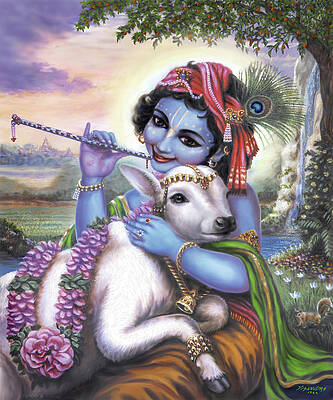
The narratives of Gopala Krishna are set in the cowherd settlement of Vraja (the pasture) region of Gokulum (the cowherd station or house), where he is raised by his foster-parents Nanda (joy) and Yashoda (the bestower of glory).
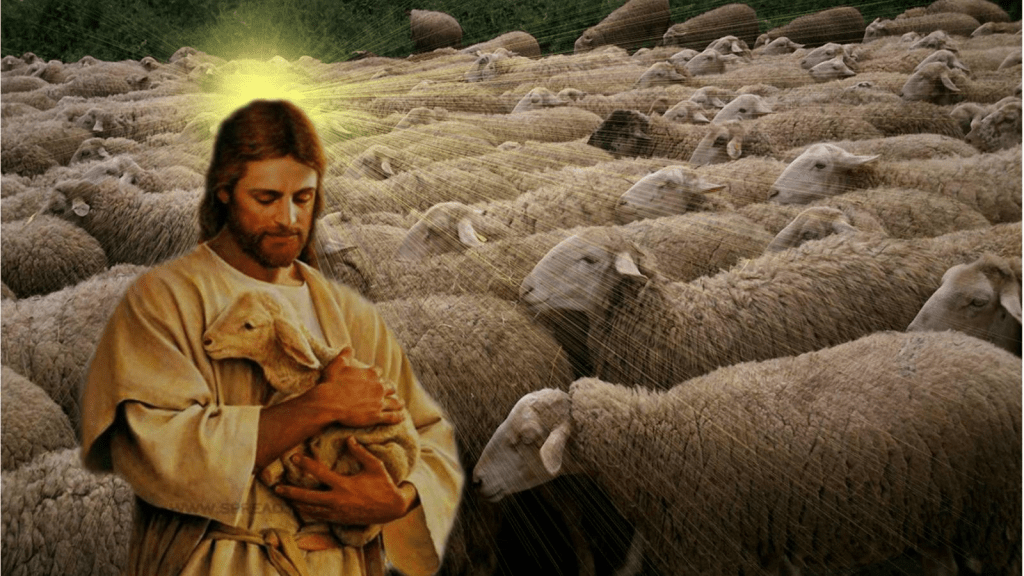
Essentially, Gopala Krishna is the Hindu equivalent of the Biblical “good shepherd”–a title applied to David in the Old Testament and to Jesus in the New Testament, both of whom “serve” under Elohim, the chief shepherd named in the first verse of Genesis.
My translation of 1.14:2 reads:
God’s true state of being (in) the forest calls the multitudes to sing the praises of the two advancing the thundering consciousness of the divine cowherd, the fire-eye of Heaven’s miracle-cow.
My definitions and syllable-breaks:
ā (God’s) tvā (true state of being) kaṇvā (the forest) ahūṣata (calls the multitudes) gṛṇanti (to sing the praises of) vipra (the two advancing) te (the thundering) dhiyaḥ (consciousness of) dev-ebhir (the divine cowherd) agna (the fiery-eye) ā (of God’s or Heaven’s) gah-i (cow of Kamadeva = cow of divine love = Kamadhenu, the miracle cow)|
My Notes:
The two advancing the thundering consciousness of Krishna are Nara and Narayana, the twin Hindu sages representing the Blood and Water Rays (the two streams of Lord Vishnu). The real mystery here is the intended meaning of gahi. According to the Sanskrit dictionaries, gah can mean anything from “cows” to “deep forest” or “deep immersion.” The rishis may, therefore, mean “the forest of Kamadeva,” which is indeed a place referenced in the annals of Hinduism. According to Google, “The Forest of Kamadeva refers to the enchanting, celestial, or mythic forest abode of the Hindu god of love, Kamadeva (or Manmatha) and his consort Rati, often characterized by lush, spring-like features. This setting symbolizes desire, spring, and the awakening of passion, where Kamadeva roams with his bow of sugarcane, influencing gods and humans alike.”
From this description we can glean that the Forest of Kamadeva (Divine Love) also is the Forest of All Beings.
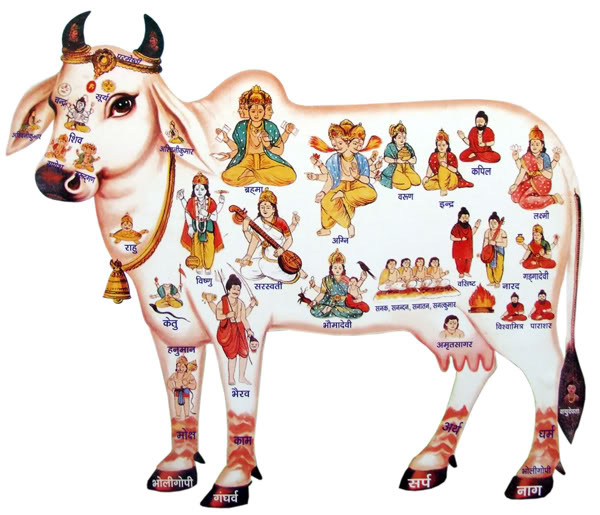
The rishis might also mean Kamadhenu, the Miracle Cow closely associated with Krishna. All the gods are said to reside in the body of Kamadhenu, the divine cow whose miracle-milk nourishes, strengthens, and grows “the calf” of God’s Will in world-dwelling humans. Her four legs are the scriptural Vedas; her horns are the triune gods Brahma (tip), Vishnu (middle) and Shiva (base); her eyes are the sun and moon gods, her shoulders are Agni and Vayu, while her legs are the Himalayas. We see this in iconographic depictions of Kamadhenu like the one below.
The fiery eye of God is a phrase also found in the Bible. In Revelation, for example, the Great Amen (Jesus Christ) is described as having “eyes like a flame of fire.” We’re also told by various prophets that a “fiery eye” looked out from the center of the wheel supported by the four Living Beings.

Given its description, Kanva (“forest”) probably refers to the forest of holy beings called Namisharanya (“the forest of the twinkling of an eye”). We talked about that forest last time, but only scratched the surface of what forests represent in Hindu philosophy.
According to the day-editor of Jansatta, a daily Delhi newspaper:
The Hindu idea is that this whole world is a forest. To keep this world as it is we have to keep the world-forest intact. Hinduism describes everything in terms of divinity and in relation to the Ultimate Reality. The different aspects of this Ultimate Reality are all to be found in the various forms of the physical world.
Every physical object symbolises some aspect of Reality. Amongst these, the forest symbolises the divine attribute of “totality” combining all life forms together in a single inter-dependent whole.
In the Bhagavad Gita, Krishna compares the world to a single banyan tree with unlimited branches in which all the species of animals, humans and demigods wander. Indian consciousness is full of trees and forests. If you look, for example, in Greek literature you will find only a few descriptions of trees and forests, whereas Indian literature such as Ramayana and Mahabharata is full of such descriptions, as if the people were always under the trees. The bond between Indian people and trees is very strong.
Hindu tradition describes three basic categories of forest. One is shrivan, the forest which provides you prosperity. Then there is tapovan, where you can contemplate as the sages did and seek after truth. The third is mahavana – the great natural forest where all species of life find shelter. Each of these categories must be preserved.
In my view, these musings are reasonably accurate. Every physical object does indeed symbolize some aspect of Divine Reality within our Holy Minds, which we’ve projected outward in the dream. And that goes for the sun, moon, stars, and planets, as well as for the forests and trees. As we walk around the wheel of the fiery eye, we gradually dissolve the dreamscape by bringing those symbolic objects back into our minds, where they originated and still remain in Reality. I’ve already shared what Jesus says on this subject in the Course (sorry, can’t find it now).
My translation of 1.14:3 reads:
Indra and Vayu expand the father’s covenantal fire to foster bowing down to the patronage of the Adityas, the wind gods of the Assembly.
My definitions and syllable breaks:
indravāyū (Indra and Vayu? Indra’s breath?) bṛhaspatim (expands the Father’s) mitrāgnim (covenantal fire or friendly fire) pūṣaṇam (to foster bowing down) bhagam (to the patronage of) ādityān (the Adityas) mārutaṃ (the wind gods) gaṇam (of the Assembly)
My Notes:
The Adityas are a group of solar deities in Hinduism, regarded as the sons of the mother goddess Aditi and the sage Kashyapa (the turtle or tortoise). So, Kashyapa is the Hindu counterpart to the Black Dragon or Black Tortoise of the North found in ancient Chinese Philosophy. Said to represent celestial light, cosmic order, and the twelve months of the year, the Adityas are often considered forms of the sun god, Surya. They protect the world from chaos, representing various aspects of cosmic law and sustaining life. While the Rigveda (allegedly) mentions six to eight Adityas, the number (also allegedly) increased to twelve in later Brahmanas, Puranas, and the Mahabharata.
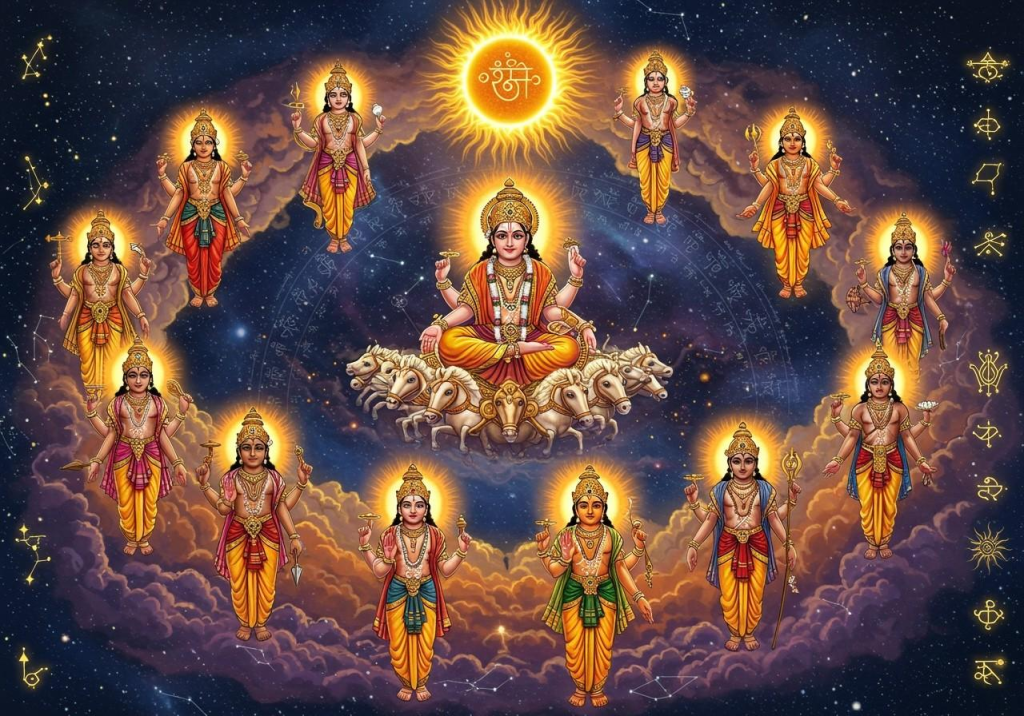
If I’m reading this teaching right, the Adityas are the Maruts, the supposed wind or storm gods lauded by the Vedic rishis. They might also be the twenty-four elders circling Elohim’s throne in Revelation (if indeed that translation is accurate). Their number isn’t specified in this Rik, but we do learn they are 1) the wind gods of the Assembly and 2) the patrons to whom we must bow down on the journey. We further learn (through simple deduction) that the fiery eye at the center of the circle represents the “covenantal fire” or “friendly fire” (of God’s presence), which Indra and Vayu spread outward from the center of the wheel as more Souls join the Assembly to sound the Om for the betterment of all forest-dwelling beings. Also found many times in the Bible, the phrase “covenantal fire” describes the “consuming fire” of our shared holiness (Deuteronomy 4:24 and Hebrews 12:29), which burns away (from within) the dark veils of sin, evil, and guilt obstructing the Truth of our Being (our forest-dwelling mode of being).
Or, as Course-Jesus similarly explains:
I inspire all miracles, which are really intercessions. They intercede for your holiness and make your perceptions holy. By placing you beyond the physical laws they raise you into the sphere of celestial order. In this order you are perfect. (ACIM, T-1.I.32:1-4)
My translation of 1.14:4 reads:
Bring forward the Self supporting the millwheel of the Moon drops of Matsya’s inner-radiance gladdening the boat dripping the honey-nectar of the Bridegroom (Lakshmi’s husband, Vishnu) from the Soma-bowl of the Assembly.
My definitions and breaks:
pra (Bring forward) vo (the Self or vessel) bhri-yanta (supporting the mechanism or millwheel) indavo (of the Moon-drops of) matsa-rā (Matsya’s inner-radiance) mādayis-ṇavaḥ (gladdening the boat) | drapsā (dripping or trickling down) madh(a)vaś (the honey-nectar of the Bridegroom) camū-ṣadaḥ (from the Soma-bowl of the Assembly)||
My notes:
The millwheel of the Moon-drops is the winepress of the Bible–the “press” used by the Atonement powers to extract the new wine of joy from the bitter-skinned grapes of wrath. That press, as we’ve established, is the Bindu or Moon Chakra behind the Ajna or Third Eye chakra. In the Rigveda, that “new wine” is madhu, the honey-mead representing the Wine of Truth.
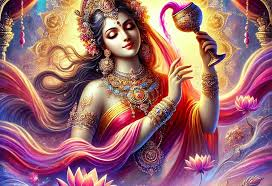
In the Hindu lore, that intoxicating “wine of bliss” is personified as Varuni, who, like all the other atonement powers and instruments, emerges from the churning of the Ocean of Milk. Varuni is the daughter of Varuna, the water lord (of universal oneness) guarding the western direction (the gate opposite Indra’s on the wheel). From this, we can determine that Varuni, the wine of bliss is the honey-nectar of the Bridegroom filling the soma-bowl of the Assembly. That bowl or receptacle is, I believe, what Course-Jesus calls the chalice of the Atonement. Sadly, most of his references to this “chalice” were removed in editing prior to the initial publication of the Standard Edition of the Course by the Foundation for Inner Peace in 1974 or 1975.
In the single remaining reference (in the standard edition), he says:
Beside you is one who offers you the chalice of Atonement, for the Holy Spirit is in him. Would you hold his sins against him, or accept his gift to you? Is this giver of salvation your friend or enemy? Choose which he is, remembering that you will receive of him according to your choice. He has in him the power to forgive your sin, as you for him. Neither can give it to himself alone. And yet your savior stands beside each one. Let him be what he is, and seek not to make of love an enemy. (ACIM, T-19.IV-D.13:1-8)
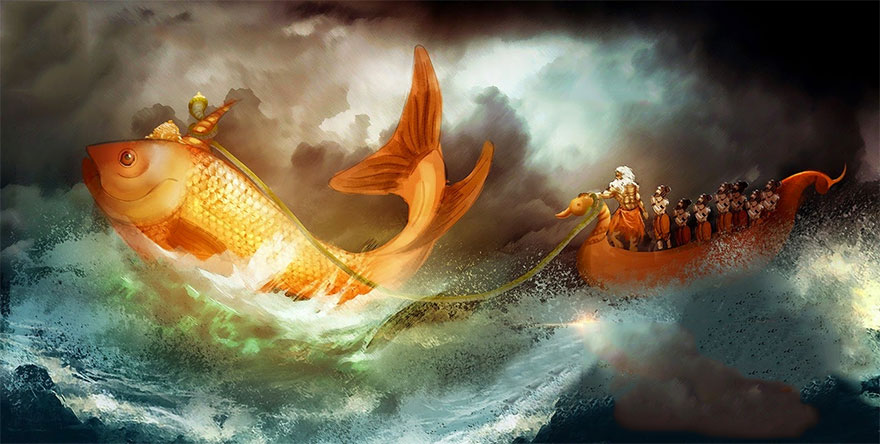
Matsya, as explained in an earlier post, is the first incarnation of Vishnu is a fish form. The boat dripping the honey is the Ark of the Covenant and Noah’s Ark in the Judeo-Christian scriptures, and the Marsya-drawn boat carrying Manu and the seven rishis to the Himalayas in the puranic lore.
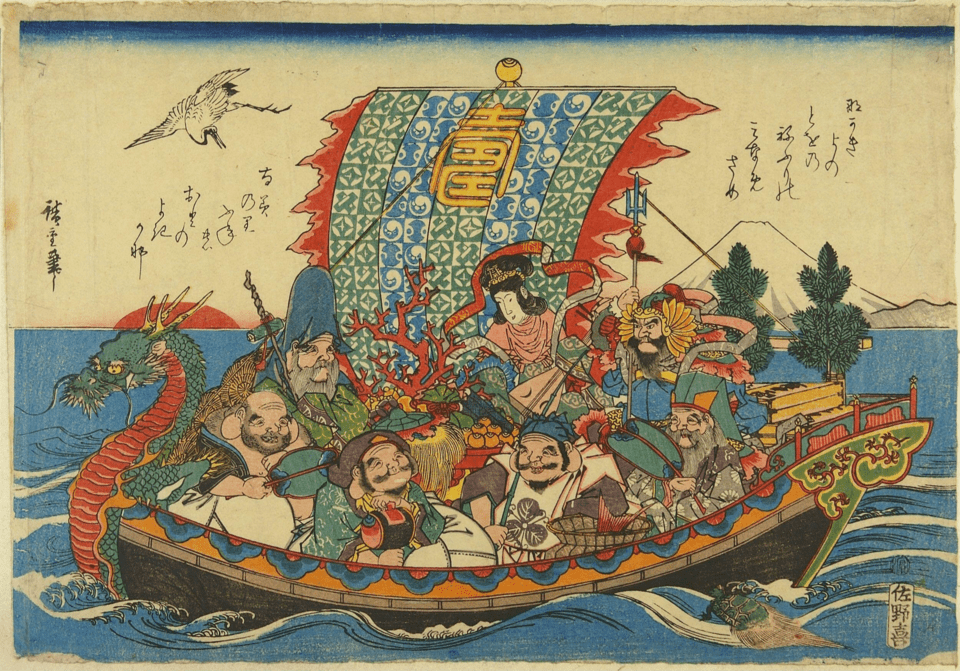
We find a similar narrative in Japanese folklore, wherein a “treasure ship” called Takarabune (宝船) is piloted through the heavens by the Seven Lucky Gods during the first three days of the New Year. Images of that boat remain an essential part of traditional Japanese New Year celebrations.
The Sukta’s next line doesn’t track with Wilson’s line breaks. To make sense, Rv 1.14:5 needs to borrow a word from 1.14:6, so as to read: īḻate tvām avasyavaḥ kaṇvāso vṛktabarhiṣaḥ haviṣmanto araṃkṛtaḥ ghrtaprstha.
My translation of Rv 1.14:5 reads:
In the state of non-existence, the True Self’s certainty calls down from the forest-abode the purified sacred grass, the offering endowing the readiness to cultivate the well of the hinder part.
My definitions and breaks:
īllate (In the state of non-existence) tvām (the True Self’s) avasy-avaḥ (certainty calls down) kaṇvāso (from the forest-abode) vṛkta-barhiṣaḥ (the purified sacred grass) haviṣ-manto (the offering endowing) araṃ-kṛ(i)taḥ (the readiness to cultivate) ghṛta-pṛṣṭhā (the well of the hinder part).
My Notes:
Firstly, ilate (they invoke) should probably be illate (the state of non-existence). Because the Real Self (tva) does indeed share and bring down to us God’s certainty, even while we wander in illate (non-existence). Course- Jesus mentions this God-given “certainty” multiple times. In one place, he says:
Right perception is necessary before God can communicate directly to His altars, which He established in His Sons. There He can communicate His certainty, and His knowledge will bring peace without question. God is not a stranger to His Sons, and His Sons are not strangers to each other. Knowledge preceded both perception and time, and will ultimately replace them. That is the real meaning of “Alpha and Omega, the beginning and the end,” and “Before Abraham was I am.” Perception can and must be stabilized, but knowledge is stable. “Fear God and keep His commandments” becomes “Know God and accept His certainty.” (ACIM, T-3.III.6:1-7)
The well of the hinder-part has to be Nisrok’s well–the well guarded by the eagle-headed cherubim. The term “hinder-part” may seem awkward, but it’s found many times in the Bible, generally to signify the inner chambers of the mind unbreeched by most illate-dwelling humans. We find the term, for example, in Exodus 33:23, 1 Samuel 5:4, and in Jonah 1:5. We also find the term in Mark 4:39:
And he [Jesus] was in the hinder part of the ship, asleep on a pillow: and they awake him, and say unto him, “Master, carest thou not that we perish?”
Same boat, different story, this time indicating that Christ is at rest on a cushion (the sacred grass) in the hinder-part of the Ark, even as we imagine the storms of earthly existence raging around us.
Master, carest though not that we perish?
Jesus answers this as follows in the Course:
There is no time, no place, no state where God is absent. There is nothing to be feared. There is no way in which a gap could be conceived of in the Wholeness that is His. The compromise the least and littlest gap would represent in His eternal Love is quite impossible. (ACIM, T-29.I.1:1-4)
My translation of Rv 1.14:6 reads:
The mind-yoke of your True Self transports the flame of God’s divine Moon, the father whose true state of being invokes the mind of the red Om, the sacred fire inspiriting the yajnas in the midst of the Assembly in the Borderland, the invisible offering arena for almsgiving.
My definitions and breaks:
Mano-yuja (the mind yoke) ye (of your) tva (True Self) vahanti (transports) vahnayaḥ (the flame) ā (of God’s) devān (divine) somapītaye (Soma, the Moon-father whose) tvaṃ (true state of being) hotā (invokes) manu-rhito (the mind of the red Om) ‘gne (the sacred flame) yajñeṣu (inspiriting the yajnas) sīdasi (in the midst of the Assembly) semaṃ (in the Borderland) no (the invisible) adhvaraṃ (offering arena for) yaja (almsgiving)||
My notes:
First and foremost, this affirms everything I’ve said about the Vedic yajna being an internal almsgiving offering made in the innermost chamber of the mind. It also affirms that the Assembly so often referenced in the Bible refers to the universal brotherhood of Souls gathered together in the Borderland to further humanity’s collective deliverance from non-existence.
The term “Red Om” was new to me, so I asked Google if it was “a thing” in Hinduism. Here’s the answer I received:
The red Om (ॐ) in Hinduism is a sacred, vibrant symbol representing the primordial sound of the universe, divine energy, and the supreme reality (Brahman). Often colored red to signify Shakti (divine feminine power), love, and prosperity, it is used in meditation, daily rituals, and as a spiritual icon. The symbol, also known as Aum, represents the Hindu trinity (Brahma, Vishnu, Shiva) and states of consciousness.
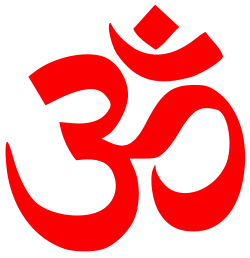
Not sure how much of that is accurate. I’m especially dubious about the Trimuti’s involvement, given the inclusion of Brahma. That said, the three Oms do represent the trinity powers operating in the dreamscape. I’m just not sure one of those powers is Brahma, the demiurge “creator” of the material world hiding the Real World underneath.
My translation of Rv 1.14:7 reads:
To spread the almsgiving offerings speaking for the Cosmic Order growing the Om, the sacred fire’s wind-consort acts to create Krishna’s sacred tongue drinking to pour out the thunder maintaining the sacred fire, the light glorifying the thundering thunder.
My definitions and breaks:
tān (to spread out) yaja-trām̐ (the almsgiving offerings speaking for) ṛtā-vṛdho ( the Cosmic Order growing the Om) ‘gne (the sacred fire’s) patnīvatas (wind-consort) kṛdhi (acting mentally)| ma-dh(u)vaḥ (to produce the Bridegroom’s) su-jihva (sacred tongue) pā-yaya (drinking to pour out) ye (the thunder) yajatrā (maintaining the sacred fire) ya (the light) īḍyās (glorifying) te te (the thundering thunder).
Let’s start with the Bridegroom’s tongue. Various schools of Hinduism teach that devotees sanctify their physical tongues by repeating the Maha Mantra. But this reflects a limited understanding about what the sacred tongue truly is and does, as well as how we activate the Om to begin freeing our minds from the Ego’s destructive interference. Rightly understood, we repeat the Holy Name (of the Bridegroom, Christ) in order to hear the inner Om vibration, as Course-Jesus explains in Lesson 184: I call upon God’s Name and on my own (and as Paramahansa Yogananda also teaches posthumously through Self-Realization Fellowship and his books). Once we hear the sound, we are advised by both to simply listen attentively with the intention of sharing its blessings with everyone and everything.
As I’ve explained many times, the Holy Name takes many forms in the world. Course Teachers who claim there is no such name disserve their followers immensely. Yes, God has no name in Heaven, where there are no names or words, but he has many names on earth. On earth, Christ is our Father. So, the name we share with God is some form of “Christ.” Jesus is one such symbolic form, but not the only one. The True Christ is the Solar Logos within us, the radiant Word of God forming the fiery eye at the center of the Wheel. That eye is Hari, Om, Aum, Amen, Christ, Anu, Elohim, Shiva, and Allah, among other names.
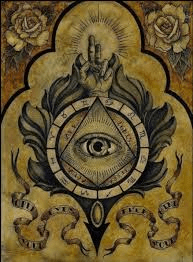
I’m sorry, but Course-Jesus wouldn’t lead us astray by telling us to repeat a name that doesn’t exist (as the late Ken Wapnik erroneously taught). In the Manual for Teachers, Jesus gives us the name we should repeat to hear the Holy Spirit’s voice (the Om). Just as he teaches in the Bible, that name is Jesus Christ–the relatable symbol of divine love in the material universe.
In John 13:14, he says:
And whatsoever ye shall ask in my name, that will I do, that the Father may be glorified in the Son.
In Matthew 18:20, he says in a similar vein:
“Where two or three gather in my name, there am I with them.”
Traditional Christians misunderstand his meaning. He isn’t promising to answer our prayers for worldly nothingness or to specially bless those who confuse spiritual fellowship with bodies gathering to worship, pray, or study the scriptures. True fellowship takes place in the Assembly, where our Souls join minds in his name (Om) to dissolve the Ego for everyone–the only thing God wills us to do while on earth.
Or, as Jesus states in the Course:
You will never rest until you know your function and fulfill it, for only in this can your will and your Father’s be wholly joined. To have Him is to be like Him, and He has given Himself to you. You who have God must be as God, for His function became yours with His gift. Invite this knowledge back into your mind, and let nothing that obscures it enter. The Guest Whom God sent you will teach you how to do this, if you but recognize the little spark and are willing to let it grow. Your willingness need not be perfect, because His is. If you will merely offer Him a little place, He will lighten it so much that you will gladly let it be increased. And by this increase, you will begin to remember creation. (ACIM, T-11.II.6:1-8)
Chanting the Maha Mantra will do the job, as will simply repeating Om, Aum, or Amen in silent meditation. It might take awhile, however. When I started repeating Aum, as per Yogananda’s instructions, it only took a couple of days before I heard the sound. But I may have been more open than most for three good reasons: 1) I heard the sound as a child; 2) serving God was my only goal in life at the time, and 3) I was celibate by choice (despite being married).
I say “may” because Jesus says in the Course that we needn’t purify ourselves before appealing to the Holy Spirit. Because he will purify us. I only know what I’ve read and experienced regarding celibacy as a prerequisite to hearing the Om. If you aren’t celibate and hear the sound, please let me know in the comments.
Let’s turn back to the Vedic verse under discussion. I translated te-te as “thundering thunder,” even though all the Sanskrit dictionaries define te as “you” or “to you.” So far, “you” or “to you” has worked only once in the first fourteen Suktas, whereas “thunder” or “thundering” has worked every other time.
What’s more, “thundering” and “thunder” are used repeatedly and often in the Bible to describe God’s Voice. Or, to quote Google:
In Scripture (the Bible), thundering symbolizes the powerful, authoritative voice and judgment of God, frequently connected to His heavenly throne, divine wrath, and manifestation of glory. It represents a “secret place” of meeting with God (Psalm 81:7), and is often accompanied by lightning, earthquakes, and judgment in Revelation.
Ixnay the ego-injected judgment and divine wrath and the definition’s pretty solid.
Rightly reconfigured, the 14th Sukta is only eight lines. The last of these is a long string of descriptions, many of which echo what I’ve just explained.
My translation of 1.14:8 reads:
Let everyone drink with this tongue, the sweet melodious voices from Agni’s place of action, away from Surya (the Greater Light of the Logos); the luminous noise of the Holy Ones for breaking the dawn (for early awakening); the vibration of the red priest invoking the Greater Light; the voice for truth, the universal light birthing Soma (the Moon and/ or the Great I Am), the sweet fire-eye acting for Indra’s True Purpose of drinking in fellowship the rays of glory from the True Self, the priest invoking the mind of the Red Om, the fire of god inspiriting the yajna in the Assembly of the Borderland, the vehicle shaking Rama’s almsgiving.
pibantu (Let everyone drink) jihvayā (with this tongue) madhor (the sweet melodious voices) agne (from Agni’s) vaṣaṭ-kṛti (place of action) ākīṃ (away from) sūryasya (Surya, the Greater Light) rocanād (the luminous) viśvān (noise) devām̐ (of the Holy Ones) uṣarbudhaḥ (for breaking the dawn) vip-ro (the vibration of the red) hoteha (invoking priest of the Greater Light) vakṣati (the voice for truth) viśvebhiḥ (he universal light) somyam (birthing Soma) madhv (the sweet) agna (fire-eye) indreṇa (acting for Indra’s) vāyunā (True Purpose) pibā (of drinking) mitrasya (in fellowship) dhāmabhiḥ (the rays of glory) tvaṃ (from the True Self) hotā (the priest invoking) manurhito (the mind of the Red Om) ‘gne (the sacred fire) yajñeṣu (inspiriting the yajna) sīdasi (in the Assembly) semaṃ (of the Borderland) no (the vehicle or ship) adh(a)va-raṃ (for shaking Rama’s) yaja (almsgiving)||
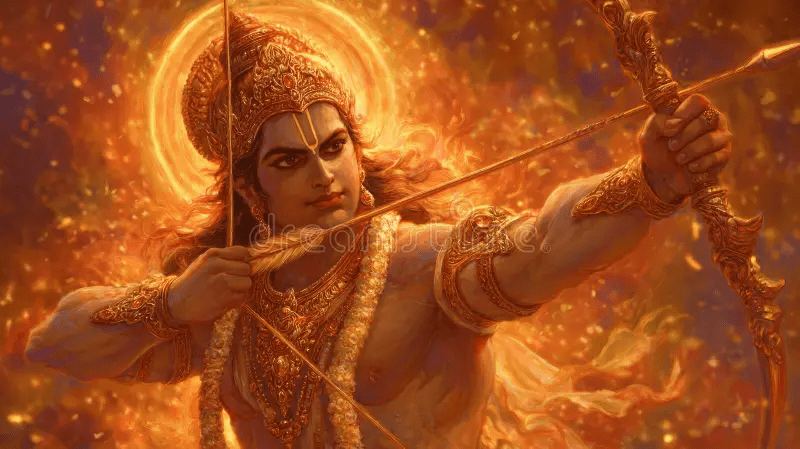
Again with the shaking. Geesh. Let’s see if we can solve the mystery once and for all. In the Ramayana, the epic story of the Soul’s Journey, Rama (the Soul) strings the bow of Lord Vishnu and breaks the celestial bow of Lord Shiva. The breaking of Shiva’s bow produces a thunderous sound that shakes the entire earth.
Elsewhere in the epic, Rama’s bow and arrows cause the sky, earth, and ocean to tremble. So, by discharging his weapons, Rama causes the shaking. To understand what causes the shaking, we need to figure out what Rama’s bow and arrow represent in the allegorical stories.
Having talked about Rama’s bow before, we know it’s Sharanga, the bow of Vishnu employed by several of the Dashavatara (Vishu’s ten avatars), including Parashurama (Rama with an axe, the sixth avatar) and Krishna (the eighth). Rama, the seventh avatar, carries the bow in the Ramayana epic, as well as in the Padma Purana. The bow is offered to him by Parashurama, who used it to slay Kshatriyas (the “caste” of aristocratic warriors protecting the social order by defending the weak, fighting injustice, and governing fairly).
This tells us that Parashurama used the bow to break the Rudra granthi, the third and final “psychic knot” binding our Souls to the illusion of separation (which includes the “noble” egoic ideas of justice, weakness, and defending righteousness in the world). So, the ideas promoting the ego’s idea of charity and righteousness, basically, which stems from the seemingly noble-yet-wrongminded ideas of levels and opposites; dualistic ideas like rich and poor, good and evil, right and wrong, guilty and innocent, and so forth. Only by perceiving the true equality or sameness of all beings created by God can we give the rightminded alms that enable us all to shake the Ego Mind’s “sleeping powder” or “dust” off our dreaming minds.
This is why Jesus says in Matthew 6:3-4 to “give our alms in secret.” Contrary to what Google reports and what most Christians suppose, giving alms in secret does NOT mean providing charity, such as money or aid to the poor, without seeking recognition, praise, or public attention. It means performing our charitable giving inwardly, by offering silent prayers for everyone’s higher good through the Om vibration (the name we share with God through Christ).
According to most sources, the Rudra (Red Ray) knot is located between the Vishuddha (the fifth or throat chakra) and the Ajna or Brow chakra. So somewhere around the nose or mouth of the spiritual body (not the physical body). And it is in that mouth, of course, that we find the sacred tongue of the Bridegroom–the tongue whispering “om” into our inner ears.
Essentially, the Rudra Granthi represents Satan’s last stand against the Soul seeking liberation. So, breaking the knot opens the way for Ida and Pingala to “marry” in the Third-Eye Chakra. This “sacred marriage” of the God and Christ energies, Rays, powers, or presences opens the Spiritual Eye, freeing the Soul from dualistic perception and individual I-am-ness.

In the Hindu lore, Rama’s bow (Sharanga) was crafted by Vishvakarma, the artisan god whose name means “universal karma” or “universal action.” As the story goes, Vishvakarma made two bows: Pinaka (Shiva’s bow) and Sharanga (Vishnu’s bow) to settle the question of which of the two ranked higher in the deific pecking order.
Vishnu won the contest, after which Shiva gave Pinaka (“the bow of the celestial realm”) to the king of Mithila ( “united in Ila” or “the union of opposites”), while Vishnu gave Sharanga (“arrow of fire”) to a revered sage named Richika (“praiser of purusha”), the grandfather of Parashurama. When Richika died, he passed the bow to his son, Jamadagni (“the Assembly of the forest fire”), who, in turn, passed it to Parashurama (Rama with an axe).
This handed-down hereditary progression shows us the steps we take in reverse, aided by the arrows of fire (the perception shifting miracles temporarily revealing the Truth to us).
Later, Parashurama meets Rama on the latter’s return from Ayodhya, where he famously broke Pinaka (Shiva’s bow) at Sita’s swayamvara (a ceremony where a woman chooses her husband from among a group of suitors contending for her hand). Enraged over the bow’s destruction, Parashurama challenges Rama to string Sharanga to prove his divine worth. After Rama strings the bow, Parashurama acknowledges Rama’s divinity and departs to perform penance at the mahendra mountain. Mahendra means “great majesty” (not great Indra), so the mountain to which Parashurama retreated was Mt. Sumeru or Mt. Meru, the uppermost peak (the Zenith) of divine-realization at the center of the universe.
All of this tells us is that the two divine bows are forged only when we act in universal brotherhood to manifest “the higher good for all beings” (Vishvakarma). The story also suggests that Shiva’s bow brings about the reconciliation of opposites that ends dualistic perception, while Vishnu’s shoots the fiery arrows bringing forth miraculous perception. Both eventually open the Spiritual Eye, but Vishnu’s miracle-bow is a faster tool for enlightenment. Hence, Vishnu’s superiority in the bow contest.
Rama (the divine Soul) stringing the miracle-bow enables the striving Soul (Parashurama) to acknowledge his own divinity and retreat to the Resting Place to join the miracle-working Assembly, whose yajnas make possible his rebirth as Rama (the realized Soul).
Makes sense, right? Well, it does to me, perhaps because that’s where I appear to be on the path at present–in the Assembly of universal brotherhood, offering the alms required to string my miracle-bow.
Next stop, Mt. Sumeru (God willing).
So, what about the shaking? I had a thought on that score the other night. When we shake a tree pretty hard, what happens? The answer is: three things typically fall to the ground: Dead leaves, dead branches, and ripe fruit. So, our almsgiving at the gate (on the lawn of the Resting Place) shakes the Tree of Life, to purge the deadwood and drop the ripe fruit. Before we pass through the gate, we need to eat that fruit–the ten fruits of our divine innocence (the lamb).
We find the metaphor “shaking the tree” various places in the Bible. Unfortunately, egoic interpreters have twisted its meaning down the ages. According to Google, the metaphor is used in Isaiah 17:6 and 24:13 to describe “God’s judgment gleaning the unfaithful olives and grapes from the tree.” Similar misguided assumptions have been made about the metaphor’s meaning in Daniel 4:14, Revelation 6:13, Matthew 7:19, and Luke 3:9 and 6:43-49.
So, let’s set the record straight here and now by retranslating and reinterpreting what Isaiah 17 actually says about shaking the tree. To get a fuller picture of what the shaking signifies, I went back a few verses to 17:2:
The rays of glory in Jacob will hang low, rich for the eating, to make the flesh-body grow thin. This harvest is from the Assembly of standing grains streaming the power to gather the waters in the vale of Rephaim (the Borderland).
Of the gleanings remaining from the shaking of the olive tree pair, three olive-berry clusters head the summit of the four-fifths bearing fruit–the branches speaking the Name of God, Elohim, in Israel.
Firstly, gleaning means retaining, not culling. So, shaking the tree was practiced in the early days to keep the good fruit on the tree. Secondly, Isaiah doesn’t say three or four berry clusters; the two refers back to the trees (the two olive trees seen by Zechariah), while the three refers to the olive-berry clusters left at the summit to direct the four-fifths bearing fruit. Those three clusters are probably the Trinity Powers at the higher levels of consciousness. Because these three Rays do indeed head the summit of the four-fifths bearing fruit. We find this same “four-fifths” referenced in Genesis 47:24, wherein Joseph, acting as governor of Egypt during a severe famine, established a law requiring citizens to give one-fifth (20 percent) of their harvest to Pharaoh while keeping four-fifths (80 percent) for themselves to use as food and seed for their families. So, “bearing fruit” is a metaphorical reference in the scriptures to the almsgiving yajnas we perform “in secret” in the Borderland Assembly.
The Ray of Adam (the Red Ray or Red Om) bestows the Eye (the spiritual eye, third eye, or single eye providing Christ’s or Shiva’s Vision) to see Holy Israel, and the compassionate regard for the Altar-work done through the eye to touch the vision of others making offerings to Asherah, the sun-pillar.
In Isaiah’s day, Asherah was a major ancient Semitic mother goddess, revered as the consort of the high god El and later Baal, often associated with fertility, trees, and the sea in Canaanite religion. Represented by sacred wooden poles or trees (Asherim), she was widely worshipped throughout the ancient Near East, with archaeological evidence suggesting she was considered a consort to Yahweh in early Israelite history before being suppressed.
So, Asherah, the sun-pillar and consort of Yahweh (the Name of God in Israel), is probably the ancient Semitic personification of the Tree of Life bearing the fruits of the Lamb. She might also represent Jacim, the pillar of the Cosmic Order supporting Solomon’s Temple.
The yom (the Red Ray) protects the city of the Self in the forest at the top; the self of the face of the son of Israel, listening attentively to the handmaids, having forgotten Elohim, the savior. To recall the secure fortress protect the firmly planted Na’aman–the sapling scattering seeds to other branches.
From our Rigveda studies, we know the forest at the top is the Forest of All Beings forming the Borderland. We also know that the handmaids are the sefirot, the fruits of the Lamb, harvested from the Tree of Life, as well as the Hindu Mahavidyas.
In the Biblical allegories, Na’aman was the “nice-guy” Armean commander of the armies of Hadadazer (“the thundering helper”), the king of Aram-Damascus in the time of Jehoram (Yahweh exalted), the king of North Israel (Samaria). The name supposedly means “pleasantness,” “sweetness,” or “graciousness” in Hebrew.
According to the folks at the Abarim Publications Biblical Name Vault, “The related adjective נעים (na’im) describes a soft or pleasant sound.” So, Na’aman may, in fact, represent the “sweet sound” of God’s saving grace — the nice-guy commander of the armies of the thundering helper exalting the Om (the miracle-workers spreading God’s grace through the universe through the Om vibration).
But wait. Because Na’aman was from Syria, where they spoke Aramaic. If the name is, in fact, Nar-aman, it means “the purifying fire” (nar) of “faithfulness” (aman). In Sakskrit (for what it’s worth), Nar-Aman means “the waters of peace.”
In Genesis 46:21, Na’aman is identified as the grandson of Benjamin (the son of the right-hand), who became the patriarch of the sub-clan of the Naamites.
In 2 Kings 5:1, he is a leprous Aramean captain healed of his affliction by Elisha; and in Luke 4:27, he is mentioned by Jesus during his sermon in the synagogue of Nazareth.
What Jesus said was this (according to the KJV translation):
And many lepers were in Israel in the time of Eliseus the prophet; and none of them was cleansed, saving Naaman the Syrian.
Based on these clues, I’m inclined to believe Na’aman represents the “sap” mentioned elsewhere in the Bible. That “sap” is, I believe, the “Soma drop” and/or divine spark of the Rigveda. In Psalm 107:16, for example, we are told, “The trees of the LORD are full of sap” (i.e., the eternal and divine lifeforce supplied by God to all his creations). From Google’s perspective, this “sap” represents the Holy Ghost’s energy enabling believers to remain fruitful and “green” even in old age. From my perspective, it represents the honey-sweet divine lifeforce “elixir’ Hindus call Amrita, Christians call the Blood of the Lamb, and the ancient Greeks called Ambrosia.
The Ray-sapling (the seedling of Adam) is enclosed (for protection and adornment) by the breaking dawn to sow and spread the harvest of accumulated rays cut off to be weak and heartsick.
Alas, the noise of the abundant compatriots making the sound of the sea on the western side (of the Wheel), the roar gathering at the same time the great waters; Gathering the community making the din like the roar of many waters to rebuke and escape the faraway place of chasing the chaff of the hills, the countenance of the wind whirling dust in the face of the Red Sea. The time of calamity, breaking dawn’s smooth tongue despoils in allotments of seized booty (from the enemy).
Okay wow. Rather abstract, but I get the idea. The spirit of breaking dawn dissolves the illusion and our attachment to the ego-made world and identity in gentle strokes, like a tongue licking away an ice-cream cone or a lollypop.

The tongue of the Bridegroom dissolves the Ego, by speaking to us in the Voice of God–in a language that, according to Course-Jesus, is abstract and wordless. That voice is the Holy Spirit and the Om vibration. Ergo, the Holy Spirit is the Om vibration still sounding in our minds underneath the clamorous din of the Ego-constructed world of words and symbols.
Or, to quote Course-Jesus:
You who speak in dark and devious symbols do not understand the language you have made. It has no meaning, for its purpose is not communication, but rather the disruption of communication. If the purpose of language is communication, how can this tongue mean anything? Yet even this strange and twisted effort to communicate through not communicating holds enough of love to make it meaningful if its Interpreter is not its maker. You who made it are but expressing conflict, from which the Holy Spirit would release you. Leave what you would communicate to Him. He will interpret it to you with perfect clarity, for He knows with Whom you are in perfect communication.
You know not what you say, and so you know not what is said to you. Yet your Interpreter perceives the meaning in your alien language. He will not attempt to communicate the meaningless. But He will separate out all that has meaning, dropping off the rest and offering your true communication to those who would communicate as truly with you. You speak two languages at once, and this must lead to unintelligibility. Yet if one means nothing and the other everything, only that one is possible for purposes of communication. The other but interferes with it.
The Holy Spirit’s function is entirely communication. He therefore must remove whatever interferes with communication in order to restore it. Therefore, keep no source of interference from His sight, for He will not attack your sentinels. But bring them to Him and let His gentleness teach you that, in the light, they are not fearful, and cannot serve to guard the dark doors behind which nothing at all is carefully concealed. We must open all doors and let the light come streaming through. There are no hidden chambers in God’s temple. Its gates are open wide to greet His Son. No one can fail to come where God has called him, if he close not the door himself upon his Father’s welcome. (ACIM, T-14.VI.6:1–8:8)
This is, btw, the true meaning of “speaking in tongues.” Jesus explained this is the Course’s original dictations, but it, too, was cut from the Standard Edition. Retained was, however, this related teaching:
Attest his innocence and not his guilt. Your healing is his comfort and his health because it proves illusions are not true. It is not will for life but wish for death that is the motivation for this world. Its only purpose is to prove guilt real. No worldly thought or act or feeling has a motivation other than this one. These are the witnesses that are called forth to be believed, and lend conviction to the system they speak for and represent. And each has many voices, speaking to your brother and yourself in different tongues. And yet to both the message is the same. Adornment of the body seeks to show how lovely are the witnesses for guilt. Concerns about the body demonstrate how frail and vulnerable is your life; how easily destroyed is what you love. Depression speaks of death, and vanity of real concern with anything at all. (ACIM, T-27.I.6:1-11)
In Christian thought, there are said to be “three powers of the tongue.” This is, in fact, true, with a little tweaking. Those powers are: 1) Direction by Christ’s inner voice (like a rudder guiding a ship), 2) destroying (illusions — not through ruin, but by breaking the chains around our minds with perception-shifting miracles), and 3) building up or blessing (by sharing the message of light through the universal mind-yoke that is Indra’s net and the Miracle Matrix).
Hence, My yoke is easy and my burden (message) is light.
That’s all for now. Hope you found this helpful. Until next time, Om Hari Om and Namaste.
 The Holy Meeting Place
Leave a comment