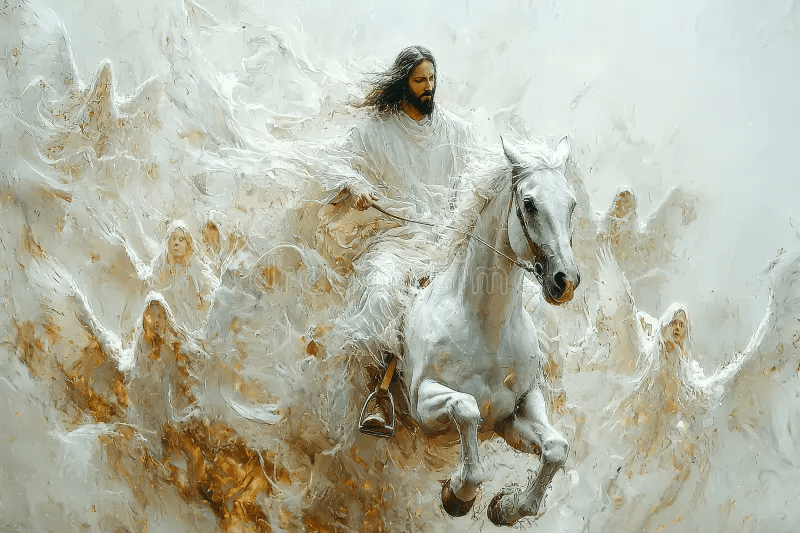
Going forward, we’re discarding the rules devised by the Sanskrit scholars. Why? Because those “rules” support translations that, quite frankly, make a mockery of the Rigveda’s incredibly powerful wisdom-teachings — wisdom-teachings with an undeniable divine provenance.
God’s messengers don’t speak gibberish. And yet, if we follow the “rules” set forth by academic “experts” like H. H. Wilson, Ralph T. H. Griffith, Sir Monier Monier-Williams, (or even the great sages, Aurobindo, Sayana, and Panini) we get truth-obfuscating nonsense on a par with Wilson’s translation of Rv 1.11.1 (a holy number, btw), which reads:
All our praises magnify Indra, expansive as the ocean, the most valiant of warriors who fight in chariots, the lord of food, the protector of the virtuous.
Such balderdash might beguile those who regard the sacred scriptures as quaint specimens for scholarly study, but they fail to communicate anything of use to sincere spiritual seekers. And isn’t that the fundamental purpose of the scriptures? Isn’t that why we study day after day and year after year the Bible, the Vedas, the Gita, the Course, and the Qur’an? Isn’t that why the Holy Spirit’s messengers revealed these texts to his chosen scribes and prophets?
The answer to all three questions is a resounding YES.
True scriptural texts are like acorns. Stored within them are mighty oak trees. Those fetal trees will, however, only sprout and grow in fertile soil. Those who trivialize their merit will never behold the splendor of those majestic trees or taste the sweet fruits they will bear over time. And the same goes for charlatans and the star-struck acolytes and dilettantes who blindly trust their misleading interpretations.
Now, having said all that, let me say this: It isn’t my intent to insult or criticize anybody. My aim is to open your eyes to the universal truths the Ego Mind doesn’t want you to recognize. And that means encouraging you to first question — and then smash — all the cherished idols and false beliefs getting in your way. I’m trying to help you see the trees and the illuminating light gleaming through their branches. So please don’t shoot the messenger.
And on that note, let us allow the Holy Spirit to reveal to us what s/he, in fact, revealed to the great rishis of India four thousand or so years ago in the illusion of time.
As the post-title indicates, our subject today is the Rig Veda’s eleventh Sukta, the first line of which reads (in transliterated Sanskrit): indram viśvāḥ avīvṛdhan samudra-vyacasam giraḥ rathitamam rathi-nām vājā-nām satpatim
My translation:
King Indra’s universal call seeks out the ancient mark of God’s Word to enlarge the span of the voices singing the praises of the charioteer of the Whole, the Charioteer of the Name, speaking for the coming of the True Husband (the Biblical Bridegroom).
My Word divisions and definitions:
indram (Indra’s) viśvāḥ (universal call) avī-vṛdhan (seeks out the ancient) sa-mudra (mark of God’s Word) vyacasam (to enlarge the span of) giraḥ (the voices singing the praises of) rathi-tamam (the charioteer of the Whole) rathi-nām (the Charioteer of the Name ) vā-jānām (speaking for the coming) satpatim (of the True Husband/Bridegroom).
My notes:
Here again, we encounter the mark of God’s Word. To get a better handle on what this “mark” truly is, let’s explore the word samudra–a term used 133 times in the Rigveda. So, it must be pretty important in the annals of Vedic wisdom. Most “experts” identify the term as a compound of sam (coming together) and udra (water), meaning “the gathering together of the waters.” But the word can also mean “ocean” or “confluence” (the place where two bodies of water meet). I say supposedly because the word also occurs in the (presumed) title of the epic story of the churning of the Ocean of Milk — the allegorical account of how the Holy Spirit changed the world’s purpose so we could reclaim the “elixir of immortality.” And in that (presumed) title — Samudra Manthana — Samudra should mean “the Ocean of Milk.”
But it doesn’t.
The Sanskrit term for Ocean of Milk is Kshira Sagara. So does Samudra Manthana actually mean “the churning of the gathering of the waters”? Maybe. But samudra might, in fact, be a marriage of sa (the Word of God) and mudra (seal or mark). And, if I’m right, the word used 133 times in the Rigveda actually means “the Seal of God’s Word,” “the Mark of God’s Word,” or “the Mark of God.”
Furthermore, Manthana can also mean “shaking.” So, Samudra Manthana might actually translate as “The Shaking of the Mark of God.” We talked about this mark in our study of Revelation, but there’s some additional evidence yet to be explored in the Bible and the Course.
In the Course, the phrase “Mark of God” occurs three times. In the New Testament, the synonymous phrase “seal of God” similarly appears thrice (in Ephesians 1:13-14, 2 Corinthians 1:21-22, and Revelation 7:1-8).
Three times each in the Bible and the Course, and 133 times in the Rigveda.
If we Google “seal of God’s Word,” we are told:
In the Bible, the seal of God’s Word is the Holy Spirit, who marks believers as God’s children. The seal is a symbol of the certainty that believers receive from the Holy Spirit.
We are all God’s children, whether we “believe” it or not. So, Google’s answer as to what the seal or mark represents must be flawed. To get a better handle on what Samudra represents, let’s examine what the Bible and the Course tell us about this celestial seal or mark.
We’ll start with the Bible. In Ephesians, we are told (by St. Paul):
In whom ye also trusted, after that ye heard the Word of Truth, the gospel of your salvation: in whom also after that ye believed, ye were sealed with that holy spirit of promise, which is the earnest of our inheritance until the redemption of the purchased possession, unto the praise of our glory.
In 2 Corinthians, we are told (again by Paul):
Now he which establisheth us with you in Christ, and hath anointed us, is God; Who hath also sealed us; and given the earnest of the Spirit in our hearts.
And, finally, in Revelations, we are told (by John of Patmos):
And after these things I saw four angels standing on the four corners of the earth, holding the four winds of the earth, that the wind should not blow on the earth, nor on the sea, nor on any tree. And I saw another angel ascending from the east, having the seal of the living God: and he cried in a loud voice to the four angels, to whom it was given to hurt the earth and the sea, saying, “Hurt not the earth, neither the sea, nor the trees, till we have sealed the servants of our God in their foreheads.” And I heard the number of them which were sealed: and there were sealed an hundred and forty and four thousand of all the tribes of the children of Israel.”
Those are the KJV translations, which may or may not be trustworthy. Even so, they all seem to suggest the seal marks those able to hear God’s Voice speaking through the open channel in their foreheads.
Let’s now see what Course-Jesus says about the mark of God.
The miracle acknowledges everyone as your brother and mine. It is a way of perceiving the universal mark of God. (ACIM, T-1.I.40:1-2)
Ultimately, every member of the family of God must return. The miracle calls him to return because it blesses and honors him, even though he may be absent in spirit. “God is not mocked” is not a warning but a reassurance. God WOULD be mocked if any of His creations lacked holiness. The creation is whole, and the mark of wholeness is holiness. Miracles are affirmations of Sonship, which is a state of completion and abundance. (ACIM, T-1.V.4:1-6)
Okay, yes. None of this makes clear to the average person what the “seal” or “mark” of God actually is. As Jesus suggests, it’s the mark of the innate wholeness and holiness our Souls possess eternally as part of “the Christ” — the One Son created by God “in the beginning.” We all, therefore, bear that invisible mark in our foreheads. And it is that mark, I believe, that enables us to hear the Call to Return, which is the Holy Spirit whispering the three-part Om (the sound preserving creation’s wholeness). When verbalized, that three-part sound looks like this:
Hari-Om (Vishnu, the two streams of love)
Hare-Om (Rama-Krishna, the Souls yoked through the Lamb’s holiness)
Hara-Om (Shiva, the overarching power of grace)
The powerful Sanskrit mantra, “Om Hari Hare Hara” calls forth these three powers within us to clear the chakras of the ego’s veils, thereby dissolving the illusion and fostering spiritual bliss and consciousness.
These three powers are represented in the “mark” of the Om, by the numeral 3. We see this symbol at the center of the glyph for the Ajna chakra (shown below). Representing the three-part Om, that symbol sits inside the “yoni” of Shiva, the inverted triangle representing Prakriti consciousness, inside a circle flanked by twin lotus petals. Crowning the triangle is the two-part symbol representing Samadhi or Bindu (the dot) suspended in maya (the inverted arch supporting the dot).
What this symbol communicates is essentially this: even in upside-down prakriti consciousness, we are still part of the Trinity, still safe within the Golden Circle, and still embraced by God’s Everlasting Arms.

Note that Course-Jesus says, “Of your ego you can do nothing to save yourself or others, but of your spirit you can do everything for the salvation of both.” That’s also why St. Paul writes (in Ephesians 2:8-9), “For it is by grace you have been saved, through faith — and this is not from yourselves, it is the gift of God — not by works, so that no one can boast.”
Despite what many wrongminded zealots believe and proclaim, we can’t “save” anyone’s Soul by preaching, knocking on doors, or threatening those our egos misjudge as “sinful” with eternal damnation. We can only “save” ourselves and the world through the TRUE forgiveness made possible by perceiving God’s mark of holiness in ourselves and everyone else. And we learn to see that mark not by acting in the world, but by listening to God’s Voice whispering to us lovingly in the silence of meditation.
Furthermore, when the four angels say (in Revelation) to the fifth angel “ascending from the east” with the seal, “Hurt not the earth, neither the sea, nor the trees, till we have sealed the servants of our God in their foreheads,” they mean, “Don’t destroy the illusion till we’ve had time to get more Souls in our care to the Bridge,” which starts in the second quadrant of Artha (Holy Purpose) — the quadrant of the circle-journey we enter after we begin to hear the Om vibration.
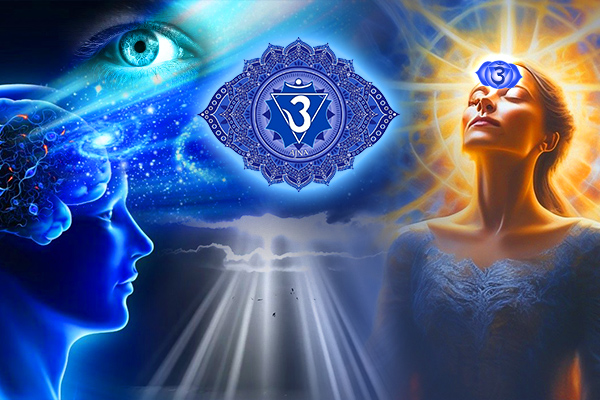
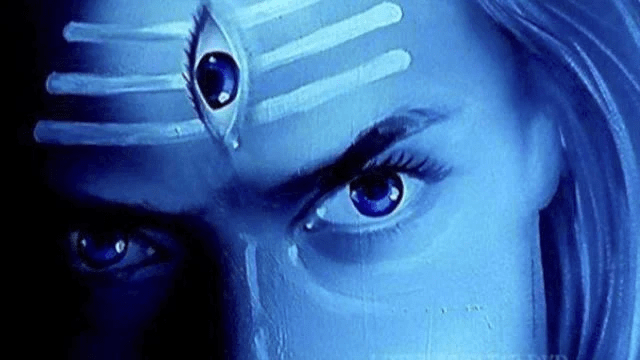
That the servants of God will be “sealed in their foreheads” is an obvious reference to the Spiritual Eye or Third-Eye Chakra, the opening of which results in Christ Consciousness or Miraculous Perception, wherein we experience “Christ’s Vision” or “Shiva’s Vision.” We perceive “the Forgiven World,” in other words — the Heaven-on-Earth revealed through the power of grace. And that is why the Spiritual Eye and the Ajna Chakra are so closely associated with Shiva, who is almost always depicted with the Tripundra (the three marks) upon his forehead.
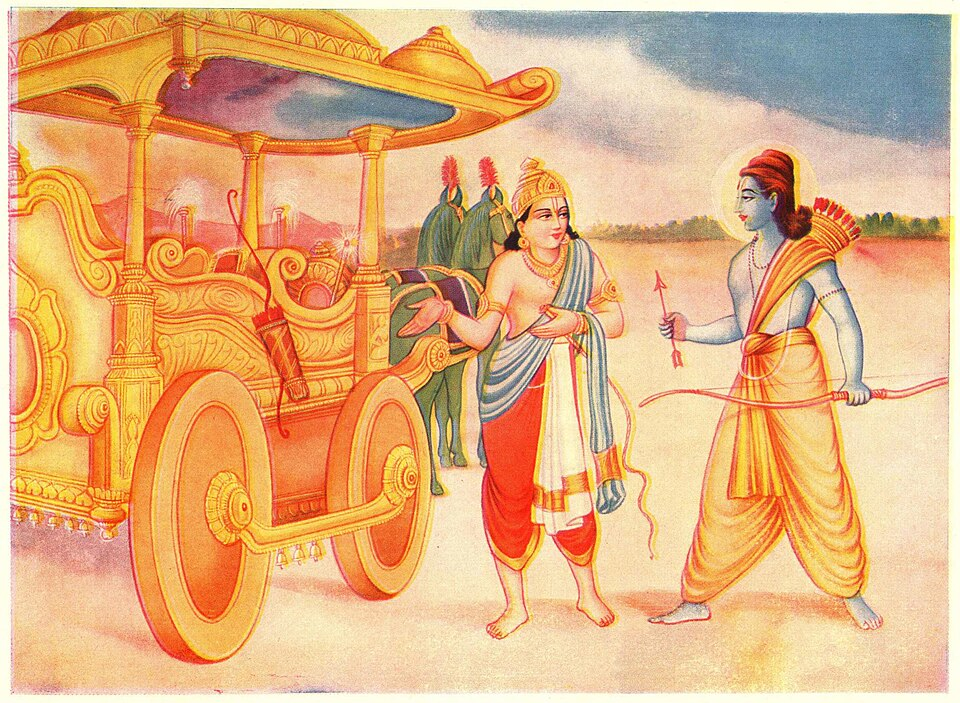
Let’s now go back to Rv 1.11.1. Who is the charioteer of the whole and the name? I’m pretty sure the rishis mean Indra, the charioteer of Surya. In the Hindu lore, Indra’s chariot is driven by Matali, whose name means “producing the sound of clapping” or “producing the thunder-clap” — the sound made when King Indra discharges his Vajra.
The rishis might also mean Krishna, the Soul’s charioteer, or Daruka, the highly skilled charioteer of Lord Krishna, whose name means “giving freely from a mindset of abundance.” But the Sukta describes him as “speaking for the coming of the Bridegroom.” So, he’s the herald for the Logos, sounding the Om through the Trinity voices. And, in the lore, Matali is associated with the divine guidance provided by the Voice for God. That the rishis mean Matali is, therefore, a safe bet.
This brings us to “the True Husband,” who is identified in the Old Testament Book of Isaiah (54:5-8) as “the Holy One of Israel” and “Lord of all the Earth” — two epithets for Yovah or Yaweh, the Biblical equivalent of Om. The passage from Isaiah, which also mentions “the Call,” echoes this Vedic verse in other ways as well.
“Do not be afraid; you will not be put to shame.
Do not fear disgrace; you will not be humiliated.
You will forget the shame of your youth
and remember no more the reproach of your widowhood.
For your Maker is your husband –Yaweh is his name —
the Holy One of Israel is your Redeemer;
he is called the God of all the earth.
The LORD will call you back
you were a wife deserted and distressed in spirit —
a wife who married young, only to be rejected, says your God.
For a brief moment I abandoned you,
but with deep compassion I will bring you back.
I hid my face from you for a moment,
but with everlasting kindness
I will have compassion for you, says Yahweh, your Redeemer.
Now that we better understand what the metaphorical components signify, let’s discuss what the whole verse attempts to communicate. From my perspective, the rishis are saying that the universal Call to Awaken, which King Indra sounds from the seventh plane of consciousness (through the Trinity Rays: Hari-Hare-Hara), seeks out those able to hear the Living Water to expand the reach of the mind-healing grace vibration to herald the second coming of the Logos.
The next verse (Rv 1.11.2) reads: patim sakhye te indra vajinahma bhema savasah pate tvam abhi-pra no-numahjetaram apara-jitam purvih.
My translation:
The True Husband’s platform of universal brotherhood protects Indra’s horse of surrender, the awe-inspiring Word of God garmenting the Husband of the Soul-Self of the Red Ray advancing reverence for the Great Triumphant Light from the waters of illumination coming from the east.
My word divisions and definitions:
patim (The True Husband’s) sakhye (platform of fraternity or universal brotherhood) te (protects) indra (Indra’s) vāji-naḥma (horse of surrender) bhema = bhima (the awe-inspiring) śa-vasaḥ (Word of God covering or garmenting) pate (the Husband) tvām (the Soul-Self) abhi-pra (of the Red Ray advancing) nonu-maḥ (reverence for the Great) jetā-ram (Triumphant Light from) apa-rājitam (the waters of illumination) pūrvīḥ (coming from the east)
My notes:
Noteworthily, the three phrases “True Husband,” “the awe-inspiring Word of God,” and “the Great Triumphant Light” also are found in the Bible. We also find the symbolic “horse of surrender” referenced in Proverbs 21:31. We also find the Bridegroom on a horse in Revelation 19:11-16, wearing a robe dipped in blood with many crowns, signifying his victory over the sin and guilt forging the chains of worldly judgment.
So, pretty much the same imagery described herein.
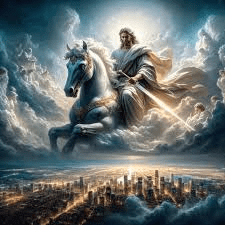
The True Husband is God, whose “wife” is all of us joined together in the “universal brotherhood” of love, faithfulness, and protection –the Ark of the Covenant, described herein as “the platform of fraternity.” This “covenantal relationship,” described in Isaiah 54:5 and Hosea 2:19-20, is what Course-Jesus calls the Holy Relationship.
Christ, being one with God, can also be called “the Husband” or “the Bridegroom” whose metaphorical bride is “the church” — the worshipful “body of Christ” we form as Souls bowing down in submission to the superior will of our True Husband.
And no, that doesn’t mean wives should bow down to their husbands, or that women are inferior to men. Quite the opposite, in fact. It means that Christ is our True Master, and, therefore the only one to be served and obeyed. Rightmindedly perceived, we are all Souls, not bodies, and, therefore, genderless. In God’s eyes, we are all ONE Being, and, therefore, all perfectly equal and equally perfect.
The awe-inspiring Word of God garments the Husband we learn herein. What does that mean? I suspect it means the Word of God forms the shining robes of righteousness worn by the Souls just under the altar (those in the Real World, who’ve metaphysically “married” the Bridegroom, and share his shining pure-white robes).
According to Google:
The awe-inspiring Word of God is a divine, enduring force that reveals the Creator’s majesty, power, and love, leaving humanity in reverent wonder. It acts as a guide, providing wisdom, comfort in affliction, and a, lifelong foundation that never runs dry. This profound, living Word calls for a response of worship, deep respect, and faithful obedience.
This brings us to “the Great Triumphant Light.” According to Google, this “light” symbolizes the unstoppable victory of Jesus Christ, truth, and divine life over the darkness (the dark illusion) of sin, death, and evil. This light, we are told in John 1:5, “shines in the darkness, and the darkness comprehends it not,” suggesting that the radiant power of Christ’s inner-presence cannot be extinguished by Satan’s deceptive illusions.
Based on the following from the Course, I suspect the “triumphant light” describes the Circle of All Beings, the Golden Circle forming the Real World, “the world of light” described below:
This world of light, this circle of brightness is the real world, where guilt meets with forgiveness. Here the world outside is seen anew, without the shadow of guilt upon it. Here are you forgiven, for here you have forgiven everyone. Here is the new perception, where everything is bright and shining with innocence, washed in the waters of forgiveness, and cleansed of every evil thought you laid upon it. Here there is no attack upon the Son of God, and you are welcome. Here is your innocence, waiting to clothe you and protect you, and make you ready for the final step in the journey inward. Here are the dark and heavy garments of guilt laid by, and gently replaced by purity and love.
Yet even forgiveness is not the end. Forgiveness does make lovely, but it does not create. It is the source of healing, but it is the messenger of love and not its Source. Here you are led, that God Himself can take the final step unhindered, for here does nothing interfere with love, letting it be itself. A step beyond this holy place of forgiveness, a step still further inward but the one YOU cannot take, transports you to something completely different. Here is the Source of light; nothing perceived, forgiven nor transformed. But merely known.
Before we move on, let’s briefly discuss my definitions of jetaram and iaparājitamas as “the triumphant light” and “the waters of illumination.” While those definitions might not be 100 percent accurate, they are vastly superior to the alternatives.
Charles Rockwell Lanman, for example, a Harvard University Sanskrit scholar and professor in the 19th century, wrote (in his book, Rigveda Repetitions) that the two terms were considered by his contemporaries to be epithets for Indra. Various other sources tell us aparajita can signify Rudra, Shiva, Vishnu, a legendary king, a goddess, or a demon. Still others define aparajita as “unconquered.”
Can one word really have all those meanings? The only sane answer is: of course not. As I read the word, aparajita is a compound of apa (water) and rajita (illumination), which achieves the triumvirate of making sense grammatically, communicating higher truth, and echoing the Holy Spirit’s teachings in other scriptural forms. And “triumphant light” also fits the bill on all three counts.
The specific phrase “triumphant light” appears nowhere in the Course or the Bible, but Jesus does declare himself in both as “the light of the world.” In the Course, he further proclaims that WE are the light of the world. We, the shining Souls making up the Golden Circle of the Christ in wholeness.
In John 8:12, for example, we are told:
Then spake Jesus again unto them, saying, “I am the light of the world: he that followeth me shall not walk in darkness, but shall have the light of life.”
In the following from the Course, he more clearly explains his meaning:
The Holy Spirit was given you with perfect impartiality, and only by recognizing Him impartially can you recognize Him at all. The ego is legion, but the Holy Spirit is one. No darkness abides anywhere in the Kingdom, but your part is only to allow no darkness to abide in your own mind. This alignment with light is unlimited, because it is in alignment with the light of the world. Each of us is the light of the world, and by joining our minds in this light we proclaim the Kingdom of God together and as one. (ACIM, T-6.II.13:1-5)
Elsewhere, he says:
It is impossible not to believe what you see, but it is equally impossible to see what you do not believe. Perceptions are built up on the basis of experience, and experience leads to beliefs. It is not until beliefs are fixed that perceptions stabilize. In effect, then, what you believe you DO see. That is what I meant when I said, “Blessed are ye who have not seen and still believe,” for those who believe in the resurrection will see it. The resurrection is the complete triumph of Christ over the ego, not by attack but by transcendence. For Christ does rise above the ego and all its works, and ascends to the Father and His Kingdom. (ACIM, T-11.VI.1:1-7)
Let’s move on to the Sukta’s next verse (Rv 1.11.3), which reads: indrasya ratayah navi dasyanti utayah yati.
My translation:
Belonging to Indra, the chariot conveys the nine bestowing on the one who is wise the miracle impulses lighting the lamp.
My word divisions and definitions:
indrasya (Indra’s) rāt(h)a-yaḥ (chariot conveys) navi (the nine) dasyanti (bestowing on the one who is wise) utayah (the miracle impulses) ya-di (lighting the lamp).
My notes:
This one was especially tricky. From the previous line, we know that Matali is Indra’s charioteer. And from the image I shared, we know that Matali invites Rama (with a bow) to enter Indra’s chariot. We further know that Rama with an axe is Parasurama, the sixth avatar of Lord Vishnu, while Rama with a bow is the seventh avatar. Rama’s sacred bow is called Sharanga or Saranga (meaning spotted deer). Fashioned by Vishwakarma, Sharanga is the divine bow of Vishnu. Rama is sometimes called Kodanapani, holder of the bow, Kodanda.
Presumably, kodanda simply means “bow,” but it can also mean “arch” or “arc””– the same meaning assigned to Shemayin in Hebrew. In The History of Science in South Asia, we further learn that Konanda specifically refers to “the arc of the circle congruent to the ecliptic, which is between the equinoctial point and the celestial object.”
In plain English, please. Although I took astronomy in college, most of it went right over my head. And what didn’t, I’ve long since forgotten. So I asked Google to explain: “In essence, the arc represents a segment of a great circle that is identical in size and inclined at the same angle to the equator as the ecliptic itself, often utilized in specific historical celestial calculations.”
Smacks of the Golden Circle, the edge of which forms the arc of Shemayin or Konanda, the Celestial Spere. So, Rama receives his bow from Vishnu when he enters the celestial realm, through Self-Realization. And that step shifts his self-awareness from the Soul’s smaller solo merkabah, to Indra’s larger shared chariot (the body of Christ). And it is then and therein that he encounters “the nine bestowing the miracle impulse.”
Who are the nine? Hard to say. The number might refer to the nine forms of the goddess Durga, the nine aspects of devotion, the nine gates, the nine fruits of the Holy Spirit, the nine gemstones, or the nine divine wisdoms leading to awakening. According to Google, the nine associated with Indra are the navagraha, the nine planets or celestial bodies, nine points of the compass or nine divine forces.
So, the Vasu, plus one. That “plus one” is the guardian of the zenith–the uppermost point of the celestial sphere. In Hinduism, that uppermost guardian is said to be Brahma, “the creator”. But it should, I believe, be Surya, the logos on the chariot-throne at the top of the dream-realm.
According to Wikipedia:
The navagraha are nine heavenly bodies and deities that influence human life on Earth according to Hinduism and Hindu mythology. The term is derived from nava (“nine”) and graha (“planet, seizing, laying hold of, holding”). The nine parts of the navagraha are the Sun and Moon, the two nodes of the Moon, and the planets Mercury, Venus, Mars, Jupiter, and Saturn.
So, no Brahma among these nine powers, but Surya (the Sun) is there, as is Soma, the Moon. In Vedic astrology, the two nodes of Soma are called Ketu and Rahu.
We’ll come back to them in a bit, and to the navagraha more generally in another post. For now, let’s carry on and see if the rishis tell us more.
Moving on, Rv 1.11.4 reads: vajasya gomatah stotrbhyah mamhate magham puram bhinduh.
My translation:
Belonging to Vaja, the Mother Cow (Kamadhenu or Surabhi, (the milch-cow of Divine Love) glorifies the embracing light liberally bestowing the bounty from the fortress of Bindu.
My word divisions and definitions:
vāj-asya (To strengthen the Mouth) or Vaja-sya (belonging to Vaja) gomataḥ (the Mother Cow) stot-ṛbh-yaḥ (glorifies the embracing light) maṃhate (liberally bestowing) magham (the bounty from) purām (the walled city of) bhindu (the Bindu Chakra — the sacred point from which the universe originated and to which it ultimately returns as a unified whole)
My notes:
If Vajasya refers to the Mouth, this verse may be about the relationship between the lion-headed and cow-headed cherubim on the right-hand (eastern) side of the wheel. The Mother Cow in the fourth quadrant of Moksha glorifies the embracing light through her miracles, thereby strengthening the mouth of the Lioness speaking the Word through Garuda, the eagle-headed cherubim governing the second quadrant.
If, on the other hand, Vajasya means “belonging to Vaja,” it’s a reference to one of the Ribhus of Hindu lore — the three demigod “artisans” credited with fashioning Indra’s horse, the miracle-cow, and other divine instruments for the devas to use for our salvation. Primarily mentioned in the Rigveda, the Ribhus are said to be the sons of King Indra or the sons of Sudhavan (the Sacred Sound or Holy Voice), descending from Angiras (the Spiritual Body or Temple, rather than an ancient sage).
The word-name Ribhu means “the flow of purification,” while the name Vaja means either “the strength of God” or “the sound of water coming from the mouth.” The youngest of the three Ribhu brothers, Vaja supplies “the plenitude of the divine light and substance by which the complete work (of the atonement) can be done.”
Based on the evidence, the Ribhu probably represent the three channels or sacred rivers on the right-hand side of the circle.
Herein we learn that the Miracle Cow, which the Ribhus crafted, belongs to Vaja — if indeed the enigmatic Sanskrit term gomata or gomatah means “Mother Cow.” Let’s assume for the moment that it does, since better definition elude me. And I’m down with the Mother Cow. But let’s also be crystal clear about what the Rigveda’s SYMBOLIC Mother Cow or Miracle Cow actually represents.
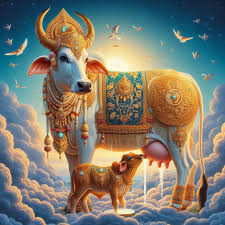
In the scriptures and legends of Hinduism, the Mother Cow is known by two names: Kamadhenu and Surabhi. Contrary to popular belief, Kamadhenu is NOT a compound of kama (desire) and dhenu (milch-cow). She is NOT, that is to say, the grantor of our egoic or worldly wishes and desires.
More accurately, the name is a three-way marriage of kama (the Love of God), dhe (to be absorbed or taken into one’s self), and nu (in the now). Surabhi, meanwhile, is either a compound of sur (the supreme or divine power) and abhi (the Red Ray) or of su (holy), rabh (embrace), and i (Kamadeva = divine love).
A phrase found in Christianity, “the holy embrace of divine love” represents, (according to Google) “a profound, intimate, and unconditional connection with the Creator, often described as an eternal, protective, and comforting force. This spiritual experience fosters inner peace, healing, purpose, and the capacity for unconditional love toward others. It is often described as an active, inviting presence, encouraging individuals to surrender fears and embrace a life of compassion.”
And all of this describes what happens when we listen to the Om in meditation.
Ergo, the Miracle Cow symbolizes the idea of extending the embrace of God’s love and light to our fellow Souls in the Circle of Forgiveness, through the mindful exchange of miracles.
In the Course, Jesus lays out fifty “principles” to help us understand what miracles are and do. Not that we really CAN understand what they are and do until we get quite a bit further along in the curriculum.
For the purposes of our current discussion, let me share just three of these “miracle principles”:
–Miracles make minds one in God. They depend on cooperation because the Sonship is the sum of all that God created. Miracles therefore reflect the laws of eternity, not of time.
–Miracles reawaken the awareness that the spirit, not the body, is the altar of truth. This is the recognition that leads to the healing power of the miracle.
–Miracles are natural signs of forgiveness. Through miracles you accept God’s forgiveness by extending it to others.
Let’s move on. The next line (Rv 1.11.5) reads (in transliterated Sanskrit): yuva kavih amitaojah ajayata indrah visvasya karmanah dharta vajri.
My translation:
The youthful singer possesses the infinite power to bring into being Indra for the whole world of action-mindedness to uphold the established order strengthening the shaking walled city eulogizing the individual Soul belonging to Vala (or enclosed in the mouth).
My word divisions and definitions:
yuvā (the youthful) kaviḥ (singer-poet) amita-ojāḥ (possesses the infinite power) ajāyata (to bring into being) indraḥ (Indra) viśvasya (for the whole world) kar-maṇaḥ (of action-mindedness) dha-rtā (to uphold the established order) vaj-rī (strengthening the shaking) puru-stutah (the walled city eulogizing) tvam (the individual Soul) vala-sya (belonging to Vala.) or val-asya (enclosed in the mouth).
My notes:
The youthful singer to which the rishis refer is likely Tumburu, the mythical Ghandharva hailed as the finest singer among the divine musicians in the courts of Kubera and Indra. He is said to lead the Gandharvas in their singing in praise of Vishnu. Often depicted with a horse’s head, Tumburu is a master of music, a devotee of Vishnu, and a peer to Sage Narada. He is considered the leader of the Gandharvas and the Kinnaras.
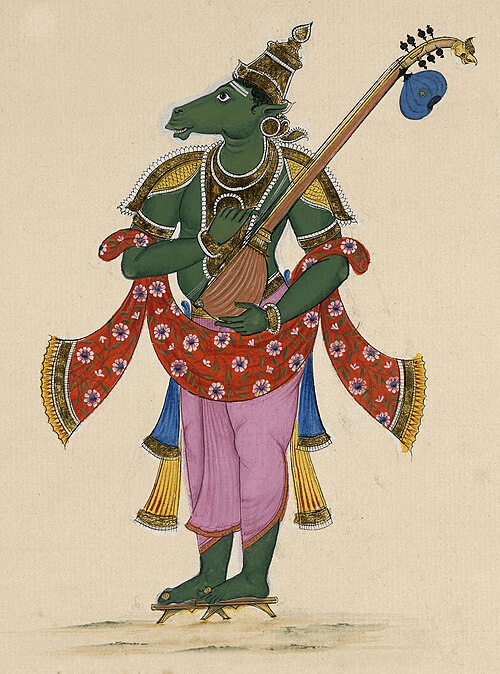
Couldn’t find a decent definition for the word-name Tumburu, so let’s move on to Vala. In Hinduism, Vala is described as a demonic figure representing a cave, enclosure, or covering, wherein many “cows” are held captive, along with Ushas, the goddess of breaking dawn (illumination). Vala is the chief of the panis, a class of demons characterized by their greed and miserliness. Like their leader, the panis seek to keep for themselves the “Light (of God)” belonging to everyone.
Google gives us this bulleted synopsis of Vala
–the brother of Vritra, Vala is the “encloser” or “circumscriber,” often identified as a stone demon holding back divine cows or light in a cave (bilam).
–Indra, often aided by Brihaspati or the Angirasas, breaks open this cave, similar to how he breaks Vritra.
–Vala symbolizes the hoarding of light and knowledge, preventing its conscious manifestation.
–In some Puranic accounts, the body of the demon Vala was dismembered upon his death, after which his body parts turned into precious gemstones found on Earth, such as sapphires, rubies, and emeralds.
–Vala is frequently mentioned in the Rigveda, the Atharvaveda, and the Garuda Purana.
Based on Google’s descriptions, the panis represent the ego-encased Souls not giving their allotted alms of Living Water and miracles. Those not fulfilling their Metron, in other words.
The definition of Vala as “cave,” “enclosure,” or “covering” is extremely interesting, given that the same definitions are assigned to the Hebrew word gan. In the second chapter of the Book of Genesis, we are told that Elohim planted a gan east of Eden for Adam and Eve to live in after the fall from grace. In the KJV Bible, gan is translated as “garden,” but the word also means “enclosure” or “walled garden.”
If Vala does represent that same gan or “enclosure,” his characterization as a demon is an interesting twist, suggesting the “enclosure” or “cave” imprisons the Soul (the Light of God) in the “shell” of ego-body consciousness and self-interested manifesting on the left-hand side of the Wheel . Vala’s cave would be, therefore, Brahmanda, the Primordial Egg in which the Soul hangs upside-down in Prakriti consciousness.
In the lore, King Indra overcomes Vala and his allies, freeing the cows and Ushas, thus symbolizing the triumph of light over darkness and established order over the chaos and conflict Vala represents.
Those “cows” in the story aren’t physical milk-producing bovine; they’re the miracle-workers sharing God’s light and life with their brothers in Christ in the endless Circle of True Forgiveness. By freeing those “cows,” Indra essentially elevates our self-perception from being separate mortal beings with competing interests, to being connected immortal Souls dutybound to help one another (by performing our Metron).
The word-name Vala supposedly means “enclosure” or “cave,” but when divided as v-ala, the word means “divided channels” or “two scorpion stings.” The second definition harkens back to the verse in Revelations, wherein the locusts are given the power of the scorpion-sting. When divided as va-la, the word means “to cover the tail” or, possibly, “the cover of doing.” Vala is also sometimes spelled Va’ala, which might translate as “to cover the scorpion sting.” If I’m right about the scorpion sting representing the teeth of God’s Word, than the Souls trapped in Vala’s cave are those who can’t yet hear the ego-devouring locusts.
After writing this section initially, I arrived at Workbook Lesson 239: The glory of my Father is my own. I mention this because the prayer in the lesson perfectly describes what King Indra personifies in Hindu theology. That illuminating prayer reads as follows:
We thank You, Father, for the light that shines forever in us. And we honor it, because You share it with us. We are one, united in this light and one with You, at peace with all creation and ourselves. (ACIM, W-239.2:1-3)
According to the Garuda Purana, Vala’s war-cry agitated the Great Ocean, leading to the creation of Vaiduryayas. And this fits with Course-Jesus’s account of what provoked God to devise the Atonement Plan. In case you missed that particular post, it was the first act of murder, which God could not abide.
Let’s put a pin in Vala for now and move on to Vaiduryayas. Based on my research, the word means either the Four Cat’s Eyes, the Four Eyes of Shiva, or the Four Beryls. We find those same Four Beryls in the Bible — as the eye-speckled gyroscopic wheels under the four Living Beings. In Ezekiel 1:16 and 10:9, the Hebrew prophet describes those mysterious double wheels as being “like unto the color of a beryl.”
There’s lots of speculation among Biblical scholars about what the prophet meant by “beryl.” Most suggest the wheels he saw resembled a yellow jasper or topaz. But what Ezekiel actually wrote was mareh ophan ma’asah ayin tarshiysh, which I translate thusly: “Revealed in my prophetic vision was a revolving chariot wheel producing an eye of shining crystal.”
If you question my result, consider that the idea of a “crystal-clear eye” in the context of clear vision, perception, and/or righteous judgment (of reality) features in Christianity, Hinduism, and Buddhism (and probably other world religions as well).
Interestingly, this particular verse from Ezekiel contains tarshiysh — one of those mysterious Hebrew words whose meaning still eludes scholars. Never mind that the word appears twenty-five times in the Old Testament, often in relationship to boats and metals. From these associations, many presume tarshiysh was an ancient city or place near a body of water. Others more insightfully suppose the word refers to some sort of gemstone.
I solved the longstanding mystery by converging several different clues. The first came from a credible source suggesting shiysh means “white crystal” in Hebrew. The second came from a slightly less credible source suggesting the Hebrew-rooted name Tarsha means “shining.” Since no other definition for tar could be found — and “shining” works well with “crystal” — I put them together. The third clue was the plausible-albeit-untraceable idea that tarshiysh means “beryl.” The fourth was all the eyes on the double-wheel shown below. And the fifth and most reliable clue came from my research into Vala’s role in the Hindu fable of the Churning of the Ocean of Milk.
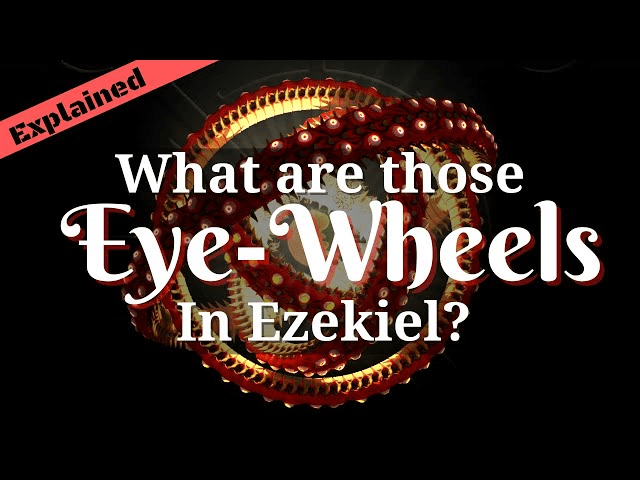
From all of that, I worked out that the ayin-tarshiysh Ezekiel saw represents the Spiritual Eye–the shining eye of true perception.
Or, to quote Course-Jesus:
Correction is for all who cannot see. To open the eyes of the blind is the Holy Spirit’s mission, for He knows that they have not lost their vision, but merely sleep. He would awaken them from the sleep of forgetting to the remembering of God. Christ’s eyes are open, and He will look upon whatever you see with love if you accept His vision as yours. The Holy Spirit keeps the vision of Christ for every Son of God who sleeps. In His sight the Son of God is perfect, and He longs to share His vision with you. He will show you the real world because God gave you Heaven. Through Him your Father calls His Son to remember. The awakening of His Son begins with his investment in the real world, and by this he will learn to re-invest in himself. For reality is one with the Father and the Son, and the Holy Spirit blesses the real world in Their Name. (ACIM, T-12.VI.4:1-10)
Okay, so … what’s all this got to do with beryls? Quite a lot, actually; because the “eye of shining crystal” Ezekiel saw and described is no less than the “crest-jewel” in the breastplate of righteousness in the New Testament, the breastplate of the priest in the Old Testament, and the “crest-jewel” in the supreme invincible armor or kavacha worn by Shiva, Vishnu, and Karna (who got it from Surya and gave it to Indra) in the Hindu literature. That breastplate or armor is worn by those who have recovered the Holy Vision or Spiritual Sight described above by Jesus.
In scriptural symbolism, the “crest-jewel” in the kavacha is the Kaustubha gem or “lotus-hued ratna” worn by Vishnu and Krishna. And yes, before you ask, cat’s eye beryls can be red in color. Typically, however, they are a smoky golden-green, like the one pictured below.

Was Ezekiel acquainted with the “cat’s eye beryl”? And was he, in fact, describing that stone when he wrote ayin-tarshiysh back in the day? It’s certainly possible, given that the stone is mentioned in various Jewish texts. One of those texts is Midrash Talpiyot, a detailed commentary on the Torah published in the 1800s, which describes the cat’s eye beryl as a powerful talisman for attracting prosperity, as well as protection, luck, intuition, and self-fulfillment. Proof positive the stone was known to and valued by Jews in times past.
Reasonably rare and valuable, cat’s eye beryls are found in Brazil, Sri Lanka (Ceylon), Myanmar (Burma), and India, as well as Russia, China, and Zimbabwe. In India, the semiprecious gems are most commonly mined in Cassis and Kerala (formerly Malabar), the port city where Jesus sent Thomas Didymus to establish his ministry and church after Christ’s (un)death and resurrection.
Being a major trade port, Kerala had a sizeable Jewish population at that time — a population whose roots date back to antiquity. So, it’s safe to presume the majority of cat’s eye beryls the Jews acquired and/or traded back in Ezekiel’s day came from the Kerala mines. It’s probable, therefore, that some of the mystical beliefs attached to those gems also originated in India.
In Hinduism, the cat’s eye beryl is closely linked with Vishnu, Krishna, and Ketu, the moon node or “shadow planet” in Vedic astrology associated with Moksha. Ketu can mean “mark,” “sign,” or “ray of light.” Among the Navagraha, Ketu is the descending node of the Moon.
In the allegorical story, nine to fourteen (depending on source) precious treasures, jewels, or ratnas emerged after Vala’s war-cry agitated the Ocean of Milk. Among the first and most precious of these was the Kaustubha — the crest-jewel in the breastplate worn by Vishnu. The Skanda Purana (Chapter 11, verses 51 to 53) describes what went down as follows:
From the ocean that was being churned emerged a highly refulgent, extremely bright, most excellent gem having the brilliance of the Sun. It was called Kaustubha. With its brilliance, it illuminated the three worlds. Keeping the Cintamani (a miraculous stone) in front, they saw the Kaustubha brightening the worlds. All those Suras gave the Kaustubha to Visnu. Suras and Asuras of enhanced strength lustily roared again and began to churn the ocean, keeping Cintamani in the middle.
Kaustubha means “crest-jewel,” while Cintamani supposedly means “auspicious jewel” or “magic gem. More accurately, Cintamani translates as “the touchstone of God’s Thoughts” — a turn-of-phrase Course-Jesus uses in the following excerpt from Workbook Lesson 157: Into His Presence would I enter now:
From this day forth, your ministry takes on a genuine devotion, and a glow that travels from your fingertips to those you touch, and blesses those you look upon. A vision reaches everyone you meet, and everyone you think of, or who thinks of you. For your experience today will so transform your mind that it becomes the touchstone for the holy Thoughts of God.(ACIM, W-157.5:1-3)
Let’s hop back to Ezekiel for a moment, because the double wheel the prophet saw wasn’t gyroscopic in configuration. Gyroscopes weren’t, in point of fact, invented until the 1800s. So the insertion of the word “gyroscope” in Ezekiel’s description of the wheels in the KJV Bible had to be a later addition. What Ezekiel actually saw and described was a revolving two-part chariot wheel whose inner and outer sections turned in opposite directions. So, what he beheld was the Wheel at the Center of the Universe, around which we walk to surrender our truth-blocking egos. That Wheel is, btw, the endless Circle of True Forgiveness mentioned in the Rig Veda’s sixth Sukta, as well as the Circle of Atonement described in the following from the Course:
We are all joined in the [circle of] Atonement here, and nothing else can unite us in this world. So will the world of separation slip away, and full communication be restored between the Father and the Son. The miracle acknowledges the guiltlessness that must have been denied to produce the need of healing. Do not withhold this glad acknowledgment, for hope of happiness and release from suffering of every kind lie in it. Who is there but wishes to be free of pain? He may not yet have learned how to exchange guilt for innocence, nor realize that only in this exchange can freedom from pain be his. Yet those who have failed to learn need teaching, not attack. To attack those who have need of teaching is to fail to learn from them. (ACIM, T-14.V.5:1-8)
On that clarion note, let’s move on to Rv 1.11.6, which is rather lengthy compared to the others in this Sukta. It’s also incredibly profound. In transliterated Sanskrit, the verse reads: gomatah apa avah adrivah bilam tvam devah abibhyusah tujyamanasah avisu tava aham sura ratibhih prati ayam sindhum avadan upa atisthanta girvanah viduh te tasya karavah
My translation:
The Mother Cow’s water of life manifests Kamadeva (the Love of God) to support the cave of the Souls of the shining ones fearlessly joined in the offering pushing forward the thoughts protecting the Majesty of the I Am, the holy being shining the three rays directing the four rivers of God’s communication above and beyond the Resting Place, the neck of the whole extracting or milking from the Holy Name, the Great Purusha’s humming sound.
My word divisions and definitions:
go-mataḥ (the Mother Cow’s) apa (water) avaḥ (of life) adrivaḥ (the stone supporting) bilam (the cave of) tvām (the Soul-Selves) devāḥ (the Shining Ones) abibh-yuṣaḥ (fearlessly joined in the offering) tujyamānāsaḥ (pushing forward the thoughts) āviṣuḥ (protecting) tava (the Majesty) aham (of the I Am) śūra (the divine being) rāti-bhiḥ (shining the three Rays) prati (directing) āyam (the four) sindhum (oceans or rivers) āvadan (of God’s communications) upa (above) ati-ṣṭhanta (and beyond the Resting Place) girva-ṇaḥ (the neck or throat of the whole) viduḥ (to milk out) te (from) tasy-a (the Holy Name) kā-ravaḥ (the Great Purusha’s thunder-like sound or bee-like humming noise)
My notes:
I told you it was long and rather profound. It also echoes, to a large extent, the quote I shared earlier about the Trinity and the Name from Chapter 12 of the Course’s Text. There are, nevertheless, a few phrases crying for further explanation. Let’s tackle them in order, starting with “the Cave of the Soul-Selves.” As I understand it, this cave is sometimes called “the Innermost Cave of the Self,” as well as “the Cave of the Heart” or Guha — a metaphor in Hinduism for the deep inner dwelling place of the True Self, together with the Divine Presence(s) of God and Christ.
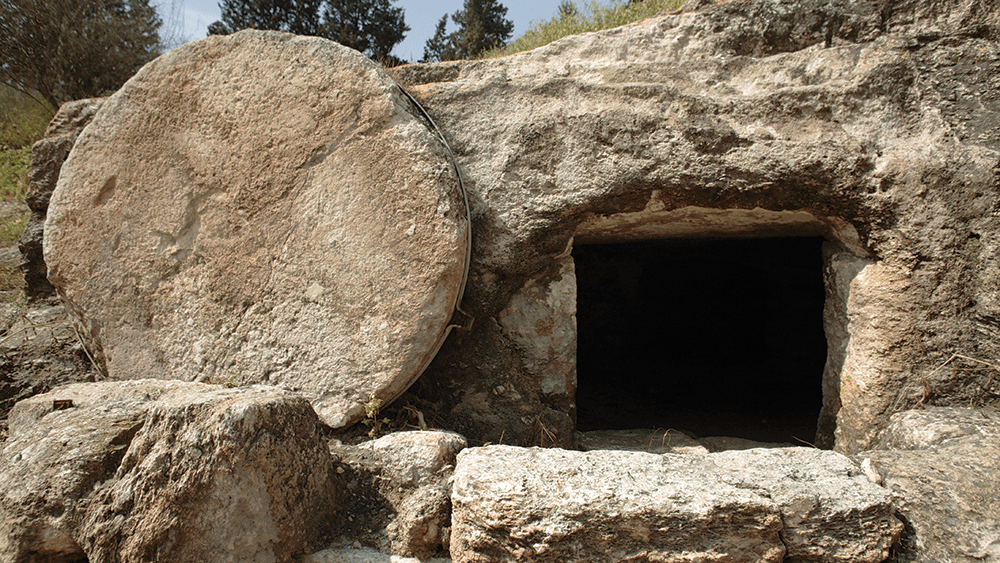
As I read what’s written, the image of the cave where Jesus was entombed crossed my mind. And I’m pretty sure, that tomb symbolized this same cave in the greater allegory of the Life of Jesus. Now, it would seem that the “cave” Vala represents and the “cave” mentioned herein are the same, meaning Vala isn’t a demon at all. He’s merely an atonement device our Souls eventually “outgrow,” with Indra’s help. And this tracks with Vala being the son of Tvashtr, the artisan god who fashioned the other atonement instruments.
I mean, why would Tvashtr make a demon?
According to Google, the “cave of the self” describes all of the following:
–a space for contemplation that allows us to recognize our True Self and our connection to the Supreme Spirit
–the place where the True Self and the ego unite (or do battle)
–a secret passageway to an “underworld,” where we can make contact with powers and forces that will eventually make their way into the world of light
–a place where Brahman’s essence is realized
–a place where the Atman or eternal Self is hidden
So, essentially, when Course-Jesus instruct us to “sink deep into the peace that waits … beyond the frantic, riotous thoughts and sights and sounds of this insane world” (as he does in Workbook Lesson 49: God’s Voice speaks to me all through the day), he is advising us to enter the deep inner Heart-Cave or Cave of the Self. It’s also to this “Innermost Cave” that King David refers in Psalm 51:6, when he writes:
Behold, thou desirest truth in the innermost-innermost: and in the hidden-hidden thou shalt make me to know wisdom.
(As explained in a much earlier post, repeating a word in Hebrew elevates it to divine status, so the innermost-innermost and hidden-hidden denote spiritual rather than physical locations.)
This “Innermost Cave” spoken of by King David and the Vedic scribes also is the place Bible-Jesus instructs his disciples to pray when he says (in Matthew 6:6): “When thou prayest, enter into they closet, and when thou hast shut thy door, pray to thy Father, which is in secret; and thy Father which seeth in secret shall reward thee openly.”
The Greek word translated into English as “closet” was tameion, which more accurately describes an “inner room” or “secret chamber.” So, Jesus never said we should pray inside actual closets. Neither did he say “shut thy door.” What he said was keio sous thura, which translates metaphorically as, “in the glory of the divine presence.”
So, when translated with more illuminated insight, Matthew 6:6 should read:
When you pray, enter into the innermost chamber and, in the glory of the divine presence within, pray to your Father who is hidden; and your Father who beholds the hidden offering to your own Self shall give back inwardly.
This dovetails beautifully with my retranslation of the Lord’s prayer. In case you missed that post, the prayer Jesus gave us should open thusly: We come together, Father of the inward prayer, to glorify your name and to strengthen your will to make earth like heaven.
But wait, there’s more … because Jesus also mentions this “innermost chamber” in the Gospel of Philip — one of the disciple-authored texts rejected, condemned, and ordered destroyed by the early “catholic” authorities who chose the New Testament canon. Philip, whose birth-name was Nadir, was a lifelong friend of Yeshua’s, as was Mary (the Magdala). According to the two Ascended Masters who dictated The Disappearance of the Universe and The Lifetimes When Jesus and Buddha Knew Each Other to Gary R. Renard (another Course teacher), the Souls of Jesus and Nadir were linked over seven lifetimes. In the one just previous, Nadir was Siddhartha, the Buddha, while Jesus was the son few knew the Buddha had.
Like the Gospel of Thomas, the Gospel of Philip was lost to humanity until the discovery in 1945 of the Nag Hammadi Library, a collection of sacred texts buried in a jar centuries earlier. Also like the Gospel of Thomas, the Gospel of Philip is a “sayings” rather than a narrative gospel. Like Thomas, Philip simply wrote down some of the things he heard Jesus say first-hand. And here’s what he heard Jesus say first-hand about the Innermost Chamber:
He said, “My father who is in secret.”
He said, “Go into the chamber and shut the door behind you,
and pray to your father who is in secret,”
the one who is innermost.
But what is within them all is the fullness.
Beyond it there is nothing inside.
This is the place they call “the uppermost.”
While I question the translation of “and shut the door behind you,” I’m not going to bother chasing that rabbit. Instead, let’s skip ahead to “the four rivers of God’s communications” — a rather odd turn of phrase I’d never heard hitherto. So, I looked it up. And guess what? The four rivers are indeed mentioned in the Bible — in the second chapter of Genesis, in the section describing “the planting of the gan” (Genesis 2:8-14). So let’s see what those passages can tell us about these four rivers.
According to the KJV translators, those passages read as follows:
And the LORD God planted a garden eastward in Eden; and there he put the man whom he had formed. And out of the ground made the LORD God to grow every tree that is pleasant to the sight, and good for food; the tree of life also in the midst of the garden, and the tree of knowledge of good and evil.
And a river went out of Eden to water the garden; and from thence it was parted, and became into four heads. The name of the first [is] Pison: that [is] it which compasseth the whole land of Havilah, where [there is gold]. And the gold of that land [is] good: there [is] bdellium and the onyx stone. And the name of the second river [is] Gihon: the same [is] it that compasseth the whole land of Ethiopia. And the name of the third river [is] Hiddekel: that which goeth toward the east of Assyria. And the fourth river [is] Euphrates.
Okay, then. Not very elucidating as translated by the Anglicans; but something tells me it’s a veritable goldmine of spiritual wisdom waiting to be excavated. So, let’s see what revisiting the original Hebrew will reveal.
Yovah-Elohim planted (in the manner of seeds) in a protective enclosure in the eastern direction of Eden (a compound of “ed” and “en,” meaning “fountain-altar” or “spring-altar”); thither to position Adam (the Red Ray) to form, fashion, or create “Adam-ah” (the universal brotherhood of Adam) bringing forth Yovah (the Name of God) sprouting from the branch of desiring greatly the vision of the good fruits to be eaten from the branches of the Living Beings in the midst of the enclosure; branches of experiential knowledge, good and ill, stream out of Eden (the fountain-altar or wellspring) to furnish drink divided into four “heads” or “faces,” united in name or glory.
Piyshown (Pishon), the first, revolves around the earth or world circle (chavilah), seeking after gold (or splendor) — the gold of worldly wealth and favor, separate from her brothers’ beryl-stone name (or glory); the second stream, Gichon, revolves around the region of Kuwsh (meaning “the Black One” or “Holy Grass” ); and the third stream, Chiddeqel, proceeds rapidly eastward on the blessed journey to the fourth stream of Perath (the Hebrew word for Euphrates, which means “Holy Glorification”).
So, pretty similar overall to the Vedic verse under discussion. When correctly translated, Genesis doesn’t say “God planted a garden east of Eden”; it says Elohim (the Logos) planted the Name of God (OM or YHWH) in an enclosure in the eastern direction of the fountain-altar — the cardinal direction “guarded” by King Indra or Adam, the Red Ray and/or Flaming Sword of God’s Creative Will.
That same “fountain” is mentioned again in Zechariah 13:1; Proverbs 14:27, 16:22,18:4; and Psalms 36:9. In Jeremiah 2, Yowah describes himself as “the fountain of living waters,” which we forsook by choosing the “broken cisterns” of ego-body perception over God’s righteous omniscience. In John 7:37, Jesus says: “If anyone thirsts (longs for spiritual fulfillment) to come toward me and to drink, to have faith and enter into me, just as the scriptures say, from out of the same heart will pour forth a river, stream, torrent, or flow of Living Water.”
From what Genesis tells us (when correctly translated), the four heads might be the four Living Beings seen by Ezekiel, Zechariah, and John of Patmos.
The Hebrew dictionaries define the names as follows:
Pishon = to scatter, spread out, or disperse
Gichon = bursting forth or gushing
Chiddeqel = swift flowing or “the swift one” (the Hebrew name for the Tigris River)
Perath = to break forth or rushing (the Hebrew name for the Euphrates River)
I’m not convinced these prescribed definitions are right, because they tell us next to nothing useful. And the Holy Spirit’s communications are always useful to sincere truth-seekers. We also know that Perath is the Hebrew name for the Euphrates River, which forms the easternmost border of Israel — the external projection of the internal Borderland–the Real or Forgiven World, in other words, projected outward as maya. We also know that Euphrates means “Holy Glorification.” So, it might represent the “river” or “tiny gap” we cross at the end between the Real World (Tif’eret) and Heaven (Da’at).
Let’s move on to the next verse, Rv 1.11.7. Another fairly long one, the text reads: mayabhih indra mayinam tvam susnam ava atrirah viduh te tasya medhirah tesam sravamsi uttira indram isanam
My translation:
In the illusion of fear, Indra is the power of love helping the Soul-Self of the hissing name sink into the prayer of Rahu, to extract or milk out the thundering Name of God. To comprehend their voices raises the riverbanks of Indra, the lord of the name.
My word divisions and definitions:
māyābhiḥ (in the illusion of fear) indra (Indra) māyi-nam (is the power of love helping) tvam (the Soul-Self) śuṣṇam (of the hissing name), ava (sink into) atriraḥ (the prayer of Rah(u)) viduḥ (to extract or milk out) te (the thundering) tasya (Name of God). medhirāḥ (To comprehend) teṣām (their) śravāṃsi (voices) ut-tira (raises the riverbanks) indram (of Indra) īśā-nam (the lord of the name)
My notes:
The hissing name probably refers to Shesha, the multi-headed Naga serving as Lord Vishnu’s water-palanquin on the Primordial Ocean. The Soul with Vishnu on that serpent-raft is Lakshmi. Ergo, if indeed the rishis mean “the Soul-Self of Shesha” they mean Lakshmi. But Susnam might also be a reference to Susna — a hissing demon-serpent in the Hindu lore representing the “waterless” drought conditions of the earthly desert. In the lore, Indra defeats Susna with his thunderbolt-throwing Vajra.
It took me a while to work out that atrirah might mean “prayer to Rahu” — the Navaghara of the ascending lunar node responsible for eclipses. And there are indeed a few prayers and mantras addressing Rahu in modern-day Hinduism.
But wait, because in Vedic astrology, Rahu, the ascending node of the north, represents the dragon’s head, while Ketu, the descending node of the South, represents its tail. Both are considered “shadow planets” that form a karmic axis, symbolizing the divided halves of Swarbhanu, an asura who was cut in half by Vishnu after stealing the nectar of immortality (Amrita). This begs four pretty important questions: Are Ketu and Rahu the Red Dagon’s head and tail? Are these two lunar nodes the two streams of Vishnu? Why is Swarbhanu considered a “demon” when his name means “splendor of radiance”? Why are the Asuras considered anti-devas, when asura means “possessors of the Breath of Life”?
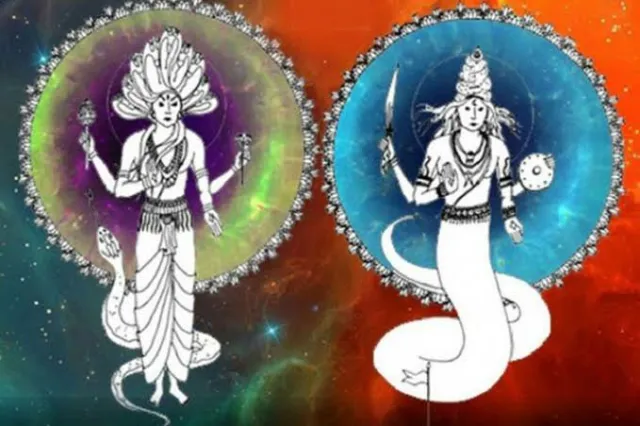
We’ll come back to Ketu, Rahu, and Swarbhanu another day, because this post is already impossibly long and complicated.
And we still haven’t talked about the riverbanks of Indra. Since the previous line mentioned the four rivers of God’s Communications, we can presume the riverbanks in this one relate somehow to those four rivers.
In the Old Testament, one of those metaphoric rivers — Chiddeqel or Hiddekel, the Hebrew name for the Tigris River — features in a vision described in Daniel 10:2-9. While sitting “by the side of the great river, which is Hiddekel” there appeared to the Biblical patriarch a figure he describes not as “a certain man” (as per the KJV translation), but as “a bridegroom, clothed in fine white linen, whose loins were girded with a pure gold uwphaz.”
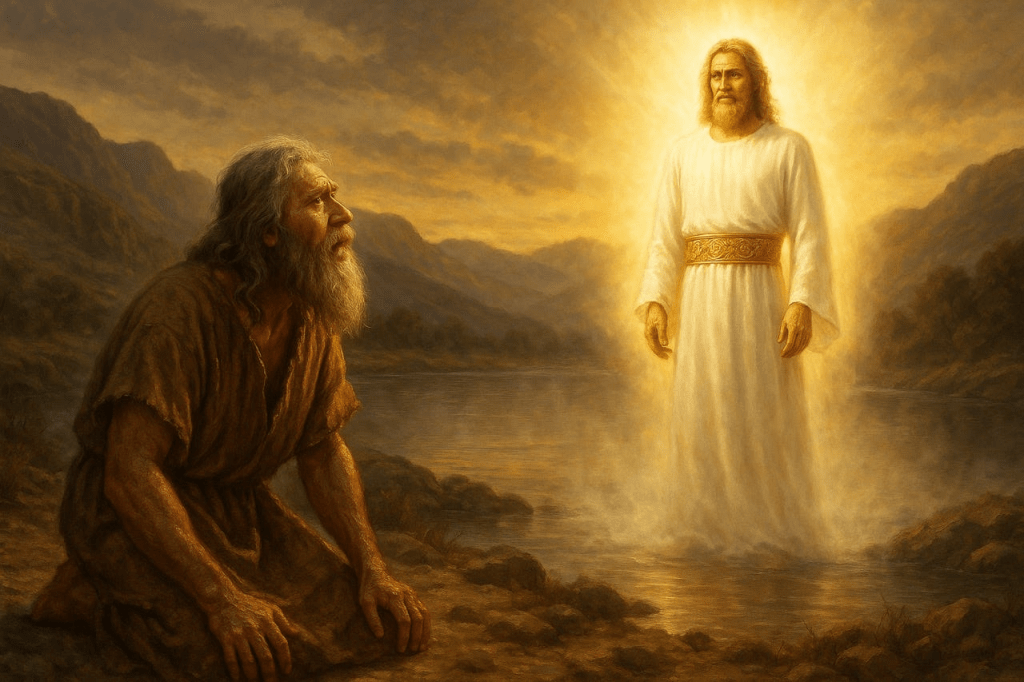
Why did Daniel describe the apparition as “a bridegroom”? I’m guessing it’s because he was dressed in the fine white linen costume of a Jewish man about to be married. And that white linen costume also identified him as the True Husband mentioned at the start of this Sukta.
Let’s go back to the Hebrew word uwphaz, the meaning of which has eluded scholars and Hebrew-speakers for centuries. I strongly suspect it’s a marriage of uwpha (winged or bird-like), and the Hebrew letter zayin, which can mean “sword,” “light,” “crown” or “eagle. And a pure-gold winged sword is indeed a symbol of divine power and glory, which this “riverbank” apparition exudes in every possible way. Moreover, to “gird the loins” literally meant to wear a sword in Biblical times.
But wait … because the winged zayin more specifically represents Gabriel, the messenger “archangel” who explains the vision’s meaning to Daniel. Ergo, Gabriel acts as the Bridegroom’s “winged sword” or “golden eagle.”
Daniel describes the figure thusly (as I interpret the original Hebrew): “His body was tarshish (shining crystal, like a beryl), and his countenance gleamed like a fountain of lightning flashes and fire. Mightily he stood, a fountain of burnished bronze, sounding the Word of God with a noise like a roaring crowd.”
In the next section, the Bridegroom speaks to Daniel. What he says is, however, quite different from what the KJV translation reports. Based on the original Hebrew, what he communicates is more along these lines:
Daniel, the Bridegroom desires you to perceive the Word of God (“dabar-dabar”). Arising to set free the Word’s enduring quake demands deep reverence, Daniel, for the beginning-time of bestowing the heart-thoughts to perceive the Answer in the presence of Elohim, the Word of God to be heard to enter into God’s communications, covenantal promise, or guidance of higher authority. The Kingdom’s scattered or spread-out parts (our Souls) remain one in completion eternally. Michael, the one firstborn prince, has come to assist in preserving the relationship of the Kingdom’s scattered parts, by bringing to pass the perception of meeting as a collective body, identity, or name to end the dream of time.
Okay, wow. Clearly it wasn’t my ego that guided me to this excerpt from the Book of Daniel — and urged me to translate this section of dialog this morning before proceeding to the final verse. Michael, the one firstborn prince bringing to pass the perception of meeting as a collective body, is definitely Indra, the Lord of the Name.
Are you keeping up? Lol.
Let’s now move on to the Sukta’s eighth and final verse, which reads: ojasa abhi stomah anusata sahasram yasya ratayah uta va santi bhuyasih
My translation:
God’s radiant energy, the Red Ray speaks Anu’s Truth in the hidden dwelling place of the One whose love springs from the fountain bringing forth peace in abundance.
My word divisions and definitions:
ojasā (God’s radiant energy) abhi (the Red Ray) stomāḥ (speaks) anūṣata (Anu’s Truth) sahasram (in the hidden dwelling place of) yasya (the one whose) rāta-yaḥ (love springs from) uta (the fountain) vā (bringing forth) santi (peace) bhūyasīḥ (in abundance)
My notes:
In case it isn’t clear, the hidden dwelling place is the innermost chamber , while the One whose love springs from the fountain (in the vibrational “voice” of the Red Ray and supplying peace in abundance) is Christ, the Prince of Peace.
Wow. That was a lot. So, I hope you’ve learned as much as I have. In closing, let me reiterate that our true function in this world is to go within to that hidden chamber where God speaks to us and simply listen — with the intention of sharing the saving grace we receive with EVERYONE at-one with us in the Golden Circle of All Beings.
In case you doubt me, I urge you to read Workbook Lesson 154: I am among the ministers of God, which echoes all we’ve just discussed.
Thanks for visiting. Until we meet again, Om Hare Hari Hara.
P.
 The Holy Meeting Place
Leave a comment