Working out the true meaning of the three Greek letters generally mistranslated as “666” made me curious about all the other strange numbers sprinkled through the Book of Revelation. Are they also ciphers? We find, for example, the spelled-out numbers 42 and 1,260 in the following verse, wherein neither number has any useful meaning.
The metron of the Self gives not unto the races (the Souls on different levels of awakening) of the sacred city walking the path for forty-two months; but to give unto my two witnesses speaking through divine inspiration of two hundred and sixty days wrapped in the spiritual vestments of healing (sak-kos).
Let’s start with forty-two months, the usual literal translation of the phonetic Greek reading tessarakant duo men. Yes, Tessarakanta can mean forty, but it more specifically translates as “four and ten” or “four of ten.” Duo primarily means “two,” or variations on two, such as twin, pair, or twice. Men, on the other hand, has wide-ranging definitions. In addition to “month,” the word can mean “indeed,” “balance,” or even “on either side.” So, tessarakanta duo men could mean “forty two months,” “four and ten are the two on either side,” or “four and ten are the twins balancing (the established cosmic order).”
According to Google AI, “four and ten are the two on either side” also might be a riddle whose answer is either five or seven.
Here’s the explanation I received:
In Roman numerals, four is written as IV and ten is written as X. The numeral “V” (representing five) is positioned between “I” (one) and “X” (ten), making the values 4 and 10 “the two on either side” of 5.
Alternatively, the riddle could refer to seven, which is positioned between four and ten on a standard number line (4, 5, 6, 7, 8, 9, 10). The phrase “on either side” could be a spatial or sequence-based clue.
Either way, we’re talking about a path here — a circular path made up of quarters (the four) broken into ten aspects of two powers divided into five Sefirot on either side. And that is an accurate numeric description of the Kabbalistic Tree of Life, the Path of the Flaming Sword. Seven also is the divine number of completion. So, either way, the Great Amen used a cipher to describe the path of divine completion.
And he explains in the very next verse that the two in this equation are the two witnesses, the two olive trees, and the two candlesticks mentioned elsewhere in the scriptures. They also are, btw, the two horns (hornlike beams) of both the Lamb and the Miracle Cow, Moket or Hathor, the Mesopotamian and Egyptian names (respectively) for the bull-headed cherubim supporting Elohim’s Throne.
Let’s now see what we can make of the cited 1,260 days, which is written out in Greek as chilioi diakoisoi hexekona hemera.
Chilioi does seem to mean “thousand” or “one thousand,” but figuratively, the word can also mean “multitudes.” Diakoisoi is a compound of dia (moving through time or a door) and koisoi (sleep or rest), while hexa-konta might mean either “sixth place” or “six corners,” as in the six-pointed star of Solomon’s Seal.
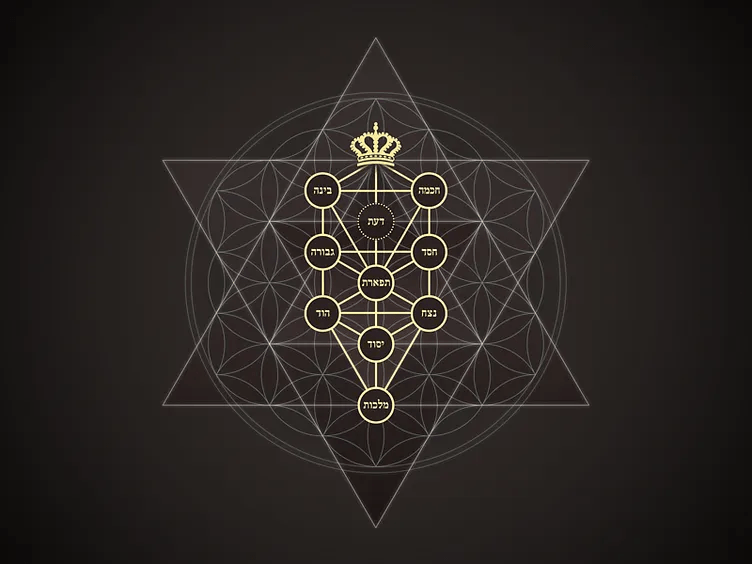
This brings us to Hemera, which means “day” in modern Greek, but also is the name of the mythological Greek goddess of daylight — the divine power bringing light into the world. So, we’re talking here about the metaphoric multitudes moving through the door of the Resting Place on the sixth point of the Star of David, the Seal of Solomon.

The sixth point of a six-pointed star represents coming full-circle, so it’s the point where the greater Circle-Journey starts and ends. The prevailing wisdom suggests that we start the journey around the star-wheel at Malkuth (the material kingdom) and end it at keter (the crown of glory). But that can’t be right, because the journey takes us back to the beginning. We originally started at Da’at and descended in stages to the low-point of Malkuth (the material kingdom). As I read the map, Keter represents “the door” between the left-side of the journey undertaken in the world of ego-consciousness and the right side of the journey undertaken in higher consciousness. The first stop on the second half of that journey is the Resting Place or City of Peace on the sixth plane.

In Chinese mythology, the northern direction is protected by Ao Shun (敖順), the Black Dragon controlling winter, ice, and snow. In the mythology, Ao Shun also is responsible for bringing rain and controlling water sources. In Chinese, his name means “profound submission.” In the Four Symbols mythology, he is the black turtle-snake, Xanwu. In Hinduism, the guardian of the north is called Kubera or Kuvera — a name meaning “hidden wealth” in Sanskrit. He is, therefore, the guardian of the spiritual treasures held in trust for us by the Holy Spirit.
Given all the symbolism, the door referenced in this section of Revelation is probably Keter, the Crown Chakra, whose Sanskrit name means “thousand-petaled lotus.” That door represents the Crown of Glory we reclaim through profound submission to the Christ Identity (i.e., bowing down at his footstool).
Hemera’s Hindu counterpart is Ushas, the goddess of breaking dawn. The fortress or walled city of Ushas is Purushas (my Sanskrit nom de plume). All of this suggests that Hemera and Usha are two forms of the Yowm of breaking dawn oft mentioned in Genesis.

If we plug these new definitions into the slots where the meaningless numbers were, we end up with this vastly superior translation:
The measured allotments of the Self give not unto the races of the sacred city walking the path of completion (the Tree of Life); but give unto my two witnesses speaking (through divine inspiration) to the multitudes moving through the door of the resting place on the sixth point (of the Shatkona) wrapped in the spiritual vestments of healing (sak-kos).
The spiritual vestments of healing aren’t itchy sack-cloth, brother; they’re the robes of light worn by the miracle-workers amplifying the power of the Great Rays shining down from the two trees. And those “robes of light” are indeed described elsewhere in the Bible.
According to Google:
“Robes of light” in the Bible represent divine glory, righteousness, and covering of holiness rather than literal clothing. Key references include God covering Himself with light (Psalm 104:2), Jesus’ radiant garments at the Transfiguration (Matthew 17:2), and the “armor of light” believers are called to put on (Romans 13:12-14).
In Genesis, we learn that we wore these robes in the Garden of Eden, before we covered them over with our physical “skins.” We still wear those robes, we just don’t know it … until we do through “realization.”
The Souls wearing these robes are seen by John “under the altar” in another section of Revelations. And I’m beginning to suspect these Souls may, in fact, make up the Great White Brotherhood or Brotherhood of Light spoken of in Theosophical circles and texts.
And on that clarion note, let me share this beautiful description from the Course:
There is a light that this world cannot give. Yet you can give it, as it was given you. And as you give it, it shines forth to call you from the world and follow it. For this light will attract you as nothing in this world can do. And you will lay aside the world and find another. This other world is bright with love which you have given it. And here will everything remind you of your Father and His holy Son. Light is unlimited, and spreads across this world in quiet joy. All those you brought with you will shine on you, and you will shine on them in gratitude because they brought you here. Your light will join with theirs in power so compelling, that it will draw the others out of darkness as you look on them.
Awaking unto Christ is following the laws of love of your free will, and out of quiet recognition of the truth in them. The attraction of light must draw you willingly, and willingness is signified by giving. Those who accept love of you become your willing witnesses to the love you gave them, and it is they who hold it out to you. In sleep you are alone, and your awareness is narrowed to yourself. And that is why the nightmares come. You dream of isolation because your eyes are closed. You do not see your brothers, and in the darkness you cannot look upon the light you gave to them.
If we ask Google about the numbers in the Book of Revelation, we are given the following summary of the prevailing wisdom:
Numbers in Revelation are symbolic, not literal counts, representing concepts like unity (1), the Trinity (3), divine perfection (7), creation (4), God’s people (12), and evil/imperfection (6 and 666).
We now know that at least some of that isn’t right. But what about the recurring number forty? We are told, for example:
–Rain fell for 40 days and 40 nights during the flood in Genesis 7:12
–Moses spent 40 days on Mt. Sinai in Exodus 24:18
–Israel was under Philistine oppression for 40 years before Samson’s deliverance in Judges 13:1;
–The Israelites wandered for 40 years in the wilderness in Numbers 14:33-34;
–Jesus fasted for 40 days in the wilderness in Luke 4:2;
–Jesus returned to earth for 40 days after his death and resurrection in Acts 1:3;
Clearly, 40 represents something pretty important, but what?
Google answers the question thusly:
In the Bible, the number forty symbolizes a complete period of testing, probation, trial, and preparation, often acting as a transition to a new phase or spiritual transformation. It signifies a, “full measure” of time that often involves cleansing, judgment, or the nurturing of a new generation.
Based on the Biblical accounts, I’m pretty sure forty represents the four corners or quadrants presided over by the cherubim, together with the ten Sephirot (the fruits of the Lamb) making up the Path of the Flaming Sword — the physical map of the circle-journey of bowing down” our Souls are “walking” (barefooted) to retrace their footsteps back to Eden.
But let’s just check the numbers, shall we? And no, I’m not going to try your patience by retranslating all the cited verses. But I am going to look at the specific wording used in the original Hebrew and Greek.
In Genesis 7:12, the original Hebrew (as per Strong’s Concordance) says the flood-rains fell for arba’iym yowm arba’iym layil.
Arba’iym supposedly means “forty,” but that pesky apostrophe in the middle suggests there’s more to the story. Especially when the line is correctly translated. I suspect it might be a shorthand contraction of arba-paniym — the four faces of yowm (the Greater Light of the Sun), the four faces of Night (the Lesser Light of the Moon).
So, the four faces of the sun and moon, presumably–the four cherubim. two of which reflect the Greater Light of the Spiritual Sun and two of which reflect the Lesser Light of the Spiritual Moon (Soma, the Great I AM). The image below roughly illustrates the idea, although I suspect the two sun faces are on the right-hand side, while the two moon faces are on the left.

Genesis 3:1-7 actually reads as follows:
The winged creatures of the Celestial Sphere (Shemiyan), seven male and female, restore to (eternal) life the seeds of the Living, the Faces (of Elohim) in the Land of the Living extending the Seven Rays. Raining down from the Land of the Living, the four faces of Day (the Greater Light) (and) the four faces of Night (the lesser light) making up the whole of existence accomplishing the obliteration. From above the faces of Adamah (the human kingdom), Noah accomplishes Yovah’s commands.
Out of context, I can’t explain what this means; but I do know the Hebrew name Noah allegedly means “rest,” “peace,” or “comfort.” So basically, Noah refers to the state of quietude or rest we must achieve to hear the Voice for God. Noah is, therefore, an allegorical symbol in the story of the flood, rather than an actual historical figure.
Because Noah is sometimes spelled Noach or even Nuach, he may represent one of the Cherubim — the “Nu” brother? Can’t find a clear Hebrew definition for Nu or No, but that nua means “shaking” has promise, strengthened by the fact that Noah is sometimes written as Nu’ach. Typically, it’s presumed to be nuwach, meaning “rest.” But what if it’s a contraction of Nua-ach, meaning “shaking brother”?
Tempted as I am to dive down that rabbit hole, I will refrain (for now). Because we’re looking for the symbolic meaning of forty, not the name of the Cherubim causing the shaking. So, let’s double back and check the Greek. In Luke 4:1, we find again the phrase tessara-konta hemera translated as “forty days,” when it more accurately means “the four and ten hemera (divine rays of breaking dawn) — a cipher representing the Third Cross and/or the Tree of Life mapping the Soul’s journey.
Based on these two questionable translations, let’s assume the other references to forty are also erroneous, suggesting that forty has no symbolic significance in the Bible. In all instances, it’s a misunderstood reference to the Soul’s Journey, which does indeed prepare us for our “higher calling” in the world.
So, there we are.
Let’s now go back to some of the nonsensical numbers in Revelations. We’ve cracked the big one: 666. But what about the 7,000 humans who supposedly die from the shaking brought on by Nua-ach? In Revelations 11:13, the Greek words transcribed as seven-thousand were hepta and chilios, which do indeed mean seven thousand. BUT, if we google the phrase “seven thousand men,” we find that very same number of men are mentioned in 1 Kings 19:18, 2 Kings 24:16, 1 Chronicles 19:18 and Romans 11:4. Presumably, they’re the cadre of human souls who did not bow down to the Ego Mind.
In Romans 11:4, for example, we read:
But what saith the answer of God unto him? I have reserved to myself seven thousand men, who have not bowed the knee to the image of Baal.
From this we can glean that “the seven-thousand men remaining” in Rev. 11:13 are these same 7,000 Souls. So, let’s revisit that particular line with this understanding firmly in hand.
And the inner time to bring into being the Great Shaking, when the tenth polis will fall, and the inner shaking uncovers the tight rein or bow of mankind’s seven thousand remnants, and those remaining in fear will give glory to God in Heaven.
An incomplete thought, to be sure, but definitely not a reference to 7,000 people dying in a massive earthquake in the physical world. I got “tight rein or bow” by dividing the Greek word apokteino, which is typically egoically translated as “to slay” or “put to death.” When divided as apok and teino, however, the word means “uncovering” (apok) “the tight rein or bow” (teino)–a reference, we can safely presume, to the bow Shiva gave Rama, whose string represents the established order of the Cosmos.
Given how often these 7,000 men are mentioned, they must play an important role in God’s Plan, but let’s leave that investigation for a future post.
In Revelations 14:1, we find the Lamb and the 144,000 having the Father’s Name written by the Christ Self in their foreheads. The number 144,000 is written in Greek as hekaton tessarakonta tessares chilias. Can those words have a different meaning? And, if not, what does 144,000 signify?
Not surprisingly, there’s a lot of speculation about what this number represents. Knowing what I know, it is NOT the limited number of seats available in Heaven, as Jehovah’s witnesses believe. After reading myriad speculative interpretations, I’m guessing the number refers in some way to the Chosen Ones, the Souls who answered the Holy Spirit’s call to return ahead of the pack, so they could help everyone else cross over too (as Jesus did).
Having restored the innocence of the Lamb, they bear the mark of the Father’s Name, which was written in their foreheads by Christ. They are the members of Team Jesus, the active miracle-workers who’ve joined the Great Crusade of the Atonement, as described below:
When you have been restored to the recognition of your original state, you naturally become part of the Atonement yourself. As you share my unwillingness to accept error in yourself and others, you must join the great crusade to correct it; listen to my voice, learn to undo error and act to correct it. The power to work miracles belongs to you. I will provide the opportunities to do them, but you must be ready and willing. Doing them will bring conviction in the ability, because conviction comes through accomplishment. The ability is the potential, the achievement is its expression, and the Atonement, which is the natural profession of the children of God, is the purpose. (ACIM, T-1.III.1:5-10)
In the original dictations, Jesus said more about the members of his team. Those descriptions were, however, removed in editing by the original publishers of the Course. I’d share what he said in the URText, if I could find it, but I can’t.
And it’s quitting time. So we’ll leave it there for today.
Unitil we meet again, Om Hari Om and Namaste.
 The Holy Meeting Place
Leave a comment