
After identifying Nisrok as the eagle-headed Living Being or Cherubim supporting the Throne of Elohim, I wanted to see if the names of the other three Cherubim also might be “lost in translation,” as it were, in the Holy Bible. Since Nisrok also enjoyed deific status in other ancient civilizations, I started by looking for bull-headed “gods” in other places around Judea. I found two: Apis in ancient Egypt and Moloch or Molach in Canaan/Phoenicia (two older names for the region encompassing what is now Lebanon, Israel, and Syria).
Of these two “gods”, only Moloch gets Biblical mention — and not in the most flattering of terms. Moloch is, in fact, vilified as the inspiration for the “golden calf,” to which human children were ritually sacrificed in Canaan.
But then, Nisrok was similarly slandered by unilluminated translators, so let’s investigate further.
Etymologically, Moloch is very similar to the Hebrew words for king (melek) and angel (molach). As Moloch, the name appears to mean “opposing” (mol) and “spirit” (och). Moloch is mentioned once in Leviticus 18:21 and a handful of times in Leviticus 20:2-5 (as Molek in all instances). The name might be Aramaic, rather than Hebrew. In Aramaic, presumably, molek refers to a fire-sacrifice or fire-offering involving this bovine deity. Keep that in mind as we attempt to sort out what this bull-headed being, beast, or creature actually represents.
In the KJV Bible, Leviticus 18:21 reads as follows:
Do not give any of your children to be sacrificed to Molek, for you must not profane the name of your God. I am the Lord.
In truth, Leviticus 18:21 says nothing about children or sacrifices. When translated correctly, the verse reads thusly:
To bestow the seeds passed through Molek, perforate or pierce (to make a narrow hole to act as a flue) the name of Elohim, which is Yovah. To find rest and remember the Resting Place of the Spirit, abominate performing copulation as a beast, which defiles the spirt of each party; the spirit stands upside-down in the beast; to breed together is, therefore, unnatural.
So, Molek doesn’t eat children. He or she facilitates the miracle-exchange in the almsgiving rituals the Vedic rishis call yajnas. And this totally dovetails with the scholarly view that Molek refers to some sort of fire-offering ritual performed in ancient Canaan. Those almsgiving rituals are, as we know, actually performed in the innermost chambers of our heart-minds, where miracles of grace are exchanged between Souls.
With regard to what Leviticus 18 says regarding sex, you should know that Jesus said the same thing in the original dictations of the Course. Those teachings were, however, removed from all published editions for spurious reasons. So my translation of Leviticus definitely holds water. As Jesus and Leviticus both explain, having sex for pleasure objectifies the Soul as a body, defiles the inner-altars of both parties, and blocks the Soul’s natural miracle impulses.
The true definition of “fornication” is, btw, “debasement of the spiritual nature, caused by functioning in carnal consciousness”– not consensual sex by unmarried couples!
I’m perfectly serious–and so was Jesus, who, though married at 18, was celibate for the last fifteen years of his life (according to Gary Renard’s ascended masters). I am also married and celibate by choice.
So, my revised translation of Leviticus 18:21, solves the mystery of what the verse says in truth, but, not, unfortunately the mystery of Molek’s true identity.
The association of Molek with fire sacrifices or fire offerings makes it pretty obvious (to me, at least) that Molek is, in fact, the Canaaite counterpart of Agni, the eternal flame presiding over those almsgiving fire-rituals. She might also be Surabhi, the Miracle Cow of Krishna, also known as Kamdhenu.
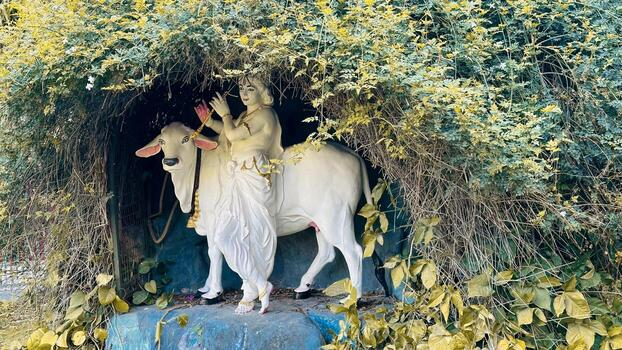
Either way, Molek is NOT a pagan god to whom anyone ever sacrificed children.

Before I speculate further, let’s see what Leviticus 20:2-5 might further reveal about Molek — a name mentioned several times in these three verses.
The Living Water of the Son of Israel is the spirit of the Son of Israel, a sojourner abiding in Israel to give his seed to Molek to kill the killer of the Tribe of Israel in the Land of the Living. By casting together the stones to be given the face of spirit, a covenant is made with the inner Self to give the seed of Molek to make clean the sanctuary piping the Holy Name of the I Am into the Land of the Living. The hidden Self seen by the Spirit gives the seed of Molek to kill nothingness. Without the presence of spirit, the tribe makes a covenant with idolatry and fornication, in faithlessness to Molek, the innermost part of the I Am.
Just for fun, and to make a point, here’s how those same passages read in the KJV Bible:
Again, thou shalt say to the children of Israel, Whosoever he be of the children of Israel, or of the strangers that sojourn in Israel, that giveth any of his seed unto Molech; he shall surely be put to death: the people of the land shall stone him with stones.
And I will set my face against that man, and will cut him off from among his people; because he hath given of his seed unto Molech, to defile my sanctuary, and to profane my holy name.
And if the people of the land do any ways hide their eyes from the man, when he giveth of his seed unto Molech, and kill him not:
Then I will set my face against that man, and against his family, and will cut him off, and all that go a whoring after him, to commit whoredom with Molech, from among their people.
All I can say is, God save us from Satan’s scriptural deceptions! Clearly, Molek isn’t the golden calf. Far from it, in fact. According to these verses, Molek is no less than the holy power through which we offer the “seeds” scattered by the Holy Spirit during our fire-altar offerings — a.k.a, our secret almsgiving rituals or yajnas. Those seeds, I’m fairly certain, are the fiery pearls on Indra’s Net, the miracles of grace given and received by our Souls through our prayers for everyone’s good. Molek is, therefore, the bull-headed Cherubim whose miracle-milk we imbibe through our almsgiving meditations.
According to Google,
The innermost flame of God’s Will is often interpreted as the Holy Spirit dwelling within the human spirit, serving as a divine, guiding light that searches the heart. It represents the intimate, purifying, and eternal presence of God within, which individuals must “fan into flame” through prayer, obedience, and devotion.
In Hinduism, the innermost flame of God’s Will is Agni. And if Molek is indeed the Canaanite version of Agni, then he or she supports and watches over the southeast quarter or corner of the Wheel under Elohim’s throne. He or she also is, therefore, the deity known as Apis in ancient Egypt, Surabhi, Kamdhenu or Nandi in India, and the Bull of Heaven in the ancient Mesopotamian Epic of Gilgamesh.

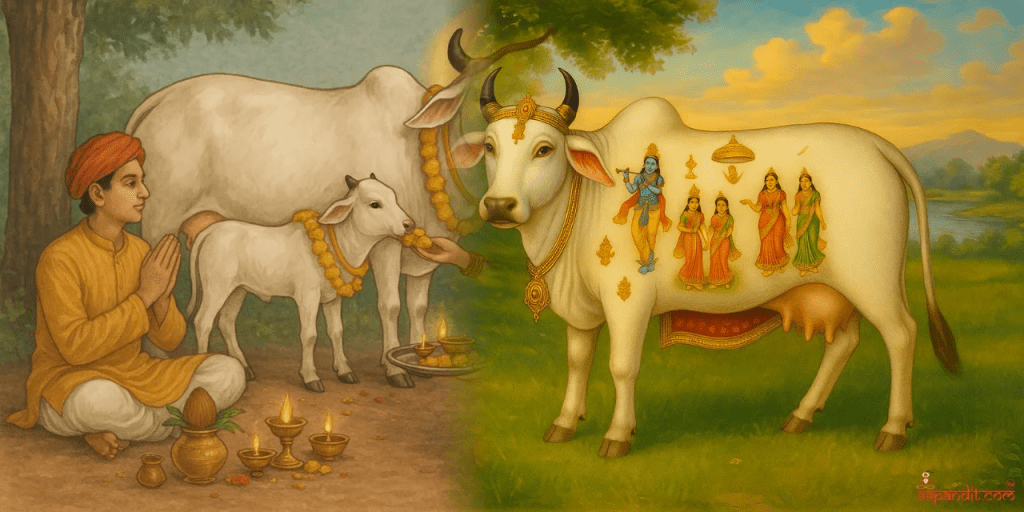
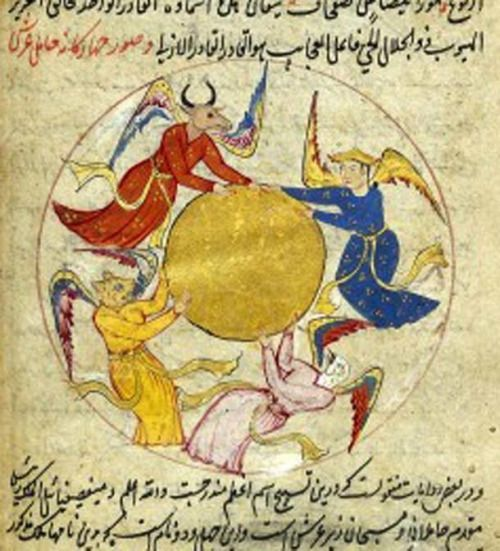
We have now unmasked two of the four cherubim, Nisrok and Molek. Let’s see if we can also find the lion-headed cherubim similarly hidden in the flawed translations and scribal errors all-too-commonly mistaken for scriptural truth.

According to Google:
The primary lion-headed goddess in ancient Egypt is Sekhmet (shown above), known as “The Powerful One,” representing war, destruction, plagues, and healing, often depicted as a woman with a lioness head, solar disk, and uraeus (cobra). She embodies the sun’s fierce, destructive aspect, but also possesses potent healing powers, serving as protector of pharaohs and physicians, while other lion-headed deities include Wadjet and Bastet in their fiercer forms.
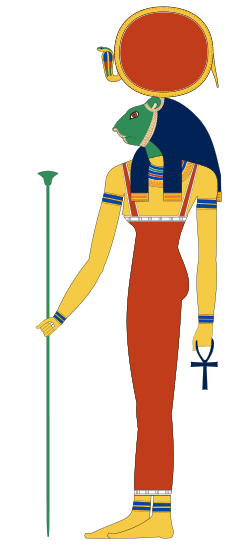
According to other sources, there were more lion-headed deities in ancient Egypt than Sekhmet, Wadjet, and Bastet.
There were many, but Sekhmet, the daughter of Ra, the Sun God, was, hands down, the main lion-headed deity. She is sometimes described as the Eye of Ra, the falcon-headed sun god slso called Horus and Nisrok. So, she’s the “eye” through which we “see the light.” And, as Course-Jesus emphatically states in Workbook Lesson 92: “Miracles are seen in light, and light and strength are one.”
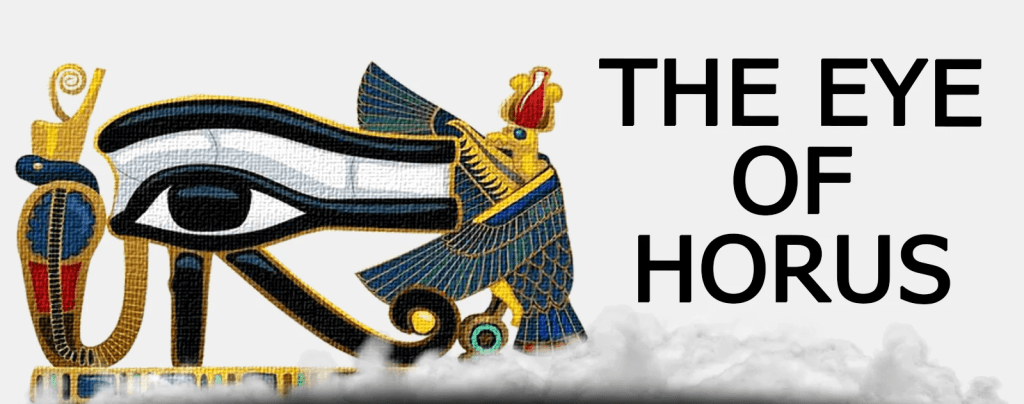
Let’s now see if the name Sekhmet shows up in the Bible.
It doesn’t. But she’s still a contender for our lion-headed cherubim, given that her name means “the Mighty One,” and Egyptians called her “the destroyer,”
Let’s broaden our search to Mesopotamia, where numerous deities had lion-like features (not surprising, since lions represent kingly power and authority). As I scanned the list of names, my eye stopped on Inanna/Ishtar, who, “though not usually depicted with a lion head, is heavily associated with lions as symbols of war and power, often shown standing on them or driving a chariot drawn by them” (per Google).
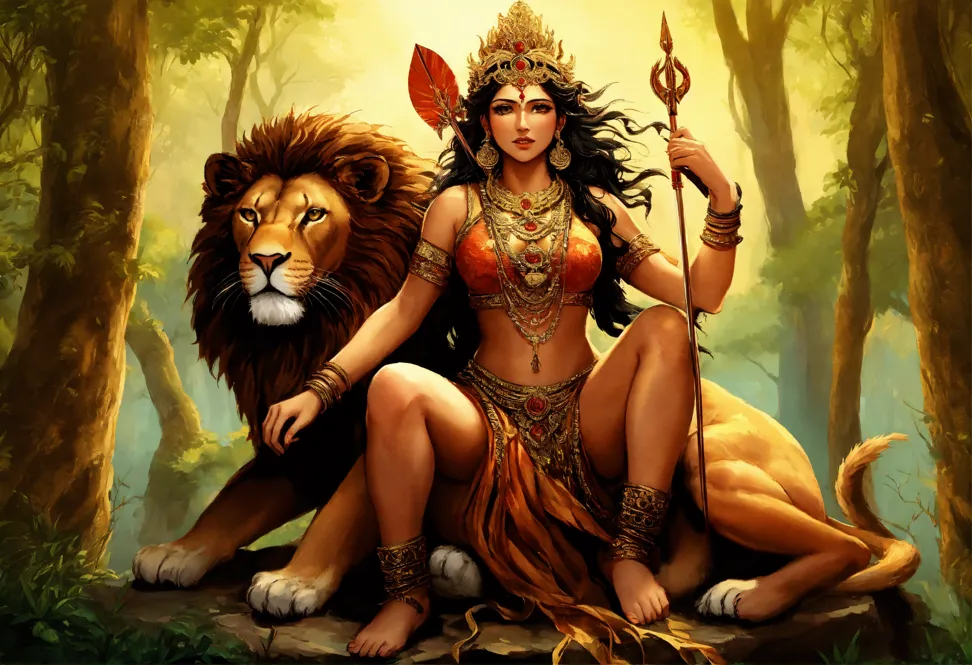
This is promising for four very solid reasons: 1) Inanna/Ishtar has much in common with Sekhmet and Durga, the lion-riding chief goddess in Hinduism; 2) the name Inanna is very like Ishanna, the guardian of the northeast quadrant, 3) Ishanna is another form of Shiva, “the destroyer,” whose wife (Parvati) rides a lion and 4) the name Ishtar is linked in the Bible with the Queen of Heaven (in a derogatory manner in Jeremiah 7:18, and 44:17-25).
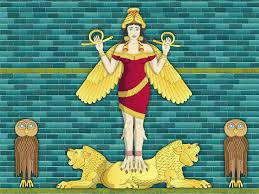
According to Google,
Ishtar, also known as Inanna and Astarte, was a prominent deity whose cult reflected practices like baking cakes and pouring drink offerings, which the Israelites adopted. While the Bible forbids her worship, her influence appears in biblical criticisms of idolatry and cultural allusions like “dens of lions” in Song of Songs.
None of this is, in fact, true. Because all of it is based on mistranslations of what the Bible actually says about Ishtar. We also know that lions symbolize the shift in perception miracles make possible in the allegorical stories of Sampson and Daniel. Additionally, the lion symbolizes both God’s strength and God’s Mouth in the Book of Revelation.
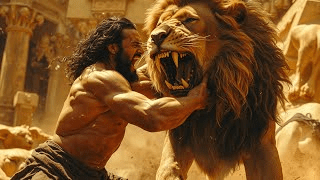
In the words of Course-Jesus:
The lion and the lamb lying down together symbolize that strength and innocence are not in conflict, but naturally live in peace. “Blessed are the pure in heart for they shall see God” is another way of saying the same thing. A pure mind knows the truth and this is its strength. It does not confuse destruction with innocence because it associates innocence with strength, not with weakness. (ACIM, T-3.I.5:3-6)

And what Jesus describes is exactly what Parvati, the gentle and devoted lion-taming wife of Lord Shiva, symbolizes in Hinduism, as well as the idea symbolically illustrated on the Tarot card of STRENGTH (above). And I’ll wager it’s also what Ishtar, the Queen of Heaven, symbolized in ancient Mesopotamia. But let’s double check the translation of Jeremiah, just to be sure.
Let’s start with Jeremiah 7:18, whose translation I extended to the end of the stanza.
The Son gathers up the branches the Father burns with the fire of spirit to knead the dough to become the offering-wafer or cake for the Queen of Heaven to anoint the drink-offerings of the other Elohim stoking the inner Holy Fire of Adonai-Yovah. The Bosheth-face speaks for Adonai-Yovah as the dawning ray of churned milk or butter (chemah) pouring forth in the standing place of Adam and the Great Beasts of the Tree (of Life) to spread out the fruit in Adamah (the human kingdom) to kindle the lights of Kabballah (the Sefirot?). The Living Water of Yovah-Tsaba (the Lord of Hosts? Yovah’s army? the gathering place?), the Elohim in Israel (the cherubim) scatter this offering to cut away the body-persona. The Word of God, the Father, ordains the Rays (yoms) to go out of the Land of the Living into Egypt; the Word of God lifts up the offerings; the Word of God commands the heart-mind hearing the Voice of Elohim, the I Am, to walk the journey ordained as good. To hear expands hearing the counsel to harden the heart-mind against enmity; the inner heart-mind underneath the westward facing Rays of the father coming out of the Land of the Living into Egypt. The Rays sent forth by the servants and prophets; the Rays of breaking dawn sent to be heard and to spread out the hearing hardened by the apostasy of breaking with the Father.
When hearing is hardened we become “hard of hearing.” So, we lost the ability to hear God’s Voice through the apostasy of breaking with the Father — a disability the Rays of breaking dawn seek to remedy.
Herein, we also find the metaphor Jesus uses of branches being pruned and thrown into the fire. Except that here, it’s very clear that those branches fuel the fire of the Father’s presence kneading the dough of the offering cakes or wafers (the shewbread or bread of life) we offer to Bastet for anointing or “buttering.” And she is, we are told, the dawning ray of the churned milk poured forth by and for the Great Beasts and our Souls in the Circle of Standing Stones.
All of this is interesting for several reasons. Firstly, “churned milk” and “butter” are also used figuratively to describe offerings in the Hindu literature. Secondly, the Hebrew word Boseth can’t mean “shame” or “disgrace,” as commonly believed. Shame and disgrace are ego concepts. These erroneous definitions were, therefore, probably made up to fit the fearful frame distorting the true picture Leviticus paints of Bastet.
I’m not alone in this belief. From the 1901 Jewish Encyclopedia, we learn that Marcus Jastrow (1829–1903), a prominent Prussian-American rabbi, Talmudic Scholar and lexicographer, also believed Boseth was a distortion of the deific name Bastet.
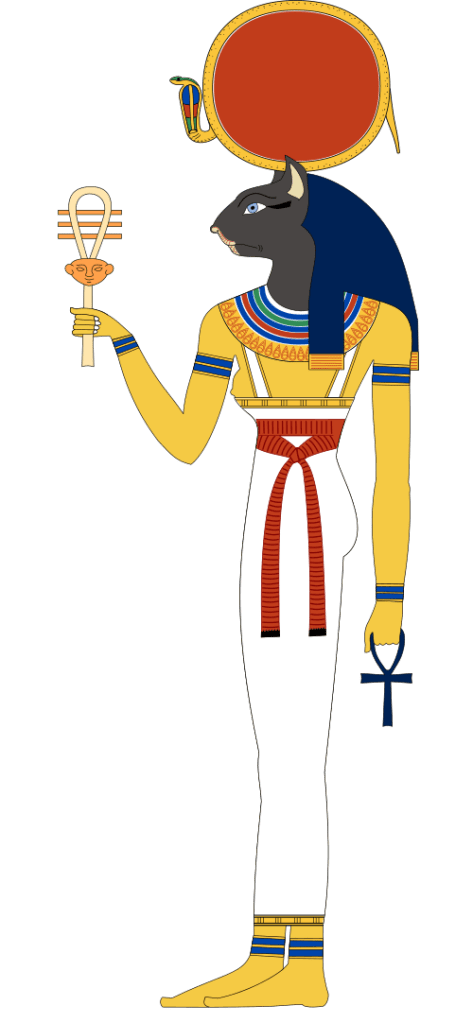
According to Wikipedia:
Bastet was worshipped in Bubastis in Lower Egypt, originally as a lioness goddess, a role shared by other deities such as Sekhmet. Eventually Bastet and Sekhmet were characterized as two aspects of the same goddess, with Sekhmet representing the powerful warrior and protector aspect, and Bastet, who increasingly was depicted as a cat, representing a gentler aspect.
Nobody seems to know for certain what the Egyptian name Bastet means, but the Egyptian word Bast means “ointment jar,” which tracks with Jeremiah’s description of Bastet as the anointer the offering-cakes fired in the ovens of at-one-ment. Those metaphoric ovens are fueled by the pruned wood of wrong-minded thinking about our origins, the world’s purpose, and what we’re here to do. Dead-wood we gave up willingly, with the help of miracles. And anyone who’s read the Bible knows burning the unfruitful branches pruned from the True Vine is a metaphor for the Holy Spirit’s ego-undoing process.
And this certainly illuminates the true meaning of the Zen proverb, “Chop wood, carry water.”

If I’m right about this, Bastet (Boseth in Hebrew) appears many times in the Bible, in some rather important roles. As Ish-bosheth, the supposed son of King Saul, she is mentioned at least 15 times (mostly in 2 Samuel). She appears another 13 times in the guise of Mephi-bosheth.
When accurately translated, Ish-bosheth means “the Bridegroom’s Bastet,” whilst Mephi-bosheth means “from the mouth of Bastet.” There is no Queen of Heaven in the patriarchal religions of Judaism, Islam, and Christianity, but in Hinduism, the designation belongs to King Indra’s wife, Indrani, who is also called Shachi, a Sanskrit word meaning “grace.”
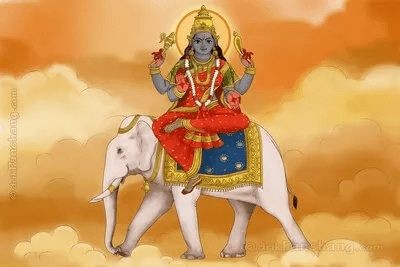
In Book Three of the Essene Gospel of Peace, Jesus speaks of “the Queen of Heaven,” whom he characterizes as a life-giving and nurturing force sustaining God’s power and authority on Earth, and with whom humans remain connected.
In the Gospel of Mary (Magdalene), Jesus also mentions this “Queen,” who, though barren, is “the Mother of the Angels.” In Catholicism, both of these honorific titles were bestowed on the Blessed Virgin, whom Jesus (meaningfully) rejects as his real mother in Mark 3:31.
According to Wikipedia, ancient goddesses known by the title Queen of Heaven include Inanna (Ishtar/Batet), Anat, Isis, Nut, Astarte, and (possibly) Asherah. Batet represents, therefore, the lionlike mouth of God from which the Word of God goes forth symbolically (as purifying fire, smoke, and brimstone) from the Land of the Living into Egypt (the desert of earthly existence). And those offerings are the “churned milk” or “butter” made from the milk of the Miracle Cow, Moket, from our almsgiving prayers.

So, let’s say our lion and cow-headed cherubim represent shakti energies, which would be a refreshing counterbalance to all that patriarchal testosterone flying around the Abrahamic-envisaged celestial sphere. We’re pretty sure Nisrok, the eagle-headed cherubim is male or gender-neutral, so the human-headed spirit probably is, too. Figuring out his identity will, of course, be much more difficult.
We have now unmasked three of the four Living Beings or Throne-bearers. By my reckoning, they are as follows:
–Nisrok, the eagle-headed cherubim — the miracle-saliva watering the Tree of Life
–Moket, the cow-headed cherubim — the miracle-cow producing the milk of truth from the seeds we scatter in Adamah through our goodwill almsgiving rituals in the Resting Place.
Bastet-Inanna-Ishtar, the lion-headed cherubim — the Queen of Heaven and mouth of God speaking the Word that churns Molek’s raw milk into the anointing fat (butter or ghee) of Atonement.
Pretty interesting, right?
Thanks for visiting. Until we meet again, Om Hari Om and Namaste.
 The Holy Meeting Place
Leave a comment