Today, let’s talk about the Lord’s Prayer — the “example” Jesus gave his disciples as the “proper” way to pray. If you’re unfamiliar with this old standard, it reads thusly in the KJV Bible:
Our Father, who art in Heaven, hallowed be thy name. Thy Kingdom, come; Thy Will be done; on earth as it is in Heaven. Give us this day our daily bread and forgive us our trespasses as we forgive those who trespass against us. And lead us not into temptation, but deliver us from evil.
I haven’t checked the accuracy of this translation yet, but I will before we’re through. What I can tell you right now is that “daily bread” is NOT an accurate translation of what Jesus advised his disciples to ask for “in the hallowed name of the Father.” The Greek word translated as “daily bread” by the Jacobean Anglicans was Epiousios, which means, more or less, “the sacred substance that hastens wisdom in the manner of dawning light.”
Many Biblical scholars insist the true meaning of Epiousios (epi + ousios) was lost to the sands of time, but that’s not entirely true. According to Google, ousios is a phonetic spelling of the Greek word for “oasis.” (Just as Jesus is a phonetic spelling of the Greek word for Yeshua). So, epiousios translates as “the upper oasis” or, possibly, “the light-filled oasis”– a reference to the Resting Place housing the fountain and/or wellspring drawing up the waters of the Primordial Ocean of Divine Thought into the barren dream-desert.
We find a similar word in the Secret Book of John — one of the disciple-authored gospels rejected by the Nicolaitans who chose the New Testament canon. Not only was the Secret Book of John rejected by these men, it also was condemned as “gnostic” and destroyed. Had it not been unearthed with other “lost” sacred texts in the Nag Hammadi desert in 1947, John’s “secret book” would have indeed been lost forever, along with insight into the true meaning of the Greek word Epiousios.

Now, John’s Secret Book is on an esoteric par with Helena Blavatsky’s The Secret Doctrine and the Pistis Sophia. Hard for most of us to make sense of, in other words.
That said, John’s Secret Book defines the related word Epinoia as “light-filled conceptualization,” evidence that epi once meant “light-filled.” Epinoia also is the name given the Holy Spirit in John’s little book. Thus, when Jesus advised his disciples to pray to the Heavenly Father for Epiousios bread, he was instructing them to ask for what the Vedic rishis called aganta — “the sacred substance that hastens wisdom in the manner of dawning light.”

And the sacred substance that hastens wisdom in the manner of dawning light is the Living Water of Grace through which our Souls give and receive miracles in the Resting Place, the Gathering Place, and/or the Upper Oasis or Upper Spring.
And the “bread” of the Upper Oasis is what Jews call “the bread of the presence,” the shewbread and/or the Bread of Life. That metaphoric bread is stored within the Tabernacle of the Temple (in our holy minds) to provide sustenance to our dreaming Souls.

So, let’s now see what Jesus really says in Matthew 6, starting with his instructions for right-minded “almsgiving.”
Be careful not to do your almsgiving with personal goals not of the Higher Self; otherwise, you derive no recompense from the Father in Heaven.
Therefore, when you do your almsgiving, sound the trumpet but do not sound the trumpet before you, as the hypocrites do. Act internally in the Assembly so that the currents (of sound) magnify the glorification of humankind. Amen speaks unto you of receiving in full the immediate recompense of your almsgiving. To come to know on the left side what you do on the right, do your almsgiving internally to your Father to perceive the hidden (Higher) Self giving back to you within.
When you pray you should not be in the state of the hypocrite; because the heart prays standing in the Assembly and also in the quarters of the Gathering Place, so that “An” can bring light to humankind. Amen speaks to you to receive your full recompense now. So, whenever you pray, enter into your innermost chamber. To glorify the (golden) door, pray to bring into being the inwardly hidden, including your Father, to perceive the rewards returning to you within.
The next bit, which I forgot to include in my initial posting, was the trickiest of these tricky verses to work out. In the end, I came up with the following result:
Moreover, to pray to God, repeat the name of God, not meaningless repetitions, just as in ethnikos (the time of overcoming the world). Expecting to hear the Higher Self by speaking meaningless words reflects not the true picture. Therefore, become like the Self, because, truly, your Father understands only one sound–the requisite sustenance superior to all your requests.
Firstly, the word battologeo appears twice in the first sentence of the verse above, separated by the Greek word for “not.” Supposedly, the word means “stammer” and/or “empty repetitions,” but batto can also mean “immerse” or “repeat,” while logeo is the verb-form of Logos, a noun meaning not “word,” but “divine idea.” Secondly, the presumed definitions don’t work with the correct meaning of ethnikos — a word generally mistranslated as “heathen,” “gentile,” or “foreigner.”
All I can say is that anyone who knows Jesus, also knows he saw only the Holy Light of God in everyone. He would NOT, therefore, EVER use such divisive egoic terms as “heathen” or “foreigner.”
Rightly discerned, ethnikos is a compound of eth (in time) and nikos (victory of the people or, more accurately, overcoming the world).
And “the time of overcoming the world” is the Holy Instant, wherein the Miracle of corrected perception shifts our comprehension of reality from wrong-minded to right-minded.
So, ethnikos, like the Hebrew word goy, both refer not to “foreigners,” “gentiles,” or “outsiders,” but to the Holy Instant–the “true picture” Jesus mentions later in this passage from Matthew. I know this because he uses the same terminology in the following from the Course:
The holy instant is a miniature of Heaven, sent you FROM Heaven. It is a picture, too, set in a frame. Yet if you accept this gift you will not see the frame at all, because the gift can only be accepted through your willingness to focus all your attention on the picture. The holy instant is a miniature of eternity. It is a picture of timelessness, set in a frame of time. If you focus on the picture, you will realize that it was only the frame that made you think it WAS a picture. Without the frame, the picture is seen as what it represents. For as the whole thought system of the ego lies in its gifts, so the whole of Heaven lies in this instant, borrowed from eternity and set in time for you. (ACIM, T-17.IV.11:1-8)
Let’s assume battologeo has more than one meaning. It can mean “repeat God’s Word or Name,” “immerse in God’s Word,” or “meaningless repetitions.” Let’s further presume that Jesus uses two of those definitions herein to explain what true prayer is. And true prayer is, in fact, repeating the Name of God until we hear the echo of God’s Voice, and then immersing ourselves in the sound.
Ego-worshipping translators love to twist our Savior’s words into a chastisement of the chanting practiced by Hindus and Buddhists, but that’s not what he’s saying at all. He is, in fact, advocating the eastern practice of Japa — repeating a holy name or mantra (in the mind) to amplify the power of that name or mantra across the Miracle Matrix.
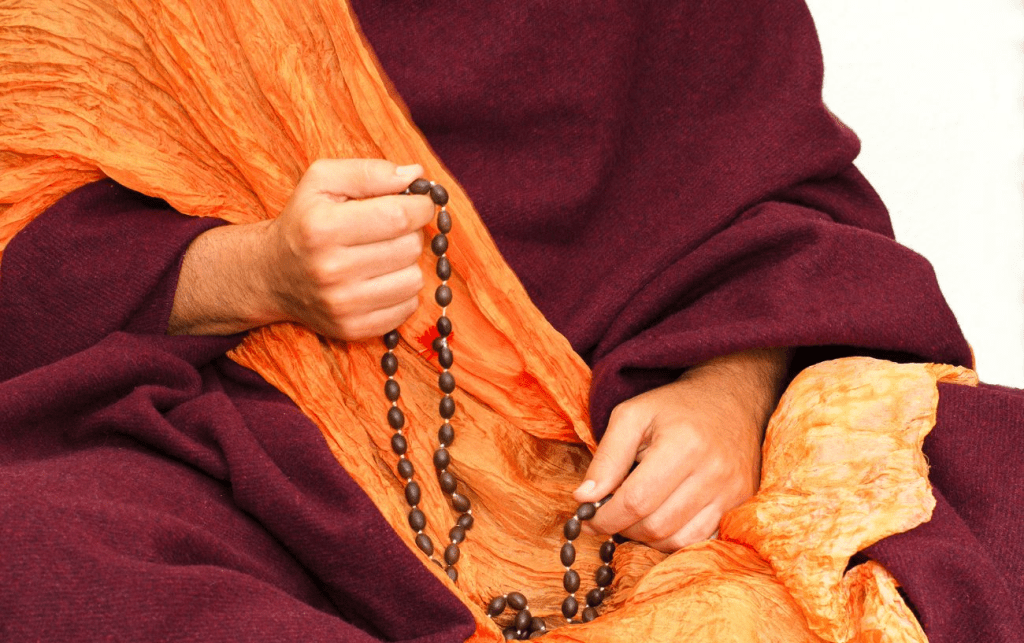
Those who don’t hear the sound can’t know these things — unless they study with a teacher who both hears and knows that repeating the Holy Name is how we open our inner ears. A yogi or a buddha, for example. Or, someone who understands what Bible-Jesus attempts to explain in Matthew 6, which echoes what Course-Jesus says in this excerpt from Workbook Lesson 184: I call upon God’s Name and on my own:
Repeat God’s Name, and all the world responds by laying down illusions. Every dream the world holds dear has suddenly gone by, and where it seemed to stand you find a star; a miracle of grace. The sick arise, healed of their sickly thoughts. The blind can see; the deaf can hear. The sorrowful cast off their mourning, and the tears of pain are dried as happy laughter comes to bless the world. (ACIM, W-183.3:1-5)
Repeat God’s Name as a Japa and the earthly illusion of separation will disappear. The blind will see God’s Face, and the deaf will hear his Voice.
That Voice is, btw, the Trumpet of God– the same “trumpet” mentioned earlier in Matthew 6, as well as in 1 Thessalonians 4:16, 1 Corinthians 15:52, Joel 2:1, and Zechariah 9:14.
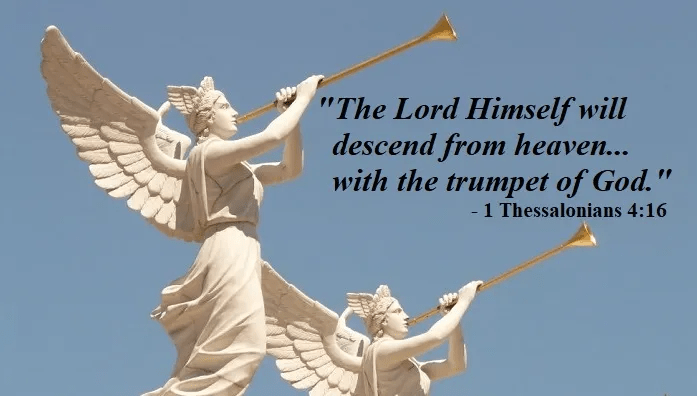
And yes, when Jesus walked the earth in a body, Jewish “priests” did regularly blow silver trumpets outside their manmade Temples as a call to worship, and to herald the start of Shabbat and other holy days and festivals. On special occasions, they also sometimes blew shofars (ram’s horns), as shown below.

And, yes, the priests blew their trumpets in the Temples and synagogues, and possibly on street corners, but those aren’t the only trumpets Jesus describes herein. Essentially, he differentiates the outward sounding trumpet of the earthly priests, from the inward-sounding trumpet of the Holy Spirit. Both are “calls to prayer,” but only one earns the recompense of the Father: the Trumpet of God heard with the inner-ears of the Soul standing in the Assembly in the Great Gathering Place.
Another thing I want to point out is that Jesus says twice in Matthew 6: “Amen speaks unto you.” He does NOT say, “Verily, I say unto you” here or anywhere else in the New Testament.
I kid you not. Every “verily” attributed to Jesus is, in fact, a mistranslation of the Holy Name, “Amen.” Check Strong’s Concordance yourself, if you don’t believe me.

Amen is the Great Amen, a Name of God synonymous with “Om, “Aum” and “I Am.” In Egypt, where Jesus grew up, Amen means “the hidden one.” Even in Hebrew, Amen means not “so be it,” but “the universal one-being-ness.” It was also the name of the chief god in ancient Egypt–a god about whom little was recorded. So, Bible-Jesus did tell us the Holy Name to repeat in meditation, many times over, as it happens; but his instructions were altered, initially by the the men who standardized Christianity and condemned “gnosis” (direct experiential knowledge of God’s presence within) and later by the unilluminated translators who reworked the redacted New Testament canon.
I speak the truth, my brother; in case you doubt me. And only the Truth will set you free.

Let’s proceed to the prayer, which actually reads as follows:
We join together, Father of the inward Heaven, to sanctify your Name, your sovereign power arising from your will to make earth like Heaven.
Bestow on us today our Epi-ousios bread, and release us from our debts, as we, ourselves. release our debtors.
And lead us not into temptation, but deliver us from guilt.
Because you are the kingdom, and the miraculous power, and also the glorious, everlasting Amen.
Jesus then adds:
For when you forgive the human-self a false step, your heavenly father also forgives you. But, if you forgive not human missteps, neither will your Father forgive your false steps.
One more thing before I sign off. In the verse that follows, I translated the alleged Greek word an as the proper name An. I did this for two reasons. The first is that an or av is considered an undefinable word in Greek, despite its frequent use in the New Testament. Presumably, an means “if,” but that’s pure speculation. And “if” doesn’t work where it appears herein.
More accurately, An is a shortened form of “Anu,” the “father-god” in ancient Mesopotamia; the name also appears in the Rigveda, where it is described as tri-tasya — the three-part Name of God. And that would also fit in our refigured line from Matthew 6:
When you pray you should not be in the state of the hypocrite; because the heart prays standing in the Assembly and also in the quarters of the Gathering Place, so that An ( Anu, the triune Name of God) can bring light to humankind.
Makes sense, right?
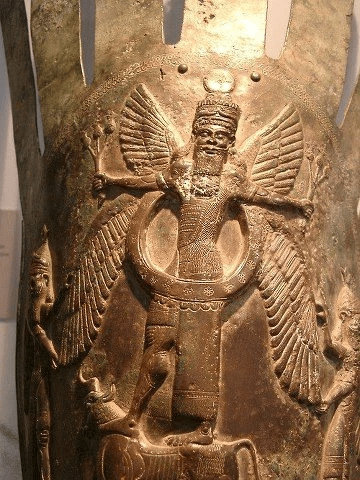
Alternatively, an might be a referenced by Jesus to the indwelling Christ Self. In Aramaic, the native tongue of Jesus, an means “I.” And a little Aramaic might have crept into the Greek lingua franca accounts of his teachings in the New Testament canon.
I don’t buy the Christian presumption that Jesus never went to Mesopotamia. The Bible tells us nothing about his life between the ages of twelve and thirty, and only one story from his entire childhood (apart from the Nativity Story). And who’s to say the story about him wandering off to speak to the Temple elders didn’t happen somewhere else? I mean, we have no real proof that Jesus grew up in Nazareth, do we? All we know is that his family fled to Egypt when he was a baby. When did they come back? Right away or decades later?

According to Google AI, “The Holy Family traveled extensively through Egypt, staying in numerous locations identified by Coptic tradition, with major stops including Farma, Sakha, Tel Basta, Ain Shams, Maadi, and most notably, Old Cairo, where they stayed for about three months, and Al-Muharraq Monastery, where they resided for over six months, making it a very significant sacred site.”
According to The Aquarian Gospel of Jesus the Christ, Jesus was reared and educated in Egypt, where he passed the “initiations” of spiritual mastery before studying abroad in India, Persia, and Tibet, among other locales.
Persia and Mesopotamia were both part of the Parthian Empire during the time of Jesus. And the Parthian Empire was a major Aramaic-speaking refuge for Jews fleeing Roman-occupied Judea.
So, it’s entirely feasible that Jesus visited Jewish refugees in Mesopotamia and Persia before returning from his travels to Nazareth to begin his earthly ministry. He might also have learned of Anu in India, or from other travelers. Or maybe he just “knew” because he was a pure channel for the all-knowing Holy Spirit.
Never underestimate the power of God!!
Until next time, Om Hari Om and Namaste.
 The Holy Meeting Place
Leave a comment