
Before we get started, let me state for the record that in no way do I consider myself an expert on Hinduism — not insofar as the world defines “expertise,” anyways. And, let me also just say that the deeper I wade into the Makara-infested waters of Hinduism’s multi-headed dog-ma, the more I wish I’d stayed on the shore.
Why didn’t I?
Because my Waheguru (Jesus) urged me to go in — and to keep moving forward, however strongly the undertow might try to pull me down. Presumably, it’s one of those Workbook Lesson 25 “things,” as in: I don’t need to know the purpose; I just need to trust that my spirit-guided sojourn into Hinduism, as confounding and labyrinthian as it feels at times, will prove fruitful to my Soul in the long run.
For those unfamiliar with the Course, the affirmation for Workbook Lesson 25 is “I don’t know what anything is for.”
With that said, do fasten your seatbelt, because we’re going to cover a lot of bumpy ground very quickly. Let’s start by shooting down what is probably the BIGGEST western misnomer attached to Hinduism: the widely held FALSE belief that it is a polytheistic and, therefore, “heathen” religion.
In actuality, what appears to be an extensive and complex pantheon of “gods” is simply the personified aspects and attributes of TWO thought-forces. One of these forces is divine and helpful to human Souls, while the other is deceptive and harmful. The divine force is called BRAHMAN or PARAMBRAHMAN– the True God or Absolute Creator operating beyond the known universe; whilst the deceptive force operating within the known universe is called BRAHMA.
An unworshipped “god” in Hinduism, BRAHMA represents the maya-manifesting Ego Mind, the thought-force of fear, which expanded nothingness into the Divine Universe BRAHMAN originally created. Not that most practicing Hindus today understand that is who or what Brahma truly represents.

The image above depicts Brahma in typical iconographic fashion, as a four-headed man riding a Hamsa — a mythical swan-like bird with the miraculous ability to separate milk from water when the two liquids are mixed together. Brahma’s heads represent the four attributes of “ignorance” Patanjali spelled out in The Yoga Sutras; whilst the Hamsa symbolizes the power our Souls still possess to separate the “milk of truth” from the “water of lies”– even under Brahma’s influence. That power is “higher reason” — the Buddhi, Seer, Decider, or Witness we discussed last time. In Hinduism, the Buddhi is personified as Krishna. That Krishna plays the Call to Awaken on his flute tells us he is part of the Holy Spirit. And this is affirmed by his status as the seventh incarnation of Vishnu, the Hindu “god” representing the Holy Spirit.
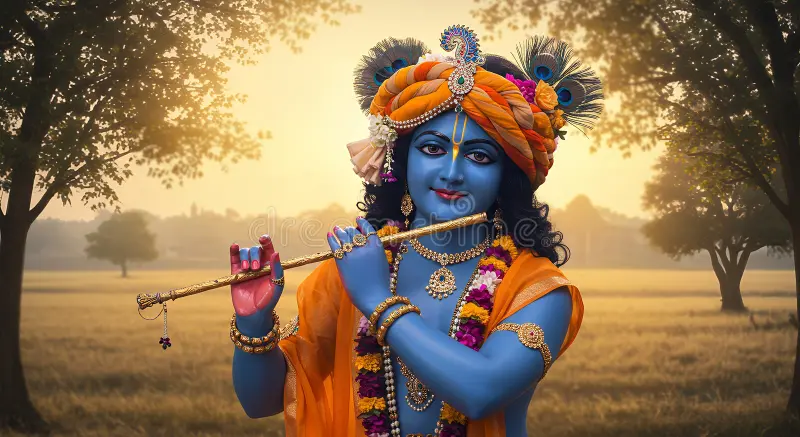
Whatever we might call it, that reasoning aspect of the intellect makes liberation from ego-enslavement possible. The Buddhi cannot, however, make the leap from understanding to “knowing,” or from existing to “being”. Our reasoning capabilities must, therefore, be surrendered to the Soul before we can experience the higher levels of restored Self-Knowing.
That Brahma is called “the creator” in Hinduism greatly confuses his true identity. Ditto for his inclusion in the Trimurti, the presumed Holy Trinity of Hinduism. First of all, Trimurti doesn’t mean “the three-in-one powers” of Brahman. It means the three (tri) fixed (mu) orders (rti). In Hinduism, those three fixed orders are said to be, from highest to lowest, Brah-ma (expanding creation in wholeness with God), Shi-va (the Temple or Holy Resting Place in the drought), and Vi-shnu (the two streams).
Typically, these three orders are misidentified as the three aspects of material creation, which, as in most religions, is confused in Hinduism with divine creation and, therefore, wrongly attributed to God/Brahman.
And this confusion leads to the further conflation of the orders and the gods of the same names, until we end up with these cryptic and largely incorrect designations:
Brahma = the creator
Shiva = the destroyer and rebuilder
Vishnu = the all pervasive preserver
I say “largely incorrect,” because Brahma is indeed “the creator” (of illusion), which Shiva (the transcendent power of God’s grace and will) destroys and rebuilds in accordance with Rta, the Established Order of Divine Reality. And, in the meantime, Vishnu — the two streams flowing down from the chief gods — preserves and protects the Rta underneath the illusion.
Most explanations I’ve read of these phenomena are off-base because they erroneously presume Param-Brahman either created or authorized the creation of the material universe for His own egoic purposes. And, as in most other Satan-distorted religious teachings, that gaffe knocks everything else on its ear. So, to clarify the functions of these three “powers,” I’ve summarized their designations as follows:
Brahma = the creator of Prakriti, the illusory realm of material existence
Shiva = the destroyer of Prakriti (illusion) and restorer of Rita (Divine Law and Order)
Vishnu = the all-pervasive Living Water whose presence preserves the Brahma-deluded Son of God’s Holy Relationship with the other parts of its Self

As Hinduism more rightly teaches, Brahmanda or “Brahma’s Egg” (pictured above) is the subjective reality, illusion, or “maya” each person constructs through their defective lower-mind programming and prejudices — all the chitta-baggage and karmic markers, basically, we’ve acquired in this and past lives. What we take in through our senses is objective enough, Hindu philosophy correctly espouses, but we then contaminate or distort that data with our ingrained biases and judgments, both positive and negative. These encoded preferences can arise from individual, familial, or societal attitudes and influences (all the modes of worldly learning we must “undo” to awaken). Whatever their source, this chitta-conditioning distorts everything we observe, think, experience, remember, dream, and do in Brahmanda.
Because each of us constructs our own chitta-tinted version of reality, we are all complicit with Brahma in making Brahmanda. We are all, in fact, Brahmas ourselves, because we, too, are mis-creators of MAYA (the projected material illusion). Understanding this might explain why the names Brahman and Brahma are so similar — and also why Brahma is an unworshipped god in Hinduism. Their names may be alike, but the creative functions of Brahman and Brahma are as different (quite literally) as Day and Night.
In a nutshell:
Brahman = Son of God as Perfect Co-Creator through the shared extension of Love
Brahma = Son of God as deluded miscreator through the separate projections of fear and guilt
When considered in this light, we begin to see that the Trimuti represents the three facets of the Christ or Purusha Self we experience in the dream-realm: Brahma, who perceives the I and Thou as separate sinful selves pursuing their own interests; Vishnu, who perceives the I and Thou as separate Holy Selves pursuing related interests (healing separation-mindedness); and Shiva, who perceives the I and Thou as ONE Holy Self pursuing a single shared interest with God (Perfect Creation).
Clearly, the Hindu Trimuti is NOT analogous with the Christian Trinity. Attempts to liken the two are, therefore, an egoic exercise in futility. That said, a more accurate comparison of the chief powers of Hinduism and Christianity would look something like this:
Param-Brahman = God the Father in Heaven
Brahma = The Evil One or Satan deceiving us on earth
Shiva = The Son of God as Good Shepherd and Savior
Vishnu = The Holy Spirit as pervasive guide, comforter, and teacher
Although a vast improvement, this assimilation is still a case of two wrongs merging to make another muddled wrong, because neither the Hindu nor Christian trinities portrays what’s really going on. Because the At-one-ment process is all about SELF knowledge, which we restore or remember at graduating levels of perception as we advance through the curriculum. And Christianity, which erroneously insists Jesus is the ONLY Son of God, misses this point entirely. Hinduism sort of gets it — or did once upon a time — BUT, like everything else Brahma touches, the baseline Satya got buried over the ages under a slagheap of deception.
And, just to be clear, this happens to all religious and spiritual teachings. In most cases, the Truth is still there, but perverted beyond recognition by egoic obscuration. To exhume that core Truth, we have to sort through all the rubbish Brahma and his interfering agents introduced to cover it over. We must, in other words, question everything we presume to be true — because it probably isn’t. We then must return to the original scriptural source of the Truth under investigation. Because the Ego Mind adulterates all Higher Truth over time, the original source of anything of a spiritual nature will generally be the purest and most reliable. That’s why I prefer the URText of the Course and the first English translation of the Holy Bible, with Strong’s concordances at the ready.

What are the earliest — and, therefore, most trustworthy — scriptural texts of the Hindu religion? The short answer is: the four Vedas. The longer answer might be: the body of texts grouped under the heading Shruti or “that which is heard.” As the term implies, the Shruti corpus was passed down through word-of-mouth for many centuries before being written down. Originally revealed to “seers,” “sages,” or “rishis” as far back as 1250 BCE, those Shruti texts include the Vedas (Rig, Sama, Yajur, and Atharva) and their embedded post-Vedic or “Vedantic” collections: the early Upanishads, the Samhitas, the Brahmanas, and the Aranyakas.
I won’t go into what those auxiliary collections contain at this time. What I will say is that, if compared to the Course, the Vedas would be the Text and auxiliary Song of Prayer, the Upanishads would be the Workbook for Students, and the Brahmanas would be the Manual for Teachers and the Clarification of Terms.

As the earliest and most authoritative of the Shruti texts, the Vedas make up the foundational canon of Hindu theology. And, within that canon, the Rig Veda is universally regarded as the most ancient and sacred of the four. Despite this well-earned distinction, the Rig Veda is not the most widely studied among the Hindu scriptures. Why? For two reasons, in my estimation. The first is that it was composed in ancient Sanskrit, which (like Aramaic and Latin) is a “dead” language. The second is that, like most TRUE scriptural texts, the Rig Veda employs highly figurative language.
And when I say “highly figurative,” I mean symbolic language that makes the Old Testament read like Dick and Jane.
Thus, only those with the gift of illumination stand any chance of correctly interpreting the original suktas (holy thoughts, not hymns). The rest have to make do with error-riddled translations and, sadly, an equally error-ridden Sanskrit dictionary or lexicon. And this largely explains why the slightly newer and marginally less reliable Upanishads have surpassed the Vedas as influencers of Hindu thought and tradition.
Yes, I know. This is pretty dry stuff, so I’m keeping it brief. BUT my quick-and-dirty overview of the Hindu canon would be incomplete without at least a cursory mention of the secondary group of texts categorized as Smriti — or “that which is remembered.” The major difference, apart from age, is that this younger body of texts is attributed to particular authors — rather than anonymous rishis. The Smriti corpus includes the two great epics — the Mahabharata (which contains the Bhagavad Gita) and the Ramayana — as well as the Puranas. The Yoga Sutras of Patanjali are, I believe, also part of the Smriti corpus.
Okay, so … why am I boring you with all this academic stuff? For a couple of reasons. The first is that it will provide some context when I rattle off the names of these texts in this and future posts. The second and more immediate reason is that Brahma isn’t mentioned (as a god) in the Vedas — and neither is the Trimurti. Both are, therefore, later contrivances — inspired, no doubt, by the Great Deceiver himself (in his tireless campaign to replace Brahman as supreme “creator”).
The earliest references to the Trimurti occur in the Mahabharata epic and the Maitreyan Upanishad — a medieval addition to the Vedantic body of literature. In both cases, the word is mentioned only once.
Later perhaps we’ll explore what the Maitreyan Upanishad says about Brahma; for now, I want you to open your mind to the indisputable FACT that both Brahma and the Trimurti are latter-day constructions that were shimmed into Hindu theology in the medieval period. And, from that day to this, that pesky little wedge has slanted everything else.
So, to square things up again, let’s take with a grain of salt everything modern-day Hinduism teaches about Brahma and the Trimurti. Yes, it’s a tall order, but a necessary one in our ruthless quest for Satya. And if the Trimurti are suspect — as they certainly are — then so are their “consorts” or “wives”– the trio of goddesses known collectively as the Tridevi. Pictured below, those three devi are Sarasvati, Parvati, and Lakshmi.
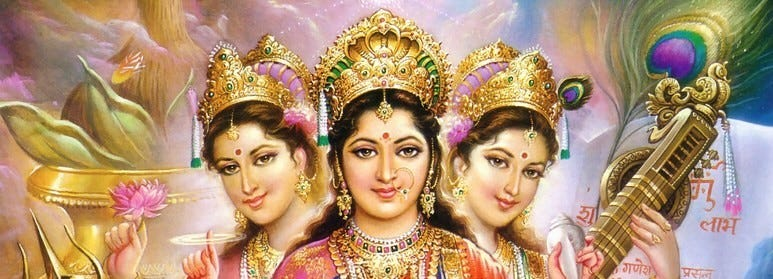
Before we begin to scrape the Evil One’s scales off the sacred devi, let me state again that I do NOT profess to be a learned expert. I simply intuit what I intuit — or rather, I recognize Satya shining through egoic conflation and trickery in whatever I’m guided to study.
When the Trimurti and Tridevi are paired as husbands and wives, Brahma is typically partnered with Sarasvati, Shiva with Parvati, and Vishnu with Lakshmi. Except that, confoundingly, Vishnu also is sometimes “married” to Sarasvati instead of Lakshmi, or to yet another devi named Mohini (who is, in fact, the personification of egoic desires).
So, what gives?
What gives, in part, is that the whole matchmaking exercise is a monumental fail because Brahma isn’t a helpful deva. And having this imposter in the mix creates two major problems. The first is that it excludes Indra, the Hindu version of the Aleph or Father’s Will aspect of Elohim (Surya in Hinduism). The second is that it forces an incompatible partnership between the Evil One and Sarasvati, the Cosmic Ocean underneath sounding her water-music through her fountain aspect, Iravati.
When paired with Brahma, Sarasvati’s four arms are said to “mirror” her husband’s four heads. In these ego-infected tales, Brahma’s role as “creator” is conflated with Brahman’s. What the Great Deceiver’s four heads ACTUALLY represent are 1) conscious lower-mind thought and sensory perception (Manas); 2) the intellect’s reasoning capacity (Buddhi or Higher Manas); 3) the unconscious part of the lower-mind storing our wrong-minded impressions, resentments, conditioning, judgments, and experiences (Chitta); and 4) the ego-body self-concept and individual sense of “I-am-ness” (Ahamkara).
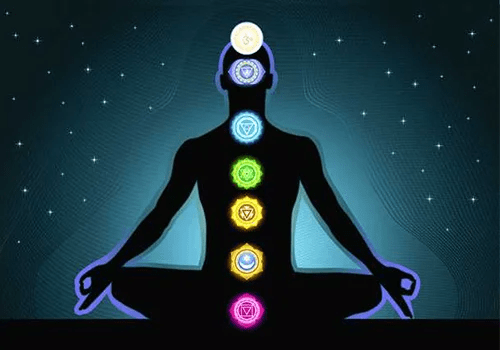
As the Vedanta schools (those based on the Upanishads, rather than the Vedas) correctly profess, these four “veils” of the false self-concept must be released or dissolved as we cross, climb, or build the Bridge or Antahkarana between “heaven” and “earth.” As these wisdom schools also get right, that channel houses the chakras. How these teachings typically characterize the chakras is not, however, consistent with my understanding of these at-one-ment devices. As I understand them, the chakras are the metaphorical “windows” or “eyes” through which we see the world. If we look outward, through Brahma’s two eyes, we perceive a physical world plagued by war, famine, pestilence, and death. To see the world as the Soul-saving academy it actually is, we have to open the Spiritual Eye of the inner Christ or Shiva power. And that symbolic “single eye” looks inward, into the Temple of the Holy Spirit — the shared Mind of the Atonement.
That seven-lidded “eye” restores our Holy Vision. But to reclaim that natural attribute of the Soul, we first have to dissolve the seven veils the Ego Mind manufactured to render that “single eye” sightless. And that is the function the chakras serve as we cross, climb, or build the Antahkarana.
The specific meaning of the word Antahkarana is described somewhat differently in various dictionaries and schools of Hinduism. Based on my studies, the term refers to the inner-organ or inner-instrument via which the Soul returns to the Heart of its Being and True Purpose. And, just so we’re clear, the Soul’s True Purpose in the world is two-fold: First, it must forgive all the parts of its Greater Self for choosing separation and deception over Wholeness and Satya, and then it must join with those forgiven fragments to restore its Greater Self to Wholeness and Satya.
Does Jesus mention the Antahkarana in the Course? He does indeed — BUT he calls it the “Bridge to the Real World,” the “Bridge to Eternity,” and the “Bridge of the Return.” As the channel along which the chakras are supposedly set like gemstones, that same ethereal “Bridge” is what Yoga schools call the Sushumna “nadi.” According to these teachings, that “nadi” forms the “spiritual spine” up which the mind-purifying “liquid-fire” (Kundalini) uncoils in serpentine fashion.
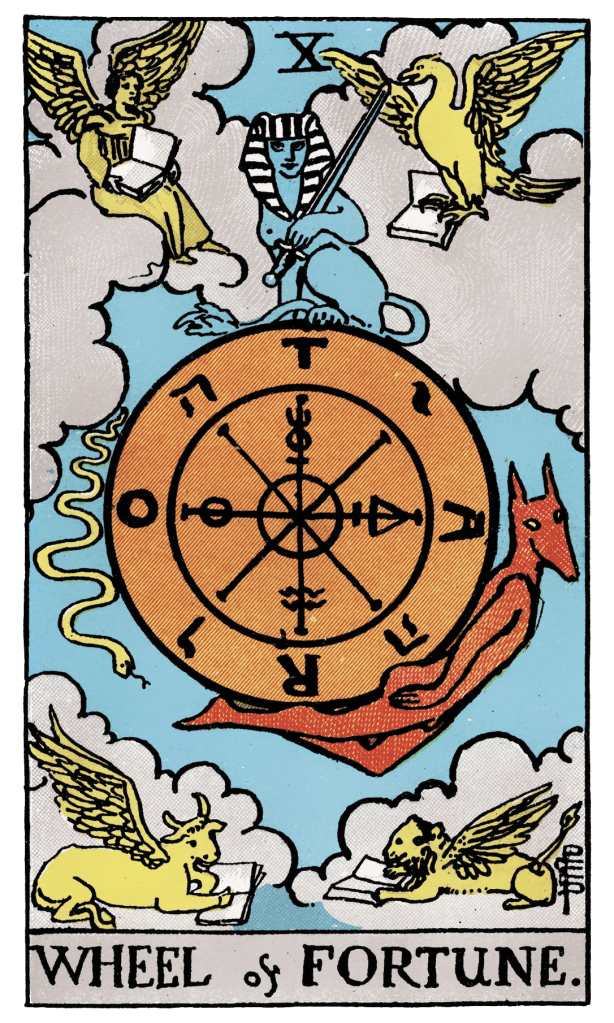
In the Shandilya Upanishad, one of the Yoga Upanishads attached to the Atharva Veda, this same channel or Bridge is called the “Raja Path” or “Royal Road.” More interesting still, the word “taro,” as in Tarot, is a compound of the Egyptian words “tar” (road) and “ro” (royal). Thus (as I’ve said all along), the Tarot is meant to help us follow the Royal Road leading back to Self-Knowledge. This is supported by the appearance of the word “Taro” on the WHEEL OF FORTUNE card in the Rider-Waite deck. Rightly understood, that wheel symbolizes the Antahkarana.
So essentially, as I said, Brahma’s heads represent the four levels of ignorance we must rise above to liberate ourselves from his Soul-imprisoning “Cosmic Egg.” Sarasvati helps us do that. The objects she holds aren’t, therefore, intended to “mirror” Brahma’s four heads; they’re meant to lop them clean off.
What are those objects?
The veena sounding the Song of God, a book suggesting the higher wisdom attained by listening, a japa mala to be used to invoke our Holy Helpers, and a pot or jug of sacred water. Those objects also represent the four “pillars” or “legs” of Dharma — the righteous path we must follow in our quest for the Holy Grail of Self-Knowledge.

In many Hindu texts, including the Rig Veda, dharma is equated with a bull or cow who stands on four legs. Which four virtues those legs represent varies between sects. Generally, they are said to be 1) Austerity or Simplicity, 2) Purity (especially sexual purity), 3) Truthfulness, and 4) Kindness. For Course students, the ideological legs upon which we tread the Royal Path are probably the first four characteristics of Advanced Teachers of God, as listed and described in the Manual for Teachers. Those four characteristics are (in order) Trust, Honesty, Tolerance, and Gentleness.
At another time, we’ll explore the nuances of these dharmic “modes of being.” For now, be aware that Hinduism encourages the development of these same four qualities. They are not, however, tidily grouped together anywhere I looked. So, it took some rooting around to find the best-fit terms and practices. The correspondences below might not be bang-on, but they should be pretty close:
Trust = Sraddha (total faith in God, the scriptures, and our intuitive guidance)
Honesty = Satya (complete authenticity in thought, word, and deed)
Tolerance = Samata (equanimity and non-judgment toward all beings)
Gentleness = Mardava (meaning softness, mildness, gentleness, tenderness, and leniency; a key divine quality in Hindu theology)
Let move on to King Indra, the Trinity Power usurped by Brahma. despite being the acknowledged “king of the gods,” and guardian of the eastern direction, Indra isn’t worshipped in modern Hinduism. Presumably, this is because Indra delegated his authority to Krishna (the Buddhi). Allegorically, this surrender represents God’s Will being channeled through the Buddhi, rather than acting directly at full force to wake us up. And this is indeed how God devised the Plan to preserve the Sonship’s free will.

Aided by the Living Water, the Buddhi (Lord Krishna) teaches the Divine Spark to rise toward its Source, the Red Ray, which in Hinduism is personified as Indra. Remember that Indra’s vahana is Airavata, the Great White elephant representing the seven spouts of the fountain. And the Hindu story of Indra’s defeat of Vrittra, the Chief demon invading Heaven, is almost identical to the Biblical story of Michael casting Satan and his angels out of Heaven.
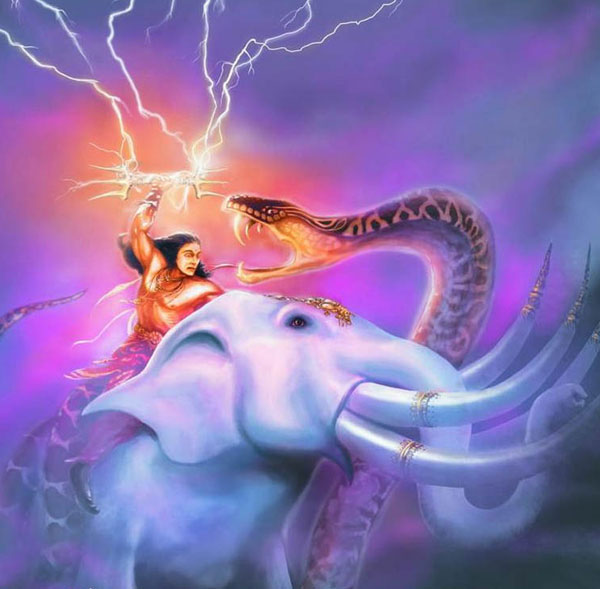
So, Indra is the Hindu counterpart to the Archangel Michael, the Red Ray and/or, the Anointed One of God. And it is indeed Indra who stands at the eastern gate into Eden with his thunderbolt-throwing “vajra”–the Hindu equivalent of the Flaming Sword.
The Rig Veda explains all this, when it’s correctly translated. It also tells us that Indra took one of the wheels off the chariot-throne of Surya, the supposed “sun god.” in Sanskrit, Surya means the Supreme or Greater Light of God, more or less, so he’s a great deal more than another pagan sun-god. As the occupier of the chariot-throne, Lord Surya is, in fact, the Hindu equivalent of Elohim and Allah. Thus, Indra is to Surya what Aleph is to Elohim. We’ll explore what the Rig Veda says about Surya and Indra in the future. For now, let’s construct our own model of the Judeo-Christian deities for modern Hinduism.
God the Father = Brahman
Elohim = Surya
Christ = Shiva
Holy Spirit = Vishnu
Plenty of Hindus will probably argue with this configuration, because it’s really a case of apples and oranges, but this is as close as I can come for the time being.
But wait — because this contrived trio actually represents the three higher stages of restored Self-Awareness all Souls pass through on the Royal Road back to Heaven proper (Knowledge or Superconsciousness). And, working together on our behalf, these three “devas” of our own Higher Self produce the Living Water that progressively uncovers the Truth of our Being. As I currently envision the system, those three “orders” of increasingly purified Self-Knowing and their Elohim equivalents are:
Indra = Aleph = The Lamp or Ray of God-Realization (we are of one mind with God)
Shiva = Lamed = The Lamp or Ray of Christ-Realization (we are of one mind with Christ)
Vishnu = Hey = The Lamp or Ray of Vishvedeva-Realization (we are connected as Souls through the one mind of Christ)
Below these three “deva-selves” are the three evolving egoic “modes of being” or gunas we briefly discussed last time. For the sake of our current discussion, think of the gunas thusly:
Sattva = Discipleship or Vigilant Devotion to Satya Dharma (Piety)
Rajas = Initiation into Satya Dharma (Desire for Betterment)
Tamas = Rejection of Satya Dharma (Total Ignorance/Spiritual Denial)
Let’s now check this line-up against the Holy Vedas. Do they support my conjectures? The short answer is: Sort of. Of the four, only the Atharva Veda allegedly mentions the Gunas by name (as tribhir guebhi in transliterated Sanskrit). The third ray of gu-ebhi — the holy light in darkness or illusion, basically. What the Holy Text supposedly says in this regard is actually quite interesting:
There is a nine-gated lotus, covered under three bands of Gunas, in which lives the Spirit with the Atman within, that the Veda-knowers know.
Pretty sure that isn’t right, but let’s check, shall we? The line under discussion is AV 10.2:31, which reads as follows in transliterated Sanskrit: aṣṭacakrā (eight chakras or circles) navadvārā (with nine gates) devānāṃ (the Holy Name) pūra-yodhyā (an unconquerable fortress or walled city) tasyāṃ (within the heart) hiraṇya-yaḥ (the Golden Yah??) kośaḥ (covering or containing) svargo (the celestial Rays) jyotiṣ-āvṛtaḥ (of the Higher Self, hidden from view).
Okay, wow — and my gut was right. Nothing close to the accepted translation and nothing about the gunas, either.
Here’s what it actually says:
Eight circles with nine gates, the Holy Name is an unconquerable fortress within the heart, a golden Yah containing the celestial rays of the Higher Self, hidden from view.
We don’t find the gunas; but we do find the Great Rays and the mysterious Golden Yah.
Ya or yah are typically defined as a flexible pronoun meaning “who,” “which,” “that,” or “whoever.” BUT, ya or yah can also mean “light.” And “golden light” is indeed a phrase which appears more than once in the Course.
Jesus says, for example:
Apart from the Father and the Son, the Holy Spirit has no function. He is not separate from Either, being in the Mind of Both, and knowing that Mind is One. He is a Thought of God, and God has given Him to you because He has no Thoughts He does not share. His message speaks of timelessness in time, and that is why Christ’s vision looks on everything with love. Yet even Christ’s vision is not His reality. The golden aspects of reality that spring to light under His loving gaze are partial glimpses of the Heaven that lies beyond them.
This is the miracle of creation; THAT IT IS ONE FOREVER. Every miracle you offer to the Son of God is but the true perception of one aspect of the whole. Though every aspect IS the whole, you cannot know this until you see that every aspect is the same, perceived in the same light and therefore one. Everyone seen without the past thus brings you nearer to the end of time by bringing healed and healing sight into the darkness, and enabling the world to see. For light must come into the darkened world to make Christ’s vision possible even here. Help Him to give His gift of light to all who think they wander in the darkness, and let Him gather them into His quiet sight that makes them one.
At another point, he says:
Beyond the body, beyond the sun and stars, past everything you see and yet somehow familiar, is an arc of golden light that stretches as you look into a great and shining circle. And all the circle fills with light before your eyes. The edges of the circle disappear, and what is in it is no longer contained at all. The light expands and covers everything, extending to infinity forever shining and with no break or limit anywhere. Within it everything is joined in perfect continuity. Nor is it possible to imagine that anything could be outside, for there is nowhere that this light is not.
Pretty awesome, right? Not to mention, synchronistic. This Golden Light or Golden Miracle (of God’s One Holy Creation) also is the Ayat or Ayah mentioned more than 6,000 times in the Holy Qur’an. Because in Arabic, ayat and ayah mean “miracle,” “sign” or “evidence of God’s oneness,” rather than “verse.”
And so, our verse from the Atharva Veda actually reads thusly:
Eight circles with nine gates, the Holy Name is an unconquerable fortress within the heart, a golden light containing the celestial rays of the Higher Self, hidden from view.
And this tells us so much more than the universally accepted mistranslation about a nine-gated lotus. Mainly, it tells us, that the Holy Name contains the eight circles with nine gates, which forms the fortress of the heart containing the golden light of the seven rays of the Higher Self.
The nine gates mentioned herein are NOT, btw, the nine orifices of the human body, as is commonly professed by ego-thinkers. Rather, those gates or doors are ethereal passageways found in the Spiritual Body. Precisely where they are and how we pass through them is above my pay-grade at present; but I suspect they may be related to the nine initiations described in the teachings of Theosophy.
The eight circles are undoubtedly the chakras, which are indeed eight in number in some yoga teachings, with the eighth being the Crown, Soul Star or Aura Chakra. In this paradigm, the seventh circle is the Bindu Chakra, which sits between the Ajna and Sahasrara chakras. And it is the Bindu or Moon chakra that supplies the Amrita or “elixir of immortality” coming down from the Red Ray (Atman, Adam, Indra and/or St. Michael, the Flaming Sword). Christians call that “elixir” the Blood of Christ. In the ancient Persian religion of Zoroastrianism, that same “elixir” is said to come from a mystical plant called Haoma and/or Gaokerena, which supposedly contained the seeds of all the plants on earth. This is, of course, an ego distortion, like the false belief in Hindu culture that Soma is an actual plant growing in the world at the time the Vedas were written. Soma means Moon, a reference to the Moon Chakra, whilst the ancient Persian word Gao-kerena means “horn-shaped ray of light” rather than “cow’s ear.” Haoma means “that which is pressed or extracted.” Haoma is, therefore, the Zoroastrian version of the “winepress metaphor” found in the Judeo-Christian scriptures. From all of this, we can deduce that the Bindu chakra is indeed God’s ego-crushing winepress.

The Spiritual Body itself resembles a three-dimensional Shatkona or Star of David. Also the Seal of Solomon, that six-pointed star is the Merkabah or “chariot” transporting the Soul on its journey through the circles. The chariots described in the various scriptures are, therefore, symbolic Merkabahs, rather than actual animal-drawn vehicles. In the Old Testament, the word “chariot” was, in fact, an English replacement for the Hebrew word Merkabah. Even the Chariot-Throne of Elohim-Allah-Surya is a Merkabah.
And this bring us back to the chariot analogy found in the Hindu Upanishads and Bhagavad Gita, as well as throughout the Judeo-Christian Bible. To refresh your memory, the Buddhi drives the chariot, whose reins are the two minds, and whose horses are our thoughts. To reach the destination (Moksha or True Perception), the charioteer (Krishna) must have firm control of the reins (the two minds we choose between in every moment) to guide the horses (our thinking) along the Righteous, Right-minded, or Royal path.
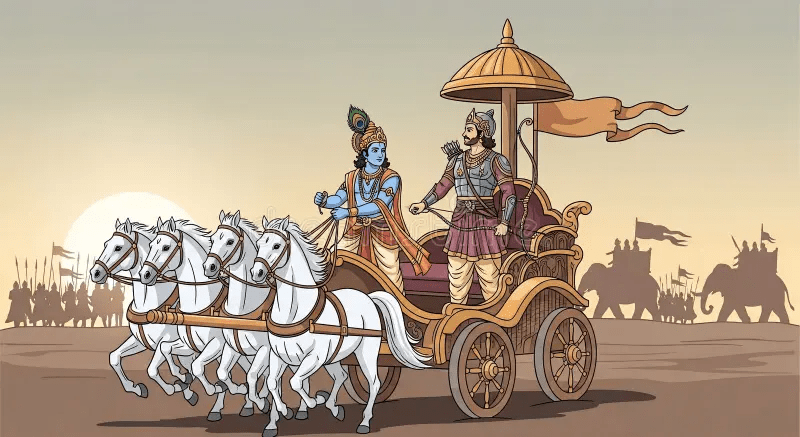
And here’s another fun fact: in Hebrew, the three syllables of Merkabah break down as Light (mer), Spirit (ka) and body (bah). So, the Light Body of the Spirit, basically. And our Souls “wear” those Light Bodies in-between our physical incarnations, as well.
As the image above rightly shows, Krishna’s chariot is drawn by four horses. Their names are Shaibya, Sugriva, Meghapushpa, and Balakhala. These same four horses are, btw, those “sent forth” in different directions by the Living Creatures in the Bible. They are described by Zechariah and John of Patmos as being red, white, black, and dappled. And, yes. They ARE the four horses (not horsemen) of the apocalypse, whose riders are our own awakening Soul-Self.

Apocalypse simply means “revelation.” So, the biblical horses represent the four thought-forces that reveal the presence of God to us.
And what’s scary about that?
Shaibya means “daughter of Sibi,” a righteous king famed for his selfless charity. In the Vishnu Purana, Shaibya is called Mitravinda “the virtuous.” The name Mitra-vinda actually means “finding the covenant.” So, Shaibya guides our Souls to the Ark of the Covenant.
Sugriva means “holy neck” or “holy throat,” a reference perhaps to the Vishuddha chakra or Fifth Circle.
Megha-pushpa is said to mean “cloud (megha) flower (pushpa or puspa),” or, more specifically: “the cloud of blooming offerings (of grace).” Puspa might also be a compound of push (casting down, supporting, augmenting, or dispersing) and pa (protection or drinking). In the Hindu epics, this cloud-colored horse (thought-force) is described as a powerful steed able to transport Krishna anywhere instantly.
So, Meghapushpa represents both the Pillar of Cloud and the Holy Instant.
Balakhala is either a marriage of Bala (strength or power) and khala (underneath) or Bal (breath), a (of god) and khala. I vote for the second option, given that the Breath of God underneath is Purusha as well as Ruach, the Cosmic Breath of God’s Will gently influencing the illusion from underneath the illusion.

Pretty interesting, right? And that’s just a small sample of what Hinduism actually teaches.
Before closing today’s discussion, I want to share something from the Bhagavad Gita allegedly referring to this revolving Dharmachakra — and also interpret the surrounding verses with more acumen than can be readily found on the internet. This might get a bit tedious, so please bear with me.
In Chapter 3, verse 14, Krishna says to Prince Arjuna (in transliterated Sanskrit): Annat bhavanti bhutani parjanyat anna sambhava yanjnat bhavati parjanyo karma-samudbhavah.
Generally, these words are translated more or less as follows:
All living beings subsist on food, and food is produced by rains. Rains come from the performance of sacrifice [yajna], and sacrifice is produced by the performance of prescribed duties.
Before I disclose what Krishna ACTUALLY said, let me ask you this: Why would Krishna, the voice of higher reason, bother to explain that rains produce the grains we eat? I mean, honestly. Isn’t that pretty mundane worldly information? Furthermore, how is it even remotely helpful to a Soul preparing to do battle with the Ego Mind?
The answer is: it isn’t the least bit useful because Krishna said nothing of the kind. Based on my own research and guidance, what he says in Bg 3:14 is more along these lines:
From purest minds [annat] in the present moment [bhavanti], all beings created by God [bhutani] offer a rainlike vibration [parjanyat] generated through the light of higher thinking [ya-jnas]. These yajnas bring into being [bhavati] and make possible [samudbhavam] the activity of Yanjnat (Lord Vishnu, the water-director and/or Holy Spirit).
The rain or, rather, rainlike vibration to which Krishna refers is, of course, the Om vibration, NOT physical rain — which the next line bears out, when interpreted correctly. That line (Bg 3:15) reads: karma brahmodhavam viddhi brahm-akshara-samudbhavam tasmat sarva-gatam brahma nityam yagne pratishthitam.
This verse is commonly mistranslated thusly:
The duties for human beings are described in the Vedas, and the Vedas are manifested by God Himself. Therefore, the all-pervading Lord is eternally present in acts of sacrifice.
First of all, this isn’t true. So, its either mistranslated or an erroneous teaching. I’m pretty sure the Bhagavad Gita is a God-breathed text, so it must be a mistranslation arising from the pervasive misapprehensions that 1) God created matter, 2) Brahma is the creator-god, and 3) God demands sacrificial offerings of his “fallen” creations. Nothing is, in fact, farther from the Truth, because God only gives, in accordance with His own unbreakable Law of Love. The ego-inspired idea of sacrifice casts God in the unholy role of a “taker” — a role our Heavenly Father is utterly incapable of assuming. In another post, I’ll expand on my reasons for changing the meaning of yajna from “sacrifice” (the false definition) to “the light of higher thought” (the true definition).
For now, just be aware that this verse, in point of fact, says nothing whatsoever about sacrifice or the Vedas. Bringing the Vedas into the picture is the result of two major errors in understanding.
The first is presuming that brahmodhavam is a marriage between Brahma (the Creator) and udbhavam (“produced by” or “generated from”). The second is equating Brahma with the Vedas, when the two are, in fact, like oil and water. In the context of Hindu thought, Brahma rightly means “error, mistake, illusion, confusion, or perplexity” in reference to the fallibility of human perception. In Sanskrit, the word or name is a marriage of brah (solid form) and ma (“to produce” or “to make”). So, Brahma refers to the wrong-minded thinking that produces the veil of matter blocking out Satya. The word Veda, meanwhile, simply means “Knowledge.”
And, when it comes to perverting the Bhagavad Gita’s meaning, this is only the tip of Brahma’s iceberg of lies.
In actuality, brahmodhavam isn’t traceable as a Sanskrit word. So, the author of the Gita probably used some archaic form of Brahmodya, which refers to a Vedic ritual in which priests question their disciples to test their knowledge of the scriptures. Literally translated, Brahmodya means “to be spoken about Brahman.” So, Brahmodhavam could mean “to speak about, praise, or invoke Brahman.” Brahm-akshara, meanwhile, refers to the sacred syllable Om — the source of higher knowledge, NOT the divine source of the written Vedas.
So, what Krishna actually says in Bg 3:15 is something closer to this:
Through the action [karma] of praising God [brahmodhavam] do we come to know [viddhi] the sacred syllable Om [Brahm-akshara]; and from that all-pervading [sarva-gatam] and eternal [nityam] light of higher thought [yajna] everything is established in truth [pratishthitam].
The non-word brahmodhavam might also be an earlier spelling of brahmotsavam, which is a marriage of the words brahm and otsavam. In this context, brahm means “grand,” while otsavam translates as “special occasion” or “festival.” And brahmotsavam is indeed the name given the major multi-day celebrations held on various special occasions at Hindu temples. Owing to Brahma’s Truth-blocking cunning, the word is wrongly presumed to mean “Festival of Brahma.” Brahma is not, however, the object of worship at these festivals. Typically, they are characterized as “cleansing ceremonies” honoring Lord Vishnu.
If the word in BG 3:15 is indeed brahmotsavam, the passage would read:
Through the action [karma] of the celebratory and cleansing Temple ceremonies [brahmotsavam] do we come to know [viddhi] the sacred syllable Om [Brahm-akshara]; and from that all-pervading [sarva-gatam] and eternal [nityam] light of higher thought [yajna] everything is established in truth [pratishthitam].
And brahmotsavams are, of course, physical re-enactments of the Golden Circle “meetings” we hold in the Temples of our Higher Mind, wherein we give and receive the Holy Spirit’s mind-purifying Living Water (the light of higher thought). And it is surely those “meetings” to which this verse refers, rather than their physical reflections.
This brings us to verse 3:16 — the one supposedly about the Dharmachakra. In transliterated Sanskrit, that passage reads: Evam pravartitam chakram anu-varta-yati ya aghayar indri-yar-amo mogham partha sa jivati.
Below are two different but similar translations of this verse found on Bhavagad Gita websites hosted by swamis who, if truly enlightened, would know better:
O Parth, those who do not accept their responsibility in the cycle of sacrifice established by the Vedas are sinful. They live only for the delight of their senses; indeed their lives are in vain.
My dear Arjuna, a man who does not follow this prescribed Vedic system of sacrifice certainly leads a life of sin, for a person delighting only in the senses lives in vain.
How anyone came up with these outrageous misinterpretations boggles the mind. How the verse truly reads, word-by-word, is closer to this:
Evam [The Holy Spirit] pravartitam [advances the hidden] chakram [circles] anu-varti [of Anu, the lamp-wicks} ya-ti [of the three lights] aghavar [of the Whole] indri [belonging to Indra] yar [the one whose] amo [love] mogham [is obscured in delusion] par-tha [the equal protectors] sa [of the Word of God] jivati [maintaining the essence of true being].
When the syntax is polished a bit, Bg 3:16 reads as follows:
The Holy Spirit advances the hidden circles of Anu, the lamp-wicks of the three lights of the whole belonging to Indra, the one whose love is obscured in the illusion [in which those] equal protectors of the Word of God maintain the essence of True Being.
Big difference, right? And let this serve as a lesson in how grossly and widely scriptural texts can be distorted by ego-duped interpreters, including those professing to be “learned” or even “enlightened.” Or, as Jesus cautions us in the Gospel of Matthew, “Beware of false prophets” (7:15) because “if the blind lead the blind, both will fall into a ditch” (15:14).

In the Rig Veda, Anu is described as tri-tasy-a — the three-part Name of God — making Anu another name shared by the Trinity Lamps or Powers. And it is indeed those three equal powers or Great Rays (of God’s radiant Word) that protect and preserve the Truth of our Being in the illusion of separation.
We’ll talk more about Anu and the Rig Veda in future posts. For now, I want you to compare what Krishna tells Arjuna to the following from the Course:
There is another purpose in the world that error made, because it has another Maker Who can reconcile its goal with His Creator’s purpose. In His perception of the world, nothing is seen but justifies forgiveness and the sight of perfect sinlessness. Nothing arises but is met with instant and complete forgiveness. Nothing remains an instant, to obscure the sinlessness that shines unchanged, beyond the pitiful attempts of specialness to put it out of mind, where it must be, and light the body up instead of it. The lamps of Heaven are not for mind to choose to see them where it will. If it elects to see them elsewhere from their home, as if they lit a place where they could never be, then must the Maker of the world correct your error, lest you remain in darkness where the lamps are not.
The lamps aren’t in the body, brother. Or anywhere else in the world the devil made to hide God’s Light. To seek them there is to seek in vain.
Thanks for visiting. I hope you found this useful to your journeying Soul. Until we meet again on the physical plane, Om Hari Om and Namaste.
 The Holy Meeting Place

Leave a comment