
Today, let’s continue our discussion of “The Fundamentals of True Yoga,” by turning to another highly revered text in the Hindu literature: The Yoga Sutras of Patanjali. Although published later than the Gita, The Yoga Sutras were reportedly compiled over many centuries. either by various sages using a common pseudonym (Patanjali) or by an Avatar living in the world for many lifetimes.
In Hinduism, the word “avatar” describes a manifested deity, a free Soul in bodily form on earth, and/or an incarnate divine teacher. Like the immortal guru, Babaji, who sometimes visited Paramahansa Yogananda. Interestingly, the Sanskrit word-name Patan-jali translates as “casting down the net” — a powerful metaphor used more than once in the Bible.
Coincidence?
I think not, because there are no coincidences.
“Casting down the net” is a reference to Indra’s Net, the Divine Matrix connecting together the flaming pearls of the Red Ray through the vibration of at-one-ment that is the Holy Spirit. As a metaphor, “casting down the net” describes how we extend grace into the world through the shared-mind matrix that IS the Holy Spirit or Yoke.
Jesus describes this mind-joining process when he says unto his disciple, Simon-Peter (in Luke 5:4), “Launch out into the deep, and let down your nets for a draught,” as well as in John 21:6, when he instructs his disciples and their fellow fishermen to, “Throw your net on the right side of the boat and you will find some [fish].”
So, Patanjali might not, in fact, be the name of a sage. It might be part of the title. When the Sanskrit words are spelled out according to their meanings, the title of this illuminating text reads along these lines: The Yoke (Yoga) is the Holy Instrument (Sutra) for casting down the Net (Patanjali). And, just so we’re clear, “casting down the Net” does not describe spreading the gospels by oral means, because the gospels are NOT the True Word of God. We become “obedient disciples” and “fishers of men” only through Yoga, the disciplined mind-training required to silence the Ego Mind, so we can hear God’s Word coming through the Holy Mind underneath the noise.
So we’d better be clear on the practices the original teachings of Yoga actually prescribed. Because The Yoga Sutras are deliberately vague and esoteric. Like many sacred texts, the enigmatic phrasing enables the Spirit to reveal more to us as our minds open to the Higher Truths he yearns to share. Also like many sacred texts, the Sutras suffer from poor translation and unilluminated interpretation. In what follows, therefore, I will stay as true as possible to the original wording of the teachings and the meanings the words embodied when the Sutras were compiled.
Early in the text, the author (Patanjali?) defines Yoga as “the cessation of the fluctuations of the mind, so that the Seer or Buddhi comes to know Itself and abide in Its own real, fundamental nature.” These undesirable fluctuations, he then explains, result from four lower-mind afflictions and/or distractions, which fall under the general heading of “ignorance.”
These four afflictions or distractions are:
1) “I-am-ness” of the individual self
2) Worldly desires
3) Aversions or fears
4) Attachments to physical possessions and pleasures
The author then says:
The afflictions are to be suppressed by meditation. The suppression of distracting vrittis [streams of thought] is attained by abhyasa and non-attachment. That suffering which has not yet come can be warded off. The cause of that suffering which should be warded off is the entanglement of the Seer with the seen [visible form]. The problem is solved by getting established in samādhi, which is liberation. The seen consists of the elements and the sense organs. It is of the nature of Prakrti [unreality/illusion]. Its purpose is experience and liberation of the jiva. The seen is for the purpose of serving Purusha.
First, let me say that this agrees 100 percent with the Course. Second, let me define the Sanskrit terms he uses and also review the ones we already know.
—The Seer and Buddhi are the reasoning part of the human intellect–the part of the mind perceiving the dream-world as its “reality.” The Buddhi also is sometimes called “the observer,” “the Witness” or, in the case of the Course and Platonic philosophy, plain old “reason.” This aspect of the dreaming mind can recognize and choose between right-minded and wrong-minded thoughts and perceptions. Opinions differ as to whether the Buddhi is attached to the Ego Mind or to the Higher Mind. I believe it operates in-between the two, as a mediator and guide to choosing, whilst Patanjali assigns it to the Higher Mind.
The image below illustrates the concept. The guy in the middle represents the Buddhi or Decider, who helps us choose which voice to listen to: the angel of the higher mind on our right shoulder or the devil of the lower mind on our left.

—Purusha has many definitions, depending on the source. For our purposes, it refers to the Divine Force or “shakti” of God’s Will influencing the dream from underneath the illusion (in the Cosmic Ocean).
—Jiva refers to the Soul or Divine Spark of Creation within each person or lifeform. That Spark, Soul, Spirit, or Jiva is the only part God created and recognizes. It is, therefore, the only part that’s real.
—Abhyasa refers to making regular efforts over a long period of time to maintain outside meditation the stillness and peace acquired in meditation. We establish peace and stillness in meditation by being present in the now-moment and focusing on God’s Voice. So, abhyasa means practicing being in the moment and focusing on God’s Voice when we’re not meditating, as well as when we are. Krishna also recommends the practice of abhyasa in The Gita, as does Course-Jesus in Workbook Lesson 49: God’s Voice speaks to me all through the day.
In Course vernacular, the Holy Instant is the Eternal Now–the only time that exists in Divine Reality. And in that Eternal Now moment, God ended the dream through the Holy Spirit. That Holy Instant still exists underneath the dream — the unholy instant we made in league with Sat-an. We can, therefore, connect to that dream-over eternal moment at any time and wake up instantly.
—Patanjali also mentions non-attachment or vairagya as an essential means of controlling the mind. Vairagya roughly translates as dispassion or detachment from the pains and pleasures of the material world. Two sides of the same coin, pain and pleasure arise from our attachment to or desire for “specialness” and the Ego Mind’s worthless temptations and unholy mis-creations. We detach ourselves from these desires not by giving anything up, but by coming to realize they have no value to the Spiritual Being we truly are. They are, in fact, obstacles to achieving liberation. When we reach this point on the journey, we gladly give up these debilitating desires and attachments.
Vairagya then becomes a matter of willing SURRENDER rather than unwilling SACRIFICE. Jesus describes the practice of vairagya throughout the Course, but especially in Workbook Lesson 133: I will not value what is valueless.
—Prakṛti includes all the cognitive, moral, psychological, emotional, sensorial, and physical aspects of the illusory world and universe. It is the substance of everything within the illusion, Material World, or Cosmic Egg. When Patanjali says, the purpose of Prakrti is experience and liberation of the jiva, he means the visible world exists BOTH so we can experience “specialness” (our will) AND so the Holy Spirit can cure us of that insane desire (God’s Will). When he says, “the seen is for the purpose of serving Purusha,” he is affirming that the illusion’s primary purpose is to carry out God’s Will to end the separation.
Patanjali packed a lot of meaning into that brief paragraph, didn’t he? What he’s essentially explaining is that the illusion exists to liberate the Higher Self from the illusion. It’s a school, in other words, for the Soul’s deliverance from lower-mind miscreating. He also clarifies that the three best practices for detaching the jiva from the illusion are abhyasa, vairagya, and establishing ourselves in samādhi. Jesus says the same thing in fewer words when he extols us, in the Bible and the Course, to “Seek God and His Kingdom – and nothing else.”
In the next few stanzas of The Sutras, Patanjali explains that, to overcome the afflictions/distractions of “ignorance,” we also must purify our minds through the practices of tapah, japa, and bhakti. Since we already know bhakti means ‘loving devotion to God,” let’s explore the meanings of the other two Sanskrit terms.
Because tapah is often mistranslated as “austerity,” many schools of Yoga advocate asceticism (which Krishna and Jesus BOTH say is unnecessary and pointless). In actuality, Tapah means “penance,” which originally meant the same as “atonement” — i.e., to change one’s mind and purpose to better reflect God’s Will.
Back when Patanjali wrote The Sutras, penance wasn’t associated with punishment, suffering, or sacrifice. Derived from the Latin word paenitentia, “penance” originally meant a change of mind, regret over an action, or the desire to be forgiven. Acenturies later, owing to misconceptions of “sin” perpetuated by the Ego’s fear-based “religions,” did the word “penance” take on negative connotations. Tapah, then, merely means the willingness to change one’s mind and purpose.
In Course terms, Tapah is what Jesus calls “the little willingness” (to experience the Holy Instant of release).
He also says:
Your practice must therefore rest upon your willingness to let all littleness go. The instant in which magnitude dawns upon you is but as far away as your desire for it. As long as you desire it not and cherish littleness instead, by so much is it far from you. By so much as you want it will you bring it nearer. Think not that you can find salvation in your own way and have it. Give over every plan you have made for your salvation in exchange for God’s. His will content you, and nothing else can bring you peace. For peace is of God, and no one beside Him. (ACIM, T-15.IV.2:1-8)
Japa refers to the meditative repetition of a mantra or divine name. Silently chanting Aum or Om is the japa Patanjali recommends. In the Workbook for Students (Lesson 183), Jesus instructs us to repeat “the name we share with God” in meditation. He also, therefore, recommends the practice of japa.
Is Aum/Om the name we share with God? Aum/Om is certainly ONE of the names, but not the only one or the one advocated by Jesus in the Bible and the Course. What name does Jesus want us to repeat?
His name (Jesus Christ), which symbolizes Perfect Love (the Word, the Yoke, and the Net) in the dream of separation.

The practice of japa isn’t just about repeating a word or name, however; it’s about summoning into our minds the Pure Presence or Holy Power that name or word represents. Technically speaking, it’s a highly effective form of prayer — perhaps the MOST effective form. Being an onomatopoeia of the Cosmic Force of Agape, Aum/Om also is a symbol for Perfect Love. As a Japa-mantra, Aum/Om mimics the vibratory tone of the Aleph and Lamed powers of Elohim. Repeating Aum/Om, therefore, achieves two objectives. The first is that it “yokes” our little light to the Greater Light (the underlying Purusha furthering God’s Will), thereby increasing the flow of Grace, Manna, or Soma/Amrita into our heart-minds. That Grace, Manna, or Soma/Amrita is the strengthening sustenance that enables the Soul to see through the illusion and find the Way or Tao. Thus, the more Grace, Manna, or Soma/Amrita we take into our heart-minds, the quicker we open the Soul’s Spiritual Eye. And the quicker we open the Soul’s Spiritual Eye, the quicker we rise to the Fifth Plane of Vishudda consciousness (Self of Soul-Realization).
Makes sense, right?
Okay, so … according to Patanjali, the practice of Yoga consists of three activities which purify the Higher Mind of the lower-mind’s imprisoning “ignorance.” These practices, when correctly understood, are:
Tapah = changing our mind and purpose through our willingness to awaken to the Truth of our Oneness of Being.
Japa = repeating a sacred name or mantra to invoke the Presence, power, or vibratory stream of holy thought said name or mantra represents.
Bhakti = Demonstrating loving devotion to God (in all his encasing forms) in thought, word, and deed — or, in the words of Course-Jesus, we love God by loving the Living God in each other with all our hearts, minds, and Souls.

From there, Patanjali goes on to describe the eight “limbs” or component-practices that free us from the ignorance brought on by Prakrti. Boiled down to essentials, those eight limbs are:
I. Yamas: Typically described as the five “do nots” of Yoga, Yamas more accurately refers to bringing forward the radiant inner presence of Yama — the seed of the True Vine. Syllabically divided as ya-mas, the word translates as “mastering or uplifting (ya) “the indwelling being (mas).” When divided as yam-as, it similarly means “belonging to” (yam) “the moon (as).” And, in scriptural lingo, the moon is a metaphor for the light of God shining in the darkness of ego ignorance. So, either way we slice it, yamas means focusing on the inner light of God.
How Yamas came to be defined as “restraints” is anyone’s guess. But be assured, Satan’s fingerprints are there somewhere.

In the Sutras, there are five yamas. Five powers to be employed to bring forward the inner-light. They are (with their corrected definitions): 1) Ahim-sa, the Cloud or Water of God’s Word (a reference to Boaz, the left-hand pillar of Solomon’s Temple, the pillar of Cloud leading our Journeying Souls through the desert in the right direction) 2) Satya, the Absolute Truth (representing Jacim, the right-hand pillar of the Temple, as well as the pillar of Fire guiding the way from underneath or within); 3) Astey-a, God’s abundant blessings and/or treasures; 4) Brahmacharya: obedient discipleship to the Waheguru; 5) Apa-rig-ra-pha: the water speaking for the light expanding the fullness or wholeness (of God, Christ, and/or Creation).
As cogent as it may seem, aparigrapha is not a marriage of a and parigrapha (worldly attachments and desires, allegedly). Because stand-alone a means “God’s” or “of God in Sanskrit, rather than “not” or “non” (like ah in Hebrew). Moreover, apa means “water” or “purifying water,” whilst rig means “spoken” or “speaking,” ra means “inner-light” or “inner-radiance,” and pha means “expansion” in reference to fullness or wholeness.
And those definitions make much more sense with the rest of the yamas, which, apart from Brahmacharya, are powers provided by God to aid our liberation. Furthermore, as I intend to prove, Sanskrit is a language comprised of strung-together syllables, rather than one built upon a system of roots, like Greek, Latin, and Hebrew. And that is why most ancient Sanskrit words texts are both grossly mistranslated and grossly misunderstood. The Rig Veda, especially.
Yoga’s second “limb” is Niya-mas, which means “the guidance of the moon” or “the purpose of the moon.” The five Niyamas and their real meanings are these: 1) Sha-ucha = purity of thought attained by gathering together in God’s Word; 2) Santosha = complete contentment attained through acceptance; 3) Tapah = changing one’s mind and purpose to reflect God’s Will brings happiness through At-one-ment; 4) Sva-dhyaya: meditating upon the True Self to attain liberation; and 5) Ishwara-pranid-hana: heeding Ishwara’s guiding wisdom to give up the false self.
Who is Iswara or Ishvara? The answer varies according to the source-philosophy. Basically, Ishwara is the higher intelligence working within the dream-universe to both preserve the Established Order and guide the Soul’s journeying therein without undue intervention.
Ishwara is, in short, the Holy Spirit, which Hindus call Vishnu.
I kid you not. This is what the five Niyamas actually mean. And, for the record, when Jesus says (in Matthew 18:20), “Where two or more gather in my name, there will I be also.” he means when we invoke his presence by gathering together in God’s Name with the intention of freeing the Higher Self from the chains of upside-down ego thinking. He does NOT mean, he is present when we gather in small groups of bodies to worship in accordance with the Ego’s inverted notion of “fellowship.” As Jesus states elsewhere in the Bible, he doesn’t “know” us when we come together as bodies and we don’t “know” him, either.
The third “limb” is Asana, which means not “posture,” but “a comfortable seat.” This limb, therefore, simply calls for finding a sitting posture for meditating that’s comfortable, sustainable, and effective; it does NOT require mastering “poses” with names like “downward-facing dog” and the like. The asana-based “yoga” so prevalent in the west is, in actuality, nothing more than an ego contrivance designed to keep us “seeking but not finding” spiritual contentment through heightened body consciousness–a goal utterly antithetical to Satya.

True Yoga’s fourth “limb” is pranayama, which doesn’t mean “breath control,” because prana refers to the Cosmic Breath –the streaming Thoughts of God we “breathe” in and out through our minds; NOT the elemental air we inhale through the body’s lungs. That said, pranayama isn’t a marriage of prana and yama; it’s a compound of pranaya (divine love) and ma (begetting or creating). This exercise in “following the moon’s guidance” refers, therefore, to the process by which we create or beget Divine Love in the material universe. Following the Law of Love, in other words, which mandates that we give only what we wish to receive in return. Simply stated: To have love, we must give only loving thoughts to everyone, without exception. I’m sorry to shatter anyone’s illusions (actually, I’m not), but fire-breathing, breathing through alternating nostrils, and other such body-oriented “techniques” are ineffectual egoic deceptions.
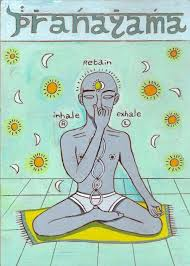
Being of the body, which exists on the lowest and densest plane of awareness, the breath is NOT the great channel of spiritual energy many gurus make it out to be. Breathing exercises during meditation do, however, help to improve focus and concentration. That is, in fact, their only useful purpose as a spiritual practice.
Real Breath is Neshama — the Inner-Divinity embodied by the Presence of God and Christ. This breath, which is Ruach, Vaya, and/or Pranava (as opposed to prana or chi), we draw in NOT through the corporeal body’s nose, mouth, or lungs, but through the psychic nadis of the Spiritual Body.
The fifth “limb” is Prat-yahara, which means “the breaking dawn of Yahara,” rather than “sense withdrawal.” Note the consistency of phraseology with the Old Testament Hebrew. Yahara means “sacred river” or “blessed waters,” so, this “limb” refers to tapping the Living Water flowing down from the fountain or wellspring in the Land of the Living, basically.
6) Dha-ran-a means not “concentration,” but “giving (dha) the sound (ran) of God (a).”
7) Dhy-ana means “meditating on (dhy) the Cosmic Breath (ana),” which Patanjali describes as “the uninterrupted flow of the (holy) mind – the content of the consciousness – in a single and unbroken stream.” So, the Cosmic Breath is what Jesus called the Holy Stream of Sound in the Essene Gospel of Peace, and the Living Water in the New Testament. Adi Shankara, the founder of Vedanta Advaita, similarly describes the Cosmic Breath as “a stream of identical vritti [thoughts] as a unity, a continuity of vrittis not disturbed by intrusion of differing or opposing vrittis.” So, dhyana describes the discipline of focusing the mind or “meditating” on the Voice for God, which speaks to us as the pranava, Cosmic Breath, Ruach, or Holy Spirit.
The eighth and final “limb” is Samadhi, a word supposedly meaning “communion” or “enlightenment.” These definitions aren’t, strictly speaking, incorrect. More accurately, though, Samadhi is a compound of sa (the Word of God), ma (begetting or creating) and dhi (wisdom or light). The highest step on the Eightfold Path of Yoga, Samadhi refers, therefore, to the the unification, fusion, “yoking together,” or “communion” of the meditator with the object of meditation — in this case, the vibratory stream of God’s Word or God’s Breath. Becoming one with that sound in our minds, in other words.
To attain Samādhi, yoga rightly teaches, the meditator must concentrate on the vibratory Om until the Ego Mind dissolves completely, freeing the Soul to rise upwards into the higher waters of Spirit.
Does Jesus teach any of these “limbs” in the Course? Oh, yes. He teaches all of them. And, as I may have mentioned, the Holy Spirit guided me to study Yoga after I’d completed the Workbook for the third time. And it was through those studies that I learned about the chakras and, more importantly, the Om vibration.

That Jesus studied Yoga in India during some of the years unaccounted for in the canonical gospels is documented in various ancient records. It has also been confirmed in several reliable books, including The Yoga of Jesus by Paramahansa Yogananda, Jesus in India by Mizra Ghulam Ahmadin, The Lifetimes When Jesus and the Buddha Knew Each Other by Gary Renard, and The Aquarian Gospel of Jesus the Christ by Levi Dowling. It should come as no surprise, then, that Christ’s teachings in both the New Testament and the Course incorporate many elements of Yoga.
Those teachings were, as stated earlier, mindfully omitted from the New Testament canon and also condemned as “gnostic” or “heathen” by the very men who chose the redacted canon.
Course-Jesus may not use Sanskrit words like Purusha, yama, bhakti, or japa, but he absolutely teaches the same ideas. Truth is one, after all, whatever form or language it may be packaged within. This doesn’t mean Jesus “borrowed” his ideas from Yoga; Jesus “borrowed” his ideas from the Holy Spirit, who shared the same wisdom with us through Patanjali, the Hebrew prophets, Muhammad, the Vedic rishis, and Helen Schucman, among many others.
Like all the other Spiritual Truths the Evil One gets his mitts on, the original teachings of Yoga have been radically distorted over time to hide those Truths from us. That’s why we must question everything we’ve been led to believe, including the widely accepted interpretations of the scriptures of our chosen faith. Like a rough diamond, the truth is in there, but hidden under the sediment of mistranslation, scribal errors, editorial misjudgments, and flawed interpretations.

Some newer schools of Yoga claim, for example, that enlightenment can be attained “scientifically” — i.e., without believing in a Higher Power. Buddhism and Theosophy also promote this preposterous notion to some extent.
And this is why I can’t fully embrace the teachings of Buddhism or the modern wizardry known as “occult science,” which also attempts to “intellectualize” the workings of God’s Divine Reality. Yes, there is some truth in these teachings, but also a lot of “level confusion.”
God is real, as Jesus declares outright in the Course. He is NOT an abstract concept. And I believe him — and in God — now more than ever.
The Gita, The Yoga Sutras, The Bible, and the Course all state very clearly that loving devotion to God (bhakti) is an essential practice for those seeking salvation. We also must uphold Higher Truth in thought, word, and deed (dharma), turn our lives over to God (Ishwarapranid-hana), and yoke our will to God’s (samādhi). How, then, can it be possible to achieve enlightenment without believing in God? To presume we can join or surrender to something we deny exists is patently absurd ego bollocks, pure and simple.
Or, as Course-Jesus affirms:
Only if you ACCEPT the Fatherhood of God will you have anything, because His Fatherhood GAVE you everything. That is why to deny Him IS to deny yourself. Arrogance is the denial of love, because love shares and arrogance withholds. As long as both appear to you to be desirable, the concept of choice, which is not of God, will remain with you. While this is not true in Eternity, it IS true in time, so that, while time lasts in YOUR minds, there WILL be choices. Time itself WAS your choice. If you would remember Eternity, you must learn to look on only the Eternal. If you allow yourselves to become preoccupied with the temporal, you are LIVING IN TIME. As always, your choice is determined by what you value. Time and Eternity cannot both be real, because they contradict each other. If you will accept only what is timeless as real, you will begin to understand Eternity, and make it yours.

It is equally ridiculous to believe we can achieve enlightenment – or any form of inner-peace – without turning inward on a regular basis. Like True Yoga, the Course is a path of meditative mind-training. The Workbook for Students provides the progressive meditative exercises required to align our thinking with the theoretical ideas presented in the Text and Manual for Teachers. Unlike westernized “Yoga,” the Course excludes the body COMPLETELY from the reawakening process – except as a communications vehicle for the Holy Spirit, which also happens to be what Patanjali originally taught. With regard to meditative postures, the only instruction Jesus offers is to sit up while doing the lessons to avoid falling asleep.
In future posts, we’ll talk more about meditation, Yoga, and Yoga-Nidra, which Hindus call akarma, and ancient Chinese philosophers called Wu-Weu. All three terms concern the spiritual discipline of doing nothing to generate Karma at the level of the body.
Thanks for visiting. I hope you found this post useful to your Soul. Until we meet again outside the endless circle, Om Hari Om and Namaste.
 The Holy Meeting Place
Leave a comment