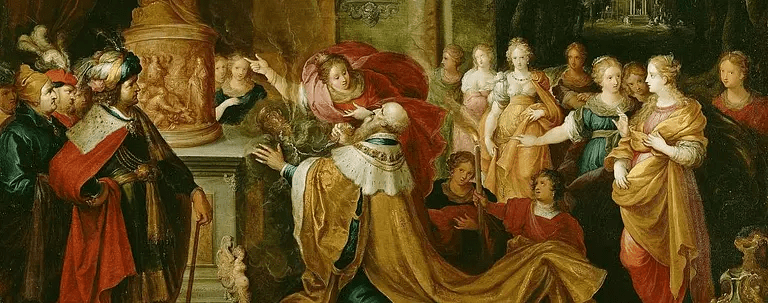
Yesterday, while meditating on the Om, it came to me that the Bible says something about King Solomon having had many wives. And that made me wonder if those wives might represent the seven sacred rivers we discussed last time. So, I looked up the verse in question (1 Kings 11:3), wherein I found the following report:
He had seven hundred wives of royal birth and three hundred concubines, and his wives led him astray.
Seven hundred wives and 300 mistresses? I think not for two solid reasons. The first is that no man could handle 1,000 women, however virile he might be. And the second is that King Solomon was an allegorical representation of the Holy Spirit aspect of Yovah, the triune name of God in Hebrew. He was not, therefore, an human man or king. So, let’s see what 1 Kings 11 actually communicates about King Solomon, starting with that highly suspicious third line.
In transliterated Hebrew, 1 Kings 11:3 reads as follows:
sheba me’ah ishsa-ha sar-ah shalowsh me’ah peleg-esh ishsa-ha natah leb.
By my calculations, those words form an incomplete sentence reading as follows:
… seven waters of God and the Christ Light ruling over the three waters of God divided into spiritual channels extending outward from the heart-mind.
Nothing whatsoever about wives or concubines, as you can see. So how did the KJV translators get it so wrong? Firstly, they translated me’ah as “hundred” throughout the Old Testament, when the word is, in fact, a compound of mem (waters) and ah (of God or from God). And that makes sheba mem-ah the “seven waters of God,” rather than “seven-hundred.” Secondly, they made the huge error of translating Isha-ha as “woman” or “wife” not only here, but from Genesis onward. Isha-ha more rightly means the Christ Self or Christ Ray, making Isha-ha the Greater Light of Christ, the Christ Light or the Great Christ Ray of Elohim. And that Great Ray, the David or Lamed Aspect Ray, is indeed “the lord” or “chief shepherd” of the three waters of the Atonement Trinity, whose horn-like beams combine in different pairings to form the lesser four “rays of attribute.” Furthermore, the Hebrew word translated as “concubine” should be peleg-esh (the divided channels of spirit that are the sacred rivers or nadis) rather than pilegesh (paramour or mistress).
So, the Bible does not, in fact, EVER suggest that Solomon had 700 wives or 300 concubines, which is neither humanly possible nor spiritually permissible.
In Truth, 1 Kings 11:3 forms the second part of the previous sentence. So, let’s start at the beginning of the chapter to uncover the many other Great Truths we’ve been denied down the ages by ego-influenced translators:
King Solomon loves abundantly the water-bearers or miracle-workers (nokriy) watering to fullness the Christ Light divided into measures in the Kingdom of Egypt (Sat-an’s waterless desert or Kingdom of Darkness); the descendants in the likeness of the Father (moab), the Amen in Adam (ammon-edom) in the storehouse (sidon) enclosure (heth) in the Eternal Now (goy) of Yovah communicating to the Sons of Israel to enter into certainty or truth. To expand the inner heart-mind leading back to Elohim, Solomon joins together in Love (the name we share with God) the seven waters of God with the Christ Light ruling over the three waters of God (the rivers of the Trinity Rays) divided into channels of spirit extending outward from the heart-mind (God’s Inner-Altar). In time, Solomon matures the Christ Light radiating from the inner heart-mind to follow after the other Elohim Solomon keeps close to love; the heart-mind at peace in Yovah-Elohim; the heart-mind of David, the Father of Solomon conveys the teaching or guiding flame of truth (ash-toreth) from Elohim’s storehouse (Elohim sidon) to the western side. The mother’s milk or milk of om (milc-om), the anointings (shikkuts) of Amen, by which Solomon recasts adversity in the sight of Yovah as fully apart from Yovah, David, and the Father (nothing to do with God, in other word). Solomon rebuilds the high place of the Savior (chemosh), the anointed one in the likeness of the Father (mo-ab), the higher presence
in Jerusalem, the Resting Place, to serve the water-bearers (nokriy) of the Christ Light making incense-smoke offerings and ?? unto the Elohim powers.
A branch or extension of Yovah, Solomon is the heart-mind extending Yovah-Elohim in Israel, the perceived faces ordained by the Word of God to convey the other Elohim powers preserving Yovah’s established order (the Temple Pillar of Jacim). Yovah is the Living Water by which Solomon preserves and protects the covenant and commandments ordained by the split tearing apart the kingdom given to serve the Yom made by David for the Father to tear it from the hand of the Son. But how to tear down the kingdom except to give the one correction (also scepter or rod) to the Son, David, the servant of Jerusalem, to choose Yovah and stand against Satan?
Solomon, the thunder from Edom, is the king sowing the seeds of Edom with David. Through Edom, Joab (the Father of the Trinity) governs the gathering place to exalt the buried dead and bring forward the remembered innocence (or purity). In Edom, six new moons of Joab remain in Israel to remember that innocence. The thunder hastens the escape from mortality in the Edomites (the descendents of Adam) helping the Father enter into Egypt. The thunder of the lesser promise or vow (na’ar = nadar) to arise or stand up in Midian (the Resting Place) to enter into the glory dignifying humankind collectively; the glory brought into Egypt by the smoke-offering of the Young Bull within the Temple; the Living Water bread provided in the Land of the Living; the thunder for acquiring the abundant grace of the fountain offering the young bull’s gifts to the Christ Light sisters; the Christ Light sisters, the underlying sounds or voices (tach-phnohes rather than Tahpenes). The sisters of the underlying sound bring forth or beget the measured blessings (genubath) of the Son the underlying voices recompense through the Temple offerings; the Temple offerings of the sons offering the Thunder, the Living Water flowing forth from the Land of the Living; the Living Water offered unto the needy seeking the Land of the Living to send forth the weapon (shelach rather than shalach) of Elohim’s stand against Satan.
A bit confusing in places, perhaps — but still far more sensible and TRUE than the ridiculous KJV translation about wives, concubines, and Egyptian kings and queens. In the above, I’ve assigned the Hebrew words Moab, Ammon, Edom, Sidon, and Heth their actual meanings, rather than erroneously preserving them as place names. Moab means “from the Father’; Ammon means “Amen”; Edom means “red” and refers, therefore, to the Red or Blood Ray sourcing Adam, the Soul or Divine Spark; Sidon means “storehouse” or “container”; and Heth means “enclosure” or “walled city.” This tells us a couple of things. The first is that the Amen, a word meaning “hidden one” in Egyptian, is the Red Ray, as well as the Blood of Christ and the “storehouse” or “treasure house” preserving our memories of the Truth of our Being within the “enclosure” or “walled city” that is heavenly Jerusalem or Medinah, the resting place or place of peace discussed last time.
And, as Course-Jesus explains in Workbook Lesson 159: I give the miracles I have received, that “storehouse” or “treasure house” more specifically contains all the miracles we received to awaken from the dream the first time around (in the Holy Instant in which God ended the dream via milta). In the repeating dream-memory we’re living in presently, we need to give away (to keep or have) that store of miracles to remember that we’re already awake.
I promise you that this is absolutely what Course-Jesus means when he says:
Behold the store of miracles set out for you to give. Are you not worth the gift, when God appointed it be given you? Judge not God’s Son, but follow in the way He has established. Christ has dreamed the dream of a forgiven world. It is His gift, whereby a sweet transition can be made from death to life; from hopelessness to hope. Let us an instant dream with Him. His dream awakens us to truth. His vision gives the means for a return to our unlost and everlasting sanctity in God. (ACIM, W-159.10:1-8)
It’s also what this section of 1 Kings 11 attempts to explain, when rightmindedly translated. I mean, c’mon. Being the Holy Spirit, Solomon couldn’t reasonably have wives and concubines or fall out with God, now could he?
Okay, so … who or what is the “young bull” or “bullock” referenced herein? Presumably, that’s a reference to the bull-headed throne-bearer or Living Being seen by the prophets Isaiah, Zechariah, John of Patmos, and Mohammad. I’m still a bit fuzzy on the identity of those four “beings,” but I believe they are the four Rays of Attribute made by the Trinity Rays. The bull, I’m fairly certain, represents the Bull of Heaven, a symbol for God’s Will found in the scriptural texts of ancient Mesopotamia, Persia, and India. In Hindu iconography, that bull is represented by Nandi, the white bull “vahana” or “vehicle” for Lord Shiva. This association suggests the bull-headed “Living Being” represents Ray Four, “the ray of harmony through conflict” (in Theosophy), which combines the energies of Aleph (Ray One) and Lamed (Ray Two).
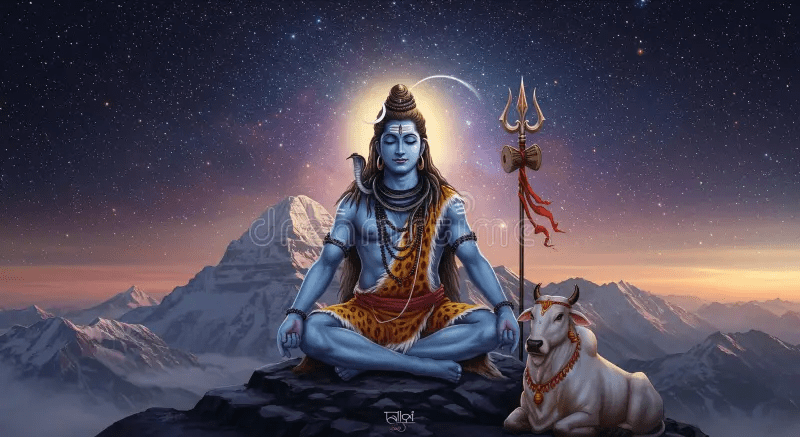
If I’m right about this, the eagle-headed Living Being is Garuda, the eagle-headed “vahana” of Lord Vishnu, the Hindu Holy Spirit. That “being” corresponds, therefore, with the Fifth Ray made when Aleph and Hey fuse their thought-force energies or “shaktis” of Higher Will and Higher Mind. The lion-headed being, likewise, is the vahana of Parvati, the bride of Shiva, who won her husband (the Christ Ray) through obedient discipleship.
So …
Bull-headed being = Fourth Ray = Aleph + Lamed. Ray Four is, therefore, the “Attribute” of God’s Will shared in the dream by the Christ Self through the second covenant (the oath made between David and Yovah alluded to in Psalm 132, as well as “the lesser vow” described in 1 Kings 11).
Eagle-headed being = Fifth Ray = Aleph + Hey. The Fifith Ray is, therefore, the “Attribute” of God’s Mind or Thoughts actively working to bring the Separated Ones back together in harmonious At-one-ment.
Lion-headed being = Sixth Ray = Lamed + Hey. This would make Ray Sis the “attribute” of God’s Strength, which restores the Holy Vision we regain through obedient discipleship to the Shepherd/Bridegroom and the Teacher/Comforter.
The human-headed Being = Seventh Ray = Aleph + Lamed + Hey. Combining all three Trinity Powers, Ray Seven represents the Divine Attribute of Holy Creation’s Wholeness, which we regain by meditating on the Living Water in the Resting Place.
This is my current “take” on the Seven Rays, about which there is much discussion in esoteric and mystical circles. Wikipedia offers a decent summary of the various and sundry teachings , both ancient and modern, about these “living beings” or “Holy Powers”; some of what the Wiki reports sounds right, while some of it should be taken with a grain of salt.
And yes, we WILL discuss the Rays in greater depth in future posts.
At present, all of this begs a question: Are the Seven Rays the Seven Sisters mentioned in Kings? I don’t know, but I do believe they may be the Seven Stars mentioned four times in the Book of Revelation. If so, the they are also the Seven Stars depicted on the Tarot card of THE STAR, (which we outwardly projected collectively as the Pleiades constellation).
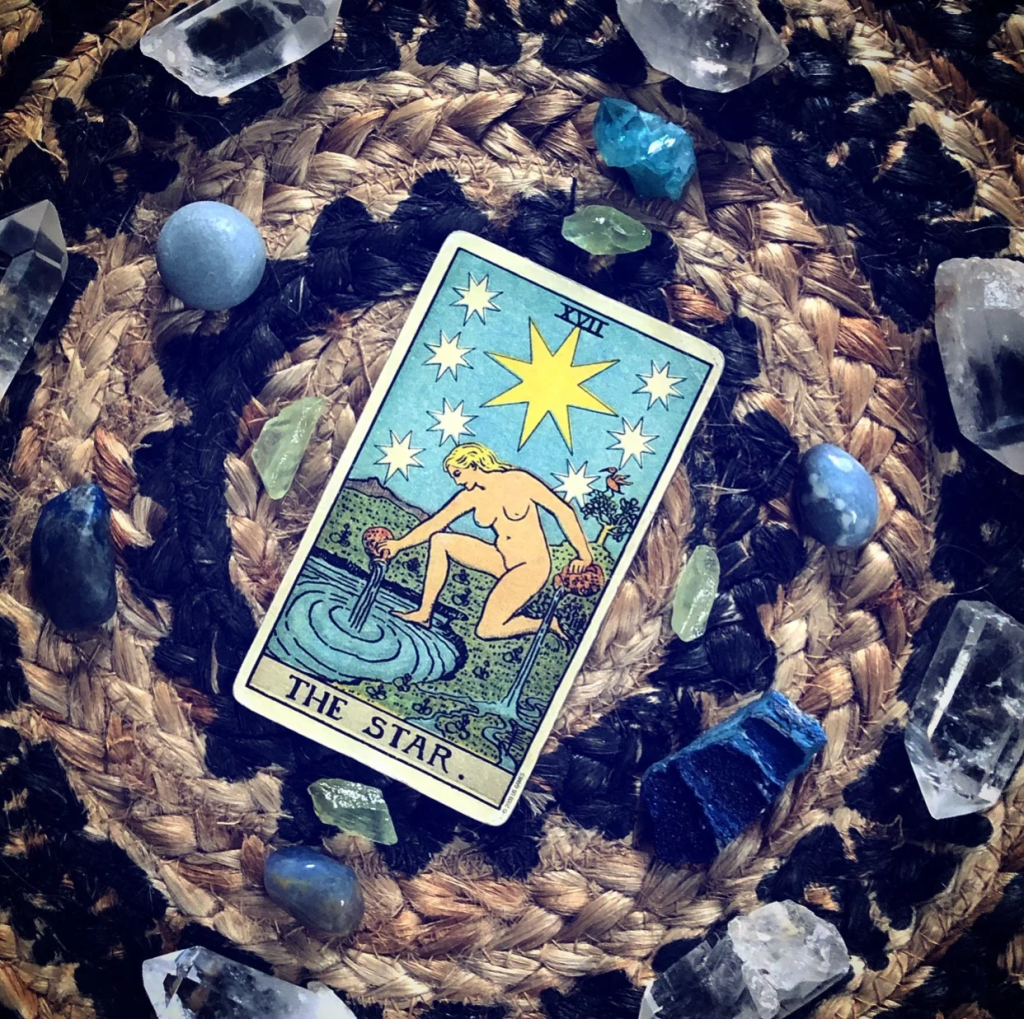

The seven stars are mentioned five times in the Bible: four times in Revelations (1:16, 1:20, 2:1 and 3:1) and once in verse 5:8 of the Old Testament Book of Amos.
Let’s see what each of those verses can tell us about those mysterious sister-stars.
In Revelation 1:16, we read:
And he had in his right hand seven stars: and out of his mouth went a sharp two-edged sword: and his countenance was as the sun shineth in his strength.
In Revelation 1:20, we read:
The mystery of the seven stars which thou sawest in my right hand, and the seven golden candlesticks. The seven stars are the angels of the seven churches: and the seven candlesticks which thou sawest are the seven churches.
In Revelation 2:1, we read:
Unto the angel of the church of Ephesus write; These things saith he that holdeth the seven stars in his right hand, who walketh in the midst of the seven golden candlesticks;
And in Revelation 3:1, we read:
And unto the angel of the church in Sardis write; These things saith he that hath the seven Spirits of God, and the seven stars; I know thy works, that thou hast a name that thou livest, and art dead.
Amos 5:8 (per KJV):
Seek him that maketh the seven stars and Orion, and turneth the shadow of death into the morning, and maketh the day dark with night: that calleth for the waters of the sea, and poureth them out upon the face of the earth: The Lord is his name:
Now, let me retranslate Amos 5:8-10, to provide more clarity and context:
To bring forth the seven stars (kiym-ah), the spiritually ignorant (kesil) must overthrow the shadow of death by which the breaking dawn of Yom (the Greater Light of God) grew dark. Call upon the waters of yam pouring out the presence in the Land of the Living–Yovah, the name that uplifts the ravaged strength of the ravaged entering into the stronghold. To hate and judge breaks into pieces (sha’ar should be not “gate,” but shabar, broken into pieces) the Word of God’s wholeness, completion, purity and/or perfection.
As indicated, the Hebrew word traditionally translated as “seven stars” was kiymah, which allegedly means “star cluster,” but actually is a compound of Kiym and ah, meaning “peacemakers of God.” Likewise, the word translated as Orion was Kesil, another Hebrew word retained in the Greek translation. The word means not “Orion,” but “spiritually ignorant.”
The “waters of yam” are, I presume, the vibrations of the seed-mantra said to open the Heart Chakra (the fourth of the seven tonal oms). In Hebrew, yam means “to roar, like the sea.” So, waters of yam literally translates as the waters of the roaring sea (the Primal Sea or Ocean of Milk underneath the illusion of form).
From all of these verses, we learn that 1) the stars are the angels (messengers) of the churches and not the seven spirits or lamps before the throne; 2) that the churches are the metaphorical candlesticks, and not actual churches or religions that once existed in the world (as most Biblical scholars erroneously presume and profess); and 3) that the seven stars are the “peacemakers” working through the seven candlesticks or churches.
These “peacemakers” are mentioned elsewhere in the Bible, most notably in Matthew 5:9, wherein Jesus says: “Blessed are the peacemakers, for they shall be called sons of God.” What he’s talking about are, I believe, the miracle-workers sharing the Living Water/Light of Truth/Om vibration (through the seven messengers or Rays) from the Resting Place on the eastern side of the Wheel with the “ignorant” still dwelling in darkness on the left-hand side. And this is, I believe, what Jesus alludes to in the following from the Course:
You maker of a world that is not so, take rest and comfort in another world where peace abides. This world you bring with you to all the weary eyes and tired hearts that look on sin and beat its sad refrain. From you can come their rest. From you can rise a world they will rejoice to look upon, and where their hearts are glad. In you there is a vision that extends to all of them, and covers them in gentleness and light. And in this widening world of light the darkness that they thought was there is pushed away, until it is but distant shadows, far away, not long to be remembered as the sun shines them to nothingness. And all their “evil” thoughts and “sinful” hopes, their dreams of guilt and merciless revenge, and every wish to hurt and kill and die, will disappear before the sun you bring. (ACIM, T-25.IV.3:1-7)
We further learn from Revelations that to see the Seven Stars, we have to stop the Satan-induced hating and judging that breaks God’s unblemished Wholeness into pieces. We have to stop hating and judging our fellow creatures, in other words, who are, in truth, ONE with us eternally in the Trinity of the Holy Name (Yovah)
In the Manual for Teachers, Course-Jesus identifies this step on the journey as the fifth of six stages we will pass through on our way to attaining trust and/or peace in God.
More specifically, he says:
The next (sixth) stage is indeed “a period of unsettling.” Now must the teacher of God understand that he did not really know what was valuable and what was valueless. All that he really learned so far was that he did not want the valueless, and that he did want the valuable. Yet his own sorting out was meaningless in teaching him the difference. The idea of sacrifice, so central to his own thought system, had made it impossible for him to judge. He thought he learned willingness, but now he sees that he does not know what the willingness is for. And now he must attain a state that may remain impossible to reach for a long, long time. He must learn to lay all judgment aside, and ask only what he really wants in every circumstance. Were not each step in this direction so heavily reinforced, it would be hard indeed! (ACIM, M-4.I-A.7:1-9)
When he says this state “may remain impossible to reach for a long, long time,” he means it might take several lifetimes. And this is the stage I’m at right now; trying to suspend all judgements concerning what happens in the world — which is easier said than done. But my faith in the power of the Holy Spirit is strong and steady, so I keep listening to the Living Water, knowing that’s what God would have me do.
Or, to quote Course-Jesus yet again:
The term “Last Judgment” is frightening not only because it has been projected onto God, but also because of the association of “last” with death. This is an outstanding example of upside-down perception. If the meaning of the Last Judgment is objectively examined, it is quite apparent that it is really the doorway to life. No one who lives in fear is really alive. Your own last judgment cannot be directed toward yourself, because you are not your own creation. You can, however, apply it meaningfully and at any time to everything you have made, and retain in your memory only what is creative and good. This is what your right-mindedness cannot but dictate. The purpose of time is solely to “give you time” to achieve this judgment. It is your own perfect judgment of your own perfect creations. When everything you retain is lovable, there is no reason for fear to remain with you. This is your part in the Atonement. (ACIM, T-2.VIII.5:1-11)
I hope that was helpful. We’ll get to yoga eventually, but for now I’m letting the Holy Spirit show me the way. Until next time, OM Hari Om and Namaste.
 The Holy Meeting Place
Leave a comment