
Yes, I know. I promised we’d talk about yoga next time, but that was before the Holy Spirit guided me to the fourth chapter of Isaiah, and then down an exciting rabbit-hole that led me to the Exodus story of the seven daughters of Jethro (Yitro), the high priest of Midian, who meet Moses at a well where they are being prevented from watering their father’s sheep.
In the story, Moses helps the sisters get the water, and is later rewarded for his heroic service by being allowed to marry one of the girls. The one he marries is called Zipporoah, a Hebrew name said to mean “bird,” but which actually means “zeal for God.” Although Jethro’s wife isn’t named in Exodus, we learn in Isaiah 4 that her name was Bath, short for Bath-sheba, the same symbolic name given to the wife of King David, who bore Solomon. Are Jethro and David’s wives the same Bath-sheba? Probably, given that all scriptural stories are meaning-layered allegories, rather than static historical accounts of earthly people and events.
As always, the names are the keys to unlocking the story’s deeper meaning. So, let’s do the requisite etymological sleuthing, starting with Bath-sheba. In Hebrew, the word-name supposedly means “daughter (bat) of the oath (sheba).” But bath isn’t bat (daughter); it was a measure used in Biblical times to divide liquids. And sheba is translated as “seven” rather than “oath” in Isaiah 4:1. So, the name more accurately means, “the waters divided into seven measures.” That Bath-sheba has seven daughters with Jethro (Yitro) suggests that she brought forth the seven spouts or founts of the wellspring or fountain (of breaking dawn) in the Resting Place after she joined forces with Jethro. In the Rig Veda, those same streams of spiritual sustenance or grace are called the Sapta-Sindu, a Sanskrit term meaning “seven sacred rivers.” In the Vedas, those seven streams are identified as the river goddesses Ganges, Yamuna, Sarasvati, Narmada, Godavari, Kavari, and Krishna. The Sanskrit term nadi also translates as “holy stream” or “holy river” — so, the Ida, Pingala, and Sushumna nadis– the three chief “spiritual channels” said to uplift the pranava, as well as the serpent-fire Kundalini, also are categorized as “sacred rivers.”
Pretty synchronistic, right?
And just so we’re clear, those sacred rivers exist at the level of mind, NOT at the level of physicality.
Let’s now look at Jethro (Yitro), a Hebrew name meaning either “abundance” or “generosity.” I suspect it means “generosity,” as it is through our generosity of spirit (toward all our fellow beings) that we willingly share the seven streams or founts of Living Water by meditating on the Om vibration in the Circle of Forgiveness, thereby fortifying as well as fulfilling God’s Will on earth.
Generosity is, in fact, one of the characteristics of God’s Teachers listed by Course-Jesus in the Manual for Teachers. In that section, he says:
The term generosity has special meaning to the teacher of God. It is not the usual meaning of the word; in fact, it is a meaning that must be learned and learned very carefully. Like all the other attributes of God’s teachers this one rests ultimately on trust, for without trust no one can be generous in the true sense. To the world, generosity means “giving away” in the sense of “giving up.” To the teachers of God, it means giving away in order to keep. This has been emphasized throughout the text and the workbook, but it is perhaps more alien to the thinking of the world than many other ideas in our curriculum. Its greater strangeness lies merely in the obviousness of its reversal of the world’s thinking. In the clearest way possible, and at the simplest of levels, the word means the exact opposite to the teachers of God and to the world. (ACIM, M-4.VII.1:1-8)
That Jethro is identified as a priest in Midian also has etymological significance. Midian doesn’t mean “judgment” or “place of judgment,” as Sat-an and his ministers would have us believe; it means “covering” — a term also used in the Rig Veda to describe the “enclosure” or “cave” that is the walled city, Resting Place and/or Garden established by Elohim “east of Eden.” Moreover, Midian is closely related to the Arabic word madina or medina, which means “city” — or, more specifically, “a walled city or enclosure used as a gathering place for an assembly of deities.” Noteworthily, Medinah (Yathrib in the Qur’an) is, in fact, the final “resting place” of the prophet Mohammed.
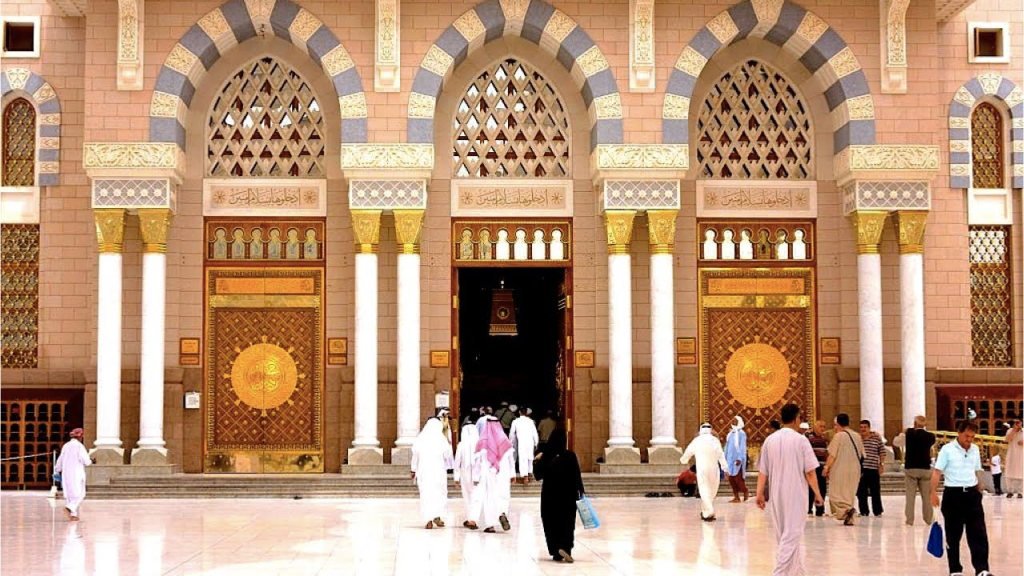
All of this supports my belief that Midian represents the Holy Resting Place in the Exodus story of Jethro and his daughters. And, therefore, the holy pilgrimage cities of Medinah in Saudi Arabia and Jerusalem in Israel are, in fact, outwardly reflected symbols of that inner Holy Place of Peace we’ve forgotten in our ego-induced stupor.
Bearing all that in mind, let’s now look at what Isaiah 4 actually communicates about the seven daughters. If you’ve been following my blog, you should be able to recognize some of the telling symbols in the highly flawed translation below from the KJV Bible:
And in that day seven women shall take hold of one man, saying, We will eat our own bread, and wear our own apparel: only let us be called by thy name, to take away our reproach.
In that day shall the branch of the Lord be beautiful and glorious, and the fruit of the earth shall be excellent and comely for them that are escaped of Israel.
And it shall come to pass, that he that is left in Zion, and he that remaineth in Jerusalem, shall be called holy, even every one that is written among the living in Jerusalem:
When the Lord shall have washed away the filth of the daughters of Zion, and shall have purged the blood of Jerusalem from the midst thereof by the spirit of judgment, and by the spirit of burning.
And the Lord will create upon every dwelling place of mount Zion, and upon her assemblies, a cloud and smoke by day, and the shining of a flaming fire by night: for upon all the glory shall be a defence.
And there shall be a tabernacle for a shadow in the day time from the heat, and for a place of refuge, and for a covert from storm and from rain.
Like I said, highly flawed, because this is what the prophet actually recorded:
The Seven Rays (yom-sheba) of the One Christ (Isha-sah) strengthen the One Spirit advising us to eat the bread and put on the mantle proclaiming the Name bringing our Souls together to remove the disgrace we cast upon each other.
The Rays sprout from Yovah’s splendor and glory — the fruits of the Land of the Living, the Divine Majesty liberating Israel (another name for Jacob, the ascending Soul), the remnant left in Zion to preserve Jerusalem, the Living Water sanctuary drawing from the Living the holiness of Jerusalem with which Adonay (the First Ray of God’s Will and Authority) washes away the grime of guilt. The divided streams of Zion wash clean (purify) the blood of Jerusalem (Adam or Jacob, the Soul in a perpetual state of grace) in the heart-center, innermost chamber, or inner-altar of Ruach’s (the Cosmic Breath of Holy Spirit) Divine Judicial Rulings. Ruach burns away the division of Yovah (the triune Name of God) to create the established dwelling place, the Mountain of Zion convoking (calling together the Assembly) the cloud-vapor of the Rays brightly shining the Christ Light in the darkness. The glorious chamber of the Tabernacle protecting the Rays from the drought, the refuge place shelters the downpour of the divine rain refreshing God’s Souls (matar).

As an interesting aside, matar means “mother” in Sanskrit. And there are indeed seven divine mothers (Septamatrikas) frequently mentioned in the various sacred texts of Hinduism. So, the final line of this verse from Isaiah may indeed refer to the “downpour” (of grace) coming from those seven founts, Septamatrikas, and/or shakti energies. Those seven mothers also are sometimes described as “the daughters of the Visva-devas” (the Holy guardians of the Wheel or Chakra of the Soul’s Journey). In the Indian lore, those daughters are rightly said to be the offspring of Devu-ka (the Holy Light of Purusha underneath the illusion of matter) and Bha-dra (the sleeping light).
The Sanskrit word Purusha, incidentally, is a marriage of pur (stronghold or fortress) and usha (the godess of breaking dawn). So, the Vedas and the Bible definitely use the same symbols and language to describe what’s really going on in the world.
Pretty interesting, right?

So, the seven daughters of Jethro Moses meets and helps at the well in Exodus are those same seven mothers, shaktis, spirits, Lamps, sacred rivers, waters of Yovah, and/or Great Rays. In the Bible, they are called Zipporah (zeal for God), Tirzah (joy of God), Hoglah (the circle or circle-dance of God), Milcah (the milk of God), Noah (the rest of God), and Mahlah (the journey, path, or course to God).
So, the story in Exodus tells us that Moses, a name meaning “drawn out by the water,” helps the seven daughters water the father’s sheep (our Souls thirsting for grace) by drawing the Living Water out of the well they can’t access on their own. As a reward for this service, he marries the daughter symbolically representing the zeal to know or remember God — the prerequisite for hearing the Om. And this narrative perfectly reflects what Jesus explains throughout the Course about us being each other’s saviors. To summarize both teachings, WE provide the Living Water the Holy Spirit uses to “save the world” by gathering together in the Resting Place (in our minds) to listen to the Om.
So, Job One is training our mind to hear the sound. And Job Two is sitting in meditation to listen for everybody’s greater good.
Or, as Course-Jesus explains at one point:
The only part of your mind that has reality is the part that links you still with God. Would you have all of it transformed into a radiant message of God’s Love, to share with all the lonely ones who have denied Him? God makes this possible. Would you deny His yearning to be known? You yearn for Him, as He for you. This is forever changeless. Accept, then, the immutable. Leave the world of death behind, and return quietly to Heaven. There is nothing of value here, and everything of value there. Listen to the Holy Spirit, and to God through Him. He speaks of you to you. There is no guilt in you, for God is blessed in His Son as the Son is blessed in Him. (ACIM, T-14.V.1:1-12)
Yoga next time, unless the Holy Spirit has different ideas. Until then, Om Hari Om and Namaste.
 The Holy Meeting Place
Leave a comment