
Lush expanses of lawn, sacred grasses, and verdant green pastures feature prominently in the scriptures of many faiths. But what are these peaceful meadows intended to represent? Today we’re going to walk through those grassy fields (and many scriptural passages) in search of the answer.
Let’s begin with the Old Testament Book of Genesis, wherein we read (when correctly translated):
Elohim said, “Land of the Living God, bring forth green pastures from the scattered seeds of fruitful blessings the True Vine (or Tree of Life) bestows abundantly; fruits of the kind that seed the Land of the Living God.” And the Land of the Living God brought forth green pastures from the scattered seed of the kind the True Vine bestowed abundantly to sow seeds of the kind Elohim considered beneficial, in the twilight before the dawning of the third Yom.
From this retranslation of the verse we learn all of the following:
–The seeds discussed last time are scattered abundantly by the True Vine or the Tree of Life.
–Those seeds bring forth the “fruitful blessings” bestowed by said Vine or Tree.
–Those fruitful blessings “sow” the Land of the Living (Jerusalem, the place of peace) to sprout the “green pastures” mentioned in Psalms, the Course, the Qu’ran, and the Rig Veda, among other sacred texts.
–the Hebrew word yom allegedly means “day” or “epoch,” but I question that definition. Why? Because “day,” as previously explained is Biblical “code” for the Greater Light of God. And yom is a marriage of the Hebrew symbols for Yovah (the Holy Name) and “water.” And the “water” of Yovah are the thought vibrations streaming down from the Logos or Thought of God that is Elohim. What the first chapter of Genesis describes is, therefore, the chronology of Elohim’s “radiating forth” of the seven Great Rays, spirits, lamps, graces, or holy vibrational streams of the Word of God.
The passage above describes, therefore, how Elohim brought forth the Third Ray or Holy Stream of God’s Word and/or Name. And that Ray, by most accounts, is the green Ray, Spirit, or Lamp of the God Mind scattering its miracle-seeds around the dream-realm to bring us to the Resting Place. As I understand all this, the Third Ray is what Christian’s call the Holy Spirit, Jews call Ruach, and Hindus call either Vayu or Vishnu. And, as the chart below shows, the third Ray is emerald-green in color. And that certainly explains the symbolic grasses, lawns, and pastures in the scriptures.
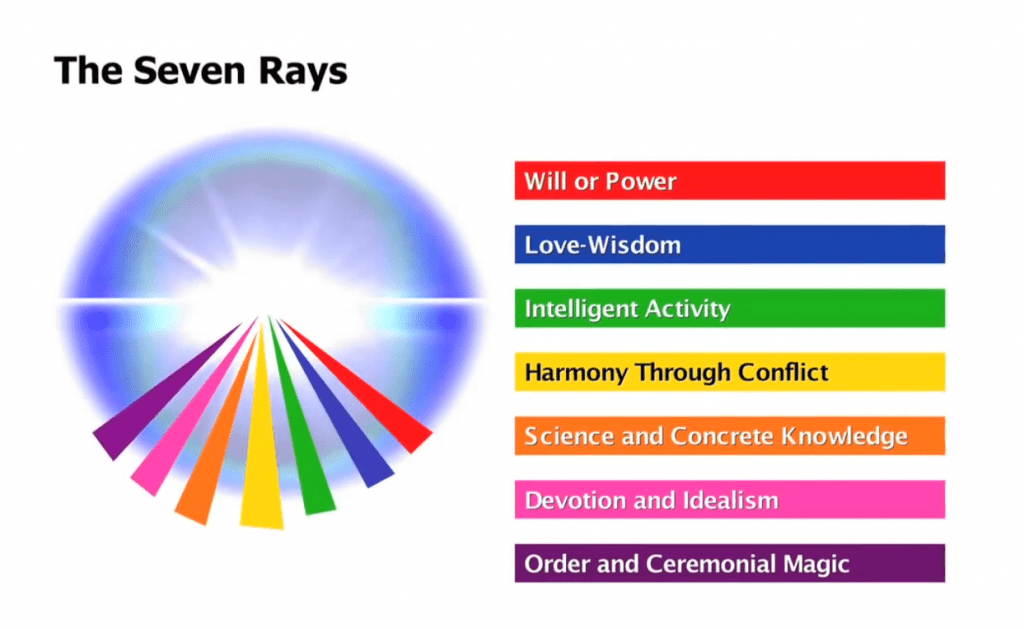
Later on, we’ll discuss, compare, and debunk the varied and sundry mystical teachings about the Seven Rays. For now, please open your Bible to the Old Testament Book of Psalms, a collection of hymns written during the Epoch of David and Solomon (a.ka., “the Golden Age of Israel”). Back when the dream-world was still a happy and peaceful place, in other words.
Let’s start with the lesser-known Psalm 27, which, like our Genesis passage, mentions the Land of the Living. In the KJV Bible, that hymn is translated thusly:
The Lord is my light and my salvation; whom shall I fear? the Lord is the strength of my life; of whom shall I be afraid?
When the wicked, even mine enemies and my foes, came upon me to eat up my flesh, they stumbled and fell.
Though an host should encamp against me, my heart shall not fear: though war should rise against me, in this will I be confident.
One thing have I desired of the Lord, that will I seek after; that I may dwell in the house of the Lord all the days of my life, to behold the beauty of the Lord, and to enquire in his temple.
For in the time of trouble he shall hide me in his pavilion: in the secret of his tabernacle shall he hide me; he shall set me up upon a rock.
And now shall mine head be lifted up above mine enemies round about me: therefore will I offer in his tabernacle sacrifices of joy; I will sing, yea, I will sing praises unto the Lord.
Hear, O Lord, when I cry with my voice: have mercy also upon me, and answer me.
When thou said, “Seek ye my face”; my heart said unto thee, “Thy face, Lord, will I seek.”
Hide not thy face far from me; put not thy servant away in anger: thou hast been my help; leave me not, neither forsake me, O God of my salvation.
When my father and my mother forsake me, then the Lord will take me up.
Teach me thy way, O Lord, and lead me in a plain path, because of mine enemies.
Deliver me not over unto the will of mine enemies: for false witnesses are risen up against me, and such as breathe out cruelty.
I had fainted, unless I had believed to see the goodness of the Lord in the Land of the Living.
Wait on the Lord: be of good courage, and he shall strengthen thine heart: wait, I say, on the Lord.
Not utterly deceptive, but still a misleading portrayal of what the psalmist wrote in the original Hebrew. The “good news” Psalm 27 actually conveys is more along these lines:
David-Yovah illuminates the deliverance from fear. Yovah is the refuge, fortress or stronghold for those living (chay) in fear, affliction, conflict, and enmity. Draw near to destroy the body of the fall (the physical body) –the camp pitched by the mind making fear and war (the Ego Mind) Arise and TRUST in the one request of Yovah to seek after your home in the Temple of Yovah. The thought vibrations of the Living (yom-chay) beholding the splendor or grace of Yovah bring forth the sanctuary. The thought vibration of Adversity hides the Tabernacle–the secret shelter concealing the exalted Christ-Self (the Rock) in the uppermost circle above enmity/hate–the circle of holy offerings in the Tabernacle sounds the trumpet of joy, the song of praise to Yovah.
To hear Yovah sounding the call to be merciful and gracious, answer the request to seek the hidden face (the Face of Christ) of the inner heart-mind; the Living Water presence of Yovah. To seek the hidden face of the inner heart-mind, the Living Water presence of Yovah, extend to the bondservants spreading out anger help in fortifying the Self saved by Elohim–the Father of the One Universal Self Yovah assembles or gathers together to teach the way of Yovah, the strait path (of which Jesus speaks in Matthew 7:13).
Enmity and hostility give the Soul adversity, the deceptive witness destructively expelling the breath of violence or cruelty. Instead, support seeing the goodness of Yovah in the Land of the Living. Gather together in Yovah to strengthen and fortify the heart-mind.
Pretty remarkable, right? And much more a spiritual wisdom-teaching than a hymn or prayer. And one closely echoing the Course, btw. By way of an explanation, David-Yovah refers to the Lamed, Good Shepherd, or “Savior” power or thought-vibration of Elohim. An “aspect” or “trinity” power, David-Yovah is the Second or Christ “aspect” Ray of the Holy Name (Yovah or Jehovah). He’s also, therefore, the Blue Ray or Lamp of God’s Love and Wisdom emitting “the Living Water presence” of Yovah (the Holy Spirit) — as Jesus showed Sister Faustina in the 1930s, and also explains in the New Testament. And because we, too, descend from the David Ray, we are an integral part of the Trinity, as Jesus affirms in the following from Course:
Freedom is the only gift you can offer to God’s Sons, being an acknowledgment of what they are and what He is. Freedom is creation, because it is love. Whom you seek to imprison you do not love. Therefore, when you seek to imprison anyone, including yourself, you do not love him and you cannot identify with him. When you imprison yourself you are losing sight of your true identification with me and with the Father. Your identification is with the Father and with the Son. It cannot be with One and not the Other. If you are part of One you must be part of the Other, because They are One. The Holy Trinity is holy because It is One. If you exclude yourself from this union, you are perceiving the Holy Trinity as separated. You must be included in It, because It is everything. Unless you take your place in It and fulfill your function as part of It, the Holy Trinity is as bereft as you are. No part of It can be imprisoned if Its truth is to be known. (ACIM, T-8.IV.8:1-13)
Let’s now turn back a few pages to the more familiar Psalm 23, which (for the uninitiated) reads as follows in the KJV Bible:
The Lord is my shepherd; I shall not want.
He maketh me to lie down in green pastures: he leadeth me beside the still waters.
He restoreth my soul: he leadeth me in the paths of righteousness for his name’s sake.
Yea, though I walk through the valley of the shadow of death, I will fear no evil: for thou art with me; thy rod and thy staff they comfort me.
Thou preparest a table before me in the presence of mine enemies: thou anointest my head with oil; my cup runneth over.
Surely goodness and mercy shall follow me all the days of my life: and I will dwell in the house of the Lord for ever.
Comforting words, to be sure; but, again, not quite what the psalmist penned back in the Epoch of David. The psalmist’s actual words are closer to these:
David-Yovah (the Christ Ray of Yovah-Elohim) shepherds the lacking, wanting, or deprived (the Souls living in scarcity-mindedness) to recline upon the newly sprouted grassy pasturelands leading to the waters of the Resting Place–the waters (mayim) of the Call to Return (by which) the Living Beings guide the Path, Circle, or Course of the Righteous Name–the walking-journey leading out of the valley of darkness, death, fear, and adversity. The rod and staff of changing minds (nacham) prepare the offering table in the Tabernacle (sulchan) to oppress the face of adversity and anoint the head (the mind) with oil from the Cup of (God’s) Abundance, Beneficence, and Mercy. Vigilantly seek after the thought vibrations of the Living (yom-chay) to abide in the House of Yovah forevermore.
This affirms what I just explained about David-Yovah being the Christ, Lamed, or “second” aspect of Yovah-Elohim, as well as the “good shepherd” who guides our “lost-in-dreams” Souls to the pastures of the Resting Place. He does this, we learn here and in Genesis, by scattering the “seeds” that remove the obstacles obscuring the Truth of our Oneness of Being with the Trinity powers. Metaphorically, those “seeds” of corrected thought (coming from the rod and staff of the Name) are the “miracles” the Course prepares us to give and receive in the Resting Place, Gathering Place, or Circle. And, as we further learn in Psalm 23, those thought-correcting “miracles” bring forth the “sacred grass” or “green pastures” carpeting or preparing that Holy Place of Repose. As the psalmist additionally explains, it is in that “place” (in our minds) that we access the spout or fount of Living Water the Bible variously terms “the fountain,” “the wellspring,” “the cistern of love,” “the well of Jacob,” and the “pool of abundance,” as well as the “mouth of God.” That “well” or “mouth,” btw, also is “the door” Jesus Christ opened for all of us when he ascended into Heaven.
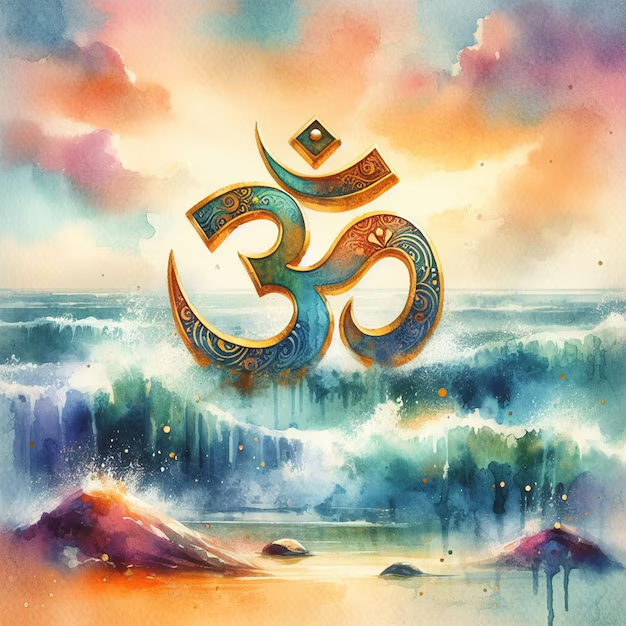
From other scriptural accounts, we know that “spout” or “mouth” draws its “waters” from the Primal or Cosmic Ocean (of Divine Thought) underneath the illusion of matter. It also is, therefore, the “storehouse” or “container” keeping safe the memories and treasures of God and Heaven, which our Souls (the Israelites) commissioned Sat-an to block whilst they elected to wander around the waterless desert of earthly exile playing at self-creation.
To my mind, the ocean and fount look something like the images below:

And from that “fount” or “mouth” arises the Call to Awaken, which we “answer” (mentally) by listening to or “drinking in” the miracle-scattering Living Water referenced in Isaiah 12:3, 44:3 and 58:11; Zechariah 14:8-9; Jeremiah 2: 9-1 3 and 17:13; John 4:4-26, 4:14, and 7:37-39; and Revelation 7:13-17, 21:6-8 and 27, and 22:1-2.
Or, to again quote Course-Jesus:
Wholeness heals because it is of the mind. All forms of sickness, even unto death, are physical expressions of the fear of awakening. They are attempts to reinforce sleeping out of fear of waking. This is a pathetic way of trying not to see by rendering the faculties for seeing ineffectual. “Rest in peace” is a blessing for the living, not the dead, because rest comes from waking, not from sleeping. Sleep is withdrawing; waking is joining. Dreams are illusions of joining, because they reflect the ego’s distorted notions about what joining is. Yet the Holy Spirit, too, has use for sleep, and can use dreams on behalf of waking if you will let Him. (ACIM, T-8.IX.3:1-8)
And this is indeed what Bible-Jesus attempts to impart when he shares the Parable of the farmer scattering seeds in Mark 4.
“And He said, ‘The kingdom of God is as if a man should scatter seed on the ground, and should sleep by night and rise by day, and the seed should sprout and grow, he himself does not know how. For the earth yields crops by itself: first the blade, then the head, after that the full grain in the head. But when the grain ripens, immediately he puts in the sickle, because the harvest has come.’”
Here’s my take-away from all of this: We join the “living” in the Circle of Yovah by meditating on the Om vibration. as we do this, we simultaneously purify our own minds of Sat-an’s adversity thought-vibrations and extend Christ’s healing thought vibrations (the Living Water or Holy Streams of Sound) to others through the seed-scattering Hey and Lamed powers attending the Circle.
Let’s start with Zechariah. In the KJV Bible, the verse reads:
And in that day living waters will flow out of Jerusalem [the place of peace], half of them toward the eastern sea and the other half toward the western sea; it will be in summer as well as in winter. And the Lord will be king over all the earth; in that day the Lord will be the only one, and His name the only one.
But wait, because this passage from Zechariah actually reads more like this (when rightmindedly translated):
The Living Water coming from Yovah Tsaba brings forth Miraculous Perception, the oracle or eye of Yovah Tsaba. The Living Water coming from Yovah Tsaba frees the True Self in the eastern Land of the Living God to enter into the western land to lift them up to the dwelling place in the midst of Jerusalem (the place of peace) of the True Self, Elohim, firmly established in righteousness or right-mindedness.
The Living Water of Yovah Tasba holds the power to grow stronger in hearing yom-dabar. The mouth of prophecy (or mouth of the prophets), yom establishes the dwelling place of Yovah Tsaba to lay the foundation of the Temple Yovah Tsaba rebuilds.
In the above, the two Hebrew words Yovah and Tsaba are not only linked, they also are thrice repeated. Generally, the two words are translated as “Lord of Hosts.” BUT, as we’ve established, Yovah refers to the shared Holy Name, whilst tsaba means Gathering Place rather than “hosts” or “army.” And that Gathering Place IS the Circle of Standing Stones or Standing Circle of Yovah, as well as the Resting Place and the Place of Peace (Heavenly Jerusalem, the walled city, polis, fortress, and enclosure). Furthermore, we find here again the mysterious word yowm or yom. And in this context, “day” definitely doesn’t fit.
Let’s see if we can solve the mystery once and for all, by deconstructing the Hebrew letters comprising yom. The three letters are yod (the Divine Spark), vav (the hook or yoke), and mem (water). Strung together, the letters mean “the Divine Sparks (of Elohim) yoked together by the water.” So, in this construct, yom describes the Living Water vibration both preserving and restoring the unity of Holy Creation, which makes yom the Hebrew equivalent of Om. And that definition works beautifully in the context of this Psalm. It also makes yom-dabar the “Soul-yoking Water of God’s Word” or “the Soul-joining Om vibration of God’s Word.” Alternatively, yom might be a combination of “yo” (a shorthand designation for Yovah) and “mem” (water). In this construct, yom would mean the “Water of God’s Name.” So, pretty much the same meaning, given that the Name and the Word are, in fact, the same thing.
Does that clear things up? I hope so, because it also affirms my description of what happens in the Resting Place.
And this leads us back, once again, to Genesis, where we learned that the seeds or miracles scattered by the True Vine (the David Ray, Christ Light, or Christ Presence) guide us to the Resting Place, where we “see the dawning light” of the third yom (the Hey or Holy Spirit Ray). We begin to “see,” that is to say, that we are all connected through the Om vibration or Cosmic Breath that restores the wholeness of the “Body” or “Church” of Christ in the Resting Place.
In the Theosophical and Ascended Master teachings, the Third Ray is sometimes characterized as the pink ray of unconditional love, creative expression, compassion, nurturing motherly energy, and comfort. I’m more inclined to believe the Hey Ray is emerald-green — the color of the pastures and grasses associated with the Resting Place. It’s also, rather importantly, the color of the fourth, Anahata, or Heart Chakra–the heart-mind so frequently mentioned in Psalm 27.

Most things I’ve read about the Heart Chakra have been tainted by ego perception and “level confusion.” In Sanskrit, the chakra is called Anahata (meaning “unstruck sound”–a sound not made by objects colliding or heard with the body’s ears). Depicted as a green, twelve-petaled lotus, the fourth chakra contains the Shatkona or Seal of Solomon with the pictograph for “Yam” at the center. Similar to yom, yam is the Sanskrit seed-mantra chanted to open this chakra, as well as the summoning mantra for Vayu, the Hindu equivalent of Ruach, the Breath of God that is the Living Water, Holy Spirit, Hey Power, or Third Ray.
All of this suggests that the ubiquitous green pastures under discussion are, in fact, scriptural metaphors for purifying the Heart Chakra with the waters of Divine Love.
Let’s now jump back to Psalm 23, wherein we find yom–dabar (the Water of God’s Word), described as “the mouth of prophecy” or “the mouth of the prophets,” where we gather together to “drink” the Living Water (Om) together, thereby rebuilding the Temple of Solomon in Jerusalem, the walled city, Place of Peace, or Resting Place.
And this is indeed what I explained, as well as what Jesus tells us in Matthew 4:4:
Man shall not live by bread alone, but by every word that proceedeth out of the mouth of God.
It’s also what St. Paul describes in Ephesians 5:26-27, which further supports my definitions of yom and yom-dabar:
Husbands, love your wives, even as Christ also loved the Church, and gave himself for it. That he might sanctify and cleanse it with the washing water of the Word. That he might sanctify it to himself a glorious church not having spot or wrinkle, or any such thing, but that is should be holy and without blemish.
Let me repeat: the Church of Christ is the whole of Holy Creation gathered together in the Resting Place to drink and share the Living Water — NOT any building or religion in the world of dreams!
Christ does NOT, in fact, love the churches our egos built in the world to muddle his scriptural teachings about seeking the Voice of God within, as he clearly states below:
I am sorry when my brothers do not share my decision to hear only one Voice, because it weakens them as teachers and as learners. Yet I know they cannot really betray themselves or me, and that it is still on them that I must build my church. There is no choice in this, because only you can be the foundation of God’s church. A church is where an altar is, and the presence of the altar is what makes the church holy. A church that does not inspire love has a hidden altar that is not serving the purpose for which God intended it. I must found His church on you, because those who accept me as a model are literally my disciples. Disciples are followers, and if the model they follow has chosen to save them pain in all respects, they are unwise not to follow him. (ACIM, T-6.I.8:1-7)
Forgive the long quote to follow, but in this section of the Text, Course-Jesus aptly explains many of the critical points under discussion:
I am in charge of the process of Atonement, which I undertook to begin. When you offer a miracle to any of my brothers, you do it to yourself and me. The reason you come before me is that I do not need miracles for my own Atonement, but I stand at the end in case you fail temporarily. My part in the Atonement is the cancelling out of all errors that you could not otherwise correct. When you have been restored to the recognition of your original state, you naturally become part of the Atonement yourself. As you share my unwillingness to accept error in yourself and others, you must join the great crusade to correct it; listen to my voice, learn to undo error and act to correct it. The power to work miracles belongs to you. I will provide the opportunities to do them, but you must be ready and willing. Doing them will bring conviction in the ability, because conviction comes through accomplishment. The ability is the potential, the achievement is its expression, and the Atonement, which is the natural profession of the children of God, is the purpose.
“Heaven and earth shall pass away” means that they will not continue to exist as separate states. My word, which is the resurrection and the life, shall not pass away because life is eternal. You are the work of God, and His work is wholly lovable and wholly loving. This is how a man must think of himself in his heart, because this is what he is.
The forgiven are the means of the Atonement. Being filled with spirit, they forgive in return. Those who are released must join in releasing their brothers, for this is the plan of the Atonement. Miracles are the way in which minds that serve the Holy Spirit unite with me for the salvation or release of all of God’s creations.
I am the only one who can perform miracles indiscriminately, because I am the Atonement. You have a role in the Atonement which I will dictate to you. Ask me which miracles you should perform. This spares you needless effort, because you will be acting under direct communication. The impersonal nature of the miracle is an essential ingredient, because it enables me to direct its application, and under my guidance miracles lead to the highly personal experience of revelation. A guide does not control but he does direct, leaving it up to you to follow. “Lead us not into temptation” means “Recognize your errors and choose to abandon them by following my guidance.”
Error cannot really threaten truth, which can always withstand it. Only the error is actually vulnerable. You are free to establish your kingdom where you see fit, but the right choice is inevitable if you remember this:
The Soul is in a state of grace forever.
Man’s reality is only the Soul.
Therefore you are in a state of grace forever.
Atonement undoes all errors in this respect, and thus uproots the source of fear. Whenever you experience God’s reassurances as threat, it is always because you are defending misplaced or misdirected loyalty. When you project this to others you imprison them, but only to the extent to which you reinforce errors they have already made. This makes them vulnerable to the distortions of others, since their own perception of themselves is distorted. The miracle worker can only bless them, and this undoes their distortions and frees them from prison.
You respond to what you perceive, and as you perceive so shall you behave. The Golden Rule asks you to do unto others as you would have them do unto you. This means that the perception of both must be accurate. The Golden Rule is the rule for appropriate behavior. You cannot behave appropriately unless you perceive correctly. Since you and your neighbor are equal members of one family, as you perceive both so you will do to both. You should look out from the perception of your own holiness to the holiness of others.
Miracles arise from a mind that is ready for them. By being united this mind goes out to everyone, even without the awareness of the miracle worker himself. The impersonal nature of miracles is because the Atonement itself is one, uniting all creations with their Creator. As an expression of what you truly are, the miracle places the mind in a state of grace. The mind then naturally welcomes the Host within and the stranger without. When you bring in the stranger, he becomes your brother.
That the miracle may have effects on your brothers that you may not recognize is not your concern. The miracle will always bless you. Miracles you are not asked to perform have not lost their value. They are still expressions of your own state of grace, but the action aspect of the miracle should be controlled by me because of my complete awareness of the whole plan. The impersonal nature of miracle-mindedness ensures your grace, but only I am in a position to know where they can be bestowed.
Miracles are selective only in the sense that they are directed towards those who can use them for themselves. Since this makes it inevitable that they will extend them to others, a strong chain of Atonement is welded. However, this selectivity takes no account of the magnitude of the miracle itself, because the concept of size exists on a plane that is itself unreal. Since the miracle aims at restoring the awareness of reality, it would not be useful if it were bound by laws that govern the error it aims to correct.
Got it? Good.
Let’s now return to the Bible, where we find in John 14:4:
But whoever drinks of the water that I will give him will never be thirsty again. The water that I will give him will become in him a spring of water welling up to eternal life.
Or, as Course-Jesus reiterates:
Rest does not come from sleeping but from waking. The Holy Spirit is the Call to Awaken and Be Glad. The world is very tired, because it is the idea of weariness. Our task is the joyous one of waking it to the Call for God. Everyone will answer the Call of the Holy Spirit, or the Sonship cannot be as one. What better vocation could there be for any part of the Kingdom than to restore it to the perfect integration that can make it whole? Hear only this through the Holy Spirit within you, and teach your brothers to listen as I am teaching you. (ACIM, T-5.II.10:4-10)
Here, Jesus tells us — in no uncertain terms — that the Call to Awaken IS the Holy Spirit. And as I assimilate all these clues, Yovah, the Holy Name that can’t be spoken (not because it’s forbidden, but because it’s a supernatural vibration), is the sound made by the seven Rays singing together in the Celestial Sphere. And this is, in fact, what my inner-guru told me when I first started hearing the Om again. More specifically, he said, “What you hear is the Cosmic Chorus of all seven rays singing together in perfect harmony.”
Bearing all this in mind, let’s jump ahead to Psalm 132, which again mentions the green pastures of the Resting Place. What does the psalmist actually tell us? NOT what we find in the KJV Bible. In truth, what the Psalmist wrote is closer in spirit to what follows:
The Song of Arising, Yovah calls to mind David, the Beloved One (Son) of God, who swore an oath with Yovah — a vow unto God by Jacob to come into the Tabernacle of the Temple within the Arch (Shemayim) to be given in sleep the fountain of breaking dawn to attain the Standing Place of Yovah, the Tabernacle of the Mighty One, Jacob’s Resting Place: The Ark of Safety.
To hear Ephra-ath (the fruit of miracle-working), join in the field in the (dark) forest. To come into the Tabernacle, bow down at his footstool. Rise up to Yovah’s Resting Place — the Ark of Strength for the ministers clothed in righteousness, the holy ones loudly singing with joy; the servants of David returning to the presence of the Anointed One (Elohim).
Yovah witnesses to the fullness (wholeness) of David to return the offspring of the innermost part to their (rightful) seat upon the throne. The Son preserves the covenant of the assembly to teach the sons of the Son to remain upon the throne evermore; the Holy Ones singing aloud; the bonded servants of David returning to the presence of the Anointed One.
Yovah chose Zion Avah (the highest mountain of the egoless desire only for universal love and peace) as his abode and everlasting resting place; the dwelling place of the highest desire to abundantly bless the provisions sating those needing food (the epiousion or spiritual bread the Holy Spirit provides). To put on the clothes of the ministers of salvation, the godly ones loudly sing of joy, working to bring forth the ray (qaran) of David shining from the Lamp of the Anointed One (Elohim).
Hating or adversity clothes him (Elohim) in the disgrace of separation self-perception.
This psalm took several hours to translate and could easily take me just as long to explain. So, to save time, let me provide a few quick definitions, supported by applicable quotes from the Course:
As already explained, David represents the second yom or Ray of the Word/Logos (Elohim), which is the Christ Ray and/or Good Shepherd aspect of the Atonement Trinity (Yovah/Jehovah). David’s Son, Solomon, likewise represents the third yom or Ray–the Hey power or Holy Spirit. Aleph or Adonay, the first Ray of the Father’s Will and Authority is allegorically depicted in the Old Testament as Saul, the first King of Israel and Judea whose throne passed to David, his son-in-law, after the murder of his son and rightful heir, Ish-bosheth (a Hebrew name allegedly meaning “the son in disgrace”) If this definition has merit, Ish-bosheth represents the “fallen” Sons of God or “the separated ones”– the Souls who projected out of Heaven by choosing the Ego’s laws and ways over God’s.
Given the word’s history, bosheth is more likely a distortion of the Egyptian god-name Bastet, a lion-headed goddess representing the strength God gives us to see through Satan’s dark veils of illusion. That strength is the spiritual sight or holy vision of the Spiritual Eye.
–The Tabernacle is the Inner Altar, the Holy of Holies, and/or the Uppermost and Innermost Chamber of the Temple that IS the Spiritual Mind-Body or Inner Instrument enabling our awakening.
For perfect effectiveness the Atonement belongs at the center of the inner altar, where it undoes the separation and restores the wholeness of the mind. (ACIM, T-2.III.2:1)
The Standing Place of Yovah is the Circle of Standing Stones, the Circle of the Risen Son, the Circle of Om, and/or the Circle of At-one-ment or Forgiveness.
Blessed are you who teach with me. Our power comes not of us, but of our Father. In guiltlessness we know Him, as He knows us guiltless. I stand within the circle, calling you to peace. Teach peace with me, and stand with me on holy ground. Remember for everyone your Father’s power that He has given him. Believe not that you cannot teach His perfect peace. Stand not outside, but join with me within. Fail not the only purpose to which my teaching calls you. Restore to God His Son as He created him, by teaching him his innocence. (ACIM, T-14.V.9:1-10)
–The Resting Place is the Ark of Safety, the shelter into which we enter two-by-two (through forgiveness) until nobody is left out as “unforgiven.” Also known as the Ark of the Covenant.
Either there is a gap between you and your brother, or you are as one. There is no in between, no other choice, and no allegiance to be split between the two. A split allegiance is but faithlessness to both, and merely sets you spinning round, to grasp uncertainly at any straw that seems to hold some promise of relief. Yet who can build his home upon a straw, and count on it as shelter from the wind? The body can be made a home like this, because it lacks foundation in the truth. And yet, because it does, it can be seen as not your home, but merely as an aid to help you reach the home where God abides. (ACIM, T-28.VII.3:1-6)
The “qaran of David shining from the Lamp of Elohim” is the Lamed Power, Christ Ray, or “second Ray” of Elohim, the One Anointed to do God’s Will in the dream-realm. In Hebrew, the word qaran means “to shine or emit a horn-like beam of light.” And this is, I suspect, the true original meaning of Qu’ran, which also is sometimes spelled qaran and defined as “horn.” I mean no disrespect to my Muslim brothers, but isn’t al-qaran — the horn-like beam(s) of light emitted by Allah — a better name for a scriptural text than “recitation”? I’m just saying. This also clarifies the original meaning of the horn of Gabriel (in the Bible) or Jabril’s horn (in the Qur’an). In Hebrew, Gabriel combines “ga” (meaning “the redemption or the return”) and “briel” (meaning “god’s strength, gifts, or creation”). In Sanskrit, “ga-bril” means “the sacred-syllable of the gemstone beryl.” And guess what? That same “gemstone beryl” is mentioned several times in the Bible and the Rig Veda.
–Jacob represents the “obedient disciple,” Brahmachari, or Teacher of God climbing “the ladder” (back to Heaven) by following Yovah’s song and teachings.
Jacob saw the ladder in a dream-vision. And I also see it in meditation — but as a wheel divided into quarters.
Is any of this making sense?
Maybe not, but it makes sense to me. And it also dovetails with many things Course-Jesus explains, including this:
I am sorry when my brothers do not share my decision to hear only one Voice, because it weakens them as teachers and as learners. Yet I know they cannot really betray themselves or me, and that it is still on them that I must build my church. There is no choice in this, because only you can be the foundation of God’s church. A church is where an altar is, and the presence of the altar is what makes the church holy. A church that does not inspire love has a hidden altar that is not serving the purpose for which God intended it. I must found His church on you, because those who accept me as a model are literally my disciples. Disciples are followers, and if the model they follow has chosen to save them pain in all respects, they are unwise not to follow him. (ACIM, T-6.I.8:1-7)
–“Bowing down at his footstool” means submitting completely to God’s Will, as Jesus demonstrated whilst he walked among us and also explains in the following from Workbook Lesson 328: I choose the second place to gain the first:
What seems to be the second place is first, for all things we perceive are upside down until we listen to the Voice for God. It seems that we will gain autonomy but by our striving to be separate, and that our independence from the rest of God’s creation is the way in which salvation is obtained. Yet all we find is sickness, suffering and loss and death. This is not what our Father wills for us, nor is there any second to His Will. To join with His is but to find our own. And since our will is His, it is to Him that we must go to recognize our will. (ACIM, W-328.1:1-6)
Does Jesus mention the Resting Place in the New Testament? Not as such; but he does allude to it in the passage below from Matthew 11:
Come unto me, all ye that labour and are heavy laden, and I will give you rest.
Take my yoke upon you, and learn of me; for I am meek and lowly in heart: and ye shall find rest unto your souls.
For my yoke is easy, and my burden is light.
From all I’ve shared so far, we can safely conclude that the Resting Place, Gathering Place, and/or Circle of Om all refer to the dwelling place of Hey, the third ray, in the Temple of our Holy Minds. And it is there that we find “the door” leading up to the dwelling place of the Christ Ray on the sixth plane of consciousness (the Ajna or Third Eye Chakra), where we again perceive the world through Christ’s Vision.
Consider all I’ve just explained in the light of what Course-Jesus says below:
Whenever you are tempted to undertake a useless journey that would lead away from light, remember what you really want, and say:
The Holy Spirit leads me unto Christ, and where else would I go? What need have I but to awake in Him?
Then follow Him in joy, with faith that He will lead you safely through all dangers to your peace of mind this world may set before you. Kneel not before the altars to sacrifice, and seek not what you will surely lose. Content yourself with what you will as surely keep, and be not restless, for you undertake a quiet journey to the peace of God, where He would have you be in quietness.
Or, as he says elsewhere:
When you are tempted by the wrong voice, call on me to remind you how to heal by sharing my decision and making it stronger. As we share this goal, we increase its power to attract the whole Sonship, and to bring it back into the oneness in which it was created. Remember that “yoke” means “join together,” and “burden” means “message.” Let us restate “My yoke is easy and my burden light” in this way; “Let us join together, for my message is light.” (ACIM, T-5.II.11:1-4)
Now, let’s weigh all we’ve discussed so far against what Course-Jesus says below regarding “the lawns of Heaven.”
In the Text, he says:
Let us be glad that we can walk the world, and find so many chances to perceive another situation where God’s gift can once again be recognized as ours! And thus will all the vestiges of hell, the secret sins and hidden hates be gone. And all the loveliness which they concealed appear like lawns of Heaven to our sight, to lift us high above the thorny roads we travelled on before the Christ appeared. Hear me, my brothers, hear and join with me. God has ordained I cannot call in vain, and in His certainty I rest content. For you WILL hear, and you WILL choose again. And in this choice is everyone made free. (ACIM, T-31.VIII.9:1-7)
In Workbook Lesson 194: I place the future in the hands of God, he says:
Today’s idea takes another step toward quick salvation, and a giant stride it is indeed! So great the distance is that it encompasses, it sets you down just short of Heaven, with the goal in sight and obstacles behind. Your foot has reached the lawns that welcome you to Heaven’s gate; the quiet place of peace, where you await with certainty the final step of God. How far are we progressing now from earth! How close are we approaching to our goal! How short the journey still to be pursued! (ACIM, W-194.1:1-6)
And, finally, in the Song of Prayer, an addendum to the Course, he says:
Lay down your dreams, you holy Son of God, and rising up as God created you, dispense with idols and remember Him. Prayer will sustain you now, and bless you as you lift your heart to Him in rising song that reaches higher and then higher still, until both high and low have disappeared. Faith in your goal will grow and hold you up as you ascend the shining stairway to the lawns of Heaven and the gate of peace. For this is prayer, and here salvation is. This is the way. It is God’s gift to you. (ACIM, S-1.in.3:1-6)
Makes more sense now, doesn’t it?
Let me share three more things before I sign off. The first is that the “yoke” joining us to each other and God is Yovah, the three-fold Om or Name. The second is that “yoga” means “yoke” in Sanskrit. So “yoga” teaches the spiritual dos and don’ts for joining our minds in the Gathering Place of Yovah. And I mean TRUE Yoga, as taught by the avatar-sage Patanjali — not the shabby substitute passing for “yoga” in the western world. True Yoga, as first outlined in Patanjali’s Yoga Sutras, consists of eight “limbs” known as yama, niyama, asana, pranayama, pratyahara, dharana, dhyana, and samadhi. Westernized “yoga” focuses exclusively on asana — the limb concerning the physical postures of meditation. Next time, I’ll explain how Patanjali defined those terms, which differs somewhat from how they’re commonly understood today, even in India.
In the meantime, let me say one more thing: the pastures and lawns we’ve discussed today also are the “sacred grass” mentioned many times in the Rig Veda. That those purely metaphoric “grasses” are variously identified as Kusha, Darbha, and Durva tells us what the grass represents. Contrary to common presumption, these “grasses” are NOT found in the material world. Rightly perceived, Kusha is a marriage of the Sanskrit syllables ku and sa. Ku means “the base of the triangle” or “storehouse,” whilst sa is shorthand for the Word of God. If we picture the upright triangle as the Holy Trinity, the base would represent the Holy Spirit (Solomon/Hey) — the Bridge between our Souls and the Christ (David/Lamed), the left side joined at the topmost point to the Father (Saul/Aleph).

Beyond that uppermost point is God, the Absolute and Infinite singularity from which the visible universe emerged. The intersecting Circle (in the image above) shows how the Golden Circle reconnects us with all three Trinity powers in ascending order. Similarly metaphoric, Dar-bha means “breaking light” — as in “the fountain of breaking dawn” mentioned in Psalm 132, whilst Dur-va means “the door of the water” or “the door of the Ocean.” So, it’s the door through which the Living Water flows upward from the Primal Ocean. And all that makes very clear that the Vedic “sacred grass” is the Hindu counterpart to the “lawns of Heaven” in the Course, as well as the “green pastures” in the Bible and Qur’an.
That modern-day Hindu priests weave actual grass into rings to wear while performing sacred rituals demonstrates just how craftily the Ego Mind can twist the truth to deceive those who don’t question the prevailing “wisdom.”
On this blog, as in life, I stive to question everything, as Jesus instructs. Until we meet again, Om Hari Om and Namaste.
 The Holy Meeting Place
Leave a comment