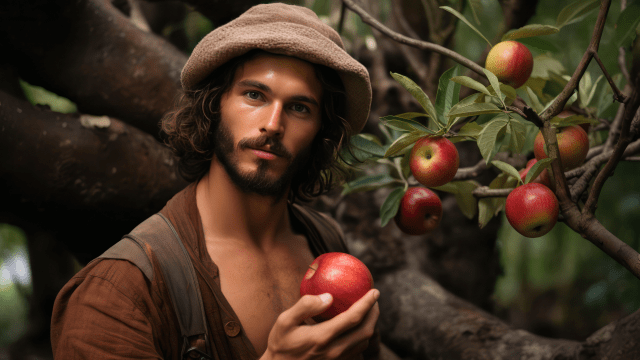
Over the past several days, I’ve received mental images equating Johnny Appleseed with the Holy Spirit. Upon reflection, this makes sense, given that, in Biblical terms, apples symbolize the fruit of knowledge we threw away by condemning our Brothers in Christ (as per Zechariah 4 and the Course). And John Chapman — the “real-life” Johnny Appleseed — did, in a manner akin to the Holy Spirit, scatter those symbolic “seeds of knowledge” around the Northwestern Ohio River Valley.
As I subsequently learned, Chapman was a devoted follower of Emmanuel Swedenborg (1688-1772), the Christian Reformer who founded the New Church “to lift up the name of Jesus Christ, call all people to repentance, and destroy every lie with the sword of truth” (as stated on the Church’s flagship website at http://thenewchurch.church). In principle, this idea is correct, but it remains to be seen if the New Church of today does indeed “lift up” the Savior’s Name in the manner taught by Jesus himself.
According to Wikipedia:
Swedenborg’s writings focus on a narrative of Christianity’s historical decline due to the loss of the “inner sense” of Scripture into a purely exoteric understanding of faith. In this state, faith and good acts become external displays motivated by fear of hell, desires for material blessings, personal recognition, and other worldly things, devoid of true spiritual essence. Swedenborg also wrote extensively about Salvation through a process of “regeneration” (rather than through faith or acts alone), wherein individuals accept divine truth from the Lord into their “inner self” (or higher faculties), controlling the “outer” (or earthly) self by placing their highest love in goodness and truth rather than in worldly desires and the evils and falsehoods which serve them.
All very true, as far as it goes. But Swedenborg also founded a church, which in and of itself promotes “exoteric” devotion, despite incongruently insisting the Kingdom of God can only be found within. Rightmindedly understood, WE comprise the Church of Christ, not some ecclesiastical organization professing to “save” our Souls through sermons and services presented in brick-and-mortar structures in the world of shadows. And Chapman was spreading these righteous ideas — insofar as he and Swedenborg understood them — alongside his apple seeds through the Ohio heartland as an itinerant evangelist for Swedenborgism.
The first known use of Chapman’s enduring nickname, “Johnny Appleseed,” was, in fact, recorded in a letter written by a fellow member of Swedenborg’s New Church. That letter contained the following report:
According to Harper’s New Monthly Magazine, toward the end of his career he [Chapman] was present when an itinerant missionary was exhorting an open-air congregation in Mansfield, Ohio. The sermon was long and severe on the topic of extravagance, because the pioneers were buying such indulgences as calico and imported tea. “Where now is there a man who, like the primitive Christians, is traveling to heaven barefooted and clad in coarse raiment?” the preacher repeatedly asked, until Johnny Appleseed walked up to him, put his bare foot on the stump that had served as a pulpit, and said, “Here’s your primitive Christian!”
Like John the Baptist, Johnny Appleseed practiced “aestheticism” — a lifestyle based on the wrongminded idea that God demands that we “give up the world” by depriving ourselves through the sacrifice of such so-called “indulgences” as wearing shoes or having a roof over our heads. This sort of “giving up” is NOT, in fact, what Jesus meant when he urged those wishing to “follow” his teachings and example to relinquish “the things” of this world. What, then, did he mean? Let’s ask him, shall we?
In 1 John 2;15-17, Jesus reportedly said:
Do not love the world or the things in the world. If anyone loves the world, the love of the Father is not in him. For all that is in the world — the desires of the flesh and the eyes and pride of life — is not from the Father but is from the world. And the world is passing away along with its desires, but whoever does the will of God abides forever.
What Jesus meant was that the world of form, and all its deceitful offerings, are both fleeting and valueless. Not being eternal and perfect, they are the produce of “Sat-an” rather than “Sat” (i.e., God’s Whole Creation, a.k.a., “the Christ”).
In Luke 14:33, he similarly stated:
So, therefore, any one of you who does not renounce all that he has cannot be my disciple.
Here, he meant that persons still concerned with worldly matters (anything and everything EXTERNAL, VISIBLE, or WORLDLY) are NOT following his teachings and example.
In Mathew 16:24, we find this resonant report:
Then Jesus told his disciples, “If anyone would come after me, let him deny himself and take up his cross and follow me.”
Rather then offer my read on the above reference to “the cross,” let me defer to Course-Jesus, who says:
The journey to the cross should be the last “useless journey.” Do not dwell upon it, but dismiss it as accomplished. If you can accept it as your own last useless journey, you are also free to join my resurrection. Until you do so your life is indeed wasted. It merely re-enacts the separation, the loss of power, the futile attempts of the ego at reparation, and finally the crucifixion of the body, or death. Such repetitions are endless until they are voluntarily given up. Do not make the pathetic error of “clinging to the old rugged cross.” The only message of the crucifixion is that you can overcome the cross. Until then you are free to crucify yourself as often as you choose. This is not the gospel I intended to offer you. We have another journey to undertake, and if you will read these lessons carefully they will help prepare you to undertake it. (ACIM, T-4.in.3:1-11)
Mark 10:21 reports the following along similar lines:
And Jesus, looking at him, loved him, and said to him, “You lack one thing: go, sell all that you have and give to the poor, and you will have treasure in heaven; and come, follow me.”
Forgive me if I’ve said this already, but when Jesus says “the poor” or “the needy” in the New Testament gospels, he means the spiritually poor, NOT those lacking in material comforts. I mean, what would be the point of giving the worthless things of the world to other people? Wouldn’t doing so merely ENSLAVE them all the more to the very things Jesus would have us all relinquish in order to awaken from the dream? Would he really ask us to give the ephemeral and valueless to our brothers as a prerequisite to discipleship? Of course he wouldn’t. Moreover, “rich” and “poor,” as the world defines the terms, are wrong-minded judgments arising from the upside-down perception of what constitutes “wealth” and “value” in the eyes of the Lord. Or, as Course-Jesus explains more clearly in Workbook Lesson 133: I will not value the valueless:
You do not ask too much of life, but far too little. When you let your mind be drawn to bodily concerns, to things you buy, to eminence as valued by the world, you ask for sorrow, not for happiness. This Course does not attempt to take from you the little that you have. It does not try to substitute utopian ideas for satisfactions which the world contains. There are no satisfactions in the world. (ACIM, W-133.2:1-5)
Or, as he says in Matthew 6:19: “Do not lay up for yourself treasures on earth, where moth and rust destroy and where thieves break in and steal.”
Following his logic, to “sell” our worldly possessions, and give the monetary proceeds to our brothers, would be to give them “worthless treasures.” Freeing ourselves of our attachments to these valueless worldly attainments would, on the other hand, open our minds to “give and receive” the Holy Inheritance that IS God’s Name (as Jesus explains in Workbook Lesson 184: The Name of God is my inheritance.
In Mark 8: 35, he further says:
For whoever would save his life will lose it, but whoever loses his life for my sake and the gospel’s will save it.
Here, Jesus meant that by clinging to our false self-concepts and/or worldly identities, those identities and all they encompass will perish with the body, our “chosen home” in this life. To give up that deceptive “self” for the sake of the Whole Christ and its universal salvation will, conversely, awaken us to the Truth that we are still the perfect and eternal spirits or thoughts God created “in the beginning,” rather than bodies in a material world God did not create.
Jesus also makes pretty clear that this is, in fact, his meaning in Luke 14:25-35, which reads as follows:
Now great crowds accompanied him, and he turned and said to them, “If anyone comes to me and does not hate his own father and mother and wife and children and brothers and sisters, yes, and even his own life, he cannot be my disciple. Whoever does not bear his own cross and come after me cannot be my disciple. For which of you, desiring to build a tower, does not first sit down and count the cost, whether he has enough to complete it? Otherwise, when he has laid a foundation and is not able to finish, all who see it begin to mock him, …
What will it cost us to follow Jesus? Everything our ego-selves currently value, but nothing with any value to our Souls. Because we can’t free our mind from the illusion, as long as we relish and retain our desire for or attachment to ANY part of it. And our “body-identified” families are a big part of Sat’an’s treachery. Rightmindedly perceived, we are all Souls on a shared journey to awakening. The body is our vehicle on that spiritual journey. The parents, siblings, and generational ancestors of that body are, therefore, part and parcel of our wrong-minded identification with the embodied “self.”
I don’t believe Jesus means we should literally “sell” everything we own or “hate” our families; Rather, he means we should and must relinquish our attachment to the possessions and relationships that contribute to our ego-created “self-concept,” “identity,” or antithetical sense of “individuality” and/or “specialness.”
Or, as he clearly and emphatically states in the Course:
Seek not outside yourself. For it will fail, and you will weep each time an idol falls. Heaven cannot be found where it is not, and there can be no peace excepting there. Each idol that you worship when God calls will never answer in His place. There is no other answer you can substitute, and find the happiness His answer brings. Seek not outside yourself. For all your pain comes simply from a futile search for what you want, insisting where it must be found. What if it is not there? Do you prefer that you be right or happy? Be you glad that you are told where happiness abides, and seek no longer elsewhere. You will fail. But it is given you to know the truth, and not to seek for it outside yourself.
And that includes, btw, any worldly “church” or “religious organization” we follow, promote, support, or defend to protect the insane belief that God is a wrathful and jealous Father who punishes his children’s “sins” with eternal damnation.
Or, as Jesus explains in the Course:
A major tenet in the ego’s insane religion is that sin is not error but truth, and it is innocence that would deceive. Purity is seen as arrogance, and the acceptance of the self as sinful is perceived as holiness. And it is this doctrine that replaces the reality of the Son of God as his Father created him, and willed that he be forever. Is this humility? Or is it, rather, an attempt to wrest creation away from truth, and keep it separate?
Any attempt to reinterpret sin as error is always indefensible to the ego. The idea of sin is wholly sacrosanct to its thought system, and quite unapproachable except with reverence and awe. It is the most “holy” concept in the ego’s system; lovely and powerful, wholly true, and necessarily protected with every defense at its disposal. For here lies its “best” defense, which all the others serve. Here is its armor, its protection, and the fundamental purpose of the special relationship in its interpretation.
It can indeed be said the ego made its world on sin. Only in such a world could everything be upside down. This is the strange illusion that makes the clouds of guilt seem heavy and impenetrable. The solidness that this world’s foundation seems to have is found in this. For sin has changed (Holy) Creation from an idea of God to an ideal the ego wants; a world it rules, made up of bodies, mindless and capable of complete corruption and decay. If this is a mistake, it can be undone easily by truth. Any mistake can be corrected, if truth be left to judge it. But if the mistake is given the status of truth, to what can it be brought? The “holiness” of sin is kept in place by just this strange device. As truth it is inviolate, and everything is brought to it for judgment. As a mistake, it must be brought to truth. It is impossible to have faith in sin, for sin is faithlessness. Yet it is possible to have faith that a mistake can be corrected.
FYI: When he says “special relationships” in the Course, he means the relationships forged between bodies and egos, especially those with our parents, siblings, friends, spouses, and children. To perceive ourselves ONLY as the spiritual beings we truly are, we first must strive to perceive other people only as equal members with us in the whole and healed Christ Mind.
I could quote more verses from the New Testament on this critical subject. Many, many more, in fact, including Matthew 5;42, 6:20, 13:44-46,19:21, and 19:27; 1 Timothy 6:17-19; Mark 8:34, 12:43-44; 1 John 5:39 and 14:6; 1 Corinthians 13:1-13; 2 Corinthians 5:17; Luke 12:34 and 18:22, 9:23, and 6:38; Romans 6:23; and 1 Peter 3:1-18. But I won’t.
Instead, let me cite various other sources on the practice of Brahmacharya — the “right-minded practice” of “giving up” our attachments to our worldly desires. The fourth of the five yamas prescribed in The Yoga Sutra, the ancient and seminal text on Yoga by the legendary Indian sage/avatar Patanjali, Brahmacharya is, unfortunately, as misunderstood in the East, as Jesus’ oft-repeated requirements for discipleship are in the West.
To better understand what the practice of Brahmacharya actually entails, let’s start with the ego-tainted description offered by FITSRI.com, an online platform created and maintained by various spiritual and wellness teachers from India:
The word Brahmacharya is derived from two Sanskrit words: Brahman, meaning the Divine or Absolute Consciousness, and Charya, meaning conduct. Thus, Brahmacharya literally translates to “conduct that leads to the realization of Absolute Consciousness.”
Practically, Brahmacharya is often synonymous with celibacy, referring to a voluntary vow of sexual abstinence.
However, sexual abstinence and living in solitude do not fully define Brahmacharya. It can also be practiced while living in the world, interacting with people, and leading a normal, active life. More than abstinence, Brahmacharya is about cultivating an attitude of living above all temptations. Swami Vivekananda, Sri Ramakrishna, and Paramahansa Yogananda are notable examples of individuals who embodied this principle.
IMHO, that definition misses the mark on nearly every level. What the “yama” of Brahmacharya actually entails is relinquishing our desires for worldly treasures and pleasures, not through “avowed abstinence,” but through the higher realization of their “worthlessness” to our journeying Souls. Giving up worldly “indulgences,” as ascetics do, isn’t enough. To truly “give up the world,” we have to liberate our minds from any and all lurking desires for money, sex, worldly power, and personal relationships (to name a few examples) by perceiving these Satan-manifested “anti-Christs” as the obstacles to awakening they truly are.
Can we then live in the world while practicing Brahmacharya, as the content creators at FITSRI.com would have us believe?
The answer is a resounding NO. And don’t let anyone tell you differently.
Swami Vivekananda defines the practice thusly:
The Indian concept [of]Brahmacharya (Bengali: ব্রহ্মচর্য, Hindi: ब्रह्मचर्य) and [the] Western concept [of] Celibacy are not exactly [the] same. Celibacy means a state of being unmarried and sexually abstinent; but Brahmacharya is stricter, it not only includes one’s physical activities, but also his/her thoughts and words.
I wouldn’t say “stricter” exactly, but certainly broader in scope. Celibacy, for example, governs behavior alone, while Brahmacharya (as the Swami rightly states) concerns the relinquishment of the wrongminded thoughts and desires that motivate karma-producing actions or behaviors. The celibate might, for instance, perceive the world’s temptations as “sinful” or impure indulgences to be given up through sacrifice and deprivation, whereas the well-schooled Brahmachari more correctly recognizes the world’s temptations as the fetters binding the pure and perfect Soul to the Wheel of Reincarnation it yearns to escape.
And this is indeed the idea Jesus attempted to impart in Matthew 5:27-30, when he said:
“You have heard that it was said to those of old, ‘You shall not commit adultery.’ But I say to you that whoever looks at a woman to lust for her has already committed adultery with her in his heart.”
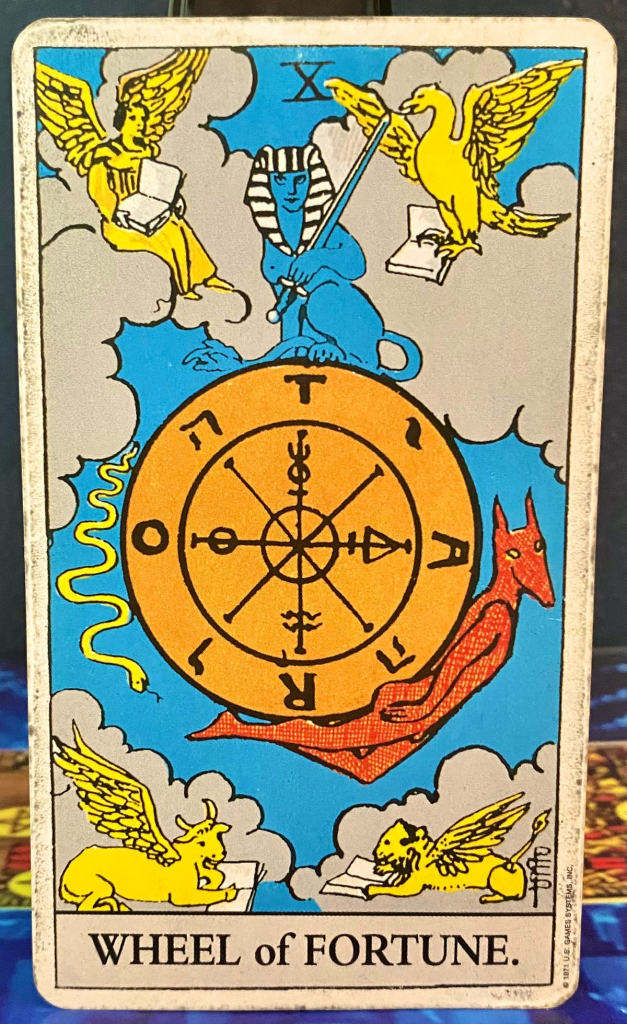
To commit adultery is a behavior motivated by lustful desires arising from upside-down thinking. We can’t think such thoughts unless we first mis-perceive a fellow Soul as an object to be used to gratify our physical desires. We can’t think lustful thoughts, that is to say, unless we wrongmindedly perceive both our own person and the person we desire as BODIES rather than the spiritual beings they truly are. In making this error, we first reinforce our own false self-concept and then project the fallacious perception onto the other person. Consequently, we tighten the chains binding both Souls to another “useless Journey” around Satan’s Wheel of (mis)Fortune.
Or, as Jesus states in John 14:26:
But the Advocate, the Holy Spirit, whom the Father will send in my name, will teach you all things and will remind you of everything I have said to you.
Does that make sense? I hope so, because most descriptions I’ve found of Brahmacharya don’t do the practice justice. Ditto for most dictionary definitions of the term. A Sanskrit word, Brahmacharya is NOT a marriage of Brahman (God, the formless Absolute) and charya (conduct), because Brahmacharya a) doesn’t contain the word Brahman and b) has nothing to do with “conduct” (as I’ve explained). The yama conerns not behavior, but right-minded perception. In Truth, the word is a compound of Brahm (belonging to) and acharya (the spiritual master or Master Teacher)
Rephrased in simpler terms:
Brahm-acharya means “obedient discipleship to the Master Teacher.”
In Christianity, Jesus Christ is believed to be that Master Teacher or acharya. In actuality, as Jesus explains in the Course, the Master Teacher is the Holy Spirit, which Jesus of Nazareth both embodied and “brought down” to the rest of us when he “tore the curtain” hitherto standing between the Temple’s inner and outer sanctums.
And, as we know from the many New Testament verses cited above, we can’t be an obedient disciple to the Master Teacher –the Waheguru or Wondrous Teacher of Sikhism — unless and until we relinquish our attachment to EVERY aspect of our Sat-an-constructed ego-body Identity– the “self” we manifested through the “original error” of concupiscence.”
Makes sense, right?
Yes, but what has any of this got to do with Johnny Appleseed? Several things, actually. The first is that, Johnny Appleseed did indeed symbolize the Holy Spirit scattering his “seeds” of knowledge across Ohio — a word meaning “great river.” The second reason is (as I’ve also come to see) that the Holy Spirit sowed his “seeds” of knowledge in many more “fields” than the Holy Bible. We’ll never know this, however, as long as we “reject” or “condemn” his other prophets and scribes as “inferior,” “heretical,” or “heathen.” And those prophets include the rishis of India to whom the Master Teacher gifted the Vedas, Upanishads, and Bhagavad Gita, the foundational scriptures of Hinduism; Muhammed, to whom he revealed the Holy Qur’an of Islam; Valentinus, who received the “gnostic” Gospel of Truth; Mary (the wife of Jesus), whose insightful gospel was excluded from the New Testament canon; Guru Nanak, the founder of Sikhism; Levi Dowling, who “downloaded” (from the Akashic Record) The Aquarian Gospel of Jesus the Christ; and Helen Schuchman, Christ’s chosen scribe for the Course; among many others.
Condemn any of these “prophets” or their “apples” and we besmirch the Holy Spirit’s gifts to us and humankind as a whole.
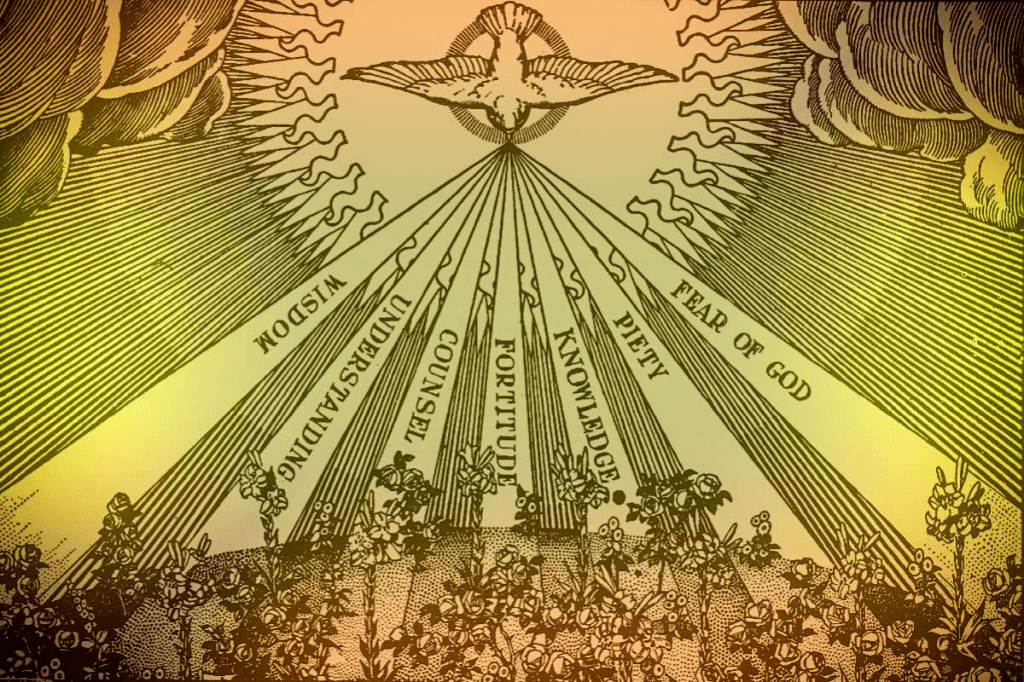
The Holy Sower’s seeds of knowledge are, in fact, scattered across the dreamscape, waiting to be discovered by open-minded seekers. Many of these truths have been tainted or uprooted by egoic subterfuge, as Jesus explains in the Parable of Sowers recorded in Matthew 13. The section reads as follows in the KJV Bible:
The same day went Jesus out of the house, and sat by the sea side. And great multitudes were gathered together unto him, so that he went into a ship, and sat; and the whole multitude stood on the shore.
And he spake many things unto them in parables, saying, Behold, a sower went forth to sow; And when he sowed, some seeds fell by the way side, and the fowls came and devoured them up: Some fell upon stony places, where they had not much earth: and forthwith they sprung up, because they had no deepness of earth: And when the sun was up, they were scorched; and because they had no root, they withered away. And some fell among thorns; and the thorns sprung up, and choked them: But others fell into good ground, and brought forth fruit, some an hundredfold, some sixtyfold, some thirtyfold. Who hath ears to hear, let him hear.
First and foremost, the sower in this parable is the Holy Spirit working on behalf of the Christ Mind on the left-hand or worldly side of the Lamp of Redemption. If we are blind and deaf to His Voice — the Voice for Truth in our dreaming minds — how can we know if the scriptures of our chosen faith are producing the hundredfold, sixtyfold, or thirtyfold fruits of which Jesus speaks? Obviously, we can’t know. We can only closed-mindedly cling to and ignorantly defend our potentially misplaced beliefs in the guise of being true to our “faith.”
Swedenborg was right about at least one thing; faith expressed externally is utterly impotent. And that includes church-going — a TRUTH churches would rather we not recognize. In Truth, we come to KNOW God and Christ in the Great Gathering Place, through the Circle of Standing Stones. We also “witness” for them there, by giving and receiving the Living Water (OM or AUM, the Holy Name of the Trinity) they shower down from above. This reciprocal “alms-giving” takes place in the heart-mind or Inner-Altar, where God’s Grace preserves the Truth of our Oneness of Being; NOT in the world of shadows. The world isn’t real and neither is anything we do in it. Until we reach the endless Circle of God’s Holy Family Name, we can’t know God, Christ, the Master Teacher, or our own True Self. And they, in turn, can’t know us.
This is, in fact, the idea Jesus attempted to impart in the following passage from Luke 13:
Strive to enter in at the strait gate: for many, I say unto you, will seek to enter in, and shall not be able.
When once the master of the house is risen up, and hath shut the door, and ye begin to stand without, and to knock at the door, saying, ‘Lord, Lord, open unto us’; and he shall answer and say unto you, ‘I know you not whence ye are’:
Then shall ye begin to say, ‘We have eaten and drunk in thy presence, and thou hast taught in our streets.’
But he shall say, ‘I tell you, I know you not whence ye are; depart from me, all ye workers of iniquity.’
There shall be weeping and gnashing of teeth, when ye shall see Abraham, and Isaac, and Jacob, and all the prophets, in the kingdom of God, and you yourselves thrust out.
And they shall come from the East, and from the West, and from the North, and from the South, and shall sit down in the Kingdom of God.
And, behold, there are last which shall be first, and there are first which shall be last.
Firstly, he “knows us not” when we “stand without” or “stand outside” (the Inner Altar or Innermost Chamber), as we do whilst attending church services, sermons, study groups, prayer meetings, or taking part in ceremonial rituals. We may have “shown up” for these external and, therefore, impotent demonstrations of our faith, but the Master Teacher only KNOWS those of us who “strive to enter at the narrow gate” — those meditating upon the sound coming from the Ajna Chakra or Spiritual Eye — the gateway or portal to the higher levels of consciousness, from which God and Christ “speak to us” from deep inside our dreaming minds.
Secondly, when Jesus says, at the end of this section of Luke, that those who are “first will be last” and visa-versa, he means that those the Ego Mind deems pious through their external displays of devotion and worldly forms of learning and teaching (including seminaries and schools of theology) will be the last to enter Heaven, while those who quietly love and serve God in their hearts and minds, will be the first to cross the threshold.
Jesus says virtually the same thing in Matthew 19:30 and 20;16, Mark 10:31, and Luke 13:30. As the Bible Hub astutely points out, “All of these passages concern discipleship, the rewards in God’s Kingdom, and the surprising ways God brings grace to those society deems unimportant. Examining these verses collectively reveals the emphasis Jesus placed on humility, service, and our willingness to relinquish worldly status.”
Or, as Christ plainly proclaims in Luke 14: “Those of you who do not give up everything you have cannot be my disciples.”
He’s not just talking about giving up our worldly status, as he makes clear in these words from Matthew 10:39: “He that findeth his life shall lose it: and he that loseth his life for my sake shall find it.”
Translation: We find our life or True Being in the Holy Spirit of Christ within by surrendering our false identity in the external world; and only by relinquishing our worldly identities for the sake of the whole Christ Self, will we find our True Identity as God’s One Holy Son.
This is indeed how we “bow down” to Jesus Christ and/or the Holy Spirit, to demonstrate our reverent respect for their superior knowledge and guidance.

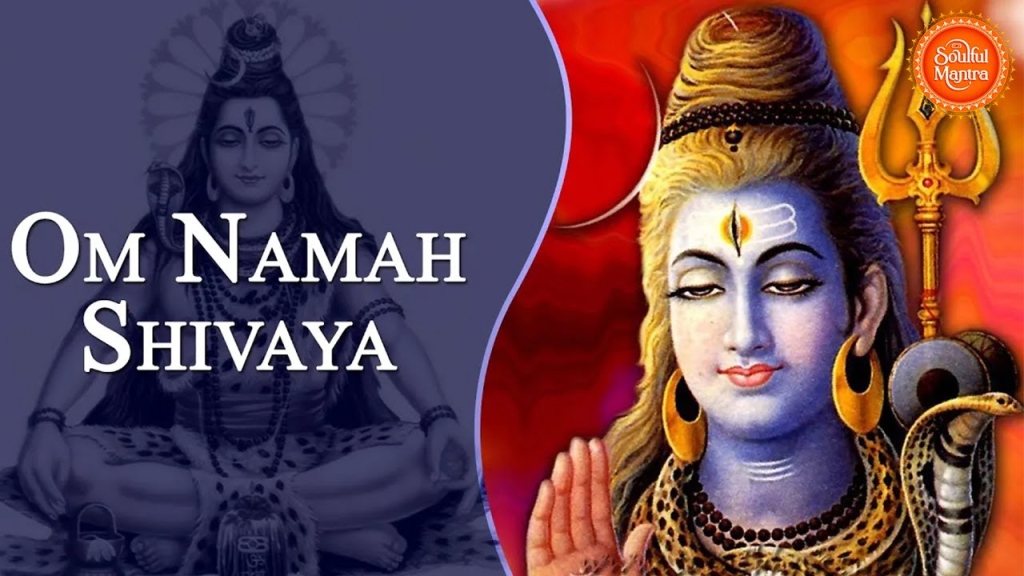
In the Course, Jesus expresses the same ideas without pulling any punches:
Give up the world! But not to sacrifice. You never wanted it. What happiness have you sought here that did not bring you pain? What moment of content has not been bought at fearful price in coins of suffering? Joy has no cost. It is your sacred right, and what you pay for is not happiness. Be speeded on your way by honesty, and let not your experiences here deceive in retrospect. They were not free from bitter cost and joyless consequence. (ACIM, T-30.V.9:4-12)
Having said all that, let me now say this: In the first quadrant of the Circle-Journey (before we can hear God’s Voice), the Master Teacher must speak to us through his body-clad Teachers of God “standing in the Circle”. The True Teachers of God sharing the Om, that is, rather than the false prophets, charlatans, and hypocrites about whom Jesus warns us repeatedly in the scriptures. And those misguided hypocrites, I’m sorry to say, include the vast majority of religious leaders; those ordained by the Ego’s Religions, rather than by God’s grace. Or, as Jesus proclaims in Matthew 23:27-28:
“Woe to you, scribes and Pharisees, hypocrites! For you are like whitewashed tombs, which outwardly appear beautiful, but within are full of dead people’s bones and all uncleanness. So you also outwardly appear righteous to others, but within you are full of hypocrisy and lawlessness.”
Could his meaning be clearer? Probably not, but he is no less transparent in several other verses. How do we know the difference? By their fruits, of course — the spiritual fruits of grace the Holy Spirit brings forth through His True Teachers (in the Circle of Om) to nourish our hungry Souls; not through their deeds or works in the world of illusions and lies. Those fruits, according to Galatians 5:22-23, include love, joy, peace, forbearance, kindness, goodness, faithfulness, gentleness, and self-control. Compare these to the ten characteristics of Advanced Teachers of God described in the Course’s Manual for Teachers, which are trust, honesty, tolerance or non-judgment, gentleness, defenselessness, generosity, patience, faithfulness, and open-mindedness. Peace, Jesus tells us, is a by-product of honesty, whilst love, sinlessness, perfection, knowledge and eternal truth are our birthrights as God’s Creations, rather than gifts we receive to advance our enlightenment.
How many times do the scripture tell us “not by good works, but by grace or faith alone” will we be delivered? At least ten times, by my calculations. To save you time, those ten references occur in Ephesians 2:8-9, Titus 3:5, Romans 3:28, John 14:6, 2 Timothy 1:9, 1 Peter 1:18-19, Romans 11:6, and Hebrews 4:16.
In Titus 3:5, for example, the gentile convert and trusted companion of St. Paul wrote: “He saved us, not because of works done by us in righteousness, but according to his own mercy, by the washing of regeneration and renewal of the Holy Spirit.”
By “the washing of regeneration and renewal of the Holy Spirit” he means “lustration” (purification through “undoing”) enacted through the Living Water of God’s Grace coming down in two streams from the olive trees described in Zechariah’s prophecy. We see this process illustrated in the Hindu image of Lakshmi-dev, the personified Soul (not the goddess granting worldly wealth and prosperity!), seated upon a lotus with her Bindu or Moon Chakra radiating a circle of holy light from the back of her head, as she is showered from above by two white elephants, one on the right and one on the left. This image, rightly interpreted, shows us exactly what happens when we meditate upon the Om vibration, the Voice for God that is both the Holy Spirit AND the Living Water.

If I had to guess, I’d say the elephant on the right represents Airavata, the “vahana” or “vehicle” for Indra, the king of the gods (the Hindu equivalent of Aleph, the Red Ray of God’s Will), whilst the elephant on the left signifies Ganesha, the elephant-headed “son” of Shiva (the Hindu equivalent of Christ, the Bridegroom) and Parvati, the personification of the “obedient discipleship” leading to the marriage of the Bride or Soul to the Bridegroom.

Contrary to common belief, the Sanskrit word-name Ganesh is a marriage of “ga” — the sacred-syllable, guru-word, and/or Cosmic Breath that is Om/AUM — and “nesh” — a Sanskrit word meaning “fullness,” “completion,” or “wholeness.” Ergo, Lord Ganesh, a prominent deity in Hinduism, personifies the Om– the Cosmic Breath that restores Creation’s Wholeness by removing or undoing the seven Ego-constructed blinders or veils blocking our Chakras — the inward-looking eyes or windows through which we perceive Higher Truth. Hence, Lord Ganesh’s designation in Hinduism as “the remover of obstacles.” As the personification of Om, Ganesh does indeed a) remove the obstacles to right-minded or True Perception (NOT the obstacles to our worldly desires) and b) comes forth through the marriage or union of Christ/Shiva and the Soul’s Obedient Discipleship (Parvati).

So, Ganesh dissolves the six veils over his brother’s Spiritual Eye, more or less, and, therefore, the foundational teachings of Christianity and Hinduism are essentially the same, when both are interpreted right-mindedly.
That said, we might need to rely on embodied Teachers on the first leg of the journey (the first quadrant of Dharma). The goal of the True Teacher, as Jesus explains in the Course, is to bring their assigned pupils to “the bridge”‘ (of the return), at which point the human Teacher becomes unnecessary. Stated in clearer terms, the True Teachers of God must train their pupils to hear the Om for themselves; once they hear the sound, they no longer need a human teacher, because the Holy Spirit will guide them the rest of the way back to Super Consciousness.
And herein lies the litmus test of a True Teacher of God. If they aren’t teaching us to hear the Om, they are a charlatan.
Teaching us to hear the Om is, in point of fact, the learning-teaching goal of the Course’s Workbook for Students. Rightly understood, the daily meditative exercises are designed to train our minds to hear the ever-present echo of the Om vibration. Once we hear the sound, this imperative becomes crystal-clear. Until then, the Ego Mind will do everything in its power to hide the Truth from us, as he’s done rather successfully since time began.
Let me help you to disperse some of those obfuscating clouds RIGHT NOW by sharing the following illuminating passages from the Course:
God created His Sons by extending His Thought and retaining the extensions of His Thought in His Mind. All His Thoughts are thus perfectly united within themselves and with each other. The Holy Spirit enables you to perceive this wholeness now. God created you to create. You cannot extend His Kingdom until you know of its wholeness. (ACIM, T-6.II.8:1-5)
The Thought of God created you. It left you not, nor have you ever been apart from it an instant. It belongs to you. By it you live. It is your Source of life, holding you one with it, and everything is one with you because it left you not. The Thought of God protects you, cares for you, makes soft your resting place and smooths your way, lighting your mind with happiness and love. Eternity and everlasting life shine in your mind, because the Thought of God has left you not, and still abides with you. (ACIM, W-165.2:1-7)
The aforementioned Thought of God takes many different symbolic forms in the world’s religions and scriptures, some of these are 1) the Red Ray urging us to do the Father’s Will in the world, 3) the Word of God, 4) the Aleph power of Elohim, 5) the anointing oil moving through the golden pipe representing the Pingala “nadi” on the right side of the Spiritual Body 6) the first red lightning bolt of Creation; 5) King Indra, the chief “deva” (Holy One) and guardian of the eastern direction, 6) Amrita, the elixir of immortality, 7) the indestructible Logos or Divine Idea God first extended to create “the Christ,” 8) the Master Charioteer, 9) the Archangel Michael, 10) the Red Horse of the Apocalypse, 11) the Blood of Christ, 12) the Blood of the Lamb, and 13) the Flaming Sword of the Bridegroom.
On our worldly journeys around the Wheel of Time, the Red Ray dwells within us (and all living beings) through the Christ Self as “Adam,” the Divine Spark.
There are probably other symbols as well, but those are the ones that come to mind.
This stuff is incredibly challenging to grasp. But, at present I believe the Holy Spirit embodies the Idea of Healing, which “bridges” the distance between Ego Consciousness and God Consciousness, with Christ Consciousness as the “midpoint of transcendence” (for lack of a better descriptor).
O, as Course-Jesus further explains:
The way to recognize your brother is by recognizing the Holy Spirit in him. I have already said that the Holy Spirit is the Bridge for the transfer of perception to knowledge, so we can use the terms as if they were related, because in His Mind they are. This relationship must be in His Mind because, unless it were, the separation between the two ways of thinking would not be open to healing. He is part of the Holy Trinity, because His Mind is partly yours and also partly God’s. This needs clarification, not in statement but in experience.
The Holy Spirit is the idea of healing. Being thought, the idea gains as it is shared. Being the Call for God, it is also the idea of God. Since you are part of God it is also the idea of yourself, as well as of all His creations. The idea of the Holy Spirit shares the property of other ideas because it follows the laws of the universe of which it is a part. It is strengthened by being given away. It increases in you as you give it to your brother. Your brother does not have to be aware of the Holy Spirit in himself or in you for this miracle to occur. He may have dissociated the Call for God, just as you have. This dissociation is healed in both of you as you become aware of the Call for God in him, and thus acknowledge Its being. (ACIM, T-5.III.1:1–2:10)
To boil it down to bare essentials;
The Red Ray, Sun Ray, or Blood Ray = the Thought of God, the Divine Idea, or Logos = the firstborn Son = the ONE Son or first coming of the Christ Self that IS the indwelling and indelible Truth of our Being as God’s Whole Creation
Blue, Moon, or Water Ray = the Idea of Healing or “the Atonement,” the ever-present “Call to Awaken,” which is God’s ANSWER to the separation. That sound, which we simultaneously give and receive simply by listening, “washes away the sins of the world” (by “undoing” or “dissolving” the false beliefs in “sin” and separate identities masking the underlying holiness of the indwelling Soul or Divine Spark of the Red Ray).
Or, to again quote Course-Jesus;
To all who share the Love of God the grace is given to be the givers of what they have received. And so they learn that it is theirs forever. All barriers disappear before their coming, as every obstacle was finally surmounted that seemed to rise and block their way before. This veil you and your brother lift together opens the way to truth to more than you. Those who would let illusions be lifted from their minds are this world’s saviors, walking the world with their Redeemer, and carrying His message of hope and freedom and release from suffering to everyone who needs a miracle to save him. (ACIM, T-22.IV.6:1-5)
As Jesus explains elsewhere in the Course, we can’t heal anyone until we heal ourselves. If you prefer Bible-Jesus, know that this is indeed what he meant when he said, in Matthew 7:5: “Thou hypocrite, first cast out the beam out of thine own eye; and then shalt thou see clearly to cast out the mote out of thy brother’s eye.”
We can’t teach Truth to others, that is to say, until we open our own Spiritual Eye or awaken Adam from the deep TRANCE he fell into upon exiting the Garden of Eden.
So, yes. Technically speaking, I am a hypocrite and a charlatan because I’m not yet “awake.” But I do hear and share God’s Voice and understand its importance in the At-one-ment process. Having “given up the world” and nearly all my special relationships, I also meet the minimum requirements for “obedient discipleship.” And, as Paramahamsa Yogananda, along with many other “realized” gurus, explains, only an advanced Brahmachari can hear the Om. So, there you go.
Or, as we learn in Genesis 2: 21-23:
And the Lord God caused a deep sleep to fall upon Adam, and he slept: and he took one of his ribs, and closed up the flesh instead thereof;
And the rib, which the Lord God had taken from man, made he a woman, and brought her unto the man.
And Adam said, This is now bone of my bones, and flesh of my flesh: she shall be called Woman, because she was taken out of Man.
Hold on. Is that what it really says? Actually, those critical passages read more along these lines in the original Hebrew:
Yovah-Elohim sent down a trance to drop Adam (the Soul) into sleep and to take one side enclosing the body; the side into which Yovah-Elohim enclosed the Soul to reestablish the altar (or family) of the One Son (the Christ or Ishshah) to receive, accept, or marry the Soul (Adam).
The Soul’s Living Water (Adam ‘amar) impels the divine essence of the Self — the spiritual body called Ishshah (the Christ) — to marry or receive the Bridegroom.
Thus, to know the Bridegroom Self of the Father, the universal oneness (em, the Water of Elohim that is the Holy Spirit) holding together the Christ Spirit as one body in two parts exposes to the Soul (Adam) the Christ (Ishshah) in bondage.
I kid you not. That’s what it says. And all of this tracks with what we’ve already established as true — unlike the traditional translation. So, nothing whatsoever to do with Eve, ribs, bones, flesh, or women. As an interesting aside, “Isha” is the name by which Jesus was known when he traveled to India to study Natha Yoga — the yoga of love and forgiveness. Even today, Jesus Christ is called “Isha” in India. In Sanskrit, Isha also refers to “the Supreme Lord,” who is sometimes called Rudra, “the mightiest of the mighty” — the Holy One bringing forth Shiva (the transcendental power of Brahman). Often loosely defined as “the howler,” Rudra actually means “the howling wind-like noise” (rud) of “that which is radiant within” (ra). Rudra and Isha represent, therefore, the sound (OM/AUM) that brings forth, through ego-detoxification, the Soul’s memory of the Christ Self, the Whole Creation or Family of God, to which we all belong in Divine Reality.

As we are beginning to see, there is a strong relationship between Sanskrit and Hebrew, as some scholars now realize. Most, however, still have their heads deep in the sands of denial. Which came first? Technically speaking, neither pre-dated the other because time isn’t real.
And now you know.
Thanks for coming to the Holy Meeting Place. Until you return, Om Hari Om and Namaste.
 The Holy Meeting Place
Leave a comment