
Like most things in scriptural texts, the first and second Temples of Jerusalem are symbols rather than physical structures. And today, we’re going to explore what the Judeo-Christian scriptures really tell us about those two Temples. So, get out your Bible and turn to the first Book of Kings.
In most English translations, the first Book of Kings opens with an account of King David, aged and infirm, being cared for by a selfless young virgin called Abishag the Shunammith.
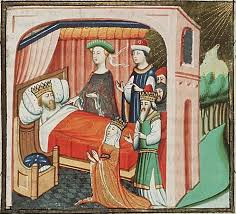
It all sounds rather pointless, truth be told, but is it? Not if we accept two indominable absolutes. The first is that (as I keep saying) all scriptural stories are instructive allegories rather than chronicles of historical events. And the second is that the names of the characters in those allegories are the keys to the narrative’s deeper meaning.
What, then, can the name “Abishag the Shunammith” tell us? Quite a lot, actually, because the name translates as “father of the error of the two resting places in the desert encampment of the Israelites.” So, the character long identified as King David’s virginal and selfless caregiver and consort actually represents the father of duality — the “lie” that split the Beloved Son of God (King David) into the two levels of self-awareness Course-Jesus calls “mind awake” and “mind asleep.”
In the next section of the story, the translators make the same mistake in reverse by painting Adonijah — a name meaning “Lord of Yah” (Lord of the Holy Name, basically)– as a villain. Here’s how Kings 1:5-8 reads in the KJV Bible:
Now Adonijah, whose mother was Haggith, put himself forward and said, “I will be king.” So he got chariots and horses ready, with fifty men to run ahead of him. (His father had never rebuked him by asking, “Why do you behave as you do?” He was also very handsome and was born next after Absalom.)
Adonijah conferred with Joab son of Zeruiah and with Abiathar the priest, and they gave him their support. But Zadok the priest, Benaiah son of Jehoiada, Nathan the prophet, Shimei and Rei and David’s special guard did not join Adonijah.
Based on our implacable rules, Adonijah can’t be David’s usurper — or even his son. Because, as our absolutes dictate, the “Lord of Yah” or “Lord of the Holy Name” can’t play the part of a villainous usurper in a scriptural allegory. Furthermore, this section of Kings makes no reference to humans named Haggith, Zeruiah, Abiathar, Zadok, Benaiah, Nathan, Shimei, or Rei. Every one of those supposed names is, in fact, a word whose meaning tells the real story.
Here’s how 1 Kings 1:5-8 reads when interpreted as a spiritual teaching, rather than an historical narrative:
The Lord of the Holy Name, the anointed one of the gathering place of refuge and upliftment, communicates (to the heart): “To return to the throne, bring forth the chariot-horses equipped by the messenger faces of the Father toiling daily to speak and act vigilantly for the holiness bringing forth the underlying Peace of the Father communicating God’s Grace to open the Spiritual Eye.”
The Abundant Father’s chief minister underneath (the illusion of form), the Lord of the Holy Name helps the righteous ministers the Holy Name has built up, the sons the Lord knows and has given prophecy (or inspiration), to hear the Mighty Shepherd, the Beloved One of the Lord of the Holy Name.
Very different, right? And much more meaningful than the literal KJV interpretation, which has Adonijah — the Lord of the Holy Name — gathering chariots, horses, and infantrymen to take his earthly father’s throne by force.
I mean, c’mon. Aren’t the chances greater that the chariot-horses mentioned in Kings are the same ones described by the prophets Ezekiel, Zechariah, and John of Patmos? The answer is a resounding “yes” — because they are indeed those purely symbolic horses, which go forth from the Living Beings or “Cherubim” — the messenger (angel) faces mentioned herein. And those same figurative horses and chariots also show up in the scriptural texts of other religions, especially Hinduism.

Need I say more? Well, I could, but I won’t at the moment. Because our current focus is the two temples, not the chariots and horses, which we’ll come back to later. So, let’s jump ahead to 1 Kings 5, where the Temple of Solomon enters the picture.
The first six lines read as follows in the King James Bible:
And Hiram king of Tyre sent his servants unto Solomon; for he had heard that they had anointed him king in the room of his father: for Hiram was ever a lover of David. And Solomon sent to Hiram, saying, “Thou knowest how that David my father could not build an house unto the name of the Lord his God for the wars which were about him on every side, until the Lord put them under the soles of his feet. But now the Lord my God hath given me rest on every side, so that there is neither adversary nor evil occurrent. And, behold, I purpose to build an house unto the name of the Lord my God, as the Lord spake unto David my father, saying, ‘Thy son, whom I will set upon thy throne in thy room, he shall build an house unto my name.’ Now therefore command thou that they hew me cedar trees out of Lebanon; and my servants shall be with thy servants: and unto thee will I give hire for thy servants according to all that thou shalt appoint: for thou knowest that there is not among us any that can skill to hew timber like unto the Sidonians.”
Yes, well. We already know (from my last post) that at least part of the above isn’t right, because neither “cedar trees” nor “Lebanon” existed as citable names on earth at the time the Book of Kings was written — let alone way back when Solomon’s Temple was reportedly built (950 BCE).
So, what might this verse actually communicate?
The short answer is: Something completely different from what the standard translations suggest. As I decipher the symbols and archaic language, 1 Kings 5:1-6 actually says nothing about Solomon or the Temple. Not in so many words, anyway. Hard as it may be to accept, this section of Kings should read more along these lines:
Exalted Brother, ruler of the citadel, let loose from bondage the King of Peace to announce and anoint as king and father the Exalted Brother on the Day of the Lord. The Beloved of the Beloved One of God, the King of Peace sent the Exalted Brother to say (to the heart), “To know the Beloved One of the Father makes it possible to obtain inner conscious knowledge of the wholeness of the Holy Name of Elohim, the presence battling to turn around the Holy Name given by God to actualize the journey.”
The Holy Name of Elohim gives rest (or comfort) on the circuit around Satan’s evils and misfortunes, asking the heart to restore inner knowledge of the wholeness of the Holy Name of Elohim. The Holy Name sings of the Beloved One of the Father, communicating to the heart, “Son whom God gave the Throne, rebuild the inner conscious knowledge of wholeness commanding the covenantal Path of the Heart of God. Serve the Holy Purpose of giving reward for service intended to know the Bridegroom, to know the covenantal Tree of Life, the True Vessel of Miracles.”
The words the Jews and Anglicans translate as “Hiram, King of Tyre,” actually refers to Hananiah, an allegorical character described elsewhere in the Bible as the citadel-ruling “exalted brother” of Nehemiah, the cupbearer of Susa who rebuilt the walls of Jerusalem.
Susa was an ancient city in the Kingdom of Elam, a word meaning “Elohim’s Family.” In Hebrew, susa means “mare” or “female horse.” But this Susa is an Elamite word meaning “lily” — a symbol of the guilt-dissolving power of forgiveness. So, the cup Nehemiah “bears” in the Kingdom of Elam is the Chalice of Atonement.
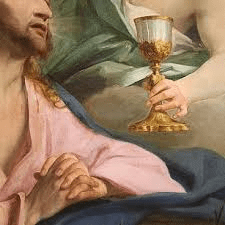
So, Hananiah ruled the city whose walls Nehemiah, the bearer of the Chalice of Atonement, rebuilt. And that “city” or “enclosure” is ‘eretz — the Land of the Living God.
According to Hancock’s Bible Names Dictionary, the name Hananiah translates as “the grace and mercy God has given.” In the Book of Jeremiah, Hananiah is described as the “son of Azzur from Gibeon” — a symbolic reference, I’m pretty sure, to China’s Azure Dragon of the East. In the three Abrahamic religions (Judaism, Christianity, and Islam), the Azure Dragon of the East is Michael, the bad-ass Satan-slaying chief archangel. So, in this version of events, Hananiah is the son of Michael from Gibeon — a word meaning “High Place,” “City on the Hill,” or “Real World.”
And Michael — the Flaming Sword — is indeed the guardian of the gate into the fourth quadrant of Moksha — the Real World and/or Borderland (between Heaven and Earth) much-discussed in the Course.
In Jeremiah 1-4, Hananiah delivers a message from Elohim, the Lord of Hosts, “in the temple of the Lord in the presence of the priests and all the people.” Hananiah says, quoting Elohim: “I have broken the yoke of the king of Babylon. Within two years I will restore to this place all the articles of the Lord’s temple that King Nebuchadnezzar of Babylon took from here and transported to Babylon. And I will restore to this place Jeconiah (Jehoiachin), son of Jehoiakim, king of Judah, and all the exiles from Judah who went to Babylon’ — this is the Lord’s declaration — for I will break the yoke of the king of Babylon.’”
Later in Jeremiah, Hananiah is declared a false prophet. But nothing he says above is untrue — apart perhaps from the literally interpreted two-year timeframe. Elohim has, in fact, broken the yoke of the Ego Mind — the King of Babylon in the allegory — thereby restoring the Holy Treasures we forfeited during our captivity in the desert of earthly exile.
(Because the dream ended eons ago, and what we’re experiencing now is its recorded replay.)
So, the Hananiah addressed in Kings 5:1 is probably one of the four teacher-brothers or “Great Dragons” mentioned in Genesis 1. The meaning of his name, together with his designation as “ruler of the citadel,” suggests that he is, in fact, the “guardian” of the third or northeast quadrant of the Circle-Journey.
In the Book of Tobit, a deuterocanonical text dating to the 3rd or 2nd Century BCE, the archangel Raphael travels in disguise, pretending to be the son of Hananiah. And Raphael, “the divine healer,” is indeed the “guardian of the third gate” into the “citadel” governed by Hananiah.
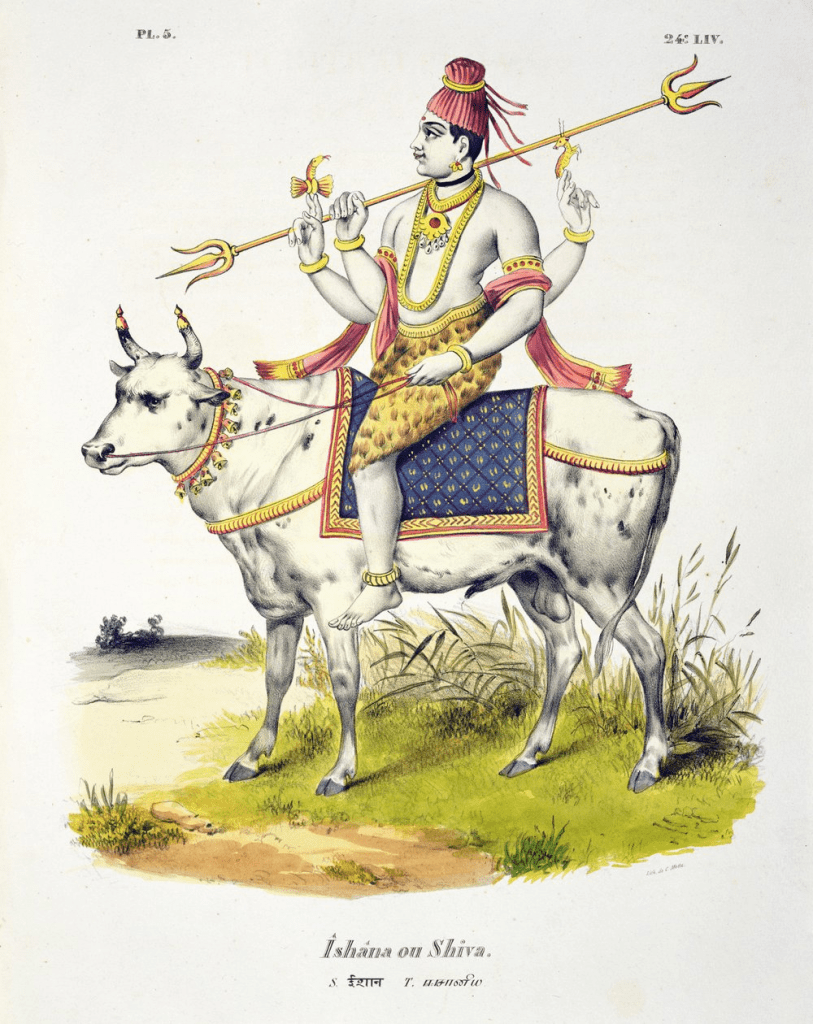
In Hinduism, the guardian of the northeast direction (the third quadrant of Kama) is Ishana, the face of Sadashiva associated with esoteric knowledge, wisdom, and transformation. Generally, Ishana is depicted holding Shiva’s trident-like Trishul whilst riding the Bull of Heaven. So, Ishana is the “face” of Sadashiva commonly identified as “Lord Shiva.”
As I read all this, Nehemiah, the royal cupbearer of the lily, is the Archangel Gabriel, whilst Hananiah is, in fact, Raphael. Hence Gabriel’s common association with what Course-Jesus terms the “lilies of forgiveness.”

Meanwhile, the Beloved One of the Father is David — the One Son or Holy Creation to which all our Souls belong in Divine Reality. So, David represents the Lamed, Christ, “Heart of God,” and/or “Good Shepherd” aspect of Elohim. And, in the Biblical allegories, David was indeed a shepherd before ascending to the throne of Israel (the fourth quadrant of Moksha). David’s much-referenced lineage or dynasty refers to, therefore, all the Holy Powers and Souls descending from the Christ Self for the purpose of restoring David’s at-one-ment.
David’s first descendent is Solomon, a Hebrew name meaning “King of Peace.” Solomon represents, therefore, the Christ Light or Holy Spirit — the Hey power of Elohim.
Or, as Course-Jesus explains:
This is the light that shows no opposites [duality], and vision, being healed, has power to heal. This is the light that brings your peace of mind to other minds, to share it and be glad that they are one with you and with themselves. This is the light that heals because it brings single perception, based upon one frame of reference, from which one meaning comes. (ACIM, W-108.3:1-3)
In the Hebrew Bible, the King of Peace is identified as Melchizedek, a name meaning “King of Righteousness.” First mentioned in Genesis 14:18-20, Melchizedek is described as both the King of Peace (Salem) and Priest of El Elyon. El Elyon is generally defined as “Elohim’s highest power,” but can also mean “the High Priest of On” — a title also found in the story of Joseph in the Book of Genesis. In that narrative, the High Priest of On is identified as Potipherah, an Egyptian name meaning “Priest of the Sun,” “Priest of the Bull,” or “the priest given by Ra, the Sun God.”
All of these definitions indicate that Melchizedek a.k.a. Solomon a.k.a. Potipherah is the High Priest for Aleph — the Father aspect of the Atonement Trinity, who (as we’ve established) is both the Bull of Heaven and Elohim’s Highest Power. So, Melchizedek a.k.a. Solomon a.k.a. Potipherah is the High Priest speaking for the Father’s Will and Authority. And Course-Jesus does indeed tell us “the Holy Spirit is the highest communication medium.” (ACIM, T-1.I.46:1)
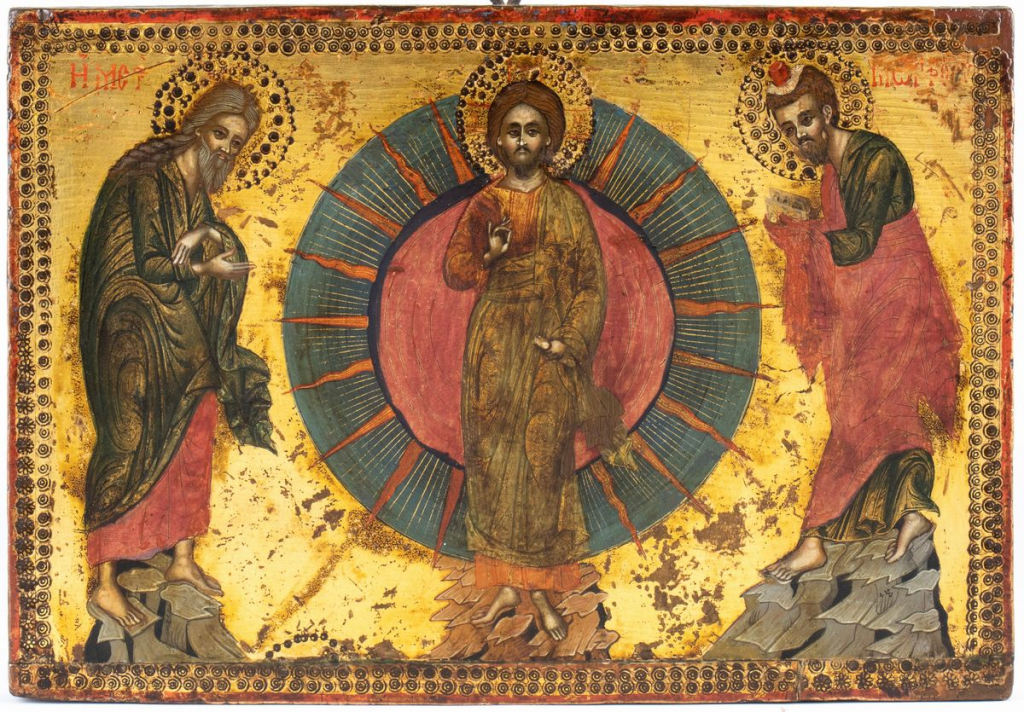
In the New Testament Epistle to the Hebrews, Jesus Christ is identified as “High priest forever in the order of Melchizedek,” presumably making him the High Priest in the line of David (Lamed, the shepherd) taking orders from Solomon (Hey, the Holy Spirit). And that’s true, as far as it goes, because, as Prince of Peace, Jesus is the friendly, relatable “public face” of Solomon, the King of Peace reflecting Christ’s Presence on the earthly plane.
And Jesus — or, rather, what Jesus represents — is referenced indirectly in this excerpt from Kings as the Bridegroom, the True Vine, and the True Vessel of Miracles.

This is all emblematic language, of course, because there was no more “Jesus” after the Transfiguration. There was only a physical shell inhabited and controlled by the King of Peace, as Paul the apostle attempts to explain in the following from Philippians 2:
Let this mind be in you, which was also in Christ Jesus: Who, being in the form of God, thought it not robbery to be equal with God: But made himself of no reputation, and took upon him the form of a servant, and was made in the likeness of men: And being found in fashion as a man, he humbled himself, and became obedient unto death, even the death of the cross.
Are you still with me?
I hope so, because I’m covering a lot of ground pretty quickly. And I haven’t even mentioned that my revised definition of ‘erez lebanon as the Path of the Heart of God (rather than Cedars of Lebanon) works perfectly in my illuminated translation of Kings.
These verses are, in fact, veritable founts of wisdom waiting to be tapped by the right disciple-teacher.

Let’s return to Solomon and David, both of whom the Bible depicts as Kings of Israel in the Davidian line. Both occupied the Throne of God, in other words, at different periods in the dream. David reigned until the mirror broke, after which Solomon took over. Hence, David’s instructions to Solomon to build the Temple that would reveal the Face of Christ to our dreaming Souls.
In the Course, Jesus calls Solomon’s Temple “the Temple of the Holy Spirit,” affirming that Solomon does indeed represent the Hey or Holy Spirit aspect of the Atonement Trinity.
That Solomon means “King of Peace” tells us the First Temple is the mental space through which we restore the “time of peace” experienced during Solomon’s original reign. This “time of peace” also is, presumably, the “Millennial” Peace, Kingdom, or Reign of Christ prophesied in both the Old and New Testaments.
Course-Jesus also mentions this “time of peace” in the following excerpt from Workbook Lesson 125: In quiet I receive God’s Word today:
Your Father wills you hear His Word today. He calls to you from deep within your mind where He abides. Hear Him today. No peace is possible until His Word is heard around the world; until your mind, in quiet listening, accepts the message that the world must hear to usher in the quiet time of peace.
This world will change through you. No other means can save it, for God’s plan is simply this: The Son of God is free to save himself, given the Word of God to be his Guide, forever in his mind and at his side to lead him surely to his Father’s house by his own will, forever free as God’s. He is not led by force, but only love. He is not judged, but only sanctified.
As Christ makes abundantly clear above, God’s Word isn’t any form of scriptural text. Rather, it’s the “ever-present echo” David-Christ-Lamed sounds within our minds to remind us of our ancient agreement with God to awaken. Hence, King David’s renowned musicality in the Biblical allegories.

Rightly understood, Solomon’s Temple — the Temple of Peace — represents the “corporate body” and/or “church” of the Christ Self holding our Souls together in the Holy Relationship that IS the Covenant of Atonement. That body is the Holy Spirit or Holy Thought whose beating heart is the Ark of the Covenant, the vibratory instrument through which God communicates with His Souls. And that is why the Ark is identified in Judaism as the vehicle through which God spoke to the Israelites (the Souls in Eden) and also generously provided for their needs. That the mythical Ark housed the Ten Commandments, the Spiritual Bread of Life (Manna), and the Rod of Aaron suggests it also supplied guidelines, spiritual sustenance, and miracles granting higher perception.

Rightly understood, the Rod of Aaron, which sprouted and produced almond flowers and fruits, is the Tree of White Fruit mentioned in the Book of Mormon. Partaking of the sweet fruit of that tree — the Tree of Life — is said to bring great joy. That “fruit” — the eye-shaped white almond — symbolizes the inner Holiness restored to our awareness or “sight” through the power of Hananiah — the conduit for the mercy and grace already given by God.
Think Workbook Lesson 168: Your grace is given me. I claim it now.
My interpretation is supported by the fact that the Hebrew word translated as “ark” was tovah, which CAN mean “container” or “vessel,” but also can mean “word” or “written word.” So, the Ark of the Covenant could very well symbolize the sacred Word God “wrote across our hearts” to seal the second covenant.
That indelible word, seal, or signet is YHVH — the Holy Name or Tetragrammaton that can’t be spoken by the human tongue. That indelible word, seal, or signet also is Om/Aum — the Pranava holding creation together in wholeness, as well as the passageway or “bridge” transporting us from inverted worldly perception back to upright heavenly perception. So, the On referenced in the Bible is, in fact, Om, rather than an ancient lost city. And Solomon a.k.a. Melchizedek is indeed “potipherah” — the High Priest of Om or High Priest of Amen — a title also used by the ancient Egyptian Cult of Amen, which flourished around 1500 BCE.
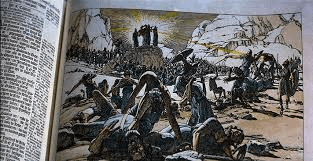
That the Israelites carried the Ark into battle to defeat all their enemies is a purely metaphorical characterization. By entering the Ark of the Covenant — the vessel of the Holy Relationship, more or less — we defeat or overcome the false idea of enmity we project onto other people.
Or, as Course-Jesus explains:
The meaning of the Son of God lies solely in his relationship with his Creator. If it were elsewhere it would rest on contingency, but there IS nothing else. And this is wholly loving and forever. Yet has the Son of God invented an unholy relationship between him and his Father. His real relationship is one of perfect union and unbroken continuity. The one he made is partial, self-centered, broken into fragments and full of fear. The one created by his Father is wholly Self-encompassing and Self-extending. The one he made is wholly self-destructive and self-limiting. (ACIM, T-20.VI.1:1-8)
Let’s return to the Biblical narratives concerning the First Temple. In 2 Kings 25 we learn the Temple was destroyed during a siege staged by Nebuchadnezzar II, the ruler of the Neo-Babylonian Empire.
That this siege took place on the worldly stage is unlikely based on two factors. The first is that the Temple is an internal atonement mechanism. And the second is the deeper story revealed by the names and places found in the narrative.
Jerusalem, for example, is the “walled city,” “enclosure,” or “covering” Elohim established “east of Eden,” as per the Book of Genesis. That “enclosure” or “covering” protects our memories of God, Heaven, our True Identities, and the world’s real purpose. As such, it also is the metaphoric “cistern,” “pasture,” and “sacred grass” referenced in more scriptural texts than the Holy Bible.
Rightly understood, the Jerusalem mentioned in the Book of Kings is the “City of the Living,” rather than the earthly city of the same name. “This heavenly Jerusalem is a place of spiritual significance,” Google rightly explains, “a place of God’s presence and the dwelling place of rightminded spirits.”
Hebrews 12:22 describes the “City of the Living” as the destination of those who have come to Mount Zion — a symbolic reference to the higher mind Circle of Forgiveness. This “City of the Living” also is the “city on a hill” referenced in Jeremiah and Matthew 5:14. The lampstand mentioned in that teaching is the Golden Lampstand the Great I Am instructed Moses to festoon with almond blossoms
Ergo, the Menorah, Lampstand, Tree of White Fruit, and Aaron’s Rod all symbolize the Tree of Life — the Path of the Heart of God our Souls must follow to return to Heaven.

So, the Siege on Jerusalem described in 2 Numbers 25 definitely took place in the invisible world, rather than in the visible world. That siege was led by Nebuchadnezzar, a name meaning “chief spokesman for Nebu” — a “false god” worshipped in ancient Babylon and Egypt, two desert civilizations associated with tyranny, false idols, slavery, and excess.
Nebu is mentioned once or twice in the Old Testament, most notably in Jeremiah 48.1, which reads as follows when stripped of its ciphers:
Father, sayeth Yovah-Elohim of Israel, Nebu destroyed the City of the Living.
Nebu’s “chief spokesman” is fear. So, Nebuchadnezzar represents the fearful thinking that increasingly besieged the heavenly Jerusalem after the fall from grace. Ergo, the story of Nebuchadnezzar’s siege on Jerusalem echoes the account of the War in Heaven provided in Revelation 12:7-10.
Ass those verses report, the Great Dragon of fearful thinking penetrated the walls of the City of the Living, but was challenged and cast out by Michael and his fellow angels. After his expulsion, Satan and his followers fell to earth — the Nebu-manufactured desert where we chase the materialistic goals and sensual pleasures the Father of Lies promises will bring us happiness. And that is why the Bible reports that the Siege of Jerusalem destroyed Solomon’s Temple, the Ark of the Covenant, and the City of the Living, all of which resulted in our extended “exile” in Babylon. Babylon, btw, is a derivative form of the Hebrew word for confusion or chaos. The root of Babylon is Babel, as in the Tower of Babel.

A quick read of the supporting literature suggests that the fall of the Tower of Babel represents our loss of God’s direct communications. We lost the Ark of the Covenant, the vehicle for hearing God’s Voice, when we blocked the High Priest of Om. Consequently, our ego-constructed selves had to develop languages to communicate ideas through our disconnected and vastly inferior verbal faculties.
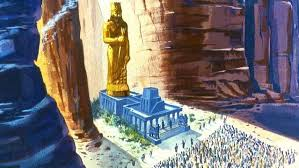
In the Book of Daniel, we learn that Nebuchadnezzar fashioned a golden idol in his own likeness, which he forced all his subjects and captives to bow down to in worshipful adoration. So, Nebuchadnezzar promulgated, through the egoic weapons of coercion, subjugation, and fear, the widespread practice of replacing God with the “false idols” of material gain, worldly power, and physical pleasures.

Let’s now factor in the symbols on the THREE OF PENTACLES — the card depicting the rebuilding of the Temple in the RWS Tarot. What we see is a craftsman and two monks inside a temple or cathedral. The craftsman is standing on a bench, holding a mallet and chisel. He appears to have been carving something on the wall before stopping to consult with the two clerics holding the blueprints. Those two monks represent Christ (David) and the Holy Spirit (Solomon) — the only two who know the whole plan, according to Course-Jesus.
Above the three figures we see the arch of Shamayim displaying three pentacles. Far from an emblem of evil or witchcraft, the pentacle represents the five faces of Elohim exerting their influence as we travel around the Wheel of Time.
Underneath the pentacles is a rosette whose center is a circle divided into quarters by a cross. Another similarly divided circle sits between the pentacles above. Those two circles almost certainly represent the Soul’s Journey, which is indeed split between the left and right-hand sides of the circle or wheel. On the lower left-hand or western side, we are still infected by ego thinking. On the higher right-hand or eastern side, we are free of Satan’s influence.
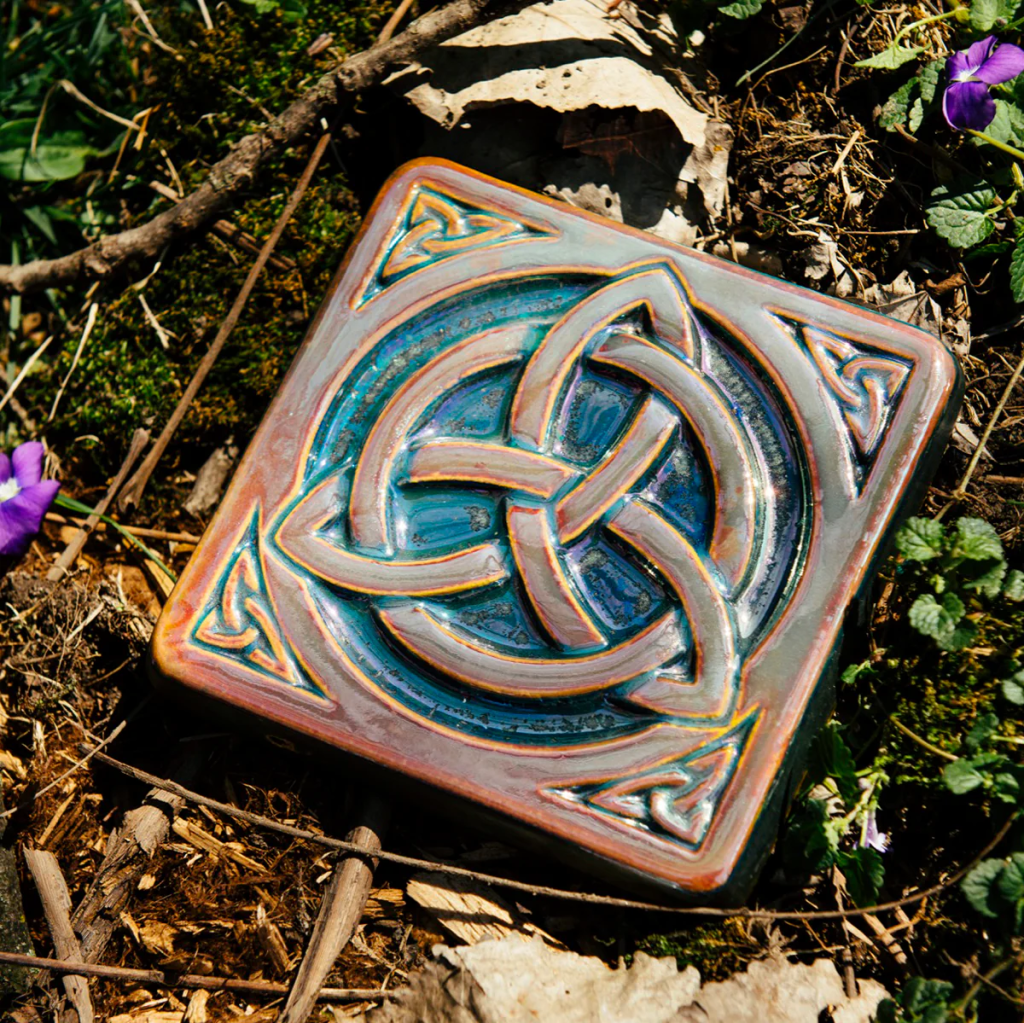
Presumably, the three pentacles represent the three Upper Chambers of the Temple governed by the Trinity Powers of Elohim (Aleph, Lamed, and Hey), as do the three highest chakras, as well as the reminiscent Celtic Triquetra pictured above. The rosette, meanwhile, symbolizes either the Heart Chakra or the Circle of Forgiveness. It might, in fact, represent both, as does the Sacred Heart of Jesus.
Let’s now return to the Bible. In 2 Kings and the Book of Chronicles, we learn that Solomon placed ten lampstands or menorahs in the Temple’s main chamber. Those lampstands, we also learn, were fashioned according to detailed instructions given to Solomon by King David.
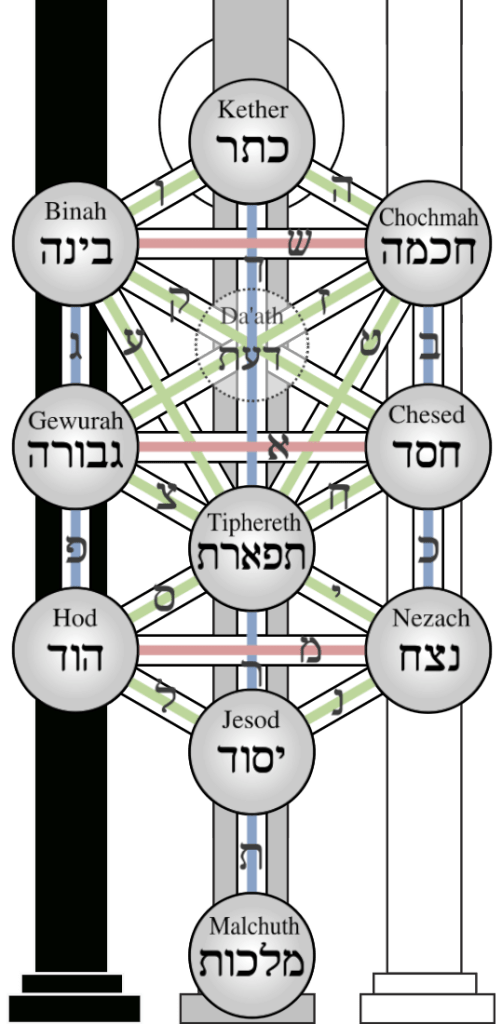
As I see it, those lampstands represent the ten sephirot or “emanations” on the Kabbalistic Tree of Life — the map, more or less, of the Path of the Heart of God. Kabbalists call it the Path of the Flaming Sword and/or the Path of the First Lightning Ray of Creation. The sefirot are typically described as spherical channels through which the Divine Will reveals itself, step-by-step, to humans.
The Old Testament Book of Jeremiah tells us the ten lampstands, the Ark, and several other cherished relics were stolen by Nebuchadnezzar, who afterward installed a man named Mattaniah as the new King of Judah. He then changed Mattaniah’s name to Zedekiah.
Mattaniah means “gift of God,” while Zedekiah means “Yah is righteousness.” Applying our two absolutes, the name-change signals metaphorically a downward shift in Jerusalem-consciousness from having the gifts God gave the Sonship to needing the Holy Name to recover those gifts.

The monarch Nebuchadnezzar displaced was King Jeconiah of the Davidic Dynasty. Not only was King Jeconiah dethroned, he also was taken captive, along with his court, his family, and many of his loyal subjects. According to the legends, those captives were held in Babylon for several decades before being freed when Cyrus the Great of the Achaemenid Empire conquered the Babylonian Empire.
All of this is, of course, allegorical. So let’s now decode the symbols, starting with Jeconiah, a name meaning “Yah will establish.” Sound familiar? It should, because that is the same definition assigned to “Jachin,” the right-hand pillar flanking the entrance to Solomon’s Temple. In the Biblical allegory, therefore, King Jeconiah of the Davidic Dynasty represents the “pillar” of God’s Established Order we lost sight of through fearful thinking.
Or, as Course-Jesus affirms:
Before the separation the mind was invulnerable to fear, because fear did not exist. Both the separation and the fear are miscreations that must be undone for the restoration of the temple, and for the opening of the altar to receive the Atonement. This heals the separation by placing within you the one effective defense against all separation thoughts and making you perfectly invulnerable.
The name Cyrus means “lord,” “sun,” or “heir to the throne.” So, Cyrus represents the the “brother-redeemer” who is the way, the truth, and the life.
In the Biblical narrative, Jeconiah dies before Cyrus frees the captives. His eldest son, Shealtiel, becomes the heir to the throne of Judah, but never reclaims the crown. Shealtiel means “I asked Elohim,” so his character in the story represents the request for salvation mandated by the second covenant. God already did his part. We do ours by asking for the gifts He already gave, which we allowed the Ego Mind to steal from us.
Or, as Course-Jesus explains:
The Bible gives many references to the immeasurable gifts which are for you, but for which you must ask. This is not a condition as the ego sets conditions. It is the glorious condition of what you are. (ACIM, T-4.III.5:3-5).
So, we asked and Elohim answered through the High Priest of Om, whose agent in the allegory is Zerubbabel, the eldest son of Shealtiel.
After being freed by Cyrus, the Jewish captives didn’t race back to Judah en masse. Instead, they sort of trickled back to their homeland in small groups (as our Souls also seem to do). The first of these bands of repatriates was led by Zerubbabel, a name meaning “the seed sown in Babel” — or, more precisely, “the seed sown in confusion and chaos.” Zerubbabel represents, therefore, either the Soul (the seed of the True Vinir) or the seed we must sow to “restore the Temple of Solomon, the High Priest of Om.”
When Zerubbabel set off on the journey back to heavenly Jerusalem, King Cyrus sent with him some of the sacred relics stolen by Nebuchadnezzar, as well as permission to rebuild the walled city and the Temple. Allegorically, this tells us Zerubbabel — the seed sown in Babylon — returns to us the Holy Treasures we forfeited through fearful thinking.
Not returned to Zerubbabel by Cyrus were the Ark of the Covenant, the Tablets of Stone displaying the Ten Commandments, the Urim and Thummim, the Holy Oil, the Sacred Fire, and the jar of manna that was placed before the vessels containing the Urim and Thummim. Also unreturned were Solomon’s ten lampstands.
Presumably, this means that the Ark, the heavenly bread, God’s behavioral guidelines, the Urim and Thummim, the Holy Oil, and the Sacred Fire are treasures we recover only after surrendering wholeheartedly to the Holy Spirit’s inner guidance.
Or, as Jesus says:
Love will enter immediately into any mind that truly wants it, but it must want it truly. This means that it wants it without ambivalence, and this kind of wanting is wholly without the ego’s “drive to get.” (ACIM, T-4.III.4:7-8)

Once Zerubbabel reached Jerusalem, he began reinforcing the city’s crumbling walls and laying a foundation for the new temple. Begrudging his authority (and his decree that only Jewish hands could do the work), some of the Samaritan residents of the city hatched a plot to halt construction. By this time, Cyrus was dead and his son, Cambyses II, ruled the empire. So, the conspirators wrote to Cambyses, claiming (untruthfully) that the Jews were planning to rebel against the crown.
So, Zerubbabel started rebuilding the Temple of the Holy Spirit, only to be delayed by the machinations of non-believers loyal to Cambyses — a Persian name meaning “the one who enchants.”
In response to the accusations, Cambyses ordered Zerubbabel to stop building until he decided what to do. What this tells us is that Satan used various tactics to delay the completion of Zerubbabel’s mission.
Or, to quote Course-Jesus:
Delay is of the ego, because time is its concept. Both time and delay are meaningless in eternity. I have said before that the Holy Spirit is God’s Answer to the ego. Everything of which the Holy Spirit reminds you is in direct opposition to the ego’s notions, because true and false perceptions are themselves opposed. The Holy Spirit has the task of undoing what the ego has made. He undoes it at the same level on which the ego operates, or the mind would be unable to understand the change. (ACIM, T-5.III.5:1-6)
Fourteen years later when Cambyses met his demise, the Second Temple’s construction was still on hold. Enter his successor, Darius the Great — a Persian name meaning “upholder of the good.”
Are you getting the idea?
In the Biblical narrative, Zerubbabel wrote to Darius early in his reign to compel a decision. After digging up the original decree by Cyrus, Darius not only green-lighted the stalled construction, he also made Zerubbabel governor of the province of Judah. Unfortunately, Zerubbabel wasn’t able to complete the work before he died, so the temple remained unfinished.
Archeological and historical evidence suggests that a brick-and-mortar “Second Temple” was completed in the sixth year of Darius’s reign (around 516 BCE). But the building of that earthly temple isn’t mentioned anywhere in the Bible. And that’s because the structure erected on Temple Mount was a worldly reflection of the spiritual temple Zerubbabel wasn’t able to complete.
Or, as Course-Jesus explains in Workbook Lesson 325: All things I think I see reflect ideas:
This is salvation’s keynote: What I see reflects a process in my mind, which starts with my idea of what I want. From there, the mind makes up an image of the thing the mind desires, judges valuable, and therefore seeks to find. These images are then projected outward, looked upon, esteemed as real and guarded as one’s own. From insane wishes comes an insane world. From judgment comes a world condemned. And from forgiving thoughts a gentle world comes forth, with mercy for the holy Son of God, to offer him a kindly home where he can rest a while before he journeys on, and help his brothers walk ahead with him, and find the way to Heaven and to God. (ACIM, W-325.1:1-6)
Let’s now return to the “seal” or “signet” I brought up earlier. In medieval Jewish, Islamic, and Western mysticism, that “seal” or “signet” was said to be debossed on a ring worn by King Solomon. It was also believed to grant its wearer the power to communicate with spirits, both good and evil. So, I don’t think I’m wrong about the “seal” or “signet” being the Name of God.
The “seal” the ring bore was a six-pointed star, something like the one pictured below.
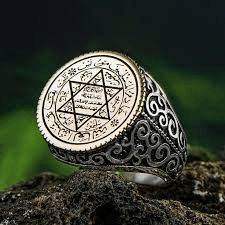
We now know that Solomon wasn’t a living, breathing historical figure — not in the sense most people think, at any rate. As we’ve firmly established, Solomon symbolized the King of Peace and/or the High Priest of Om, Aum, or Amen. So, it was, in fact, Solomon’s envoys who spoke to the Hebrew prophets Haggai and Zechariah about the unfinished Temple of Peace. And it was also, therefore, those envoys who mentioned the signet ring to both prophets.
Both the Temple and signet ring are discussed in the second chapter of the Book of Haggai. In the interest of space, I’ve provided a link to the KJV translation rather than copying it out. What follows is my VERY different deciphering of the original Hebrew.
The descendants of the returning captives (shebi-ites) in unison support the cycle of renewal (the New Moon) by speaking the Holy Name offering the prophet Haggai the Word of the Holy Mind of Zerubbabel, the son of Shealtiel governing Judah for Jeshua, the offspring of the Holy Name’s righteous cause, the High Priest of the remnant flock communicating (to the mind) to retain sight of the Temple of former glory (David’s Temple); to see with the Spiritual Eye, as it were. Strengthen Zerubbabel’s Holy Mind communications, the Holy Name supporting the manifestation of Jeshua, the offspring of the Holy Name’s righteous cause, the High Priest fortifying the flock of the Land of the Living God; the Word bestowing the divine communications of the Holy Name of Creation; the Word of the Covenant drawing forth the sheltering pillars of Ruach abiding within to inspire the word of the mind.
The Holy Name of Creation, the unified whole, is a small noise in Shamayim; in the Land of the Living God, a roaring sea; and in the desert, a noise like a swarm of locusts, a longing swarm of locusts bringing fullness to the Temple gloriously communicating the Holy Name of Creation. Silver and gold are the communications of the Holy Name of Creation, wealth coming from the sea beneath the Temple, the great primordial Word of the Holy Name of Creation; the established place given by God to the (King of) Peace to speak the Holy Name of Creation.
And these are only the first two paragraphs of this mind-blowing chapter.
In the original Hebrew, the first four words of the first line are shebiite echad esriyam chodesh, which the KJV translators (probably per Tyndale) fudged into a date. When less clumsily translated, those words describe the Babylonian captives who returned to heavenly Jerusalem through Zerubbabel’s agency.
In Ezra 2:1-6, those returnees are identified by name as Jeshua (the Messiah), Nehemiah (the cupbearer), Seraiah (the chief chamberlain or master of the house), Reelaiah (the thunder of Yah), Mordecai, Blishan, Mizpar, Bigrai, Rehum, and Baanah.
Not sure what all those names signify, but I do know that the Jeshua named herein is Jesus Christ, the prophesied Messiah — and not, as generally supposed, a flesh-and-blood high priest who finished the temple Zerubbabel started building in earthly Jerusalem.
We also learn in this passage from Haggai, that 1) Zerubbabel would govern Judah until Jeshua took over, and 2) Zerubbabel’s broadcasts of the Holy Name would help Jeshua “manifest.”
That Jeshua is named in this circa 520 BCE communication is pretty amazing. That he’s identified as “the high priest of the remnant flock” also tells us he’s the “righteous branch” of King David prophesied a century earlier by Jeremiah. We know this because the specific phrase “remnant flock” occurs in Jeremiah 23:3-8.
Let’s now look at the name Haggai — a marriage of haj (pilgrimage) and gai (valley). So, Haggai represents the venue for the Soul’s Journey, or, more specifically, the place of safety and refuge on that pilgrimage. Haggai represents, therefore, the Merkabah through which Zerubbabel, the Voice for God, broadcasts the Holy Name inside our dreaming minds.
And Merkabah is the Hebrew word translated as “chariot” in the Book of Kings and pretty much everywhere else in the Old Testament. If it could be seen, that Merkabah would look something like the image below.
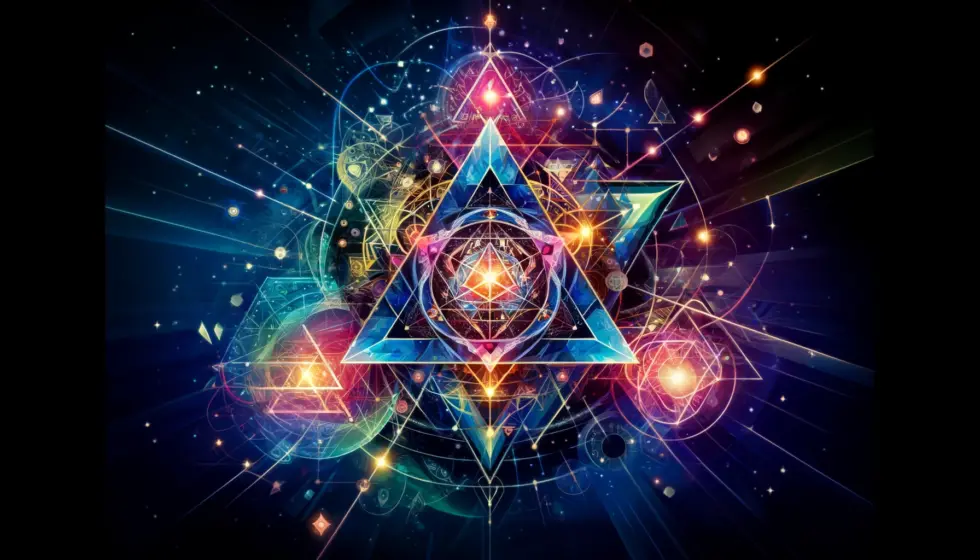
Let’s move on to the next two paragraphs of Haggai, which I’ve retranslated as follows:
The Four supporters of the Ninth twice in the age of Darius spoke the Holy Name offering to Haggai the prophet these words: “Uttering the Holy Name of Creation calls upon the High Priest (Melchizedek) teaching the True Path specified by the Bridegroom to forgive the holy body in the four quarters of his garments; the four quarters for attaining the bread stewed in wine and oil, the provisions consecrated by the High Priest.”
Singing the Holy Word to declare Haggai’s innocence, the Living Beings reached through the High Priest’s song communicating guiltlessness to Haggai, to say to the flock: “In the Eternal Now, the faces speaking the Holy Name work to extend the offerings of forgiveness moving the Day of the Lord upward by stages, raising up, stone upon stone, the Temple of the Holy Name.
“The Holy Name enters into the elevated place of the Blessed Supporters to come into the wine-vat to clean the five holy winepresses, helping to smite the blighting mildew and hailstones striving to reach the oracle of the Holy Name.“
To set in place the Day of the Lord in Heaven, the four supporters of the Ninth Day of the Lord established the Holy Name’s Temple to put the seeds in the storehouse of the vine and the fig tree, the pomegranate and the olive tree, to bring forth the Day of the Lord’s abundant blessings.
First of all, wowza. Second of all, this communication didn’t come to Haggai “on the twenty-fourth day in the ninth month in the second year of Darius,” as all other translators suggest. Correctly deciphered, the FOUR Living Beings or Great Dragons spoke to Haggai twice during the reign of Darius (522 to 486 BCE) through the Holy Stream of Sound.
Now, as you can imagine, it took a while to work all this out, mainly because several words typically translated as numbers aren’t, in fact, numbers. The prime example is esriym, a word mistranslated throughout the KJV Bible as “twenty.” A plural form of ezri or azri, both of which mean “to help” or “to support,” esriym probably means “helpers” or “supporters.”
Many other ciphers found elsewhere in the Bible also show up in this passage. The four quarters of his garment, the bread stewed in wine and oil, the wine vat and winepress, the vine and fig tree, the pomegranate and olive tree, the seeds in the storehouse, and the Ninth Day of the Lord.
Let’s tackle them one by one, shall we?
The four quarters of his garment refers to the four quadrants of the Circle Journey overseen by the four Living Beings. The bread stewed in wine and oil describes the spiritual bread (manna) the Holy Spirit provides, softened and sanctified for ease of consumption by the wine of truth and the anointing oils of atonement. The wine vat represents the cistern of love, fountain, wellspring, or pool mentioned elsewhere in the scriptures.

The winepress shows up throughout the Bible to symbolize the inner instrument through which the Holy Spirit purifies our ego-corrupted thinking. In goes the uprooted vines of the earth, and out comes the Lamb of God — our Souls washed clean of the perception of sin trapping them in hell. So, nothing whatsoever to do with the crucifixion of Jesus Christ, as the image above wrongmindedly suggests.
Rightly understood, the five holy wine presses represent the five levels of Self-knowing the Ego Mind “polluted” to hold our Souls captive in its “world of doing.” To remove these perceptual impurities, we must refine (through “lustration” or “purification through undoing”) those five levels in the manner of a winepress. In Judaism, those levels are identified as Nefesh, Ruach, Neshama, Chaya, and Yechida.
Another recurring motif in the Judeo-Christian scriptures, the vine and the fig tree don’t represent worldly prosperity, as many pundits egoically suggest. Rather, the Vine represents our progress along the True Path, whilst the fig tree symbolizes the “fruits” or “blessings” we reap by treading that path.
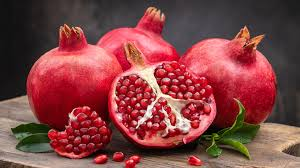
Pomegranates represent the Body of Christ, within which dwells our Souls — he seeds of the True Vine. So, the pomegranate represents the Red Ray or Pillar of Fire guiding us from within (underneath or behind) through the two left-hand quadrants of the Circle-Journey. The olive tree produces the oil that fuels the lamps of the Temple Menorah; so, the olive tree produces the anointing oils of the atonement, which purify our minds as we meditate upon God’s Word im thre Circle of Om.
The seeds in the storehouse are, I believe, the blessings, gifts, and miracles we give and receive or “scatter in the world” by listening to the Living Water vibration. And it is those seeds that Zerubbabel may well represent in the allegories.
According to most pundits, the Ninth Day of the Lord refers to the Final Judgment or End of Days. It might also represent the ninth luna mansion or ninth gate referenced in the Vedas of Hinduism. So, “the Four supporters of the Ninth” refers to the four Living Beings, Great Dragons, or Heavenly Kings overseeing the Circle-Journey leading our Souls back to the gate of Heaven mentioned repeatedly by Course-Jesus.
If I’m not mistaken, it was those same FOUR (not twenty-four) beings John of Patmos described encircling the Throne of Elohim in the Book of Revelations. And that’s why nobody has ever figured out who those non-existent twenty-four elders really are.
Like ezrim, the Greek word transcribed as “twenty” in Revelations 4:4 is rather nebulous. The word is eikosi, which does mean “twenty” in modern usage, but probably didn’t originally. I say this because the root of eikosi is eiko, which means “likeness” or “resemblance.” So eikosi is probably a plural form of eiko, just as ezrim is a plural form of ezri.
To be certain, I’d need to retranslate all the Biblical verses containing the number twenty. And that would be more trouble than its worth at the present time. So let’s assume for now that there were four beings who spoke to Haggai “twice in the age of Darius.”
Let’s now talk about goy — one of the most misunderstood words in the Hebrew language. The word does not mean “nation,” “foreign nation,” “foreigner,” or “non-Jew,” as commonly supposed. Far from it, in fact. As my retranslation of Haggai suggests, goy is the Hebrew word for what Course-Jesus calls “the Holy Instant” and many other master teachers — including Deepak Chopra, Eckhart Tolle, and Jeremy Lopez — call “the Eternal Now.”

How do I know this? From the three pictographic letters comprising goy. Those letters are gimmel, vav, and yod. Gimmel means “to give and receive,” vav is the “divine hook” or “yoke” uniting everything in Holy Creation, and yod is the divine spark, Atman (Adam), or Soul in all living things. So, goy literally means “the giving and receiving that yokes the God Mind in everything at the level of Souls.”
Now compare this definition to Course-Jesus’s description below of the Holy Instant:
The holy instant is a time in which you receive and give perfect communication. This means, however, that it is a time in which your mind is open, both to receive and give. It is the recognition that all minds are in communication. It therefore seeks to change nothing, but merely to accept everything. (ACIM, T-15.IV.6:5-8)
According to Wikipedia, the word goy and its variants appear 560 times in the Bible. Let me repeat: the Hebrew word for the Holy Instant appears in various forms 560 times in the Bible. Not that we’d know this, given that goy has been consistently mistranslated as “nation,” “heathen,” “gentile,” or “people” down the ages.
We can’t squeeze blood from a stone, nor can we extract from a constellation of ancient Hebrew glyphs a meaning antithetical to those letters. Like Elohim, goy is the sum of its parts, which have nothing to do with the Satan-inspired concepts of nations, heathens, or gentiles.
We’re all one, my brother. And everything we see with the body’s eyes is illusion, pure and simple.
In the next set of verses in Haggai, we find the phrase mamlakah goy, which also appears in Genesis 14:1, Joshua 12:23, and Exodus 19:6. In all three cases, the phrase is translated as “Kingdom of Nations” or “Kingdom of the Holy Nation” — which is what, exactly?
According to Google, the term refers to “a community, particularly ancient Israel, designated by God as a people set apart for His purposes, distinguished by their holiness and called to a priestly role in relation to other nations.”
That description is, in fact, fairly accurate — if we take into account these three absolute truths:
- There is no Holy Nation or sacred place in the physical world the Devil made.
- We’re all equal in the eyes of God, because we’re all ONE in the eyes of our Creator, who created the Sonship as an inseparable whole.
- The Holy Nation of Israel is the Real World, Promised Land, Holy Meeting Place and/or Land of Milk and Honey, which exists solely in the mind. Israel means either “to see God” or “Elohim shines forth.” So, it refers to the mental “state” of True Perception, Miraculous Perception, Christ Consciousness, or Moksha, essentially.
Based on all this, I contend that mamlakah goy actually refers to the Realm of the Eternal Now much discussed in Buddhist philosophy. In the Course, Jesus calls that same place the Sphere of Celestial Order. In that sphere, he briefly explains, we dwell together as the perfect and holy beings we really are underneath our form-perceiving flesh-suits.
Buddhists call that elevated mode of being “the Body of Glory” or Sambhogakaya, which the Wisdom Library describes as “the radiant and blissful manifestation of an enlightened being, experienced by those on the path to Buddhahood and serving as a conduit for the Buddha’s compassionate activity.” The image below, borrowed from an article in Buddha Weekly, shows the locations of the Sambhogakaya “body” on the Kabbalist Tree of Life.

So, mamlakah goy is Chokmah, the Real World, the Borderland, Israel, the fourth quadrant of Moksha, the Eternal Realm, the Garden of Eden, the Innermost-Uppermost Chamber, the Holy of Holies, the Inner Altar, the Throne Room, and Aravot, among other names for what is essentially the seventh (or possibly the ninth) plane of consciousness.
And now we’re all on the same page, which is a giant step in the right direction.
Let’s move ahead to the last section of Haggai’s second chapter.
Again communicating the Holy Name to Haggai, the four supporting the cycle of renewal (the New Moon) spoke, saying: “Zerubbabel, the governor of Judah, speaks the rumbling noise in Shamayim and Erets (the Land of the Living God) to overthrow the throne of the kingdom bringing to naught the force of the Sphere of the Eternal Now. To turn around the Merkabah, ride the horses driving downward (drawing us inward) toward the Bridegroom, the sword-brother of the Day of the Lord. Speak (in the mind) the Holy Name of Creation to receive Zerubbabel, the Father’s witness, the son of Shealtiel. Speak (in the mind) the Holy Name to set in place the seal (or signet ring) of the Chosen One speaking (in the mind) the Holy Name of Creation.
Here, Zerubbabel is twice described as a Holy Power, rather than as a human being. So, I stand by my absolutes. Before Jesus came, we learn herein, Zerubbabel was “the governor of Judah” — the Chosen One speaking the Holy Name of Creation. After Jesus ascended, he became the metaphoric “governor of Judah” — the Chosen One in charge of the Atonement.
That’s how I read these communications, anyway.
This brings us badk to the Merkabah — the Hebrew word generally translated as “chariot” in the Old Testament. The Merkabah is indeed the Soul’s “chariot” — the vehicle in which it travels through the dream, more or less. So, it’s also the Spiritual Body.
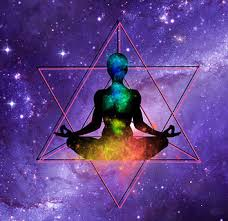
The Merkabah resembles a six-pointed star — and is, in fact, the Seal of Solomon. It’s also the Kabbalistic Tree of Life mapping the Path of the Flaming Sword (the Bridegroom’s sword, which is Michael, the guardian of the fourth gate into Eden). So, everything we’ve talked about up to this point now comes together.
I may have explained this already, but the upright triangle of the six-pointed star represents the rightminded, true, or miraculous perception of God’s Established Order (Jachim). The Soul returns to that upright state of self-knowing by eating the “fruits” of the Tree of Knowledge, more or less — i.e., meditating on God’s Word, Name, or Song.

The inverted triangle, like THE HANGED MAN card in the RWS Tarot, represents the Soul suspended upside-down from the Tree of Ignorance.
In Hinduism, the six-pointed star formed by two interlocking triangles is called a Shatkona. The upward-pointing triangle represents Purusha, True, or Divine consciousness, whilst the downward-pointing triangle represents Prakriti, false, or material consciousness. The upper triangle is the Lingam of Shiva, which gradually penetrates the Yoni of Parvati (the bride of disciple of Christ), through right-minded spiritual practice. Their union gives birth to Kumara — a name meaning “earth death” or “ego death” in Sanskrit.

We see the lingam and yoni on THE CHARIOT card in the RWS Tarot. That chariot symbolizes the Merkabah in which our Souls journey through the desert wilderness of inverted or dualistic perception. The goal of the journey is to turn our upside-down perception (the lower triangle) right-side-up again (the upper triangle), which we achieve through our willing participation in the Atonement Process. We participate in that process by “riding inward” the four horses of revelation, which go forth from the Bridegroom’s sword-brothers — the four Living Beings or Great Dragons supporting the Throne of Elohim.

In Islam, those four beings are known as the hamlat al-arsh — the throne-bearers of Allah. In Hebrew, those same throne-bearing beings are the Hayyoth described in the Book of Ezekiel, as well as the mysterious Living Creatures or Living Beings found throughout the Bible. They also are, I’m almost certain, the Cherubim — a word whose meaning has been lost to time. Presumably, it’s derived from Keruvim, a Hebrew word also of unknown meaning.
Let’s see if we can solve the mystery through the letters making up the root word keruv. Those letters are kaph, resh, vav, and bet. We already know that vav represents the “divine hook” or “yoke” holding Holy Creation together in “at-one-ment,” and that bet represents the House of God or Temple. So, we’re halfway there already.
Kaph represents the power of God present in the physical realm, whilst resh is a little more complicated. Based on my research, the letter carries the triple meaning of poor, head, and evil — so “the inferior mind of the evil one,” basically, but with the potential to evolve into kaph.
So, kaph is the upright triangle, resh is the reversed triangle we turn around through the at-one-ment process, vav is the hook connecting our Souls to Divine Reality, and bet houses the whole apparatus. So keruv or “cherub” describes the Merkabah, Seal of Solomon, Shatkona, or Chariot of the Soul, making the Cherubim, Hayyoth, and/or hamlat al-arsh the “drivers” of that at-one-ment vehicle.

Chariots and charioteers are common symbols in the scriptures of many faiths. In the Bhagavad Gita, for example, Lord Krishna (the Holy Spirit) drives the chariot conveying Prince Arjuna (the Soul) to the symbolic battlefield of redemption. In the Bible, the Ark of the Covenant is described as the chariot of God’s Presence, flanked by the Cherubim, Elijah is taken to heaven in a “chariot of fire,” and Zechariah sees four chariots with different colored horses.
And these are but a few examples.
In the Katha Upanishad of Hinduism, we find this revealing passage:
Know the Self as lord of the chariot, the [spiritual] body as the chariot itself, the discriminating intellect as the charioteer, and the mind as reins. The senses, say the wise, are the horses; selfish desires are the roads they travel. When the Self is confused with the body, mind and senses, they point out, he seems to enjoy pleasure and suffer sorrow.
According to Google, chariots don’t appear anywhere in the Holy Qur’an. But they do feature in the Sufi branch of Islam, as well as in a wonderful poem by Rumi titled “The Great Wagon.” The poem reads as follows:
When I see your face, the stones start spinning!
You appear; all studying wanders.
I lose my place.Water turns pearly.
Fire dies down and doesn’t destroy.In your presence I don’t want what I thought
I wanted, those three little hanging lamps.Inside your face the ancient manuscripts
Seem like rusty mirrors.You breathe; new shapes appear,
and the music of a desire as widespread
as Spring begins to move
like a great wagon.
Drive slowly.
Some of us walking alongside
are lame!Today, like every other day, we wake up empty
and frightened. Don’t open the door to the study
and begin reading. Take down a musical instrument.Let the beauty we love be what we do.
There are hundreds of ways to kneel and kiss the ground.Out beyond ideas of wrongdoing and rightdoing,
there is a field. I’ll meet you there.When the soul lies down in that grass,
the world is too full to talk about.
Ideas, language, even the phrase each other
doesn’t make any sense.The breeze at dawn has secrets to tell you.
Don’t go back to sleep.
You must ask for what you really want.
Don’t go back to sleep.
People are going back and forth across the doorsill
where the two worlds touch.
The door is round and open.
Don’t go back to sleep.I would love to kiss you.
The price of kissing is your life.Now my loving is running toward my life shouting,
What a bargain, let’s buy it.Daylight, full of small dancing particles
and the one great turning, our souls
are dancing with you, without feet, they dance.
Can you see them when I whisper in your ear?They try to say what you are, spiritual or sexual?
They wonder about Solomon and all his wives.In the body of the world, they say, there is a soul
and you are that.But we have ways within each other
that will never be said by anyone.Come to the orchard in Spring.
There is light and wine, and sweethearts
in the pomegranate flowers.If you do not come, these do not matter.
If you do come, these do not matter.
Note his mention of Solomon, wine, grass, and pomegranates, Aas well as the open door or gate, which Jesus also mentions in both the Bible and the Course.
In meditation the other night, I saw that the two overlapping triangles in the Seal of Solomon represent the two Temples. And those two Temples, in turn, represent the two covenantal agreements between God and our Souls. The upright First Temple represents the original or established Covenant of Love — the symbiotic Holy Relationship required for Perfect Creation, whilst the inverted Second Temple represents the Covenant of Grace — the mutual agreement between God and His disenfranchised Souls to end the separation at the appointed time.
And all this, in turn, tells us that the two triangles also are the two pillars of Solomon’s Temple. Jachin, “the established order,” is the upright triangle representing the first covenant, whilst Boaz, “the strength that redeems,” is the inverted triangle representing the second covenant.
Makes sense, right?
_-_Google_Art_Project.jpg)
The “signet ring” or “seal” also is mentioned in what’s variously known as the “Song of Songs,” “Canticle of Canticles,” or “Song of Solomon” — one of the Five Scrolls or Megillot found in the Ketuvim (Writings) of the Tanakh (the whole Hebrew Bible). Those Five Scrolls contain the Song of Songs, the Book of Ruth, the Book of Lamentations, Ecclesiastes, and the Book of Esther.
In the “Song of Solomon,” the lines pertaining to the “signet ring” or “seal” read as follows in the Hebrew Bible:
Wear me as a signet ring (seal) on your heart, as a ring on your hand. Love is as overpowering as death. Devotion is as unyielding as the grave. Love’s flames are flames of fire, flames that come from the LORD.
Framed as a dialogue between two lovers, the Song of Solomon is often misinterpreted as a celebration of sexual intimacy. What the Song of Songs actually describes is the ecstatic devotion we feel toward God as we, to quote Course-Jesus, “open the Inner-Altar to accept the Atonement.”
That intensity of devotion characterizes the Holy Relationship or Covenant of Love we still share with each other and our Creator through the reflection of holiness underneath Satan’s mirage. To return to God, that is to say, we must first see Christ’s reflection in the pieces of the mirror we shattered when we chose to follow the Ego Mind into the desert wilderness of earthly existence.

The Holy Spirit holds together all the scattered pieces of Christ’s reflection like a spiderweb of pearls — pearls of divine fire reflecting Creation’s interconnectedness, holiness, and wholeness. The pearls on the net are the miracles that, one by one or all at once, open our inner eye to the Truth of our Being.
Jesus explains how this works in various ways throughout the Course. At one point, he says:
Be confident that you have never lost your Identity and the extensions which maintain It in wholeness and peace. Miracles are an expression of this confidence. They are reflections of both your proper identification with your brothers, and of your awareness that your identification is maintained by extension. The miracle is a lesson in total perception. By including any part of totality in the lesson, you have included the whole. (ACIM, T-7.IX.7:1-5)
He says even more on the subject in a section of the text titled The Reflection of Holiness. Tempted as I am to quote the whole thing, doing so would make this post impossibly long. So, I’ll offer this small taste to entice you to read the rest on your own:
Merely by being what it is, does truth release you from everything that it is not. The Atonement is so gentle you need but whisper to it, and all its power will rush to your assistance and support. You are not frail with God beside you. Yet without Him you are nothing. The Atonement offers you God. The gift that you refused is held by Him in you. The Holy Spirit holds it there for you. God has not left His altar, though His worshippers placed other gods upon it. The temple still is holy, for the Presence that dwells within it IS Holiness. (ACIM, T-14.IX.3:1-9)
In Buddhism and Hinduism, the “web of pearls” or “web of jewels” under discussion is called Indrajala or Indra’s Net. In Hinduism, Indra is the “king of gods,” as well as the guardian of the eastern direction, making him the Hindu equivalent (I believe) of the Archangel Michael.
Best-selling author and scientist Gregg Braden calls that same “net” or “web” the Divine Matrix.

That matrix is the mirror of our eternal holiness. That matrix also is, therefore, all of the following: 1) the upright triangle in the Merkabah and the Seal of Solomon, 2) the First Temple where the presence of our holiness still dwells, 3) the Holy Relationship much discussed in the Course, and 4) the Holy Instant reflecting the “heaven on earth” variously known as the Real World, Israel, Moksha, Aravot, the Seventh Heaven, and Al-Firdaus Al-‘Ala (which the Sunni Hadith describes as “the highest level of Paradise where God’s closest and most beloved servants in the hereafter shall dwell.”
There are, in fact, two overlapping matrixes. The Divine Matrix or the Holy Instant reflects Heaven, whilst the Devil’s Matrix of the Unholy Instant — the Web of Lies, as it were — reflects the untruths the Ego Mind spun together to form its dark veils of deception.
Or, to quote Course-Jesus:
The instant that the mad idea of making your relationship with God unholy seemed to be possible, all your relationships were made meaningless. In that unholy instant time was born, and bodies made to house the mad idea and give it the illusion of reality. And so it seemed to have a home that held together for a little while in time, and vanished. For what could house this mad idea against reality but for an instant? (ACIM, T-20.VI.8:6-9)
Elsewhere in the Course, he says, in reference to the Holy Instant Miracle Matrix:
Time is your friend, if you leave it to the Holy Spirit to use. He needs but very little to restore God’s whole power to you. He Who transcends time for you understands what time is for. Holiness lies not in time, but in eternity. There never was an instant in which God’s Son could lose his purity. His changeless state is beyond time, for his purity remains forever beyond attack and without variability. Time stands still in his holiness, and changes not. And so it is no longer time at all. For caught in the single instant of the eternal sanctity of God’s creation, it is transformed into forever. Give the eternal instant, that eternity may be remembered for you, in that shining instant of perfect release. Offer the miracle of the holy instant through the Holy Spirit, and leave His giving it to you to Him. (ACIM, T-15.I.15:1-11).
And that, my beloved brother in Christ, is how we restore — or, rather, re-inhabit — the First Temple of David.

To wake up, in other words, we have to dissolve the upside-down triangle of “specialness” blocking our awareness of the upright Triangle of Holiness underneath. When we (insanely) chose “specialness” and self-interested striving over “sameness” and shared-interest endeavoring, we forgot that we were created to work as ONE WHOLE, HOLY, and WHOLLY LOVING co-creative “unit” or “body.”
So, we restore the Temple by rebuilding the Holy Relationship the upright Triangle represents.
Or, as Course-Jesus explained in the URText:
The holy relationship reflects the true relationship the Son of God has with his Father in reality. The Holy Spirit rests within it, in the certainty it will endure forever. Its firm foundation is eternally upheld by truth, and love shines on it with the gentle smile and tender blessing it offers to its own. Here the unholy instant is exchanged in gladness for the holy one of safe return. Here is the way to true relationships held gently open, through which you walk together, leaving the body thankfully behind, and resting in the Everlasting Arms. Love’s arms are open to receive you, and give you peace forever.
Now, go back to the beginning of the post and re-read my illuminated translation of the Book of Kings, because the symbols should make much more sense to you now.
Let they who have eyes to see, see. Let they who have ears to hear, hear. And let they who have minds to understand, understand.
Until we meet again outside the Golden Circle, Om Gam Ganapataye Namaha — which means, “Om, the sacred syllable of the Lord of Song (Ganesha, the personified Pranava), I bow down to thee.”
 The Holy Meeting Place
Leave a comment