According to Google, the word Elohim (אֱלֹהִים) appears between 2,500 and 2,700 time in the Hebrew Bible — the original form of the Judeo-Christian Old Testament. Google, among many other sources, also suggests that Elohim is a plural form of the Hebrew words Eloah and/or El, all three of which translate as “God.”
As stated in my recent post on Genesis, The Aquarian Gospel of Jesus the Christ identifies Elohim as the collective term for the seven spirits before the Throne of God seen and described by John of Patmos, the prophet who authored the Book of Revelations.
The website for Abundant Life, “a movement dedicated to seeing lives changed by Jesus,” alternatively suggests that Elohim, as the plural of El, “implies the triune nature of God: Father, Son, and Holy Spirit. In Psalm 82:1, we discover God created other elohim to bear His image here on earth. They were the high-ranking beings judging and ruling alongside God.”
Okay, wait. Is that what Asaph, the supposed author of Psalm 82, actually wrote? I have my doubts, so let’s investigate further.
In the KJV Bible, Psalm 82:1 reads as follows:
God standeth in the congregation of the mighty; he judgeth among the gods. How long will ye judge unjustly, and accept the persons of the wicked? Selah.
Put a pin in “the congregation of the mighty,” because we’ll come back to it shortly. First, I want to explore selah, the word sitting apart at the end of the line. Finding this placement odd, I did some sleuthing, only to discover that nobody knows the etymology or precise definition of selah. Never mind that the word appears seventy-four times in the Hebrew Bible.
The best educated guesses define selah as a musical pause or rest. So, presumably, it was loosely interpreted in this psalm to be a notation by Asaph to “pause for reflection” at various points in his “song of praise.”
But, as Benno Jacob, a liberal rabbi and Biblical scholar, more insightfully suggests, selah specifically refers to the pausing of a temple song — but not (as he further speculates) the hymns sung in ancient synagogues. Selah‘s true meaning was lost not to safeguard rabbinic secrets (as Jacob conjectures), but because we stopped hearing the Temple Song of Elohim — and subsequently forgot it existed.
Rightly interpreted, the Temple Song we paused is “The Forgotten Song” Jesus discusses in the Course. And, what he explains about that song parallels what Asaph says in Psalm 82:1. Namely, that the wrong-minded judgments of guilt we lay upon our brothers in Christ selah the song “the congregation of the mighty” sounds inside the Temple of our Higher Minds.
Selah isn’t, therefore, a notation by Asaph to pause for reflection; it’s part of the prose of Psalm 82:1, which reads as follows when correctly translated:
Elohim established the Congregation of “El” to govern the inner thoughts of Elohim. To judge unrighteously [wrongmindedly] advances the presence of the guilt silencing the Song of the Temple.
With that cleared up, let’s turn to the “assembly” or “congregation” mentioned herein, as well as in Micah 2:5 and Deuteronomy 23:1-8.
Google says the “congregation of the mighty” in these verses refers to “a gathering of human rulers or judges who are considered to be powerful and influential in society. God addresses these ‘gods’ (in the Hebrew text, elohim) to question their justice and fairness in ruling. The psalm suggests that these human rulers are accountable to God and will face judgment for their actions.”
Now, Google’s AI brain didn’t conjure that answer out of thin air. She compiled it from a range of sources on the Internet. So, it reflects not the TRUTH, but the prevailing view of what this “congregation” or “assembly” is or was. Not a word of Google’s answer is, in fact, TRUE — and neither, therefore, is the statement by Abundant Life that God created other elohims to judge and rule beside him on earth.
Firstly, God doesn’t judge; and secondly, God only rules in absentia (through Elohim, the Chief Shepherd) within the dream-realm of earthly existence.
Oh, what a tangled web Satan weaves in the minds of gullible humans with the sticky silken threads of his deceptions.
Woeful sigh.
The Hebrew words translated in Psalm 82:1 as “congregation of the mighty” are edah and el. While edah can mean “community,” “assembly,” or “congregation,” the word generally implies commonality of purpose. Moreover, the word edah derives from ed, a word meaning “witness” — as in “bearing witness.” Edah is, in fact, a marriage of ed (bearing witness) and ah (brotherhood) — so, edah-el more literally translates as “the witnessing brotherhood of El.”
And, as Course-Jesus explains:
Your witnessing demonstrates your belief, and thus strengthens it. Those who witness for me are expressing, through their miracles, that they have abandoned the belief in deprivation in favor of the abundance they have learned belongs to them. (ACIM, T-1.IV.4:7-8)
Is he talking about evangelism? I don’t think so, given the reference to miracles. The presumption that Jesus meant “go out and share your beliefs with everyone you meet” is largely based on what he says in Matthew 28:18-20 — the verse known as “The Great Commission.”
In the KJV Bible, those verses read thusly:
And Jesus came and spake unto them, saying, All power is given unto me in heaven and in earth. Go ye therefore, and teach all nations, baptizing them in the name of the Father, and of the Son, and of the Holy Ghost: Teaching them to observe all things whatsoever I have commanded you: and, lo, I am with you always, even unto the end of the world. Amen.”
What Matthew 28:18-20 actually communicates is more along these lines:
And Jesus drew near to talk to them, saying “All spiritual authority to act or influence others is granted to me in the celestial realm and on the earthly journey; and, consequently, to teach all nations to submerge themselves in the Name of the Father and Son — the sacred wind teaching the Self to keep intact the All in All commanding the Self to behold the I Am — the wholeness perpetually gathering together the everlasting Amen.”
Pretty different, right? And much more consistent with what I know to be true.
The following statement from the Bible Hub more accurately captures the true spirit of the aforementioned “assembly” or “congregation.”
The Assembly of the LORD is a foundational concept that underscores the communal and covenantal relationship between God and His people. From its Old Testament roots to its New Testament fulfillment in the Church, it represents the gathering of God’s people for worship, instruction, and fellowship, ultimately pointing to the eschatological hope of a united assembly in the presence of God.
All true, when interpreted rightmindedly — apart from the bit about the Church. Because we do indeed “assemble,” “gather,” or “congregate” as Souls in the Ark of the Covenant holding Creation together as ONE — for worship, instruction, and fellowship — with the eschatological hope of bringing all our fellow Souls into the boat in like manner.
What we’re talking about is, of course, the spiritual coming together of Souls to “commune” with God, Christ, and each other through the Living Water vibration that IS the Holy Spirit’s Voice — and NOT any sort of physical fellowship, gathering, or ruling body.
I’ve gotten a bit off-topic — as I’m prone to do — so let’s return to Elohim. Is the word-name, in fact, a plural form of Eloah or El? Truthfully, I’m dubious, mainly because Eloah — a word appearing more than seventy times in the Tanakh (the complete Hebrew Bible) — doesn’t mean “the one and only God of Israel,” as long presumed. Rather, it means “El-Brotherhood.” So, Eloah and Ehad-El both refer to “the brotherhood” of Souls witnessing for Christ and God through their miracle-exchanges in the Circle of Atonement and/or Circle of Om.

And, as Psalm 82 explains, Elohim established ehad-el, “the witnessing brotherhood of El” also sometimes called eloah. Elohim could not, therefore, logically be a plural form of eloah.
Could Elohim still be a plural form of El? We can’t make that determination until we know what El actually means. Google tells us el means lower-case “god” or “deity” — in the same way that deva means “god” or “holy being” in Sanskrit. If that’s true, then el means lower-case “celestial being” or “holy being,” rather than upper-case “God.” So, ehad-el and/or eloah would, in fact, translate as “the witnessing brotherhood of holy being” or “the holy being brotherhood.” And the “holy being” we’re talking about here is, of course, the Spirit of Christ within all Living Beings, and NOT some external “god.”
Alternatively, El could be translated more literally as a two-letter glyph consisting of aleph (the first, lead, or father) and lamed (the shepherd), making El the Chief Shepherd or Father Shepherd.
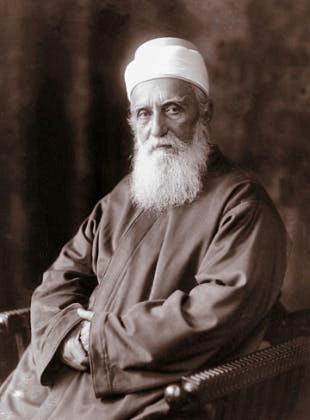
Abdu’l-Baha, a leading early proponent of Bha’i Faith, had the right idea about “the congregation of El” when he said, back in 1912:
It is evident, therefore, that the foundation of real brotherhood, the cause of loving cooperation and reciprocity and the source of real kindness and unselfish devotion is none other than the breaths of the Holy Spirit. Without this influence and animus it is impossible. We may be able to realize some degrees of fraternity through other motives, but these are limited associations and subject to change. When human brotherhood is founded upon the Holy Spirit, it is eternal, changeless, unlimited.

Any way we slice it, Elohim can’t be a plural form of either El or Eloah — except, perhaps, in the sense that the Chief Shepherd does indeed reflect more than one “face,” “presence,” or “holy being.” As we’re about to discover, Elohim has five “faces” or “aspects” — the same number, not coincidentally, as the Hindu deity Sadashiva — the highest and holiest form of Shiva acting in the realm of samsara-maya. Believed to be the divine embodiment of ultimate consciousness and bliss, Sadashiva is usually depicted, as shown above, with five faces representing the at-one-ment or transcendent powers of Shiva.

The characters just above spell Elohim in Hebrew. In anglicized form, Elohim has six letters, but in Hebrew it has only five. Those five letters, which evolved from pictorial glyphs, are (from left to right) Aleph, Lamed, Hey, Yod, and Mem.
Those letters represent the five faces of Elohim — the Hebrew equivalent of Sadashiva. Each letter has, that is to say, a specific meaning and identity. And that wouldn’t be the case if Elohim were simply the plural form of Eloah or El. So, let’s firmly establish here and now that Elohim isn’t a plural form of some other word, but DOES encapsulate more than one “face,” “presence,” or “holy being.”
And we’re now going to meet each one of those “faces,” starting with Aleph, the first letter in the Hebrew form of the anglicized words Elohim, Eloah, and El — all of which start with an English letter not found in the Hebrew aleph-bet.
Aleph
The first letter in Elohim and the Hebrew aleph-bet (alphabet), Aleph means “first,” “main,” “head,” or “leader.” The original pictograph for Aleph depicted an ox or bull — a symbol of strength or, in this context, the strength of the Absolute Will of God driving everything in Creation, even on the unreal earthly plane. So the first face of Elohim represents the Holy Purpose God assigned to the dream world we made in error.
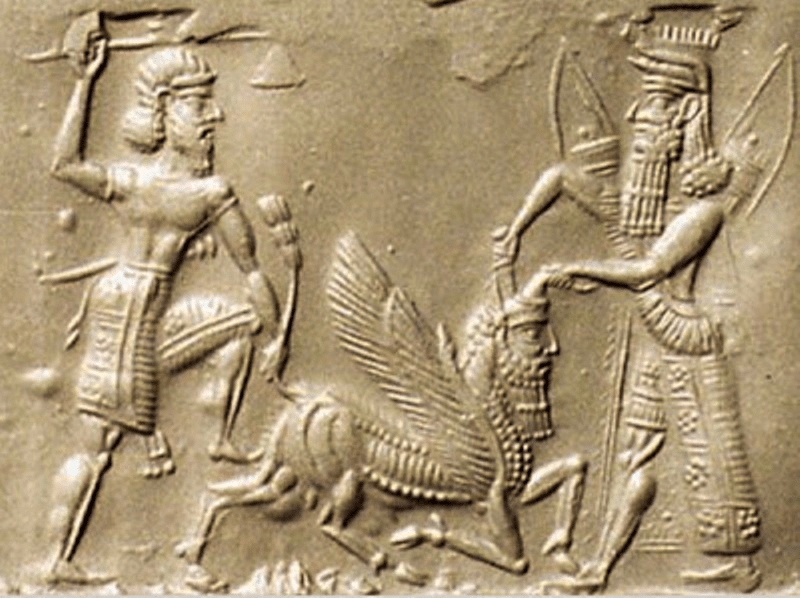
This explains a lot, actually, because the White Bull of Divine Purpose shows up in many spiritual allegories, both ancient and modern. He was, for example, the (winged) Bull of Heaven or Gugalanna slain by the hero Gilgamesh (with the help of Enkidu, the embodiment of the lower nature) in the epics of ancient Sumera of Mesopotamia. The name Gilgamesh means “one who is unique” or “one who is special.” Through the desire to be “special” or “unique,” therefore, Gilgamesh “killed” God’s Will and Purpose in the little kingdom he forged for himself on Earth. In the epic, Gilgamesh eventually transcends the earthly realm to achieve spiritual sight.

In Hinduism, the White Bull of Heaven is Nandi — the vahana or vehicle of Lords Shiva and Krishna. This association communicates in symbolic shorthand that God’s Will for our return is the driving force behind the actions of both Shiva and Krishna. Moreover, Nandi’s legs are said to represent the four pillars of Dharma — the path of rightminded living. In Vedic traditions, those four pillars are Satya, Tapa, Daya, and Daan.
The definitions of those four Sanskrit words have been twisted over time by the Ego Mind. When rightmindedly translated, Satya means “seek the Divine Truth in every situation,” Tapa means “choose Atonement over Ego,” Daya means “be merciful and compassionate toward your fellow beings,” and Daan means “give your charitable alms through Living Water miracle-exchanges.”
I kid you not.
In classical Hebrew script, Aleph is constructed with two yods or “arms,” one of which reaches upward and one of which reaches downward. In Hebrew teachings, Aleph‘s two arms are said to represent the upper and middle realms of Shamayim (the rainbow arch above Elohim’s Throne) and Eretz (the Land of the Living God or heavenly Jerusalem below Elohim’s Throne). What Aleph‘s arms actually represent are God’s Promise to end the dream without stepping too hard on the Sonship’s free will.
These two “arms” of Divine Purpose are sometimes described as “active” and “passive.” In actuality, they represent the Father’s Will to wake us up, already achieved in the Holy Instant, and the Sonship’s will to remain asleep until he/we have exhausted his/our futile pursuit of happiness through “specialness.”
The active counterpart of Aleph is Beth (the second letter or B-equivalent in the Hebrew aleph-bet). Yes, Beth is the ACTIVE counterpart, because Aleph rarely (if ever) acts directly in the dream-realm. As the fixed, embedded, or banked Will to awaken and be awakened, Aleph sits on his Throne, passively watching from above as his will is carried out below. Beth, meanwhile, is the more fluid and nurturing “manager” of the Atonement Plan’s various phases, components, and devices. To carry out the Father’s Will, in accordance with the Son’s, she channels her gently persuasive power through the four Living Beings and their sea-like “roar.”
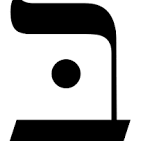
In its original pictographic form, Beth depicted a house with a dagesh inside. In mystical teachings, Beth is understood to symbolize the “House of God” sheltering the Souls wandering in the desert of Asiya, the Hebrew word for the physical world of action or “doing.” So, Beth is the “enclosure” or “temple” we must rebuild in the heavenly Jerusalem. She is, in short, the part we play in upholding the second covenant.
The relationship between Aleph and Beth in the dream-realm is represented by the intersecting triangles on the Star of David and/or Seal of Solomon. Aleph is the upright triangle, whilst Beth is the inverted triangle preventing Aleph from “having his way” immediately.
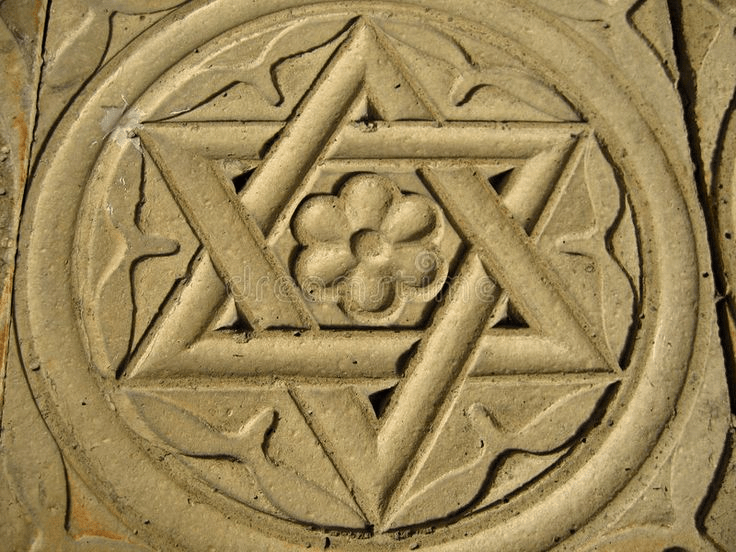
As above (Aleph), so below (Beth). As Aleph‘s active partner, Beth works in the dream of time, space, and matter to restore Neshama — the Creative Will our Souls share eternally with the Father-Creator.
Rightly understood, it is this “active” aspect that allows us to exercise free will in the dream of earthly existence. We exercise our seemingly independent will by choosing when and how we will awaken. We made this choice way back when God ended the dream through Milta. We also made this choice from a limited set of options presented to us by Elohim.
In case you missed the memo, free will is NOT a carte-blanche license to do whatever we please. Having free will merely allows us to choose between Atonement-mindedness (love, forgiveness, and mercy) and separation-mindedness (hate, guilt, and punishment) for a limited period of time.
These are, in fact, the only two choices EVER available to us, whether or not we’ve yet figured that out in our ego-induced stupor.
In the Rider-Waite-Smith Tarot, Aleph and Beth are represented by THE EMPEROR and THE EMPRESS. Yes, I did say earlier that the EMPEROR represented Elohim, sitting on the Throne of God. But THE EMPEROR more particularly represents the Aleph aspect of Elohim governing the dream-realm through the will, power, and authority delegated to him by God. Note that his royal scepter is an ankh — the Egyptian symbol for “life.” He also holds a golden orb, representing the Established Order or Universal Purpose over which he reigns supreme.
And by “Established Order” I mean what the Hindu Vedas call r(i)ta — the universal Holy Purpose assigned to the dream by God through the Logos. And that Exalted Purpose, as Course-Jesus repeatedly explains, is bringing about the restored at-one-ment of God’s Holy Creation.


As THE EMPRESS, Beth displays symbols suggestive of Demeter, the Greek goddess of abundance, and her ill-fated daughter, Persephone. In the myths, Persephone is raped and abducted by Hades, the god of the underworld, who makes her his “queen.” She can escape her captivity, her mother tells her in secret, if she doesn’t eat any offered food. Succumbing to temptation and hunger, Persephone eats three tiny pomegranate seeds, sealing her fate to return to Hades for three months every year. The story supposedly explains winter — the three-month period in which Demeter mourns her daughter’s absence. But the allegory also spiritual significance.
At the deeper level, Demeter represents the rich bounty of heavenly rewards we reap through the fruitful harvests of the sort Jesus describes in his parables. She reflects, in other words, the blessings that come from making “God and His Kingdom” our highest priority in life. Pomegranates, meanwhile, represent resurrection into eternal life, as well as the Blood of Christ, so the fruits Persephone eats enable her to come home, rather than the other way around.
THE EMPRESS wears a crown of twelve stars and a white gown covered in pomegranates. In her right hand, she holds a scepter topped by the orb of Established Order seen in THE EMPEROR’S right hand. Propped beside THE EMPRESS is a heart-shaped shield bearing the symbol of the planet Venus. Because of its association with Venus, the Roman goddess of love, the symbol is often associated with feminine power, but “feminine” and “masculine” are ego constructs. In actuality, the symbol depicts the hand mirror or looking glass of Venus, indicating that Beth holds the mirror reflecting God’s Face — the Face or Presence of Divine Love — in the lower waters of consciousness.
Or, as Rumi explains so beautifully:
All through eternity
Beauty unveils His exquisite form
in the solitude of nothingness;
He holds a mirror to His Face
and beholds His own beauty.
he is the knower and the known,
the seer and the seen;
No eye but His own
has ever looked upon this Universe.
His every quality finds an expression:
Eternity becomes the verdant field of Time and Space;
Love, the life-giving garden of this world.
Every branch and leaf and fruit
Reveals an aspect of His perfection.
The cypress gives hint of His majesty,
The rose gives tidings of His beauty.
Whenever Beauty looks,
Love is also there;
Whenever beauty shows a rosy cheek
Love lights Her fire from that flame.
When beauty dwells in the dark folds of night
Love comes and finds a heart
entangled in tresses.
Beauty and Love are as body and soul.
Beauty is the mine, Love is the diamond.
They have together
since the beginning of time-
Side by side, step by step.
I swear, since seeing Your face,
the whole world is fraud and fantasy
The garden is bewildered as to what is leaf
or blossom. The distracted birds
can’t distinguish the birdseed from the snare.
A house of love with no limits,
a presence more beautiful than Venus or the moon,
a beauty whose image fills the mirror of the heart.
In Hinduism, the Aleph-Beth partnership would be comparable to the marriage between Indra, the “king of the gods,” and his wife, Indrani or Shachi, the “shakti” or divine energy of saving grace, who “speaks for” Indra. Indrani also exists in Buddhism and Jainism, where she is considered the mirror-image of Indra. In the Rig Veda, she supposedly boasts about her husband’s submission, suggesting she is indeed the “active” aspect of the partnership.
According to the Puranic lore, Indra and Indrani descend together, riding the great white elephant Airavata, to celebrate the birth of a Tirthankara or “World Savior.” Indra’s primary “vahana,” Airavata represents the Living Water of Grace that came into the world as a happy consequence of the resurrection and ascension of Jesus Christ.

The face of Sadashiva corresponding with Aleph-Beth is Sadyojata, the invisible creative force associated with Brahman (not Brahma, the Great Deceiver!). The word supposedly means “born in a trice,” but the Sanskrit word Sadyojata more accurately translates as “immediate rebirth.” So, Sadyojata possesses the power to awaken us at once — through “birth into the holy present,” as Course-Jesus explains below:
Time is inconceivable without change, yet holiness does not change. Learn from this instant more than merely that hell does not exist. In this redeeming instant lies Heaven. And Heaven will not change, for the birth into the holy present is salvation from change. Change is an illusion, taught by those who cannot see themselves as guiltless. There is no change in Heaven because there is no change in God. In the holy instant, in which you see yourself as bright with freedom, you will remember God. For remembering Him IS to remember freedom. (ACIM, T-15.I.10:1-8)
Lamed
Elohim’s second letter is Lamed. Originally drawn as a shepherd’s crook, Lamed is the “shepherding” aspect of Elohim. The twelfth and tallest letter of the Hebrew aleph-bet, Lamed represents Elohim’s predominant role in the Atonement process.
As Chief Shepherd, Lamed guides us, in the wise and loving manner of an elder brother, to become Perfect Co-Creators, as Brothers to each other, Sons to God, and Fathers to our own Creations. The Lamed power, therefore, also oversees the At-one-ment process, including the individual forgiveness, teaching, and miracle-working assignments each of us is required to complete in God’s Atonement Plan.

In the Rider-Waite-Smith Tarot, THE HEIROPHANT represents the Lamed aspect of Elohim. In divinatory readings, the figure on this card is generally interpreted as a high-ranking religious authority in the world — such as the Pope — but that’s not how I read the symbolism. Nor is it how A. E. Waite describes THE HEIROPHANT in his 1912 guide, The Pictorial Key to the Tarot. The figure on the card is, Waite said, “the symbol of all that is righteous and sacred in the world, the channel of grace, the leader of salvation for the human race at large, and the head of the Hierarchy.”
THE HEIROPHANT is, in short, the spiritual High Priest of the deck. He’s also, therefore, the Son of God, Christ, Logos, or Word of God resident in our hearts and minds. His “shakti” partner-power is THE HIGH PRIESTESS. Note that both figures sit between two pillars.
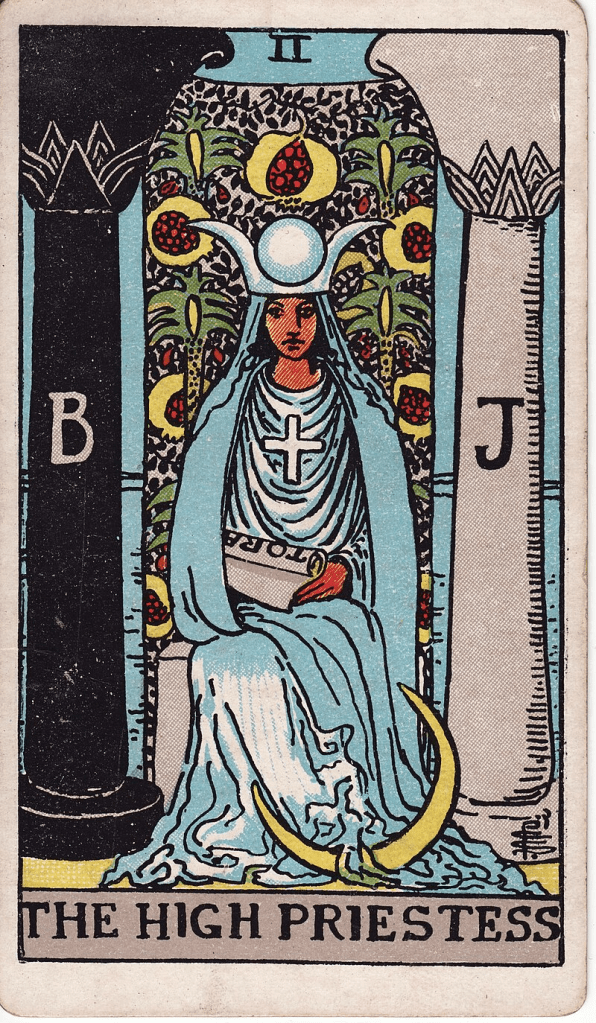
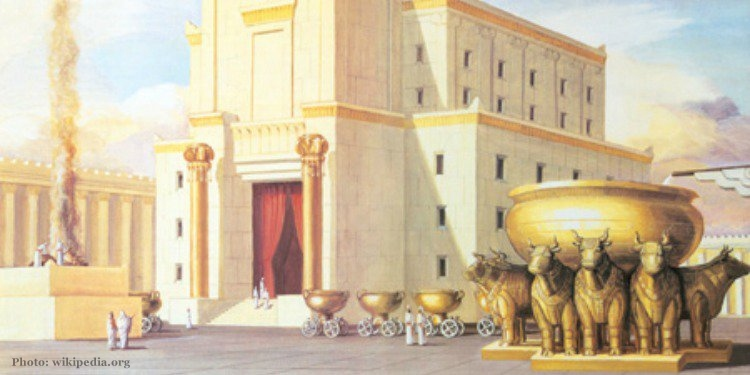
The pillars flanking THE HIGH PRIESTESS are very clearly Boaz and Jachin — the two great columns marking the entrance to Solomon’s Temple in Jerusalem. According to the lore, Boaz and Jachin weren’t part of the Temple’s structural support. Rather, they were placed at the entrance as symbols of God’s strength and “establishment” — i.e., the Established Order or Universal Purpose of Atonement God assigned the world through the Holy Spirit. The pillar on the right, Jachin means “He shall establish.” The pillar on the left, Boaz means “in Him is strength.”

Note that THE HIGH PRIESTESS holds a scroll marked “Torah,” a clue that she, too, represents Bet or Beth — the first letter in the Torah. The final letter in that text is Lamed; and, when combined, the two letters form Lev, the Hebrew word for “heart.”
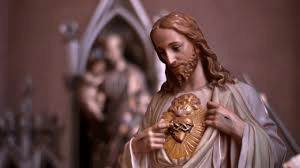
Ergo, the Lamed-Beth partnership represents “the Heart of God, and also of His Son” (to borrow from Course-Jesus) — the Sacred Heart that is the Covenant of Love binding together eternally the Father and the Son in Holy Relationship. And that “covenant” also is the Wellspring of Grace “watering the grass” in the heavenly city of Jerusalem.
According to Course-Jesus, the nearest we can come to Agape in the dream of guilt is True Forgiveness. So, the Lamed-Beth aspect of Elohim represents the passive and active energies fueling that paramount separation-mending power.
And, as with Aleph-Beth, Lamed is the passive partner, whilst Beth is the active “shakti” of the Soul-shepherding aspect of Elohim. In the symbolic representation of Jesus as the good shepherd, Lamed would be the gentle and caring shepherd watching over his flock, whilst Beth would be the staff he employs to guide, manage, rescue, and protect the sheep.
In Hinduism, the Lamed-Beth aspect of Elohim is personified by Shiva and Parvati. A name meaning “to spread blessings,” Shiva represents the transcendent aspect of Brahman, which IS forgiveness or mercy, whilst Parvati represents the gentle and nurturing strength that guides, manages, redirects, and protects the flock in Shiva’s care.

The union of Shiva and Parvati produced two offspring — but not through “copulation.” According to the lore, Kumara was born of Shiva’s “seed” without Parvati’s participation, whilst Ganesha was formed by Parvati without Shiva’s knowledge.

The “Kumara” Shiva produced has to be the four Living Beings, Direction Guardians, or Dragons discussed in Genesis. Significant figures in Hinduism, especially in Vaishnavism, the four Kumaras are revered as pure devotees of Lord Vishnu — the Vishwapurusha who also embodies Ishvara and Narayana.
Known for their wisdom and detachment, the Kumaras are believed to have received knowledge from Brahman (not Brahma!), which they share with the world. In the legends, the Kumaras are “teacher-brothers” who travel together, study the Vedas, and emphasize the importance of a loving and sincere relationship with the Divine.

Ganesha, meanwhile, is the “trumpet of God” — the instrument sounding the Call to Awaken that will precede the second coming of Christ or Shiva “consciousness” or “vision.” And that is why Ganesha has an elephant’s trunk. At the risk of overexplaining, his trunk symbolizes the trumpet through which Elohim sounds the “roaring waters” of the Call to Awaken.
In terms of Sadashiva’s faces, Lamed is equivalent to Ishana, the guardian of the fifth, upward, or “zenith” direction. Rightly understood, Ishana IS the Circle of Forgiveness in which Nataraja “dances” to advance the Established Order.

Hey
The third letter in Elohim is Hey — the Holy Spirit or Ruach aspect of the Atonement Trinity or Trinity of the Second Covenant. As a word, Hey means “to reveal” or “true revelation comes from Heaven alone.” In Jewish mysticism, the letter represents the ever-present and penetrating wind and light the Holy Spirit employs to wake us up. Like wind and light, Hey‘s influence is constant, gentle, penetrating, and illuminating.
And “revelation” is indeed the Holy Spirit’s superpower, as Course-Jesus explains below:
Revelations are indirectly inspired by me because I am close to the Holy Spirit, and alert to the revelation-readiness of my brothers. I can thus bring down to them more than they can draw down to themselves. The Holy Spirit mediates higher to lower communication, keeping the direct channel from God to you open for revelation. Revelation is not reciprocal. It proceeds from God to you, but not from you to God. (ACIM, T-1.II.5:1-5)
Being the Ruach aspect of Elohim, Hey is the spirit or breath hovering over the Primordial Ocean as God’s Face in the water. He safeguards the mirror, in other words. we broke apart to experience the fractured fairy tale of specialness.

In Heaven, that mirror is still whole. In the dream-realm, it only appears to be broken into pieces we perceive as individual “selves,” but which are, in actuality, parts of the whole reflection of Creation. Behind or underneath the illusion, Hey holds those pieces together through what is variously known as the Divine Matrix, the Atonement Network, Indra’s Net, and/or the Indrajala.
Buddhists describe that “net” as a spiderweb of pearls reflecting everything in Creation. And that’s an accurate description, as far as it goes, but only if we apprehend that what we project outwardly as maya — the desert-mirage — symbolizes something known inwardly, but forgotten.
When Course-Jesus says the Holy Spirit is the Mind of the Atonement, he means the Holy Spirit is the “face” or “aspect” of Elohim assigned to put the pieces of the mirror back together. Hey does this by bestowing the miracles allowing us to see through the veil hiding the truth that there is no “other.” There’s only God’s Face, broken into shards reflecting back to us the errors or debts we must reverse, correct, or “cancel out” to return to “wholeness” or “mind-awake” consciousness.
Or, to quote Jesus:
Miracles rearrange perception and place all levels in true perspective. This is healing because sickness comes from confusing the levels. (ACIM, T-1.I.23:1-2)
Rightly understood, miracles are not superhuman feats of physical healing. Yes, Jesus performed such feats in the scriptures, but that was (he told me) so we’d SEE what miracles can achieve when given and received at the level of mind through our prayers in the Innermost Chamber.
If he simply prayed to manifest miracles, we wouldn’t know what he was doing, right?
And, as he states outright on the very first page of the Course:
Prayer is the medium of miracles. It is a means of communication of the created with the Creator. Through prayer love is received, and through miracles love is expressed.
and
Miracles are thoughts. Thoughts can represent the lower or bodily level of experience, or the higher or spiritual level of experience. One makes the physical, and the other creates the spiritual.
And when Jesus says “prayer,” he means right-minded prayer for universal healing and upliftment — not the kind asking God to do something in the world our egos deem He ought to be doing but isn’t.
Rightly understood, miracles are loving “gifts” from Souls who have harnessed the healing power of grace and/or holiness to Souls who have not, but earnestly seek salvation. The Souls who have harnessed the power make up the Assembly, Congregation, or Brotherhood mentioned in Psalm 82.
(That same group may be the Great White Brotherhood or Lodge discussed in the occult and esoteric literature, the elders encircling Elohim’s Throne in Revelations 4:4, and/or the Teachers of Teachers “who’ve reached God directly” described by Jesus in the Course.)
The aforementioned Matrix links together the Soul-group or Soul-family travelling together through the dream of time. Having wronged each other over many lifetimes, they now must forgive each other for their past transgressions. This is what Jesus means, I suspect, when he says:
Miracles are part of an interlocking chain of forgiveness which, when completed, is the Atonement. Atonement works all the time and in all the dimensions of time. (ACIM, T-1.I.25:1-2)
Elsewhere in the Course, Jesus describes the Holy Spirit as “the bridge” between inverted perception and Miraculous Perception. Rightly understood, that “bridge” IS the Miracle Matrix whose pearls reflect the Established Order underneath the form.
If it helps, think of the Divine Matrix as the Internet Backbone in our minds, connecting our Souls through the Holy Spirit or Mind of the Atonement.

That “backbone” is, in fact, a projected reflection of the actually network joining our minds in Holy Relationship. And it is through those connections that we exchange the Miracles of Grace making possible the True Forgiveness through which the Holy Spirit gradually dissolves the illusion of separation.
Souls still avoiding or denying the spiritual aspects of reality are temporarily beyond the reach of the “witness-bearing congregation.” To receive healing, we have to consciously connect to the Matrix by asking the Holy Spirit for perception-correcting miracles. Hence, Workbook Lesson 159: I give the miracles I have received.
Exactly how these miracle-exchanges work is still above my pay-grade. I just know that we connect to the Matrix through the Temple Song — the vibratory sound of God’s Mind linking the Spiritual Backbone or Matrix together in wholeness. That sound is known by many names, including the Living Water, the Voice for God, the Song of Heaven, the Holy Stream of Sound, the Song of Songs, the Canticle of Canticles, the Song of Solomon, the Bhagavad Gita, the Om, the Aum, the Pranava, the Udgitha, and the Nada.
In the Course, Jesus also calls this sound the ever-present echo, the ancient melody, the song of redemption, the song of freedom, the forgotten song, and the song of Christ.
At one point, he says:
Christ’s hand holds all His brothers in Himself. He gives them vision for their sightless eyes, and sings to them of Heaven, that their ears may hear no more the sound of battle and of death. He reaches through them, holding out His hand, that everyone may bless all living things, and see their holiness. And He rejoices that these sights are yours, to look upon with Him and share His joy. His perfect lack of specialness He offers you, that you may save all living things from death, receiving from each one the gift of life that your forgiveness offers to your Self. The sight of Christ is all there is to see. The song of Christ is all there is to hear. The hand of Christ is all there is to hold. There is no journey but to walk with Him. (ACIM, T-24.V.7:2-10)
When we listen to that sound, we are, in effect, making withdrawals from the treasure-vault of the Logos (Aleph), and then giving what we withdrew to the Shepherd (Lamed), who passes our “alms” along to Hey to be disbursed across the Matrix where our gifts will do the most good in the long-range plan of the Established Order. And all the alms we give, we receive in kind.
That “song” is the key to our salvation — and the centerpiece of all true scriptural texts, including the Bible, the Rig Veda, the Bhagavad Gita, the Course, the Qur’an, and probably many others as well. And yet, nothing I’ve read about the Course, be it by best-selling authors or promotional organizations, says anything about this sound, despite Course-Jesus pointedly stating:
Our task is the joyous one of waking it [the world] to the Call for God. Everyone will answer the Call of the Holy Spirit, or the Sonship cannot be as one. What better vocation could there be for any part of the Kingdom than to restore it to the perfect integration that can make it whole? Hear only this through the Holy Spirit within you, and teach your brothers to listen as I am teaching you. (ACIM, T-5.II.10:7-10)
He also says:
The Holy Spirit’s purpose is to set the Presence of your holy Guests be known to you. And to this purpose nothing CAN be added, for the world is purposeless except for this. To add or take away from this ONE goal is but to take away all purpose from the world and from yourself.
Who are the Holy Guests of which he speaks? There are two possibilities. The first is that the “guests” are the Great Rays Jesus speaks of in the Course and also showed to Sister Faustina in the 1930s. Those Rays are, I’m absolutely certain, the Biblical Pillars of Cloud and Fire, as well as the Temple Pillars, Boaz and Jachin.
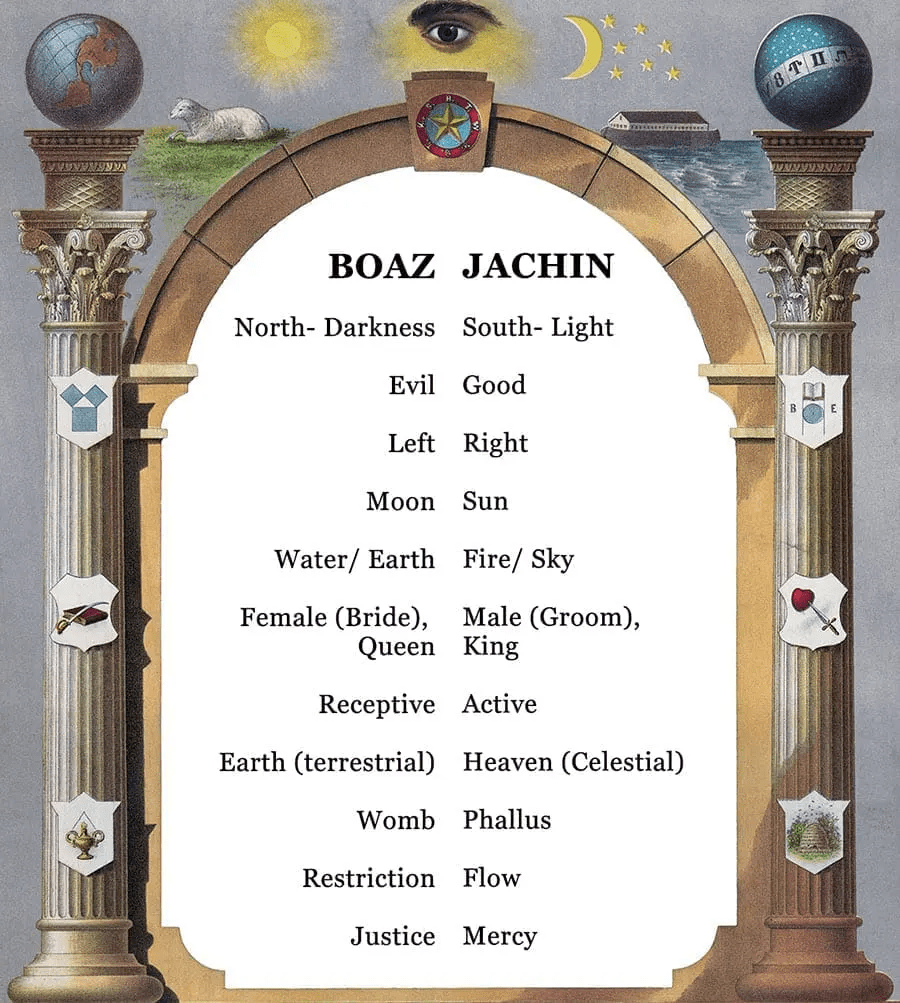
The second possibility is that the enigmatic “They” are the representatives of God and Christ in the Temple of the Holy Spirit. And those representatives would be the Aleph and Lamed aspects of Elohim. In Kabbalistic and Course terms, the “They” of which we speak are identified as the Indwelling Glory, Wholeness, and Holiness holding the “covenant” together in “at-one-ment.”
As Jewish mysticism further espouses, the Hey aspect of Elohim is the wind that lights the way. Hey is, therefore, the Lamp, the Lamb, and the Pillars of Cloud and Fire. He is the Living Water, the Voice for God, the Om, and the Bhagavad Gita. He is, in short, the LIGHT that shines away the darkness, as well as the WIND that blows away the perception of sin through “lustration” — a great word meaning “purification through undoing.”
In Judaism, Hey is both Ruach, the Breath of God, and Yowah, the Spirit of the Holy Name. In Hinduism, he is Vishnu, the all-pervading “preserver” of Creation’s Wholeness. The letter Hey, in fact, occurs twice in YHVH, the Hebrew Tetragrammaton representing the Name of God.
This is interesting, actually, because the other two letters in YHVH also have symbolic meaning. The “Y” at the start is yod, which also happens to be the fourth letter in Elohim. Yod represents the Divine Spark that is the Soul. And in Hinduism, Vishnu is paired with Lakshmi, who (unbeknownst to most Hindus) represents the Soul seeking to reclaim the holy inheritance bequeathed to it by God (and stored in the vaults of Elohim, waiting to be withdrawn). That Sri Lakshmi-dev is the goddess of wealth is a completely upside-down misconstrual of her identity.
Rightly understood, the Divine Union between Vishnu and Lakshmi is the “sacred marriage” existing between the Holy Spirit and the Soul.

Jesus explains this and more about the Holy Spirit in a section of the Course titled “The Guide to Salvation.” I’ve linked to it, in case you want to read the whole thing (which I highly recommend). Below, I’ve quoted only the first paragraph:
The way to recognize your brother is by recognizing the Holy Spirit in him. I have already said that the Holy Spirit is the Bridge for the transfer of perception to knowledge, so we can use the terms as if they were related, because in His Mind they are. This relationship must be in His Mind because, unless it were, the separation between the two ways of thinking would not be open to healing. He is part of the Holy Trinity, because His Mind is partly yours and also partly God’s. This needs clarification, not in statement but in experience. (ACIM, T-5.III.1:1-5)
That the Holy Spirit is the Bridge connecting our dreaming minds to God’s explains the meaning of the third letter in YHVH. That letter is vav — the divine hook connecting heaven and earth; or, rather, connecting the dreaming mind of the Son on earth to the awake Christ Mind in the God Mind Bubble. So, vav represents the connection Hey forms between Heaven proper and the wandering Souls on earth.
According to the website Walking Kabbalah,
Vav is the power to unite everything that is separated in creation. Literally Vav means hook or peg and the Hebrew letter is a vertical line ו. It represents the Kav, the vertical line extension of the Creator’s perfection into the created world, in order to constantly direct it, guiding the cycle of existence step by step, until eventually the perfect Oneness of the Creator which underlies all of creation is revealed. Vav is related to the Orr Yashar, the direct light of the Creator, entering the world.
As the connector, Vav contains the power to connect heaven and earth. It can be considered like a hose, or a tube, which connects and bestows all the energy of the shefa שפע abundance from above down to the created beings. It represents the ladder of Jacob Yaakov – rooted in earth, with its head in the heavens. It is the extension of the essential dot Yod י, which all of creation comes forth from. The Vav can teach us the state of constant presence needed to connect our own heaven and earth (physical and spiritual aspects).
In the Rider-Waite-Smith Tarot, THE MAGICIAN best represents the Hey aspect of Elohim. Like the letter Aleph, the figure’s arms point toward Heaven and Earth, telling us he mediates between the higher and lower planes of consciousness.
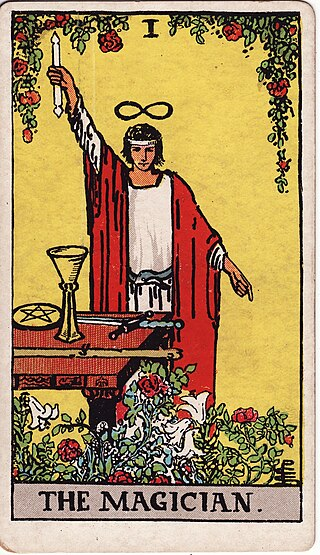
The infinity sign over his head and the Ouroboros belting his tunic indicate THE MAGICIAN is a divine rather than worldly power. As do his robes, which are the colors of the Great Rays. Entwining his altar are red roses and white lilies — fairly obvious symbols of love, forgiveness, and purity. The altar itself displays the four suits of the Tarot (cups, wands, pentacles, and swords), which, in turn, represent the four “divine attributes” we must choose over the ego’s shabby substitutions to escape the dream. of hell.
Just as Vishnu and Lakshmi are partnered in the Hindu pantheon, THE MAGICIAN is partnered with THE FOOL — the card of the Soul setting out on his journey — in the Rider-Waite-Smith Tarot.

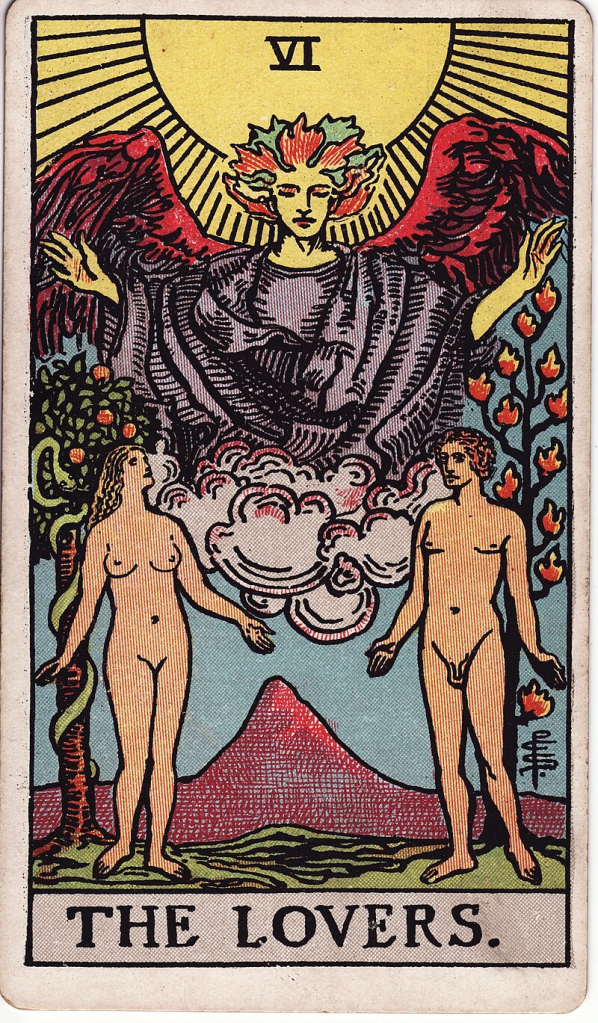
So, Hey is partnered with Adam, the Soul. And Hey is also Eve, a Hebrew word meaning “spirit.” So, Adam and Eve weren’t the first man and woman on earth; they represented the Soul and the Holy Spirit setting off from the enclosure east of Eden on the Circle-Journey back to Eden.
The face of Sadashiva Hey most resembles Tatpurusha, the darkness-dispelling “aspect” associated with air (i.e., wind and breath). A marriage of “tat” (everything belonging to God) and “purusha” (the Divine Being underneath the form), Tatpurusha also is Ishvara — another form of Vishnu/Narayana.

Yod & Mem
Now that we’ve covered the Trinity aspects of Elohim, let’s turn our attention to the remaining two letters, Yod and Mem. As I read the evidence, those two letters represent the two luminaries, pillars, anointing oils, healing elixirs, or Great Rays described in the scriptures of many faiths.
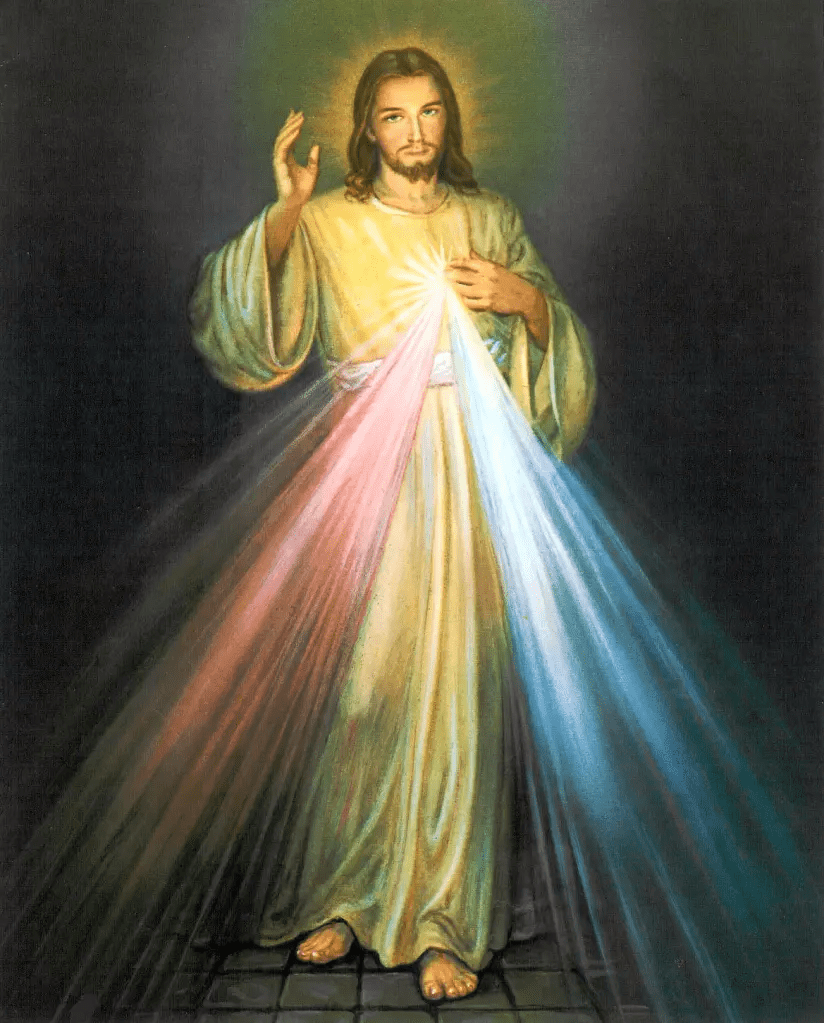
In Christian theology, Yod represents the Blood of Christ, whilst Mem is the Living Water; In Judaism, Yod is Boaz, whilst Mem is Boaz. In Hinduism, Yod is Nara, whilst Mem is Narayana. We also see these two “rays” or “beams” shining out of the heart of Jesus in portrayals of his “Divine Mercy” apparition. Notice the position of the rays, which never change. The red ray is always on the left, whilst the pale ray is always on the right (when we’re looking at Jesus).
Let’s start with Yod, and give the floor to the folks at Walking Kabbalah, because what they tell us about this letter’s symbolism is insightful:
The 10th Hebrew letter, Yod is a dot or point. The Yod represents the Creator, the single point [singularity] from which all of creation emerges, and the Unity within multiplicity. It is the foundation of all foundations, the hidden Divine spark which causes everything to be. It represents the power of the spirit to govern and guide the matter.
Yod is a symbol of the Holy One, the Creator, since the Holy Name [Yowah] starts with Yod. Small in form, the meaning of the Yod is great. According to Kabbalistic tradition, all of creation came forth from a single point – a point which represents God’s infinite presence inside of the finite world.
Yod also represents the idea of Unity within Multiplicity, of one whole that is comprised of parts. Yod as we see is a single point, but its value is 10. It shows us that many grains of sand are used to make one pot, many pages make up one book, many drops of water make up the ocean. There are many occurrences in the world, but they all stem from One God, perfect and indivisible. It also represents the 10 Sefirot. In Yod, the multiplicity returns to unity.
The yod is an infinite dot, the essence of all life. It is the foundation of all foundations. Everything comes from it and returns to it. It is a hidden dot beyond imagination – formless, the source of all thought, beyond all thoughts, beyond time and space. It is the secret hidden principle of the universe that we can’t perceive. It is the Divine spark of life that is in every single being. It cannot be grasped, but is in every cell of your body, causing you to exist. It has no mass or density, time or space. In it is the power of the spirit to govern and guide the matter of the material world.
My read on this is that Yod is the Pillar of Light or Pillar of Fire in Exodus guiding the freedom-seeking Israelites through the wilderness at night. The Pillar of Fire, we are told, lit the way from BEHIND the travelers — a symbolic clue that Yod is the inner Lamp of the Word showing us the way out of the waterless desert of earthly existence — as in “Thy Word is a lamp unto my feet, and a light unto my path” from Psalm 119:105.
Yod is, therefore, Boaz, the pillar on the left-hand side of the entrance into Solomon’s Temple. And the Red Ray also is on the left in the Divine Mercy images. Personally, I find this somewhat counterintuitive. I mean, as the Lamp of the Word and Pillar of Fire, shouldn’t Yod be the Greater Luminary associated with sunlight, fire, male energy, and the upward-thrusting lingam of Purusha-consciousness? And yet, Exodus explicitly states that the Pillar of Fire guided the Israelites “by night,” making Yod unequivocally the Lesser Luminary ruling the darkness.

Okay, so … if Yod is Boaz, then the Red Ray is THE MOON in the Rider-Waite-Smith Tarot. And that, too, feels wrong — until we really study the symbols on the card. What we see isn’t just a moon. It’s a moon sleeping within a sun raining down dewdrops onto the landscape below. In that landscape, we find a pool, a patch of grass, and two pillars. Crawling out of the pool is a lobster or crayfish. On the grass, two animals — a dog and a wolf — howl at the moon. A path cuts through the landscape, from the pool to the distant horizon.
What does all of it mean?
As I read the symbols, the combined sun and moon, together with the pillars, communicate that the Greater Luminary and the Lesser Luminary work together as inseparable partners. On the left or dark side of the Circle-Journey, Boaz, the Lesser Luminary and/or Lamp of the Word, guides us from within through intuition or intuitive knowing, whilst, from the right side, Jachin, the Greater Luminary of the Established Order, dissolves the veils of ignorance blocking the Soul’s awareness of the dream’s Holy Purpose.
And by “Established Order” we mean what the Hindu Vedas call rta — the Universal Purpose or Holy Purpose assigned to the dream by God through the Logos. And that Exalted Purpose, as Course-Jesus repeatedly explains, is bringing about the restored at-one-ment of God’s Holy Creation.
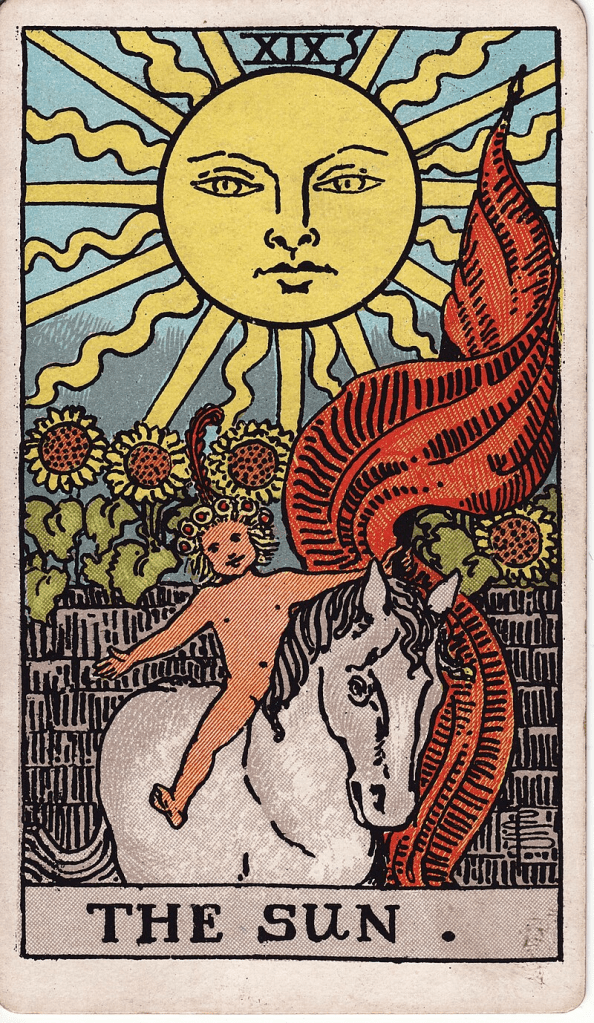
So, Yod isn’t just THE MOON. He’s THE MOON striving within us to become THE SUN, through the agency of his partner-power, Mem. On the card of THE SUN, we see Yod (the red banner) progressed to the right-side of the Circle, as the happy, childlike Soul astride the White Horse of the Apocalypse — God’s Word fully revealed. And that Word, rightmindedly interpreted, is the Son of God is still as Holy, Healed, Whole, and Innocent as it ever was.
When we think about it, Yod is indeed the passive partner in the relationship because he simply shines his light, whilst Mem plays the active role of washing clean the dark panes hiding Yod‘s brilliant inner-radiance.
If Yod is Boaz and the Pillar of Fire, he is the Aghora face of Sadashiva — the face of the left-hand side, which also takes the form of a Pillar of Light.
And if Yod is the Pillar of Fire, Boaz, THE MOON on its way to becoming THE SUN, and Aghora, then Mem is Jachin, the Pillar of Cloud, and Vamadeva — the face of Sadashiva associated with healing and water.

In the Rider-Waite-Smith Tarot, Mem is THE STAR dipping into the crystalline Pool of Holy Thought to enrich the sacred grass in the Land of the Living God. The big yellow star over her head represents the pure Thought of God mentioned by Jesus and Rumi, whilst the seven smaller stars symbolize the chakras — the seven “panes” or “veils” covering Yod‘s Lamp, which Mem‘s Living Water washes clean.
The tree in the background symbolizes the Tree of Life — the Path of the True Vine or Path of the Flaming Sword — the route back to Heaven, in other words. The bird perched atop the tree resembles an ibis — a breed known for pointing their bills toward the crescent moon. So, the bird (unbeknownst to A. E. Waite, apparently) represents “the finger pointing toward the moon” — a common metaphor in Zen Buddhism.

In Zen teachings, “the finger pointing toward the moon” is a caution not to cherish our methods more than the results they’re meant to engender. Meditation, prayer, chanting, and affirmations are, for example, the means to the end-goal of awakening. Ergo, hearing or listening to Mem isn’t the point of our practice; the point of our practice is to experience the radiant presence of Yod‘s holy light within us.
Or, as Course-Jesus says in the same vein:
We place faith in the experience that comes from practice, not the means we use. We wait for the experience, and recognize that it is only here conviction lies. We use the words, and try and try again to go beyond them to their meaning, which is far beyond their sound. The sound grows dim and disappears, as we approach the Source of meaning. It is Here that we find rest. (ACIM, W-rV.in.12:2-6)
So, the ibis on THE STAR is the finger of Mem pointing toward the moon of Yod, the inner-light of Self-knowing. So, here again, the pictures speak a thousand words when rightmindedly interpreted.
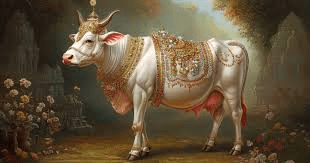
In Hinduism, Mem is portrayed as Kamdhenu or Surabhi, the Miracle Cow. Rather than grant wishes like some bovine genie, Kamdhenu pours into our dreaming minds the thought-correcting “miracles” originating from Sarasvati, the Hindu goddess personifying the Ocean of Milk.
(How do I know Sarasvati represents the Ocean of Milk? Because the Rig Veda tells us as much, when its timeless teachings are translated through illuminated understanding. Unfortunately, such translations are thin on the ground, if indeed they exist at all. In future posts, I will remedy that dearth, insofar as I’m able.)
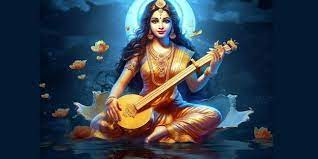
In the meantime, be aware that in Hindu theology, milk represents satya, the higher truth or higher reality of the Established Order (rta). The veena always seen with Sarasvati represents her “instrument of awakening,” which is the music of Mem, the Living Water of Grace generating Kamdhenu’s miracles.
Because Sarasvati (the Great Ocean) and Kamdhenu (the miracle generator) are inter-related, their images are sometimes (rather freakishly) combined, as we see below.

Let’s now see what our friends at Walking Kabbalah have to say about Mem.
The letter Mem is water mayim מים, the waters of wisdom, knowledge, the Torah. Representing both waters and manifestation, it is the ability to dive deep into the wisdom. It is said that in every person is the thirst for the words of the Creator, which are the waters of life. The open Mem refers to the revealed aspects of providence, while the closed Mem refers to the concealed part of the celestial rule that nonetheless guides us and all of existence. Mem also represents the time necessary for ripening and indicates to us the importance of balanced emotions and of humility.
Mem corresponds to the number 40 and represents the time necessary for the ripening process that leads to fruition (40 days for the development of the embryo, 40 years in the desert before reaching the holy land, 40 years development before Moses was prepared to be the leader of Israel).
That last part about Mem representing the number forty is interesting, because Jesus also spent forty days in the wilderness being tempted by Satan, as well as forty days on earth between his resurrection and ascendance. So the number forty definitely has spiritual significance. What it all means, I don’t profess to know.
What I am beginning to see, through this exploration into the faces of Elohim, is how the Hindus came up with two separate-but-associated trinities they call the Trimurti and the Tridevi. The Trimurti is made up of the three “male” aspects of “creation,” which are alleged to be Brahma (the creator), Shiva (the destroyer), and Vishnu (the preserver). The Tridevi, meanwhile, consists of the three female partners of these male powers.
All of this is, of course, as wrongmindedly conceived as is the Christian Trinity. The real Trimurti — the passive or inert “male” Trinity of the Atonement — consists of Indra (Aleph), Shiva (Lamed), and Vishnu (Hey). And that makes the real Tridevi — the active “female” Trinity of the Atonement — Indrani, the shakti of Divine Grace; Parvati, the shakti of Divine Strength; and Lakshmi, the Soul journeying under the protection of Lord Vishnu, the Holy Spirit.
Sarasvati, the Primordial Ocean of Holy Thought supporting the Trinity powers, is NOT part of either Trinity.
Hindus may not accept this as true, but their rejection won’t make what’s unreal real or change the truth one iota. So, there we are.
So, what have we learned today? Quite a lot, actually, starting with the fact that Elohim is neither a name synonymous with “God” (strictly speaking), nor a plural form of Eloah or El. Rather, Elohim is a set of ancient Hebrew pictorial glyphs depicting the five faces of the Supreme Being acting on God’s behalf in the dream of separation. Those five faces, which parallel the five faces of Sadashiva in Hinduism, are Aleph-Indra-Sadyojata, Lamed-Shiva-Ishana, Hey-Vishnu-Tatpurusha, Yod-Yama-Aghora, and Mem-Kamdhenu-Vamadeva.
Don’t think I mentioned Yama earlier, but he does indeed represent the Divine Spark or “divine marker” within all living beings, and not the “god of death,” as widely presumed.
We also learned the actual meaning of the Hebrew term selah, as well as what the “assembly” or “congregation” mentioned in Psalms, Deuteronomy, and Micah actually signifies.
Okay. We’re done for now. And I hope you learned as much from this exercise as I did — and are keeping an open mind. Because, as Jesus says in the Course:
Heaven itself is reached with empty hands and open minds, which come with nothing to find everything and claim it as their own.
To reach that state, we have to question everything we believe, separating in the process the wheat of Holy Truth from the chaff of Satan’s duplicity.
Until we meet again outside the Circle of Atonement, Om Hari Om.
 The Holy Meeting Place
Leave a comment