Today I’m going to reveal — probably for the first time ever — what the first chapter of Genesis actually says. So, prepare to have your eyes opened.
Let’s begin at the very beginning, with the title word genesis. A word of Greek origin, genesis means “beginning” — the same definition, more or less, assigned to the Hebrew word bereshit (בְּרֵאשִׁית) — “the first word in the original Hebrew version of the Book of Genesis,” according to Google’s artificial search-synthesizing “brain” (among other sources).
And there’s our first age-old subterfuge. Because bereshit is NOT the first word in Genesis. According to Strong’s Exhaustive Concordance, the first Hebrew word in Genesis is re’shiyth — a term Strong’s defines, rightly or wrongly, as “beginning, chiefest, firstfruits, part, time, or principal thing.”
Now, I’m no expert in Hebrew. Far from it, in fact. But I am something of a grammarian; so I know the apostrophe in re’shiyth represents something that isn’t there. And the something that isn’t there is the letter “a” or aleph — the first letter in the Hebrew aleph-bet.
If I’m right about the missing “a,” the first word in Genesis is a marriage of two terms having nothing to do with origins. Rea-shiyth means “chief shepherd” — a title also found in the New Testament Gospel of Peter. More specifically, “chief shepherd” appears in Peter 5:4-6, which reads:
And when the Chief Shepherd shall appear, ye shall receive a crown of glory that fadeth not away.
The Greek word translated as “chief shepherd” in Peter 5:4-6 is archipoimen. So, following the logic of the seventy-two Jews who named Genesis, the first book of the Hebrew Bible should have been titled Archipoimen or the Chief Shepherd.
Let’s now explore the correct meanings of the next five words in the Old Testament’s opening stanza. Those words are ‘elohiym bara’ shamayim ‘eth ‘erets.
The second longstanding subtrefuge is that ‘elohiym (Elohim) is an ancient Hebrew name for God. In the forgotten annals of Biblical Hebrew, Elohim means “Divine Grace,” which is certainly an aspect of the Father Creator, but not an interchangeable epithet for God Himself. The same is true of YHWH (Yowah or Javah), btw, but we’ll get to that a wee bit later.
For now, let’s stick with Elohim, and how his identity came to be so confused. According to my research, the trouble began in the early to middle part of the 3rd Century BCE, when the first five books of the original Hebrew Bible (Genesis, Exodus, Leviticus, Numbers, and Deuteronomy) were translated into Koine Greek by Jews living in the Ptolemaic Kingdom — a Greek sovereignty located in Egypt. These are the same guys who named Genesis and created the Greek version of the Hebrew Bible known as the Septuagint.
Working from these Greek translations, as well as the Latin Vulgate, an English protestant reformer and linguist named William Tyndale translated the Old Testament into English around 1530 — eighty-one years before publication of the derivative King James Bible. Because Tyndale’s original-source interpretations disagreed with the Vatican’s sacrosanct “spin” on the scriptures, he was tried, convicted, and executed (through strangulation and burning) as a heretic in 1536.

Tyndale’s unfortunate fate isn’t really the point. Why, then, am I telling you about him? Because Tyndale replaced the Hebrew word “Elohim” with the English word “God” throughout his Old Testament translations.
Unlike the Catholics, the Anglicans appreciated Tyndale’s efforts (which King Henry VIII utilized to establish the Church of England to undermine Catholicism) — so much so that they borrowed heavily from his translations when producing the King James Bible. Estimates suggest that approximately 76 percent of the KJV Old Testament is, in fact, identical to Tyndale’s.
In the Christian community thereafter, Elohim became synonymous with God, when he is, as we now know, the “Chief Shepherd” the Father-Creator projected into the dream-realm to bring home His wayward sheep.

Obviously, the Chief Shepherd, Great Shepherd, or Good Shepherd isn’t only Jesus Christ, whose birth was still a long way off when Elohim entered the picture. But Jesus did become a clear vessel for the Spirit of Elohim to walk among us in the world. So, he is indeed a legitimate symbol for the Logos, Word of God, and/or Chief Shepherd — a symbol humans can readily picture, relate to, respect, and aspire to emulate.
Being the “rescue” arm of the Creative Force of Agape, Elohim doesn’t create the Real and Eternal. Without Agape, which WE willfully excluded, Perfect Creation isn’t possible in the dream-realm. Elohim could not, therefore, “create” Heaven and Earth either “in the beginning” or at any other point in time. And, as I intend to demonstrate, Genesis 1:1-2 never suggested anything of the sort.
Course-Jesus affirms that Grace is indeed an aspect of Agape in the following from Workbook Lesson 169: By Grace I live. By Grace I am released:
Grace is an aspect of the Love of God which is most like the state prevailing in the unity of truth. It is the world’s most lofty aspiration, for it leads beyond the world entirely. It is past learning, yet the goal of learning, for grace cannot come until the mind prepares itself for true acceptance. Grace becomes inevitable instantly in those who have prepared a table where it can be gently laid and willingly received; an altar clean and holy for the gift.
Just as Elohim doesn’t mean “God,” the Hebrew words shamayim ‘eth ‘erets don’t translate as “the heavens and the earth” in the literal sense generally supposed. In Jewish theology, Shamayim does refer to “the heavens,” “the sky,” and/or “the celestial realm,” but those definitions are entwined in ego-distorted beliefs about God’s relationship and proximity to humankind. More accurately, Shamayim is a marriage of the smaller words sha or shua (salvation or deliverance) and mayim (waters).
Those same “salvation waters” are mentioned or described numerous times in the Bible’s New and Old Testaments. In Isaiah 12:3, for example, we are told:
Therefore with joy shall ye draw water out of the wells of salvation.
The word translated as “wells” in the KJV Bible is mayan, which also means “wellspring,” “fountain,” or “source.” Ergo, we draw Shamayim — the Living Water of Salvation — from mayan, the celestial wellspring or fountain mentioned innumerous times in the scriptures.
In like fashion, the word ‘eth does not mean “and.” Nobody seems to know what ‘eth means, despite it appearing some 72,000 times in the Old Testament. But “and” isn’t one of the contenders. “With,” on the other hand, is a possibility, as per a post by Rabbi Eli Brackman on the website of the Oxford Chabad Society. “Within” or “from,” IMHO, seems even more likely in the context of Genesis 1:1-2.
That leaves erets or eretz, which is alleged to mean either “earth,” “land,” or the “human world.” In Jewish theology, Erets rightly refers to the Land of the Living underneath Shamayim and above Sheol, the Land of the Dead. Erets does not, therefore, refer to the physical earth inhabited by embodied creatures. Rather, it is the “city of the Living God” referenced in Hebrews 12:22.
But ye are come unto mount Sion, and unto the city of the living God, the heavenly Jerusalem, and to an innumerable company of angels,
So, Erets, the City of the Living God, also is the heavenly “Jerusalem,” a word meaning “foundation of peace.” Erets also is, therefore, the “walled city,” “polis,” “enclosure,” “cistern,” “sea of glass,” or “golden egg” housing our Souls in the area Elohim established “east of Eden” after Adam and Eve “fell from grace.” And, as this verse from Hebrews explains, that “city” is located on Mount Zion — Judaism’s standard metaphor for the Upper Chambers of the Temple.
Let’s now put all of these revised definitions together and see what Genesis 1:1-2 actually reports about Elohim. Based on my findings, the whole verse SHOULD translate more or less as follows:
The Chief Shepherd, Elohim produces the waters of salvation within the Land of the Living God — the Land of the Living God existing in the desert of unreality obscuring the presence of the Primordial Ocean the Breath of Elohim hovers over nurturingly as God’s Face in the water.
Pretty different, right? And also TRUE — unlike the more familiar translation, which confuses Elohim with Satan in the guise of God, the Supreme Creator.
As Genesis rightly explains, Elohim’s primary function is to do away with “the desert of unreality obscuring the presence of the Primordial Ocean.” I’m pretty sure that translation is correct, because the Primordial or Cosmic Ocean is a motif found in creation narratives throughout human history and around the globe.
That symbolic “ocean” is not, however, “the vast, ancient sea” from which the material universe emerged and evolved — the definition generally applied by those still mistaking the dream for reality. Rather, it’s the Pond of Holy Creation we discussed in my post titled The Dynamics of Creation — the metaphoric “pool” across which God’s Thoughts ripple outward in concentric circles forever and ever into infinity.

In scriptural texts, we must understand, any sort of “waters” — be they seas, oceans, rivers, or ponds — represent creative thought. Almost never are they literal references to elemental h20.
And, as Genesis accurately states in my revised translation, “the desert of unreality” that IS the “waterless” material universe is an unwelcome pollutant in the hitherto pristine Pool of Creative Thought that IS the Great, Primordial, or Cosmic Ocean. Not only is it unwelcome jetsam in those pure and holy Waters of Thought, it also obscures the Holy Thoughts still rippling all around us. We’re still in those Cosmic Waters, as Course-Jesus constantly reminds us. We just don’t know it because we elected to BELIEVE we’re somewhere else.
And it’s Elohim’s job to preserve, protect, and finally restore our unconscious memories of that Primordial Ocean, so the pure and holy “water of waters” will still be there when we’re ready to awaken. Elohim fulfills that function — through the splendor and glory of his radiant Holy Presence — from his exalted position on the Throne of God.
Hence Peter’s statement that we shall receive a crown of glory when the Chief Shepherd appears. He’s talking, of course, about the Second Coming of the Christ Self or Logos, who is Elohim.
Located on the uppermost-innermost plane of consciousness, Elohim’s Throne is the metaphoric “seat” of God’s Presence in the dream-realm.
Located on the uppermost-innermost plane of consciousness, Elohim’s Throne is the metaphoric “seat” of God’s Presence in the dream-realm. The place Elohim occupies in our dreaming minds is, therefore, what the scriptures of various faiths call the Holy of Holies, the Most Holy Place, the Sanctum Sanctorum, Paradise, Heaven, and the Garden of Eden, among other names.
Course-Jesus calls that same holiest of holy chambers the Inner-Altar, God’s Altar, the Holy Meeting Place, the Holy Resting Place, and the Real or Forgiven World.
In Jewish mysticism, God’s Throne of Glory is located in Araboth, the highest and holiest realm also known as “the Seventh Heaven.” In the Kabbalistic teachings, Araboth also is the dwelling place of the Seraphim, Cherubim, Hayyoth, and its supervising Archangel, Cassiel.
In Islamic theology, the equivalent seat of divine power and authority is called Al-Arsh, the Throne of Allah. Carried by four angelic beings equivalent to the Hayyoth, Cherubim, or Living Beings, the Al-Arsh is said to be located “beyond the highest heaven.”

Like THE EMPEROR in the Rider-Waite-Smith Tarot, Elohim and/or Allah — two names for the same Supreme Deliverance Power(s) — sits upon his granite Throne, exuding godly power, authority, glory, splendor, and majesty. Like unadulterated Agape, Pure Grace is too powerful to act directly in the kingdom where Elohim reigns supreme; so his second Godly Act upon entering the “desert of unreality” was to “breathe” his power and influence into the lower chambers of the Temple sanctuary.
Elohim’s Cosmic Breath is “Ruach” — a name mentioned nearly four hundred times in the Old Testament. And Ruach is indeed the word traditionally translated as “Spirit” in the first verse of Genesis.
Ruach’s job is to teach us to dissolve the illusory “desert” ourselves — together, through the power of Grace or Holiness — by “forgiving” or “reversing” all the thought-errors that “dragged us down,” so to speak, into the chaotic waters of Sheol, the Land of the Dead below Eretz.
Let’s look again at my translation of Genesis 1:1-2, because the specific wording is important:
The Chief Shepherd, Elohim produces the waters of salvation proceeding from the Land of the Living God — the Land of the Living God existing in the desert of unreality obscuring the presence of the Primordial Ocean the Breath or Spirit of Elohim hovers over nurturingly as God’s Face in the water.
The Tyndale-KJV translation breaks the first verse into two lines separated by a semicolon. In the original Hebrew, there’s no “and” between “Primordial Ocean” and “Ruach-Elohim.” So, it is the Primordial Ocean over which the Breath of Elohim hovers nurturingly as God’s Face in the water.
This wording matters because a face in the water is a reflection. So, Ruach — God’s Breath, Spirit, or Voice — preserves God’s reflection in the Land of the Dead we made through external projection and division. As Jesus explains in the Course, the Holy Spirit holds up the mirror showing us the Face of Christ in “the image and likeness of God.”
When we willed to be separate from God and each other, we perceptually broke apart the mirror reflecting Creation’s Wholeness. To escape the dream, we now must reassemble the pieces — by requesting the perception-correcting Miracles that enable us to “see” Elohim’s complete and unblemished reflection shining through our brothers in Christ.
Or, to quote Course-Jesus:
Could you but realize for a single instant the power of healing that the reflection of God, shining in you, can bring to all the world, you could not wait to make the mirror of your mind clean to receive the image of the holiness that heals the world. The image of holiness that shines in your mind is not obscure, and will not change. Its meaning to those who look upon it is not obscure, for everyone perceives it as the same. All bring their different problems to its healing light, and all their problems find but healing there. (ACIM, T-14.IX.7:1-4)
Christ mentions that “mirror” a lot in the Course. In another place, he says:
This sacred Son of God is like yourself; the mirror of his Father’s Love for you, the soft reminder of his Father’s Love by which he was created and which still abides in him as it abides in you. Be very still and hear God’s Voice in him, and let It tell you what his function is. He was created that you might be whole, for only the complete can be a part of God’s completion, which created you. (ACIM, T-29.V.4:1-3)
If you think this differs from what the Holy Bible teaches, think again. Because the very same mirror metaphor is used by Paul the Apostle in Hebrews 1:3 and 2 Corinthians 3:18. The latter verse reads:
But we all, with open face beholding as in a (looking) glass the glory of the Lord, are changed into the same image from glory to glory, even as by the Spirit of the Lord.
In the mystical teachings of Kabbalism, that same mirror is the Shekinah that reflects what’s above in what’s below. What’s above is Binah — the Supernal Understanding reflected/projected to the emanations underneath. What’s below is MaIkuth — the world as a blessed Kingdom made to unveil the purpose of Binah. That higher understanding of the world’s purpose is revealed by the Indwelling Glory that is the indivisible Father-Son partnership or covenant.
Before we move on to the second verse of Genesis, let me explain that until the Great Projection there was only one “plane” of mind. That plane was Superconsciousness, Knowledge, or “mind awake” — the Divine Omniscience shared by everything inside the God-Mind Bubble. This is the only state of “being” or “cognition” that’s REAL — i.e., created and/or recognized by God.
When we projected the split-off part of our mind into the “desert of unreality,” we experienced “mind asleep,” a.k.a. consciousness or perception. Once this split occurred, it seemed as if there were two minds sharing thoughts with us, rather than just God’s. Because our perception of reality was, in fact, upside-down, we also experienced Satan’s voice as our own inner-dialog. God’s Voice, meanwhile, seemed to be an alien “other” or “background noise” threatening our safety and sanity.

This perception of God as “outside” or “other” is what philosophers and metaphysicians call “duality,” “dualism,” or “dualistic perception.” According to the two Ascended Masters who dictated Gary R. Renard’s The Disappearance of the Universe, there are four degrees of dualism. Those degrees are, from most wrongminded to most rightminded:
- Dualism = perceiving the “self” as separate from God — if He exists — other people, and the material world, over which we have no control;
- Semi Non-Dualism = perceiving God as an abstract concept, such as “love” or “mind,” but still perceiving the “self” as separate from other poeple and the material world, over which we have no control;
- Non-Dualism = perceiving our Oneness with Christ and each other, and the world as a learning environment for spiritual healing and awakening;
- Pure Non-Dualism = There is only God, who encompasses, loves, and protects All That Is.
The Masters told Renard (and us, through him) that these four stages of “dualism” make up the metaphoric rungs on the ladder back to Heaven. Personally, I find this confusing — and I’m pretty smart — so, for greater clarity and cohesion, I’ve linked the “rungs” to the four stages of the Soul’s Journey in the teachings of Santayana Dharma (a.k.a. Hinduism). The following explanations of those stages are, however, based on my own understanding.
Dharma
The first rung is “Dharma” — the stage of the journey in which we seek, find, and walk the path of rightminded living in the world. On this first leg, we have entered the Temple, by eschewing spiritual denial and inviting the Holy Spirit to show us the way. We have started the Circle-Journey, but we’re still largely wandering in confusion — blind, alone, and thirsting for the Living Water of Grace we denied ourselves when we chose “the waterless desert” over Heaven as our dwelling-place.
Artha
The second rung is “Artha” — devotion to our true Holy Purpose in the world, which is healing the split in our mind through the practice of True Forgiveness. We now “hear” the Living Water and must “drink” or “absorb” it as often as possible, by communing meditatively with the sound in our minds. That “ever-present echo” dissolves, through “lustration” (purification through undoing), the wrongminded perceptions of fear, guilt, and sin blinding us to God’s Face in the Water.
Kama
The third rung is “Kama” — desiring only to do God’s Will by giving the Miracles of Grace we’ve received to heal others. Having overcome the Ego Mind, we now serve Elohim and Ruach by performing the Miracles and other functions assigned to us by our fearless leaders.
Moksha
The fourth rung is “Moksha,” Enlightenment, or True Perception. Now healed of separation-sickness, we can enjoy our newfound peace, unity, and freedom for a while before God brings us home.
That’s how I see the four steps anyway, at my current level of perception. And my understanding seems to jibe with what Course-Jesus says below about the healing or “undoing” process:
When you have let all that obscured the truth in your most holy mind be undone for you, and therefore stand in grace before your Father, He will give Himself to you as He has always done. Giving Himself is all He knows, and so it is all knowledge. For what He knows not cannot be, and therefore cannot be given. Ask not to be forgiven, for this has already been accomplished. Ask, rather, to learn how to forgive, and to restore what always was to your unforgiving mind. Atonement becomes real and visible to those who use it. On earth this is your only function, and you must learn that it is all you want to learn. You will feel guilty till you learn this. For in the end, whatever form it takes, your guilt arises from your failure to fulfill your function in God’s Mind with all of yours. Can you escape this guilt by failing to fulfill your function here? (ACIM, T-14.IV.3:1-10)
With that out of the way, let’s return to Genesis. What else might the first chapter reveal about what Elohim did after entering the waterless desert in our dreaming minds?
The second verse reads:
Elohim said, “To be the Light of Lights Elohim sees — the Light that good and fair Elohim set apart, the Light of Wholeness Elohim named the Lamp of Day (or the Pillar of Cloud) — oppose the approaching darkness by bringing forth the bright joy of Wholeness …
The “Light of Lights” is the Light of God within us, which is all that Elohim sees. The Lamp of Day or Pillar of Cloud, which opposes darkness, is the tool through which we restore our awareness of the Greater Light of God within our dreaming minds. According to Google’s search-genie, the term “Lamp of Day” represents the Word of God, which illuminates the path of righteousness or rightmindedness.
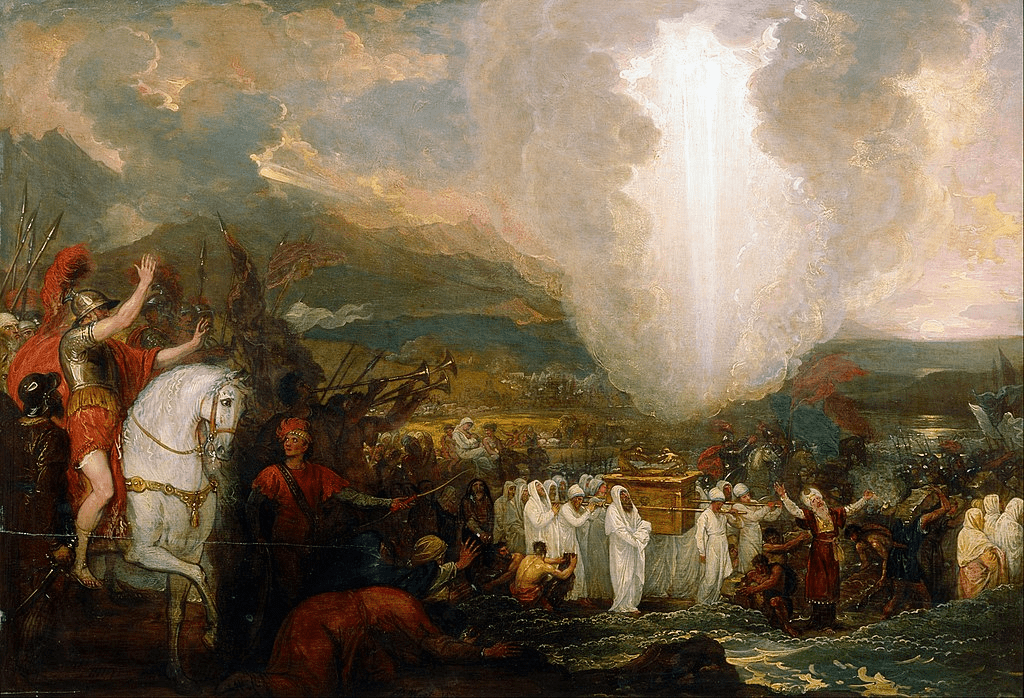
In Exodus 13 and 14, Yovah materializes in the form of a Pillar of Cloud to lead the Israelites through the wilderness during the day. At night, their way is lighted from behind by a Pillar of Fire. So, the Pillar of Cloud and the Lamp of the Day are both forms of Yovah, the Spirit of the Holy Name or Word.
The Bible mentions that same Lamp time and again. In Psalm 119:105, for example, King David writes: “Thy Word is a lamp to my feet, and a light to my path.”
In Proverbs 4:18, King Solomon similarly writes: “But the Path of the Righteous is like the shining lamp that shines ever brighter until the Perfect Day.”
In Proverbs 20:27, Solomon mentions the Lamp again, but what he communicates has been poorly translated. What he actually wrote was closer to this: “The Divine Inspiration of the Soul, the Lamp of Yovah examines the Innermost Chamber.”
As we’ve established, the Innermost Chamber is another name for the Inner-Altar, Holy of Holies, or Seventh Heaven wherein Elohim sits on the symbolic Throne of God.
In the New Testament and the Course, Jesus also mentions the Lamp or Lampstand — many times, in fact. In the following, he echoes what David says in Psalms, with a more detailed explanation of his meaning:
No one can escape from illusions unless he looks at them, for not looking is the way they are protected. There is no need to shrink from illusions, for they cannot be dangerous. We are ready to look more closely at the ego’s thought system because together we have the Lamp that will dispel it, and since you realize you do not want it, you must be ready. Let us be very calm in doing this, for we are merely looking honestly for truth. The “dynamics” of the ego will be our lesson for a while, for we must look first at this to see beyond it, since you have made it real. We will undo this error quietly together, and then look beyond it to truth.
What is healing but the removal of all that stands in the way of knowledge? And how else can one dispel illusions except by looking at them directly, without protecting them? Be not afraid, therefore, for what you will be looking at is the source of fear, and you are beginning to learn that fear is not real. You are also learning that its effects can be dispelled merely by denying their reality. The next step is obviously to recognize that what has no effects does not exist. Laws do not operate in a vacuum, and what leads to nothing has not happened. If reality is recognized by its extension, what leads to nothing could not be real. Do not be afraid, then, to look upon fear, for it cannot be seen. Clarity undoes confusion by definition, and to look upon darkness through light must dispel it.
In Exodus 25:31-40, the Lamp of which we speak is equated with the Golden Lampstand — the Menorah illuminating the Tabernacle that predated the First Temple in traditional Jewish theology. And in Revelation 21:23, the Lamp is compared to the Lamb of God (hence the Lamb’s seven eyes and seven horns). So the Lamp, the Pillar of Cloud, and the Lamb of God all symbolize the Inner-Instrument or Temple Menorah through which Elohim lights our way back to the Throne Room on the seventh plane of Moksha, Enlightenment, or True Perception.
Did the Chief Shepherd say all of this on the night before the first day? No, because “evening and morning on the first day” makes absolutely no sense, either grammatically or in terms of scriptural truth. It cannot, therefore, be an accurate translation of the (transliterated) Hebrew words: ereb boqer echad yowm.
In the interests of time and space, I won’t elaborate on the etymological evolution of these words. I will simply say that ereb means “sunset,” “dusk,” or “twilight” more than “evening,” whereas boqer means “dawn” or “daybreak” more than “morning.” And “twilight” can refer to the darkness before the dawn. So, ereb boqer probably means something along the lines of “the twilight before the dawning” or “the twilight before the breaking.”
And the “dawn” of God’s Light is certainly a theme found multiple times in the Holy Bible. In Isaiah 58:8, for example, we are told:
Then shall thy light break forth as the morning, and thine healing or restoration shall spring forth speedily: and thy righteousness (rightmindedness) shall go before thee; the glory of the Lord (Yovah) shall be thy reward.
In Luke 1:78-79, we are similarly told:
Through the tender mercy of our God; whereby the dayspring (dawn) from on high hath visited us, To give light to them that sit in darkness and in the shadow of death, to guide our feet into the way of peace.
But wait, there’s more. Because “twilight breaking” or “breaking of twilight” (bein hasmashot) is a term used in Judaism to describe the transition from day to night, which begins at sunset. According to Google, “This period is considered a time of uncertainty, with varying opinions on whether it belongs to the day or the night. It’s often treated as a safeguard against encroachment upon either, influencing the timing of Shabbat and holiday observances.”
So, ereb boqer or “twilight breaking” would refer metaphorically to a period of uncertainty where light and dark battle for dominance. In the twilight before nightfall, darkness wins. In the twilight before dawn, light prevails.
This leaves us only to work out the intended meaning of echad yowm. The easier of the two to define, echad means “one” or “first.” Yowm, on the other hand, has numerous meanings, but is generally defined as “day,” “age,” or “time period” — a byproduct perhaps of its historically LITERAL translation as “day” in this section of Genesis.
I’m more inclined to believe yowm means “Day of the Lord” in these verses, as it does in Isaiah 13:6 and Joel 2:1. Strong’s Concordance also says, “In prophetic literature, ‘yom’ can symbolize a future time of divine intervention, often referred to as ‘the day of the LORD.’”
So, ereb boqer echad yowm translates not as “the evening and morning of the first day,” but as “the twilight before the dawning of the first Day of the Lord.” The first day, in other words, that Elohim and company intervened in the dream to prepare the ground for the “seeds” of God’s Salvation Plan.
If I’m right about this, Genesis 1:3-5 should read:
Elohim said, “To be the Light of Lights Elohim sees — the Light that good and fair Elohim set apart, the Light of Wholeness Elohim named the Lamp of Day (or the Pillar of Cloud) — oppose the approaching darkness by bringing forth the bright joy of Wholeness in the twilight (the time of uncertainty) before the dawning of the first Day of the Lord.“
With this new understanding of what Genesis actually describes, let’s move on to the third set of verses (1:6-8), which read:
Elohim said, “The arch in the midst of the waters will set apart the water of waters.” Elohim made the arch to set apart the waters which were under the arch from the waters which were above the arch. Afterward, Elohim called the arch Shamayim in the twilight before the dawning of the second Day of the Lord.
There’s a lot of discussion and debate on the internet about the true meaning of the Hebrew word raqiya — in both the religious and scientific communities. The KJV Bible renders the word as “firmament” or “realm,” but it can also mean “vault,” “expanse,” or “arch.”
I went with “arch” for two very good reasons. The first is that the “arch” mentioned herein has to be the “rainbow” mentioned in Genesis 9:3, 9:12-17, and Revelation 4:2-3 and 10:1. In Genesis 9:12-17, God places a rainbow in the clouds as a sign of His Promise not to destroy the earth with another flood. In Revelation 4:2-3, the rainbow shines above the Throne of God. So, the arch is way up there — between the uppermost-innermost plane of perception where Elohim sits on God’s Throne and the God-Mind Bubble. Hence, the arch separates the waters of perception below from the “water of waters” or Primordial Ocean of the God Mind-Bubble up above.
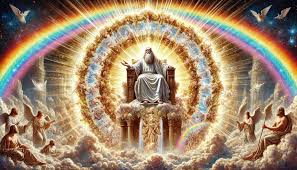
My second reason for choosing “arch” is Christ’s use of the word “arched” in the related excerpt below from the Course. The arch he describes also correlates with what the Bible says about the heavenly rainbow.
Like to the sun and ocean your Self continues, unmindful that this tiny part [the ego-constructed “self” residing in the body] regards itself as you. It is not missing; it could not exist if it were separate, nor would the whole be whole without it. It is not a separate kingdom, ruled by an idea of separation from the rest. Nor does a fence surround it, preventing it from joining with the rest, and keeping it apart from its Creator. This little aspect is no different from the whole, being continuous with it and at one with it. It leads no separate life, because its life IS the oneness in which its being was created.
Do not accept this little, fenced-off aspect as yourself. The sun and ocean are as nothing beside what you are. The sunbeam sparkles only in the sunlight, and the ripple dances as it rests upon the ocean. Yet in neither sun nor ocean is the power that rests in you. Would you remain within your tiny kingdom, a sorry king, a bitter ruler of all that he surveys, who looks on nothing yet who would still die to defend it? This little self is not your kingdom. Arched high above it and surrounding it with love is the glorious whole, which offers all its happiness and deep content to every part. The little aspect that you think you set apart is no exception.
Love knows no bodies, and reaches to everything created like itself. Its total lack of limit is its meaning. It is completely impartial in its giving, encompassing only to preserve and keep complete what it would give. In your tiny kingdom you have so little! Should it not, then, be there that you would call on love to enter? Look at the desert—dry and unproductive, scorched and joyless—that makes up your little kingdom. And realize the life and joy that love would bring to it from where it comes, and where it would return with you.
I was about to write that the Bible doesn’t contain the specific phrase “water of waters,” but it clearly does when translated correctly. Because we find those words in this verse. We also find the phrase “water of waters” in the Rig Veda, the most sacred and ancient of the Hindu scriptural texts, as well as in a powerful poem by Jalāl al-Dīn Muḥammad Rūmī, the the 13th-century Sufi mystic better known as “Rumi.”
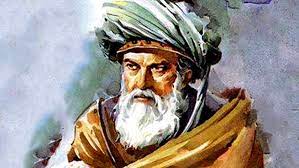
Titled “Behold the Water of Waters!,” the highly figurative poem reads as follows:
The sea itself is one thing, the foam another;
Neglect the foam, and regard the sea with your eyes.
Waves of foam rise from the sea night and day.
You look at the foam ripples and not at the mighty sea.
We, like boats, are tossed hither and thither,
We are blind though we are on the bright ocean.
Ah! you who are asleep in the boat of the body,
You see the water; behold the Water of waters!
Under the water you see there is another Water moving it.
Within the spirit is a Spirit that calls it.
When you have accepted the Light, O beloved,
When you behold what is veiled without a veil,
Like a star you will walk upon the heavens.
Pretty evocative, right?
Let’s now proceed to Genesis 1:9-13, which reads:
Elohim said, “Waters of Shamayim, patiently wait upon God’s First Place to give the illuminated vision Elohim radiates (in rays) from the Land of the Living God, the gathering place of the purifying waters sounding the roar Elohim considers beneficial.“
Elohim said, “Land of the Living God, bring forth green pastures from the scattered seeds of fruitful blessings the True Vine (or Tree of Life) bestows abundantly; fruits of the kind that seed the Land of the Living God.” And the Land of the Living God brought forth green pastures from the scattered seed of the kind the True Vine bestowed abundantly to sow seeds of the kind Elohim considered beneficial, in the twilight before the dawning of the third Day of the Lord.
The first half of this verse was a real bear to work out — and didn’t make a lot of sense once I did. So, I hunted around for what “God’s First Place” might mean. I found only one allusion to “God’s First Place” in the Course — in Workbook Lesson 328: I choose the second place to gain the first. The crux of the lesson is that we must put God’s Will ahead of our own if we truly wish to be “wholly safe and eternally at peace.” Bible-Jesus expresses the same idea when he says, in Matthew 6:33, “But seek ye first his kingdom, and his righteousness; and all these things shall be added unto you.”
God’s First Place also might refer to the Tabernacle, the Inner-Altar, or the Holy Resting Place. But I suspect it refers to putting God first, because we don’t hear the Living Water until we make achieving enlightenment the end-all be-all of our existence.
In the second part of the verse, Elohim commands the Land of the Living God to bring forth green pastures from the “scattered seeds” the True Vine bestows abundantly. Those seeds are, I’m fairly certain, the Miracles of Grace we also “scatter like seeds” — through the Living Vine’s largess — in the Golden Circle of Om. Rightly understood, those Miracles of Grace are the Living Water that causes “green grass” to grow in the waterless desert of earthly existence.
That “green grass” is, I believe, the “lawns of Heaven” Jesus mentions four times in the Course, as well as the “sacred grass,” “Kusha,” or Dharaba-gras that plays a major role in Hindu rituals. It’s not ACTUAL grass, my brother, any more than the “green pastures” mentioned in Psalm 23 are actual pastures. The famous first line of Psalm 23 is, btw, mistranslated. It actually reads more along these lines:
The melody of the Beloved One, Yovah perceives my need for the restful green pastures abiding in the resting place of the waters.
Furthermore, Bible-Jesus shares way too many parables about scattering seeds and fruit-producing trees and vines for anyone with a lick of sense to believe that the seeds, fruits, trees, and vines mentioned in Genesis are of the literal variety.
Elohim no more created trees than he “gathered together the waters and called them Seas,” as the Anglican translators suggest; because the Holy Mind powering the Logos doesn’t think in words or names. Words and names, as Course-Jesus explains, are instruments of separation WE invented to slice and dice Creation’s Oneness into discreet and identifiable forms. And Elohim’s job is to end the separation; so he certainly wouldn’t add to the chaos and division by forming and naming unreal geographical features.
As the original Hebrew more accurately reports, Elohim instructed the Waters of Shamayim to reveal the purpose he gave the world we miscreated with Satan. Up above the Land of the Dead, the Land of the Living God is indeed a wellspring of sacred waters making visible the good (as Rumi rightmindedly observed). And we access those “purifying waters” by immersing ourselves in their sound or “roar” in meditation.
As stated earlier, the “wellspring” mentioned herein also is the “fountain,” “spring,” “pool,” and/or “cistern” discussed elsewhere in the Bible, as well as the “sea of glass before the Throne” seen by the prophets Ezekiel and John of Patmos, among others. Elohim placed that “cistern,” “fountain,” or “pool” containing the waters of salvation in the third quadrant of “Kama” — the “enclosure,” “citadel,” or “walled city” east of Eden mentioned later in Genesis.
Keep these things in mind, because that “cistern,” “wellspring,” “fountain,” or “sea of glass” will come up many times in future discussions.
Let’s now discuss yabbasah — the Hebrew word I translated as “to give the radiant” (vision of Elohim). In the Tyndale-KJV Bible, yabbasah is rendered as “dry” (land). Land is encased in parentheses because yabbasah doesn’t mean “dry land”; it means “dry” or “withered.” Except that it doesn’t, because the Hebrew word for “dry,” as in drying up or withering, is yāvēsh.
So, it’s a pretty big stretch to equate yabbasah with yavesh — and then stick in “land” parenthetically to make the verse fit the Big Fat Lie Satan’s been feeding us since time began. Namely, that God created the material world; the subtext being that the creator of the material world is God. Ergo, Satan is God and, therefore, deserving of our worship, loyalty, and unquestioning obedience.

Or, to quote Bible-Jesus (from John 8:44):
Ye are of your father the devil, and the lusts of your father ye will do. He was a murderer from the beginning, and abode not in the truth, because there is no truth in him. When he speaketh a lie, he speaketh of his own: for he is a liar, and the father of it.
Are you getting the picture?
I hope so, because yabbasah doesn’t mean “dry” or “withered.” The word is a marriage of yabbah (to give) and sah (radiance). And it is absolutely true that Elohim gathered together the waters of salvation into a cistern or fountain in the third quarter of Kama to give the radiant vision of the Face of Christ to those able to hear the Living Water — the sea-like roar of the Logos through which our Spiritual Sight is restored.
Whereas it’s absolutely untrue that Elohim gathered together the waters of earth, called them “seas,” and made dry land appear. So, don’t believe that Devil-authored deception for another moment.
Or, as Course-Jesus says:
Love knows no bodies, and reaches to everything created like itself. Its total lack of limit IS its meaning. It is completely impartial in its giving, encompassing only to preserve and keep complete what it would give. In your tiny kingdom you have so little! Should it not, then, be there that you would call on love to enter? Look at the desert—dry and unproductive, scorched and joyless—that makes up your little kingdom. And realize the life and joy that love would bring to it from where it comes, and where it would return with you.
The Thought of God surrounds your little kingdom, waiting at the barrier you built to come inside and shine upon the barren ground. See how life springs up everywhere! The desert becomes a garden, green and deep and quiet, offering rest to those who lost their way and wander in the dust. Give them a place of refuge, prepared by love for them where once a desert was. And everyone you welcome will bring love with him from Heaven for you. They enter one by one into this holy place, but they will not depart as they had come, alone. The love they brought with them will stay with them, as it will stay with you. And under its beneficence your little garden will expand, and reach out to everyone who thirsts for living water, but has grown too weary to go on alone.
Believe me and Jesus, or believe the Devil’s lies. The choice is yours, my brother.
On that gonging note, let’s proceed to Genesis 1:14-19, which reads:
Elohim said: “Luminary arch of Shamayim set apart Day (the Light of God’s Presence) from Night (the opposing darkness). The miracle meeting place in the time of years, the luminary arch of Shamayim will enlighten the world.”
Elohim brought forth two Great Luminaries; a mighty luminary to govern the Day, and a lesser luminary to govern the Night. A star Elohim set in the arch of Shamayim to give light to the world, to rule over the age of darkness, and to divide the Light from the darkness. Elohim beheld the good in the twilight before the dawning of the fourth Day of the Lord.
First and foremost, the two Great Luminaries mentioned herein are NOT the visible sun and moon, as generally supposed. Rather, they are the Pillars of Cloud and Fire that guided the Israelites out of the desert of earthly existence. The narrative in Exodus is very helpful, actually, because it tells us the Pale or Water Ray is the greater luminary ruling the Day, whilst the Red Ray or Blood Ray is the lesser luminary ruling the Night. The Exodus narratives also characterize both pillars as manifestations of Yovah, the Spirit of the Holy Name or Word, who is the Lamp, the Lamb, and the Melody of the Beloved One.
So, basically, Yovah is the Hebrew equivalent of Om/AUM, the vibratory Name of God and/or Great I Am emanating from Elohim.
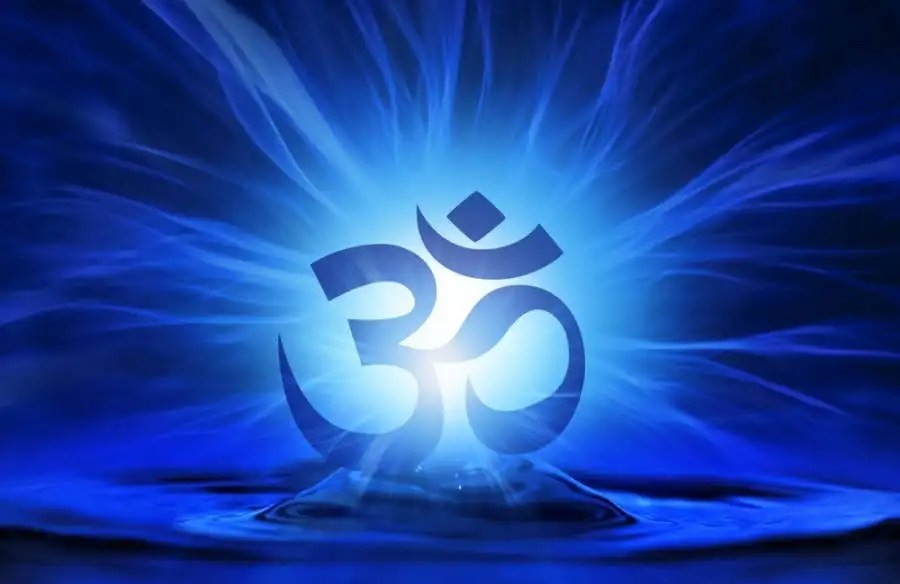
Secondly, but no less importantly, the star Elohim set in Shamayim “to give light to the world” is the SAME star Rumi mentions in his poem, as well as the one Course-Jesus describes below:
The Thoughts of God are far beyond all change, and shine forever. They await not birth. They wait for welcome and remembering. The Thought God holds of you is like a star, unchangeable in an eternal sky [Shamayin]. So high in Heaven is it set that those outside of Heaven know not it is there. Yet still and white and lovely will it shine through all eternity. There was no time it was not there; no instant when its light grew dimmer or less perfect ever was.
Who knows the Father knows this light, for He is the eternal sky that holds it safe, forever lifted up and anchored sure. Its perfect purity does not depend on whether it is seen on earth or not. The sky [Shamayim] embraces it and softly holds it in its perfect place, which is as far from earth as earth from Heaven. It is not the distance nor the time that keeps this star invisible to earth. But those who seek for idols cannot know the star is there.
Based on what he says, I’m pretty confident my translation of Genesis 1:14-19 is more accurate than those suggesting Elohim made the sun, moon, and stars on the fourth day.
Let us now move on to the sixth set of verses (20-23), which reads:
Elohim said: “The waters abound with the music of the Tree of Life, the Soul of the Living Beings of the citadel (the City of the Living God) — the quarters (of Elohim) soaring above the earth; the faces (or presences) of the arch of Shamayim Elohim fashioned. Great Dragons, the Living Beings of the Spirit move about the waters to serve their descendants in the quarters enclosing their embodiments Elohim considers beneficial. And Elohim pronounced his blessing, saying: “Be fruitful, teacher-brothers, in furnishing the waters roaring in the quarters of the teacher-brothers of the Land of the Living God, in the twilight before the dawning of the fifth Day of the Lord.”
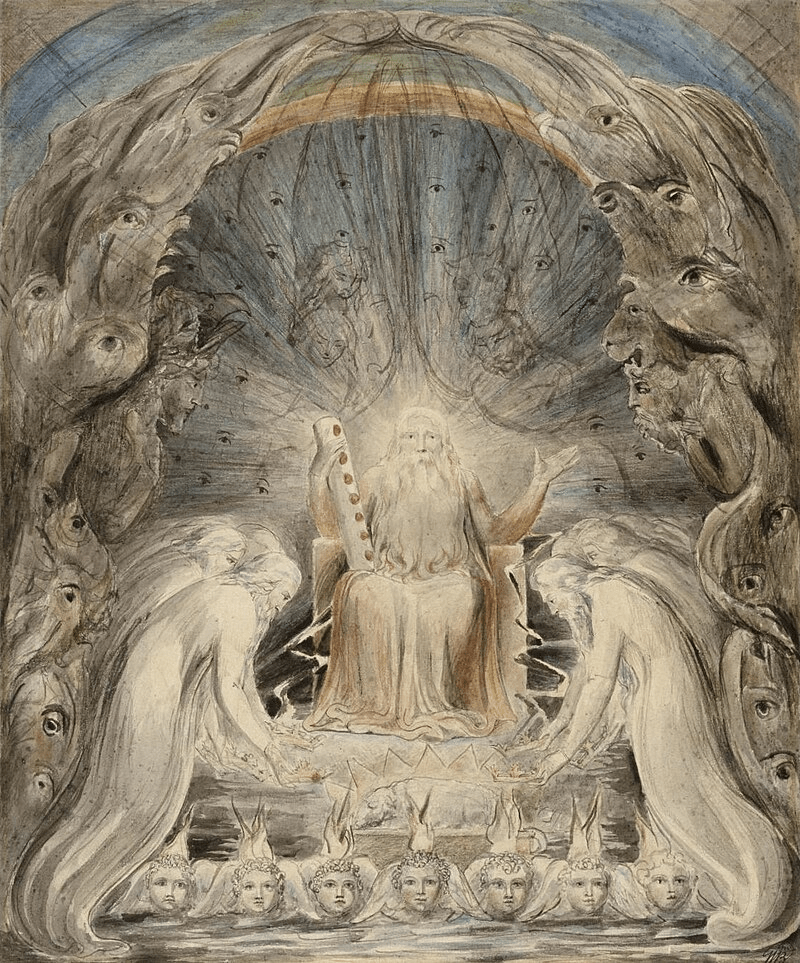
Now that I’ve painstakingly worked out what this verse actually says, it doesn’t surprise me that nobody else has come close. To say that what this verse communicates falls outside the theological parameters of traditional Judaism and Christianity would be a significant understatement. And yet, the “Living Beings,” “Living Beasts,” or “Souls of the Living God” (Chay-Nefesh in Hebrew) addressed by Elohim herein are the same four Living Beings, Living Creatures, or Cherubim described by the Biblical prophets Daniel, Isaiah, Ezekiel, Zechariah, and John of Patmos.
Rightly understood, these four beings, beasts, or creatures are the “guardian spirits” who parent and teach the reincarnating Souls assigned to the quadrant or “wing” of the Golden Circle each safeguards. Our Souls are, in actuality, their descendants, offspring, and/or embodiments. We all are, in other words, smaller reflections of these larger Divine Beings, which exercise “guardianship” over the four legs of the Circle-Journey.

Yes, this sounds really “out there,” even for me, but these same four guardians show up in different forms in just about every belief system on the planet. So, they do exist, hard as that may be to accept.
In Judaism and Christianity, these guardians are the four Living Beings, the Cherubim, and the chief Archangels. In Islam, they are the four archangels, as well as the hamlat al-arsh — the “winged creatures” bearing the Throne of Allah. In Taoism, they are the Four Symbols, Guardians, and/or Auspicious Beasts protecting the four cardinal directions: the Black Tortoise of the North, the Azure Dragon of the East, the Vermillion Bird of the South, and the White Tiger of the West.
In Buddhism, they are the four Heavenly Kings; in Hinduism, they are the Heavenly Kings, the Lokapala, and/or the four Kumaras; in Theosophy, the occult sciences, and esoteric astrology, they also are the four Kumaras, as well as the four Soul Rays and/or the four Rays of Attribute; and in Chinese “folk mythology” they are the Four Dragons or the Four Dragon Kings.
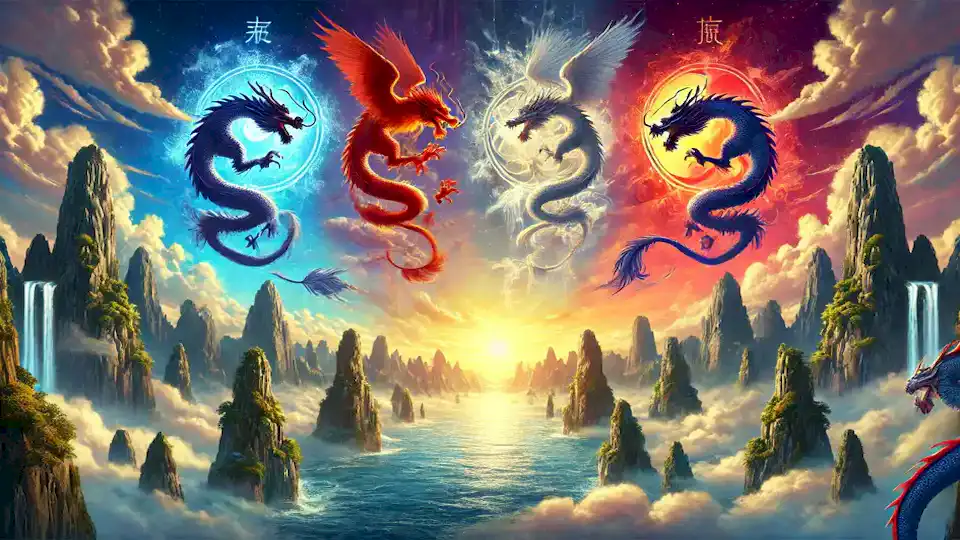
Like their Hindu, Buddhist, and Taoist counterparts, the Four Dragons of Chinese lore (and Genesis, apparently) preside over the four Great (Spiritual) Seas of the East, South, West, and North. The Biblical patriarch Daniel also described these “four beasts” as rising from the sea.
We’ll talk more about these fascinating “guardian beings” in future posts. For now, the important thing to know is that this Biblical verse has nothing to do with oceans, whales, or birds, as we’ve been led to believe for centuries.
Let’s move on to what went down on the sixth and final “Day of the Lord,” which will also require further explanation to be understood.
Elohim said, “Land of the Living God send forth the sound of the Souls of the Living God into the kingdoms of beasts and creeping things, the living souls in the Land of the Living God. Into kingdoms Elohim organized the living souls in the Land of the Living God, into kingdoms of beasts and kingdoms of creeping things, in the Adamah Kingdom Elohim considered beneficial.
Elohim said, “Make the living soul in the image of those shepherding the knowledge amplifying the roaring of the winged creatures of Shamayin, the brother-beasts of the Land of the Living God moving lightly around the Land of the Living God. Elohim formed the living soul in the image and likeness of Elohim, to remember the narrow entryway into the Temple. And Elohim pronounced his blessing, saying, “Be fruitful and increase the fullness of the Land of the Living God by shepherding the knowledge amplifying the roar of the winged beings of Shamayin, the brother-beasts of the Land of the Living moving lightly around the Land of the Living God.”
And Elohim said, “Behold! to give the fruits of the father-fire, scatter the seeds of the presences in the Land of the Living God, the fruits of the Tree of Life streaming the originating father-fire sustaining Elohim, to perceive the happiness advancing the greater good in the twilight before the dawning of the sixth Day of the Lord.
First and foremost, these verses do NOT describe the creation by Elohim of beasts, creeping things, and humans. Nor do they in any way, shape, or form assign humans “dominion” over their fellow Souls in animal bodies.
Rather, these verses describe the formation by Elohim of “kingdoms” on the ethereal plane of Adamah — a Hebrew word most accurately translated as “Brotherhood of Souls” or “Kingdom of Souls.”
According to many things I’ve read, Adamah is the Hebrew name for the Atmic or Fifth Plane of Consciousness, where we experience “realization” of the True Self after “untying” the Vishnu Granthi — the psychic knot binding our Souls to Ego Consciousness.
The winged creatures of Shamayin and/or brother-beasts of the Land of the Living God are the four Living Creatures just discussed. In Ezekiel 1:24, the beating of their wings is described as making “the noise of great waters” — a sound akin to the roaring sea, in other words. So, in the first part of this section of Genesis, Elohim is asking the Land of the Living God to extend that roaring sound into the kingdoms of Adamah.
This verse also describes the formation by Elohim of the “kingdoms” or “planes” within Adamah. And that solves the great mystery surrounding the true meaning of min (מִין) — the Hebrew word translated as “kinds” or “species” in these and other Bible verses concerning fishes, birds, and mammals. I didn’t know it was a mystery until I came across an entire essay on the subject on the BioLogos website. I just knew “species” or “kinds” didn’t cut the holy mustard.
To more fully apprehend what these last few verses describe, let’s turn to The Aquarian Gospel of Jesus the Christ, a scriptural text “downloaded” from the Akashic Record in the early 1900s by an American “mystic” named Levi Dowling. You’ve probably never heard of this book or its author — nor had I when first I came across the book while teaching classes on the Course at a local store selling crystals and other New Age accoutrements. The book called out to me one day from its place on the shelf. And I answered by buying what turned out to be an illuminating read.
It was in The Aquarian Gospel, for example, that I first encountered the word Elohim. And it was by seeking a greater understanding of what Elohim was that I discovered Helen Schucman’s account of her vision of the Inner-Altar with Elohim emblazoned across it.
Why am I sharing all this? Because The Aquarian Gospel explains — in the words of Jesus Christ — what these verses in Genesis attempt to communicate, when rightmindedly translated. And, rather than paraphrase, I’m going to let you read for yourself what Aquarian-Jesus says on the subject to a Buddhist priest named Barata Arabo.
By way of background, the conversation takes place while Jesus is studying in India during the years omitted from all four canonical gospels. They were omitted, I believe, to “prove” the Catholic contention that Jesus was born divine, rather than became — through devoted study and practice — a clear vessel for the Spirit(s) of Elohim.
What follows is most of the chapter, which includes more than the explanations echoing Genesis. I’ve kept in the additional bits because they provide insights not found in the Judeo-Christian scriptures.
Among the Buddhist priests was one who saw a lofty wisdom in the words that Jesus spoke. It was Barata Arabo.
Together Jesus and Barata read the Jewish Psalms and Prophecies; read the Vedas, the Avesta and the wisdom of Guatama.
And as they read and talked about the possibilities of man, Barata said, “Man is the marvel of the universe. He is a part of everything, for he has been a living thing on every plane of life. Time was when man was not; and then he was a bit of formless substance in the molds of time; and then a protoplast. By universal law all things tend upward to a state of perfectness. The protoplast evolved, becoming worm, then reptile, bird and beast, and then at last it reached the form of man.“Now, man himself is mind, and mind is here to gain perfection by experience; and mind is often manifest in fleshy form, and in the form best suited to its growth. So mind may manifest as worm, or bird, or beast, or man. The time will come when everything of life will be evolved unto the state of perfect man. And after man is man in perfectness, he will evolve to higher forms of life.”
And Jesus said, “Barata Arabo, who taught you this, that mind, which is the man, may manifest in flesh of beast, or bird, or creeping thing?”
Barata said, “From times which man remembers not our priests have told us so, and so we know.”
And Jesus said, “Enlightened Arabo, are you a master mind and do not know that man knows naught by being told? Man may believe what others say; but thus he never knows. If man would know, he must himself be what he knows. Do you remember, Arabo, when you was ape, or bird, or worm?
“Now, if you have no better proving of your plea than that the priests have told you so, you do not know; you simply guess. Regard not, then, what any man has said; let us forget the flesh, and go with mind into the land of fleshless things; mind never does forget.
“And backward through the ages master minds can trace themselves; and thus they know. Time never was when man was not. That which begins will have an end. If man was not, the time will come when he will not exist.
“From God’s own Record Book we read: The triune God breathed forth, and seven Spirits stood before his face. (The Hebrews call these seven Spirits, Elohim.) And these are they who, in their boundless power, created everything that is, or was.
“These Spirits of the Triune God moved on the face of boundless space and seven ethers were, and every other had its form of life.
“These forms of life were but the thoughts of God, clothed in the substance of their ether planes. (Men call these ether planes the planes of protoplast, of earth, of plant, of beast, of man, of angel and of cherubim.)
“These planes with all their teeming thoughts of God, are never seen by eyes of man in flesh; they are composed of substance far too fine for fleshly eyes to see, and still they constitute the soul of things;
“And with the eyes of soul all creatures see these ether planes, and all the forms of life.
“Because all forms of life on every plane are thoughts of God, all creatures think, and every creature is possessed of will, and, in its measure, has the power to choose,
“And in their native planes all creatures are supplied with nourishment from the ethers of their planes.
“And so it was with every living thing until the will became a sluggish will, and then the ethers of the protoplast, the earth, the plant, the beast, the man, began to vibrate very slow.
“The ethers all became more dense, and all the creatures of these planes were clothed with coarser garbs, the garbs of flesh, which men can see; and thus this coarser manifest, which men call physical, appeared.
“And this is what is called the fall of man; but man fell not alone for protoplast, and earth, and plant and beast were all included in the fall.
“The angels and the cherubim fell not; their will were ever strong, and so they held the ethers of their planes in harmony with God.
“Now, when the ethers reached the rate of atmosphere, and all the creatures of these planes must get their food from atmosphere, the conflict came; and then that which the finite man has called, survival of the best, became a law,
“The stronger ate the bodies of the weaker manifests; and here is where the carnal law of evolution had its rise.
“And now man, in his utter shamelessness, strikes down and eats the beasts, the beast consumes the plant, the plant thrives on the earth, the earth absorbs the protoplast.
“In yonder kingdom for the soul this carnal evolution is not known, and the great work of master minds is to restore the heritage of man, to bring him back to his estate that he has lost, when he again will live upon the ethers of his native plane.
“The thoughts of God change not; the manifests of life on every plane unfold into perfection of their kind; and as the thoughts of God can never die, there is no death to any being of the seven ethers of the seven Spirits of the Triune God.
“And so an earth is never plant; a beast, or bird, or creeping thing is never man, and man is not, and cannot be, a beast, or bird, or creeping thing.
“The time will come when all these seven manifests will be absorbed, and man, and beast, and plant, and earth and protoplast will be redeemed.
Barata was amazed; the wisdom of the Jewish sage was revelation unto him.
Before I sign off, let me just say that I question Dowling’s parenthetical description of Elohim as “the seven spirits before the throne.” I’m more inclined to believe that Elohim, which is indeed a plural word, represents the Triune Spirit that breathed forth “Ruach” — the Spirits of the Triune God. Whether those “spirits” are one, four, or seven in number, I can’t say for certain. So, I’m keeping an open mind, trusting more will be revealed on a need-to-know basis.
Let’s leave it there for today, because I’ve given you plenty to contemplate. And we will revisit many of these themes as we move forward.
Until we meet again outside the Golden Circle, Om Hari Om and Namaste.
 The Holy Meeting Place
Leave a comment