As stated in previous posts, almost everything in the scriptures is allegorical rather than literal – and the same can be said for many things in the world around us. The world is, in actuality, a virtual-reality learning simulator engineered by the Holy Spirit to help our Souls cooperatively learn and teach the universal “course” or “curriculum” for awakening.
Most people don’t yet know this, of course; or that the world they perceive and experience externally is, in fact, a dream mirroring their own thoughts, beliefs, and desires – thoughts, beliefs, and desires they need to correct, in many cases, to achieve the learning goal of remembering their true God-created Self. That “Self” is one in Christ, one with God, and at one with every aspect of Holy Creation – the invisible All in All doing its thing underneath the illusion of time, space, and matter.
Because the world is, in reality, an experiential learning environment for our Souls, the Holy Spirit has implanted the dreamscape with helpful signs and messages. While many of those messages can be found in the scriptures, others await discovery within novels, films, comic books, popular songs, and even video games. The original “Matrix” movie with Keanu Reeves springs to mind, as does “The Truman Show” starring Jim Carey. Both of these films are, in fact, chillingly accurate portrayals of what’s really going on in our world. Another “message-movie” is MGM’s 1939 musical adaptation of L. Frank Baum’s 1900 children’s fantasy novel, The Wonderful Wizard of Oz. And that’s the film I want to focus on today.
On the off-chance you don’t know the story, I’ve constructed the following plot summary based on the musical adaptation:
Dorothy Gale, an innocent and orphaned teenager, lives on a farm in Kansas with her Aunt Em and Uncle Henry. One day, feeling useless and afraid for her dog’s safety, Dorothy leaves her happy home to seek adventure in the world. After meeting a kindly peddler, she gets caught in a storm and is knocked unconscious. She awakens in Oz, a dream-land filled with a variety of characters and creatures, some helpful to her, and some with harmful motives. Wanting to go home, Dorothy takes the advice of the Good Witch Glinda to follow the Yellow Brick Road. If anyone can help her get back home to Kansas, Glinda assures her, it’s the Great and Powerful Wizard of Oz, who lives in the Emerald City.
Along the way Dorothy makes friends and is helped out of sticky situations by Glinda, who watches over her unseen. Meanwhile, the Wicked Witch of the West is out to get Dorothy, because she’s wearing the Ruby Slippers. She got the slippers from the mean witch’s dead sister, after crushing her accidentally when her flying house landed in Oz.
Eventually, Dorothy gets to Oz and confronts the Wizard, who seems fearsome and unreasonably demanding. He tells her that to earn his assistance she must bring him the broom of the Wicked Witch of the West – a seemingly impossible feat. On her quest to obtain the broom, Dorothy is captured by the witch, but later inadvertently kills her with a bucket of water. In the end, the Wizard tells Dorothy and her companions they’ve all had what they wanted all along. They just didn’t know where to look or how to use their innate powers to help themselves.
As the Wizard departs for Kansas without her, Dorothy clicks her heels together and repeats the magical mantra the Good Witch gave her: “There’s no place like home.” Within moments, she awakens in her own bed, safe, sound, and surrounded by her loving family and friends.

You probably spotted some of the more obvious symbols as you scanned the synopsis. The dream of Oz as the dream of separation … the Yellow Brick Road as the spiritual path … the water Dorothy throws at the witch as the ego-dissolving Living Water. What isn’t so obvious is that the Wizard hails from Omaha. “Om-a-ha,” which means “the sacred sound of God’s Greater Light” in ancient Sanskrit. And yes, I’m aware that Omaha, Nebraska, is named for the “nation” of indigenous people inhabiting the area before they were displaced by white invaders. But I checked – and no English dictionary can tell us what “Omaha” meant in the language of that “nation.”
Below are some of the less obvious symbols in the story:
- Dorothy – a name of Greek origin meaning “gift of God” – represents the Soul or Atman in the dream-world, whose misadventures began with the “original error” of running away after failing to receive enough “special” attention.
- Auntie Em’s Kansas farm, where Dorothy is loved and missed, is our “home” in Heaven. This is attested to by the fact that Auntie Em’s given name is Emma, a name of Hebrew origin meaning “the universal one” or “the universal oneness.”
- The Emerald City represents the Upper Chambers of the Temple, which our Souls must pass through before returning to Heaven.
- The Guardian of the Gates – the guy guarding the door into the Emerald City – represents Kubera, the “guardian” of the northern direction – the door into the Upper Chambers of the Temple. In Hinduism, Kubera is portrayed as a dwarfish, pot-bellied figure whose “vahana” is a human man. In Baum’s book, the Guardian of the Gates is the same height as a Munchkin, with a jolly countenance, a round physique, and a chubby face. He always wears green – the color of the Heart Chakra energy. During the long reign of the Great Oz, it was the Guardian’s duty to ensure that everyone (including creatures) who entered the Emerald City was fitted with green spectacles, ostensibly (according to the Oz Wiki) to protect their eyes from the brightness and glory within. The green glasses were locked in place with a key on a chain worn around the Guardian’s neck. Symbolically, the green glasses signify Christ’s Vision, which is bestowed through the reopened Spiritual Eye as we pass through “the door” into the Upper Chambers of the Temple.
- The Wicked Witch of the West is the Ego Mind, the architect of evil, fear, and separation. Like the Ego Mind, the witch is dissolved or melted by the “water” provided by the Logos.
- The witch’s broom symbolizes the Ego’s power over our minds. By getting the broom and killing the witch, Dorothy conquers the imagined source of her fear and also the guilt she feels for abandoning Auntie Em.
- The Good Witch Glinda is the Holy Spirit watching over and helping Dorothy as she follows the Royal Road to the Emerald City.
- The Wizard of Oz is the Logos, Christ Self, or Jesus – the “savior” upon whom our return to Heaven depends. Like the Wizard, that “savior” is commonly perceived and/or depicted as inaccessible, fearsome, and condemning. In exchange for salvation, he appears to expect us to perform superhuman feats, make unreasonable sacrifices, and attain impossible levels of perfection. Also like the Wizard, our “savior” is actually kind, humble, loving, forgiving, compassionate, and helpful.
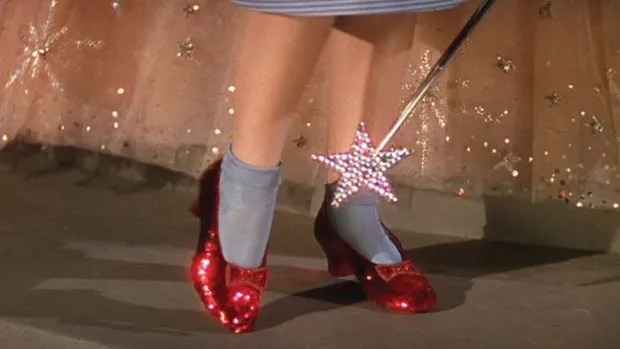
- The Ruby Slippers represent the power of forgiveness, the internal “superpower” we must reclaim and share to wake up from the dream. That “superpower” repels the Ego Mind, just as the sparks emanating from the Ruby Slippers repel the Wicked Witch in the image below.

- The three friends Dorothy meets along the way – and takes with her – represent the gifts of God we must reclaim to reawaken. Think about it. The Scarecrow wants a brain — i.e., the mental capacity to understand higher truths. The Tin Man wants a heart so he can love and create in the manner God intended. The Cowardly Lion wants “courage” – the fearless state of being we experienced before we dreamed the world into existence.
Pretty interesting, right?

Also symbolically noteworthy are how the story’s Ego figure endeavors to conceal from Dorothy (the Soul) the power she has and how desperately the Wicked Witch tries to take the Ruby Slippers from her. That’s one of the Great Deceiver’s dirtiest tricks, by the way: concealing the God-given powers we all possess to dissolve the nightmare at will.
And let’s not forget the hot-air balloon the Wizard boards to transport Dorothy back to Kansas. Need I explain what that balloon and basket represent?
Okay, so … did L. Frank Baum know he was crafting an allegory about the dream of separation when he wrote The Wonderful Wizard of Oz? Maybe not, on a conscious level. But he WAS a card-carrying member of the Theosophical Society, an organization co-founded in 1875 by spiritualist Helena Petrovna Blavatsky (a.k.a. Madame Blavatsky) and journalist Henry Steel Olcott.
The book also seemed to “take possession” of Baum, as he he explained as follows to a reporter for the Associated Press in 1960:
I was sitting on a hatrack in the hall, telling the kids a story and suddenly this one moved right in and took possession. I shooed the children away and grabbed a piece of writing paper that was lying there on the rack and began to write.
It really seemed to write itself. Then I couldn’t find any regular paper, so I took anything at nil, even a bunch of old envelopes. Had to have something …
According to the Theosophy Wiki, Baum’s mother-in-law, Matilda Joslyn Gage, was an ardent early member of the Rochester branch of the Theosophical Society. She also was a prominent feminist and suffragette who co-authored, with Elizabeth Cady Stanton and Susan B. Anthony, the three-volume History of Woman Suffrage.
Baum and his wife (Matilda Gage’s daughter, Maud) joined the Theosophical Society’s Ramayana Branch in Chicago in 1892.
In the first issue of the “Aberdeen Saturday Pioneer,” for which Baum served as editor, he wrote the following regarding the Theosophical movement in 1900 — two years before joining the Society:
Amongst the various sects so numerous in America today who find their fundamental basis in occultism, the Theosophist[s] stand pre-eminent both in intelligence and point of numbers.
The recent erection of their new temple in New York City has called forth the curiosity of the many, the uneasiness of the few. Theosophy is not a religion. Its followers are simply “searchers after Truth.” Not for the ignorant are the tenets they hold, neither for the worldly in any sense. Enrolled within their ranks are some of the grandest intellects of the Eastern and Western worlds.
Purity in all things, even to asceticism is absolutely required to fit them to enter the avenues of knowledge, and the only inducement they offer to neophytes is the privilege of “searching for the Truth” in their company.
As interpreted by themselves they accept the teachings of Christ, Budda [sic], and Mohammed, acknowledging them Masters or Mahatmas, true prophets each in his generation, and well versed in the secrets of nature. But the truth so earnestly sought is not yet found in its entirety, or if it be, is known only to the privileged few.
The Theosophists, in fact, are the dissatisfied of the world, the dissenters from all creeds. They owe their origin to the wise men of India, and are numerous, not only in the far famed mystic East, but in England, France, Germany and Russia. They admit the existence of a God – not necessarily a personal God. To them God is Nature and Nature God.
We have mentioned their high morality: they are also quiet and unobtrusive, seeking no notoriety, yet daily growing so numerous that even in America they may be counted by thousands. But, despite this, if Christianity is Truth, as our education has taught us to believe, there can be no menace to it in Theosophy.
Michael Patrick Hearn, an expert on Baum and his books, has made public the following about the author’s interest in Theosophy:
His son Frank admitted the author’s interest in Theosophy, but also reported that the elder Baum could not accept all its teachings. He firmly believed in reincarnation; he had faith in the immortality of the soul and believed that he and his wife had been together in many past states and would be together in future reincarnations, but he did not accept the possibility of the transmigration of souls from human beings to animals or vice versa, as in Hinduism. He was in agreement with theTheosophical belief that man on Earth was only one step on a great ladder that passed through many states of consciousness, through many universes, to a final state of Enlightenment. He did believe in Karma, that whatever good or evil one does in his lifetime returns to him as reward or punishment in future reincarnations…. He believed that all the great religious teachers of history had found their inspiration from the same source, a common Creator.
Based on his experience of “feeling possessed” while writing The Wonderful Wizard of Oz, as well as the book’s enduring popularity, the Holy Spirit very likely used him as a channel for this elucidating allegory. As I well know, God’s Spirit has his crafty little ways of getting his messages through, even when we’re not consciously aware we’ve received them. Our insensibility is, in fact, an asset, since the Ego Mind can’t block what it doesn’t recognize as Spiritual Truth. Our Souls, meanwhile, will understand the subtle, abstract messages our concrete intellects interpret literally.
How many times, for example, have you watched or read The Wizard of Oz? Did you understand what it was really about before I explained the symbolism? Based on all the speculations I’ve read — most of which are completely off-base — I suspect you probably didn’t. Our perception of the world is exactly the same. We don’t understand what’s really happening until we begin to recognize and understand the helpful messages the Holy Spirit sends to us constantly through every possible means.
As we move along, I’ll expose more of the hidden ciphers that have been under our noses all along. In the meantime, let me say that, like Dorothy, we are still safe at home, only dreaming we’re in a land filled with wicked witches and flying monkeys. Also like Dorothy, we all wear the Ruby Slippers of Forgiveness, which the Spirit of Grace equipped us with when s/he re-engineered the dream-realm’s purpose. We just have to click our heels together and say with complete sincerity, “There’s no place like home!”
Valuing our Ego self-concepts and the world’s shabby offerings more than going home imprisons us in the dream of Oz. If we’re suffering, it’s because we chose UNreality over Divine Reality, deceptive illusions over Higher Truth, fear over Perfect Love, miscreation over Perfect Creation, and Satan’ self-authorship and authority over God’s Authorship and Authority. But we can always “choose again” and reverse the ill-effects of our earlier wrong decisions.
Or, to quote Course-Jesus (at length and in closing):
Temptation has one lesson it would teach, in all its forms, wherever it occurs. It would persuade the holy Son of God he is a body, born in what must die, unable to escape its frailty, and bound by what it orders him to feel. It sets the limits on what he can do; its power is the only strength he has; his grasp cannot exceed its tiny reach. Would you be this, if Christ appeared to you in all His glory, asking you but this:
Choose once again if you would take your place among the saviors of the world, or would remain in hell, and hold your brothers there.
For He HAS come, and He IS asking this.
How do you make the choice? How easily is this explained! You always choose between your weakness and the strength of Christ in you. And what you choose is what you think is real. Simply by never using weakness to direct your actions, you have given it no power. And the light of Christ in you is given charge of everything you do. For you have brought your weakness unto Him, and He has given you His strength instead.
Trials are but lessons that you failed to learn presented once again, so where you made a faulty choice before you now can make a better one, and thus escape all pain that what you chose before has brought to you. In every difficulty, all distress, and each perplexity Christ calls to you and gently says, “My brother, choose again.” He would not leave one source of pain unhealed, nor any image left to veil the truth. He would remove all misery from you whom God created altar unto joy. He would not leave you comfortless, alone in dreams of hell, but would release your mind from everything that hides His face from you. His Holiness is yours because He is the only power that is real in you. His strength is yours because He is the Self that God created as His only Son.
The images you make cannot prevail against what God Himself would have you be. Be never fearful of temptation, then, but see it as it is; another chance to choose again, and let Christ’s strength prevail in every circumstance and every place you raised an image of yourself before. For what appears to hide the face of Christ is powerless before His majesty, and disappears before His holy sight. The saviors of the world, who see like Him, are merely those who choose His strength instead of their own weakness, seen apart from Him. They will redeem the world, for they are joined in all the power of the Will of God. And what they will is only what He wills.
Learn, then, the happy habit of response to all temptation to perceive yourself as weak and miserable with these words:
I am as God created me. His Son can suffer nothing. And I am His Son.
Thus is Christ’s strength invited to prevail, replacing all your weakness with the strength that comes from God and that can never fail. And thus are miracles as natural as fear and agony appeared to be before the choice for holiness was made. For in that choice are false distinctions gone, illusory alternatives laid by, and nothing left to interfere with truth.
You are as God created you, and so is every living thing you look upon, regardless of the images you see. What you behold as sickness and as pain, as weakness and as suffering and loss, is but temptation to perceive yourself defenseless and in hell. Yield not to this, and you will see all pain, in every form, wherever it occurs, but disappear as mists before the sun. A miracle has come to heal God’s Son, and close the door upon his dreams of weakness, opening the way to his salvation and release. Choose once again what you would have him be, remembering that every choice you make establishes your own identity as you will see it and believe it is.
Until we meet again, Om Hari Om and Happy Easter!
 The Holy Meeting Place
Leave a comment